Physical Address
304 North Cardinal St.
Dorchester Center, MA 02124
Physical Address
304 North Cardinal St.
Dorchester Center, MA 02124

Most height-adjustable desks stop at 45 to 48 inches, and that ceiling is exactly where the trouble starts for anyone above roughly 6 foot 2. You crank the frame to its highest setting, and the keyboard still sits below your elbows. By lunchtime your shoulders are shrugged up toward your ears, your wrists are bent, and the standing posture you paid for has turned into a forward hunch. The best standing desks for tall people are not defined by a brand name; they are defined by one number on the spec sheet, the maximum height the frame reaches with the top still on it.
I built this list around that number first and everything else second. Across the ten frames and desks below I compared published maximum height, minimum height, leg stage count, motor type, load capacity, top dimensions and warranty terms. Where manufacturers publish a noise figure, I report it as a manufacturer claim rather than a measurement, because dB readings taken at different distances on different floors are not comparable. The same caution applies to height: I flag at least one listing here where the product-detail fields and the marketing copy disagree.
Two findings shaped the ranking. First, the highest-rated option is a mainstream desk with a 50.5 inch ceiling, which means the tall-user category no longer requires a specialty frame. Second, the four-leg desks people often assume are the automatic answer for tall users are not the tallest options available; both four-leg frames in this group top out at 47 inches. Four legs buy stability, not reach, and the two are separate problems.
That is why the list is organized by measured height rather than by price or brand loyalty. If you only read one number, read the maximum height. If you read two, add the leg stage count. Everything else is a preference.
I also broke the picks into height bands rather than price bands, because the price of a desk tells you nothing about whether it will fit you. If you are relocating a whole office rather than swapping a keyboard, our guide to going away gifts that people actually want covers the other half of that move. If your new setup doubles as a gift to a partner who spends half the day standing, the fidget toys we recommend for anxious gift-givers are a better fit for the drawer than anything that clips to a desk frame.
The shortlist below covers the three genuinely different ways to solve this: buy the highest-rated desk that reaches 50.5 inches, buy the one with the strongest load rating at 50 inches, or buy the tall-reaching desk that costs the least. Everything after this section explains the full field of ten.


Read the maximum height column before anything else. Four desks in this group reach 50 inches or better, three land between 49 and 50, one stops at 48.8, and the two four-leg frames stop at 47.2 and 47. Load capacity figures are rated at the manufacturer’s test conditions and generally fall in practice as the desk rises, because leverage on the frame increases with height.
| Product | Features | |
|---|---|---|
| Vari Classic Electric 60×30 |
|
Check Latest Price |
| FlexiSpot E6 MAX 55×28 |
|
Check Latest Price |
 Vari ComfortEdge 60×30 Vari ComfortEdge 60×30 |
|
Check Latest Price |
 FlexiSpot E6 Bamboo 72×30 FlexiSpot E6 Bamboo 72×30 |
|
Check Latest Price |
| HUANUO 59×30 3-Stage |
|
Check Latest Price |
 HUANUO 3-Stage Frame HUANUO 3-Stage Frame |
|
Check Latest Price |
 FlexiSpot 4-Leg 71×32 FlexiSpot 4-Leg 71×32 |
|
Check Latest Price |
 VIVO DESK-E4B Frame VIVO DESK-E4B Frame |
|
Check Latest Price |
 Vari Ergo 54×26 Vari Ergo 54×26 |
|
Check Latest Price |
 UNICOO 3-Stage Frame UNICOO 3-Stage Frame |
|
Check Latest Price |
We earn from qualifying purchases. CERTAIN CONTENT THAT APPEARS ON THIS SITE COMES FROM AMAZON. THIS CONTENT IS PROVIDED 'AS IS' AND IS SUBJECT TO CHANGE OR REMOVAL AT ANY TIME.
Maximum height 50.5 in
Minimum 25 in
Load capacity 200 lb
1.25 in laminate top
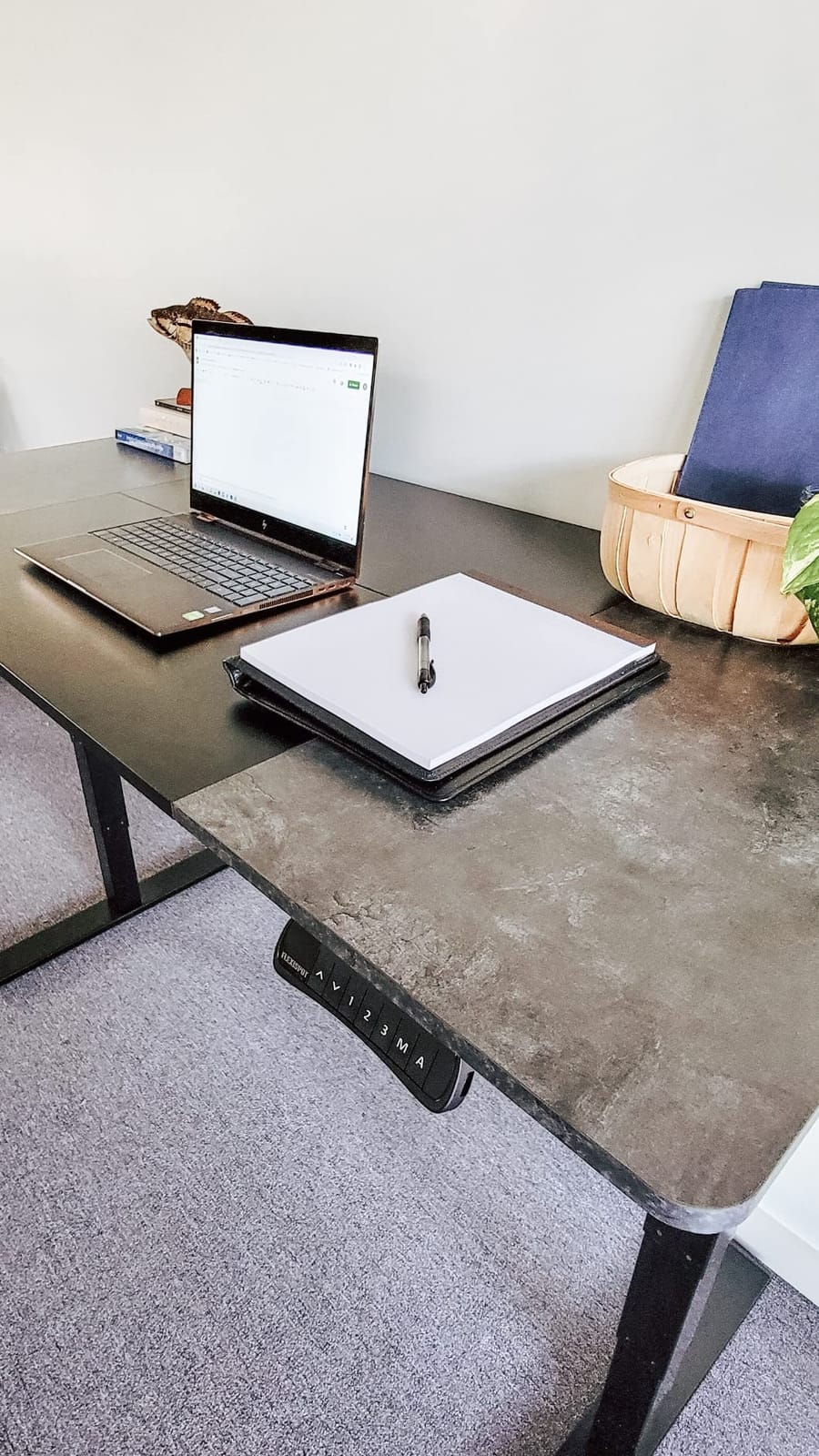
This is the desk I keep coming back to for this list because it answers the tall-user problem with the least drama. The frame runs from 25 to 50.5 inches, which puts your keyboard at true elbow height rather than somewhere below it, and the dual motors move both lifting columns together instead of lifting one leg and chasing the other. The T-style steel legs sit under the full length of the top, so the surface feels planted even when you lean on it with both forearms.
The 60 by 30 inch top is the mainstream size, and the 1.25 inch laminate is thick enough that it does not feel hollow when you tap it. Owners of this desk describe the lift as quiet enough to take a call beside, and the four height presets mean the sitting and standing positions are one press apart. In the review data, 89 percent of ratings are five star.
Standing elbow height for a 6 foot 4 person typically lands in the mid-to-high 40s, and taller users push into the 50s. A desk that tops out at 48 inches leaves roughly two to three inches of gap at that elbow measurement, which is enough to keep the shoulders lifted. This desk’s 50.5 inch maximum gives you clearance above your target height rather than landing just under it.
The single most useful detail for tall users is that the range starts low as well as finishing high. A 25 inch minimum means the same frame works for a seated position with a person of average height sharing the desk, which matters in a shared office.
The 200 pound rating is realistic for a two-leg frame in this class, and owners running dual monitors and a laptop dock report no complaints at full extension. The tradeoff is mass. This desk is heavy, and the dual-motor housing adds more of it, so standing the top upright is genuinely a two-person task on day one.
If your setup includes a desktop tower, a large monitor arm or an ultrawide panel, add that weight to the frame’s own mass. Anything approaching the 200 pound rating will be less comfortable to move, but the lifting itself stays smooth.
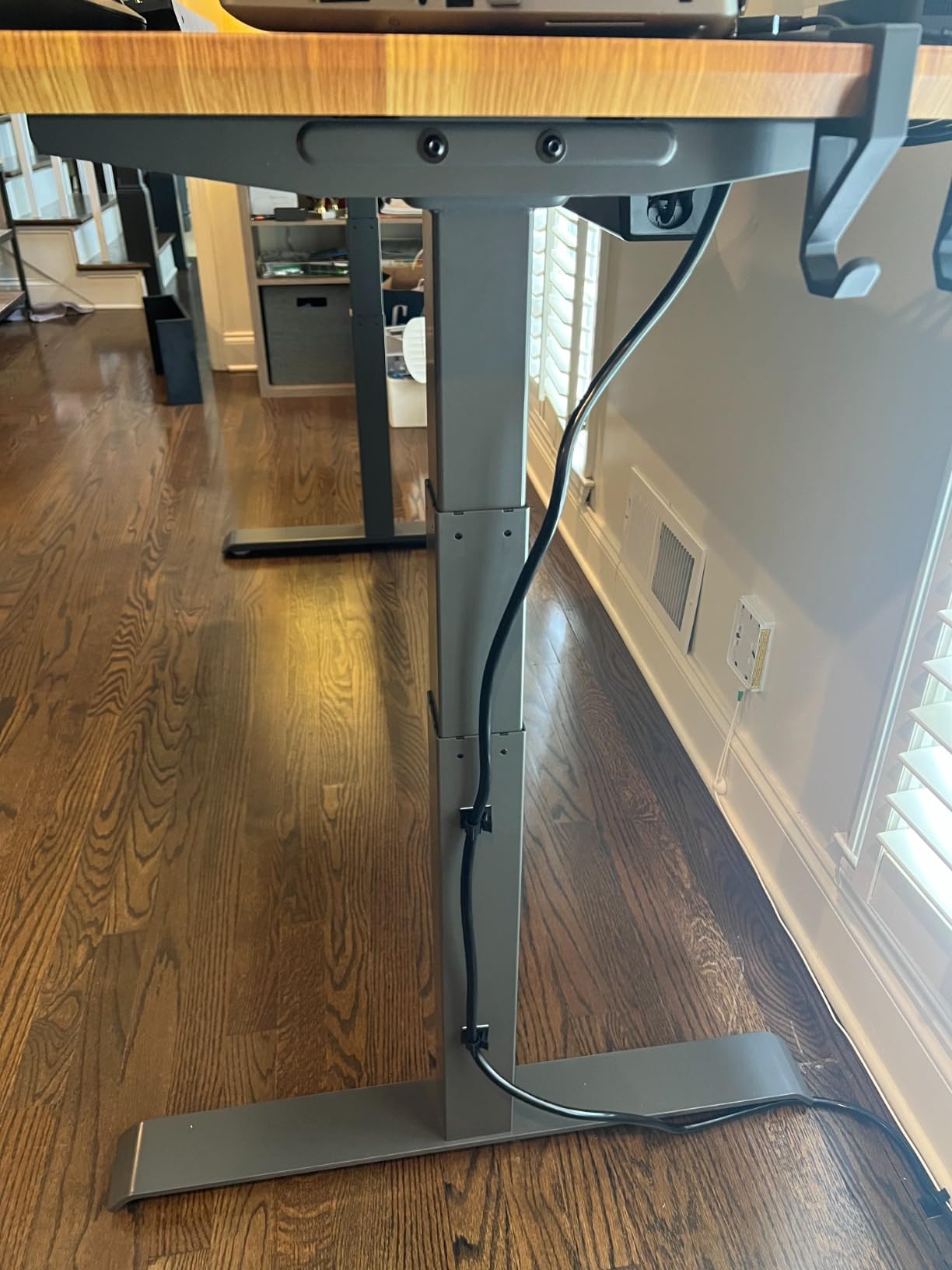
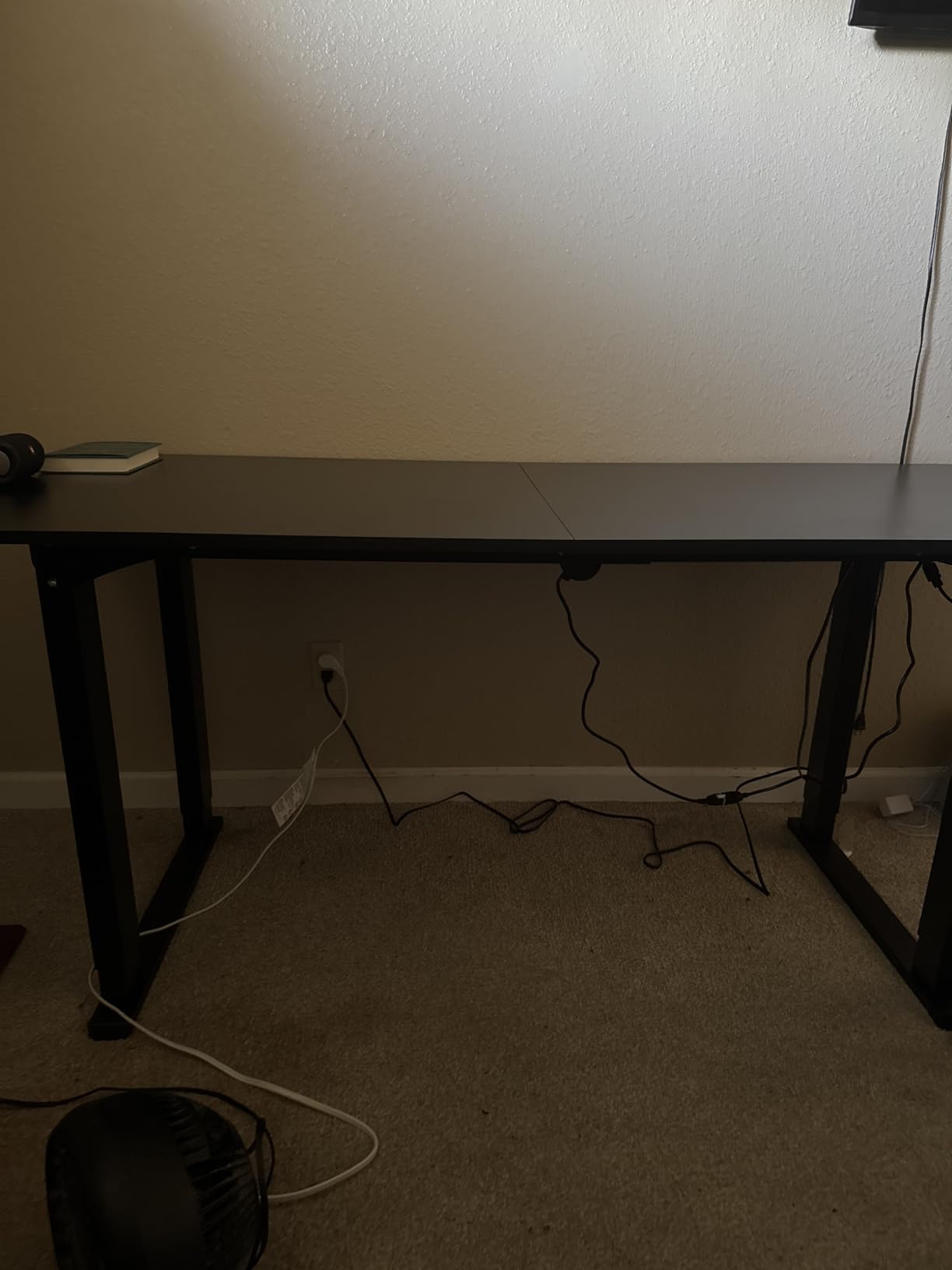
There is no cable management tray in the box. Reviewers consistently add their own routing or a clamp-on tray, and at 50 inches of height the cable run needs real slack so it does not tug when the desk moves. Budget for a small tray and a few hook-and-loop straps as part of the build.
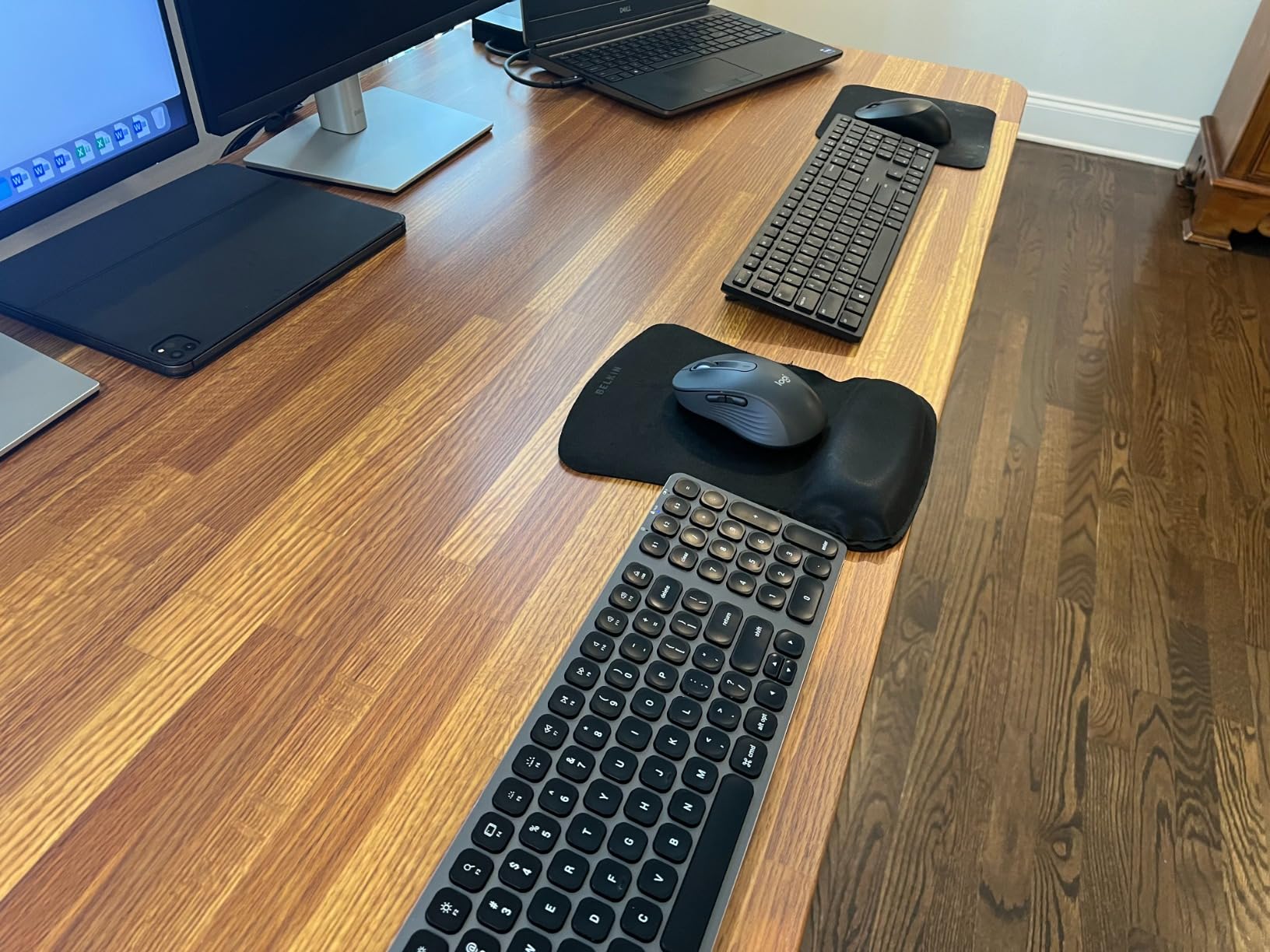
Second, the top is a one-piece engineered wood laminate rather than solid wood. It resists warping and cleans easily, which is the right trade at this height range, but it will not be mistaken for a butcher block surface.
Maximum height 50 in
Minimum 24.4 in
Load capacity 330 lb
Bamboo top, walnut finish
This is the frame to buy if your desktop is not a computer and a keyboard. At a 330 pound load capacity, it is the strongest rating among the ten desks here, and it still reaches a full 50 inches. That combination matters for anyone running multiple heavy monitor arms, a full-tower build, or a work surface that doubles as a repair bench.
The 55 by 28 inch bamboo top is narrower than the desk above it, which is a deliberate trade. You give up a little width and gain a surface that stays flat through seasonal humidity changes and feels noticeably warmer to rest a forearm on at standing height.

Published capacity numbers describe a static load at a test condition, not a guarantee at 50 inches. As the frame extends, the lever arm between the motor and the load grows, and the joints at each telescoping section carry more of the force. A frame rated at 330 pounds when seated is not rated at 330 pounds fully raised with a tower and three monitors bolted to it.
This desk handles that scenario better than anything else in the group because of the three-stage column design. Three telescoping sections keep more column overlap in place at full height than a two-stage frame, and that retained overlap is what resists racking. Reviewers running multi-monitor setups specifically report a wobble-free surface at the top of the range.
The 10-year frame and motor warranty is the longest coverage listed here, with 2 years on the control panel and electronics. For a desk expected to run electric motors several times an hour for years, that length is a meaningful part of the value calculation rather than a footnote.
The bamboo is a genuine top rather than printed film, and FlexiSpot quotes a tensile strength of 28,000 pounds per square inch for the material. Practical advantage over laminate is edge durability and resistance to ring marks and scuffs over years of forearm contact.
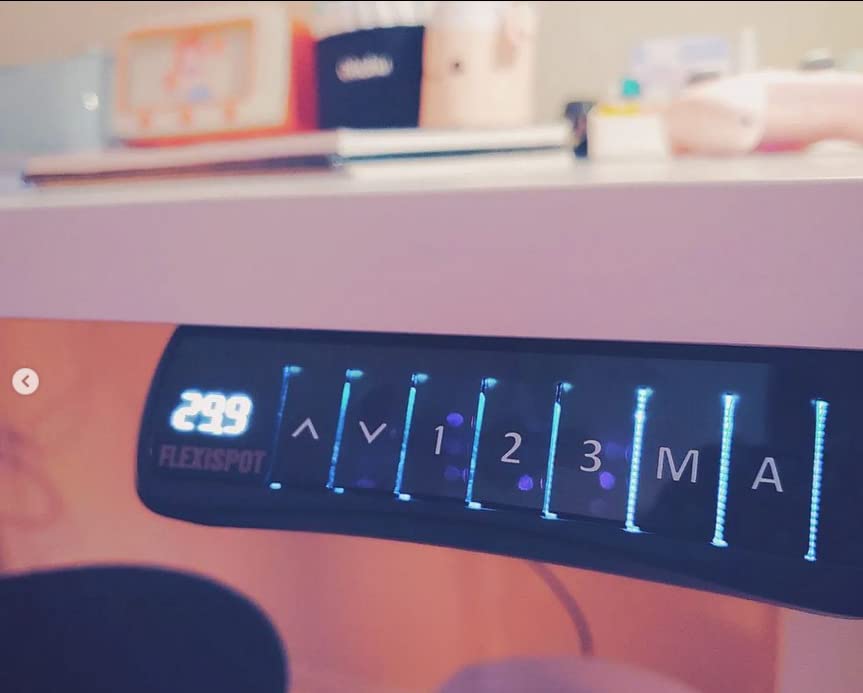
The most repeated complaint across reviews is documentation, not hardware. The assembly manual covers several desk sizes, so a buyer assembling the 55 by 28 inch version has to work out which hardware bag and which wiring section applies. Budget extra time for that step, and check the packing list against the manual before you start.
Some versions arrive with the top assembled from glued sections rather than a single piece. The result works fine, but inspect the seams before mounting the top on the frame, because a surface that is already out of flat is harder to correct later.
Maximum height 50.5 in
Sloped front edge
Load capacity 200 lb
60 x 30 in top
The ComfortEdge takes the same 50.5 inch maximum height as the desk above it and changes one thing: the front edge slopes. For a tall user whose wrists were already barking after hour three at full standing height, that curve is the difference between a tolerable posture and a sore one. It is the only desk in this group with a deliberately contoured working edge built into a tall-reaching frame.
Everything else is a smaller 60 by 30 inch build on a dual-motor frame with four presets, and the same 200 pound rating. Several owners in the review data describe owning more than one Vari desk over the years, which is a reasonable signal on build consistency.
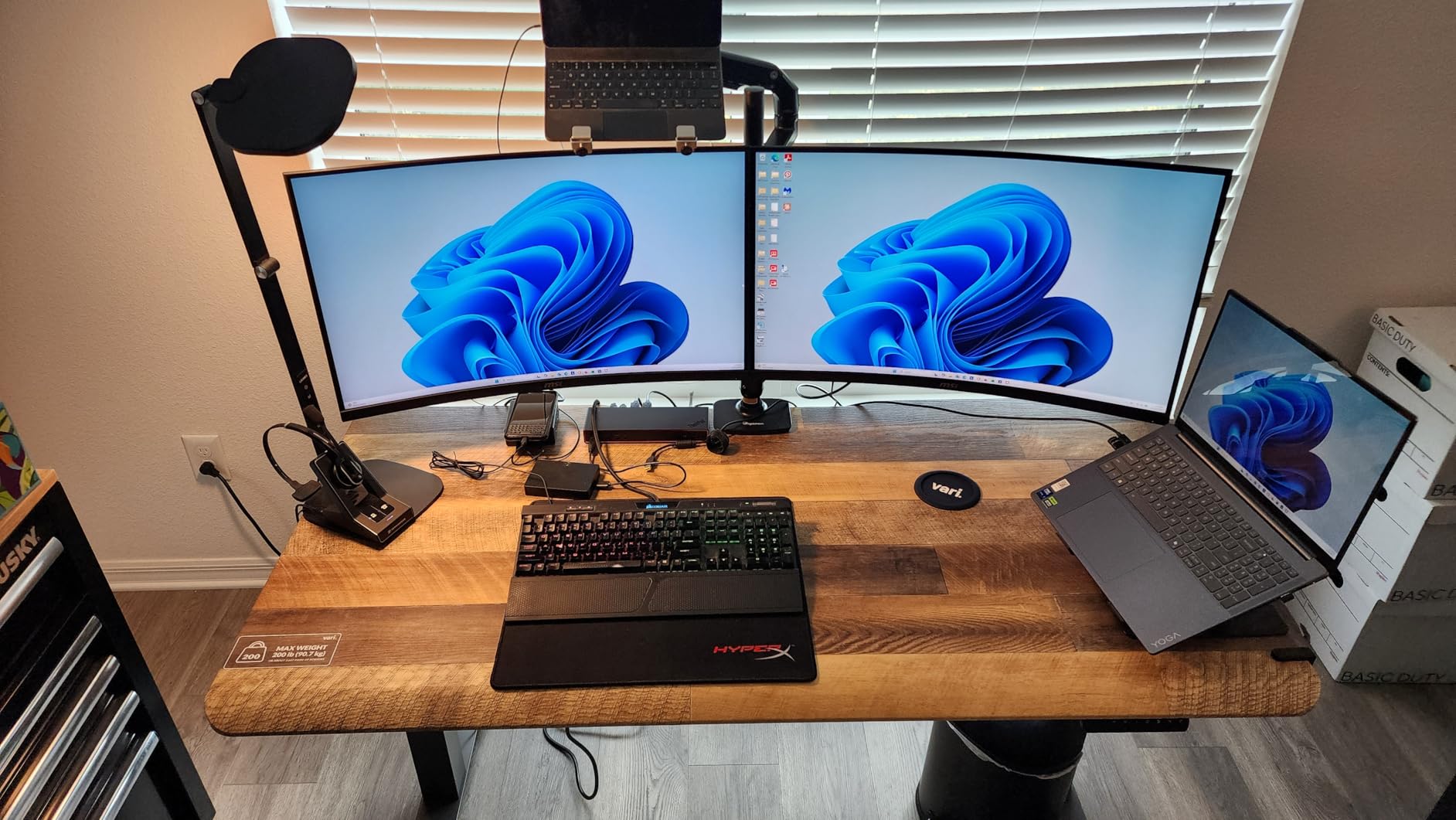
The curve works because it lets you rest the heel of your palm and the underside of your forearm at a slight angle rather than pressing the wrist extension flat against a hard 90 degree edge. It is a genuine benefit across long typing sessions, and reviewers with a treadmill or exercise bike underneath mention the edge keeps their forearms comfortable while they work through a session.
It is a preference, not a universal upgrade. If you keep your forearms parallel to the floor and type with a flat wrist, the slope changes your setup and some users find it less stable to type on. If you are replacing a curved-edge desk you already like, this one will feel familiar.
The frame arrives pre-assembled with slide-lock legs, and setup is tool-free and quick. The catch is the 122 pound shipping weight, which means you need a second person to right the top and to move the desk later. Plan the placement before you unpack rather than after.
A small number of owners reported a bent main crossbar or a defective motor on arrival, which Vari resolved with replacements. Check the frame for straightness and run the full travel once before you clamp anything down to the surface.
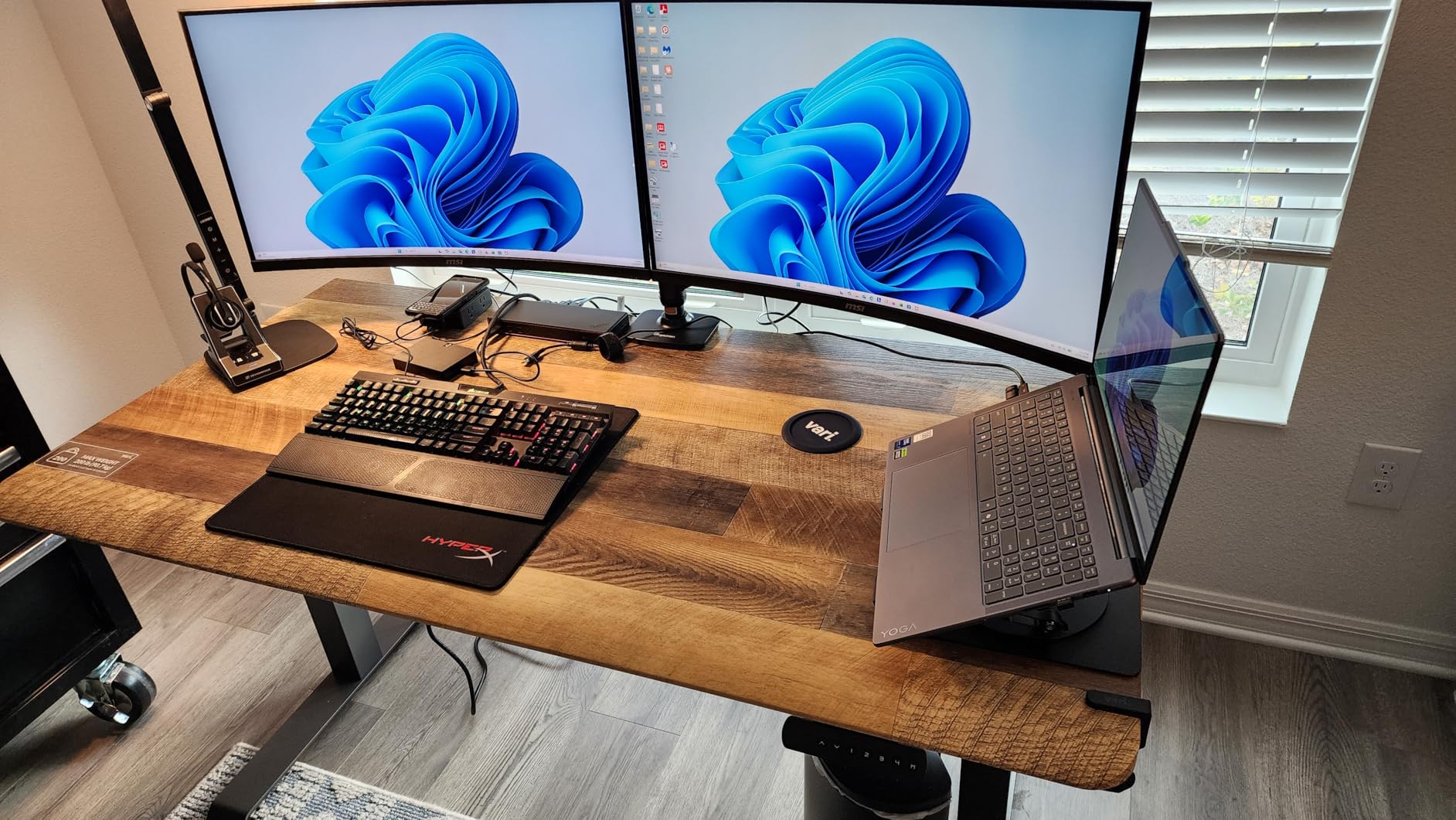
72 x 30 in one-piece bamboo
48.8 inch max height
Dual motor, 3-stage
220 lb rated load
This is the widest work surface in the group by a wide margin, and for a tall user running an ultrawide curved monitor with a laptop or a second display alongside it, width is the constraint you will actually notice. The 72 by 30 inch top is a single piece of FSC-certified bamboo with no seams to catch a keyboard or a cable.
The 48.8 inch maximum is the catch. It suits users up to about 6 foot 3 or 6 foot 4 with a slightly shorter standing elbow height, and it falls a couple of inches short of what a 6 foot 5 or taller user needs. This is the desk to buy if your width requirement outruns your height requirement.
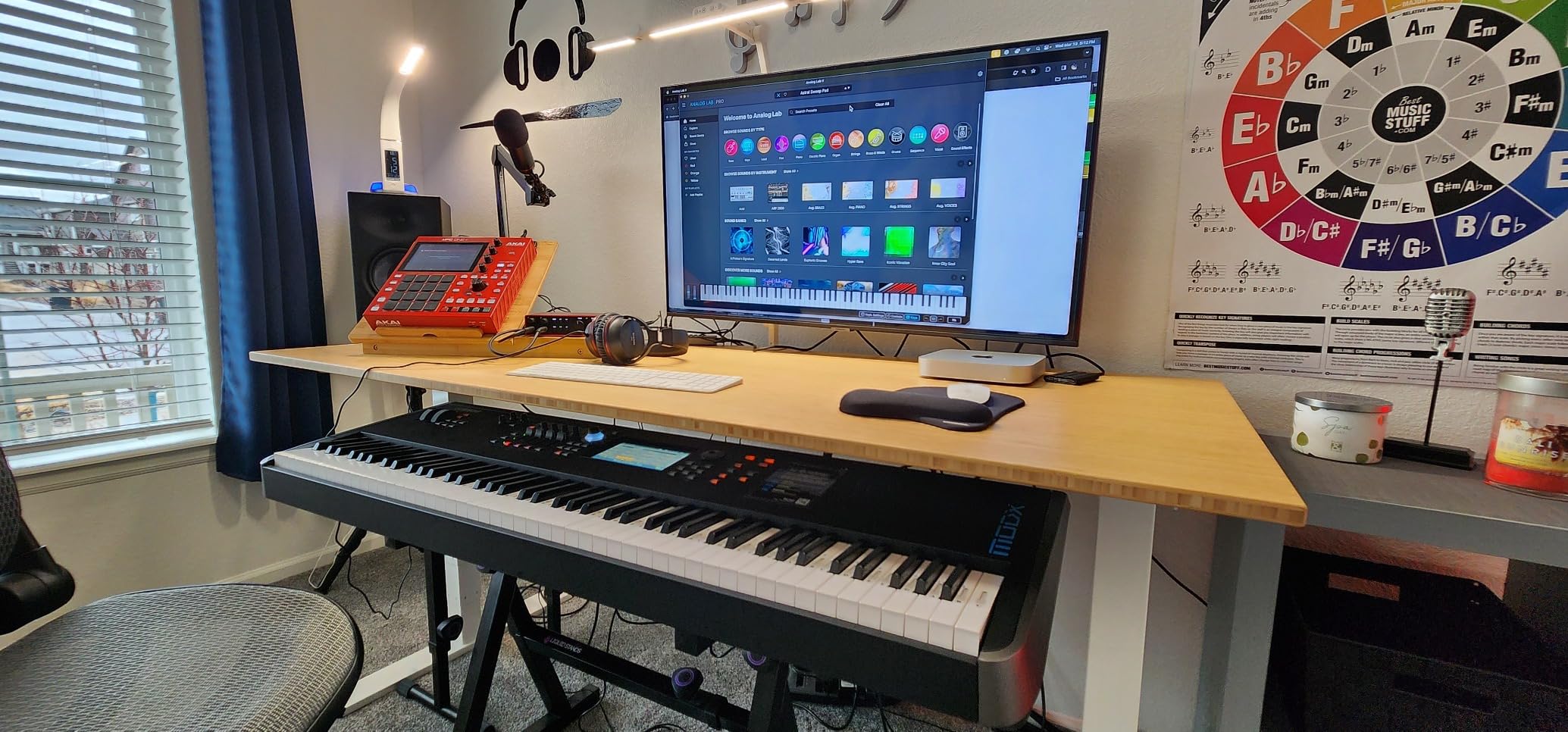
Published maximum height assumes a perfectly level floor and even weight distribution. A desk that reaches 48.8 inches measured from the floor with an even load may sit closer to 48 inches on an uneven one, so a frame with a little headroom above your target is the safer purchase for taller users. This one does not have that headroom, which is the single reason it ranks fourth despite the surface size.
Reviewers who are 6 foot 4 report that the extra lift range here makes a real comfort difference compared with a standard two-stage desk, which confirms the frame is doing its job within its class. It simply is not the tallest class.
Once assembled, sentiment on this desk is positive. The bamboo is flat, the three-section legs are stable, and the dual motors lift a heavy multi-monitor and desktop PC setup without complaint. The published motor figure is under 45 dB, which we report as a manufacturer claim rather than a measured result.
The complaints cluster on arrival, not use. Some units come with missing or mispositioned pre-drilled holes that require freehand drilling, wiring diagrams are incomplete on certain batches, and the included wire clips are widely replaced with hook-and-loop straps. This desk has the lowest average rating in the group at 4.2, with 8 percent one star, and most of that traces to the build experience.
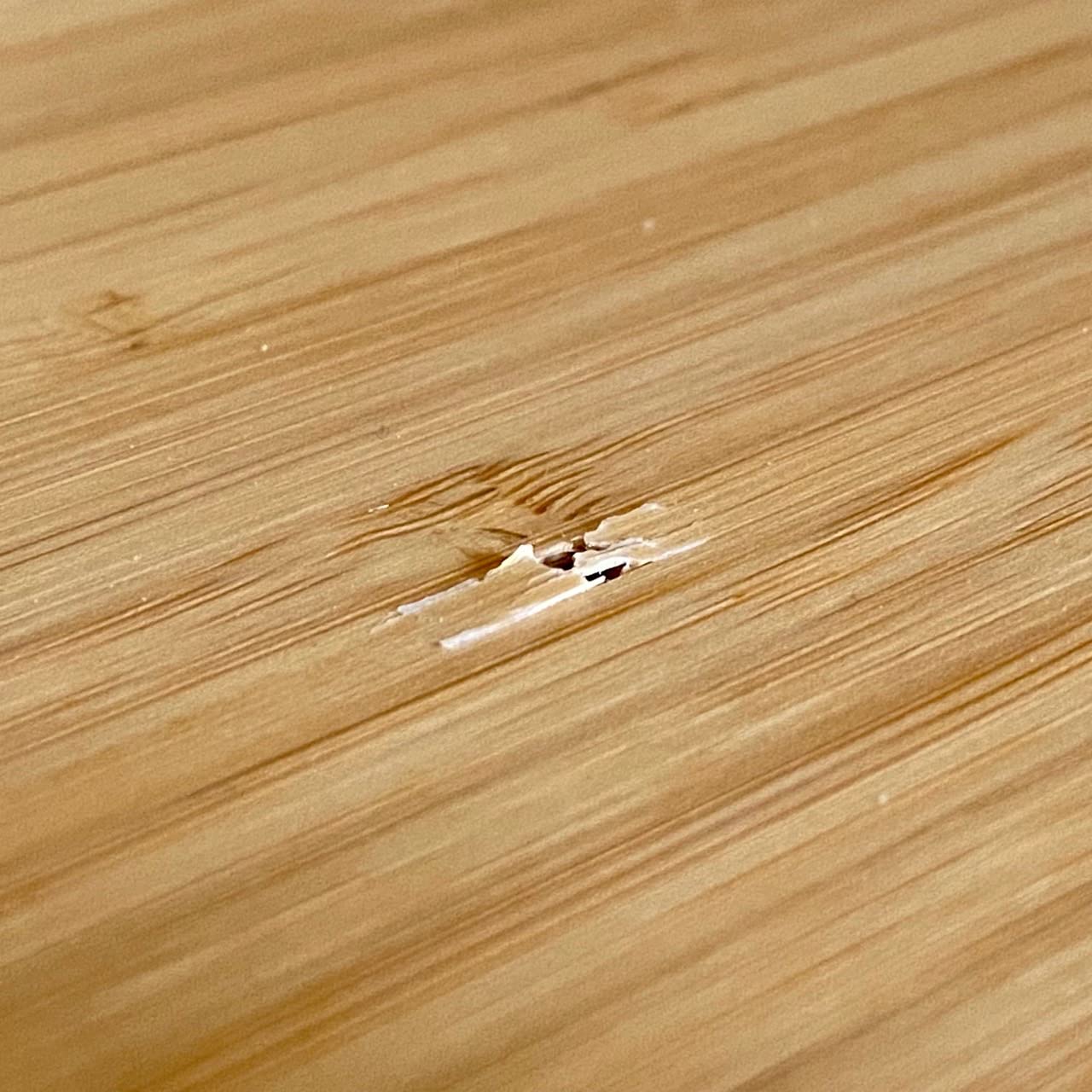
Buy it if you are 6 foot 3 or shorter, you run an ultrawide panel, and you value a seamless surface over maximum height. It is a good reason to stop shopping. If you are 6 foot 5 or taller, the two desks that reach 50 inches will serve your posture far better than the extra 8 inches of width will.
Maximum height 49.2 in
Minimum 23.6 in
220 lb capacity
Brushless motor, 59 x 30 top
If your standing elbow height lands in the upper 40s, this is the desk that gets you there without a premium frame. The three-stage columns run from 23.6 to 49.2 inches, and the manufacturer states thicker lifting columns and longer side plates as the design change that keeps the frame from racking at the top of the range. Reviewers buying multi-monitor setups report that it holds.
The brushless motor is the quiet upgrade over the single-motor budget frames people often compare it against, and the manufacturer states under 55 dB with a 100,000-cycle lifting test completed. Treat the dB figure as a claim. The 220 pound rating is a normal figure for the class, and the desk weighs 79.4 pounds, which is lighter than most of the complete desks in this group.
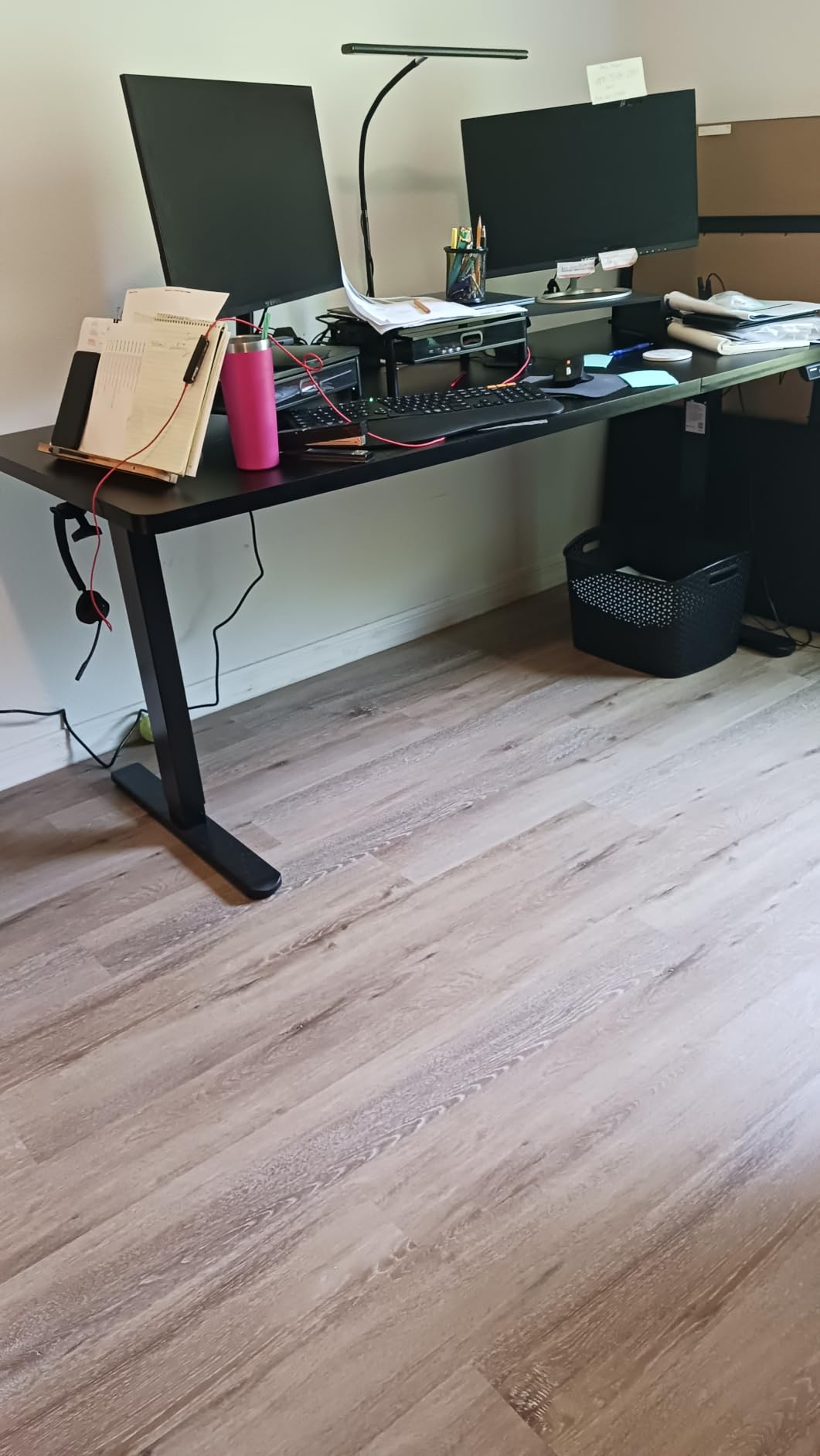
The frame is good. The desktop is where the money was saved. Reviewers repeatedly report that the multi-piece top sections can sit slightly uneven with each other, and that the difference shows under a mouse or a wrist rest. Over a 59 inch width, a small step between sections is easy to feel once you know it is there.
There is also a smaller amount of joint wobble while typing, particularly on those same multi-piece tops. It is not the behavior of a loose frame, but it is a difference from the one-piece surfaces in this group.
Use a hand driver rather than a power driver on the desktop screws. Several owners stripped threads by over-torquing with a drill, and the difference in assembly time is minutes. The instructions are described as clear and well illustrated with labeled hardware, which is better than most frames in this price range.
Desktop and frame arrive in two separate boxes, so check both for damage on arrival. Occasional cracked pre-drilled pilot holes have been reported, and catching that on day one makes the difference between a five-minute fix and a return.
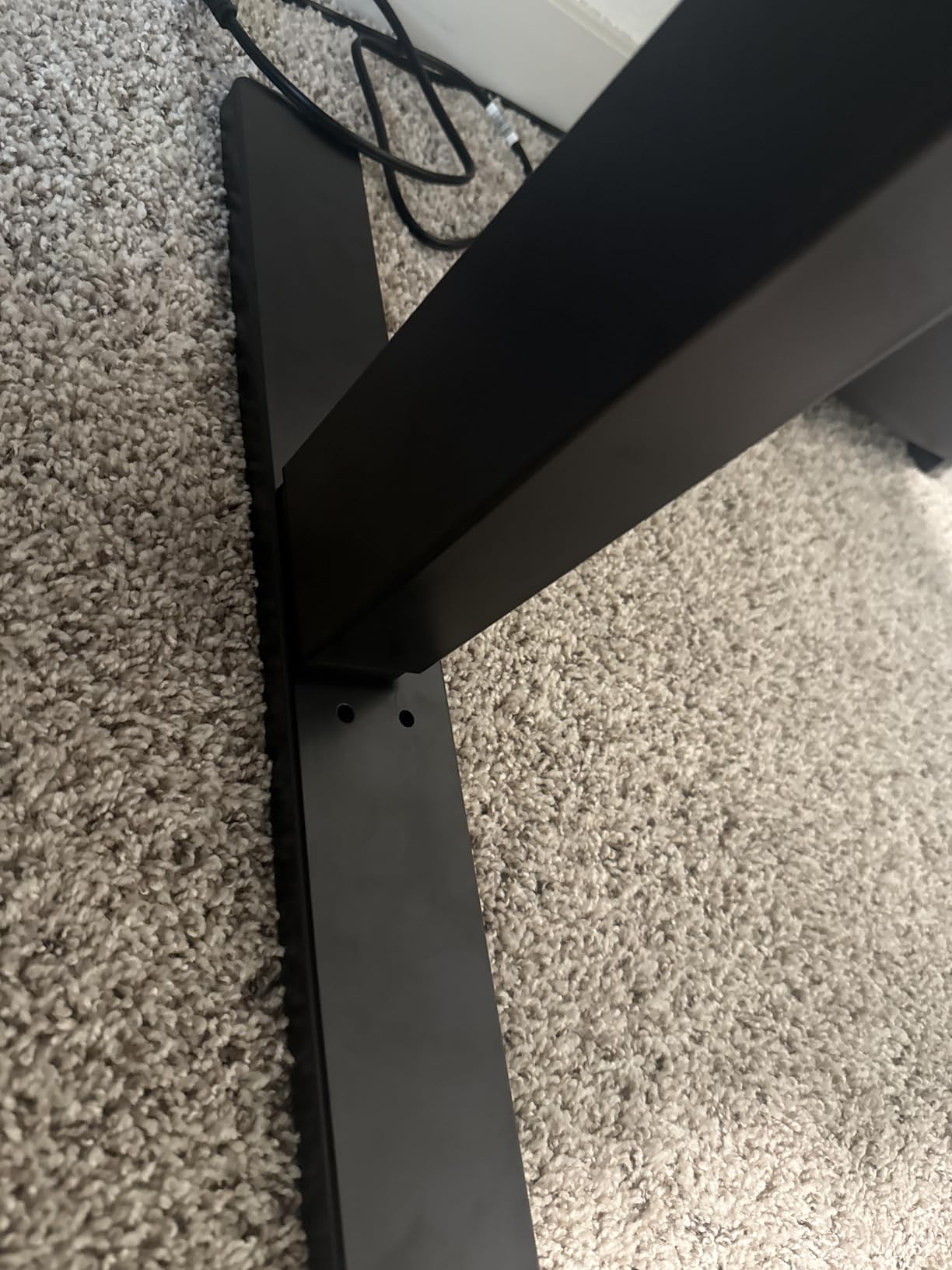
At 49.2 inches this desk serves most users up to about 6 foot 3 comfortably and 6 foot 4 if your standing elbow height is on the shorter side. Beyond that, you are relying on a monitor arm to bring the screens down to eye level while your hands sit a little higher than ideal. The two desks that reach 50 inches remove that compromise entirely.
23.6 to 49.2 in range
Rated 4 ft 11 to 6 ft 7
220 lb capacity
Frame only
This is the only frame in the group where the manufacturer publishes a user-height range rather than just a desk height, and that range runs to 6 foot 7. It is also one of only two frame-only options here that let a very tall user pair their own desktop with the frame, which matters if you need a 32 inch deep top or a thickness the ready-made desks do not offer.
The structural story is the double crossbeam, which is the same class of feature that separates heavy-duty frames from the single-crossbeam designs in this price range. Combined with 40 percent thicker columns and 30 percent longer side plates, it is the reason reviewers describe the frame as stable at maximum width with a three-monitor and laptop setup.
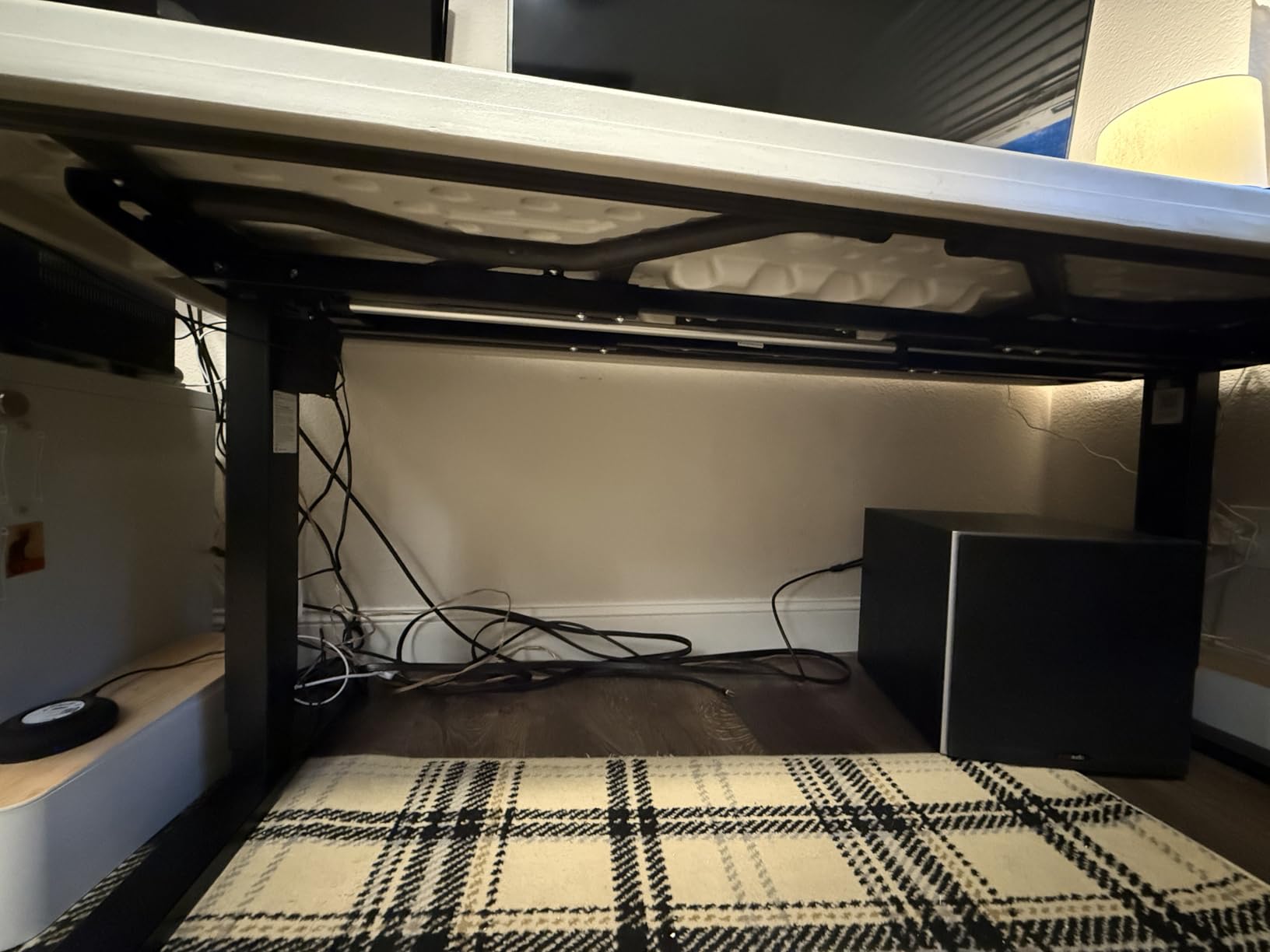
Buying the frame means you choose the top. The crossbars adjust to fit desktops from 43.31 to 86.61 inches wide and 23.62 to 35.43 inches deep, which covers nearly every size a tall user needs, including the deeper tops that help with an ultrawide at close viewing distance. You also absorb the cost of the top yourself and the risk of a top that arrives out of square.
Weight is a genuine advantage here. At 43 pounds the frame is light enough to reposition in a room before you attach a top to it, and it is among the lighter frames in this group. Leveling feet on each leg help with uneven floors, which matters more when you are at 49 inches than when you are at 28.
The included cable tray is too small for a power strip and most real setups, so treat it as a placeholder and add your own. Depth adjustment is limited, so measure your intended top against the stated 23.62 to 35.43 inch range before ordering. Several owners also note the frame width adjustability is less generous than the stated minimum suggests.
On published height, treat the 6 foot 7 figure as a manufacturer statement rather than a measured outcome. It is 49.2 inches at the top of the range, and you should confirm your own standing elbow height against that number before you commit.
28.7 to 47.2 in range
Four-leg dual motor
231 lb load capacity
71 x 32 in top
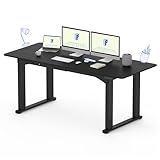
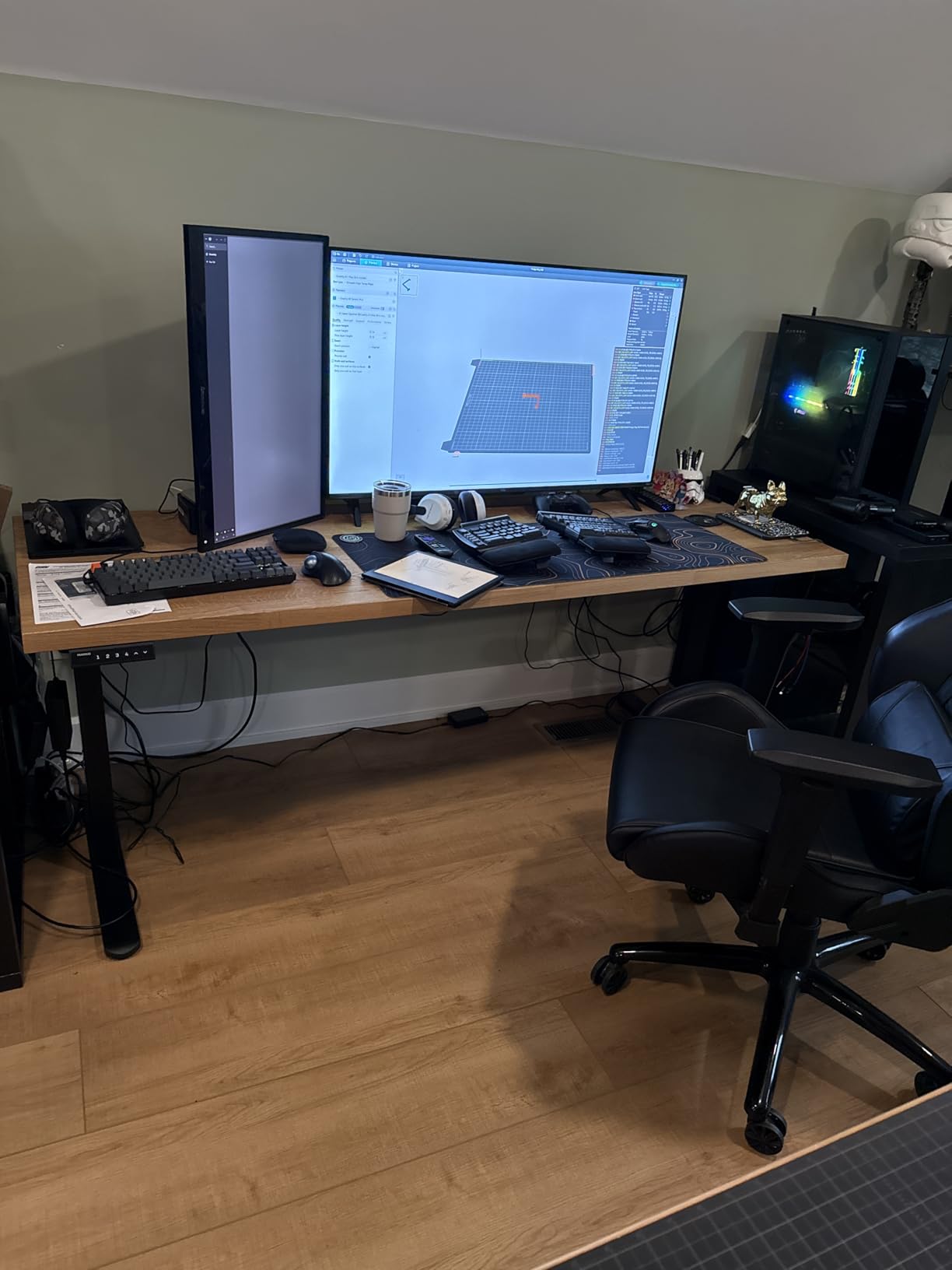
This desk is built for stability above all else, and it reaches less high than the rest. The four-leg frame lifts a 71 by 32 inch top from 28.7 to 47.2 inches, and the two extra rear legs mean the surface resists front-to-back flex in a way no two-leg frame here can match. Reviewers describe it as noticeably rock steady with a tri-monitor setup.
The 47.2 inch ceiling is the problem for this list. It suits users up to about 6 foot 2 or 6 foot 3 depending on their standing elbow height, and it leaves a 6 foot 4 user several inches short. The honest framing is that four legs solve wobble, not reach, and the two problems need different frames.
Yes, and the reason is structural rather than marketing. A two-leg frame gets its front-to-back rigidity from the top panel and a single crossbar. As the legs extend, the overlap between telescoping sections shrinks and the crossbar carries more bending load, so the surface develops a slow flex under load. Adding two rear legs turns that into a four-point support, and the load path no longer depends on the desktop alone.
This desk is rated at 231 pounds and weighs 55 pounds before the top. Several owners who replaced pricier two-leg frames report the change in feel was immediate, which is the argument for paying more when wobble is your primary complaint.
Reach, for one, at 47.2 inches. The second sacrifice is assembly. Owners describe this as a long build with instructions that are awkward to follow, so plan for a longer first session and possibly a second person.
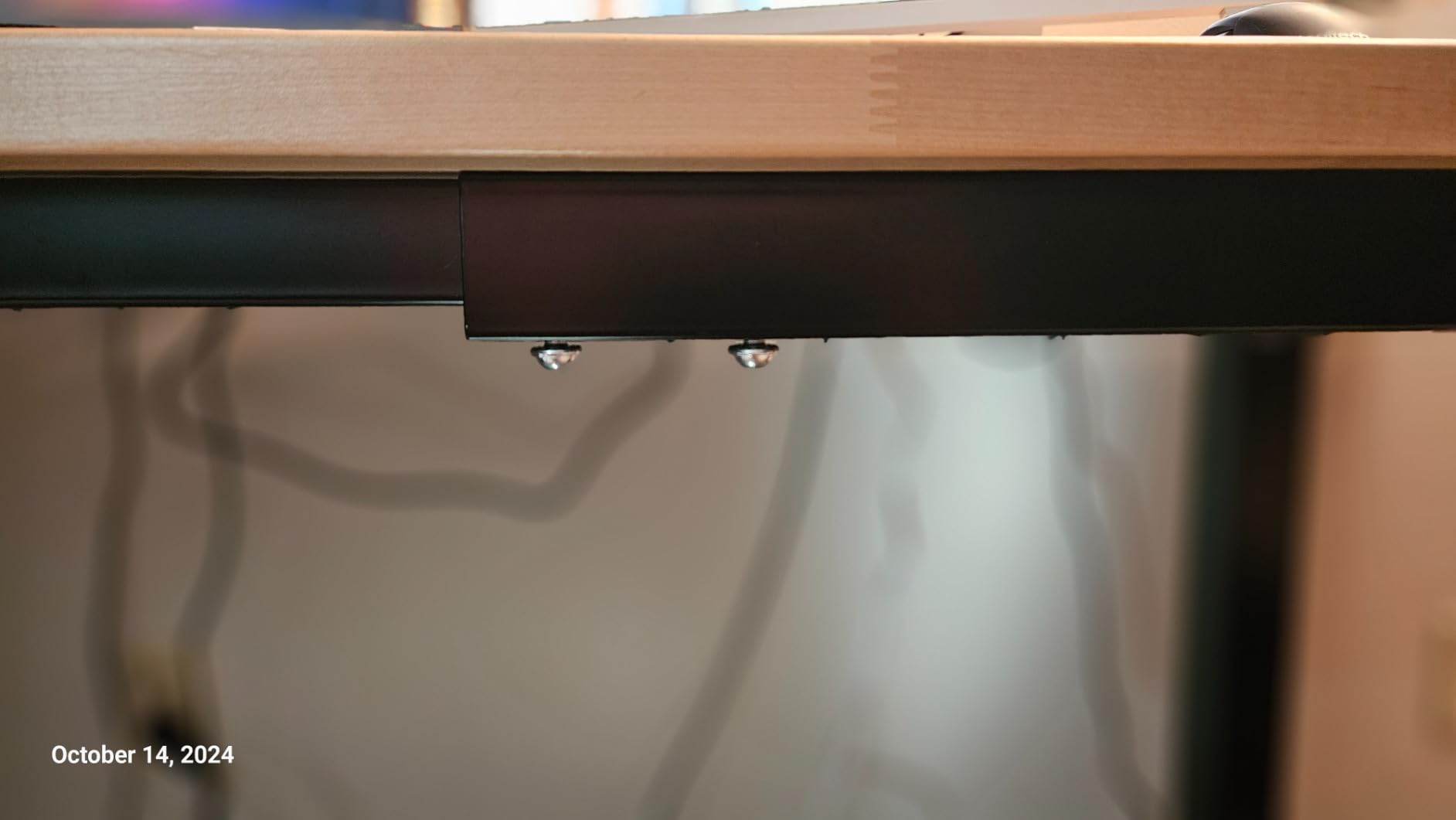
The top is assembled from four separate pieces held by flat brackets, and a splice seam is visible when you look closely across the surface. The frame also cannot be used with casters or with under-desk drawers, so if you need rolling mobility or a sliding accessory drawer, rule it out now.
Buy it if you are shorter than the frame’s ceiling allows, you run three or more displays or heavy monitor arms, and your previous desk flexed under load. Buy it if you plan to work at this desk for a decade. Do not buy it expecting it to serve a 6 foot 5 user, because it will not reach.
28.8 to 47 in range
Four-leg dual motor
220 lb capacity
Frame only, fits tops to 84 x 43
VIVO’s frame answers the same question the desk above does, but as a frame-only purchase with adjustable length. It fits tops from 46 by 23 up to 84 by 43 inches, so it covers anything a tall user would want, including a deep 32 inch work surface that the ready-made options rarely offer in a four-leg design.
The lift specification is unusually well documented for a frame: 0.8 inches per second with dual motors, three memory presets, and a 28.8 to 47 inch range. Reviewers consistently credit the all-steel construction and the quiet motors, and several describe it as the frame that eliminated the shake they had with two-leg models.
The frame depth is fixed at 22.8 inches, which means shallow desktops may not leave enough overhang beyond the leg assembly for a clamp-mounted component. If you plan to attach a monitor arm, a headphone hook or an under-desk mount, measure the top depth against the frame before you order, because length adjusts but depth does not.
The outer-leg support layout also leaves no obvious place to mount the controller on a narrow top. Plan the cable route and the controller position at the same time as the frame layout, not afterward.
The manual describes the three memory presets incorrectly, and support had to clarify the operation for some buyers. That is a small annoyance rather than a defect, but it is worth knowing before you wire the controller. One review also reports bent thin-sheet brackets and a missing power supply in the box, so inspect the contents against the parts list before assembly.
Weight is 55.6 pounds and the manufacturer recommends two people for assembly. US-based customer support is responsive on hardware sizing questions, which is a real benefit when you are buying a frame without a top.
At a 47 inch maximum, this frame is a stability purchase rather than a height purchase. If your standing elbow height is above 45 inches, the three-stage frames earlier in this list are the correct category, and the four-leg advantage here does not compensate for the gap.
Maximum height 50.5 in
54 x 26 in top
200 lb capacity
104.1 lb weight
The Ergo is the answer for a tall user in a small room. It reaches the full 50.5 inches in a footprint that is only 26 inches deep, and a 6 foot 3 owner in the review data specifically credits the extra inches for standing comfort. The curved waterfall front edge is designed for use with a treadmill or exercise bike underneath, so the frame clears the equipment while your hands stay at the right height.
It is also the only complete desk here that ships with a cable management tray alongside the grommets, and the 39.5 inch leg span adds front-to-back stability within a narrow footprint. Assembly is a no-tool two-step process that many owners finish in 10 to 20 minutes.
Depth matters for a tall user mostly because of viewing distance. Standing puts your eyes higher than seated, and a shallow top pushes an ultrawide monitor further away to fit, which makes you lean forward. A 26 inch depth is a compromise: enough for a single display and a laptop, tight for a dual-monitor side-by-side setup at the width this top offers.
Reviewers who pair it with a single large monitor or an ultrawide report good results. If your requirement is two 27 inch displays plus a laptop, look at the 60 by 30 inch desks instead.
The top is a printed laminate film over pressboard rather than real wood veneer, which is the most common complaint in the reviews and the reason 86 percent still give five stars. It is stable and easy to wipe down. It just does not feel like a solid surface, and the edge shows it up close.
There is also little clearance under the desktop for an under-desk sliding drawer, and the cable box and USB charging ports that some buyers expect are not included, only the tray and dual grommets. At 104.1 pounds, standing the top upright takes two people.
23.5 to 49 in range
264 lb load rating
Dual motor, 1.2 in per second
Fits tops 43 to 78.7 in
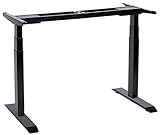
This frame exists for a specific situation: you already own a solid wood desk you like, and you want it to move. Several owners did exactly that. The UNICOO lifts a 264 pound rated load, the highest in the group, on three-stage legs that reach 49 inches, and it fits tops from 43 to 78.7 inches wide by 23.6 to 31.5 inches deep.
A 6 foot 6 owner reports the three-stage motor accommodating their full height, which is the closest anyone in this list came to a first-person account at that height. Take it as encouraging rather than conclusive, since 49 inches is the published ceiling.
Two figures here need separating. The 264 pound rating is the load capacity, and it is the highest listed in the group. The documented lift speed is about 1.2 inches per second unloaded and roughly 1.07 inches per second loaded, which is lower than some listings imply. Nothing in the group moves fast, but a frame that slows under a heavy load is worth knowing about if you switch positions often.
The more important issue for tall users is that the top is not centered on the legs. With a wide top and a multi-monitor load, the mass sits forward of the leg line, and owners report instability as a result. Center your equipment on the frame rather than pushing monitors to the far end, and check the fit before clamping.
Several reviewers report wobble on carpet and note that the plastic feet can mark hardwood. Neither is a reason to skip the frame, but both are solvable: fit a set of proper leveling feet and put the desk on a hard floor or a firm rug pad. Two people are recommended for assembly, and the frame weighs 40 pounds before the top goes on.
The seven-button controller with four customizable presets is straightforward, though this frame has no sit/stand reminder timer, which some competing frames include. That omission matters if you are trying to build the habit of hourly position changes rather than occasional ones.
Start with the measurement, not the brand list. Every other decision follows from one number, and taking that measurement takes about five minutes with a tape measure and a wall. Here is how I would do it, followed by the specs that matter once you know your target height.
Wear the shoes you will work in. Heels add an inch or more that a barefoot measurement misses.
Stand against a wall with your feet flat and your weight even, in the posture you would naturally hold at a desk.
Let your arms hang loose at your sides and your shoulders settle. Do not shrug them up to “stand taller.”
Bend each elbow to a 90 degree angle, forearm forward, keeping your shoulder relaxed and down.
Have someone measure from the floor to the underside of the point of your elbow. A phone on a tripod works if nobody is home.
Subtract about 1 inch. The underside of the desktop, not its surface, is what your forearms rest against.
Check that your target desk clears the number by 1 to 2 inches, then confirm you can still get low enough to sit comfortably.
If the result is 47 inches or under, most standard two-stage desks will serve you. At 48 to 49 inches you need three-stage legs. Above 50 inches, plan on a frame specifically sold for tall users, and verify the published figure before ordering.
Leg stage count is the single biggest driver of maximum height, because each telescoping section adds reach at the cost of overlap. A two-stage frame is two sections and usually tops out near 45 to 48 inches. A three-stage frame uses three sections and commonly reaches 48 to 50.5 inches. A four-leg frame adds rear legs for stiffness and can run either two or three stages.
That last point is where most buyers are misled. The four-leg frames in this group both stop at 47 inches or below because they use two-stage columns. Four legs buy rigidity, not reach. If your problem is wobble at 50 inches, a three-stage two-leg frame with a heavier top may serve you better than a four-leg frame that stops at 47.
Motor count matters next. Dual motors drive both columns and keep the desk level, run at a consistent speed under load, and generate less strain on a single motor over years. Single-motor frames are cheaper and lift one side first, which produces a visible tilt and a rhythmic hum that people on shared calls notice.
Every frame in this article gets less rigid as it rises, and the cause is loss of column overlap. Each telescoping section slides further out of its neighbour, and the joint that resists bending has less engaged surface to work with. Add a 200 pound top, three monitors on arms, and a cable run that tugs when the desk moves, and a small flex becomes obvious.
Four fixes handle most cases. Level every foot before anything else, because an unlevel foot is the most common cause of a desk that rocks at height. Tighten the connectors and check fasteners after the first month, as frames settle under load. Route cables with real slack so the movement is not transmitted to your monitors, and center heavy equipment on the leg line rather than at the front edge.
Published noise figures deserve the same skepticism. The dB numbers in this roundup are manufacturer claims, and the ratings were not taken under identical conditions, so do not treat a lower published figure as proof of a quieter desk. Measure at your desk if noise is the deciding factor, and if you cannot, read reviews that state the distance they measured from.
Tall users often need more depth than height. Standing raises your eye line, and a shallow top pushes a large monitor away from you, which invites leaning forward. A 30 to 32 inch depth handles an ultrawide at a sensible viewing distance, and the 72 by 30 inch and 71 by 32 inch tops in this list exist for exactly that reason.
Thickness matters less than people expect, but a 1 inch or thicker top resists the flex that makes a thin surface feel cheap. One-piece tops have no seams to catch a keyboard or a cable, and multi-piece tops can sit slightly uneven, which you feel most clearly under a mouse. The Vari Ergo here uses a printed laminate film over pressboard, which is the most affordable surface in the group and the least premium to touch.
Finally, treat load capacity as a ceiling that falls with height. Leverage on the frame increases as the desk extends, so a 330 pound rating at sitting height is not 330 pounds at 50 inches with a tower and three monitors. Check that the published rating is the higher of the two figures listed for your desk, since some listings show both a recommended weight and a lift capacity. If the desk is part of a wider office refresh and the table on the other side of the room is also on your list, our guide to the best outdoor dining tables for 8 people covers the height and clearance decisions on that side.
Published specifications for the same model can differ between a retail listing and a brand product page, and the data behind this roundup is a good illustration. The FlexiSpot four-leg listing we analyzed shows a lift range of 28.7 to 47.2 inches in its product-detail fields while its item dimension fields read 47H and 50 inches, and its 176 pound recommended weight sits alongside a 231 pound load capacity. Four different numbers, one product. None of them is necessarily wrong, but you cannot treat any of them as the confirmed maximum raised height without checking.
Protect yourself with three checks. Read the product-detail fields rather than the marketing bullets, since the fields are usually generated from the catalog. Look for a tape measure in user reviews at full extension. And before you buy, confirm the maximum height against your own standing elbow measurement with a 1 to 2 inch margin, because a spec sheet does not know about an uneven floor or a top that sits proud of the frame.
Very tall desks are heavy. The Vari ComfortEdge and Vari Ergo ship at 122 and 104 pounds, and both need two people to right the top. Clear the floor space before the boxes arrive, and assemble where the desk will live, because moving a fully assembled tall desk is much harder than moving its parts.
Run the full height range once before clamping anything to the surface. Listen for a grinding or ratcheting sound from the columns, check that both sides rise evenly, and look for a bow in the top. Then set your presets. The sitting and standing positions you save on day one are the ones you will use every day, and four memory slots are enough for nearly everyone.
For a person who is 6 feet tall, the target is your standing elbow height, which for most 6 foot adults falls around 43 to 46 inches. Measure from the floor to the underside of your elbow while standing, subtract about 1 inch, and buy a desk that clears that number by 1 to 2 inches. A 6 foot person is usually served by a three-stage frame with a 48 to 50 inch maximum.
The maximum height varies by leg stage. Two-stage frames typically top out around 45 to 48 inches, three-stage frames reach 48 to 50.5 inches, and dedicated tall-user frames go higher. Among the desks reviewed here the highest published maximum is 50.5 inches. Always check the maximum height figure for the exact model and top size, because published ranges differ between listings.
The best standing desks for tall people are the ones whose published maximum height clears your standing elbow height with a margin. The Vari Classic Electric reaches 50.5 inches with a 200 pound rating and a lifetime warranty, and the FlexiSpot E6 MAX reaches 50 inches with the highest load rating in the group at 330 pounds. Pick by measured height first, then by stability and top size.
The 20-8-2 rule means spending 20 minutes standing, 8 minutes sitting, and repeating the cycle every half hour. It keeps blood moving and reduces the static loading that causes back discomfort. For tall users the rule interacts with height range: if your desk does not reach true standing elbow height, you stop standing fully upright, and the 20 minutes become 20 minutes of hunching instead.
Yes. Two extra legs change the load path from a two-point to a four-point support, so the desktop no longer depends on the top panel and one crossbar to resist front-to-back flex. That difference grows as the frame extends. However, four legs improve stability rather than reach, so check the maximum height separately from the leg count.
Wobble at full height is usually caused by loss of overlap between telescoping leg sections as the frame extends, combined with an unlevel foot. Level every foot first, then tighten connectors after the first month of use, route cables with slack so movement is not transmitted to your monitors, and center heavy equipment over the leg line. If wobble persists, a four-leg frame addresses the cause directly.
If your standing elbow height is 48 inches or lower, the HUANUO 59×30 or the UNICOO conversion frame will serve you well, and the FlexiSpot E6 Bamboo 72×30 is worth considering if an ultrawide matters more than maximum height. If you measure between 49 and 50 inches, choose a three-stage frame, and the FlexiSpot E6 MAX gives you the strongest load rating in this list at the same height. If you measure above 50 inches, the Vari Classic Electric, the Vari ComfortEdge and the Vari Ergo are the only three desks here that clear it, and the Vari Ergo does it in the smallest footprint.
Wobble is a separate problem from reach. If you run three monitors or heavy monitor arms and your desk flexes, the four-leg FlexiSpot and the VIVO frame both solve it, but neither reaches above 47 inches, so pair them with a taller frame only if your height measurement allows it. A desk converter is the alternative for very tall users who cannot change desks, though it raises your elbows without giving you clearance to move underneath, and it will not fix a frame that stops two inches short.
Whichever you pick, measure first and verify the published maximum height for the exact model before you buy. It is the one specification that decides whether the desk works for your body, and it is the one most often quoted loosely.