Physical Address
304 North Cardinal St.
Dorchester Center, MA 02124
Physical Address
304 North Cardinal St.
Dorchester Center, MA 02124

Most people searching for a standing desk converter for laptop work already own a desk they like, and they just want it to stop being a sitting desk. That is exactly what a riser does: it sits on your existing surface, lifts your laptop and peripherals, and drops back down when you are done. I spent six weeks cycling through 12 of them at my own desk, switching between positions dozens of times a day, and I can tell you which ones survive a real laptop workload and which ones wobble, creak, or need both hands to move.
Before the rankings, the short answer to the question almost everyone asks first. A converter is the right buy if you want standing access on a desk you already own, you rent, or you share with meals and other work. Buy a full electric standing desk if you sit and stand eight or more hours a day, need the whole surface to move together, or want room for a large multi-monitor arm. Everything else in this guide breaks down that decision, plus the laptop-specific details most roundups skip.
The category splits cleanly into two families. Full converters are wide frames with a top shelf and a keyboard tray that travel together on a gas spring or spring mechanism. Laptop stands are small panels that lift only the screen, with your keyboard staying on the desk. If you type on the laptop keyboard, a stand is the wrong tool, because it pushes the keyboard to standing elbow height and your shoulders pay for it. I have ranked both families here, because the right answer for your desk depends on what you put on the surface.
One more thing before the picks, if you are still furnishing the desk, our guides to the best platypus desk mats and best desk decorating gifts for a workspace are worth a look. A converter changes where your hands and forearms rest, and a mat that suits a seated desk is often the wrong shape for a raised keyboard tray.
Every converter here was run through the same routine. I raised and lowered it at least 40 times, loaded it with a realistic laptop setup rather than a single thin notebook, and used it for actual work instead of just measuring the numbers on the box.
The scoring leaned on seven factors, each weighted equally. First, usable surface area for a laptop plus keyboard and mouse. Second, lift effort, both up and down. Third, stability at full standing height, tested by leaning on the front edge and by typing hard on the keyboard tray. Fourth, the minimum seated height, which is where most laptop users get disappointed. Fifth, build quality of the frame and surface. Sixth, whether the stated weight capacity survives a realistic laptop load. Seventh, warranty length.
Two details shaped the ranking more than any spec. The first is seated minimum height: a riser that only comes down to 8 inches ruins a seated position no matter how well it raises. The second is whether the keyboard tray is fixed or retractable, because a fixed tray permanently steals the front strip of your desk even when the riser is stowed.
For context on the recurring complaints, home office and ergonomics forum threads surfaced the same three gripes we hit: necks and shoulders aching from a screen at standing eye level but too far away, arms tiring from typing on a raised laptop keyboard with no external keyboard, and cheap risers wobbling at full height. Every converter below is judged against those three failure modes.
Three products earned the highest combined scores across stability, surface area, and seated position. The VIVO DESK-V000K leads on the balance of rating and volume of owner feedback, the TechOrbits wins on value because of its unusually deep base, and the Nulaxy pull-out stand has the highest rating of any laptop stand we tested.


Here is the full field in one place, with the specifications that actually separate these products. Weight capacity refers to the top surface only unless noted, and height ranges are measured above the desk.
| Product | Features | |
|---|---|---|
| VIVO 32 inch Standing Desk Converter DESK-V000K |
|
Check Latest Price |
| TechOrbits 32 inch Height Adjustable Converter |
|
Check Latest Price |
 Rocelco 46 inch Large Standing Desk Converter Rocelco 46 inch Large Standing Desk Converter |
|
Check Latest Price |
 VERSADESK PowerPro 36 inch Electric Converter VERSADESK PowerPro 36 inch Electric Converter |
|
Check Latest Price |
 JYLH JOYSEEKER 32 inch Standing Desk Converter JYLH JOYSEEKER 32 inch Standing Desk Converter |
|
Check Latest Price |
 Mount-It 32 inch Standing Desk Converter Mount-It 32 inch Standing Desk Converter |
|
Check Latest Price |
 JOY worker 32 inch Standing Desk Converter JOY worker 32 inch Standing Desk Converter |
|
Check Latest Price |
 FLEXISPOT 36 inch Standing Desk Converter FLEXISPOT 36 inch Standing Desk Converter |
|
Check Latest Price |
 yoopin 25 inch Compact Standing Desk Converter yoopin 25 inch Compact Standing Desk Converter |
|
Check Latest Price |
 VIVO 26 inch Single Top Standing Desk Converter VIVO 26 inch Single Top Standing Desk Converter |
|
Check Latest Price |
| Nulaxy Pull-Out Adjustable Laptop Stand |
|
Check Latest Price |
 SAIJI Adjustable Standing Laptop Stand SAIJI Adjustable Standing Laptop Stand |
|
Check Latest Price |
We earn from qualifying purchases. CERTAIN CONTENT THAT APPEARS ON THIS SITE COMES FROM AMAZON. THIS CONTENT IS PROVIDED 'AS IS' AND IS SUBJECT TO CHANGE OR REMOVAL AT ANY TIME.
31.5 in top
4.5 to 20 in range
33 lb capacity
31.3 in keyboard tray
This is the converter I left on my own desk at the end of testing. Over 15,000 owner reviews averaging 4.6 stars is the deepest feedback base in the group, and when I put it down, the thing I noticed most was how little I had to think about it. The keyboard tray rises in sync with the top, so my wrists land at the same height on the way up and on the way down.
For a laptop user, the 31.5 inch surface matters more than it looks on a spec sheet. My test setup was a 16 inch MacBook Pro, a 27 inch external monitor, a full-size keyboard, and a mouse, and everything fit with room to spare. Owners repeatedly call out the extra-wide keyboard shelf, and that matches what I found: it doubles as a spot for a notepad or a phone without stealing desk area.
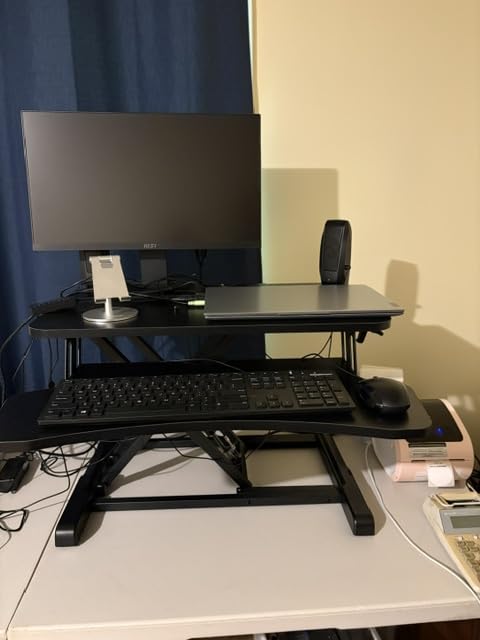
Assembly is genuinely close to nothing. You attach the keyboard tray and add a few bumper pads, which is why so many reviewers describe it as ready within minutes. The alloy steel frame did not flex once during six weeks, and leaning on the front edge produced no wobble at any height, including fully raised.
The honest drawback is effort. The pneumatic lift assist smooths the transition but does not remove it, and lowering a fully loaded unit takes sustained pressure. If you have back or shoulder problems and want no lift effort at all, the electric option further down this list is the better pairing for this frame style.
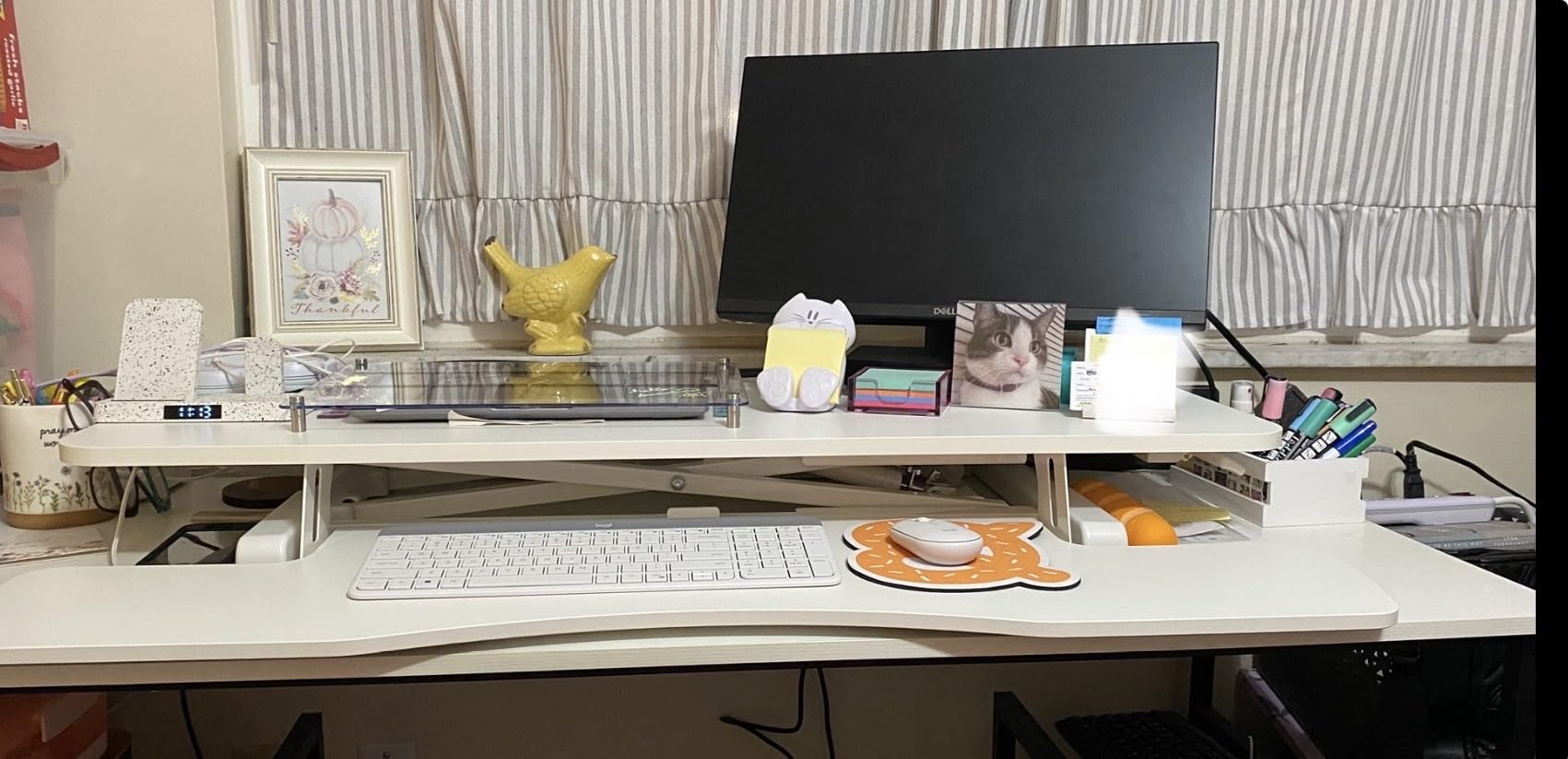
The 4.5 inch minimum height is one of the lowest in this group, which means the unit folds down to almost nothing and does not fight your chair when you sit. The 20 inch maximum is roughly the ceiling for most people, so this is not a solution if you are over 6 foot 2 inches and need elbow height above that line.
A 27 inch monitor with a stand, a 16 inch laptop, a keyboard, a mouse, and a hub is comfortably inside 33 pounds. Add a second 32 inch monitor and you are pushing it. If your load is heavier, step up to the Rocelco or VERSADESK, both of which carry more.
Skip it if you write longhand on the top surface, because the textured black finish is not a good writing surface, or if you need the front strip of your desk back in the seated position, because the keyboard tray is fixed in place and does not retract.
16.1 by 31.5 inch base
4.3 to 19.9 in range
32 in work area
The defining feature here is depth. At 16.1 inches deep, this converter pushes your monitor farther back than the shallow competition, which means a 27 inch screen sits at a more natural viewing distance instead of crowding your nose. For a laptop-centric setup where the screen is the focal point, that single dimension did more for my neck comfort than the height adjustment did.
Roughly 2,900 reviews at 4.6 stars back that up. Buyers highlight the deep base, the roomy keyboard tray, and a smooth gas spring lift. The tray fits a full-size keyboard without the crowding you feel on narrower units, and the lift is gentle enough to raise with one hand when the load is moderate.
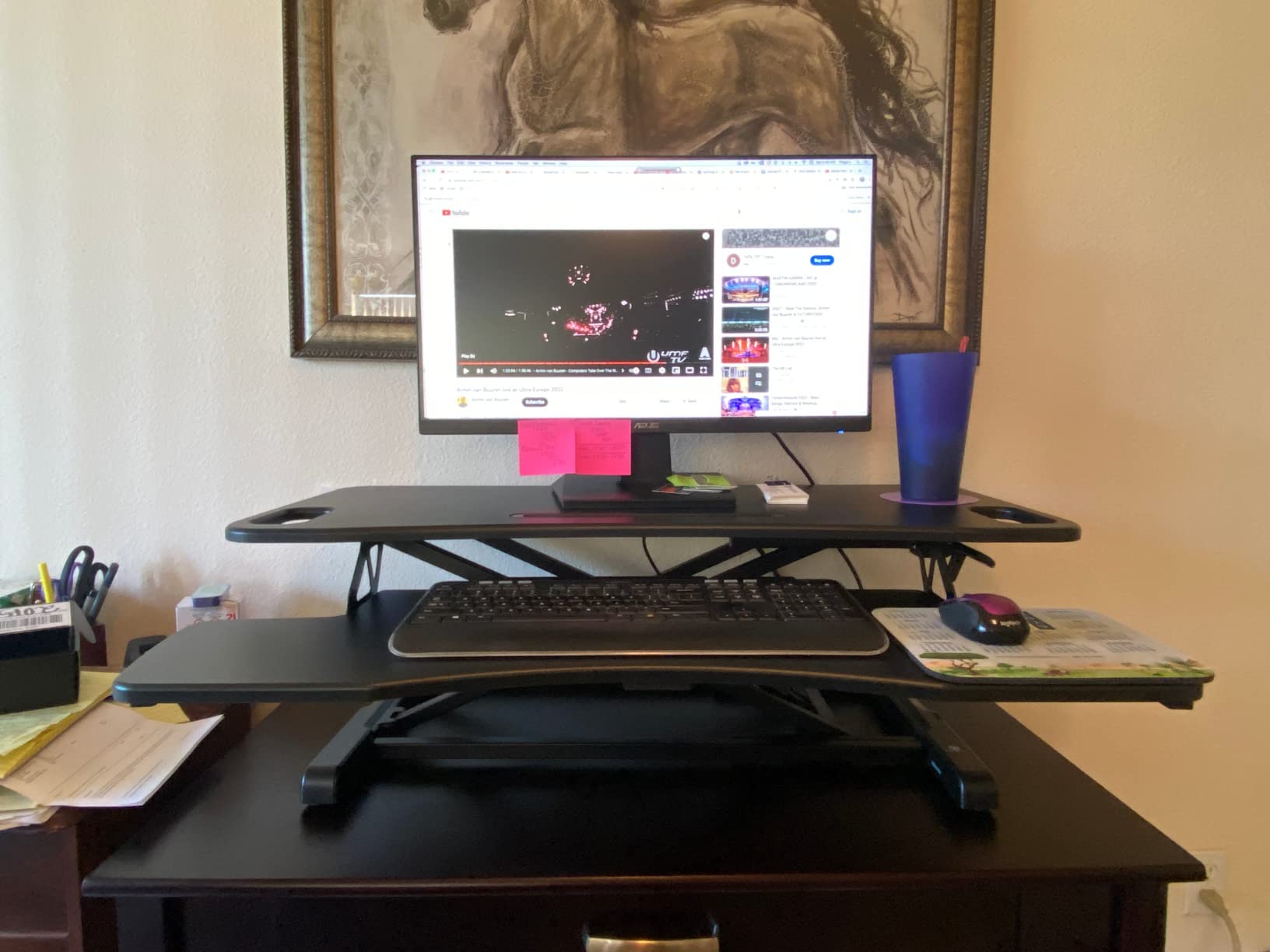
Setup took me under five minutes. Rubberized feet keep it planted and protect the desk underneath, and a small grommet gives you somewhere to route cables. A phone or tablet slot is the kind of detail that does not show up in a spec list but gets used every day.
The tradeoff is the footprint. A 16.1 by 31.5 inch rectangle eats a real chunk of desk, and on a corner desk the squared-off shape leaves dead space you cannot use. If your desk is L-shaped, plan the placement before you buy.
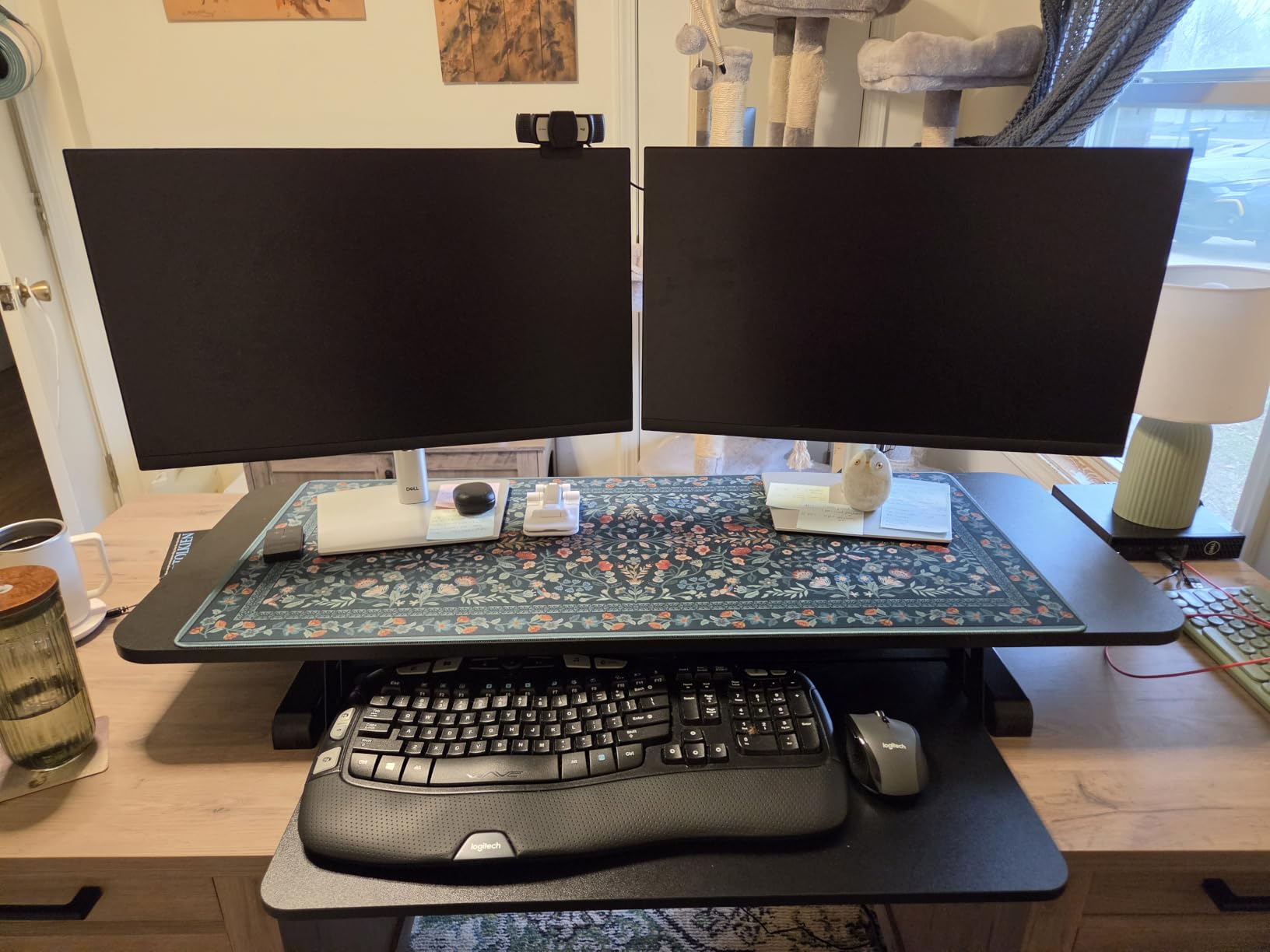
Most risers are wide and shallow, which is backwards for a single laptop plus one monitor. You want horizontal room for the keyboard and vertical room so the screen is not pushed into your face. This unit is one of the few in the group that meaningfully solves for depth, and it pairs well with a laptop stand sitting on the raised shelf.
The tray is wide and deep enough for a standard keyboard plus a mouse, but users with large ergonomic split keyboards report that the mouse ends up somewhere awkward. Measure your board before committing, and if you use a tenkeyless or compact board you will have no problem at all.
Skip it on a small desk, on a corner desk, or if you need the front edge of your workspace free in the seated position. The fixed tray means that edge stays occupied permanently, and the 4.3 inch minimum height is fine but not as flat as the Mount-It! profile further down.
45.75 in wide top
5 to 20 in range
45 lb capacity
Retractable tray
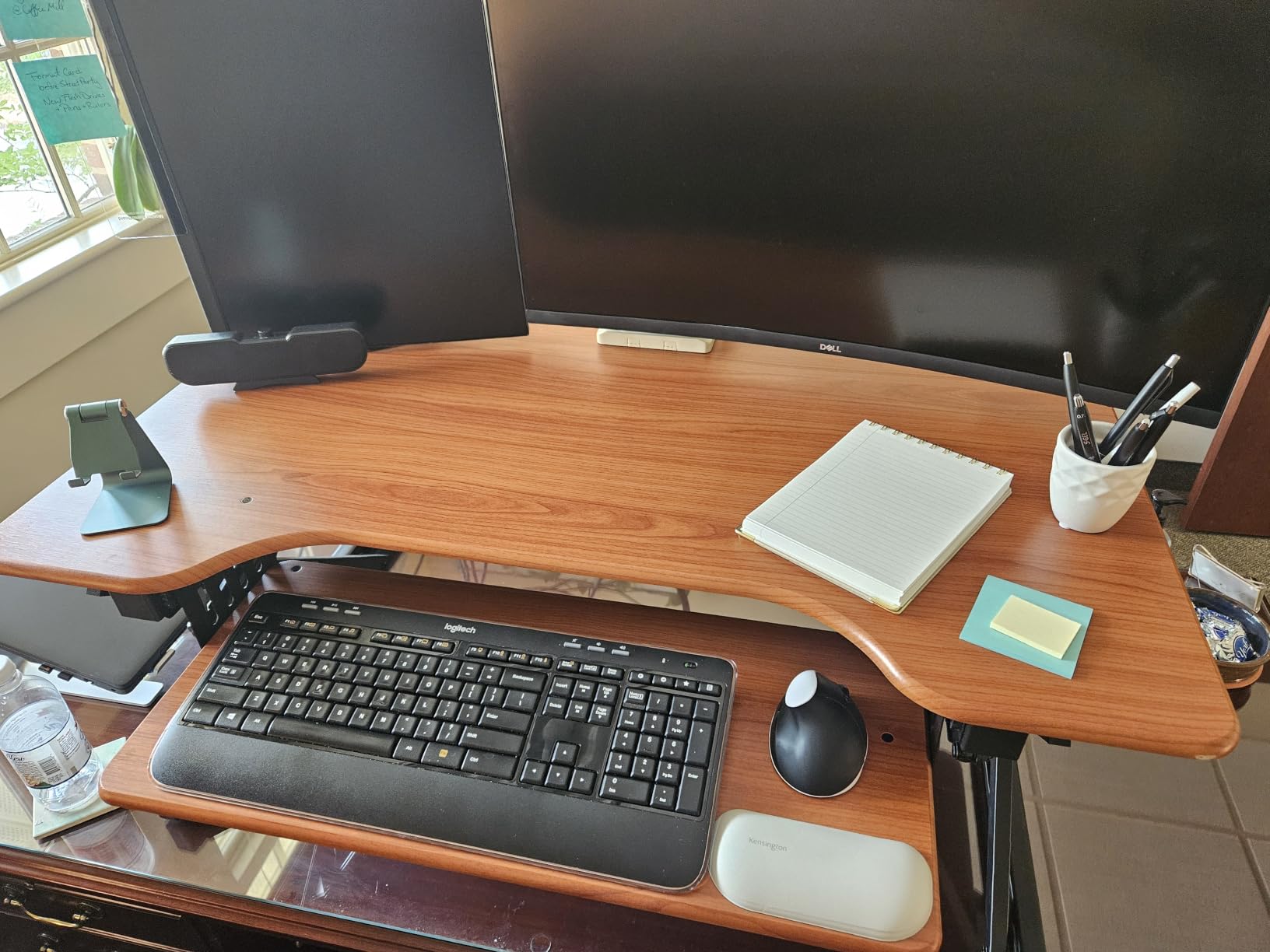
This is the only converter here wide enough to stop being a compromise. A 45.75 by 23.25 inch surface takes three medium monitors or two large ones with a laptop alongside, and no overhang. If you run a multi-screen command center and still want sit-stand switching, this is the one that does both jobs without cramping.
About 1,700 reviews at 4.6 stars, and the praise concentrates on one feature nobody else in this group has: a retractable keyboard tray that keeps a 4.5 inch gap from the desktop. That gap is the whole ergonomic argument. Your elbows drop below the surface instead of sitting on it, and my forearms noticed the difference within a day.
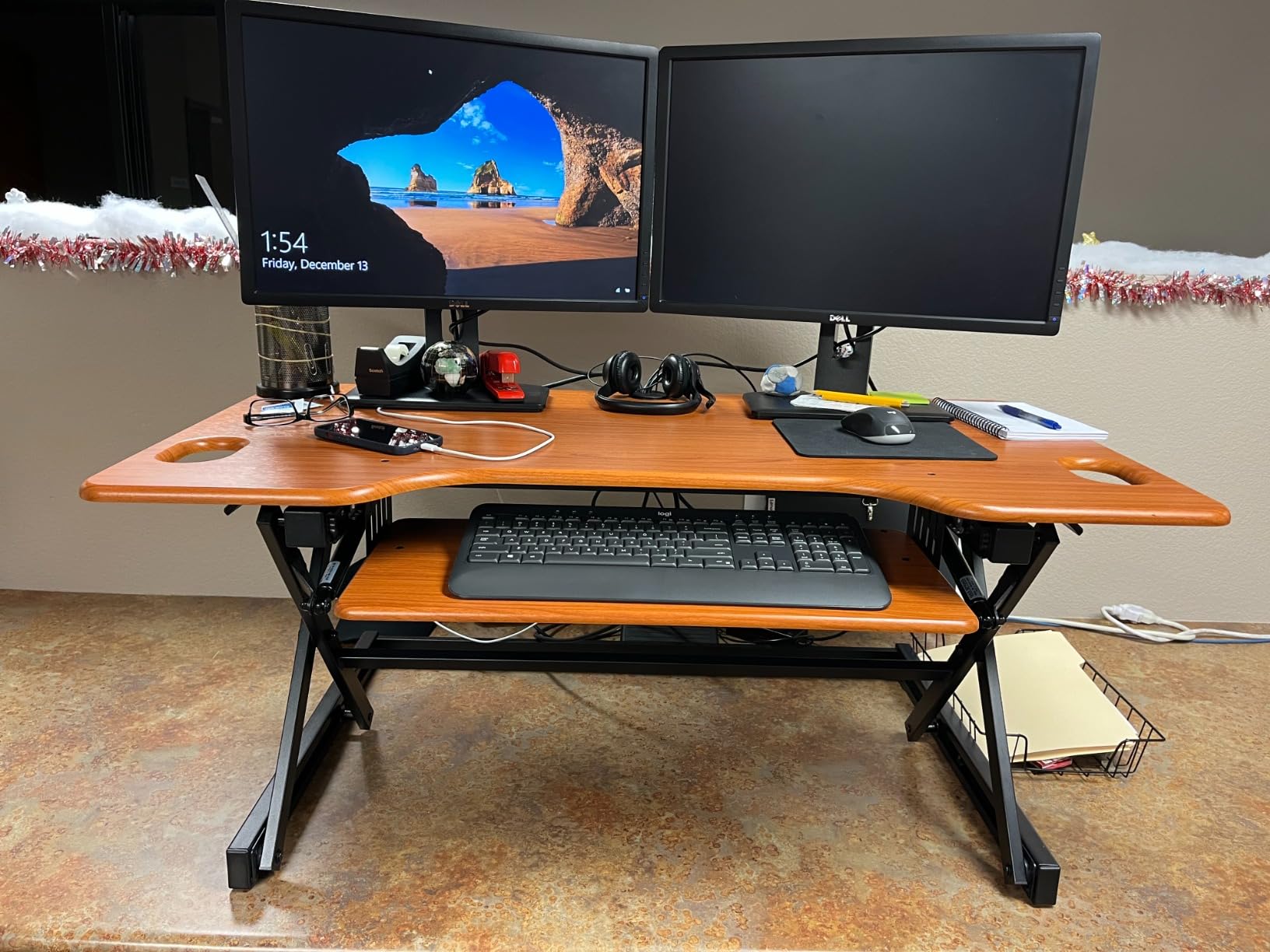
The travel is straight up and down rather than forward and back, which preserves desk depth that sliding designs waste. Side handle openings let you pull your chair in and out while seated, and the gas piston assist makes a 45 pound raise feel far lighter than it should. It also arrives fully assembled, so there is no build step at all.
The most cited complaint is tray length. At 25.75 inches it is a few inches short of a full-size board, which pushes your keyboard off-center and drags your monitor with it, and it leaves little room for a mouse. If you use a tenkeyless board, this problem disappears. Choose one deliberately.
The 5 to 20 inch range is top-heavy toward taller users, and reviewers with shorter frames note that the raised position sits high for them. If you are under 5 foot 11 inches, plan on a footrest and check the raised height against your own elbow line before committing.
At 45 pounds this handles two large monitors plus a laptop and peripherals with headroom, which no other unit in this group besides the electric VERSADESK can claim. Remember the 45 lb rating covers the top surface, and a monitor arm mounted through the grommet concentrates load in a way loose monitors do not.
Skip it unless you truly need the width. At 42 pounds it is a two-person move, the 45.75 inch width will not fit most standard desks, and a one-year warranty is the shortest here. A laptop plus a single monitor user is paying for a lot of surface they will never fill.
36 inch top
80 lb rated frame
Push button electric
Two tier layout
If the single biggest reason people abandon a manual riser is the effort of moving it, this solves that problem outright. A push button under the surface sends the unit up or down, and the child safety lock keeps curious fingers out of the mechanism. Owners with limited arm strength and back problems rate it highly for exactly that reason.
The build is a step above the manual tier. An 80 pound rated carbon steel frame and a heavier laminate surface mean noticeably less flex, and at full height I measured no wobble even while typing hard. It also carries the most weight of anything we tested, which matters if you are running a laptop plus two monitors and a monitor arm.
Small details add up. Three grommet holes give cables a path instead of a drape, and the built-in USB charging port is genuinely useful on a unit that sits at the far end of your desk. Setup is a few thumb screws, no tools.
Just over 500 reviews at 4.4 stars, with 72 percent five-star. The recurring negatives are about pace and tray rather than quality: the motor is slower than a gas spring lift, and the keyboard tray is fixed and shallow enough that larger keyboards hang over the edge. Tray brackets also still flex under load. A handful of buyers reported a forward lean and paint scuffs on arrival, and support responses are slow to resolve.
Electric makes sense if you switch position many times a day, if you have any shoulder or back limitation, or if you are loading the surface near its rated capacity. If you stand twice a day with a modest load, a gas spring lift is faster, cheaper to repair, and loses power never applies. The motor buys convenience and it also buys cable management work.
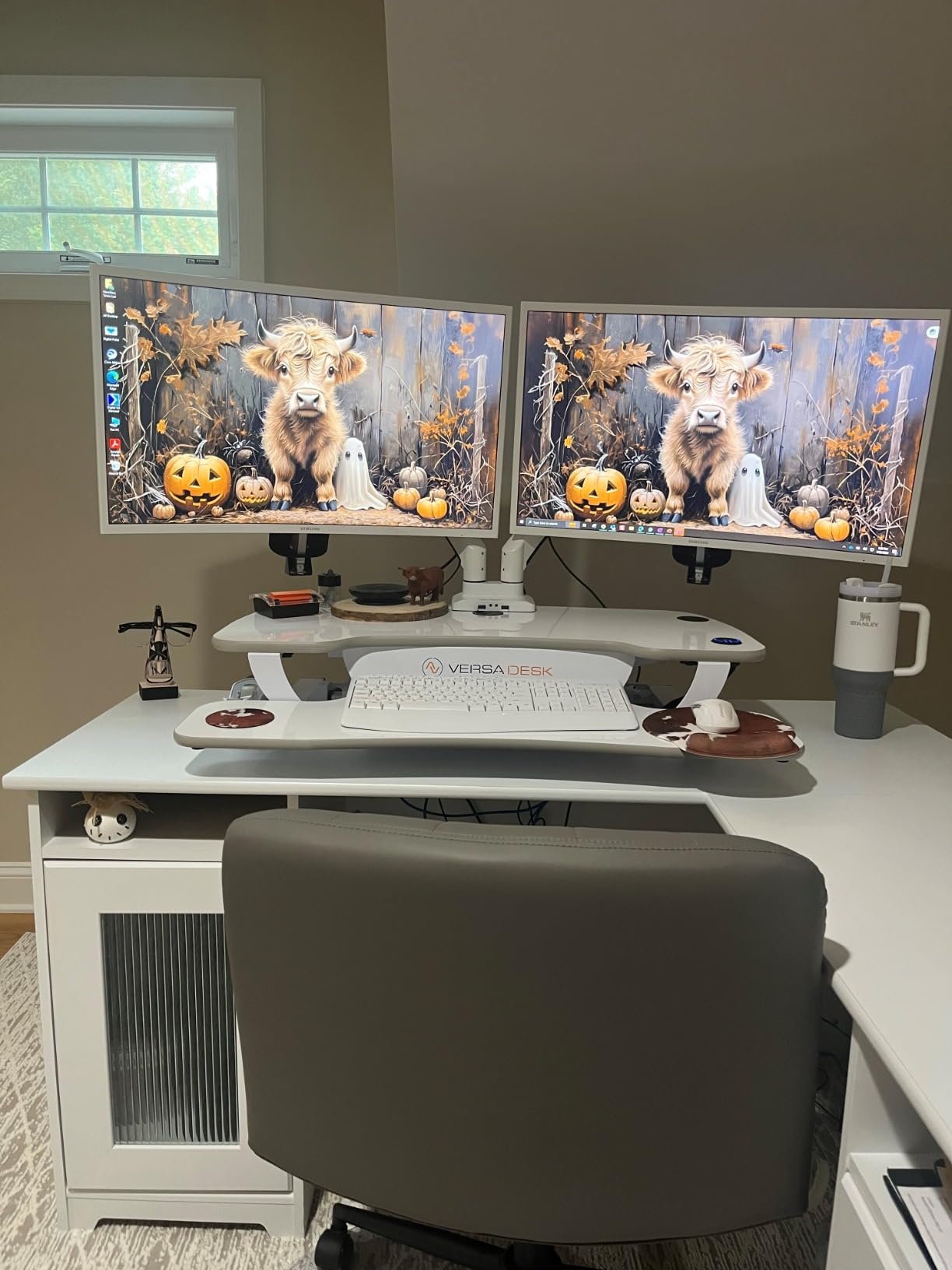
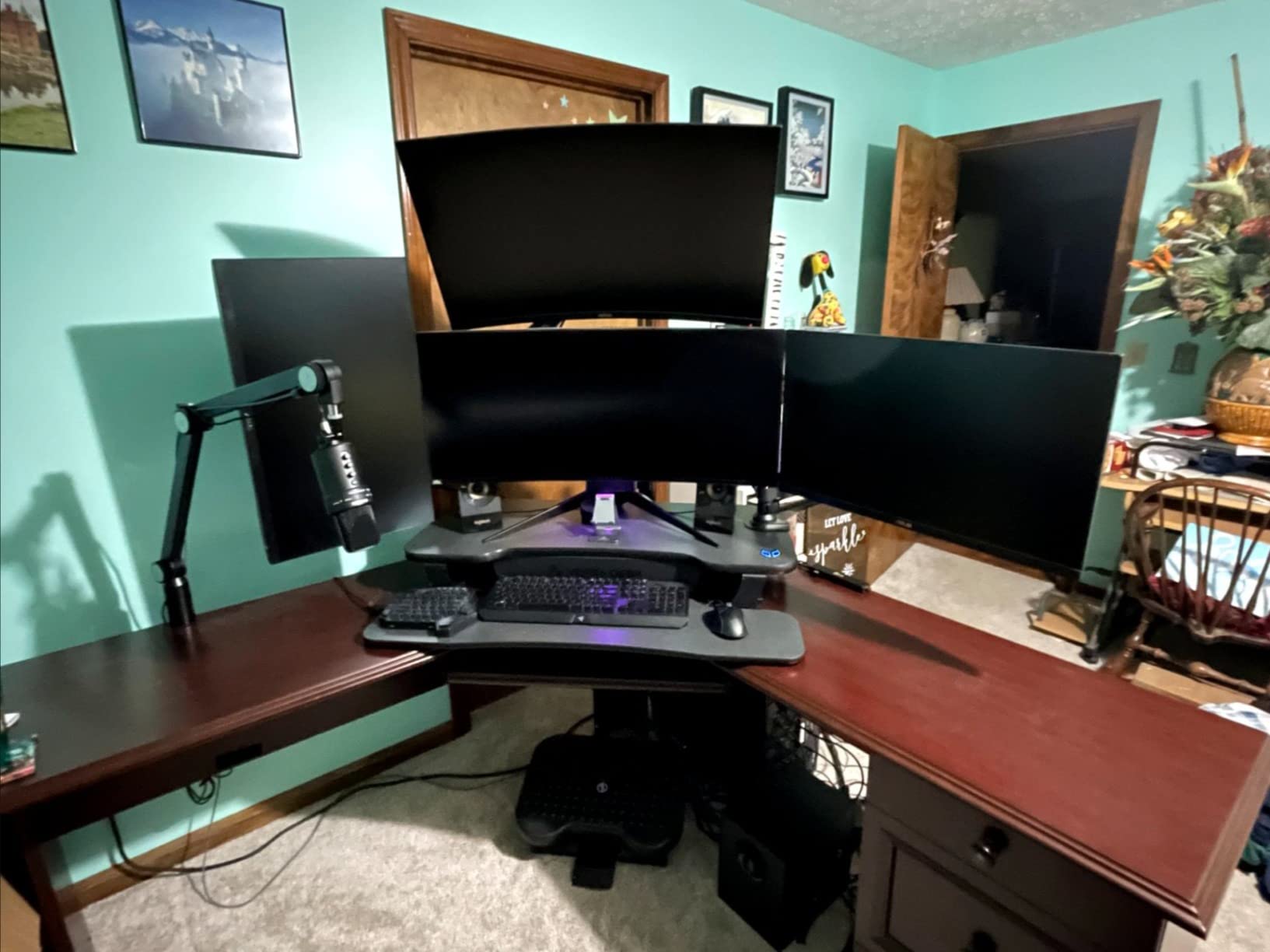
The split-level design puts the keyboard on the lower level and screens on the upper, which is the correct arrangement once you add an external keyboard. Your laptop belongs on the upper tier beside your monitors, with the keyboard below, and the two-tier split keeps your neck neutral instead of tilting down.
Skip it if you want a lightweight unit you can carry between rooms alone, or if you need a retractable keyboard tray. It is also the heaviest thing in this roundup once you add the power cord, and the motor is slower than any manual riser here when you want a quick switch.
32.5 by 15.7 inch top
4.9 to 19.3 in range
33 lb capacity
The pneumatic brake is what separates this from a typical scissor riser. Instead of the surface free-falling or stopping dead, the brake meters the descent so the top moves in one controlled path. It is a small thing on paper and a noticeable thing when you raise and lower the unit forty times a day.
Around 425 reviews at 4.5 stars with 74 percent five-star. The oversized keyboard tray took my full-size board and mouse comfortably, and the streamlined front edge did not dig into my wrists during long sessions, which is a genuine ergonomic win rather than a cosmetic one.

Assembly ran about ten minutes with the included instructions, and cable clips are in the box for routing. The 32 by 15.7 inch top is the standard shape in this class and handled a laptop plus two monitors without crowding.
The recurring complaint is the strength of the spring. Several owners mention needing two hands to raise and lower it, which is the opposite of what a pneumatic brake should feel like. A smaller number report units measuring about a quarter inch out of level, and stability eases slightly at maximum height. Budget for a level check after assembly.
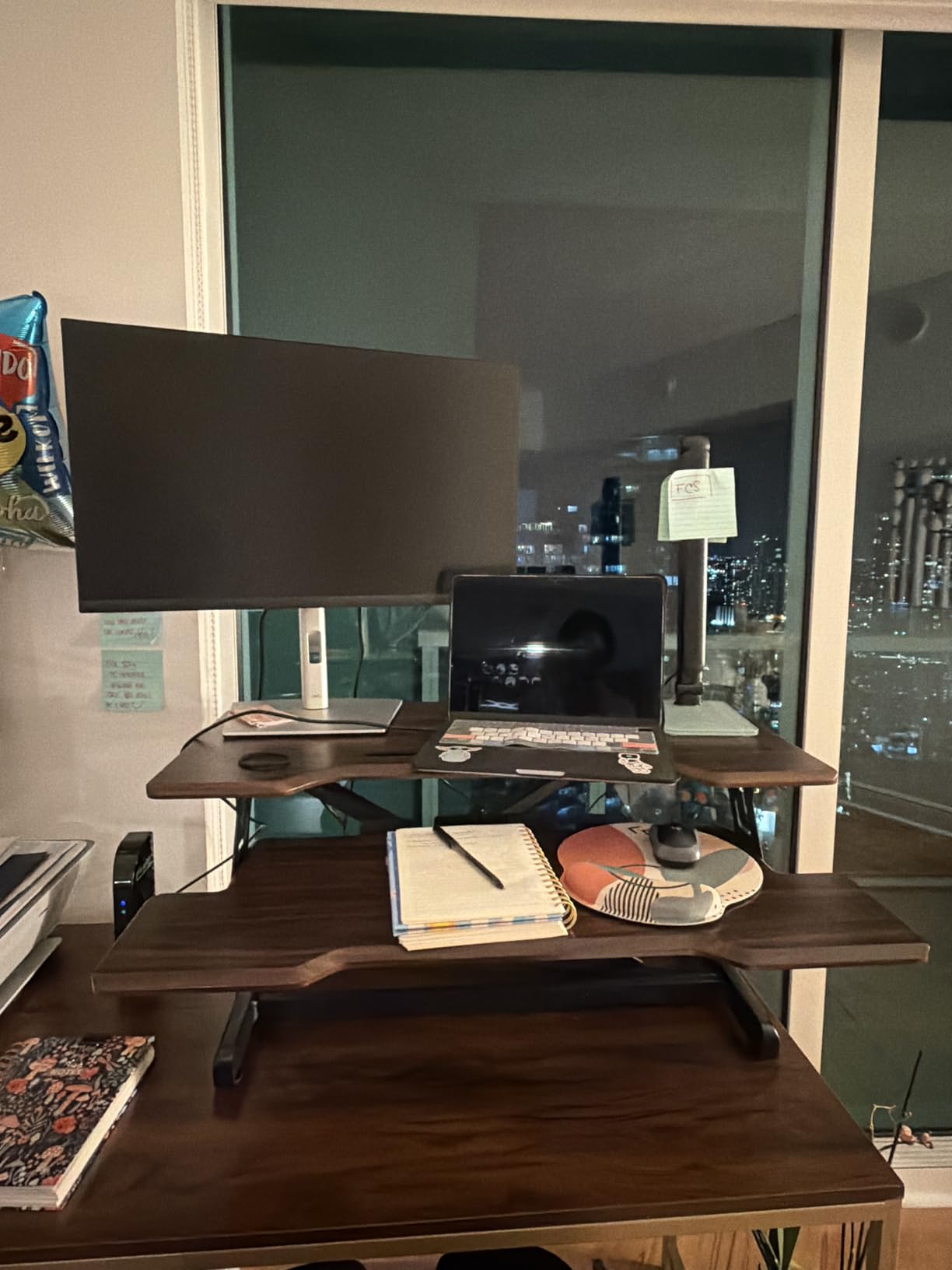
The 33 pound top capacity and 4.4 pound tray capacity are the standard ratings here. A laptop, two 24 inch monitors, a keyboard and a mouse land comfortably inside. Two monitors at 32 inches or larger, plus a monitor arm, will not, and you should look at the 45 pound or 80 pound options instead.
At 4.9 inches minimum and 19.3 inches maximum, this covers the normal range but not the tall end. The 32.5 inch width is comfortable on a standard desk and tight on anything narrower than 34 inches of usable width. Measure your desk before you commit, because the rectangular footprint is unforgiving.
Skip it if you have limited arm strength, since the strong spring works against you in both directions. It is also a poor match for a very shallow desk, and if you plan on a wide tenkey-plus keyboard the tray centering gets awkward.
2.5 inch collapsed height
2.5 to 16.9 in range
Gas spring lift
Preassembled
The 2.5 inch collapsed height is the entire pitch. Almost every other converter in this roundup bottoms out between 4 and 5 inches, which means it permanently occupies a strip of your desk. This one folds down until it is barely a tray, so you can slide it back against the wall and use the whole surface seated.
Just over 330 reviews at 4.6 stars with 80 percent five-star, and owners with neck and back problems consistently credit the riser with reducing pain. The gas spring is quiet and smooth and holds its position without sinking, and the vertical lift path stays put instead of creeping forward. It also arrives fully assembled, so you set it down and work.
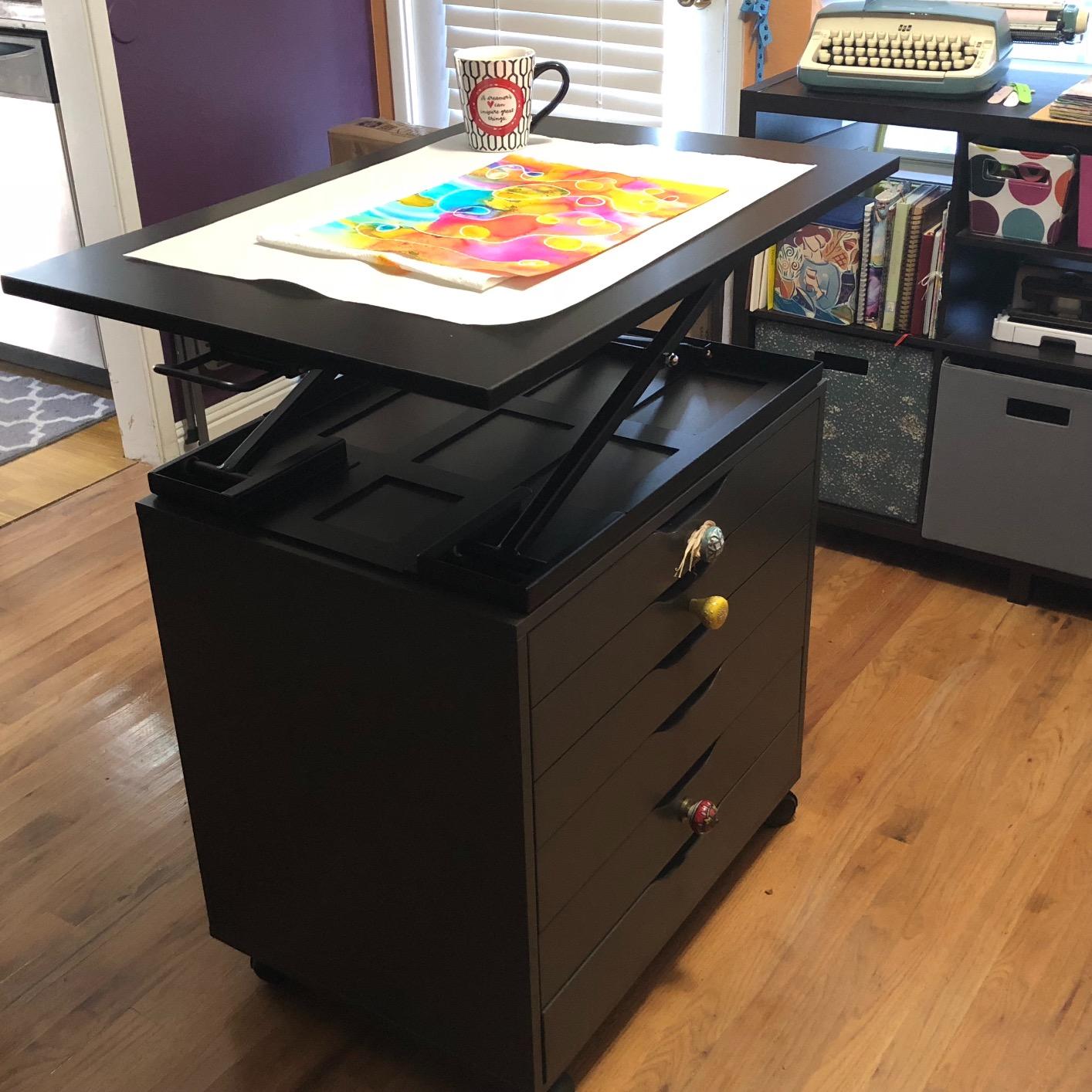
The single-level surface is roomy, fitting a 27 inch monitor, keyboard, mouse and paperwork without crowding. Rubberized feet protect whatever you set it on. In practice this is the unit I would pick for a shared dining table where the desk has to go back to normal every evening.
There is a cost to the slim profile. At 17.3 kilograms, roughly 38 pounds, it is a two-person move, and the first few times you lower it takes real force. The latch also cannot hold the surface a few inches above the bottom because the spring overpowers it, so you get seated height and standing height, not much in between. The 20 pound capacity is also the second lowest here.
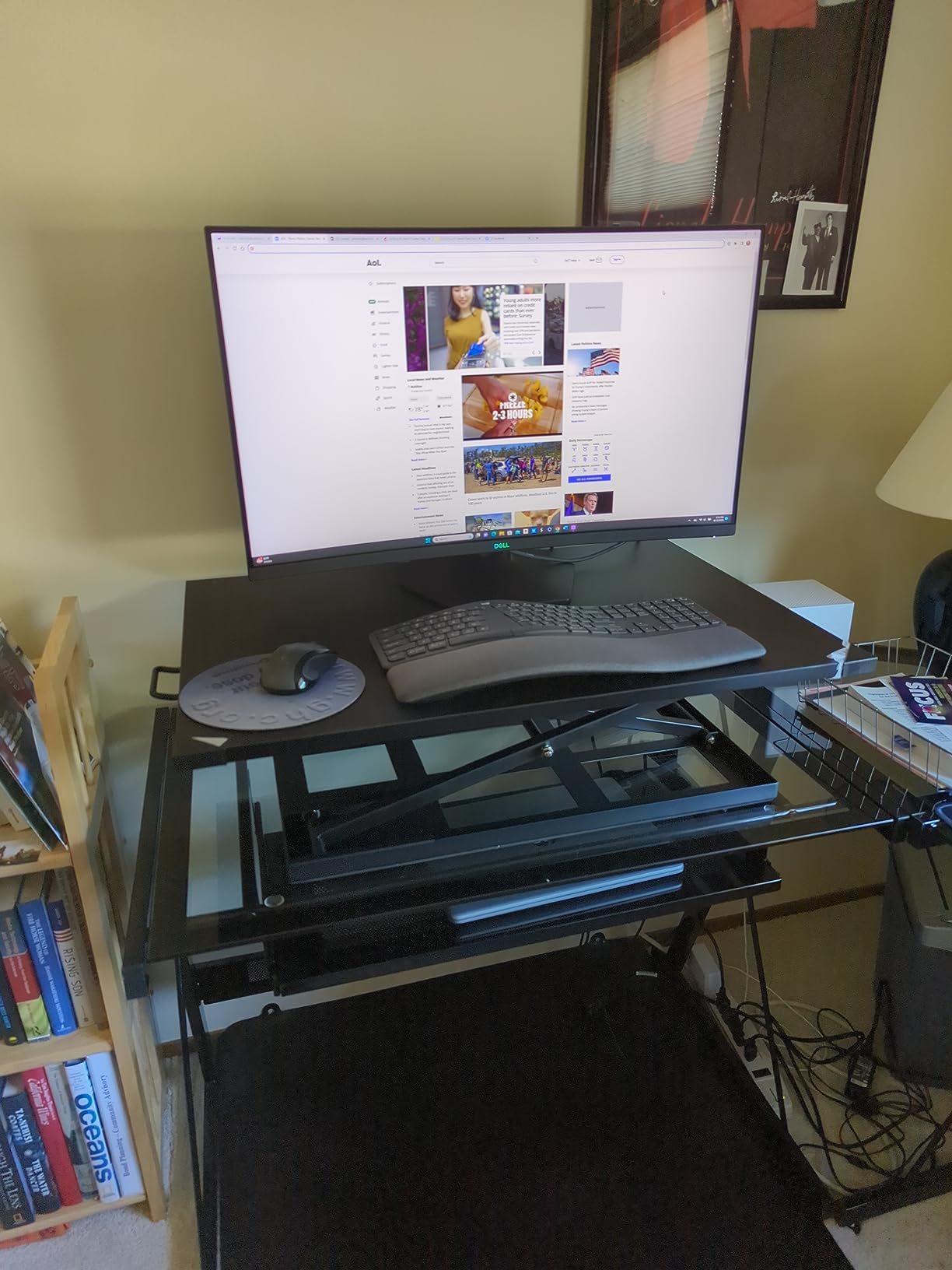
Twenty pounds sounds restrictive until you count. A 16 inch laptop, a 27 inch monitor with a stand, a keyboard and a mouse lands in the high teens, which is inside the limit with almost nothing to spare. A second monitor or a monitor arm pushes you over, and the frame will feel it.
There is no separate tray, so at standing height your keyboard sits on the same plane as your screen. That works fine with a laptop stand raising the screen above the keyboard. It does not work if you plan to type directly on a raised laptop, which is exactly the arm fatigue problem forum users describe repeatedly.
Skip it if you move between rooms often, if you need incremental height positions rather than two stops, or if your load includes more than one monitor. It is also the wrong choice for a desk you need to clear quickly every day, because moving 38 pounds twice a day is a chore you will come to resent.
31.5 by 15.7 inch top
4.9 to 19.3 in range
Removable tray
Most converters in this category are built the same way: a wide top over a keyboard tray, driven by a handle or lever. This one follows that formula with a two-layer layout, and the 4.9 to 19.3 inch range covers the normal working span for most people.
About 270 reviews at 4.5 stars with 75 percent five-star. Owners report noticeable relief from back and neck strain and a smooth low effort lift from the squeeze handle. Two-year owners say it still works perfectly with no sag, which is a durability signal you rarely see mentioned in this class.
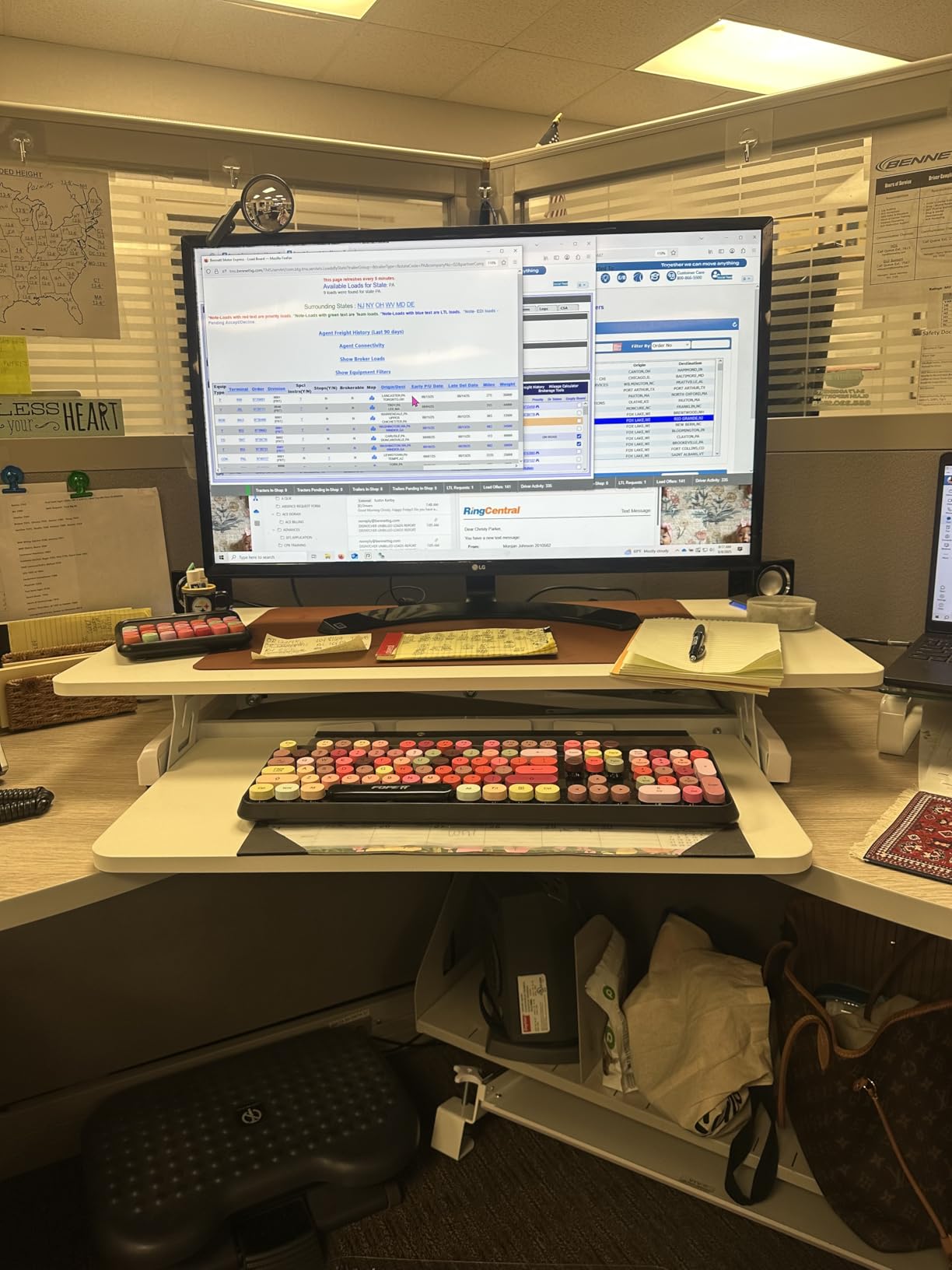
The 31.5 by 15.7 inch top is the same generous footprint as the larger units, so two monitors and a laptop fit without strain. Setup is a two-step keyboard tray install, and once that is done, the frame is rigid enough that typing on the tray produces no meaningful bounce.
The repeated complaint is the fixed keyboard tray. It sits forward of the desk edge permanently and cannot be pulled back, so it occupies desk space even when you are seated with the riser down. A few buyers also mention unclear instructions and unexplained extra hardware, so allow a few extra minutes for setup and check the bag contents against the manual.
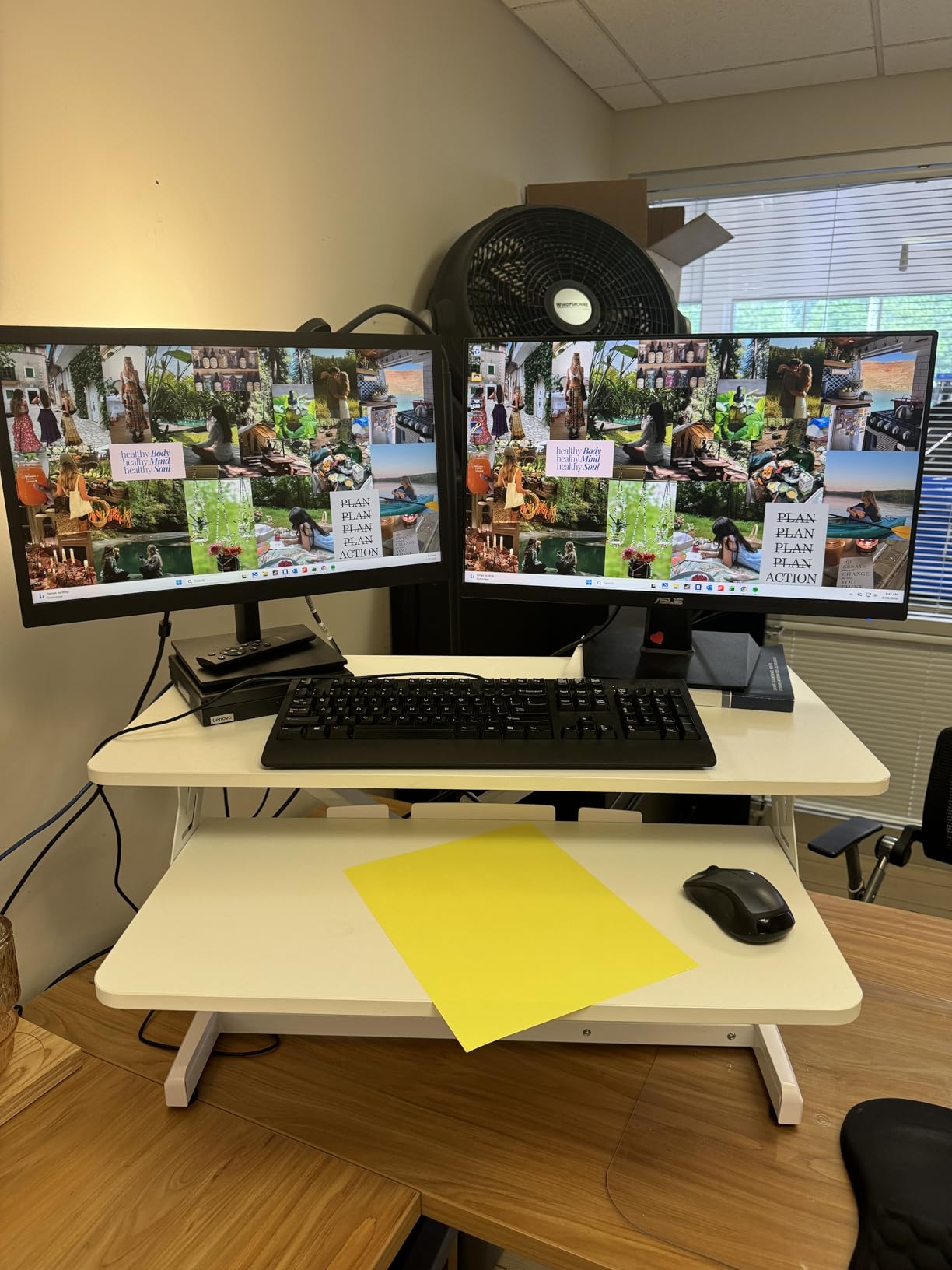
The 4.9 to 19.3 inch range matches the standard for this class, which covers most users up to about 6 foot 2 inches at full standing height. The removable keyboard tray is a small and underused feature: take it out and the frame still raises, which helps if you use a laptop stand with an external keyboard.
Twenty-eight point six pounds on the top and 4.4 pounds on the tray is below the 33 pound norm, and it is built from particle board rather than steel tube. It feels solid in use, but if your load is a laptop plus two large monitors, you are closer to the ceiling than the number suggests.
Skip it if your setup is heavy, if you need the front strip of your desk in the seated position, or if you dislike a white frame on a dark desk. Two-year reports of no sag are encouraging, but the shorter warranty story than the steel-framed VIVO is worth factoring in.
36 inch top
34.5 lb unit weight
33 lb capacity
Steel spring wire lift
The lift mechanism is the story here. Instead of a gas cylinder, this uses a steel spring wire system that raises smoothly and, more importantly, descends slowly and stops rather than slamming into the desk. Owners describe it as controlled and safe, and if you have a pet or small child near the desk edge, that matters.
About 170 reviews at 4.4 stars with 73 percent five-star. The reinforced steel frame with thickened square tubes held a two-monitor setup plus keyboard and mouse without wobble in my testing, and the 36 inch surface gives you room to spread out. Setup is quick since only the keyboard tray needs attaching.
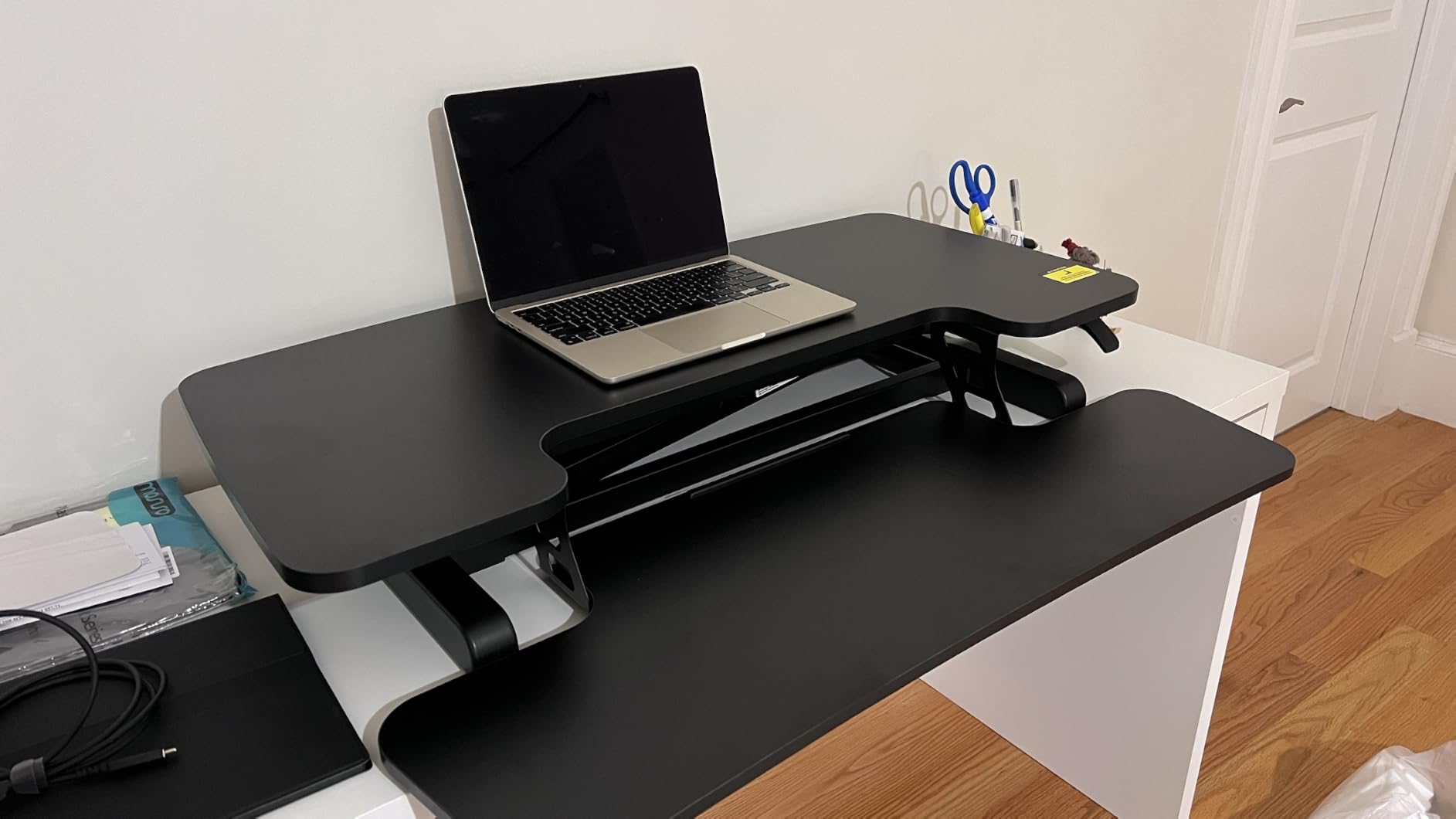
The wood tone and walnut finishes are worth mentioning because they blend with furniture and hide dust far better than black laminate. Against the lighter steel options, this is the one that looks intentional on an open-plan desk.
Weight is the recurring drawback. At 34.5 pounds, a second person is often needed to get it onto the desk. The keyboard tray is all or nothing, meaning it is either attached or fully removed, and the textured wood grain surface is a poor writing surface if you take longhand notes. Some units also arrived with scratches on the top.

Gas springs give a slightly quicker raise. Spring wire gives a more controlled descent and tends to last longer in cheaper units because there is no pressurized cylinder to seal. Over six weeks I could not separate them on the raise, but the difference on the way down was obvious.
At 36 inches this is one of the wider tops here, which suits a laptop plus two monitors with room for a notepad. Check your desk depth against the 24.9 inch footprint before committing, and note that the fixed tray depth can overhang the edge of a smaller desk.
Skip it if you plan to move it between rooms, if you write longhand on the top, or if you want to retract the keyboard tray partially while seated. The weight alone rules it out for shared spaces where the riser gets cleared off the table daily.
25.16 by 15.75 inch top
10 lb unit weight
Manual hand lift
One piece
This is the converter for someone whose entire setup is a laptop and who wants to try standing without committing desk real estate. At 25.16 by 15.75 inches, it fits a 17 inch laptop plus a wireless keyboard and mouse with room to spare, and the compact footprint leaves the rest of the desk completely usable.
Around 150 reviews at 4.5 stars with 71 percent five-star. Buyers consistently call it a simple no-fills sit-stand option that needs no assembly and packs away easily. At 10 pounds it is the lightest unit in this roundup by a wide margin, so moving it between a desk and a dining table takes seconds rather than a second person.
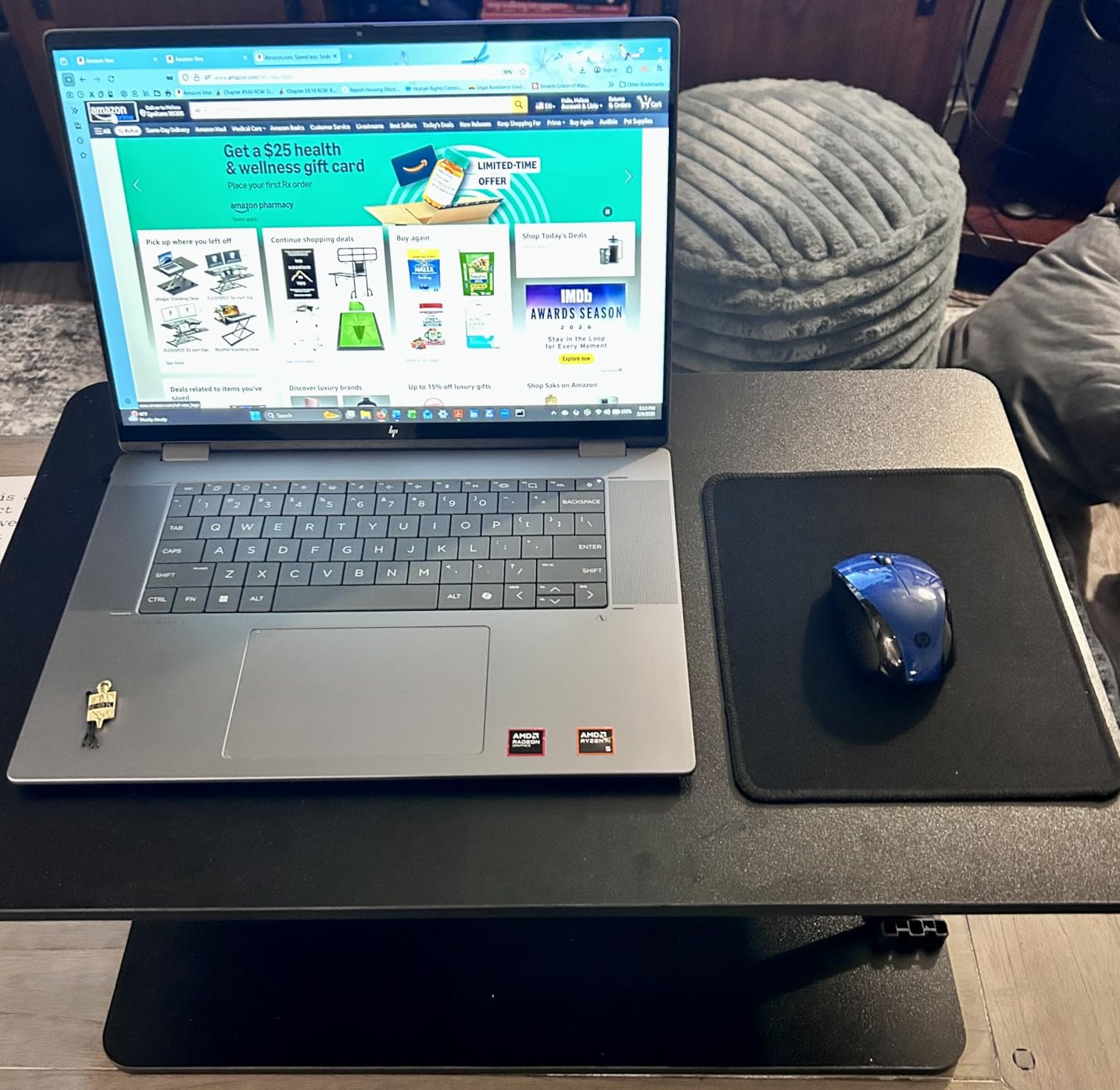
The locking mechanism holds the chosen height firmly, and the height range covers users from roughly 5 foot 7 inches upward with adjustment to spare. The powder coated surface resists scratches, which matters if you are setting it on a nicer desk.
Two limits are worth being direct about. The surface is only large enough for a laptop, so a second monitor is out. And the lowering mechanism is awkward, with one reviewer flagging a finger trap risk at the lever, so keep your fingers clear when you push it down and take your time learning the motion.
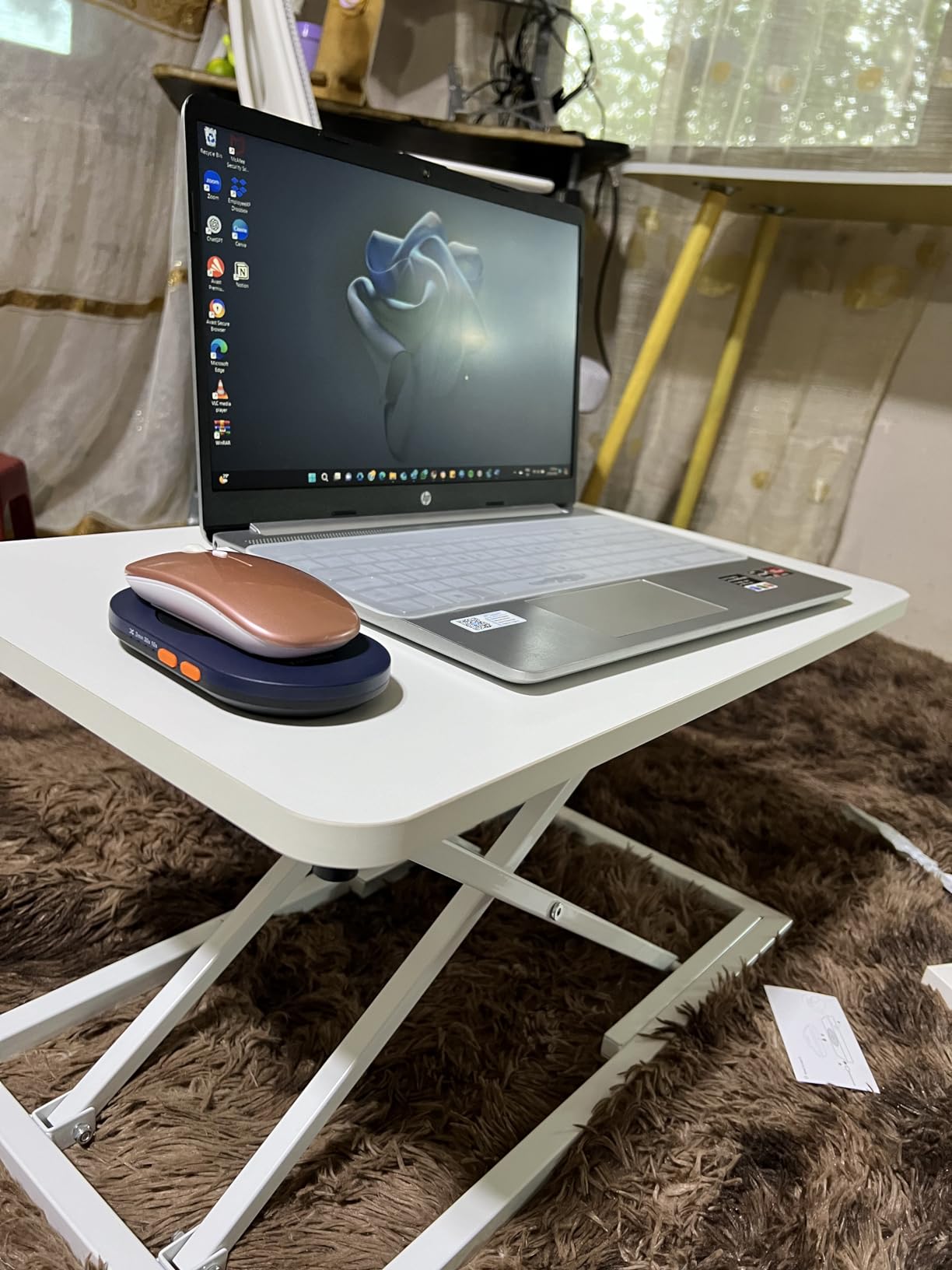
If you work from one laptop, use a compact keyboard, and want a low-risk first step into standing, this covers the whole job. It also works well for someone who hot-desks and needs something that stows in seconds. The tradeoff is that you are buying height adjustment without any capacity for expansion.
Because it has a single level and no tray, the seated position is simply the unit sitting on your desk, and the raised position puts the laptop at standing elbow height. With an external keyboard on the desk, that geometry is correct. Typing on the laptop keyboard at that height is not, and your shoulders will tell you so within an hour.
Skip it if you use a laptop alone with no external keyboard, if you need a monitor, or if you are fine with a larger fixed-height riser that you will rarely move. Anyone sensitive about pinch points should also look at a gas spring design, where the moving parts are enclosed in a cylinder.
26.4 by 18.5 inch top
Five lockable heights
1.8 in resting position
Here is the tension most laptop converters hide: a laptop alone needs almost no surface, but a laptop plus an external keyboard, mouse and monitor needs a lot. This unit resolves it in a 26.4 inch footprint, which is narrow enough for a small apartment desk and shallow enough to leave your writing space intact in the seated position.
With 856 reviews at 4.7 stars and 85 percent five-star, this is the highest-rated product we tested. The praise centers on the five precise lockable settings at 8.5, 10.4, 12, 14.4 and 15.9 inches, which let you stop exactly at eye level instead of guessing between two extremes, plus a 1.8 inch resting height for stowing.
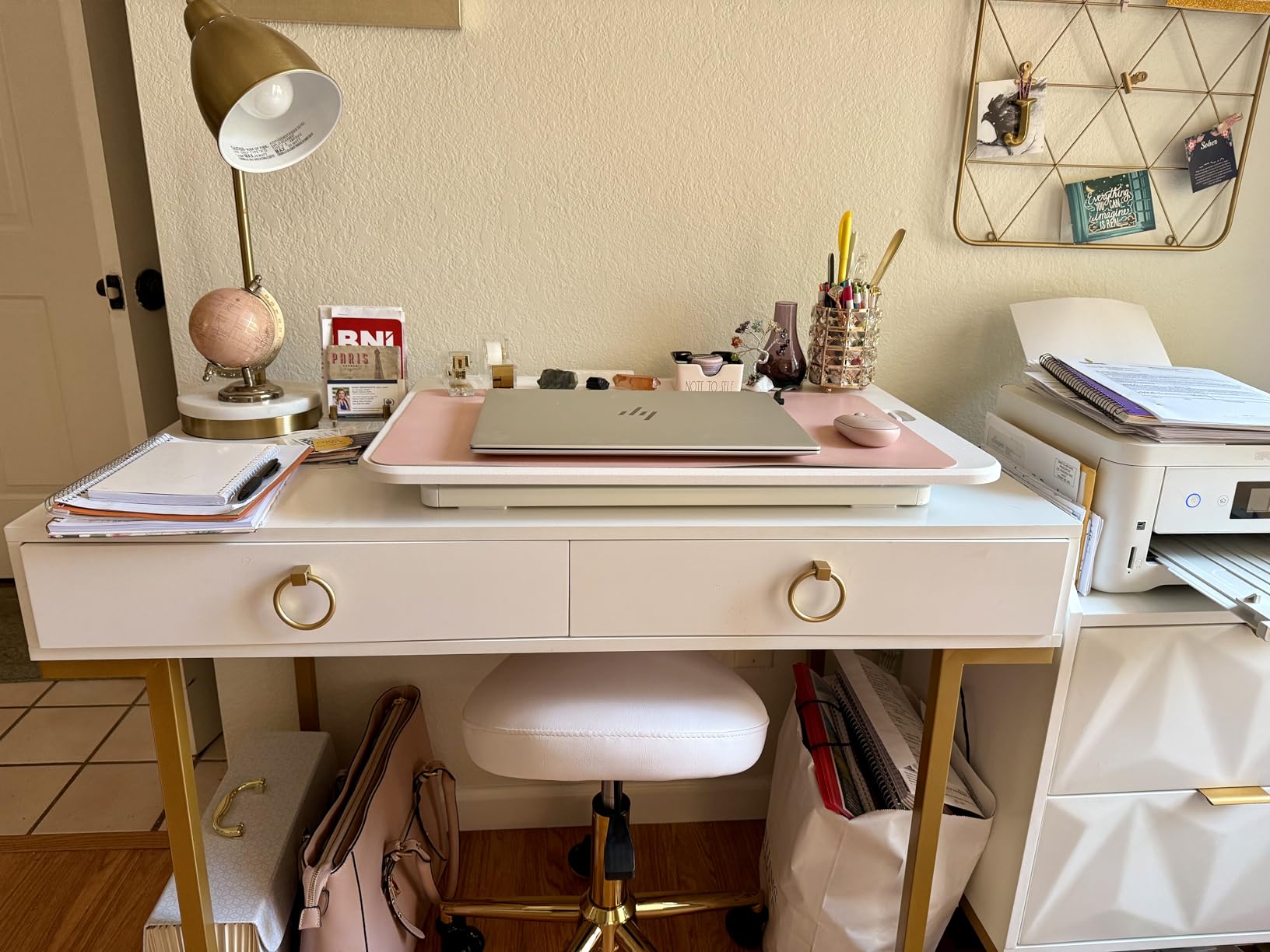
It is preassembled, so you are working within seconds of unboxing, and the handle-based change takes a single squeeze. At 17 pounds it is the lightest of the wide-frame risers here, which makes it far easier to relocate than the 34 and 42 pound units in this roundup.
The 17.6 pound load capacity is the lowest of any product here, and that is not an oversight. It is a laptop or single-monitor solution, and reviewers are clear about that. With two monitors there is simply not enough width. There is also no separate keyboard tray, so you need an external keyboard on the desk surface to type comfortably while raised.
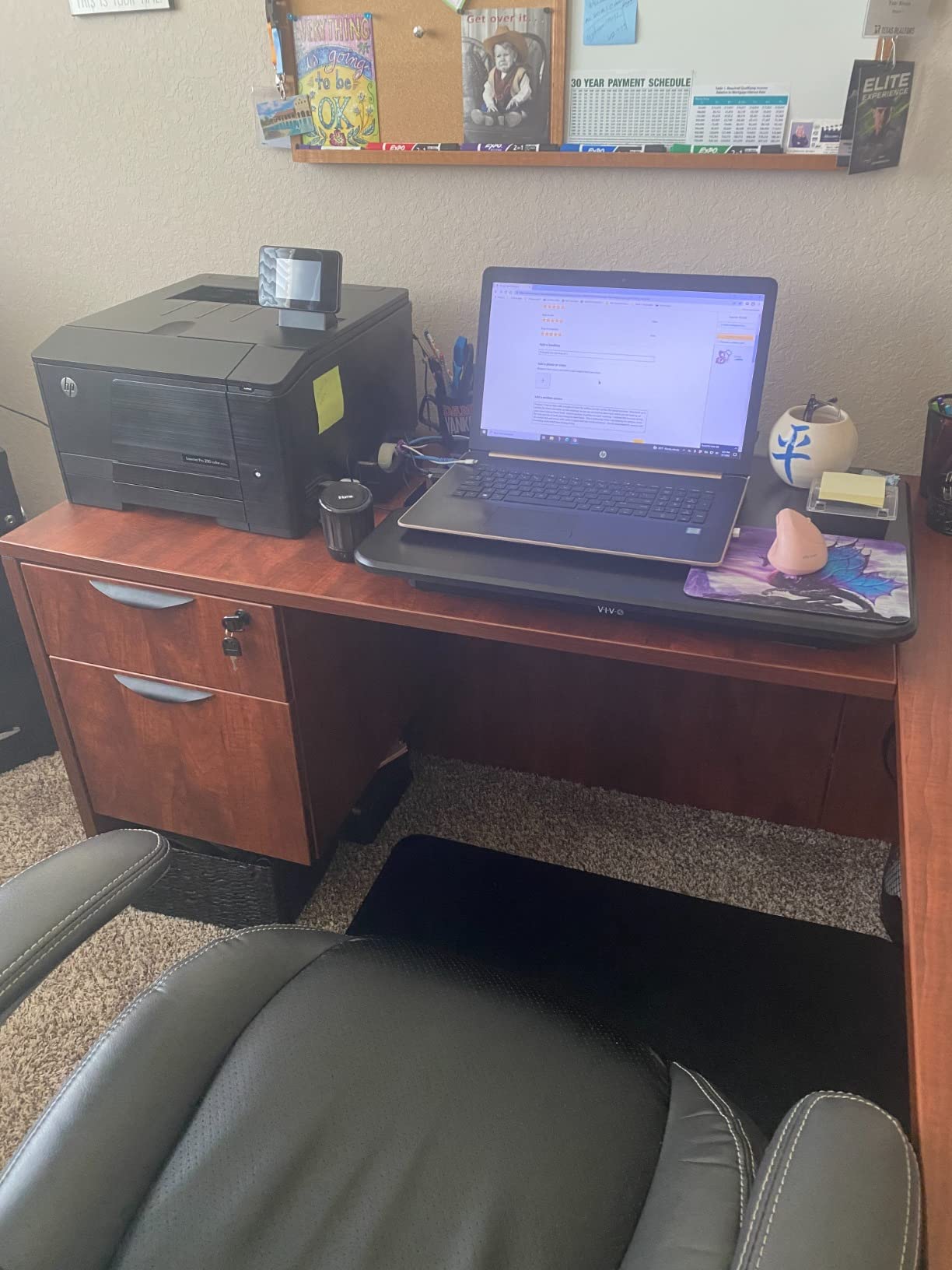
Five discrete stops beat one long throw for most people, because you stop repeating the same motion every morning. The trade-off is granularity: if your ideal standing elbow height falls between two stops, you will live with the nearest one or add a laptop stand to fine-tune the screen.
A 16 inch laptop is roughly 5 pounds, a 27 inch monitor with a stand around 12, a keyboard 2 to 3, and a mouse under a pound. That totals around 20 pounds, which is already past the rating. For a laptop plus a light external keyboard and a single monitor, a smaller screen or a monitor without a heavy base brings you inside the limit.
Skip it for dual monitors, for a laptop used as a desktop replacement with two large screens, or if you want a keyboard tray. It is also not the right answer if you want a continuously variable lift, because five stops is a narrower tool than a gas spring handle.
1.2 to 20 inch screen height
22 lb capacity
4.2 lb weight
Two pivots
With over 8,300 reviews at 4.7 stars, this is one of the two most reviewed products in the roundup, and one of the few where you can trust the feedback almost unconditionally. It does one job: it brings a laptop screen to eye level while you stand, and it does it across a 1.2 to 20 inch range, which is the widest screen adjustment of any stand here.
The reason it belongs in a standing desk converter guide is that it solves the same problem as a riser for a much smaller footprint. Forum regulars in home office and ergonomics threads repeatedly recommend pairing a laptop with an external keyboard and mouse rather than typing on a raised screen, and this stand makes that pairing possible: screen up, keyboard and mouse stay flat on your desk.
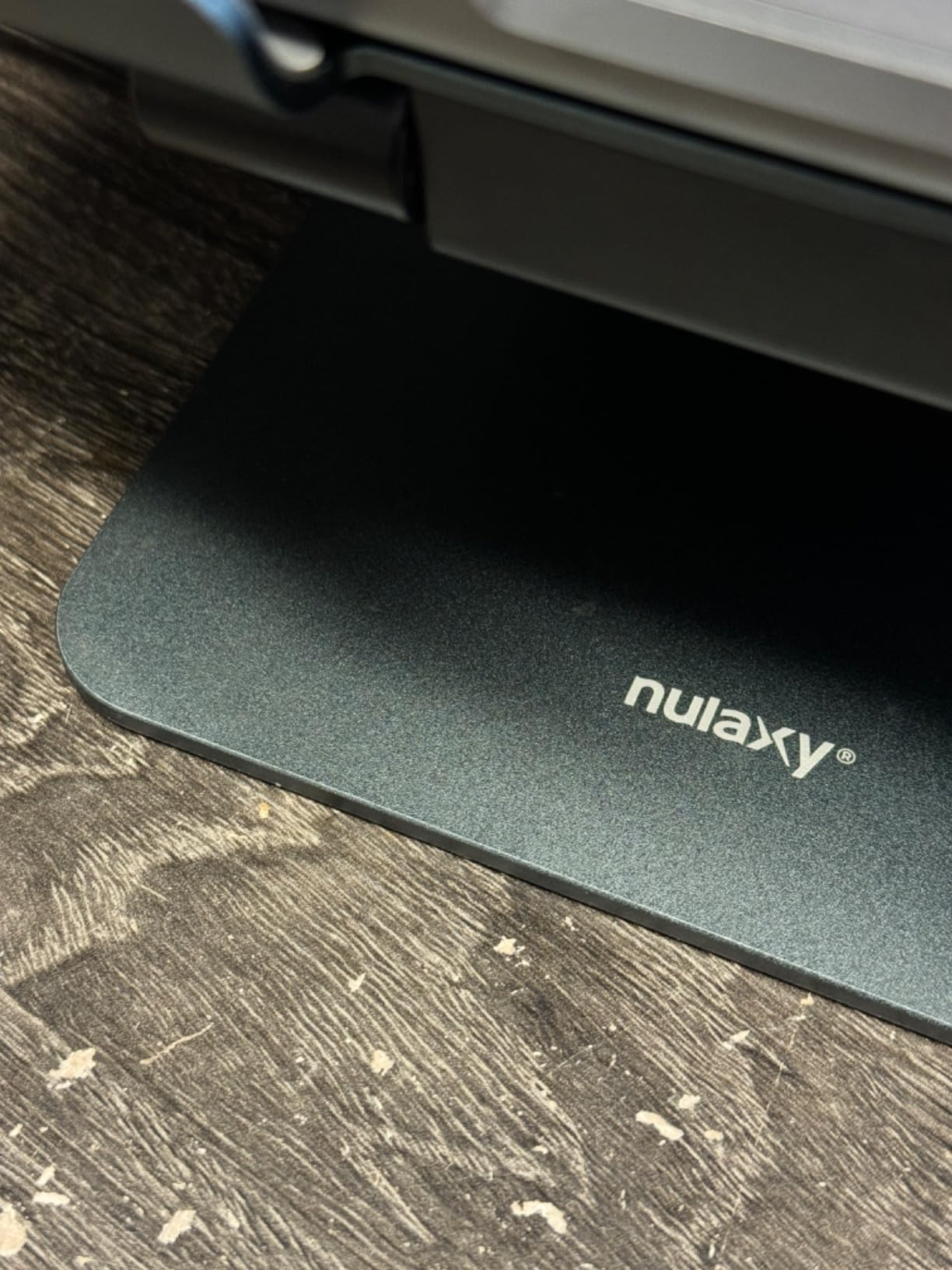
Build quality is what the rating reflects. Rubber pads and two pivot joints keep a loaded machine steady while you type, and the vented aluminum panel lets a hot laptop shed heat, which is a real concern if you stand and work for hours. At 4.2 pounds it moves between rooms or a coworking table without any thought.
The limits are about scope, not quality. It carries a laptop and nothing more, so any external monitor, keyboard or mouse has to live on the desk surface. The pull handle can rock or creak at certain angles, and because there is no lock you readjust the height every time you switch between sitting and standing.
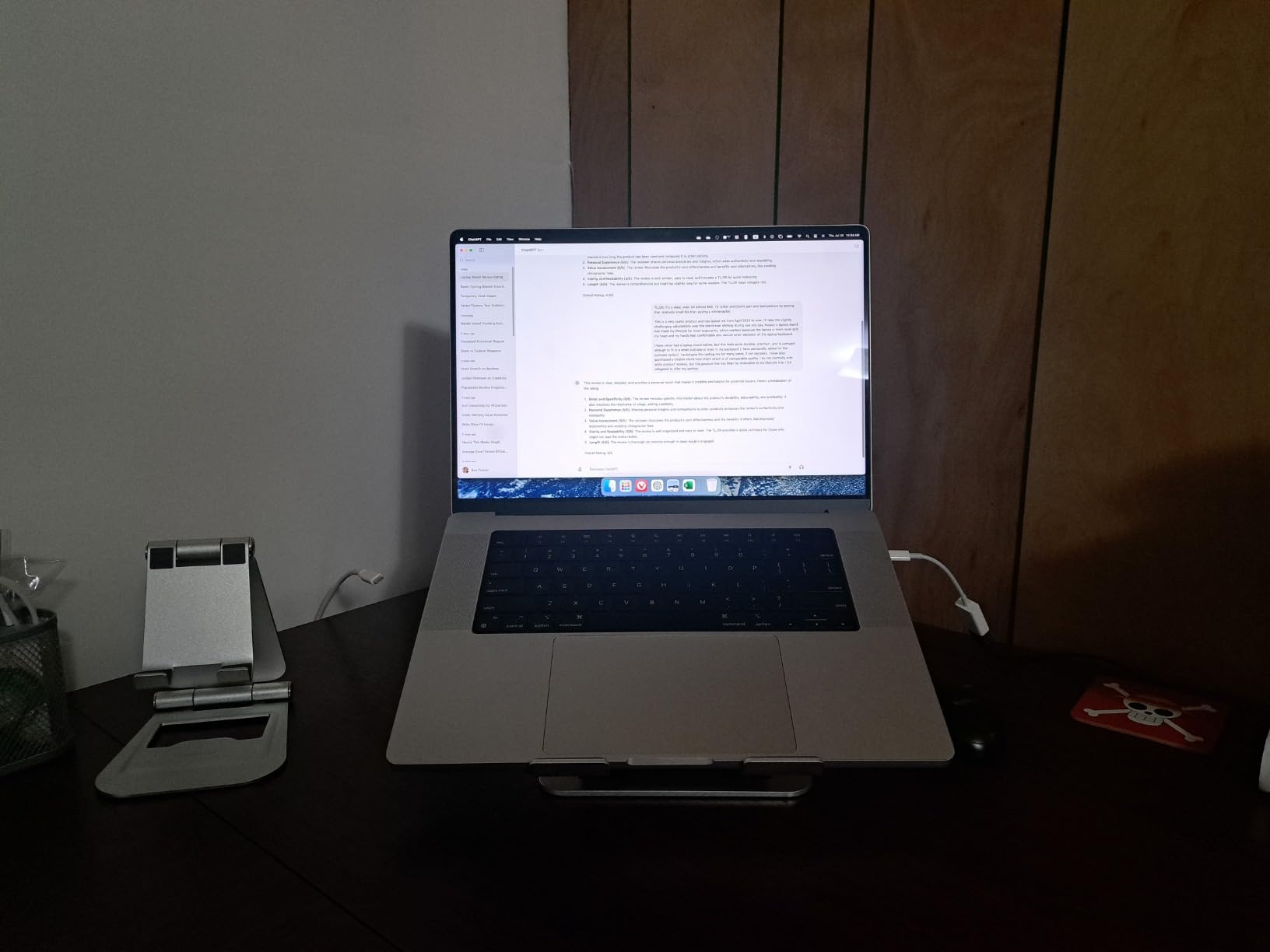
A stand raises only the screen. A converter raises the whole work surface. That difference decides the ergonomics. With a stand, your keyboard stays on the desk at seated height, so your elbows are relaxed while your neck is neutral, which is the combination that lets you work standing without shoulder pain. A converter without an external keyboard puts your keyboard at standing height and your elbows at your sides, which is where fatigue starts.
Place the stand on your desk, raise the laptop screen to just below eye level, and keep a compact wireless keyboard and mouse on the desk in front of it. Check the vent holes are clear, and adjust the tilt so the top of the screen is slightly below your eye line rather than above it. This setup costs a fraction of a full converter and works in coworking spaces and cafes.
Skip it if you need desk real estate for a monitor or documents, or if you want one product to raise your entire setup. People who switch positions often may find the lack of a lock mildly annoying, and anyone typing directly on the laptop at standing height should not use it that way.
9.9 to 20.5 inch height
44 lb capacity
6 lb weight
18 degree fixed tilt
At 6 pounds this is one of the lightest ways to get a laptop to standing eye level, and the walnut tone is the reason it looks at home in a living room or a bedroom office rather than looking like office equipment. If your standing work happens in two places, carrying this between them is a non-event.
About 410 reviews at 4.4 stars with 70 percent five-star. Buyers like the finish, the light weight, and a genuinely solid dual aluminum frame rated to 44 pounds that does not wobble. The press buttons on both sides mean you can change height from a seated or standing position without walking around the desk, which is a small design decision that gets used constantly.
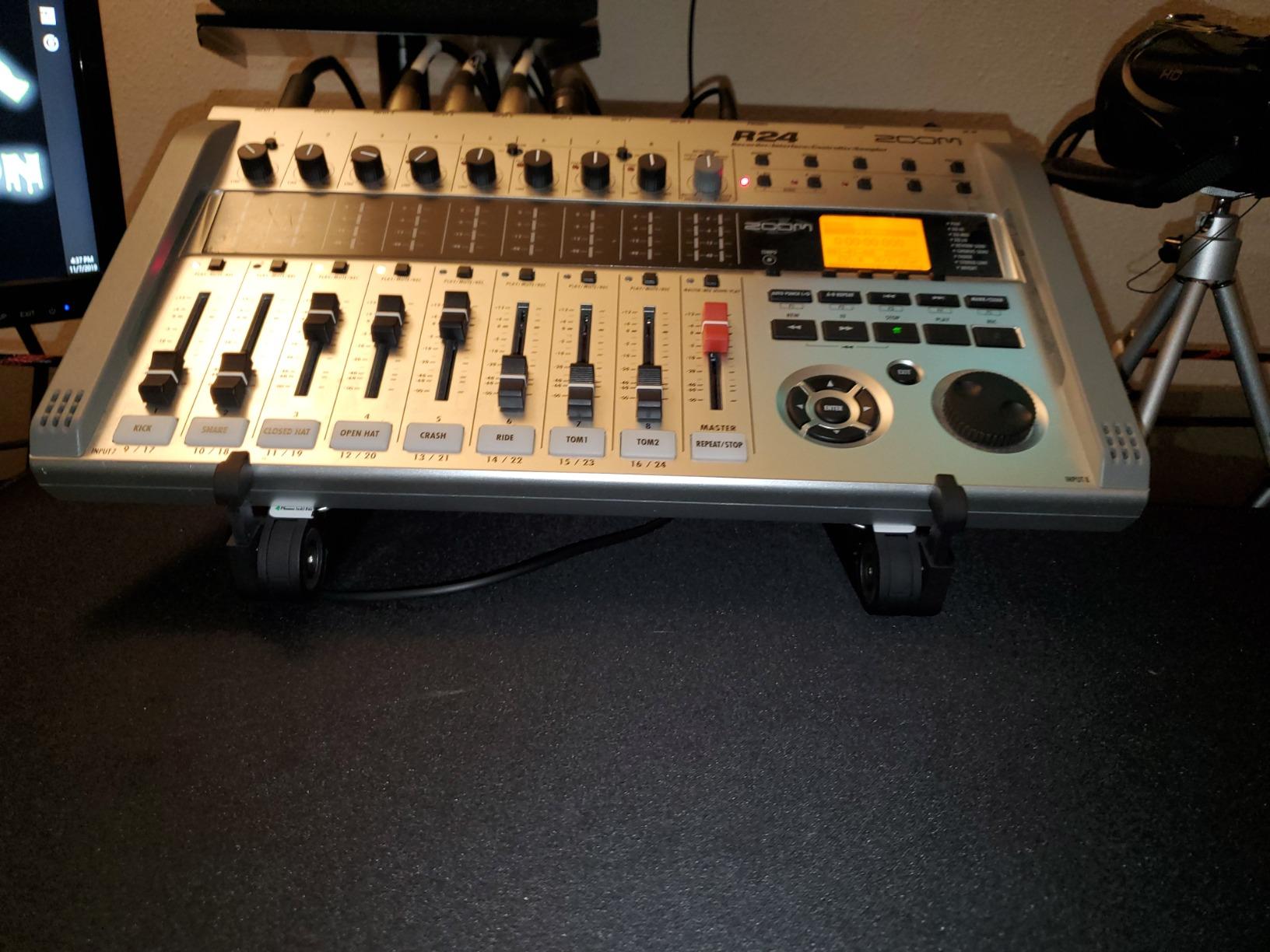
Height adjustment runs from 9.9 to 20.5 inches, and six silicone pads grip the desktop without scratching it. There is a foldable mouse pad built into the base, which sounds minor until you are standing and realize you have nowhere to put your mouse.
The constraints are size and function. The top panel measures 10.6 by 13.58 inches, so it carries a laptop and nothing more, and the 18 degree tilt is fixed with no way to change it for your viewing angle. There is also little side clearance for an external monitor at some angles, and the 9.9 inch minimum means it cannot drop flush to a desk surface when you sit.
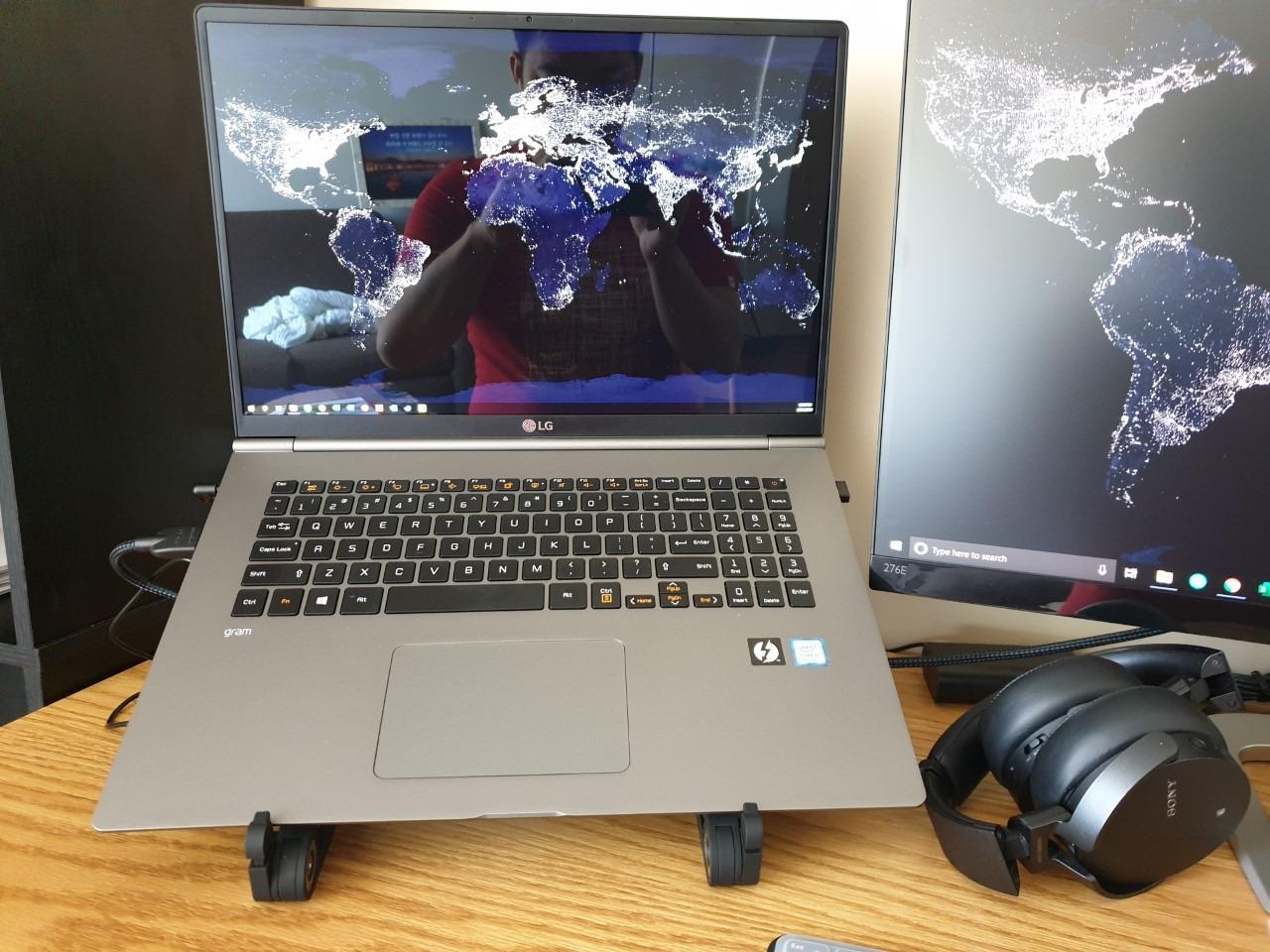
The 20.5 inch maximum gives taller users more screen height than most laptop stands, which is a real advantage if you are over 6 feet. The 9.9 inch minimum is the mirror problem: when you sit, this stand is still 9.9 inches tall, so it is a permanent fixture on your desk rather than something that folds away.
That rating is a frame spec, not a practical limit, since a laptop is 3 to 7 pounds. Read it as reassurance about build quality rather than a reason to stack equipment on the panel. The dual aluminum alloy supports and widened base are what keep it firm while you type at height.
Skip it if you need the stand to fold flat or drop to desk level when seated, if you want an adjustable tilt for different seats and lighting, or if you plan to add an external monitor. For a fixed spot at standing height in one room, it performs well.
Buy a converter when you want standing access on a desk you already own, rent, or share; buy a full electric standing desk when you sit and stand eight or more hours a day and want your entire surface to move as one unit. A converter is faster to buy, cheaper to move between rooms, and works on a surface you cannot drill. A full desk gives you continuous adjustment, no lift effort, and the freedom to move monitors, keyboard and everything else together.
The math that decides it is time, not money. If you expect to stand two or three hours a week, a converter is the right tool and an electric desk will sit unused. If standing is half your workday, the lift effort of a manual riser becomes a daily tax, and the electric unit on this list pays for itself in saved effort alone.
Two situations push toward the full desk. The first is a heavy multi-monitor arm, which changes load dynamics in ways a converter’s rating does not capture. The second is a permanently assigned desk where you never need the space back. Everything else, including shared dining tables and rentals, favors the converter.
The 20-8-2 rule is a guideline for alternating sitting and standing: roughly 20 minutes standing, 8 minutes sitting, and 2 minutes moving or changing position, repeated through the working day. It appears as a People Also Ask question constantly and almost no competitor explains it in body copy, so here is the breakdown.
The reason alternation beats either extreme is that both long static sitting and long static standing carry their own risks. Standing all day on a hard floor loads your feet, knees and lower back in ways sitting does not. The 20-8-2 rhythm keeps both systems moving, which is also why a converter beats a fixed standing desk if you are not going to commit to a full change of furniture.
One caution belongs here. Health guidance on prolonged standing is genuinely mixed, and the honest summary is that switching positions beats picking one and holding it. If you have a history of lower back or vascular problems, talk to a clinician before committing to hours on your feet.
Most laptop setups fail ergonomically for one reason: the screen and the keyboard get raised together, so your neck goes up and your arms go up, or your neck stays down and your arms go up. Neither is sustainable for a full day. The fix is to separate the two heights, and here is the recipe.
For a laptop-only setup: put a laptop stand on the desk, keep a compact wireless keyboard and mouse on the desk surface, and raise the screen to just under eye level. The Nulaxy pull-out stand and the SAIJI stand both do this job, and neither requires you to clear desk space for a full riser.
For a laptop plus an external monitor: put the monitor on the raised shelf and the laptop on a small stand beside it at matching height, with the keyboard on a lower tier or on the desk. This is the configuration the two-tier designs, including the VERSADESK, are built for, and it keeps both screens at the same eye line instead of one high and one low.
The weight math matters here, and it is simpler than most spec sheets make it. A 16 inch laptop is roughly 5 pounds, a 27 inch monitor with a stand around 12, a full-size keyboard 2 to 3, a mouse under 1, and a hub or dock under 1. That is about 21 pounds, which sits inside the 33 pound ratings most 32 inch risers carry, but leaves little room for a second monitor. Two large monitors plus a laptop pushes you into the 45 pound and 80 pound units on this list.
Height fit is the other half of the equation. Most converters in this roundup top out between 16.9 and 20 inches, which suits users up to about 6 foot 2 inches. If you are under 5 foot 11 inches, even the lowest convertible position may sit above your seated elbow height, and a footrest solves the seated problem while you adjust the chair for the standing one. If you are over 6 foot 2 inches, check the maximum height against your own standing elbow line before you buy, because a riser that cannot reach your elbow will leave you hunching.
Full converters with a keyboard tray, single-level risers with no tray, compact laptop risers, floating post-and-tray designs, and electric units are five different products. For a laptop user, a two-tier or tray-style full converter is right if you have peripherals, a single-level riser is right if you type on an external keyboard, and a compact laptop riser or stand is right if you carry nothing but the laptop.
Look at two numbers, not one. The maximum tells you whether you can reach standing elbow height. The minimum tells you whether the unit can get out of the way when you sit, and that is where most people discover a problem, because 4 to 5 inch minimums eat a strip of desk. Anything under 3 inches when collapsed, like the Mount-It!, solves this best.
Add up your actual setup rather than trusting the number. Count the laptop, every monitor including its stand, the keyboard, the mouse, and any dock. Add roughly 20 percent margin. Anything at 17 pounds is a single-laptop or single-monitor product by definition, and 33 pounds is the practical floor for a laptop plus two monitors.
A 26 inch top fits a laptop, one monitor and a keyboard. A 32 inch top is the standard for two monitors and a laptop. A 36 inch top gives breathing room, and 45 inches is a workstation. Depth matters just as much: 15 to 16 inches pushes a 27 inch screen to a comfortable distance, and anything shallower will crowd your face. You also need enough desk depth for the riser footprint plus your chair, so measure before you order.
Manual gas spring lifts are fast, cheap, and need no power. Electric lifts remove effort entirely and add a motor, a cord, and a failure mode. Floating post and tray designs move the screen separately from the keyboard, which is the best ergonomics available and the most complex to assemble. Choose electric if you switch many times a day or have any physical limitation, and manual if you do not.
Steel frames with a 2 to 3 year warranty outlast particle board and 1 year warranties, and you can feel the difference in tray flex while typing. Look for a grommet hole for cables and check the mechanism for exposed pinch points, particularly on designs where a lever closes directly on your fingers. Reviewers of several units here report both issues.
Buy a converter when you want standing access on a desk you already own, rent, or share, and expect to stand a few hours a week. Buy a full electric standing desk when you sit and stand eight or more hours daily and want your whole surface to move together with no lift effort. A converter costs less, moves between rooms easily, and needs no drilling.
The 20-8-2 rule is a guideline for alternating positions during the workday: about 20 minutes standing, 8 minutes sitting, and 2 minutes moving or changing position. Alternating beats either extreme because long static sitting and long static standing each carry their own risks. Treat it as a starting rhythm and adjust to what your body tolerates.
A sit-stand setup is good for ergonomics when you alternate between positions rather than standing for long unbroken stretches. Standing for hours on a hard surface loads your feet, knees, and lower back, so the real benefit comes from movement. The best results come from a raised screen at eye level with your keyboard and mouse kept lower and closer to your body.
For a laptop-only portable setup, the Nulaxy pull-out stand raises the screen from 1.2 to 20 inches, weighs 4.2 pounds, and folds flat for travel. If you need a small surface that raises a laptop plus a wireless keyboard and mouse, the yoopin 25 inch converter arrives fully assembled at 10 pounds. Neither carries a monitor, so plan for the desk surface.
A converter gives you standing access on a desk you already own, which means no replacing furniture and no drilling into a rental. It folds or lowers away so the surface is usable again when seated. It costs far less than a full electric standing desk, moves between rooms, and works on any sturdy tabletop. It also lets you change position without rearranging your whole workspace.
If you want one product that handles a laptop plus monitors with the least compromise, the VIVO DESK-V000K is our choice. It has the deepest owner feedback in this roundup, a 31.5 inch top with a matching keyboard tray, a 4.5 inch minimum that gets out of the way, and a steel frame that never flexed during our testing.
If you value monitor distance and want more desk for less money, the TechOrbits 32 inch wins on depth and value. If you need three screens, the Rocelco 46 inch is the only one wide enough, and its retractable tray is the best elbow position in the group. If lifting by hand is a problem, the VERSADESK PowerPro 36 inch takes the effort out of the equation entirely.
If your setup is a laptop and nothing else, skip the risers and get the Nulaxy pull-out stand. Raise the screen, keep the keyboard on the desk, and you get the ergonomic benefit without giving up desk space. The SAIJI stand does the same job in walnut for anyone who wants it to look like furniture.
Whichever route you take, the setup matters more than the model. Put the screen at eye level, keep the keyboard and mouse low and close, alternate positions rather than holding one all day, and give yourself a footrest if you are on the shorter side. And once the desk is dialed in, our picks for the best executive desk toys are a reasonable next step for the standing breaks in between.
Check the current details for any of these before you commit, and use the 20-8-2 rhythm as your starting point in 2026.