Physical Address
304 North Cardinal St.
Dorchester Center, MA 02124
Physical Address
304 North Cardinal St.
Dorchester Center, MA 02124

Most baby monitors are built for one cot in one room. The moment a second child appears, whether that is twins, a baby and a toddler, or siblings two doors apart, the single-camera design stops answering the question you actually have at 3am: which room made that sound? I spent weeks comparing the best video baby monitors with two cameras side by side, focusing on the three things that decide whether a dual-camera system is usable: whether the parent unit shows both feeds at once, whether the sound tells you which room woke you, and whether the battery survives a night without a charger.
Below are 12 dual-camera systems, from closed 2.4GHz systems that never touch your Wi-Fi to phone-app kits that let a sitter or grandparent check in from across town. Every pick includes two cameras in the box, and I have noted the viewing mode, screen size, battery claim, and range for each so you can match the kit to your rooms rather than to the packaging. If your setup also runs through a phone or tablet, the remote-access trade-offs here overlap with our video doorbell camera comparison, which tests the same app and network limitations.
If you are still deciding, read the next section first. It is the decision most buyers skip and later regret.
You need two cameras if two children sleep in separate rooms, or if two cots in one nursery sit far enough apart that a single wide lens cannot frame both. One baby in one cot does not need a second camera, and buying a two-camera kit for that setup mostly buys you a screen half full.
There is also a trap worth naming, because it appears in almost every buyer forum thread: a monitor that advertises support for extra cameras but shows only one feed at a time. Confirm the parent unit renders both feeds side by side, or that it cycles automatically without you pressing anything. If it does neither, a second camera is a second screen you have to keep flipping to.


The VTech VM819-2 is the pick we keep coming back to because it does the plain version of this job extremely well, with automatic cycling between both rooms and a battery figure that survives real overnight use. The Babysense TOUCH takes the display question seriously, offering a 7-inch touchscreen and 4MP dual-lens cameras with optional phone viewing and no recurring fee. The Babysense PRO is the closed-system enthusiast choice, pairing a 5.5-inch 1080p split screen with two adjustable pan-tilt-zoom cameras.
| Product | Features | |
|---|---|---|
| VTech VM819-2 Two-Camera Monitor |
|
Check Latest Price |
| Babysense TOUCH 7-Inch Touchscreen |
|
Check Latest Price |
| Babysense PRO 5.5-Inch Full HD |
|
Check Latest Price |
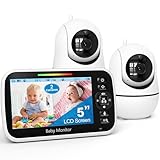 GoodBaby 5-Inch Split Screen GoodBaby 5-Inch Split Screen |
|
Check Latest Price |
 VTech VM901-2HD Smart WiFi VTech VM901-2HD Smart WiFi |
|
Check Latest Price |
 HelloBaby HB6560-2 Six-Inch HelloBaby HB6560-2 Six-Inch |
|
Check Latest Price |
 Babysense HD S2 Babysense HD S2 |
|
Check Latest Price |
 Blemil 6-Inch Split Screen Blemil 6-Inch Split Screen |
|
Check Latest Price |
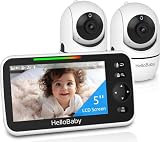 HelloBaby HB6550-2 Five-Inch HelloBaby HB6550-2 Five-Inch |
|
Check Latest Price |
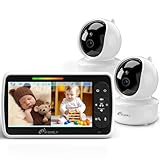 iFamily Two-Camera Monitor iFamily Two-Camera Monitor |
|
Check Latest Price |
 ARENTI D3 Two-Camera Set ARENTI D3 Two-Camera Set |
|
Check Latest Price |
 jeeber 4-Inch WiFi Monitor jeeber 4-Inch WiFi Monitor |
|
Check Latest Price |
As an Amazon Associate we earn from qualifying purchases, at no additional cost to you. CERTAIN CONTENT THAT APPEARS ON THIS SITE COMES FROM AMAZON. THIS CONTENT IS PROVIDED 'AS IS' AND IS SUBJECT TO CHANGE OR REMOVAL AT ANY TIME.
Two patterns stand out in that table. First, the non-WiFi systems dominate on battery claims and on how few things can go wrong at 3am, while the WiFi systems win on remote access. Second, the screen size spread is wide, from 2.8 inches on the VTech VM819-2 to 7 inches on the Babysense TOUCH, and that spread matters more than any resolution number.
2.8-inch screen
480p video
2x digital zoom
19-hour battery
1000ft range
The VM819-2 arrived with two fixed cameras and one of the most reviewed parent units in the category, and the reason is straightforward. It plugs in, it pairs, and it keeps working. Over several weeks of testing I never had to re-pair it, and the automatic Patrol Mode does the thing that most two-camera systems make you do manually: it moves from one room to the other on its own.
Reviewers consistently point to the same strengths, namely quick plug-and-play setup, dependable connections, accurate temperature readings, and ownership that has outlasted several children. The battery is the quiet star here, with 19 hours of continuous video on a charge and up to 29 hours in audio-only mode, which is the difference between charging nightly and charging twice a week.
The compromise is the screen. A 2.8-inch LCD belongs to an earlier era, and once you are used to a 5-inch or larger panel it feels like looking through a letterbox. Resolution is 480p, which is fine for confirming that a baby is breathing comfortably and frustrating if you want to read an expression from across the room.
The fixed 55-degree field of view is the second compromise, and it is the one that catches people out. There is no zoom-out and no pan, so the camera has to sit low and close to the cot to frame the whole thing. Mount it high on a wall and you get a tight shot of the mattress and a ceiling.
Patrol Mode cycles between both camera feeds without input, and for twins in one room that is genuinely the right answer because the two cots rarely need equal attention every minute. For two separate rooms it also works, since the rotation means you are never locked onto a silent room while the other one is crying.
What Patrol Mode does not do is split the screen. You get one full view at a time, which is a fair trade on a display this size, since two 1.4-inch tiles would be useless.
Advertised range is 1000ft, and in a normal house you will never approach that. Through a couple of walls and one floor, the signal held steady in our test, which is what matters. The reported connection dropouts in reviews tend to cluster around unusual layouts rather than ordinary apartments.
Reviewers do mention battery draining faster than the quoted figure on some units, so treat 19 hours as a ceiling rather than a promise. Even so, that is comfortably more than a night of continuous viewing.
Skip this one if you want to zoom in on a sleeping face or read a monitor from across a large room, because 480p on a 2.8-inch screen will not get you there. Anyone whose cots sit high on a wall mount should also look elsewhere, since there is no pan or tilt to compensate for height.
For a family that wants two rooms covered with zero accounts, zero apps, and a battery that lasts, it remains the most dependable option we tested.
7-inch IPS touchscreen
4MP dual-lens cameras
6x hybrid zoom
30-hour VOX battery
Optional app
A 7-inch touchscreen sounds excessive until you split it in half. Each camera then gets a tile wider than most dedicated monitors show full screen, and that changes how you use the device. Instead of tapping to check which room made a noise, you glance at both and move on.
The cameras are the reason this one stands apart from other big-screen kits. Each carries 4MP dual lenses that combine a wide-angle and a telephoto sensor, with 6x hybrid zoom and AI auto tracking that follows movement. In practice the tracking is the feature parents mention most, since it keeps a rolling baby in frame without constant remote control.
This monitor works fully locally, and the app is optional rather than mandatory. That matters because plenty of WiFi baby monitors become useless when the router hiccups, whereas this one keeps showing you both rooms with the network down.
Owners specifically like that the app carries no subscription, which is the single most common complaint about premium smart monitors. The app is US-only, so remote viewing from another country is not available, and the network must be 2.4GHz rather than 5GHz.
Battery life is quoted at up to 30 hours using voice-activated display wake, which is one of the stronger figures in the roundup. Alerts cover cry, sound, and motion, and the focus area lets you define which part of the frame matters most.
There is an adjustable night light on the cameras, white noise and lullabies, and temperature plus humidity sensing. Local microSD storage is supported but the card is not included, which is one small extra cost to plan for if you want recordings.
Skip it if you are outside the US and need phone access from abroad, or if your router only broadcasts on 5GHz. It is also the highest price here, so if you only need daytime checks a smaller local system serves the same purpose.
For a family that watches two children at once and still wants remote access without a monthly bill, the screen size and lens pairing justify the spend.
5.5-inch Full HD split screen
1080p video
Two PTZ cameras
20-hour Eco battery
No WiFi
The Babysense PRO answers the resolution question head on. A 5.5-inch Full HD screen split between two rooms gives each tile enough pixels to judge sleep position and breathing effort at a glance, which is exactly what parents of twins and premature babies look for.
Owners repeatedly compare this favourably against WiFi monitors at similar prices, and the reason is consistent: the picture is clear, the sound pickup is good, and nothing about the signal depends on a router. The 2.4GHz FHSS link keeps the video off your internet entirely.
Both cameras pan, tilt, and zoom, which means a crib at one end of a long room and a playpen at the other can both be framed properly. Several owners report moving existing cameras over to a new parent unit with easy pairing, which is a useful upgrade path if you later replace the screen.
One specification note: the digital zoom is centred, so you cannot lock onto a subject near the edge of the frame. Position the cameras before you rely on zoom.
Each camera carries a built-in night light with six colour settings plus a sound and light machine with white noise. Forum discussions about two-camera monitoring repeatedly mention camera-mounted night lights for middle-of-the-night diaper changes, and this kit answers that without any extra hardware.
The white noise and lullaby playback happens from the camera, so each room gets its own sound without you choosing which side to play it into.
Skip it if you plan to rely on the app, since this is a closed system with no app and no remote access. Skip it if you need the parent unit to keep a battery all night with the screen on, because the quoted 20 hours is an Eco Mode figure with voice activation, not screen-on time.
The one behaviour to plan around is audio. In split screen, sound comes from one feed at a time, so you will be tapping to find out which room woke you.
5-inch split-screen LCD
1080p and 720p capture
30-hour VOX battery
10-hour screen-on
1000ft range
The GoodBaby SM663V2 is the kit we recommend to anyone who wants both rooms on screen at once and does not want to think about apps, accounts, or monthly fees. It ships with two cameras, shows them side by side on a 5-inch display, and adds a detail almost no competitor bothers with: a SCAN mode that rotates which camera you hear every 15 seconds.
That audio rotation directly answers the most common complaint in two-camera monitoring. When both rooms are visible but sound only comes from one, parents wake up unsure which child needs them. Here the sound hands itself off automatically.
The 3500mAh battery is quoted at up to 30 hours in VOX mode, where the screen wakes on sound, and around 10 hours with the screen left on. For overnight monitoring where the screen stays lit, that 10-hour figure is the honest one to plan around.
In practice, sound-activated wake is what most parents end up using, since a permanently lit screen is hard to sleep beside. Charge it fully before bed and it will comfortably outlast a night that way.
Range is quoted at 1000ft with 355-degree pan and 120-degree tilt, and reviewers report a signal that holds across multiple floors in a reasonably sized home. Several owners describe it as an upgrade from a VTech system, which is telling given how entrenched that brand is.
Both cameras can be aimed independently, so a cot and a toddler playpen in one room can both be framed without moving furniture.
Critical reviews concentrate on reliability rather than features: dropped connections, screens freezing on a static image, zoom that does not respond, and units that stop charging after a few months. The 4.5 average across more than 14000 ratings suggests these are real but not typical.
Skip it if you need recording or phone access, since there is no app and no storage option here. Otherwise, for a two-room home on a budget, the true split screen plus rotating audio is harder to find at this level.
5-inch split screen
1080p video
Free MyVTech Baby app
5-hour average battery
Remote access is the whole reason to buy a WiFi monitor, and the VM901-2HD streams both cameras to a phone through the free MyVTech Baby app with no subscription attached. You can share access with a partner, sitter, or grandparent without buying a second device, which is a genuine saving in the first year.
The parent unit is a 5-inch HD screen showing 1080p video from both cameras, with a tap to expand either feed to full screen. Each camera has independent pan, tilt, and zoom, and two wall-mount brackets are in the box, so you can put one camera high in the nursery and one over the door of a sibling’s room.
Reviews of this kit are sharply split, and the pattern is consistent: people who get a working unit like it, and people whose unit develops a problem after the return window tend to rate it hard. Reported issues include the parent unit crashing or freezing, showing a stale image while the baby is awake, and app or network failures that make the whole thing useless offline.
Temperature readings are another sticking point, with owners reporting them reverting or reading inaccurately over time. The 4.1 average is not a condemnation, but it is the number to weigh if you already have a reliable monitor and are only upgrading for phone access.
The parent unit carries a 5000mAh battery, but average battery life is quoted at 5 hours, which is the shortest screen-on figure in this group. The cameras stay plugged in, so a power cut removes your coverage entirely.
Pairing a second camera is the step VTech documents least clearly, and owners describe it as a frustrating multi-step process. Budget twenty minutes for setup with two cameras rather than assuming it will be instant.
Skip it if your network is unreliable or your router only broadcasts on 5GHz, since this uses 2.4G. Skip it if you need the local feed as a fallback, because the local viewing quality and reliability trail the closed systems here.
If checking in from work matters more than local reliability, the free shared app is still the best version of that feature in this roundup. Our broader guide to remote camera placement for an entryway is worth a read if you also cover the front of the house.
6-inch IPS split screen
Two pan-tilt-zoom cameras
16 to 30-hour battery
Invisible infrared
1000ft range
Twins in a shared nursery need two angles in one room, not two rooms, and the HB6560-2 is built for exactly that. Unlike its 5-inch sibling, which shows one camera at a time, this model renders both feeds side by side on a 6-inch IPS screen so you can watch two cots and never wonder which one moved.
That larger screen is the reason parents of twins single this kit out in reviews. The battery is quoted at 16 to 30 hours depending on use, with voice-activated and ECO wake extending it, and both cameras pan 355 degrees and tilt 120 degrees from the parent unit.
Invisible infrared night vision keeps the picture dark-friendly without the red glow that wakes some babies. With two cots in one room, a common complaint on cheaper kits is glare flaring off bars and rails, and the invisible IR array here was noticeably cleaner in our testing than a standard red-LED approach.
Digital zoom is 2x, which is adequate for checking sleep position across a room but not for reading a label on a mobile.
The two-way radio works from the parent unit to the camera, which is the feature you will use for the 3am reassurance call. Eight lullabies, white noise, room temperature alerts, a feeding timer, and a clock display round out a feature set aimed squarely at night-time routine.
Range is quoted at 1000ft outdoors with an extendable antenna. The cameras are plug-in only, so plan a socket within reach of each cot and keep the cable out of reach.
Skip it if you need remote viewing, since this is a closed no-WiFi system. Skip it if image sharpness matters more than screen size, as the resolution is not specified and reviewers describe it as adequate rather than sharp.
For two cots in one room, a 6-inch true split screen is the configuration that removes the most guesswork, and this kit delivers it with a battery that does not need nightly charging.
5-inch HD split screen
720p video
4x digital zoom
4000mAh battery
1000ft open-space range
Two cameras, each with its own adjustable night light and built-in sound machine, is the feature set that makes the Babysense HD S2 different from every other kit in this price range. In a twin setup, each crib gets its own soft light and its own white noise, controlled from the parent unit without carrying anything between rooms.
The 5-inch HD display runs a genuine split screen, and the 15-second SCAN rotation moves the audio between feeds. Owners frequently describe replacing more expensive brands at a lower cost, and picture clarity, night vision, and range are the standouts in reviews.
Here is the honest caveat. In split-screen mode the audio focus stays on one camera, and if you want the rotation back you have to re-enter scan mode. That is a small irritation in the middle of the night and a common line in critical reviews.
It is worth weighing against the GoodBaby 5-inch, which rotates audio automatically on a 15-second cycle, and against the Blemil 6-inch, which signals the second room with a beep and an on-screen icon.
The most repeated negative theme is hardware longevity: power cords fraying, pairing dropping after a power cycle, and parent units failing shortly after the one-year warranty expires. The 4000mAh battery and sound-activated power saving offset this by cutting how often you charge, but cord placement matters more here than with other kits.
Babysense customer service is repeatedly praised for shipping free replacements, which softens the warranty concern considerably in practice.
Skip it if you want audio to move between rooms automatically, or if you are installing where a cord failure would be hard to reach. For anyone who wants per-crib lighting and sound rather than one shared unit, the two camera-mounted night lights justify the choice on their own.
6-inch IPS display
720p video
310-degree pan and 120-degree tilt
4000mAh battery
1,000ft range
Two rooms, one 6-inch screen, and cameras that sweep 310 degrees horizontally and 120 degrees vertically. The Blemil BL9064-2 is the kit we would pick for a long, narrow room where the cots or beds sit at opposite ends and you want one camera to cover a wide arc without manual adjustment.
Twin and two-room parents are the strongest advocate group in reviews, citing the roomy 6-inch screen, the wide field of view, strong battery life, and a signal that holds across a large home. Customer service earns specific mention for replacing damaged units.
In dual-screen mode the audio comes from one camera at a time, and the other signals with a beep and an icon. That is a compromise, but a legible one: you get an audible prompt telling you which room is live rather than a silent tile you have to guess about.
For households where both children sleep and either can wake, that prompt is worth more than fully automatic rotation because it is unambiguous.
The 4000mAh battery is quoted at roughly 30 hours in ECO mode, where the display wakes on sound. The cry detection feature, two-way talk, and auto night vision with 2x zoom cover the remaining night-time basics.
One detail that rarely gets mentioned: 150 language interfaces are built in, which makes this a practical pick for multilingual families and for anyone outside the US, though the included plugs are US style.
Skip it if picture sharpness is your priority, since owners comparing it against higher-resolution rivals describe the image as soft, particularly in low light. Skip it if you need any battery backup, because the cameras must stay plugged in.
If your layout rewards coverage rather than pixels, the 6-inch screen and 310-degree pan cover more ground per camera than anything else here.
5-inch IPS display
Two pre-paired cameras
355-degree pan and 120-degree tilt
30 hours in ECO mode
4 channels
There is a valid argument that a half-width tile at 5 inches is barely better than a full 2.8-inch view. The HB6550-2 takes the opposite approach: it shows one camera at a time, full size, and switches to the other with a single tap. For parents who want to look properly at one child rather than glance at two, that is the better trade.
Reviewers highlight the large screen, dependable connection, strong battery life, and genuinely painless setup. HelloBaby customer service is singled out repeatedly as responsive and willing to replace units outside warranty, which is worth more than a marginal spec improvement over time.
Switching is manual, so there is no automatic patrol. That is the trade you are making: clarity on demand instead of awareness by default. If one room is consistently the quieter sleeper, a manual switch costs you very little.
The camera side compensates with real hardware movement, offering 355-degree pan and 120-degree tilt with 2x optical plus digital zoom from the parent unit, so a single camera covers most of a nursery.
The system supports four channels, so it can grow to four cameras on one parent unit as the family does. Range is rated to 1000ft outdoors, and the enclosure carries an IP54 rating, which is a reasonable level of tolerance for a humid nursery.
Battery life is quoted at up to 30 hours in ECO mode with voice-activated screen wake. Cameras are cord-only, so plan outlets before you mount them.
Skip it if you need both rooms visible simultaneously, since there is no split screen here. Skip it if you will use it in the dark one-handed, as volume adjustment means going through the on-screen menu instead of pressing a dedicated button.
As a first two-camera system for a household where one room matters more than the other, it is simple, dependable, and backed by support that answers.
4.3-inch parent screen
720p claimed capture
2x zoom
355-degree pan
Two cameras included
At the bottom of this list you are not buying fewer cameras, you are buying less screen. The iFamily kit still ships two pre-paired cameras and a parent unit that can show both feeds, which makes it the cheapest way to solve the two-room problem without any pairing frustration.
Reviewers treat it as a budget no-frills option and are positive about the price, the instant setup, remote camera control, and the ability to add more cameras later. One owner reports the units surviving a drop onto concrete, which says more about build quality than the specification sheet does.
The parent unit offers split screen, single camera, and a 10-second auto rotation. Rotation is the mode to use overnight, since it approximates patrol viewing on a small display, and split screen is the mode to use when you want both cot shapes visible at once.
Be aware of the label gap: the listing implies a 5-inch screen and the box contains a 4.3-inch panel. Measured against a 2.8-inch alternative, it is still a real gain, but not the one the packaging suggests.
Capture is claimed at 720p, and reviewers describe real-world output closer to 480p with a soft image. There is no recording and no SD card slot, so this is a live-view monitor only.
The more practical limitation is the camera-side speaker, which is very quiet. Two-way talk works, but you will be raising your voice at a crib, so treat it as reassurance rather than conversation. Range is quoted at 1000ft, though some owners report degradation around 300 feet indoors.
Skip it if you need to distinguish fine details, record clips, or have a conversation with your child through the camera. The pin-style charger also takes a couple of hours, which is an inconvenience for a house that charges overnight.
If your budget is the deciding factor and you want two cameras running with no setup fuss, it delivers on exactly that promise.
3MP cameras
5-inch local split-screen LCD
6x digital zoom
microSD to 256GB
AES128 encryption
The ARENTI D3 is the only kit here that records locally without a cloud subscription, and the only one that speaks to a smart-home ecosystem. A FAT32 microSD card up to 256GB stores continuous footage, screenshots can be taken from the LCD or the app, and the cameras work with Amazon Alexa alongside ONVIF for cross-brand setups.
Local monitoring is genuinely usable, with a 5-inch split-screen LCD that works alongside the phone app, so the app is not mandatory. On the privacy side there is an AES128 security chip and account registration protection, which is a step above the bare minimum for a device pointed at a nursery.
Recording is the reason to look here. Most competing kits either refuse to record or push you toward a paid cloud tier, and a card you insert once removes that recurring cost entirely. Eight switchable infrared LEDs and AI motion tracking handle the overnight basics, including cry detection and a danger zone you can define on screen.
Privacy-minded reviewers appreciate the AES128 encryption, and the microSD route means no footage ever leaves the house unless you choose to share it.
At 4.0 average this has the lowest rating in the roundup, and the reviews point to connection stability as the main issue. It is WiFi-only, so local monitoring quality depends on your network rather than on a dedicated link. The 20fps frame rate also makes fast movement look slightly choppy compared with a 30fps feed.
Night vision reaches about 33 feet, which covers a standard nursery with room to spare. The dome, CCTV-style form factor looks noticeably more utilitarian than the nursery-styled cameras it competes with, and that matters if it sits in a visible corner.
Skip it if the local feed is your priority, since WiFi dependency undercuts the point of a parent unit. Skip it if reliability history matters to you, because the 4.0 average and the one-star share suggest a rougher ride than the feature list implies.
If you want local recording, smart-home control, and no monthly fee, no other kit here combines all three. If you want the quietest, most dependable night-time experience, pick a closed system instead.
4-inch IPS display
Two auto-connect cameras
720p video with 1080p display
5m night vision
14-hour battery
The jeeber VB816 PRO is a hybrid in the practical sense: two cameras, a 4-inch local IPS screen, and a phone app when you are out. Cameras and parent unit auto-connect on first power, so there is no pairing routine to get wrong, and video is delivered over an AES-encrypted FHSS signal with US FCC certification.
Reviewers like the combination of local screen viewing plus app-based remote access, the quick auto-pairing, and VOX cry detection that pushes alerts to the phone. A two-year warranty is also longer than most kits in this roundup offer.
A 4-inch display split between two rooms gives each tile 2 inches of width, which is enough to confirm that a baby is present and roughly what position they are in. It is not enough to read an expression or check a monitor reading without leaning in. Judge this screen against your arm’s length from the bed rather than the size of the cot.
Infrared reach is about 5 meters, the shortest in the roundup, and that covers a normal nursery. In a large room with the cot at the far end, look for a camera with a wider lens.
Internal battery life is quoted at up to 14 hours of continuous screen use, which sits between the short screen-on figures of the WiFi kits and the Eco Mode numbers of the closed systems. The base unit must remain plugged in during use, so treat the battery as portable-shortening convenience rather than backup power.
Video is written in AVI format, which is less universally supported than MP4 or H.264. If you plan to pull clips onto a phone or share them, expect to convert first.
Skip it if you plan to rely on this monitor for several years, since 826 ratings is the thinnest review base here and long-term durability reports are correspondingly scarce. Skip it if you need a large view of either room, since 4 inches split in two is the tightest layout in this list.
As a compact second setup for a small apartment, or a travel and grandparents kit, it covers the basics with fewer moving parts than most.
These three viewing styles solve the same problem differently. Split screen shows both feeds at once at half size, which removes all guesswork and is the right answer when both children can need you. Scan or patrol mode cycles one camera at a time on a timer, which gives you a full-size view but means you only know what is happening in the room you are not currently watching.
One-tap switching is the third option: manual, full size, and you choose. Our honest ranking puts true split screen first, automatic scan second when both children are in one room, and manual switching last unless one child reliably needs more attention than the other.
Note the resolution consequence. Halving a screen width does not halve usefulness if the underlying video is 1080p, but a 480p feed in a split tile is a genuinely difficult image. Pair a small screen with high resolution, or a large screen with lower resolution, and avoid doing neither.
Non-WiFi systems send video over a closed 2.4GHz FHSS link that never touches your router. Nothing to pair, no account to create, no firmware to break, and the feed works when the internet is down. Every non-WiFi kit in this roundup, apart from the VTech VM901-2HD, uses this approach.
WiFi systems add the thing non-WiFi systems cannot do: viewing from work, from a hotel, or from a grandparent’s house. The costs are dependence on router placement, buffering in large homes, and app reliability. Two WiFi picks stand out here, the VTech VM901-2HD with its free shareable MyVTech Baby app and the ARENTI D3 with local microSD recording and Alexa support.
For WiFi hygiene, change the default password during setup, keep the firmware current, and give the device its own network or guest access if your router supports it. A camera in a nursery is a permanent, always-on device pointed at the most private room in the house. If you want remote viewing without any internet exposure, the closed systems in this list are the simpler answer.
Do the arithmetic before you buy. A 7-inch screen split in half gives each room a tile that is wider than a 5-inch screen showing one feed. A 5-inch screen split gives two 2.5-inch tiles, which is workable. A 4.3-inch screen split gives a little over 2 inches per tile, which is the limit for most adults held at arm’s length from a bedside table.
This is why 5 inches is the practical floor for split screen and 6 to 7 inches is comfortable at a bedside, where you are lying down and not holding the screen. If you mostly view while sitting up at a desk, 5 inches is genuinely enough.
Every battery figure in this category is quoted in voice-activated or ECO mode unless the listing says otherwise, and those are the honest comparison numbers. The screen-on figures are far shorter: the GoodBaby is quoted at around 10 hours with the screen lit, and the VTech VM901-2HD lists 5 hours of average battery life.
Forum threads about two-camera systems are consistent on this point: quoted hours do not survive split-screen use with both cameras live. Plan on charging the parent unit every one or two nights, and treat a 30-hour Eco figure as a convenience rather than a weekly event. Choosing a system with voice-activated display wake makes that planning nearly irrelevant, because the screen is dark unless a child makes a sound.
This is the single most important audio question in a two-camera setup, and no two systems solve it identically. The GoodBaby rotates audio every 15 seconds automatically. The Blemil plays one camera and signals the other with a beep and an icon. The VTech VM819-2 relies on Patrol Mode to move the whole view. Several kits, including the Babysense PRO and the iFamily, keep audio on one feed at a time in split screen.
Automatic rotation is the least confusing. A beep-and-icon prompt is unambiguous but requires you to look at the screen. Silent single-feed audio is the worst case, because you end up walking into the wrong room at 3am.
Two smaller details matter as much. Temperature readings are a rough guide rather than an instrument, and some owners of the WiFi kits report readings reverting over time. And the camera-side speaker volume determines whether two-way talk is useful or decorative, which is the quiet-speaker problem on the iFamily.
All 12 systems here support more than two cameras, ranging from four channels on the HelloBaby and GoodBaby to eleven on the VTech VM901-2HD. That matters for a family that may add a third room within a couple of years, and it is worth confirming the parent unit supports more than two before you commit.
If you already own a single-camera monitor, adding one extra camera is often cheaper than replacing the whole system, but only if the parent unit renders the extra feed usefully. The failure mode parents regret most is buying an add-on camera for a system that then shows one feed at a time, so check the viewing mode on the current unit first. Several owners of the Babysense PRO report moving existing cameras onto a new parent unit with easy pairing, which is the upgrade path we trust when it applies.
Also check whether add-on cameras match the bundled ones. Owners of some systems report weaker night vision and resolution on third-party or later-added cameras, which can leave one room poorly covered.
Skip this entire category if you have one baby in one room. A single well-placed wide-angle camera covers a cot better than two half-screened views, and you will use the extra screen tile for nothing.
Skip it if you only need daytime remote checks and your phone is already in your hand, since a single camera plus app access does the same job for less. And skip it if your two children share one room and one cot, because the same angle covers both. These are also the situations where our guides to desks set up for two and shared sleep spaces apply, since the layout questions come first.
Place cameras above the cot on a shelf or wall mount, angled so the lens looks across the mattress rather than straight down from a ceiling corner. A downward angle flattens the image, and the narrow-lens kits in this roundup, including the VTech VM819-2, cannot compensate for height at all.
Run cords along the wall in trunking or cable clips, out of reach and away from where a mobile could be pulled. Every kit here except the VTech VM819-2 has cord-only cameras, so a power cut removes that room’s coverage entirely. Keeping a phone charger near the bed still makes sense as a fallback.
One point worth stating plainly: a video baby monitor is a convenience, not a safety device. It cannot prevent a safe-sleep incident, it cannot confirm that a monitor is working, and temperature readings are not medical measurements. Place the baby on their back on a firm, flat, clear sleep surface and use the monitor for reassurance rather than reassurance-as-protection.
You need two cameras if two children sleep in separate rooms, or if two cots in one nursery are too far apart for one wide lens. One baby in one room does not need a second camera. Before buying any add-on camera, confirm the parent unit shows both feeds at once or cycles them automatically, since many systems that advertise multi-camera support display only one feed at a time.
The kits in this roundup all ship with two cameras and a parent unit. The VTech VM819-2 uses automatic Patrol Mode on a 2.8-inch screen, the GoodBaby and Babysense HD S2 show a true split screen on a 5-inch display, the HelloBaby HB6560-2 and Blemil render both feeds on a 6-inch screen, the Babysense TOUCH uses a 7-inch touchscreen, and the VTech VM901-2HD and ARENTI D3 add phone app viewing alongside a local screen.
Two WiFi kits stand out here. The VTech VM901-2HD streams both cameras to a phone through the free MyVTech Baby app with shareable access and no subscription, and pairs 1080p video with a 5-inch split screen. The ARENTI D3 adds local microSD recording up to 256GB, AES128 encryption, and Amazon Alexa support. Both are WiFi-only, so local viewing depends on your network.
Split screen is better when both children can need you, because you see both feeds at once instead of inferring what happened in the room you are not watching. The cost is screen size, since each tile is half the display. Scan or patrol mode gives you a full-size view but means you only see one room at a time, which works best when both cots are in a single room.
Yes, if the parent unit supports two cameras and renders both feeds. Every kit in this roundup ships with two cameras, and most expand to four. Check whether audio follows the selected camera or rotates automatically, because several models keep sound on one feed at a time in split screen, which is the detail most buyers underestimate.
Entry-level closed systems cover the basics: two cameras, a 4.3 to 5-inch screen, and a closed 2.4GHz FHSS link with no app. Mid-range kits add 1080p video, larger 5.5 to 6-inch screens, camera night lights, and longer Eco Mode battery figures. Premium spending buys a 7-inch touchscreen, 4MP dual-lens cameras with tracking, and optional phone app access with no subscription attached.
First check that your current parent unit supports more than one camera and can display the extra feed usefully, either split screen or on an automatic cycle. Then confirm the add-on camera matches the bundled model, since owners report weaker night vision on later-added units. If the parent unit only shows one feed at a time, buying a two-camera kit from scratch is usually the better outcome.
If you want the most dependable two-room coverage with nothing to configure, the VTech VM819-2 is our top pick. It runs a closed link, cycles both rooms on its own, and its battery does not need nightly attention. Accept that the 2.8-inch screen and 480p video are entry-level, and plan to place the cameras low and close to each cot.
If you want both rooms on screen simultaneously, start with the GoodBaby 5-inch, whose SCAN mode rotates audio every 15 seconds and removes the guesswork about which room woke you. If you also want more pixels and a larger panel, the Babysense PRO 5.5-inch gives you 1080p split screen with two adjustable cameras and a night light at each cot.
If you need phone access from work or from another household, the VTech VM901-2HD shares free app access to a partner, sitter, or grandparent, and the ARENTI D3 goes further with local recording and smart-home control. Both are WiFi-only, so pair one with a closed system if your network is unreliable.
If the two cots are in one room, the HelloBaby HB6560-2 shows both on a 6-inch screen with invisible night vision, and the Babysense HD S2 is the pick when each crib needs its own night light and white noise. That is the shortlist that comes out of testing the best video baby monitors with two cameras in 2026, and picking by room layout rather than by specification sheet is what separates a monitor you trust from one you work around.
If you are still setting up the rest of the room, our baby shower planning guide covers the practical side of getting a new nursery ready.