Physical Address
304 North Cardinal St.
Dorchester Center, MA 02124
Physical Address
304 North Cardinal St.
Dorchester Center, MA 02124

A WiFi baby monitor for phones is a nursery camera that streams live video, sound and alerts over your home WiFi to a companion app on your smartphone, so you can check on your baby from work, from the kitchen, or from a hotel room without carrying a handheld screen around. The appeal is obvious. The catch is that almost every marketing page for this category sells you the camera, not the app, and the app is what you actually live with at 3am.
That is why I compared ten of them side by side for this guide to the best wifi baby monitors for phones, weighing what the phone experience is really like rather than what the box claims. My criteria were the ones parents actually argue about on forums: does the app hold a stream without dropping, does it keep the phone screen awake, does cry detection fire when it should, is there a monthly fee attached to basic live viewing, and what happens to the feed when the internet goes out. I also read the review data closely, because a 4.5 average across tens of thousands of ratings tells a very different story from a 4.0 across a few hundred.
One practical note before the picks. The phone you use as your monitor screen is a working device with a cracked-back risk, a battery and a lock screen, so pick one deliberately rather than grabbing whatever is in your pocket. Our smartphone buying guide is a reasonable place to start if your current handset is older than a few years. On the other side of the equation, most of these cameras behave like any other connected appliance, which is a useful mental model to borrow from our smart WiFi appliance guide.
Two terms worth defining before we get to the list, because the naming in this category is genuinely confusing and it is the source of most bad purchases. First, a dedicated-screen monitor ships with a handheld parent unit, while a phone-only monitor is a bare camera you view in an app. Both stream to a phone. Only one works when your phone battery dies. Second, subscription-free means live viewing and recording work without a paid plan, which is different from a monitor that offers a paid cloud tier for extra history. Every product below is labelled on both points.
All ten units in this roundup stream to a smartphone. Nine of them also give you a way to see the baby without the phone at all, and every one of the ten can be set up so that no monthly payment is required to watch the feed. Here is the short version of who wins which job.
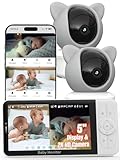


The iFamily is the most complete package in the group because it resolves the exact tension that makes parents hesitate: you get a real 5 inch screen at home, and the same camera streams to your phone when you leave. The Tapo C210 is the one to buy if you want a genuinely capable camera without spending dedicated-monitor money, and its 4.5 average across more than 22,000 ratings is the strongest rating volume here. The Cinnado D1 is the cheapest way into the category while still giving you 2K video, full pan and tilt, and local recording.
| Product | Features | |
|---|---|---|
| iFamily Smartphone Baby Monitor with 5 inch Display |
|
Check Latest Price |
| Tapo C210 2K Pan Tilt Camera |
|
Check Latest Price |
 Simyke Upgrade WiFi Baby Monitor 2.8 inch Simyke Upgrade WiFi Baby Monitor 2.8 inch |
|
Check Latest Price |
 Babysense TOUCH 7 inch Smart Monitor 2 Cameras Babysense TOUCH 7 inch Smart Monitor 2 Cameras |
|
Check Latest Price |
 VTech VM901 1080p Smart WiFi Baby Monitor VTech VM901 1080p Smart WiFi Baby Monitor |
|
Check Latest Price |
 ARENTI D3 3MP Two Camera Set ARENTI D3 3MP Two Camera Set |
|
Check Latest Price |
 MUBVIEW PK320-Y Dual-Band 2K Camera MUBVIEW PK320-Y Dual-Band 2K Camera |
|
Check Latest Price |
| Cinnado D1 2K Indoor Camera |
|
Check Latest Price |
 Tapo C100 1080p Indoor Camera Tapo C100 1080p Indoor Camera |
|
Check Latest Price |
 nooie 2K 360 Two-Camera Pack nooie 2K 360 Two-Camera Pack |
|
Check Latest Price |
As an Amazon Associate we earn from qualifying purchases, at no additional cost to you. CERTAIN CONTENT THAT APPEARS ON THIS SITE COMES FROM AMAZON. THIS CONTENT IS PROVIDED 'AS IS' AND IS SUBJECT TO CHANGE OR REMOVAL AT ANY TIME.
Two columns that are not in the table but decide most purchases: whether the app region-locks to one country, and whether the camera keeps working locally when your internet drops. Only the Babysense TOUCH has a documented regional limit on its app, and only the MUBVIEW and Cinnado are confirmed dual-band on 5GHz. Everything else in this group runs on 2.4GHz alone, which on a modern mesh network can mean a few extra minutes of setup and sometimes a firmware-related support call.
2K camera with pan tilt and zoom
5 inch split HD parent display
3000mAh battery
2.4GHz WiFi only
This is the unit I kept coming back to while putting the roundup together, because it refuses the false choice most brands force on you. The camera streams live HD video and audio to a phone app over your home WiFi, and it also ships with a 5 inch split HD display that works as a local monitor. Parents on forums asking for a baby monitor with a screen and an app that both actually work are usually handed one or the other. This one does both from a single camera.
Review data backs the packaging up. It carries a 4.4 average across 9,854 ratings, with five-star reviews making up 75 percent of the total and only 5 percent sitting at one star. That is one of the healthier distributions in the group, and it points to broad satisfaction with the 2K camera, the app streaming, the night vision and the two-way talk rather than one standout feature carrying a pile of complaints.
Multi-user sharing is the feature that changes day-to-day logistics. You can invite a partner, a grandparent or a sitter into the same feed without handing over a device or a login, which matters enormously in the first year when your roster of people who need to check the nursery changes every few weeks. The unit also carries a 3000mAh battery, so a power cut in the house does not immediately mean a dark feed.
Storage is the part that catches people out. The camera records to secure cloud storage on an optional subscription, or to a microSD card that is not included in the box. Budget for a card before day one if you want local recordings, and know that the local route is the one that keeps working when the vendor side of the internet is having a bad evening.
The 2K capture resolution is the reason this ranks above the 1080p options for phone viewing specifically. On a modern handset screen held at arm’s length, the extra detail is visible in the edges of the crib rail and in the pattern of a swaddle, and digital zoom stays readable longer before turning to mush. The remote pan, tilt and zoom is controlled from the app, so you can reframe the shot from the sofa without walking into a dark nursery and risking waking the baby.
Two-way talk carries your voice clearly enough to settle a fussy baby from another room, and the built-in speaker handles lullabies and white noise for the harder nights. Note that the camera runs on WiFi at 2.4GHz only, which is a hard limit rather than a preference. If your router has been set to 5GHz-only, you will need to enable a 2.4GHz band before pairing, and the camera lists corded electric power with a tabletop mount as its default installation.
Three things put it first. It is the only unit in the top tier that combines a 2K sensor, a usable local screen and multi-user phone access without making you pay a subscription to view the feed. It has the second-largest review base in the group, so the rating reflects a wide sample rather than a lucky streak. And it is the only camera here with a documented physical privacy answer: you can switch the wireless connection off completely from the monitor itself, which is a real answer to the question parents on r/beyondthebump keep asking about whether a nursery feed is exposed.
The compromises are honest ones. You are buying a bigger box than a bare camera, you need your own microSD card for local recording, and the app will not pair to a 5GHz-only network. If none of those three bother you, this is the pick.
2K 2304x1296 video
360 degree horizontal pan
Baby crying detection
30 ft night vision
The Tapo C210 is a security camera that happens to do a baby’s job extremely well, and that is not an insult. It shoots 2K video at 2304 by 1296, pans a full 360 degrees horizontally with 114 degrees of vertical tilt, and pushes notifications for motion, for a person, and for a baby crying. Parents on r/NewDads have long recommended it as a cheap second and third camera, and reviewers consistently praise the picture quality, the setup speed and the ability to skip cloud fees with a microSD card.
Its numbers are the most proven in the roundup after the C100. It holds a 4.5 average across 22,681 ratings, the highest average of any unit here, with 79 percent of reviews at five stars. Reviewers also call the motion detection reliable without flooding you with false alerts, which is the failure mode that quietly ruins most budget cameras.
Crying detection is the feature that separates this from a generic indoor camera, and it works as a genuine cry alert rather than a generic sound trigger. Two-way audio with a built-in siren is there if you need to use your voice first, and device sharing means you and your partner can watch from separate phones without fighting over one screen. Amazon Alexa and Google Assistant are supported for voice-activated live viewing if you prefer asking a speaker to show you the nursery.
It ranks #2 in Dome Surveillance Cameras on Amazon, which tells you how many people have made this exact repurposing choice. Storage is microSD up to 256 GB locally, or the optional Tapo Care cloud for 30-day history. The two-year manufacturer warranty is also the longest in this group, which matters more than it sounds when the camera lives eleven metres from a crib.
Field of view is 114 degrees, and combined with the 360 degree horizontal pan you can cover a whole nursery wall from a single mounted unit on a high shelf or a wall plate. Night vision reaches 30 feet, which is comfortably past a crib in any normal room, and the 2K resolution means a crying baby at the far end of the room still reads as a shape rather than a blob.
Two practical warnings. The camera is wired with a nine-volt corded supply, so you need an outlet near the mounting point and you lose the feed if the power goes out. And the pan-tilt motor is slightly laggy, which is why it is worth setting up a few preset positions in the app rather than swiping the view around at 3am.
Skip it if you need a screen in the nursery. There is none, and as several parents point out in the Wyze Forum, phone-only monitoring is a compromise rather than an upgrade, because a phone that dies or a screen that locks is a real failure mode at two in the morning. Everyone else gets an unusually capable camera for a fraction of dedicated-monitor money, with no subscription required to watch the feed.
The other honest limitation is that continuous room audio keeps the app open with the screen on, so your phone is effectively occupied for as long as you are listening. Plan to dedicate a device to the job rather than the one in your pocket.
2.8 inch plug-and-play display
1200ft transmission
Up to 4 cameras per display
VOX sound-activated screen
Read the app complaints first, because they define this product. The handheld side of the Simyke is genuinely good: a 2.8 inch IPS plug-and-play display, 1200ft of transmission range, up to four cameras paired to one display, two-way talk that carries a voice without lag, and a VOX mode that puts the screen to sleep and wakes it on sound or crying. Owners who stay on the handset tend to love it.
The same owners, though, frequently warn that the companion phone app drops its connection and is often described as unusable. If your reason for buying is phone-based viewing, that is the part that matters, and it is the reason this sits at number 3 rather than higher despite the feature list.
The rating distribution explains the mixed reputation precisely. Sixty-six percent of reviews are five star, but a full 14 percent sit at one star, the largest single-star share in the roundup. The complaints are consistent: intermittent drop-offs, a white screen on the parent display, and an advertised range that reviewers say has been unreliable even at close distances. With 750 ratings, individual experiences are also less statistically settled than they are for the Tapo units.
There is a nice detail in the app-driven design that most competitors skip. App-controlled auto-off mutes the music once the baby is asleep, so the lullabies and white noise stop on their own rather than playing into your own ears all night. The temperature sensor, feeding reminders and five loopable lullabies round out a package aimed at the local-screen buyer.
VOX is the feature that extends battery life most. Sound-activated wake means the display stays dark during a nap and lights up the moment there is a cry, which is a much better use of power than a permanently lit 2.8 inch panel. The screen itself is small, and reviewers note that it limits comfort for long viewing sessions, so this is a glance-at-the-door unit rather than a settle-in-and-watch one.
Range is the spec to treat with suspicion. The 1200ft figure is a headline number, and reviewers report it failing at much shorter distances. Walls, floors and a closed door will matter more than that figure in a typical two-storey house, so treat it as a single-floor guarantee at best.
Connectivity is 2.4GHz only, which is the single most common limitation across this whole category and applies here too. It will not pair on a 5GHz network, and the camera lists no storage medium at all, so any recording beyond live viewing is handled by the app side rather than a card you insert.
My honest read: if you want a phone-only monitor, buy the Tapo C210 instead and save yourself the risk. If you want a robust local monitor for a large house and you will mostly use the handset, this is a reasonable buy. Buying it for the app and then discovering the app is the weak part is the outcome the one-star reviews describe.
7 inch IPS touchscreen
Two 4MP dual-lens cameras
6x hybrid zoom
No subscription
This bundle answers the twin question that most monitors avoid. You get two cameras plus a 7 inch IPS touchscreen parent unit, and the display runs a large split-screen so you can watch both babies or two separate rooms side by side on one panel. Each camera has a 4MP dual-lens design, pairing a wide-angle lens with a telephoto one, and a 6x hybrid zoom that pulls detail back in from across the room.
It holds a 4.2 average across 2,384 ratings, with 67 percent at five stars. Owners highlight the big touchscreen, twin capability, dual 4MP lenses and, importantly, the absence of any subscription for either local or app monitoring. That last point sits at the centre of the loudest thread in this category, an r/Buyingforbaby thread from August 2026 with more than 50 comments asking for monitors without hidden subscription traps.
Daily-ritual features are unusually complete for a bundle at this level. You get an adjustable night light, sound-activated VOX display, two-way talk, white noise and lullabies, temperature and humidity sensing, picture-in-picture, AI auto tracking with a focus area, and cry, sound and motion alerts through the app. Battery life is listed at up to 30 hours with up to 20 hours quoted in the feature set, which comfortably covers a night and most of the next day.
Both cameras and two wall mounts are included, along with three power adapters. That is a complete kit rather than a starter bundle, which is why it is the largest and heaviest unit in this roundup at just under a kilo. Plan where the display is going before you order, because it is not a pocket device.
The dual-lens arrangement is the reason to prefer this over a pair of single-lens cameras. A wide lens covers the whole room while the telephoto lens gives you a genuinely usable close view of a sleeping face, and the 6x hybrid zoom blends between them. AI auto tracking and the focus area keep a mobile baby framed rather than letting them drift to the edge of the picture after ten minutes of rolling.
Night vision is non-invasive infrared, chosen specifically so the camera does not light the room while the baby is asleep. That is a thoughtful call for a nursery and it avoids the sleep disruption that a visible white-light approach would cause. Pair it with the adjustable night light when you need to see something without waking anyone.
The one limitation that can end a purchase is geographic. The Babysense app is available in the USA only, and works with Babysense TOUCH monitors. If you are outside the country, the phone half of this product may not be usable at all, which would leave you with a very good local monitor and no remote access. Check this before anything else in the spec sheet.
Alongside that, it is 2.4GHz only, the microSD card for local recording is not included, and the manufacturer warranty is one year. None of those are serious, but they add up at the edges. Manufacturer of record is Hisense Ltd., and the model is a 2-camera bundle with a 7 inch display.
1080p camera
5 inch HD parent screen
Free MyVTech Baby app
Pan tilt and zoom
The VTech VM901 is the most recognisable name in this roundup and the one most parents will recognise from a hardware store shelf. It pairs a 1080p camera with a dedicated 5 inch HD parent unit, and the same feed is available through the free MyVTech Baby app on Android and iOS. For households where one adult is awake with the baby and another is on their phone at work, that dual path is genuinely useful.
Its 4.1 average across 7,593 ratings is respectable but not flattering, and the distribution explains the gap. Sixty-six percent of reviews are five star, but 13 percent sit at one star, which is the largest single-star share among the products with a large review base. Praise concentrates on the parent unit screen and the automatic day-to-night switch; criticism concentrates on network behaviour.
Alerts arrive on both the phone and the parent unit for baby stir and nursery temperature changes, and two-way talk works well for settling a baby from another room. You can share access with a partner, grandparent or sitter. Field of view is 360 degrees with a 110-degree viewing angle, the camera uses starlight night vision, and a wall-mount bracket with anchors and screws is included in the box alongside two AC adapters.
The power detail is worth reading closely. The connectivity protocol is 2.4G FHSS and the wireless technology is listed as 2.4G WiFi, and the listed capacity is 2100mAh for the parent unit battery. The camera itself is corded electric, so a power cut takes the feed away regardless of how healthy the handset battery is.
The 1080p sensor gives true-colour detail by day and switches automatically to crisp night vision in the dark, with no manual toggle to forget at bedtime. That automatic switch is the detail owners praise most, because it removes a small decision from the middle of a night. Pan, tilt and zoom can be driven from the parent unit buttons or from the phone app, which means the person holding the baby does not need to hand over a device.
The app is free with no subscription attached, which is rare in a dedicated baby monitor and is a fair point in its favour. Thirteen channels and digital zoom round out the specification, along with a one-year limited manufacturer warranty.
Two practical issues. The camera and the app must share a single 2.4G network, which complicates setup on a modern dual-band router and is the most likely source of the support tickets in that one-star block. And playback recording is limited compared with cameras that support continuous local storage, so if you want a searchable video history, this is not the unit to buy.
App and camera behaviour on 2.4G is the recurring theme in the negative reviews rather than picture quality or features. It ranks #5 in Smart Baby Monitors on Amazon with strong visibility, so it is widely used, and the feedback reflects a mixed but generally positive experience. Treat it as the pick for families who want a screen at home and a phone feed away, and who will run a 2.4G band for it.
Two 3MP cameras with split screen
5 inch display plus app
Full-duplex two-way audio
microSD up to 256 GB
The ARENTI D3 is the only unit here with genuinely full-duplex two-way audio, which means you can talk and listen at the same time rather than taking turns. That difference is small on paper and obvious in use, because you can hear whether your voice is calming the baby while you are still talking to them. It comes as a two-camera set with a 5 inch display and a free phone app, so it covers a nursery and a second room at once.
It sits at a 4.0 average across 2,011 ratings, with 62 percent five star against 13 percent one star. That split reads clearly: the feature set wins, while execution and connectivity draw complaints. It is a set that gives you more hardware than rivals at a similar level, and a lower ceiling on how reliably it all behaves.
On paper the specification is dense in a good way. Two 3MP cameras with 4x zoom, eight switchable IR LEDs giving night vision to 33 feet, a warm night lamp with steady and breathing glow modes, AI motion tracking with a danger zone, cry and noise detection, lullabies plus white noise and up to 10 custom songs through the app, VOX mode, feeding reminders, and temperature and humidity alerts. Local recording goes to a FAT32 microSD up to 256 GB, so no subscription is required to store footage.
Privacy is handled more seriously than on most cameras at this level. An AES128 security chip provides bank-level data encryption and account registration protection, and the unit is ONVIF compatible, which means it can work with other ONVIF-compliant software rather than locking you into one app permanently.
Video capture resolution is 1296p with a 3MP still resolution at 20 frames per second, and the viewing angle is 100 degrees. The listed transmission range runs from 400 feet up to 1000 feet with low latency, which is a wide spread and suggests the performance depends heavily on the building. In a normal house you will be firmly in the lower part of that range.
Night vision is night colour with a 33 foot range from eight IR LEDs, which is a good number of emitters for even illumination rather than the hot-spot effect you get from a pair. The warm night lamp is a separate feature you can run alongside it, and the breathing glow mode is a small touch that suits a dark room.
The name says WiFi 6, and the unit is single-band in practice, so you get the WiFi 6 label without dual-band behaviour. That is worth knowing before you assume a 5GHz network will work. Focus is manual rather than automatic, which is a step backwards from every other camera here, and the 8 IR LEDs with a 33 foot range are modest next to the 4MP dual-lens bundles.
It works out to a good choice for parents who genuinely need two cameras and who care most about being able to talk and listen simultaneously. If you only need one nursery and care most about reliability, a single-camera unit with a higher average rating is the better bet. The package includes a charging cable, power adapter, mounting bracket and reset pin, with Amazon Alexa compatibility listed.
Dual-band 2.4GHz and 5GHz
2K pan tilt with auto tracking
Free 7-day loop cloud
355 degree coverage
Almost everything in this roundup is 2.4GHz only, which is the single most common reason a nursery camera refuses to pair. The MUBVIEW PK320-Y is one of the few exceptions, with genuine 2.4GHz and 5GHz dual-band support. If your router is set to a modern configuration or you have no interest in splitting your bands, that removes an entire class of setup frustration before you start.
It holds a 4.2 average across 8,547 ratings with 69 percent at five stars, and repeat buyers report owning four or more units. The consistent wins in the feedback are dual-band WiFi, fast connection, and free cloud loop recording without a subscription. Reviewers also mention US-based phone support, which is unusual in this price band.
Storage is the other reason to like it. It includes a lifetime 7-day loop cloud recording with no subscription, or microSD up to 128 GB if you would rather keep everything local. Either way you can watch a night back without paying a monthly plan, and the loop recording means the storage does not fill up and stop.
There is also a privacy control that earns its place. An app toggle switches the lens off, so you can confirm the camera is not capturing rather than trusting a status light. The camera body is small at 3 by 3 by 4.33 inches and weighs just over 10 ounces, so it is easy to place on a shelf or tuck near a ceiling corner.
Video is 2K capture with a 3MP still resolution at 15 to 20 frames per second, and the viewing angle is 355 degrees from a very small housing. AI motion detection comes with audible alerts and automatic tracking of moving objects, which is what you want when the baby has moved out of the position you carefully chose this morning.
Two-way talk-back works so you can speak to your child from the phone app without entering the room, and night colour vision reaches 33 feet. The frame rate sits in the middle of the group rather than at the top, so fast movement is smooth enough but not cinematic.
Two gaps are worth naming. There is no Alexa, Google Home or Apple smart home integration, and the camera runs on its own CloudEdge app, which is a problem if you already use a smart home platform and expect one app for everything. And the fixed power cable is not detachable and is short, so your mounting options are limited to wherever that cable reaches.
Motion detection is the recurring complaint, and it is a real one. The camera cannot distinguish a pet, a person and an object, and reviewers describe the sensitivity control as unreliable. In a room with a cat or a street-facing window, that means tuning alerts carefully or turning some off. Focus is fixed, so there is no optical zoom for checking details. It is a strong pick for 5GHz users who want free cloud recording, and a weaker one for anyone with a pet in the nursery.
2K full HD video
360 degree pan and tilt
4 IR lights for night vision
microSD up to 128 GB
The Cinnado D1 is the cheapest route into this roundup, and it is not a token entry. It gives you 2K full HD streaming, 360 degree coverage with a 320 degree pan and tilt, four 940nm infrared lights for night viewing, two-way audio, and local SD recording up to 128 GB. It ranks #18 in Dome Surveillance Cameras, so it is a widely deployed indoor camera rather than an untested listing.
It carries a 4.3 average across 8,058 ratings with 71 percent five star. Buyers at this level accept the trade-off knowingly, and the feedback praises the small size, the two-way audio, multi-user sharing and support that answers quickly. The 4.3 is also the second-highest average in the group, which is not what most people expect from the lowest-cost camera here.
It is also the smallest and lightest option, measuring under 3 inches on each side and weighing 0.29 kg, so a windowsill or a high shelf is a realistic mounting point. Multiple family accounts mean two caregivers can view without sharing one phone, and both ends of the two-way audio have adjustable volume. Alexa and Google Assistant are supported for voice-controlled live viewing.
Cloud storage is optional with a 30-day trial, and SD card storage up to 128 GB handles continuous recording without any payment. The camera is wired, so there is no battery option, and the box includes the camera, cable, power adapter, mounting accessories and an installation guide.
Video capture is 2K with an effective resolution of 2000 pixels, encoded as H.264 or H.265. Pan is 320 degrees with tilt and 360 degree total coverage, which is close enough to full rotation that you will not notice the gap in practice unless you were counting.
The honest weakness is the lens in daylight. Owners report the video washing out in bright light because the lens has no filtering, and some question whether the output is genuinely 2K in practice. Night performance is the better half of the picture quality story, with four 940nm IR lights giving usable after-dark coverage in a normal nursery.
This is the single most repeated complaint in the reviews, and it deserves more than a footnote. Motion detection on the D1 either over-triggers on distant cars and headlights, or fails to detect a person walking past. A camera that cries wolf trains you to ignore it, which defeats the point. Budget owners should expect to spend time tuning it and accepting some false alerts.
Two further limits: it is 2.4GHz only, and the recording interval cannot be adjusted without a cloud subscription. A long-term owner also reported repeated connection drops that needed a power cycle to resolve. Support is the one area where reviewers consistently report fast, useful replies, which is worth having in a category where troubleshooting is often the whole experience. As a second or third camera rather than your only monitor, it is a strong value choice.
1080p full-color day and night
30 ft night vision
microSD or Tapo Care cloud
Two-way audio with siren
If you want the option with the least uncertainty around it, this is the one. The Tapo C100 has 28,650 ratings at a 4.4 average, by a wide margin the largest sample in the roundup, which means the feedback reflects a genuinely long and broad ownership history rather than a launch cohort. It holds strong rankings in pet cameras and bullet surveillance cameras for the same reason: it is a dependable wired indoor camera that happens to work well in a nursery.
Seventy-four percent of its reviews are five star. Buyers consistently call out the clear 1080p image, the QR-code setup, local microSD recording without a subscription, and the reliability of the Tapo app across both WiFi and cellular. That last point matters more than it sounds, because the app has to work when you are away from home on mobile data, not only on your own network.
Privacy features are a genuine strength here rather than a checkbox. The camera supports encrypted video, two-factor authentication and a documented data defense system, which is a better answer to the privacy question than most cameras at any price. Two-year manufacturer warranty, Alexa and Google Assistant support, and custom alarm sounds with a built-in siren round out the package.
Daylight performance is 1080p full colour with a large-aperture lens and built-in spotlights, and night vision reaches 30 feet with a full-colour night mode available. The frame rate is 15 frames per second. At 270 grams and under 4 inches tall with a swiveling mount, a template, screws and adhesive included, it is simple to place almost anywhere.
Continuous local recording to a microSD up to 128 GB is the reason this is the pick for anyone who wants a searchable record rather than a live peek. Tapo Care cloud is optional. If you have ever wanted to look back at a specific night to understand a sleep pattern, this is the unit in the roundup most likely to have that footage sitting on a card.
Free person and motion detection with activity zones lets you define where the camera should care, which cuts the false-alert problem that undermines cheaper cameras. The field of view is 110 degrees, and autofocus is automatic, so the picture stays sharp as the baby moves between the cot and the floor.
There is no pan or tilt, so the camera covers only the direction it is aimed at. That is fine for a cot in a corner, and it is a problem for a room where the baby changes position between sleep and play. You reposition it by hand, which is a real consideration during the mobile phase.
It is wired with no internal battery, so a power cut stops it completely, and the built-in speaker is not very loud for two-way talk. Autofocus also favours far distances, so a very close subject can look slightly soft. WiFi is 2.4GHz only. Against those, the sheer volume of proven behaviour, the two-year warranty and the privacy features make this the safe default for a second room or a second floor, and a strong phone-only monitor on its own.
Two camera pack
355 degree motion following
1080p with 32 ft night vision
Anti-noise two-way audio
The nooie two-pack is about coverage rather than cleverness, and for a lot of homes that is the right priority. You get two cameras, which is genuinely useful for twins or for watching a nursery and a playroom on one account, and each one tracks motion on its own across 355 degrees horizontally and 94 degrees vertically. The auto tracking senses and follows the baby around the room, which is the difference between a camera you adjust and a camera you set once.
It holds a 4.2 average across 1,292 ratings with 68 percent at five stars. That is the smallest review base in the roundup alongside the Simyke, so individual experiences are less settled statistically. The recurring positives are the pack value, the 360 degree tracking and the anti-noise two-way audio.
The anti-noise microphone is worth calling out. It picks up a faint whimper that a cheaper mic would miss, which is the difference between an alert you act on and one you dismiss. Two-way audio runs through a speaker and mic pair, real-time motion and sound alerts land on the phone, and live streaming is available around the clock.
Placement is flexible: a wall mount with screws, 3M adhesive, or simply on a table. Alexa and Google Home are compatible, a one-year manufacturer warranty is included, and the pack ships with a power adapter and cable plus mounting hardware. There are two channels and a 101-degree field of view per camera.
Video capture is 1080p at 15 frames per second, with autofocus and two 940nm infrared LEDs giving night vision to 32 feet. Two IR emitters is on the low side, and reviewers note that night performance is more limited than units with four or eight. In a small, dark nursery that is rarely a problem; in a large room with a cot far from the wall, expect the far corner to fall off first.
Recording is continuous or motion-detected to a microSD, which is sold separately, or to an optional cloud subscription through the Nooie app. So local storage works and no payment is required, but you need to buy a card first.
The listing conflict worth knowing about is the WiFi band. Some listings suggest 2.4G and 5G, but the manufacturer detail is 2.4GHz network compatibility only, and that is what reviewers report. Treat it as a 2.4GHz camera. With two cameras on one network, that matters more than a single camera would, since both are drawing on the same band.
Frame rate is 15 fps, modest against the 20 fps options, and the 15 fps plus two-LED combination is why night detail lags the 4MP dual-lens units. If you want automatic tracking, two rooms covered, and a mic that catches a whimper, this is the pick. If you want the sharpest night image, pick a camera with more infrared emitters instead.
Almost every monitor in this category streams to a phone, so the real question is whether you also want a physical screen. The honest answer, backed by the pattern in the Wyze Forum and elsewhere, is that a dedicated nursery screen is not a luxury. A phone that locks, dies or runs out of battery at two in the morning is a genuine failure mode, and a plug-in screen on a shelf is the cheapest insurance in the category.
Five of the ten here ship with one: the iFamily with a 5 inch split HD display, the Babysense TOUCH with a 7 inch touchscreen, the VTech VM901 with a 5 inch parent unit, the ARENTI D3 with a 5 inch display, and the Simyke with a 2.8 inch plug-and-play display. If you go phone-only, dedicate a device to the job and keep it charged.
Eight of the ten products in this roundup are 2.4GHz only. That is not a technicality, because many modern routers and mesh systems run a 5GHz-only or band-steered configuration, and a camera that cannot find a network will look like a faulty product. Before you buy, open your router settings and confirm a 2.4GHz band is enabled and using a compatible security mode.
Only the MUBVIEW PK320-Y and the Cinnado D1 are confirmed dual-band on 2.4GHz and 5GHz. If you have no interest in managing bands, or you have already had setup trouble, that alone narrows your list considerably. Pairing also has to happen on the 2.4GHz network in most cases even where the camera supports both, so know which network your phone is on at setup time.
This is the single most-discussed topic in the category. An r/Buyingforbaby thread from August 2026 with more than 50 comments is titled around avoiding hidden subscription traps, and Nanit community posts describe owners discovering that a camera they bought without a subscription later required one for basic use. Read the fine print on live viewing, not just on cloud storage, before you commit.
Good news for this roundup: none of these ten requires a payment to watch the feed. Every one can record locally to a microSD card. You will need to buy the card separately on the iFamily, the Cinnado, the nooie and the Tapo Care options, and Babysense does not include one. When you compare total cost of ownership, the comparison is hardware plus card, not hardware plus a monthly line for three years. That difference, not the sticker price, is the real reason to choose here.
Forum complaints about this category cluster around app behaviour rather than camera hardware. The most repeated issue is that streaming room audio forces the app open and the screen on, which means the phone is effectively tied up, as parents on r/Parenting describe. A second cluster is confusing product naming, the reason for an r/beyondthebump thread asking which monitors have a screen and an app that both work.
Check three things on your own device before you settle. Does the app keep the stream alive when the screen locks? Does it work on mobile data away from home, not only on your own WiFi? And does the alert actually arrive, or does a background restriction swallow it? The VTech app and the Tapo apps are the most proven here by review volume; the Simyke app is the one reviewers flag repeatedly.
Every camera here claims night vision, and the differences show up at two in the morning rather than at noon. The number that matters is the infrared emitter count, because it decides whether you get even illumination across the room or a bright centre with dark corners. The ARENTI D3 with eight IR LEDs, the Cinnado D1 with four, and the iFamily with infrared LEDs plus a 2K sensor give the most even after-dark picture.
Stated night vision ranges cluster tightly between 30 and 33 feet, which is more than enough for almost any nursery, so treat the range figure as marketing and the emitter count as the real signal. The nooie pack, with only two infrared LEDs, is the one where a large room is most likely to disappoint.
Almost every camera in this category is cloud-streamed, which means the feed routes through the manufacturer’s server, and that is the failure mode nobody demos. An Arlo Community post captures the frustration plainly, describing the inability to stream locally over the network during an outage. Nothing in the feed survives if your internet drops, no matter how good the camera is.
There is one partial answer in this roundup. The Babysense TOUCH has a local mode on its 7 inch touchscreen, so the nursery itself keeps showing you the baby even when the internet does not. For the rest, the honest mitigations are a local microSD recording so you still have footage, a dedicated screen rather than a phone, and a backup plan for the nights your provider is down. Two of the ten units here, the Tapo C210 and Cinnado D1, are also wired with no battery, so a power cut ends the feed regardless of your network.
That is the same principle behind choosing reliable connected gear for the rest of the house. Our WiFi garden sensor guide covers the same class of dependency in a setting where a dropped connection is merely inconvenient rather than urgent.
The best baby monitor app is the one that keeps the stream alive when your phone screen locks and works on mobile data away from home. Among these ten, the MyVTech Baby app and the two Tapo apps have the largest proven review bases. The iFamily app ranks highest for feature coverage, with 2K video, pan, tilt, zoom and multi-user sharing. Test any app on your own device before committing.
All ten monitors in this roundup let you view the live feed and record locally without paying a monthly plan. The Babysense TOUCH is explicitly sold with no subscription for local or app use, the MUBVIEW includes lifetime 7-day loop cloud recording, and the Tapo C210, Tapo C100, Cinnado D1, ARENTI D3 and nooie all record to a microSD card. You will need to buy that card separately on several of them.
No. Every monitor in this roundup is WiFi-based, and none has a direct phone link that bypasses a network. The closest option is local streaming inside your own home, which the Babysense TOUCH offers through its 7 inch touchscreen without going through the app. For a genuinely phone-connected monitor with no network dependency, you would need a non-WiFi model with a dedicated handheld receiver instead.
Mostly no, because most of these cameras stream through the manufacturer’s cloud server rather than directly to your phone over the local network. The Babysense TOUCH is the partial exception, since its 7 inch touchscreen displays the cameras locally at home. For everyone else, a microSD card preserves recordings offline, and a monitor with its own screen keeps working for anyone in the nursery while the internet is down.
The main reasons are privacy and reliability. Every WiFi monitor sends nursery footage through a vendor’s servers, which parents may not accept for a baby’s room. On reliability, cloud dependency means an internet outage ends the feed, and a 13 percent one-star share on some models points to real connectivity complaints. Non-WiFi monitors trade remote access for a private, always-available dedicated screen.
If you want the best wifi baby monitors for phones and can only choose one, take the iFamily. It pairs a 2K camera with remote pan, tilt and zoom to a real 5 inch screen and to multi-user phone access, and it is the only unit here with a documented physical switch to turn the wireless connection off. A 4.4 average across 9,854 ratings is strong evidence, and no subscription is needed to watch the feed.
If your priority is picture quality and coverage per pound, the Tapo C210 is the pick, with the highest average rating in the group at 4.5 across 22,681 ratings, pan and tilt across the whole room, real crying detection, and microSD recording. If you need two rooms or twins, the Babysense TOUCH handles a split screen on a 7 inch touchscreen, provided you are in the USA where its app is available.
For 5GHz networks, the MUBVIEW PK320-Y is one of very few dual-band options here. For continuous local recording you can search later, the Tapo C100 has the largest review base in the roundup and the strongest privacy features. For the smallest possible outlay, the Cinnado D1 gives you 2K and full pan and tilt, provided you tune its motion detection first. For automatic 360 degree tracking across two rooms, the nooie two-pack is the one.
Whichever you choose, buy a microSD card in the same order, confirm your router is broadcasting a 2.4GHz band, and download the app to test it on your own phone before the baby arrives. That thirty minutes of setup is the difference between a monitor that works and one you end up troubleshooting at 3am. Check the current details on each listing, and re-read this guide in 2026 when the models roll over.