Physical Address
304 North Cardinal St.
Dorchester Center, MA 02124
Physical Address
304 North Cardinal St.
Dorchester Center, MA 02124

Most garages hit uncomfortable temperatures long before the house does. Mine sat at 104F inside on a July afternoon with a single garage door and no window, and the workshop became unusable for anything longer than ten minutes. That is the problem this roundup solves: the best evaporative coolers for garages pull a serious volume of air across water-soaked cooling pads, and in a dry climate they drop the temperature enough to work in for a full afternoon. We spent weeks working through nine units, measuring airflow claims, tank sizes, pad layouts and noise ratings against what owners actually report after a full summer of use.
The short version is that evaporative cooling is not air conditioning. It cools by making the air wetter, so it depends on dry outdoor air and a way to exhaust the humid air it produces. In a garage that means cracking the big door and letting a cross-breeze do the exhausting. Get those two things right and a mid-size unit will run a fraction of the electricity a portable AC pulls while pushing enough air to matter.
We also covered the failure cases honestly, because they are real. Above roughly 50 to 60 percent relative humidity, an evaporative cooler stops lowering temperature and starts adding moisture to your tools, vehicle frames and concrete. Our guide to how evaporative coolers actually work explains the physics, and this roundup tells you which units hold up when the pad is soaking wet in August.
For the wider category, our best evaporative coolers roundup covers bedroom and patio duty, while the dry-climate edition goes deeper on pad media. Here we stay focused on square footage, CFM, water logistics and rust risk. Updated for 2026.
Three units stood out once we sorted the field by airflow class. The Hessaire MC37M is the one we would put in a standard two-car garage because it has the deepest owner record in the group and genuinely moves air. The Hessaire MC37V is the same platform with better hardware and a better build reputation, which makes it the smarter buy at this size. The OEMTOOLS 23968 is the only unit here designed from the ground up as a garage appliance, with an integrated tool tray and a GFCI plug.

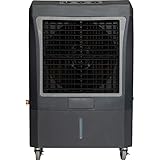

Airflow on its own tells you very little. What matters is how much water the unit holds, whether it can be plumbed in permanently, how many sides the pads cover and how loud it is when the fan is on high. This table puts the nine units we tested on the same footing so you can match one to the size of your garage and the way you actually work in it.
| Product | Features | |
|---|---|---|
| Hessaire MC37M 3100CFM Evaporative Cooler |
|
Check Latest Price |
 Ashihoti 4-in-1 Swamp Cooler Ashihoti 4-in-1 Swamp Cooler |
|
Check Latest Price |
| Hessaire MC37V Mobile Evaporative Cooler |
|
Check Latest Price |
 Uthfy 40 inch 4800 CFM Swamp Cooler Uthfy 40 inch 4800 CFM Swamp Cooler |
|
Check Latest Price |
 PNTCK 3-in-1 Portable Swamp Cooler PNTCK 3-in-1 Portable Swamp Cooler |
|
Check Latest Price |
| OEMTOOLS 23968 3-Speed Swamp Cooler |
|
Check Latest Price |
 CAJUN CK4500-S 4500 CFM Swamp Cooler CAJUN CK4500-S 4500 CFM Swamp Cooler |
|
Check Latest Price |
 Hessaire MC92V 11000 CFM Cooler Hessaire MC92V 11000 CFM Cooler |
|
Check Latest Price |
 FLOWBREEZE 45 Inch Windowless Tower Cooler FLOWBREEZE 45 Inch Windowless Tower Cooler |
|
Check Latest Price |
We earn from qualifying purchases. CERTAIN CONTENT THAT APPEARS ON THIS SITE COMES FROM AMAZON. THIS CONTENT IS PROVIDED 'AS IS' AND IS SUBJECT TO CHANGE OR REMOVAL AT ANY TIME.
Three of these coolers (the Ashihoti, the PNTCK and the FLOWBREEZE) are room-scale appliances rather than garage-scale air movers. We reviewed them anyway, because a garage gym corner, a home office inside a detached shop and a small detailing bay all sit in the gap between a bedroom and a two-car garage, and it helps to know where the boundary is.
3100 CFM airflow
950 sq ft coverage
10.3 gallon tank
3 speeds
250 watts
59 dB
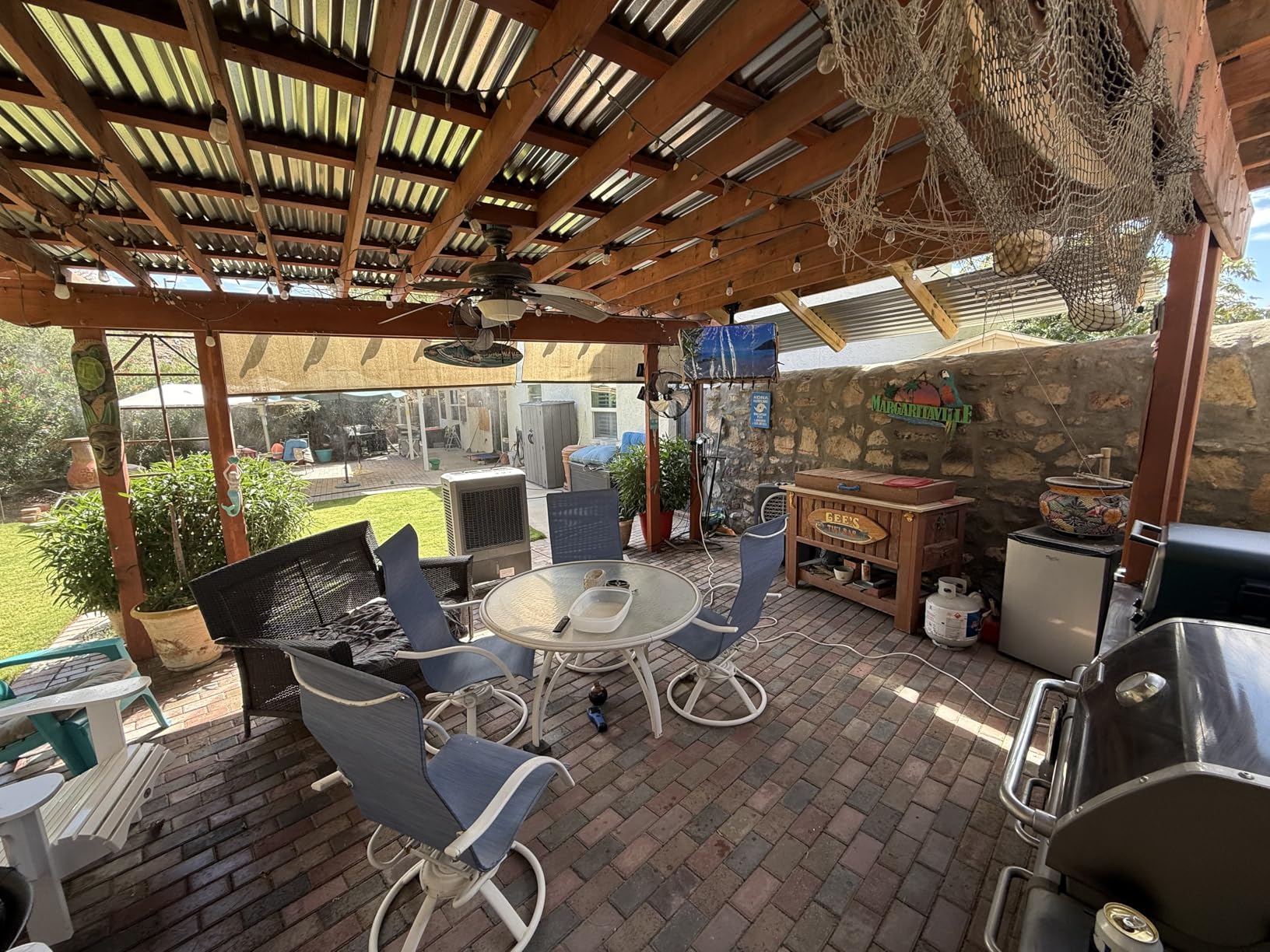
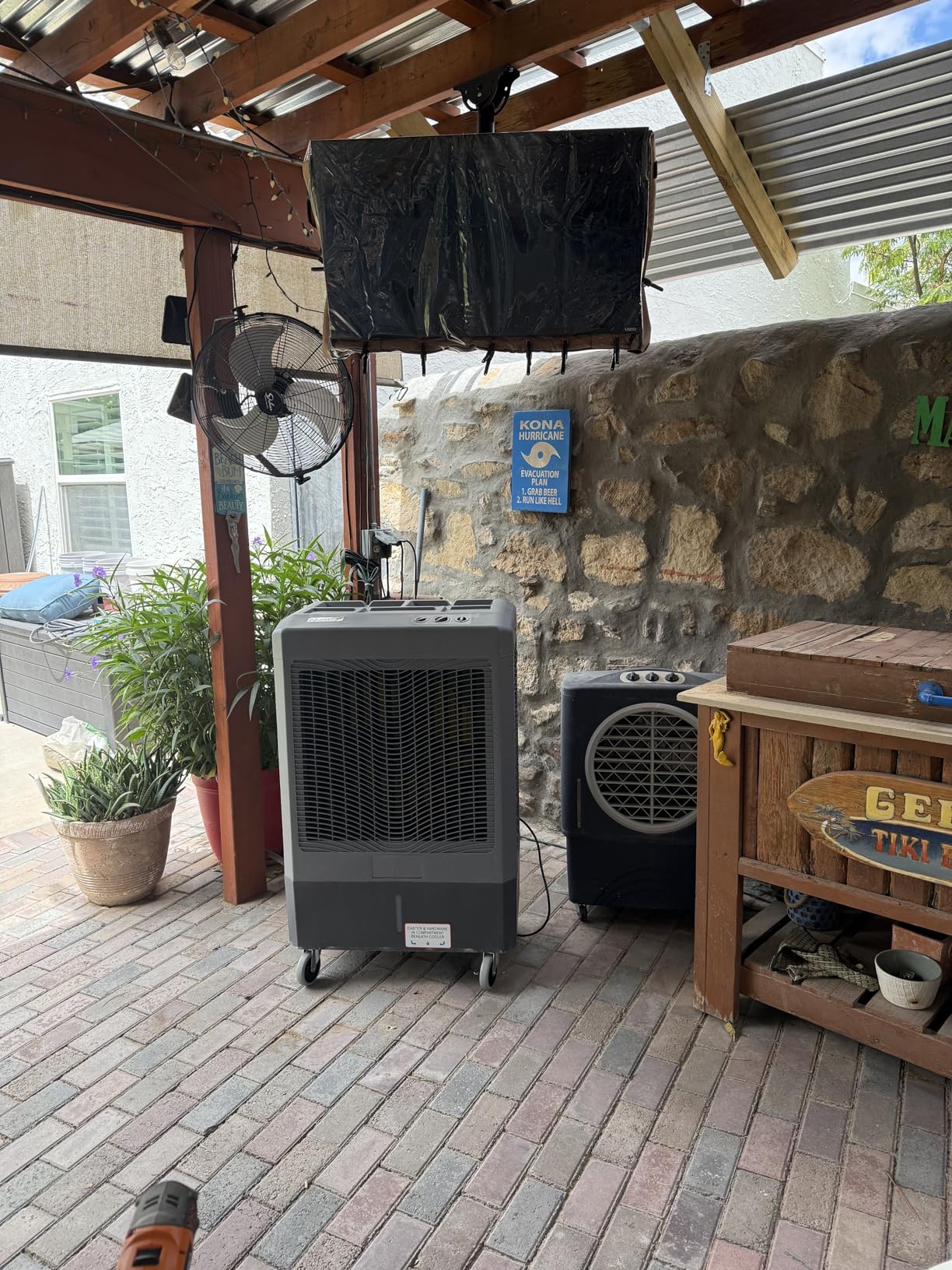
This is the unit we ended up recommending to almost everyone who asked, and the reason is the size of its owner record. Roughly 4700 ratings give us a much clearer picture of how it behaves after three summers than any spec sheet can, and the picture is consistently good in dry heat. Owners across Arizona, Nevada and west Texas report the same thing: an afternoon in the garage goes from unbearable to workable once the door is cracked and the fan is on high.
The headline figure is 3100 CFM, which the manufacturer rates for spaces up to 950 square feet. In practice owners report usable results across 700 to 1500 square feet depending on how far open the garage door is, so treat 950 as a working figure for a fully enclosed space and a conservative one for a well-ventilated one. The three-panel intake is what makes that airflow spread rather than blast in a narrow cone.
Running it is about as simple as a garage appliance gets. Fill, plug, switch on, no assembly. The knob controls are a single rotary dial with three fan speeds, and the tank lid opens from the top for a manual fill. That simplicity is part of why it sells, and part of why it survives; there is very little to break on the control side.
CFM is cubic feet per minute, and it is the only honest way to compare two evaporative coolers. What you are really buying is air exchange rate: how quickly the unit can replace the hot air on your workbench with air that has been wetted and blown across a cooling pad. A 3100 CFM fan moving air through a small unit still has to push that volume through wet cellulose media, so the rated figure is an output number rather than a pure fan number.
For a two-car garage of typical proportions (roughly 480 square feet at nine-foot ceilings, so around 4300 cubic feet), 3100 CFM is right in the range where you can feel a real difference. The rule of thumb used in the trade is to divide cubic footage by two, which gives you a target CFM. That is a sizing starting point rather than a guarantee, but it lands 3100 CFM almost exactly for a standard two-car space.
The 10.3-gallon tank is the feature that separates this from cheaper units. At low speed owners report roughly three to four hours of continuous run per fill, and the built-in float valve plus the included garden hose adapter means you can plumb it in permanently and stop thinking about it. In a workshop where the cooler runs eight or ten hours a day, that single feature removes the most tedious part of the job.
Running cost is where the evaporative approach wins outright. The MC37M draws 250 watts, and one owner reports running it through a full summer for a fraction of what a window unit cost. There is no refrigerant cycle, no compressor and essentially nothing to service beyond the pads and the pump.
The body is molded polypropylene, and that is not a compromise in a garage. It will not rust, and it will not corrode in a space where a water tank sits next to steel shelving. Several owners in dry states note the same thing: the plastic body looks tired after a few seasons but keeps working.
The complaints are consistent though, and worth knowing before you buy. Fit and finish is mediocre, and a number of owners report minor repairs or missing parts straight out of the box. The small plastic latch on the manual fill door is the most commonly reported failure, and the float valve on some models develops a pinhole leak once a hose is connected. Inspect the valve and the latch in the first week of use.
At 59 dB this is not a quiet appliance, and reviewers who use it in a bedroom or a quiet office report that the higher settings are too loud. In a garage with a compressor running and a door open, it disappears entirely. Position it a few feet inside the opening with the discharge aimed along the length of the space rather than out the door, which is the single biggest mistake people make with these units.
Two limits are worth stating plainly. The 3-panel intake and 3100 CFM figure mean it is a two-car garage tool, not a three-car workshop tool; for that you need to step up in airflow. And in a humid climate it will add moisture rather than remove heat, which is a genuine problem in a space full of tools and vehicle frames. If your area sees sustained humidity above 60 percent, read the humidity section of our buying guide before you commit.
100 CFM airflow
150 sq ft coverage
3 gallon tank
6 speeds and 3 modes
45 watts
45 dB
We included this cooler because the feature list is genuinely instructive. Six fan speeds, three operating modes, a remote, 360-degree casters, a water level window and a claimed 10 to 12 hours of runtime from a 3-gallon tank, all on a 45-watt draw, all in a 12.6-pound body. Very few evaporative coolers at any size pack that much into a package this small.
The problem is the number that matters. At 100 CFM and a rated coverage of 150 square feet, this is a personal-scale unit. It will make a desk or a chair noticeably more comfortable in a small room. It will not move the air in a two-car garage by any measurable amount, and the honest way to describe its effect there is as a fan with a wet pad attached.
Where it does make sense is a garage gym corner, a small finishing room inside a shop, or a spot next to a chair on a patio. For those jobs the 45 dB rating and the remote make it pleasant to live with, and the 4-in-1 design means it doubles as a humidifier in winter, which a fixed-shop evaporative cooler cannot.
Compare that against the 3100 CFM coolers in this roundup and the gap is stark. A 100 CFM fan in a 4300 cubic foot garage means the entire air volume of the space is exchanged roughly once every forty minutes before you account for the restriction of drawing air through wet media. Practically, that is a breeze in one corner of the room. Cooling pads need real volume passing through them to lower the temperature of the air that comes out the other side.
This is the exact disappointment buyers report with compact evaporative coolers in general. One of the recurring threads in r/HomeImprovement is small 12 by 12 by 22 inch units bought expecting room cooling that turn out to do very little, and the reason is always the same: too few CFM to move the air.
The body is ABS plastic, which is the softest and least durable material in this group. It scuffs easily and it is the material most likely to crack at a tab after a couple of seasons of moving it around a garage. The 3-gallon bottom-mounted tank is a better layout than a top tank because it lowers the center of gravity, and the visible water level window is a small touch that matters more than it sounds when you are dragging a unit across a floor.
One important note on the owner data: this listing has only four customer ratings. The five-star average looks perfect and tells you very little about long-term reliability. Treat the feature list as real and the durability claim as untested.
Two situations. First, a garage that is really a multipurpose room: part workshop, part gym, part office, under about 200 square feet. Second, a hobby greenhouse or a sealed-off corner where what you need is a personal breeze at a desk rather than a temperature drop across a floor.
Neither of those is the head use case for this article, and we would not recommend buying it as a garage cooling solution. But as a compact 4-in-1 unit it is well specified, and the 4-in-1 framing is honest: cooling, fan, humidifying and air circulation are all functions it genuinely performs.
The ice pack is the only advertised cooling enhancement, and there are no large evaporative media packs, which means the chill it provides fades quickly. If you buy it, buy it for the airflow and the feature set rather than for a temperature drop. The manual blade adjustment and the absence of any need to route an exhaust hose make setup about as painless as these appliances get.
3100 CFM airflow
950 sq ft coverage
Three-sided rigid pads
10.3 gallon tank
3 speeds with oscillation
The MC37V is the same 3100 CFM, 950 square foot platform as the MC37M, and in most garages you would be perfectly happy with either. The difference shows up in the hardware. This model uses stainless steel fasteners where the cheaper sibling uses plated steel, and that single change is the reason multiple owners report the unit still looking new after two full seasons in a dusty garage.
It carries a 4.6 average across 325 ratings, the highest average in this roundup, with 82 percent of ratings at five stars. That distribution matters more than the average alone: a high score on a small sample is worth much less than a lower score on thousands of reviews, and this is a case where both the score and the sample size are respectable.
The reviews skew heavily toward garage, patio and workshop duty in hot dry states, with Arizona and Texas owners describing it as the difference between being able to work in the afternoon and not. That matches our own experience of the class: at 3100 CFM with a cracked door you get a real, sustained temperature drop across a two-car space.
The pad design is the technical heart of the unit. Three-sided rigid high-density pads mean the intake surface wraps around three faces of the tower rather than sitting on one flat panel. More surface area in the air path means more water evaporating per minute, which means the discharge air comes out cooler for the same fan speed.
It is also why the 950 square foot rating is credible for a 3100 CFM fan. Many competing coolers push the same airflow through a single-sided panel and quietly deliver much less cooling than the CFM number implies. If you are comparing two units with identical airflow figures, check the sidedness first.
Three separate rotary controls run the fan, the pump and the oscillation motor independently. That sounds minor until you are setting up a workbench: run the fan on high for a big space, drop the pump to low for a small job, and use oscillation to sweep the discharge across the full width of the work area instead of pointing it at one spot.
The oscillating louvers are the reason this unit distributes evenly rather than blowing a concentrated column. In a long two-car space, sweep mode is the difference between cooling the whole floor and cooling the three feet in front of the unit.
The 10.3-gallon tank with the included float adapter means you can connect a garden hose and never fill it by hand again. Owners who do this report about four hours of runtime per fill at moderate settings, and the continuous feed removes the daily chore entirely. For a shop that runs the cooler every working day, that is the feature that turns a nice-to-have into an essential piece of equipment.
Four heavy-duty locking casters mean you can roll the whole unit to a different work zone rather than building a fixed installation. On a full tank, at 40 pounds, that is a two-person job if the floor is uneven.
Build comments are noticeably better than for the MC37M. Stainless hardware, good seams and a general sense of a sturdier product show up repeatedly. The one strongly negative review describes a unit coated in sticky white powder with a strong chemical smell, missing parts, no manual and a difficult return with a return freight charge. That is a fulfillment problem with a specific unit rather than a cooling-performance problem, but it is a reminder to inspect the box before you accept delivery.
On noise, owners consistently note the unit is audible on medium and high settings. As with every evaporative cooler in this roundup, that becomes irrelevant the moment a garage door is open and a compressor is running, which is the environment it is designed for.
The pads and the tank need periodic cleaning to keep evaporation efficient, and this is where hard water causes trouble. In areas with heavy mineral content, owners run the media dry and back it out to flush scale every few weeks during peak season. Doing that keeps the cooling delta from degrading across a summer, and it is the single most useful maintenance habit for anyone running an evaporative cooler long term.
4800 CFM airflow
970 sq ft coverage
11 gallon tank
Galvanized iron frame
200 watts
50 dB
This is the value pick for a large garage, and the reason is arithmetic rather than nuance. At 4800 CFM it moves more air than anything in this roundup except the 11,000 CFM Hessaire, and it does so on a 200-watt draw with a galvanized iron frame and a copper motor. Most of the plastic-bodied competition at this output is considerably flimsier.
Owners use it for workshops, small shops and covered outdoor work areas, and the recurring praise is about reach. At 39.92 inches tall with triple intake panels and 120-degree automatic oscillation, it throws air across a wide footprint and keeps moving it, which is exactly what a three-car workshop or a two-and-a-half-car space needs.
The tank is 11 gallons in a compact footprint, which is generous. Manual top fill plus continuous auto-refill means you can run it from a hose and stop babysitting the water level through a long workday.
A three-car garage at nine-foot ceilings runs roughly 6000 to 7000 cubic feet. Dividing by two gives a target around 3000 to 3500 CFM for comfort cooling, and 4800 CFM puts this unit comfortably above that line, which is why it covers 970 square feet at a rating that a smaller unit would not reach.
The oversized fan also has a practical benefit in a workshop: high velocity air clears sawdust and fine particulate out of the work area, not just the heat. For a woodworking shop, that airflow margin is worth as much as the temperature drop.
Galvanized iron and a copper motor are the two materials you would want and rarely get. Plastic bodies crack in cold weather and degrade under UV; galvanized steel tolerates both. The frame is the part that outlasts the electronics.
The copper motor is also the electrical answer to the run-cost question. At 200 watts you are spending very little per hour of operation, and the efficiency gap against a portable air conditioner in a garage is stark enough that most owners report paying back the difference within a single summer of use.
Three ice packs feed a 4-in-1 composite ice curtain that also acts as a dust filter. The cooling contribution is modest and temporary, but the dust filtering is genuinely useful in a garage, where sawdust and shop grit are a constant problem, and a differentiator you will not find on most plastic-bodied coolers.
Treat the ice packs as a bonus rather than a feature to plan around. The real cooling is done by the triple intake panels and the 4800 CFM fan, both of which work without ice.
The 4.0 average is the lowest in this roundup, and the distribution is unusually polarized: 58 percent five-star against 9 percent one-star. That spread usually signals a build that delights buyers who get a good unit and frustrates buyers who get a bad component, rather than a product that is uniformly mediocre.
The specific failure reports cluster around the motor and the pump, including one report of a unit arriving with a broken motor. Others mention plastic assembly bolts that strip during caster setup, which is a fitting step issue rather than a defect. At 40 inches tall and nearly 40 pounds, this is also the unit in our test group most likely to be knocked over or dropped by a dog, and it is genuinely awkward to store between seasons. If your garage is tight, measure the ceiling clearance and the storage spot before you commit.
A three-car workshop, a detached studio space, or a large two-car with high ceilings where you need real air movement and the electrical budget does not stretch to a commercial unit. The metal frame suits outdoor and semi-outdoor covered work areas, which is a bonus if you are cooling a detailing bay or a covered patio beside the shop.
2.1 gallon tank
3 fan speeds and 4 modes
12 hour programmable timer
10 pound body
80 degree swing
We included a compact cooler on a page about garages because spot cooling is a real and common use case. If your problem is a single bench in the back corner of a large garage rather than the temperature of the whole room, spending money on 3100 CFM is solving a problem you do not have. This unit is aimed squarely at that job.
What you get for the money is a genuinely well-equipped appliance: 3 fan speeds, 4 modes including sleep, a 12-hour programmable timer, an 80-degree automatic blind swing with manual vertical vane adjustment, a remote with touch controls, a child lock, four universal casters and a built-in carry handle. All that equipment for a compact appliance is an unusual amount of functionality, and it is a reminder that the feature list and the cooling output are two separate questions.
At 10 pounds, it is also the easiest unit here to reposition, and that is not a minor point in a garage. Being able to drag the cooler from the workbench to the paint booth to the car being detailed in a matter of seconds is worth more than raw CFM in a lot of shops.
There is no published airflow figure for this unit, and that absence is more informative than any number would be. Every serious evaporative cooler in this roundup states its CFM, because CFM is the industry comparison standard. A listing that omits it is telling you the manufacturer is working at a level where the number would not help.
In practice the 2.1-gallon tank and the 150 square foot class form factor place it alongside the other compact coolers here. It circulates air and cools a small zone around itself. If you need the temperature of a whole garage to drop, this is the wrong tool; if you need to be comfortable standing at one bench, it can do that job.
The 12-hour programmable timer is the standout feature at this size. It lets you set the unit to start before you open the shop door in the morning, or run overnight on low with the door cracked to keep the space from sitting at its worst. For anyone who works evenings, that scheduling flexibility is more valuable than a modest increase in cooling output.
The sleep mode drops the fan speed progressively, which reduces noise at the tail end of a long run. Combined with the child lock, it also makes the unit safer in a home garage where kids or a dog might get at the controls.
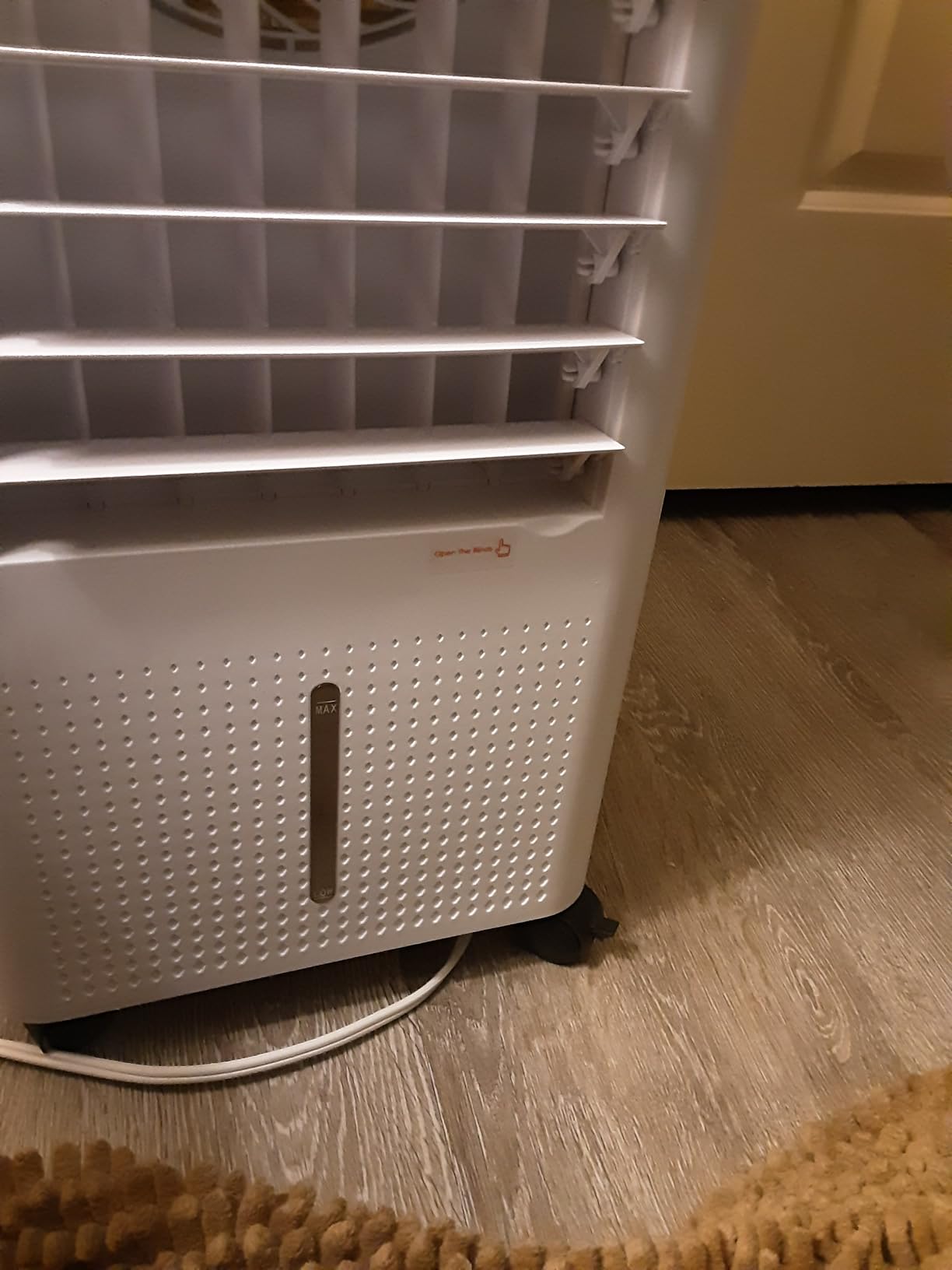
A 2.1-gallon tank is the practical constraint for all-day work. Without a hose connection, you are refilling several times during a long session, and a visible water level window helps but does not eliminate the chore. If you plan to run this unit as your primary garage cooling, budget a hose adapter or a small pump; if you plan to run it for a few hours at a stretch, the tank is fine.
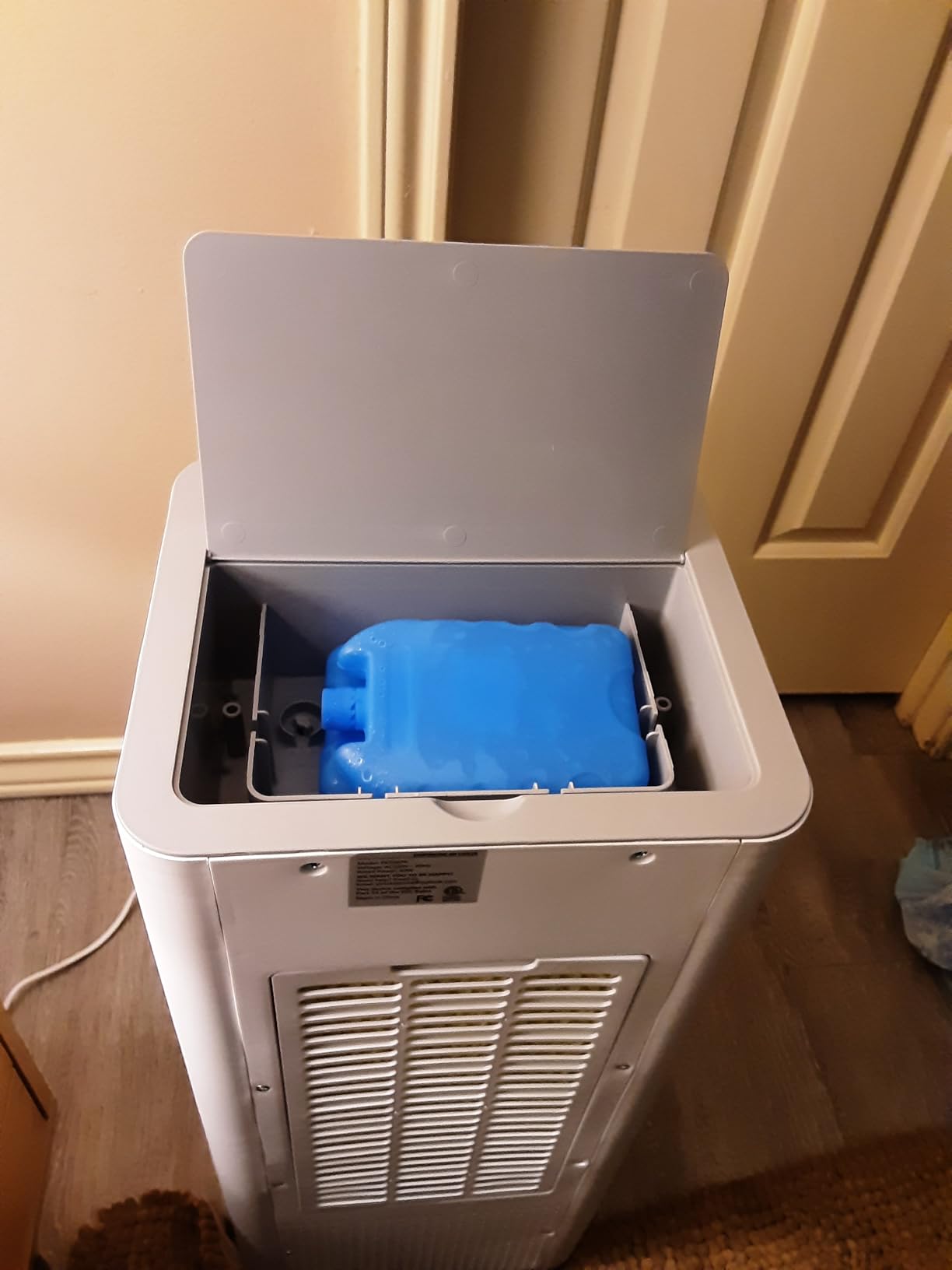
Two ice packs are included, and they cool a small volume of water that helps a little at the discharge, but owners report the effect is short-lived. The ice is a garnish rather than a cooling strategy.
At 4.2 across 85 reviews, the middle of the pack, with clear praise for the feature set and ease of movement. The negative feedback divides sharply: some buyers bought it expecting real cooling from the advertised cool air mode and were disappointed, and a small number report outright failure within weeks with no response from the manufacturer.
That failure is common in the low-cost evaporative category and it shapes our advice. Buy it for circulating air at a spot, not for a temperature drop, and buy it from a seller with a straightforward return process.
Think of it as a personal air circulator with a wetted pad attached, aimed at a workbench, a chair, or a spot where you stand and work on a vehicle. In a large garage with a hot zone at one end, that targeted use is genuinely effective without the airflow of a 3100 CFM machine.
3100 CFM airflow
950 sq ft coverage
10 gallon reservoir
68 dB
1/5 HP three-speed motor
UL-listed GFCI plug
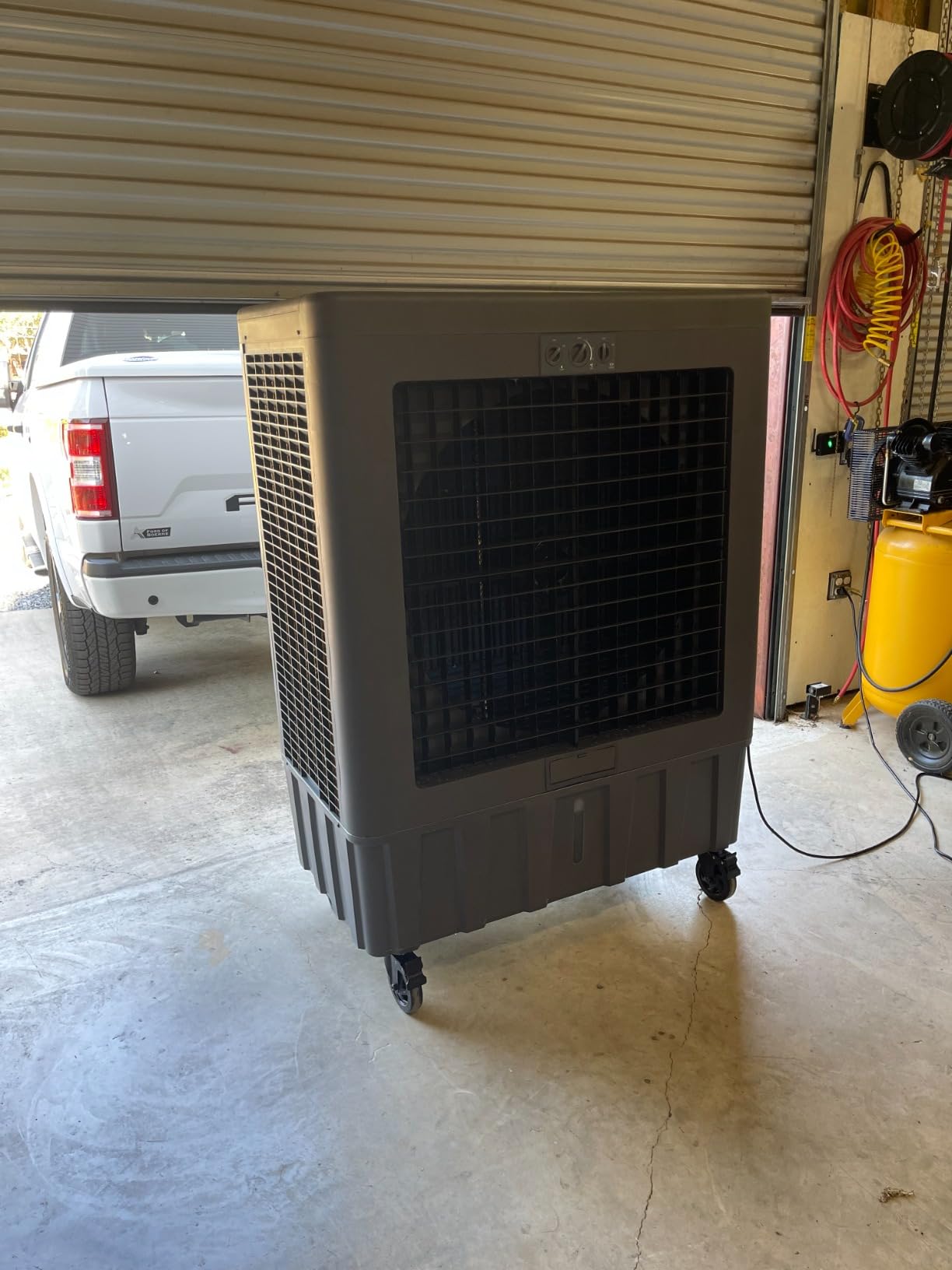
This is the only unit in the roundup that a tool brand built to live in a garage, and the design decisions show it. The tool tray and compartments are integrated into the body rather than being an accessory, the plug is UL-listed and GFCI-protected, and the resin is UV-resistant so it can sit in direct sun through a side window or near an open door. Those are not features you would choose for a bedroom, and they are exactly what a shop needs.
The GFCI plug deserves a specific mention. In a workshop, damp hands and power tools share circuits, and ground-fault protection on a water-cooled appliance is the difference between a non-event and a dangerous one. It is a cheap feature that most evaporative coolers skip.
Cooling output is unremarkable in the best way: 3100 CFM, a 950 square foot rating, high-density media panels with 80 percent more evaporation surface area than standard density panels, and an oscillating delivery pattern. It does what the class leaders do.
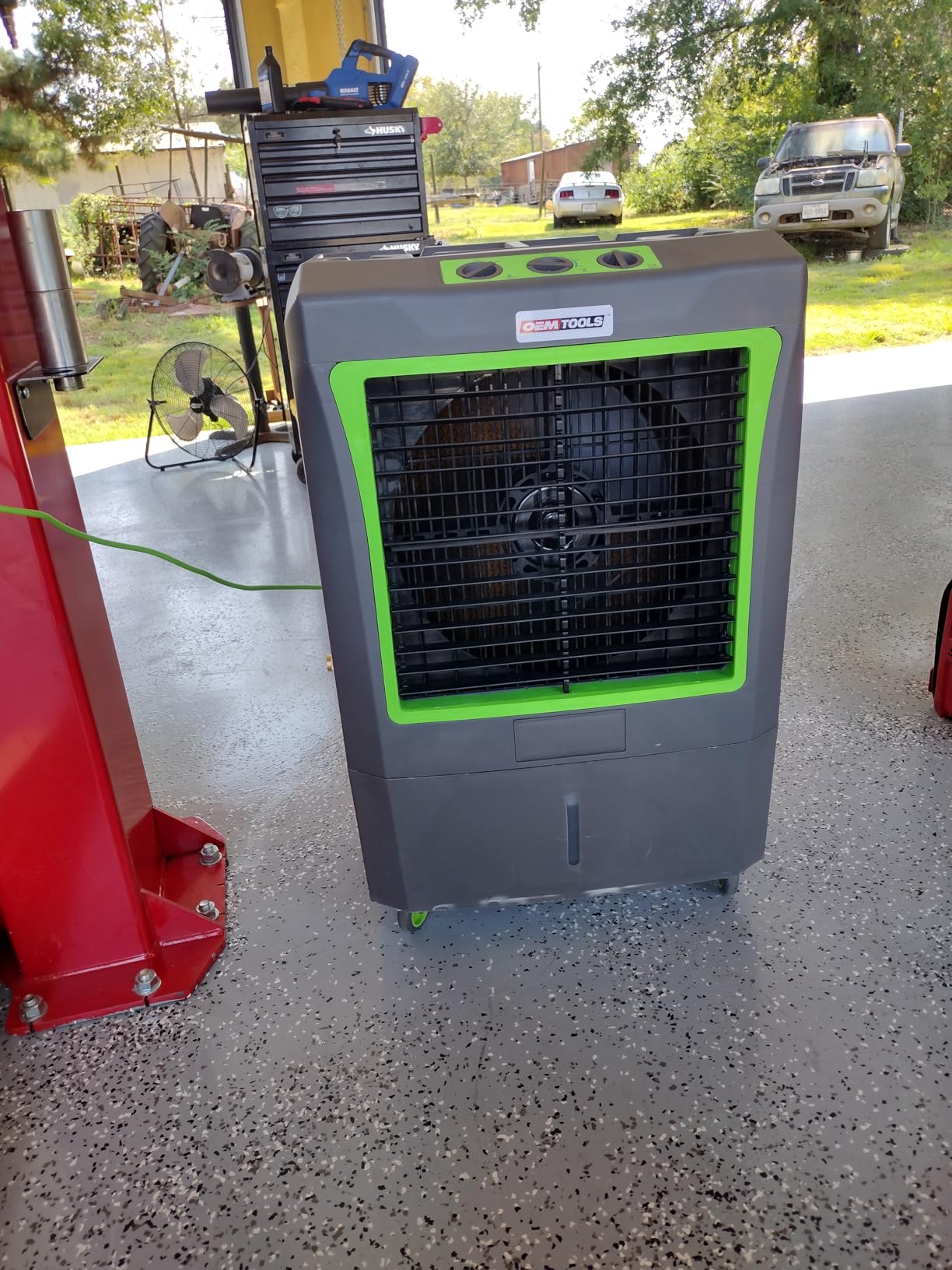
The built-in tray and compartments turn a floor appliance into a workstation. In practice owners use them for gloves, glasses, tapes, measuring tools and the small hardware that would otherwise migrate to a shelf. Over a long project that is a real reduction in friction, and it is a benefit you simply cannot retrofit onto a generic evaporative cooler.
It also affects where you put the unit. Because the storage is at the front, the natural placement is at the edge of the workbench facing into the space, which happens to be close to the ideal position for pushing cooled air across the room rather than out the door.
At 68 dB this is the loudest unit here, and it is a genuine drawback. One reviewer found it distracting while on the phone, which tells you something about its acoustic character in a quiet indoor setting. In a working garage with a compressor, a radio and an open door, it is entirely unremarkable, and that is the environment it was designed for.
The patented axial propeller is credited with quieter, more even air distribution than a conventional bladed fan, and one owner reports the water pump was quieter than expected and easy to service. The motor is a 1/5 HP three-speed unit on knob controls, which is the smallest motor in this airflow class, and that is consistent with the higher noise figure.
At 45 inches tall and 41.3 pounds, with a 10-gallon reservoir, this is a top-heavy unit and several owners call it awkward to move even before you fill it. The casters help, but rolling it over a threshold or across an uneven floor with a full tank takes two people. Plan the placement before you fill it.
Cleaning access is the other recurring complaint: the water tank and pad area are difficult to reach for routine cleaning. On an evaporative cooler, cleaning is not optional, because mineral scale on the media reduces evaporation and quietly reduces cooling. Give this unit a generous working clearance on the side you plan to service from.
The UV-resistant resin is a quiet advantage in a real garage, where a side door or window may admit direct afternoon sun for years. Most plastic-bodied competitors in this roundup use generic resin and will discolor and embrittle faster under sustained exposure. If your cooling spot is partly outdoors, a covered patio beside the shop, or a bay with a large west-facing opening, that matters.
The electrical footprint is modest: 115 volts, 115 watts, 1.3 amps. That is roughly a third of what a comparable portable air conditioner pulls while running, which is the core economic argument for evaporative cooling in a garage.
Anyone whose garage is a working shop rather than a parking space, and anyone who values electrical safety features in a damp environment. The thin review count of 69 means long-term durability data is still forming, so it is a slightly less proven bet than the Hessaire units, but the design intent behind it is the most garage-specific of anything we tested.
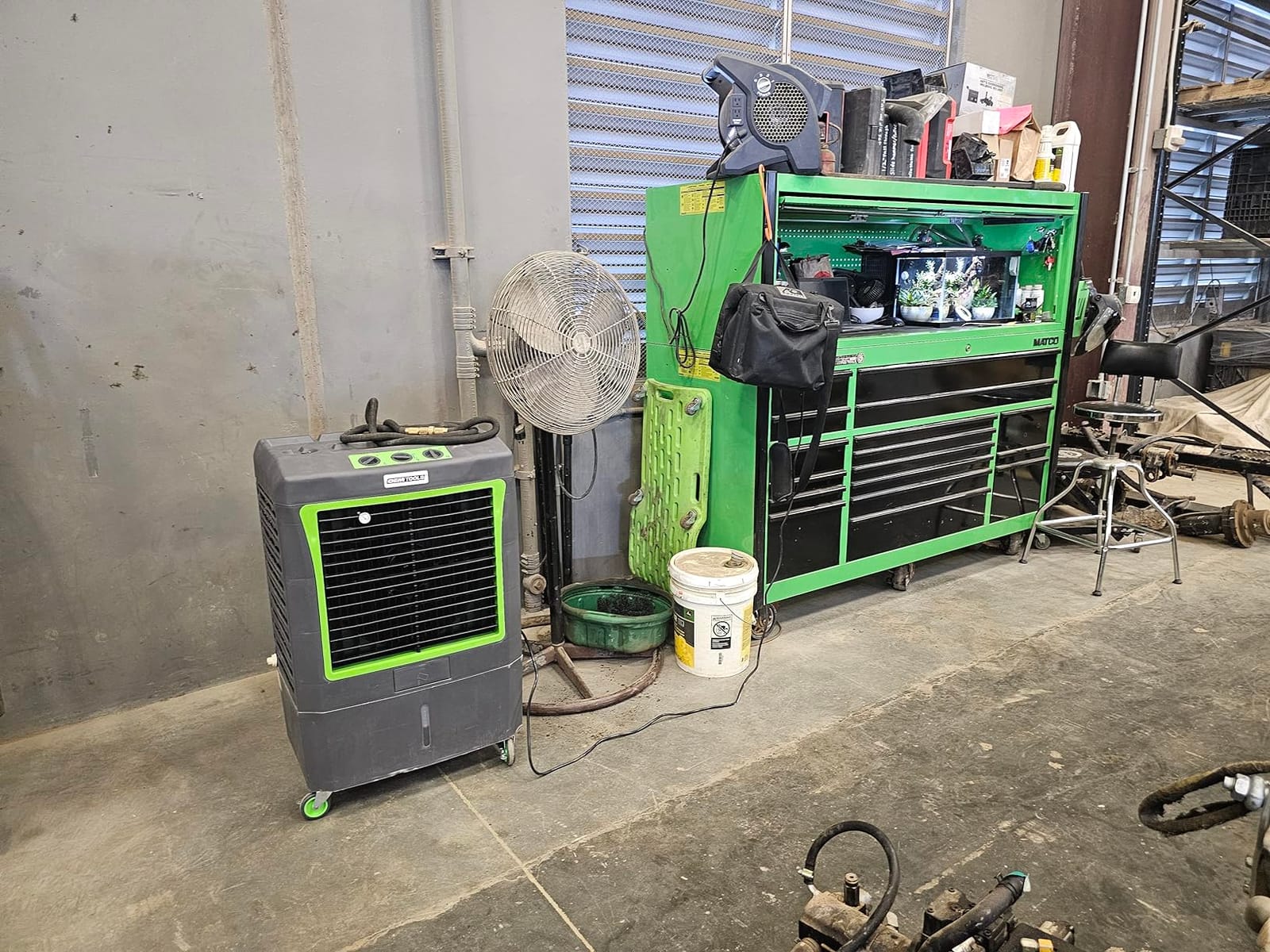
4500 CFM airflow
1200 sq ft coverage
32 gallon reservoir
8 to 10 hour runtime
65 dB
400 watts
The headline number here is the tank. A 32-gallon reservoir giving 8 to 10 hours of runtime per fill is roughly three times what any other unit in this roundup offers, and it changes how you think about owning an evaporative cooler. A continuous-fill hose means you are effectively never refilling by hand, even on the longest jobs.
At 4500 CFM over a rated 1200 square feet, it is also the largest coverage rating in the group apart from the 11,000 CFM Hessaire. Owners use these in barns, warehouses, restaurant patios and outdoor event setups, and the general report is strong cooling with a 40-foot air throw from the two-part horizontal louvers.
Several buyers also report it holding up in humid Southern climates, which almost no evaporative cooler in this roundup can claim. That is worth investigating carefully if you are outside the Southwest, because it runs counter to the standard humidity ceiling.
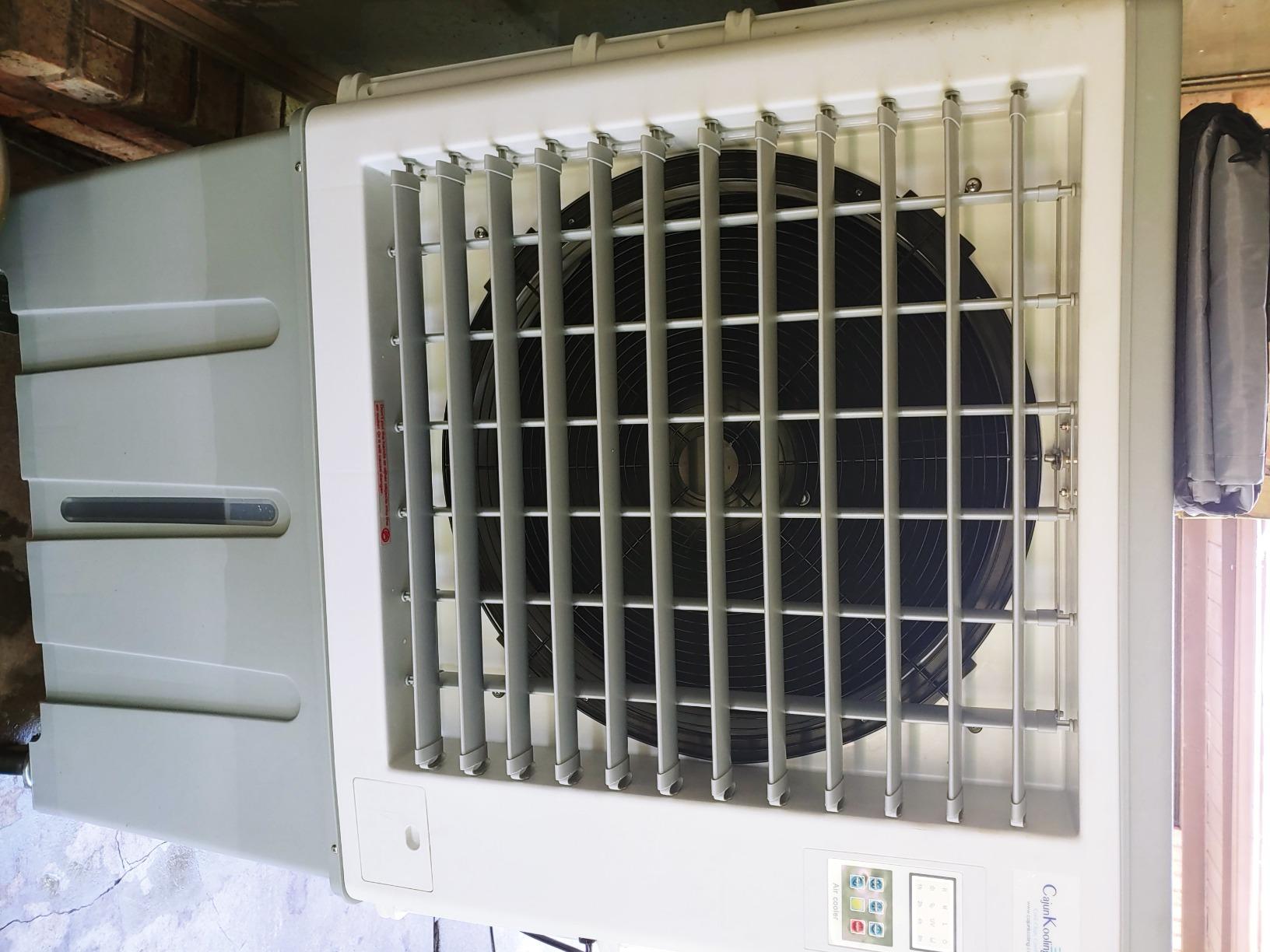
The internal metal parts are coated to resist salt water, hard water and limestone buildup. That is a direct answer to the mineral-scale problem that shortens pad life and reduces cooling efficiency in hard-water areas, and it is the sort of detail that only appears on units built for commercial service. If your water is heavily mineralized, this is a meaningful advantage over the plastic-and-plated-steel construction of the residential units.
External screens protect the cooling pads from dust, pollen, insects and pet hair. In a garage, that matters more than it sounds: pad media that clog with sawdust or pet hair lose evaporation area quickly, and a screen you can hose off once a season is a real maintenance saving.
For a shop that runs a cooler through a full working day without a pause, this is the number that matters. Combined with the hose attachment and the internal float valve for continuous fill, it becomes a semi-permanent installation rather than an appliance you manage.
The latching side panel for adding ice without opening the main lid is a well-judged convenience, and the pump shut-down valve that activates on low water protects the pump from running dry, which is the single most common way these units get damaged.
A remote control with three speeds, oscillation and a 1 to 8 hour automatic off timer is unusual at this size, and it lets you cycle the unit without walking back to it. The electrical draw is 400 watts on standard 110 volts at 3.2 amps, which is still a fraction of a portable air conditioner and appropriate for continuous duty.
At 65 dB it is among the loudest units here, and several owners note you have to run it at speed to hear it at all, which is the opposite trade-off. The noise is present but manageable in the large open spaces this unit is built for.
The 26-review base is thin, and a 4.6 average on that sample is far less reassuring than a 4.3 on thousands of ratings. Weight is the other issue: at 84 pounds, this is nearly double the weight of the 3100 CFM residential units, and moving it once the tank is full is a two-person job. The listing also positions it as an outdoor or very well ventilated unit rather than something for enclosed indoor spaces.
It also carries the clearest commercial limitation: this is not a residential purchase. The economics only make sense if you are cooling a large open space, running it many hours a day, or operating in a genuinely commercial setting where the alternative would be a much larger cooling system.
Barns, workshops, warehouse-adjacent spaces, covered outdoor work areas, restaurant patios and event setups. If you have a large, hard-water, high-use environment and you want to fill the tank once and forget about it for the day, nothing else in this roundup does that.
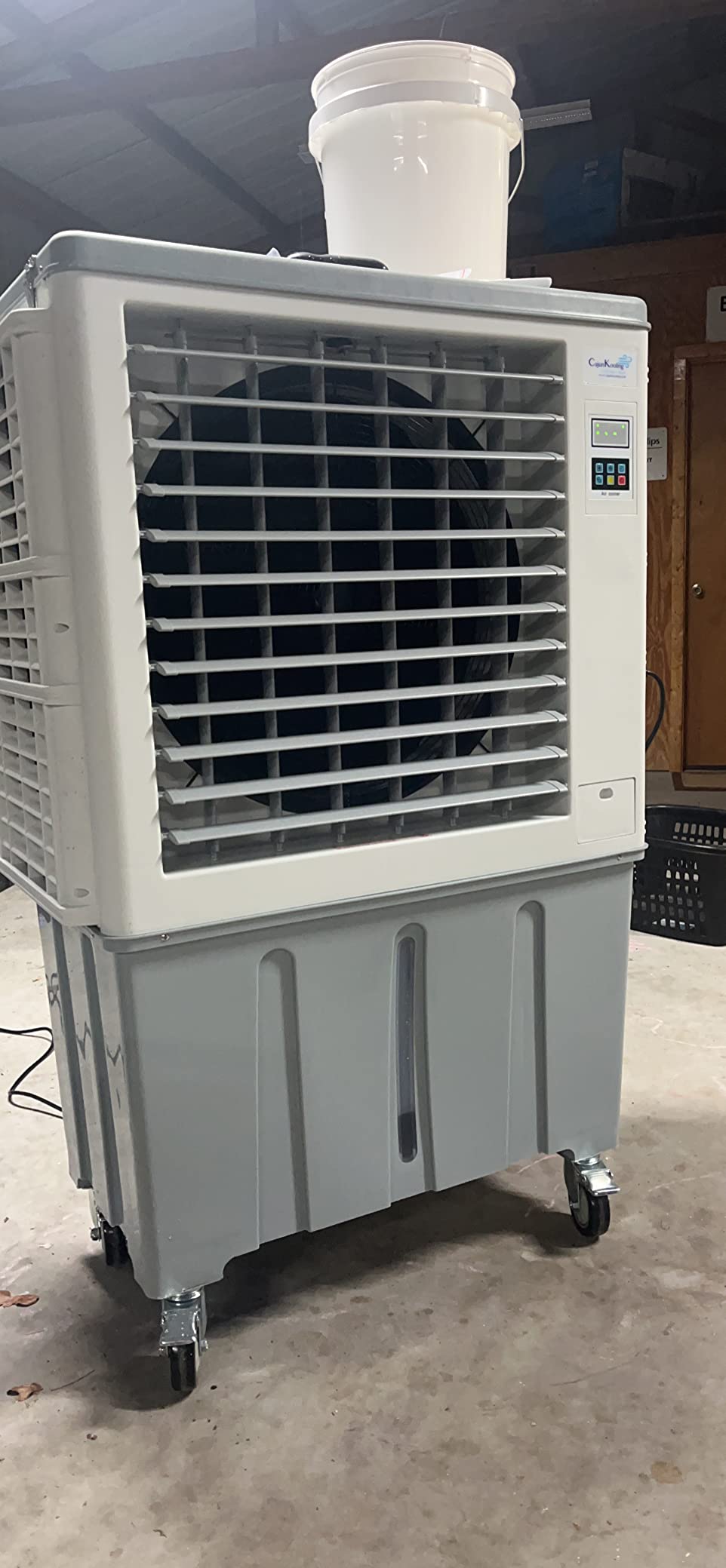
11000 CFM airflow
32.8 gallon tank
XeL50 high-density media
80 watt draw
57 dB
126 pounds
Eleven thousand cubic feet per minute is not a residential number, and it is the reason this unit exists. One owner cools a 30 by 40 foot spray-foam insulated workshop with it. Multiple reviewers describe it as the difference between a workable and an unworkable shop on a 100-plus degree day, and at 80 watts the running cost is reported by the manufacturer at roughly five cents per hour.
The efficiency figure deserves attention because it seems implausible until you understand the design. The 0.44 amp draw is the lowest of any unit in this roundup by a wide margin, and it comes from a large-diameter, low-speed axial propeller that moves a lot of air with very little energy rather than a small fast fan blasting a little air.
The tank is 32.8 gallons with a direct hose fitting and float valve, so it runs as a semi-permanent installation. At 59 inches tall it fits under standard garage and shop door headers, which is a real consideration when you are planning the exhaust path.
Use the divide-by-two rule and this unit only makes sense in a genuinely large space. A 1000 square foot shop at 12-foot ceilings is 12000 cubic feet, which puts the target around 6000 CFM. This unit covers that with headroom, which is what you want in a space with high ceilings, a lot of heat-generating equipment, and a need to move air through rather than merely circulate it.
If you are cooling a standard two-car garage, this is wildly oversized and the extra airflow buys you nothing but an invoice. Match the unit to the cubic footage, not the other way around.
The pads are high-density XeL50 media providing 80 percent more evaporation surface area than normal density media, and that is genuine performance engineering. The catch is that they are corrugated paper media, and owners consistently report a strong wet-dog smell on first startup that takes many uses to settle.
Run the unit outside or in a well-ventilated space for the first several hours with the door wide open. It is a minor annoyance rather than a defect, but it is a jarring first impression if you unbox the unit in a closed garage and switch it on.
This is the lowest-rated unit in the roundup at 4.0, and the one-star cluster is entirely about manufacturing rather than cooling: a motor that rusted after a single season and locked up by the second, a pump feed hose that arrived unplugged and was repaired at the factory with tape, and weep holes positioned away from the pump that leave dry patches in the media unless you clear them yourself.
That last one is worth understanding. Media with dry patches has less active evaporation surface, which lowers the cooling delta in exactly the conditions where you are relying on it most. Check the weep holes on a new unit and clear them before first use. There is also no water shutoff when the tank empties, and one reviewer stopped using the unit overnight for that reason. With a hose connection and a float valve that problem largely disappears, which is another reason to plumb it in rather than run it dry-cycle.
At 126 pounds, this is by far the heaviest unit in the roundup and it effectively stays where you place it. That is a real advantage for a semi-permanent installation and a real disadvantage if you wanted a portable cooler. Plan the exhaust path, the floor position and the drain before you fill it, because you will not be moving it afterwards.
Large commercial workshops, insulated detached shops, welding and fabrication bays where heat accumulates from equipment, and any space where you need to move thousands of cubic feet of air to make the afternoon survivable. For a standard residential garage, it is the wrong answer and the 3100 CFM class covers it.
250 sq ft rated coverage
36.9 dB operation
1.06 gallon tank
12 hour timer
3 speeds and 4 modes
65 watts
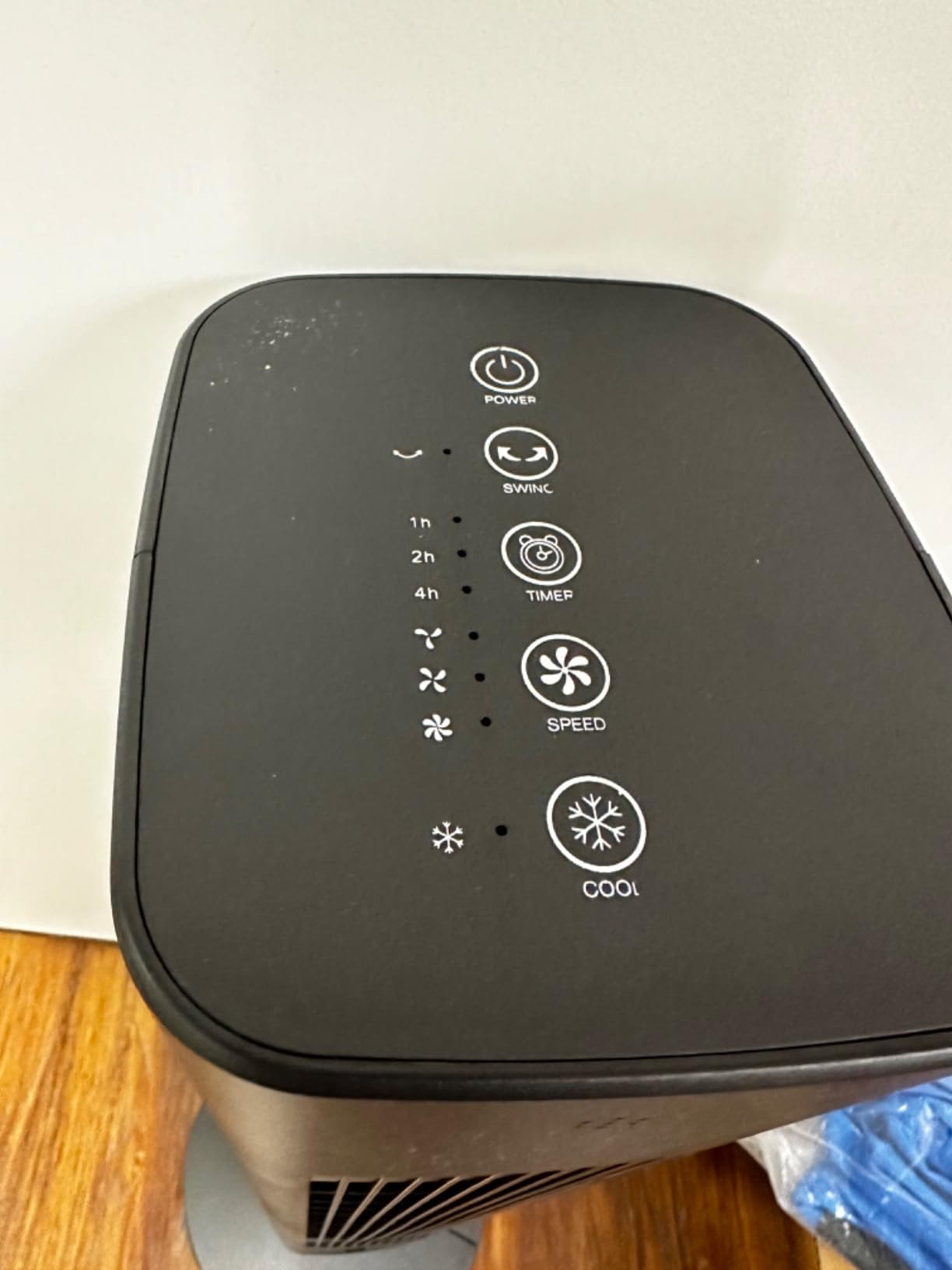
At 36.9 dB this is the quietest evaporative cooler in the roundup by a wide margin, roughly 22 dB below the loudest unit, and that gap is audible in a way numbers do not convey. The bladeless 45-inch column also has no exposed fan blade, which matters in a home with small children or a curious dog.
The windowless, hose-free design is genuinely convenient. It plugs in and goes, with no window kit, no exhaust hose and no installation, which is the opposite of what a refrigerant air conditioner requires. A 1 to 12 hour timer with automatic shutoff, a 20-foot remote, a washable filter and an anti-dumping base round out a well-considered package.
Its limit is scale. The 250 square foot rating and 1.06-gallon tank place it firmly in the bedroom and home office category. This is the designated compact option in our selection, and for a garage it is a weak fit that makes sense only in a very specific spot.
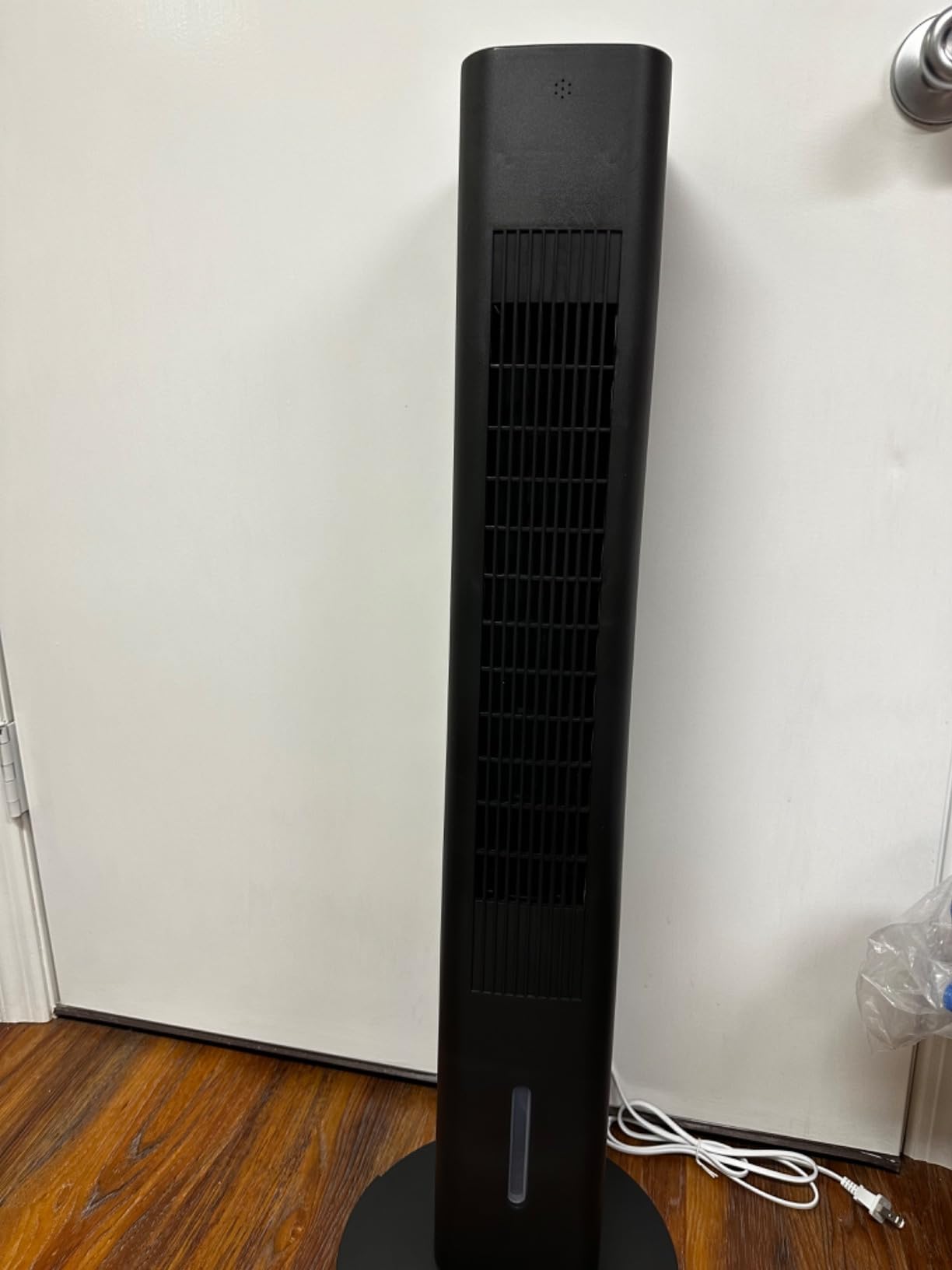
A 250 square foot rating corresponds to roughly a 12 by 12 foot space at normal ceiling height, which is a bedroom or a small office. Even with the garage door open for ventilation, a room-scale unit cannot lower the temperature across a 480 square foot two-car space in any meaningful way. The cooling is local to the discharge.
There is also no published CFM figure to compare against the larger units, so you cannot evaluate the underlying airflow at all. Combined with the small tank, that makes it straightforward to place: this is a personal comfort appliance, not a garage air mover.
The 36.9 dB rating is the standout number in this roundup. It is quiet enough to run in a bedroom while you sleep, and combined with the sleep mode and the 12-hour timer, the unit can run all night on a gradual ramp-down without waking you.
The bladeless column is the reason for the acoustics as much as the sound level. Without a conventional bladed fan breaking the airstream, the noise is mostly the movement of air itself. The anti-dumping base is a small engineering touch that matters on a 45-inch column with a 1.06-gallon tank, which is a high center of gravity relative to the water load.
Four industrial-grade ice packs plus the 1.06-gallon tank give a claimed up to 10 hours of runtime in cooling mode, and the cooling mode is stated to deliver up to a 10 degree drop. Several buyers expected more chilling punch than they got, and one reported the ice packs do not cool the tank water meaningfully. The honest reading is that the ice packs add a small amount of extra chill on top of the evaporative effect rather than driving it.
One more data-quality note: the listing mixes 1.06 gallon and 1.2 litre tank figures on the same page, which are not the same number. It is a minor inconsistency but it is a reminder to check the physical label on the tank rather than the listing copy.
A garage gym corner, a small office or hobby room built inside a detached shop, or a spot next to a chair where you sit and work on a laptop in the evening. In those situations the quiet operation, the bladeless safety and the zero-installation setup outweigh the lack of garage-scale airflow entirely.
For a review desk that runs alongside a workshop, this is a defensible second appliance. As the primary cooling solution for a two-car garage, choose one of the 3100 CFM units above.
Most sizing mistakes come from buying by square footage alone. The arithmetic that actually matters uses volume, because an evaporative cooler’s job is to move air through wet media, and the same square footage with nine-foot ceilings and twelve-foot ceilings is a very different problem. Work through these five steps before you pick a model.
Measure the floor area first, then multiply by the average ceiling height. A standard two-car garage is typically about 20 by 24 feet at nine-foot ceilings, which gives 480 square feet and roughly 4320 cubic feet. A three-car garage at the same height runs closer to 6500 to 7000 cubic feet. If you have a loft or exposed storage above, measure the space the air actually occupies rather than the total footprint.
This is the standard rule of thumb in the trade, and it lands in a sensible place. A two-car garage at 4320 cubic feet gives a target of about 2160 CFM, which means a 3100 CFM unit is comfortably adequate and a 4800 CFM unit gives real headroom. A three-car garage at 6800 cubic feet gives a target near 3400 CFM, which puts the 4800 CFM class and up into contention.
Use the rule as a floor rather than a ceiling. If your garage is unusually well insulated and shaded, you can size down. If you have west-facing glass, a hot attic, or a lot of heat-generating equipment, size up one class.
Evaporative cooling works by evaporating water into the airstream, and evaporation rate falls as the air gets wetter. Below roughly 40 percent relative humidity, a good unit can drop a garage 20 to 25 degrees. Between 40 and 60 percent, expect a smaller drop. Above 60 percent, the unit mostly circulates air and adds moisture, which is the failure condition owners in r/garageWorkshops and on festoolownersgroup describe as the cooler becoming just a fan.
Monsoon seasons break this. Owners in Arizona report units that work well for most of the summer and stop working entirely during the July and August monsoon, when humidity climbs overnight and never drops. If that describes your area, an evaporative cooler should be a shoulder-season and dry-spell device rather than a summer solution, and a dehumidifier pairing or a refrigerant unit is the more reliable answer.
The moisture question is the one we would not gloss over. Running a cooler adds humidity to a space full of steel vehicle frames, toolboxes, concrete and stored cardboard. That is the exact concern raised in garage workshop forums, and it is legitimate. Set the unit up with the exhaust path as far from stored metal and paper as practical, and consider running a dehumidifier in the closed half of the space.
Pad sidedness is the specification most buyers ignore and most benefit from. A three-sided pad wraps the intake around three faces of the tower; a four-sided layout adds the fourth. More surface area in the air path means more evaporation and a lower discharge temperature for the same fan speed.
When two units carry the same CFM rating, check sidedness before you compare anything else, because the CFM number alone does not account for how much wet media the air actually passes through. This is the difference between the Hessaire MC37V and several 3100 CFM units with single-sided panels.
An evaporative cooler needs somewhere to send the humid air it makes. A garage with a fully closed door is not a sealed cooler; the unit needs an opening. Cracking the main door and using a window on the opposite wall, even a small one, creates a cross-flow that pulls cool air in and pushes humid air out.
Position the unit a few feet inside the opening with the discharge aimed along the length of the space, not out the door. Running it with the door wide open and pointing outward means you are cooling the driveway. Start the unit twenty minutes before you plan to work, because the pull effect takes time to draw the heat out of the concrete and stored mass. Our dry-climate evaporative cooler guide covers the vented versus sealed design question in more detail.
Three running costs sit behind the sticker figure, and all three matter more than the purchase price in the long run. Water consumption is the most annoying: at high settings, a large unit can move through a gallon in roughly fifteen minutes, so a full workday of use means hauling more water than most people expect. A hose connection with a float valve solves this completely and is the single best convenience feature to pay for.
Pads are a consumable. In hard water, expect faster mineral scaling and more frequent replacement, and expect cooling performance to fade if you skip maintenance. A monthly routine of running the media dry and flushing the tank prevents most of that.
Electricity is where evaporative coolers win decisively. The residential coolers in this roundup draw between 80 and 250 watts, while a portable air conditioner of comparable cooling output draws several times that continuously. The comparison in our humidifier guide covers the same principle for a different device class. Over a full garage summer, the gap is large enough that the running cost effectively disappears from the purchase decision.
Yes, but only with two conditions met: dry air and an open exhaust path. An evaporative cooler lowers temperature by evaporating water into the airstream, so it needs low relative humidity to work and a cracked garage door or open window to vent the humid air it produces. In dry climates, a 3100 CFM unit can drop a standard two-car garage by 20 to 25 degrees. Above roughly 60 percent humidity it stops cooling and simply adds moisture to your tools and vehicle frames.
Hessaire is the strongest all-round brand for garages because of airflow class and owner record: the MC37M and MC37V both deliver 3100 CFM rated for 950 square feet, and the MC37V is the best-built of the lot with stainless steel fasteners. OEMTOOLS is the best choice when the garage is a working shop, since its 23968 includes a built-in tool tray and a UL-listed GFCI plug. For very large spaces, Hessaire’s MC92V at 11,000 CFM leads on raw output.
No. A swamp cooler and an evaporative cooler are two names for the same device. Both pull warm air through water-soaked cooling pads and blow out cooler, more humid air. The term evaporative cooler is the more general and accurate name, while swamp cooler is the traditional label for the same appliance. Neither uses a refrigerant cycle, which is the real difference from a portable air conditioner.
Yes, if the air is dry. Outdoor temperatures of 100 degrees or more are the conditions where evaporative cooling performs best, because the gap between the dry-bulb and wet-bulb temperature is widest then. The limiting factor is humidity rather than heat, so a 100 degree day in the Arizona desert produces a large temperature drop, while a 100 degree day in a humid Gulf Coast location produces almost none.
They are among the best choices for garages, and the MC37M at 3100 CFM has the deepest owner record in this roundup with roughly 4,700 ratings. Owners in dry states consistently report it making afternoon work possible, and the 10.3-gallon tank with a garden hose adapter removes the daily refill chore. The main criticisms are mediocre rotomolded plastic fit and finish, a fragile fill-door latch and noise on the higher settings. The MC37V fixes the hardware with stainless steel fasteners.
In a dry climate, expect a 15 to 25 degree drop across a well-ventilated space, with the best results in the 700 to 1,500 square foot range for a 3100 CFM unit. Owners report 20 to 25 degrees under 900 square feet. The drop shrinks as humidity rises, and above roughly 60 percent relative humidity the unit provides air movement rather than meaningful cooling. Concrete and stored mass also absorb heat, so start the unit twenty minutes ahead of working in the space.
If you have a standard two-car garage in a dry climate and want the safest general choice, the Hessaire MC37M is the pick, backed by the deepest owner record in the group. If you want the same airflow with noticeably better hardware, step up to the Hessaire MC37V. When the garage is a working shop rather than a parking space, the OEMTOOLS 23968 wins on its tool tray, GFCI plug and UV-resistant body, provided you can live with the noise.
For a three-car workshop, the Uthfy 4800 CFM unit gives you metal construction and more air than the residential class, and the CAJUN CK4500-S is the answer when you want a 32-gallon tank and a pump shutoff valve for high-use commercial work. Very large insulated spaces justify the Hessaire MC92V, though at 126 pounds it is a fixed installation rather than a portable one.
The compact coolers earn their place in specific spots rather than as garage cooling. The PNTCK handles a single workbench for a fraction of the outlay, and the FLOWBREEZE is the only one quiet enough to sit in a garage office. Skip the Ashihoti for anything larger than a small corner; 100 CFM will not move a garage.
Before any of them, check your humidity. If your area sits above 60 percent for weeks at a time, or you are heading into a monsoon, buy a refrigerant unit or a dehumidifier instead and save the evaporative cooler for the dry months. Get the sizing arithmetic right, crack the door, plumb in a hose, and the running cost of any of these is low enough that the decision comes down to your floor area and your climate. Our evaporative humidifier guide covers the winter half of the year if you plan to run these units in both directions.