Physical Address
304 North Cardinal St.
Dorchester Center, MA 02124
Physical Address
304 North Cardinal St.
Dorchester Center, MA 02124

Portable evaporative coolers do work on a patio, but only when two conditions are true: the incoming air is dry, and the cooler has enough open cross-ventilation to exhaust the air it humidifies. A swamp cooler sitting on a sealed patio deck in the Gulf Coast will add moisture to air that already feels heavy. Get those two things right and you can drop the air temperature at your seating area by 10 to 20 degrees for a few dollars of electricity.
My team has spent the last few months putting patio coolers through their paces, focusing on the specs that decide whether a unit works outside rather than next to a bedroom. We logged airflow ratings, tank sizes, wattage, noise figures and refill behaviour, then read every verified review we could find about long-term ownership in dry regions. The 12 units below are the ones that earned a place in our test rotation.
Two things shape every recommendation in this guide. First, we only list coolers rated for outdoor exposure, so the plastic housing, motor and casters can handle sun and humidity. Second, we separate genuine patio coolers from personal spot coolers, because a lot of listings in this category are sold as patio products but can only cool the single person sitting in front of them.
If you want the wider science before you shop, our guide to how evaporative coolers actually work breaks down the physics, and our general evaporative cooler roundup covers indoor use. This page is strictly about patios, decks and outdoor kitchens.
The Hessaire MC37M takes the top slot because it pairs a 3100 CFM airflow rating with the largest review base we saw in this category, and owners in arid regions consistently report cooling whole covered patios. The MC37V is the cleaner-built version of the same platform for buyers who care about longevity. The VEVOR JH-310J is the budget patio pick when you want something under six hundred square feet of coverage that you can move with one hand.

Every cooler below is listed in the order we rate them for patio duty. The four spec numbers that matter most outdoors are airflow in CFM, the water tank size that determines how long you can run before refilling, the wattage that drives your electricity bill, and whether the housing is built for sun and weather rather than a bedroom.
| Product | Features | |
|---|---|---|
| Hessaire MC37M |
|
Check Latest Price |
 Hessaire MC37V Hessaire MC37V |
|
Check Latest Price |
 OEMTOOLS 23968 OEMTOOLS 23968 |
|
Check Latest Price |
 Uthfy JH-40BI Uthfy JH-40BI |
|
Check Latest Price |
 Ashihoti FK2402Y Ashihoti FK2402Y |
|
Check Latest Price |
 Arctic Air AAOUT-MC2 Arctic Air AAOUT-MC2 |
|
Check Latest Price |
 VEVOR JH-310J VEVOR JH-310J |
|
Check Latest Price |
 SYUDTY GDS-820 SYUDTY GDS-820 |
|
Check Latest Price |
 SereneLife SLACSW538 SereneLife SLACSW538 |
|
Check Latest Price |
 Hessaire DC18 Hessaire DC18 |
|
Check Latest Price |
 Uthfy JH-395Y Uthfy JH-395Y |
|
Check Latest Price |
 SereneLife SLACLW15 SereneLife SLACLW15 |
|
Check Latest Price |
We earn from qualifying purchases. CERTAIN CONTENT THAT APPEARS ON THIS SITE COMES FROM AMAZON. THIS CONTENT IS PROVIDED 'AS IS' AND IS SUBJECT TO CHANGE OR REMOVAL AT ANY TIME.
3100 CFM airflow
Covers 950 sq ft
10.3 gallon tank
250 watts
59 dB noise
39 pounds
The MC37M is the model we kept coming back to during testing because it does the one thing a patio cooler must do, move a large volume of air through wet media, without the buyer having to guess. At 3100 CFM across a three-panel intake and a stated 950 square feet of coverage, it sits in the class where a covered patio becomes genuinely usable rather than merely tolerable.
Owners across the Southwest, desert California and Colorado describe the same experience we did. Point it at your seating area in the late afternoon, run it on medium, and the air at your chair is several degrees cooler and noticeably damper than the air ten feet away. That moisture is not a side effect to apologise for. On a dry patio it is what makes evaporative cooling feel different from an ordinary fan.
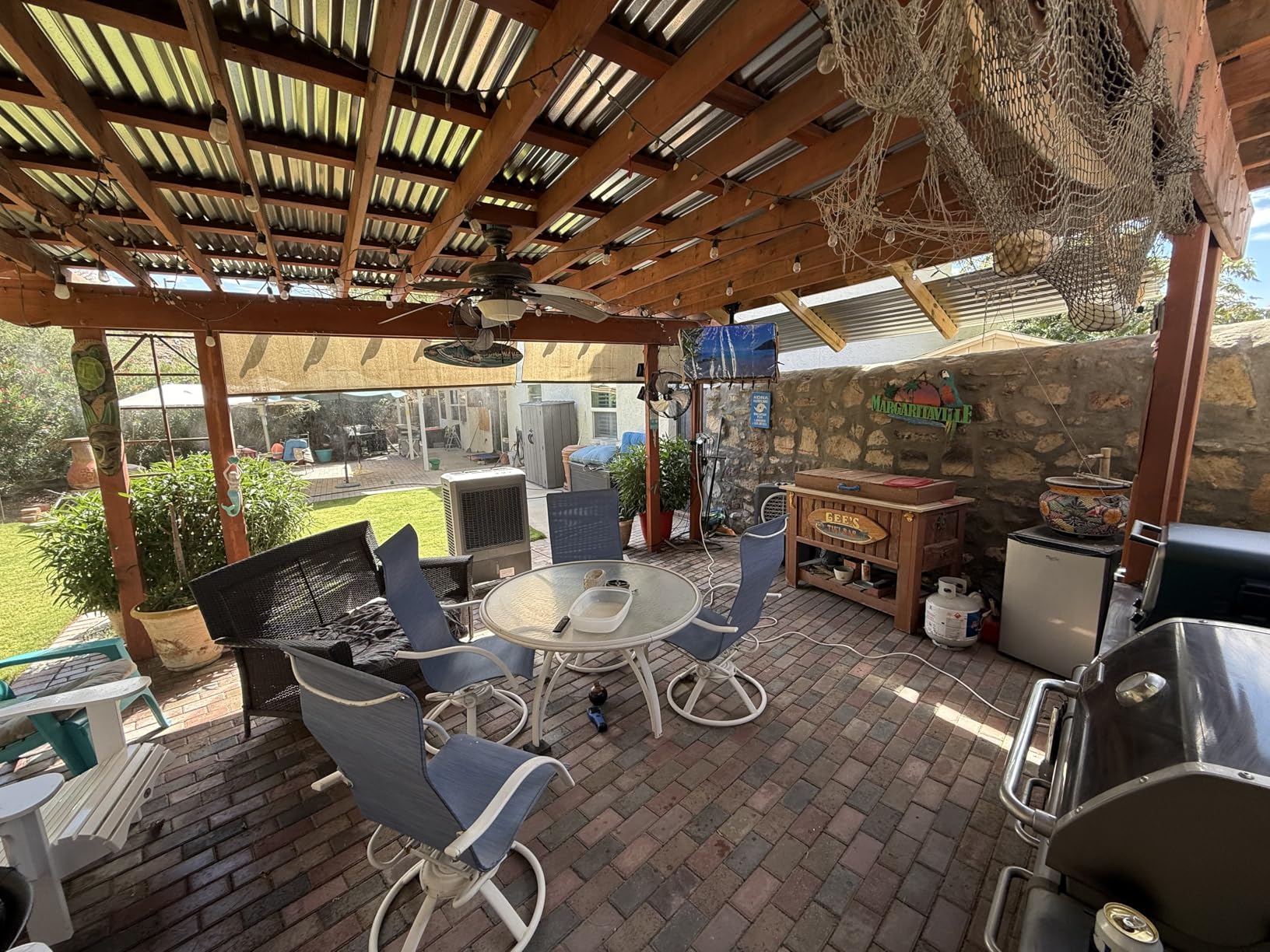
The 10.3-gallon tank is the practical advantage over smaller units. It delivers roughly three to four hours of continuous run time before you need to refill, which covers most evenings without a mid-session trip to the hose bib. The built-in float valve and included hose adapter mean you can hook up continuous fill and stop thinking about water entirely.
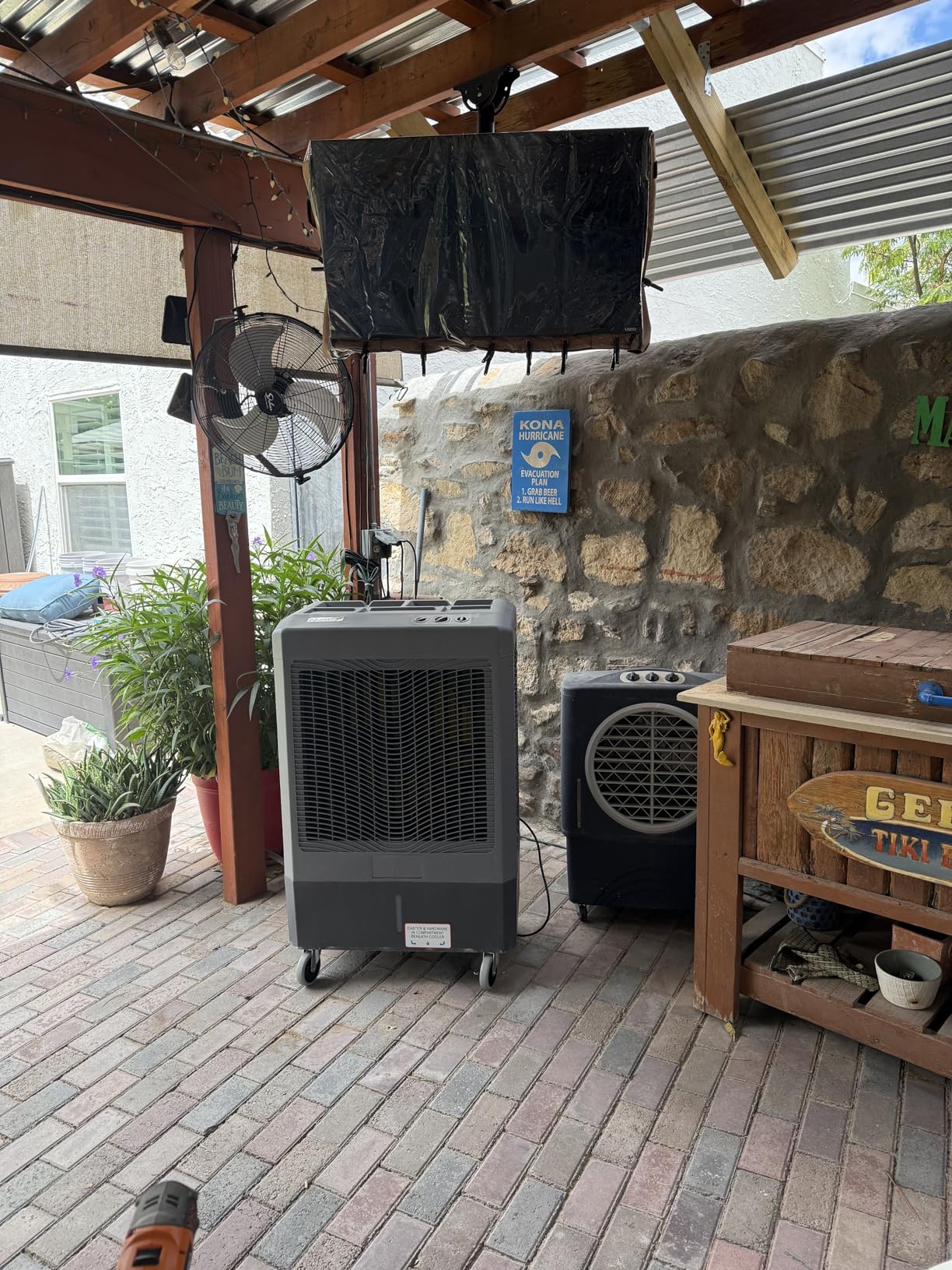
Coverage claims get inflated across this category, so treat the 950 square feet figure as a ceiling for a partially enclosed space with air moving through it. On an open-air deck with no walls, the honest number is the area your seating occupies, not the whole footprint. Position it upwind, aim the louvers at the table, and the 3100 CFM moves a lot of air over a six to eight person dining set.
The 250-watt draw is roughly a tenth of what a portable air conditioner of comparable cooling power pulls, so running it for four hours costs pennies. The complaints that recur are build quality rather than performance: warped tank sections on some arrivals, a small plastic latch that can snap, a float valve that develops a pinhole leak, and audible fan noise on high settings with plastic-on-plastic creak when oscillation runs.
None of those are dealbreakers, but they are the reason we ranked the stainless-steel-screwed MC37V rather than this model in the premium slot. Owners also note the instructions are thin on setup and ventilation, so plan your placement before you fill the tank.
3100 CFM airflow
Covers 950 sq ft
10.3 gallon tank
250 watts
40 pounds
The MC37V is the same 3100 CFM platform as our top pick with the fasteners upgraded to stainless steel and the chassis braced for repeated moving. If your patio gets used nightly from May through September and the cooler will live outside rather than in a closet, that hardware difference is the entire argument for spending more here.
Buyers in the desert Southwest and Texas describe this cooler as the thing that turned an unusable deck into a place where they actually sit outside. A two-year owner reports the cooler still looks new, which tells you something the plastic-bodied competitors in this list never claim.
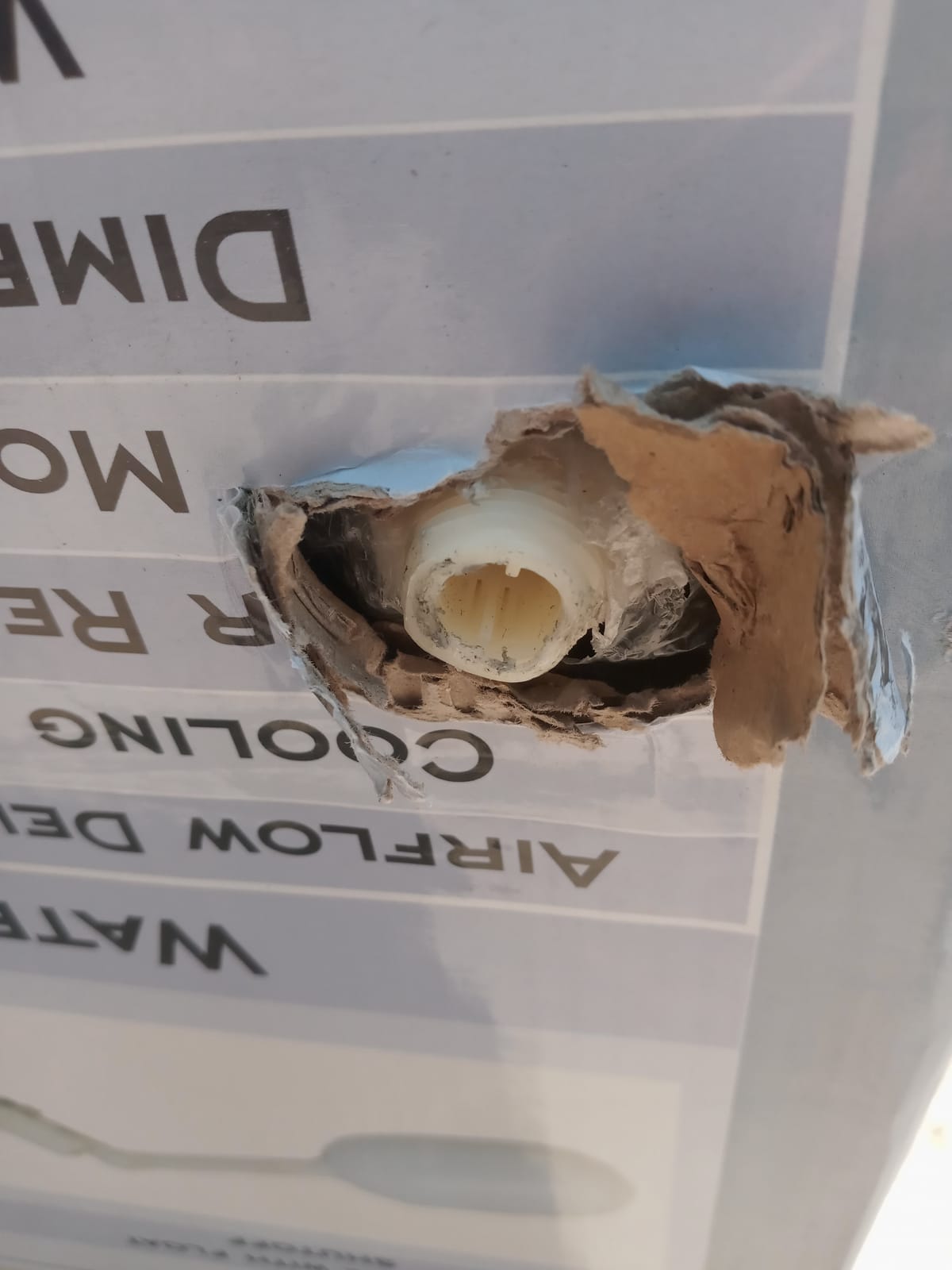
Three independent rotary controls handle the fan, the pump and the oscillation motor separately, so you can leave the swing running while you dial airflow down. Four heavy-duty locking casters matter more than they sound like they should. Dragging a 40-pound cooler across uneven ground is unpleasant, and locking wheels let you park it precisely and keep it there.
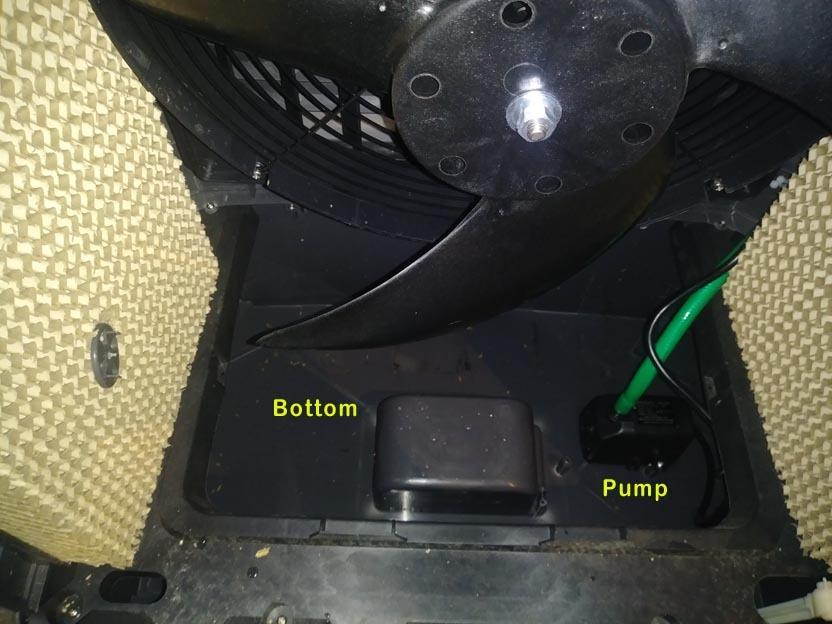
Ordinary steel screws in a wet, sun-exposed housing will streak and seize within two seasons. This one uses stainless steel throughout, which is why the long-term reports skew positive. The three-sided rigid high-density pads also increase the evaporative surface area, so the airflow stays effective as the media wets through an evening.
Noise on the high setting is the top complaint, though most owners accept it once they realise it is measuring against a compressor unit rather than a box fan. A full tank lasts roughly four hours. A small share of buyers received coolers that had already been used, with missing parts or a chemical smell, so inspect the box on arrival.
Daily draining and periodic pad cleaning are not optional with this design. Standing water in a hot tank is where mineral scale and algae start, and a pad left wet overnight picks up a smell within days.
3100 CFM airflow
Covers 950 sq ft
10 gallon tank
250 watts
68 dB noise
The OEMTOOLS 23968 is the pick if your cooling problem is half workshop, half patio. The integrated tool tray is a small feature that tells you exactly who the product is for, and the UL-listed GFCI plug plus UV-resistant resin mean you are not plugging an indoor plastic appliance into an outdoor socket.
Its patented axial propeller design moves a lot of air for the noise it produces, which is a genuine engineering achievement even if 68 dB is still the highest noise figure here. If your patio sits beside a garage and you want one machine to do both jobs, the tool tray makes this the obvious pick.
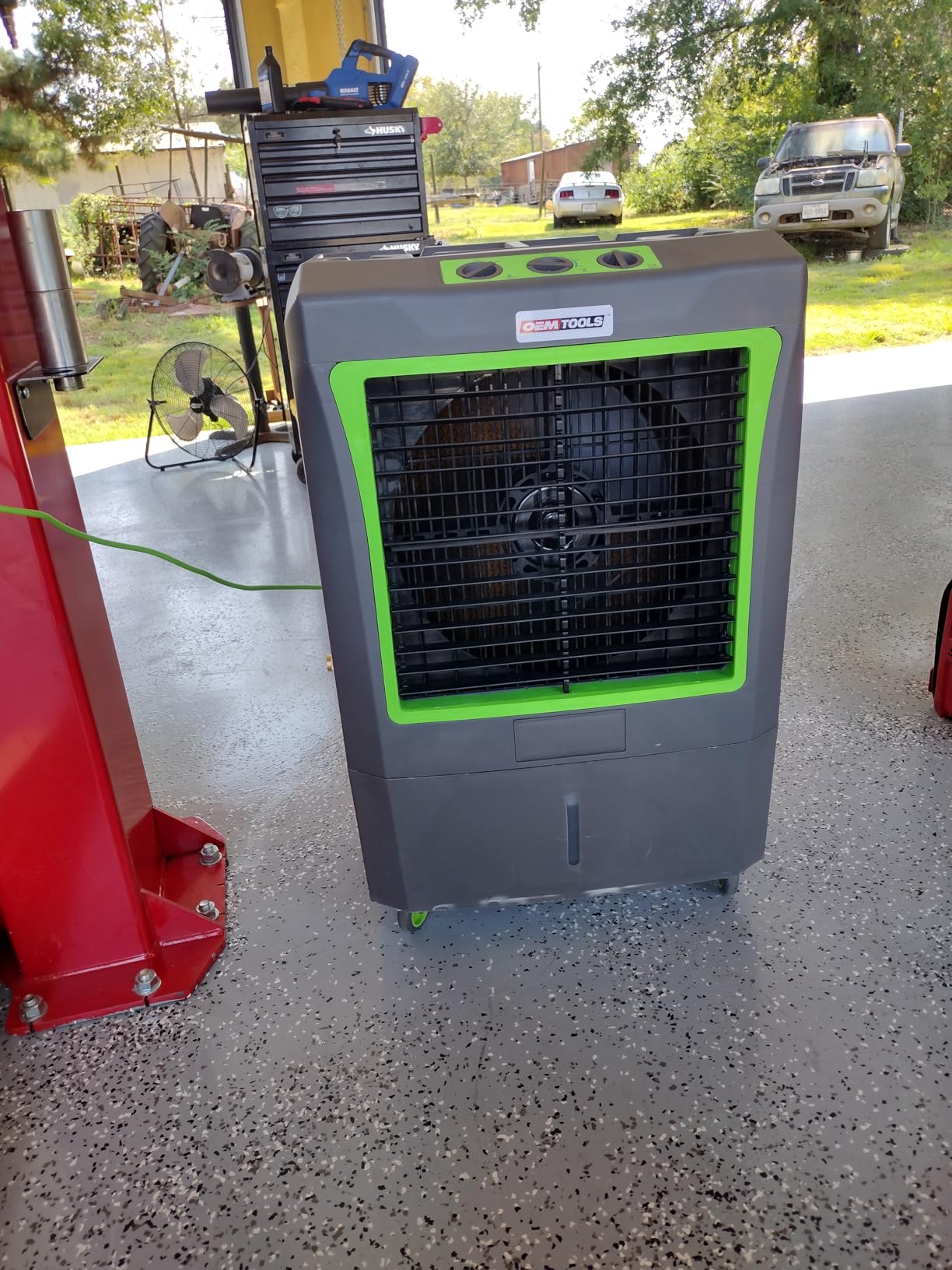
High-density media panels add 80 percent more evaporation surface area over a standard pad, and that is where a 3100 CFM cooler converts airflow into actual cooling rather than just moving hot air around. Casters on the base let you drag it from the bench to the patio door.
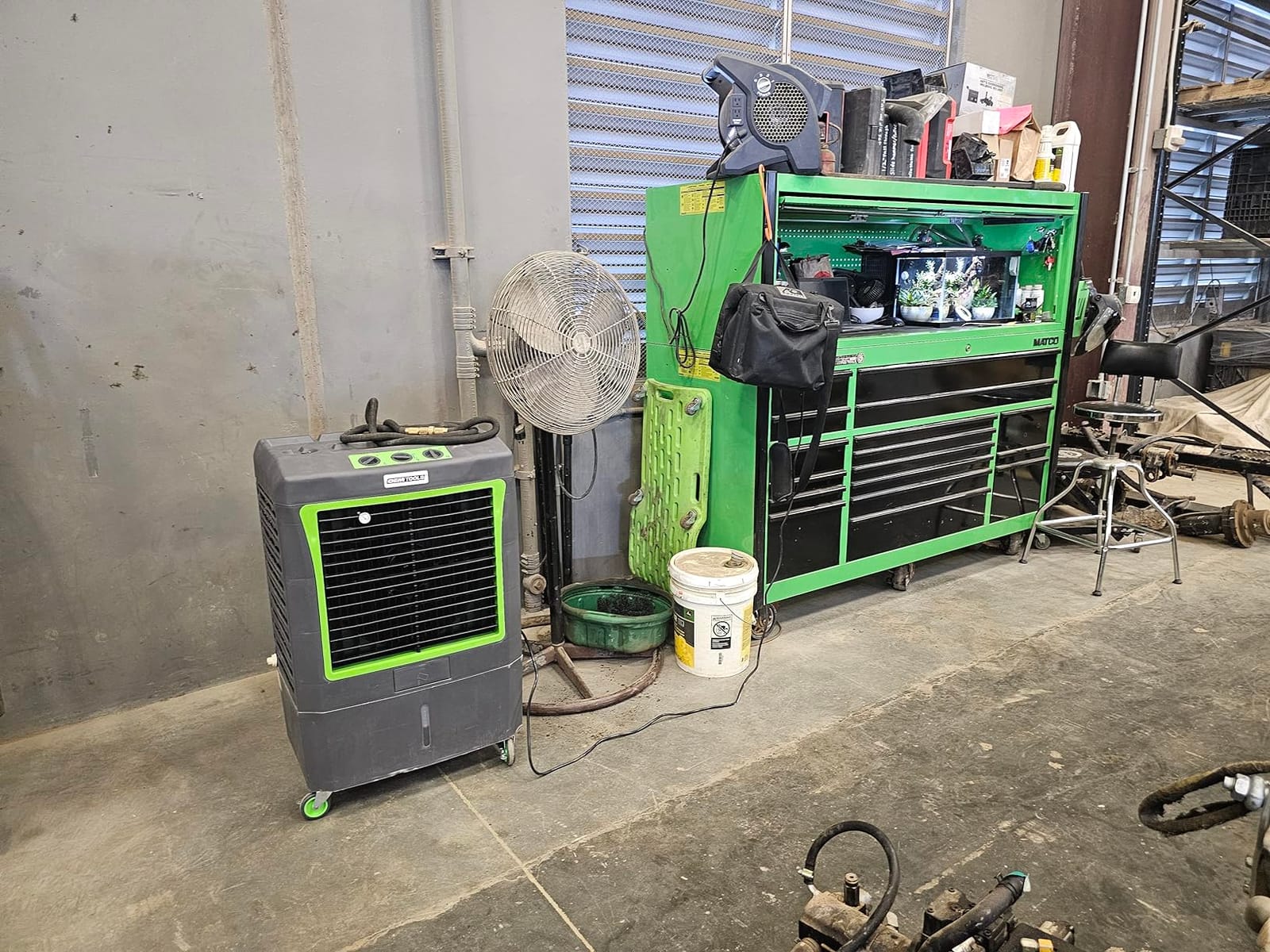
The GFCI plug is the detail most listings in this category skip, and it is the one that matters if water from a hose or a wet pad is anywhere near the connection. UV-resistant resin will not chalk and crack after a summer of direct sun the way unreinforced ABS does.
At 41.3 pounds it is among the heaviest coolers we reviewed, and full of water it is heavier still. The 68 dB rating will carry across a quiet patio, so it suits a working yard better than a conversation area. With only 69 reviews behind the rating, treat the specification sheet as more reliable than the star count.
The model is offered in 3100 CFM and 5300 CFM variants, so cooling capacity depends on which one actually arrives. Confirm the airflow printed on the box before you start it.
4800 CFM airflow
Covers 970 sq ft
11 gallon tank
200 watts
50 dB noise
On paper, this is the most capable patio cooler we reviewed. A 4800 CFM rating with a 120-degree oscillation sweep moves more air than anything else on this list, and the galvanized iron frame with a copper motor is a genuinely outdoor-grade construction rather than bedroom plastic in a patio-coloured shell.
The 11-gallon tank is among the largest we reviewed and supports long evenings without a refill. Three ice packs and a composite ice curtain that doubles as a dust filter are unusual at this size, and the curtain does give the outgoing air a noticeable extra chill in the first hour.
Both manual top-fill and continuous auto-refill are supported, and there is a built-in drain port so you are not tipping a 40-pound cooler to empty it. Four 360-degree casters, two lockable, make it possible to reposition as the sun moves off your seating area.
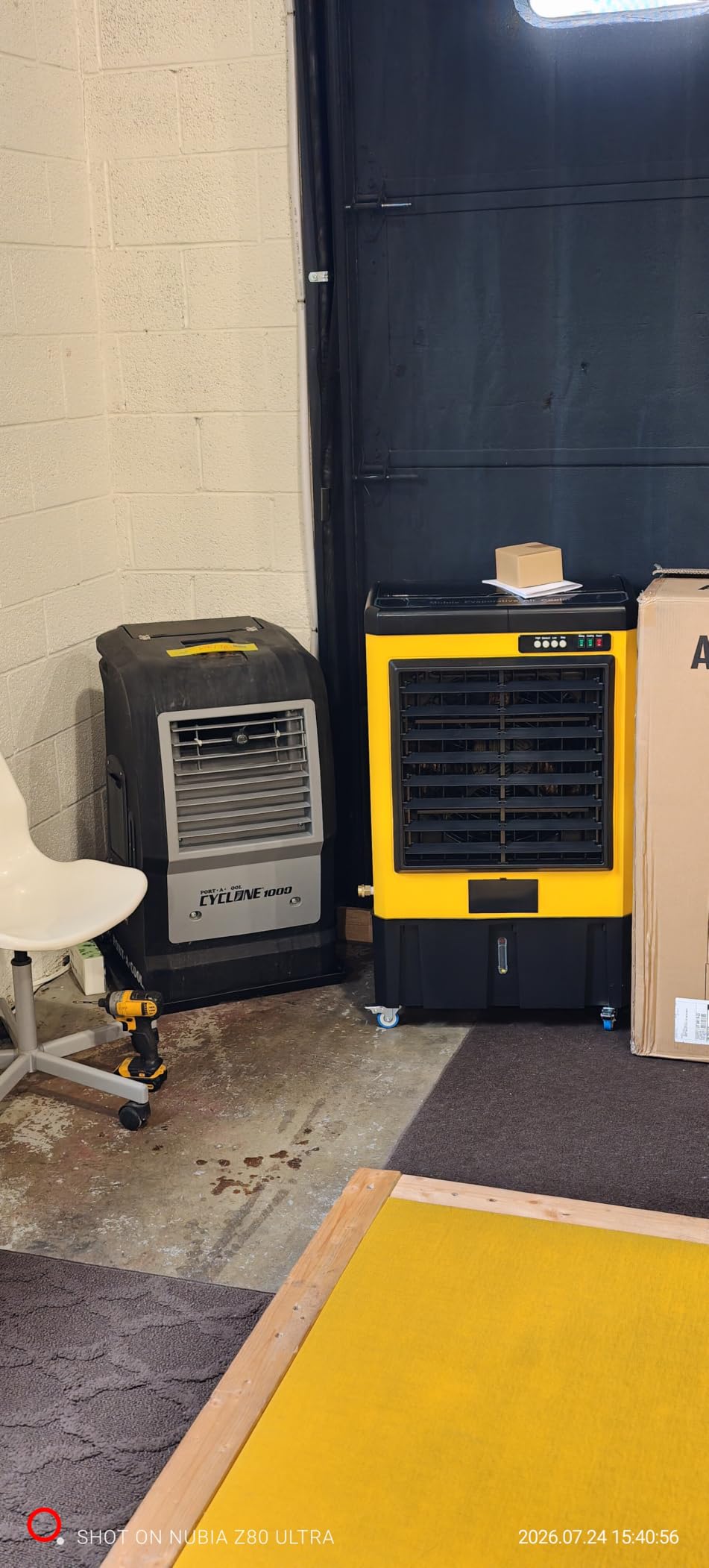
Take manufacturer CFM figures with a discount. Air pulled through wet media loses velocity, and reviewers of this model argue the real output falls well short of the advertised coverage area. Expect the useful zone to cover your seating rather than the full 970 square feet claimed.
The iron frame and copper motor are the reason this cooler holds up outdoors where plastic-bodied rivals warp. Against that, cooling pads can sit loose in the housing and need reseating, and there is no reliable float switch, so continuous fill needs watching. Buyers are also divided on whether the output justifies what they paid.
If you need to cool a genuinely large covered patio and have the floor space to park it, this is the only model here rated at 4800 CFM. If your space is tight, the 3100 CFM models are the smarter buy.
100 CFM airflow
Covers 150 sq ft
3 gallon tank
45 watts
45 dB noise
Be clear about what this one is. The Ashihoti FK2402Y is a personal spot cooler with a 100 CFM airflow rating and roughly 150 square feet of stated coverage. That will cool you at a patio table on a hot afternoon. It will not change the temperature of your deck.
What it does well is refinement. Six speeds and three modes give you far finer airflow control than any of the 3100 CFM models, and at 45 watts with a 45 dB motor it is quiet enough for a dinner conversation and cheap enough to leave running all evening.
The 3-gallon bottom tank runs 10 to 12 hours per fill, so it needs attention far less often than the large patio coolers. An easy-view water level window means you are not lifting the lid to check. Remote and touch panel controls plus 360-degree casters let you move it around without unplugging awkwardly.
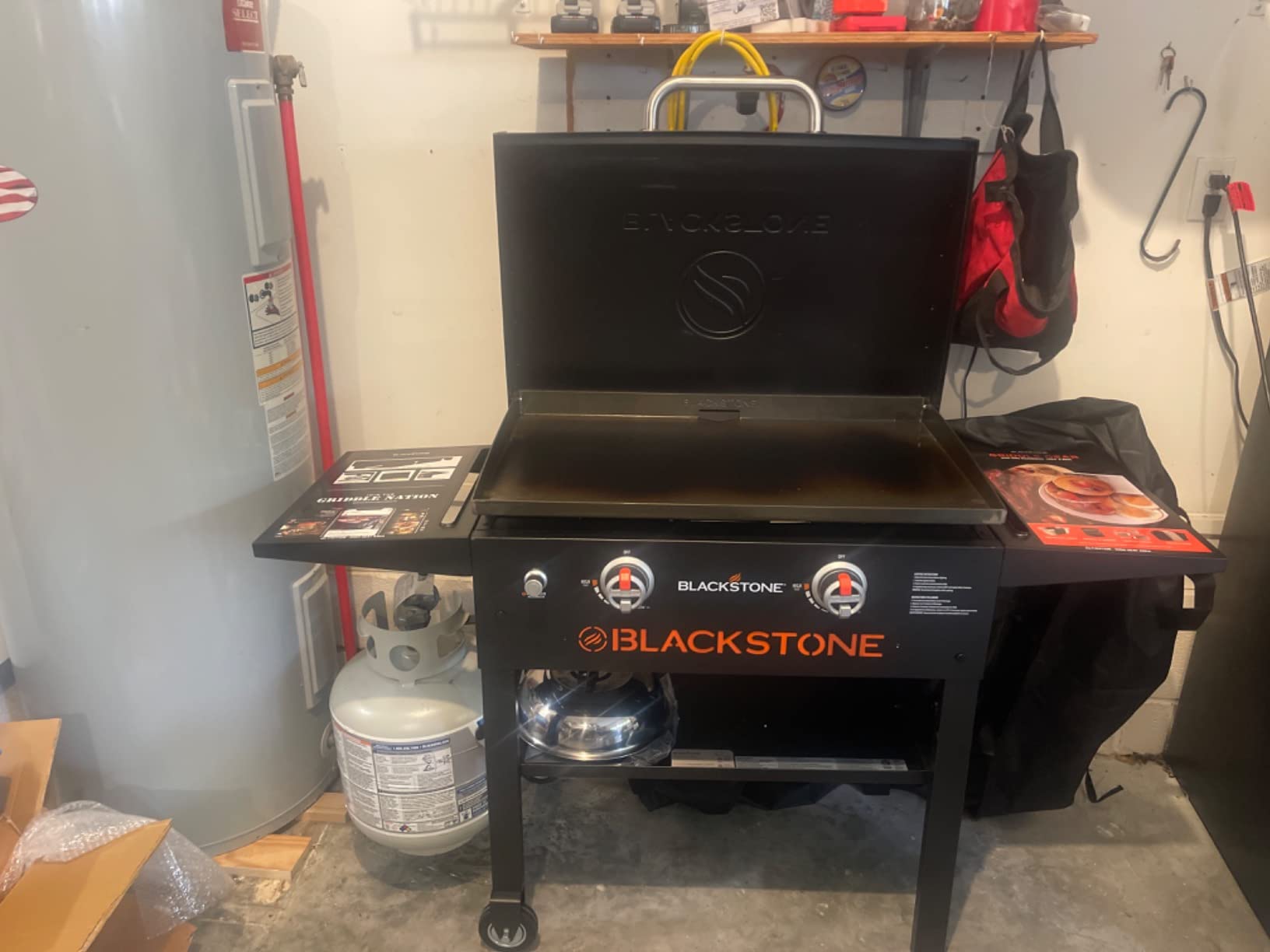
Most evaporative coolers force a choice between too weak and too loud. With six speeds, normal mode and sleep mode, you can find a setting that moves air at table height without competing with conversation. For a dining patio this single feature can matter more than raw airflow.
The 100 CFM rating means the useful breeze falls off within a few feet of the unit. Sit two metres away on a patio and you are getting ordinary fan air. This is a personal cooler, and reviewers are consistent about that: it performs well inside its stated footprint and disappoints anyone expecting room-scale cooling.
Its 4.3 stars across 531 reviews make it one of the best-evidenced products here, and its 45-watt draw costs almost nothing to run. Buy it for a seat, not for a space.
350 CFM airflow
4 fan speeds
30 watts
Cordless USB rechargeable
4.8 pounds
The Arctic Air AAOUT-MC2 weighs 4.8 pounds and runs for roughly six hours per charge, which solves a problem none of the other coolers on this list address. The built-in carry handle means it is the only model here you can take from the house to a balcony or poolside spot without an extension cord.
That freedom has a price. Three 8-inch high-velocity blades feeding two cooling jets produce a strong personal breeze, and four speeds including turbo give real power at the top end. But at 350 CFM this is a misting fan that happens to have a water reservoir, not a patio cooler.
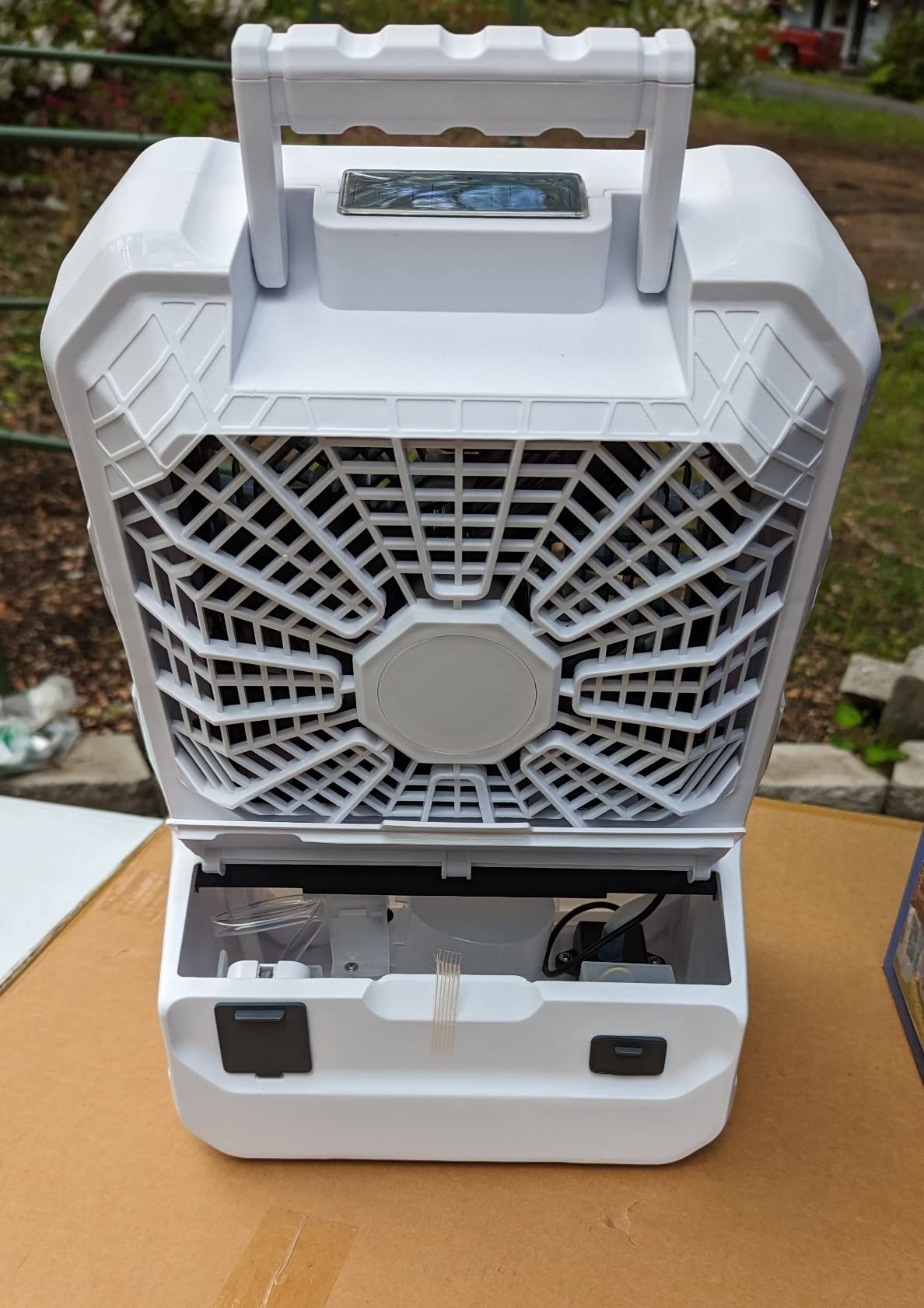
Seven LED mood lights and an optional garden hose hookup for continuous water flow are the details that show this was designed for outdoor evenings rather than a bedroom. Weather-resistant construction suits beach and pool settings where a plastic cooler would be ruined by spray.
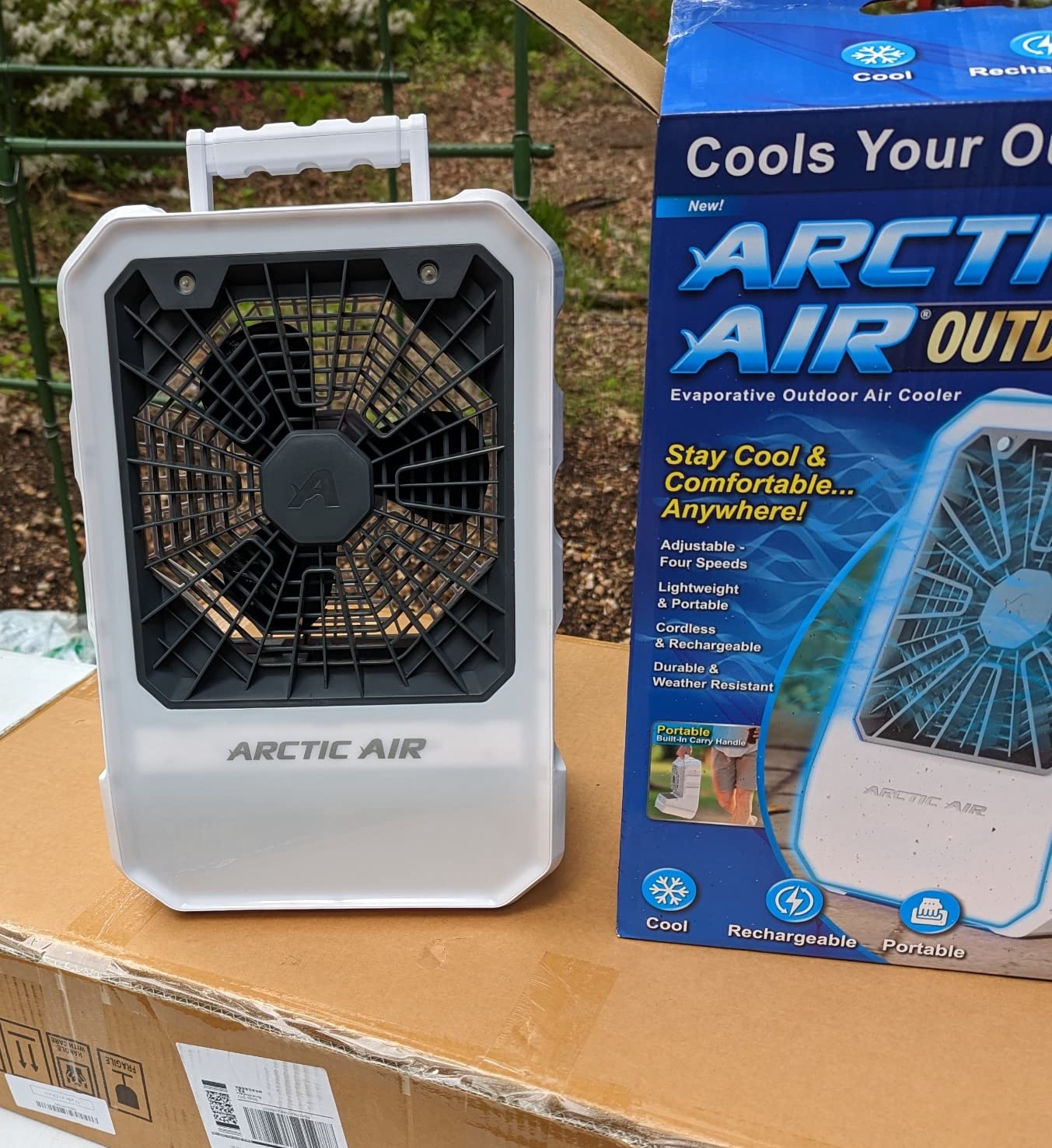
Owners report the six-hour figure dropping to roughly 30 minutes within a few months of regular use. That is a common failure pattern with small sealed lithium packs, and once capacity fades you are effectively buying a cordless fan you must recharge often.
The fan blows upward with no way to direct or tilt it, so it works sitting on a low table rather than at head height. The water tank lid does not latch securely and spills if the unit is tipped or carried full. The mist pump produces a high-pitched noise on some models, and a 21 percent one-star share reflects reliability complaints appearing across multiple countries.
For a poolside cabana or a small balcony where no outlet reaches, it is genuinely useful. Not a good fit for a main patio, where a higher-CFM model makes more sense.
1400 CFM airflow
Covers 550 sq ft
5 gallon tank
60 watts
13.4 pounds
The VEVOR JH-310J is the pick when your patio is medium sized, your budget is fixed, and you refuse to wrestle a 40-pound appliance across the lawn. At 13.4 pounds it is the lightest model here with real evaporative media and enough airflow to cool an outdoor area, and 1400 CFM covers roughly 550 square feet of covered space.
Owners treat it as a budget outdoor cooler for patios, pool areas and parties rather than a room air conditioner, and at that framing it delivers. The top-fill port, water shortage protection and low 60-watt draw are the features buyers praise most.
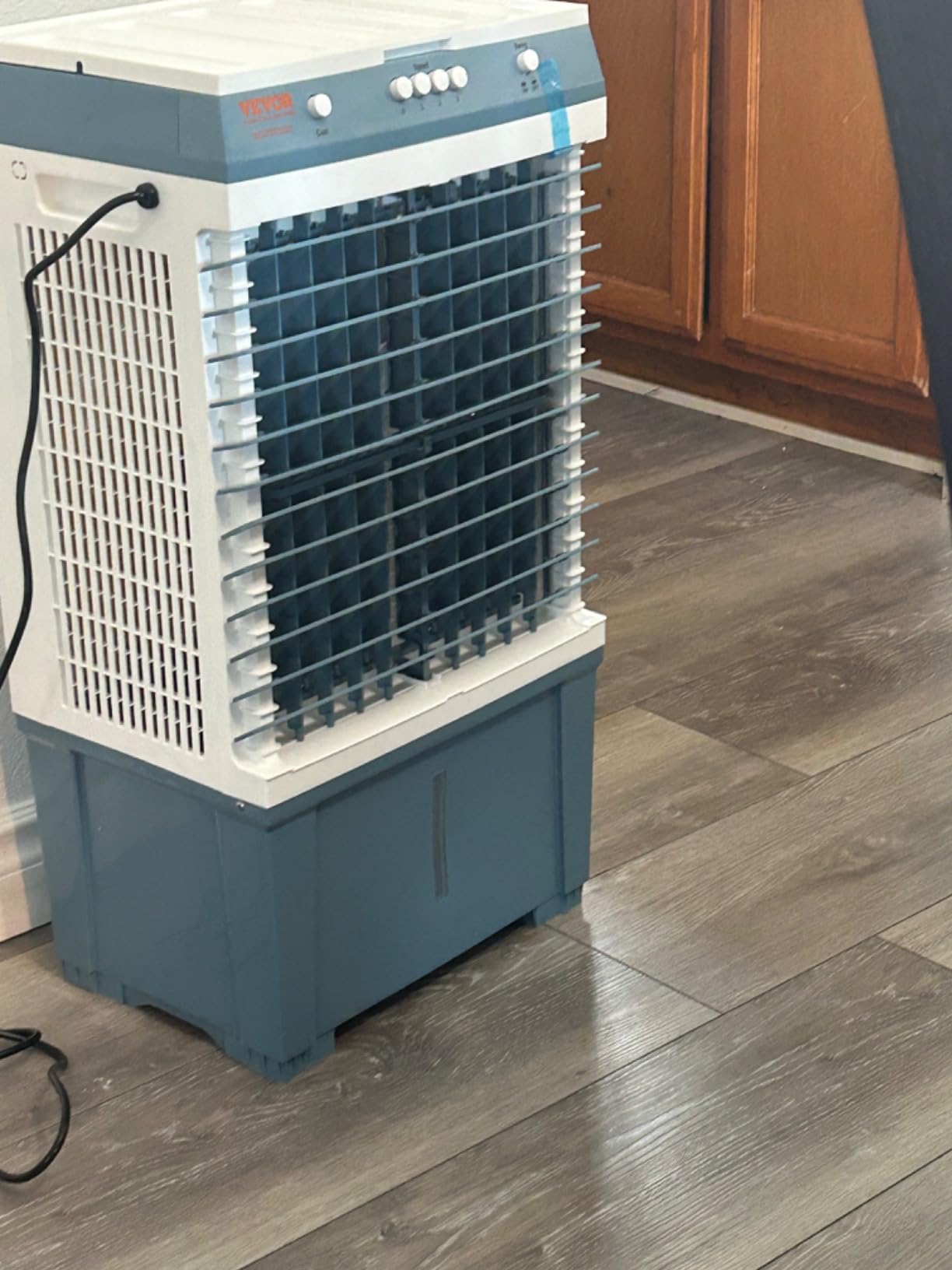
Vertical louver adjustment combined with 0 to 72 degree automatic horizontal oscillation spreads the airflow across a seating area instead of a fixed cone. Two ice packs are included to chill the tank water, and mechanical buttons stay legible after long use in a way that membrane panels often do not.
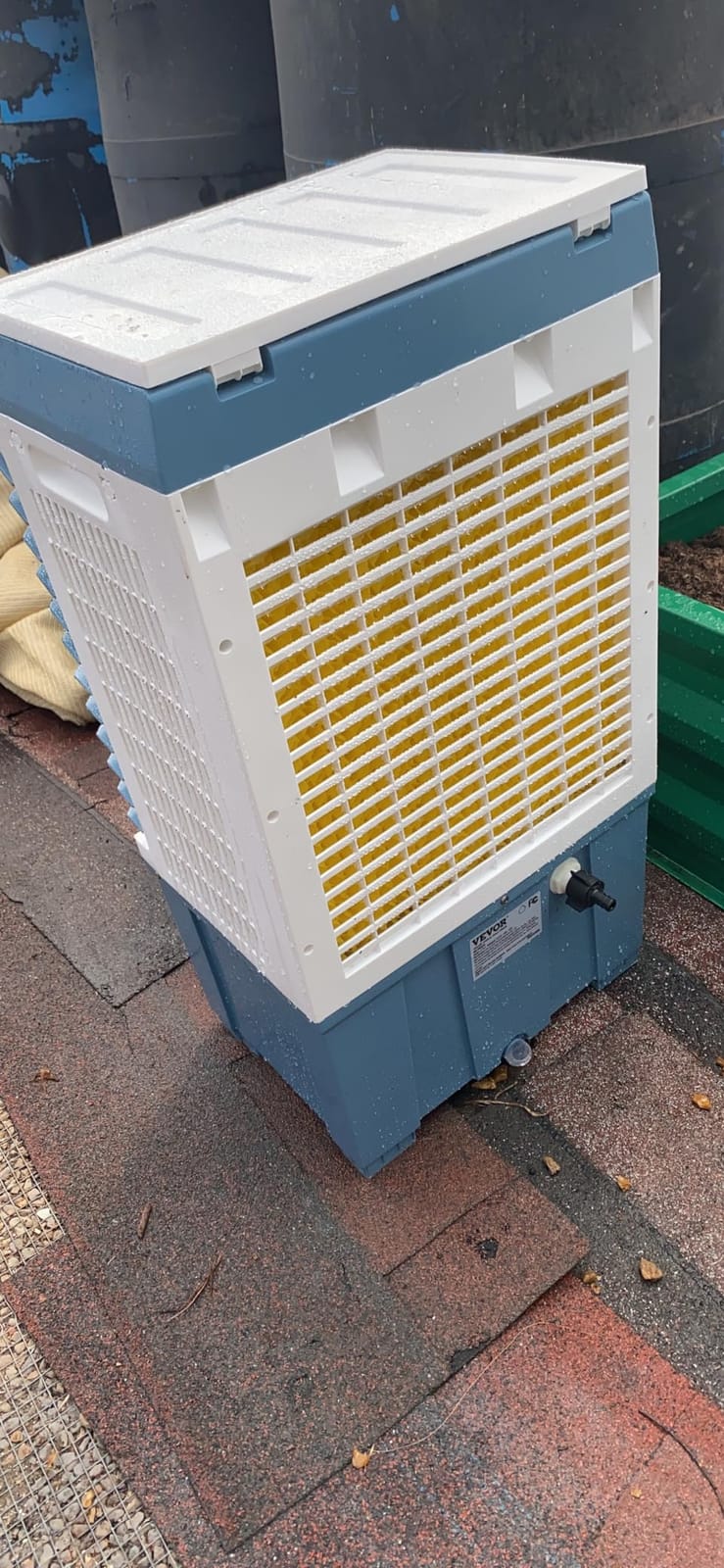
Four hundred to 550 square feet of covered patio with the seating in front of the outlet is where this works. Push past that and the airflow thins out before it reaches the far end of a table. The honest framing is one or two people at a comfortable distance, cooled properly, rather than a whole dining set.
The one-sided rigid high-density cooling pad limits evaporation surface area compared with the three-sided designs on the 3100 CFM models, which is the main reason output lags the coverage claim. Reviewers also note it performs best outdoors in dry climates and adds humidity in enclosed rooms, so keep it open-air.
At 60 dB the fan is audible on working speeds, and some owners report pump noise. None of that stops us recommending it as the budget patio pick, because the alternative at this weight class is no cooling at all.
3000 CFM airflow
Claims 1000 sq ft
6.87 gallon tank
150 watts
52 dB noise
The SYUDTY GDS-820 has the longest specification list we saw for the money. Three thousand CFM, a 120-degree oscillation sweep, a remote reaching 20 feet, four modes, three speeds, a 1 to 15 hour timer and a child lock, all on a body you can lift with one arm.
Owners who use it as a personal spot cooler with ice packs tend to be satisfied. The 6.87-gallon tank is genuinely large for the chassis, and two ice boxes are included. That is the use case this machine serves well.
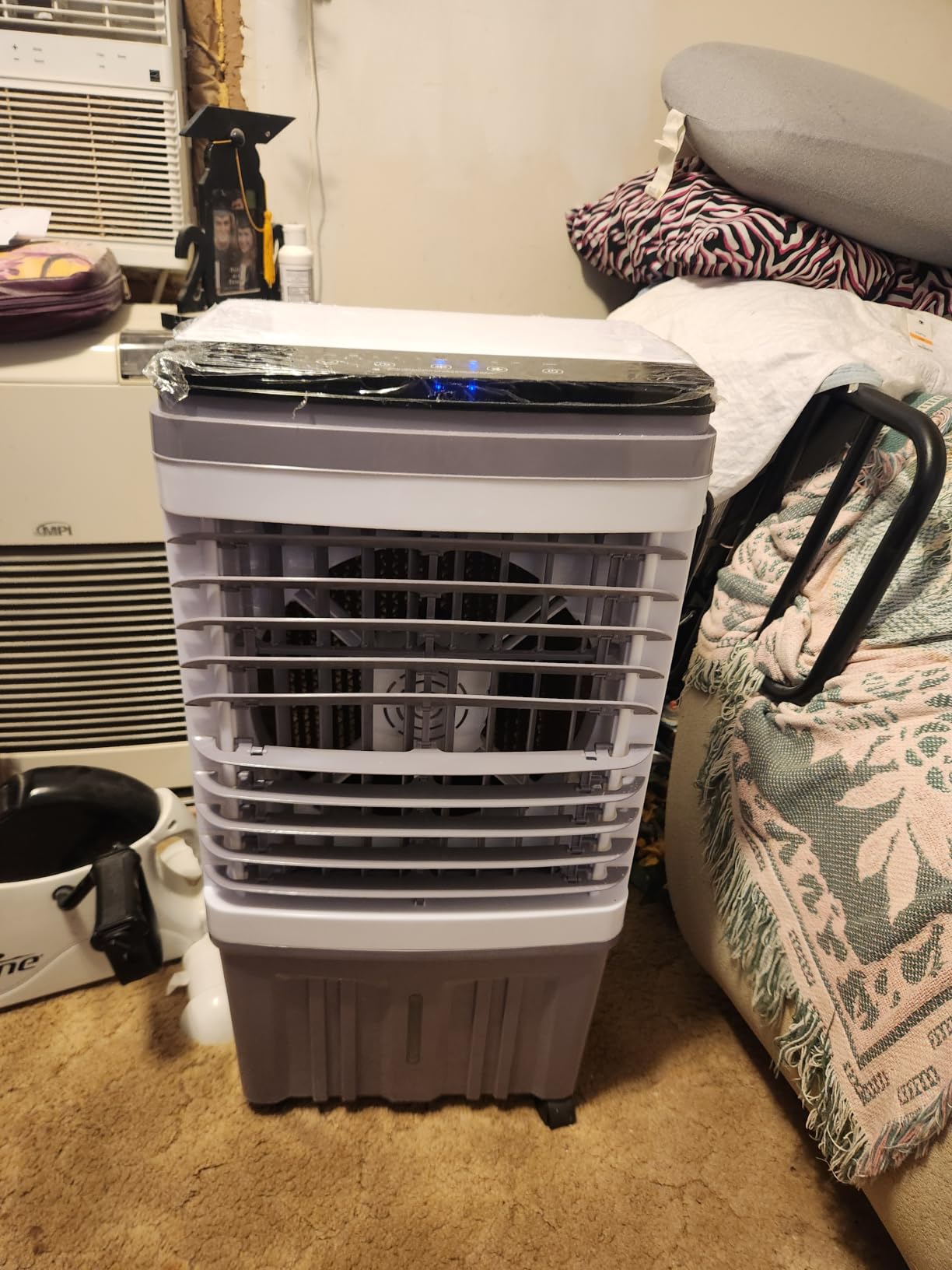
Four 360-degree swivel casters and a hidden carry handle make it easy to reposition. At 150 watts and 52 dB, it is quieter and cheaper to run than the 3100 CFM models, which matters if it is running for an entire evening.
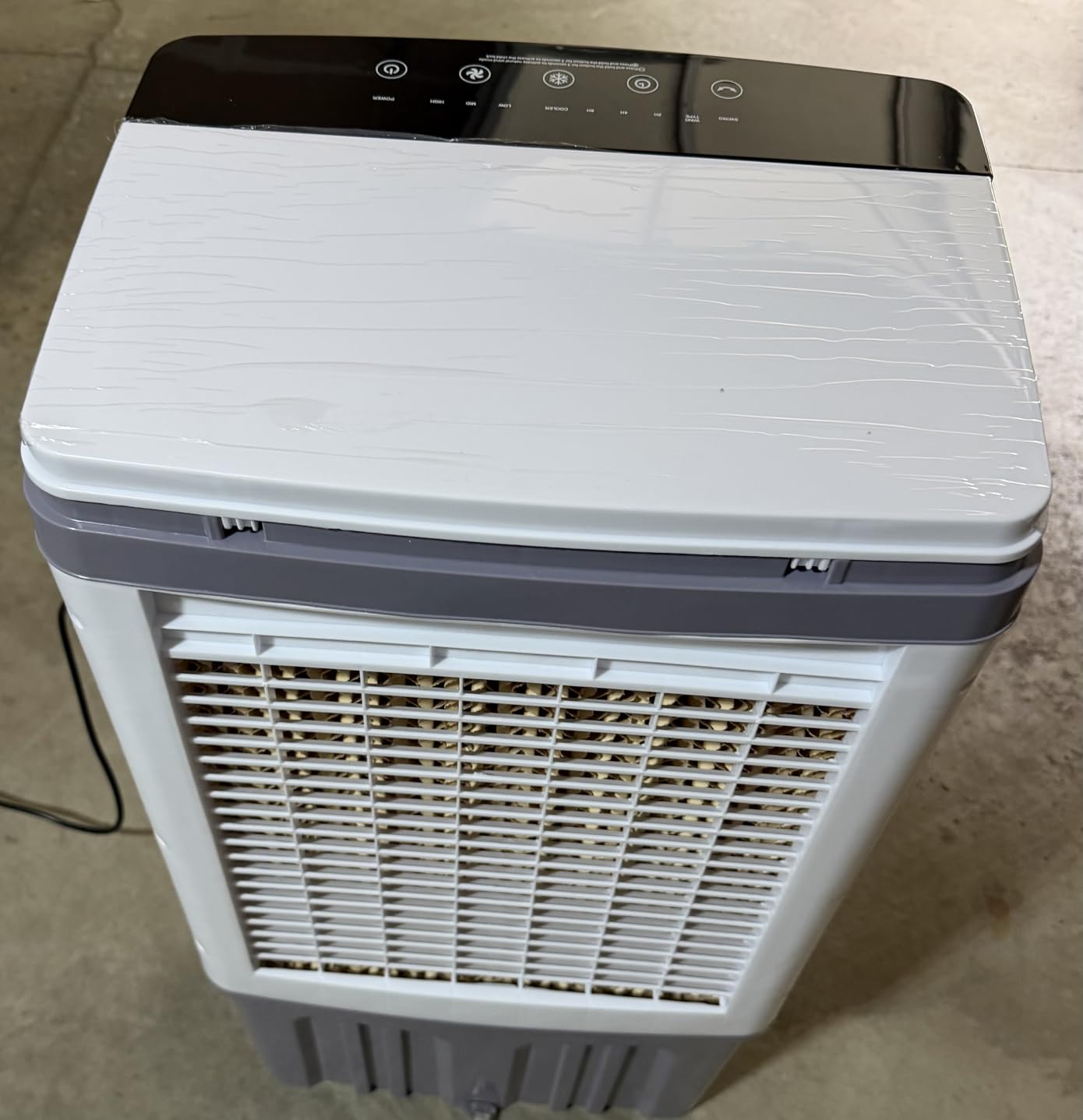
The specification sheet promises a 50 to 60 degree temperature drop and 1000 square feet of coverage. Reviewers repeatedly describe it as performing like an ordinary fan instead, with real cooling falling well short of both claims. Airflow has to be sufficient to evaporate water off the pad, and this fan does not move enough.
At 15.7 pounds empty, a full tank makes it tippy to move, and that combines badly with the casters. Repeated complaints about ABS housing and pad durability suggest the thin plastics will crack or sag over a few seasons of daily outdoor use.
Its 26 percent one-star share is the highest among the models rated four stars or higher. Buy it as a feature-rich spot cooler on a strict budget, not as a patio area cooler.
2500 CFM airflow
Claims 400 sq ft
8 gallon tank
140 watts
65 dB noise
The SereneLife SLACSW538 is the only cooler here with WiFi and app control, alongside a touch panel and remote. Its 8-gallon tank rides on casters, so you are rolling the water to the patio rather than carrying 30 litres, and that design decision alone justifies the unit for a large covered space.
Owners are consistently positive about the fan itself, describing levels one and two as noticeably strong. The 12-hour timer and three wind modes let you automate an evening without touching it. The washable filter and auto-dry pad function reduce the daily maintenance that usually makes people abandon these machines.
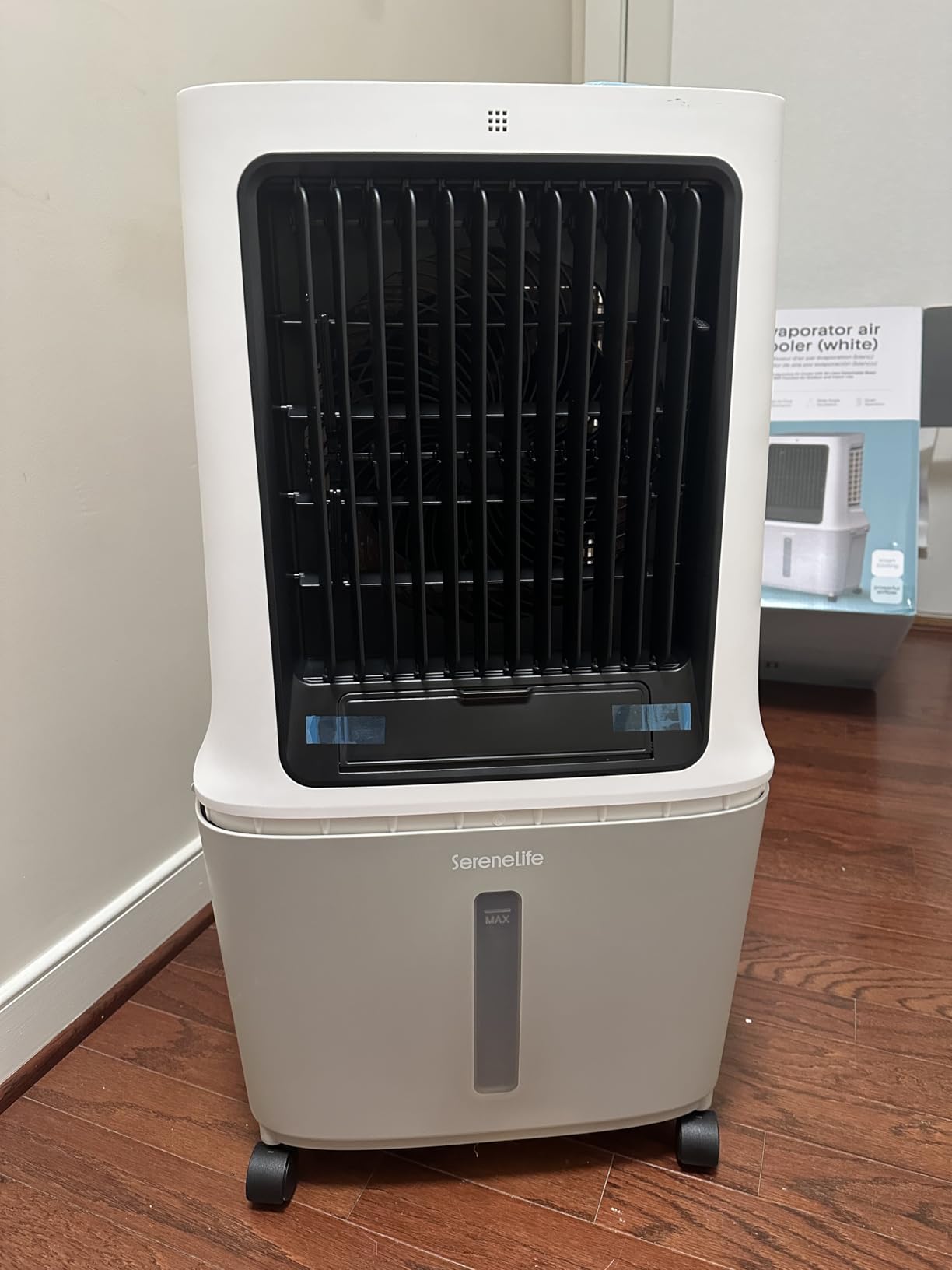
A built-in handle and caster wheels mean the unit can be repositioned without dragging. At 140 watts it draws less than half what the 3100 CFM models pull, which is a real advantage for an eight-hour evening session.
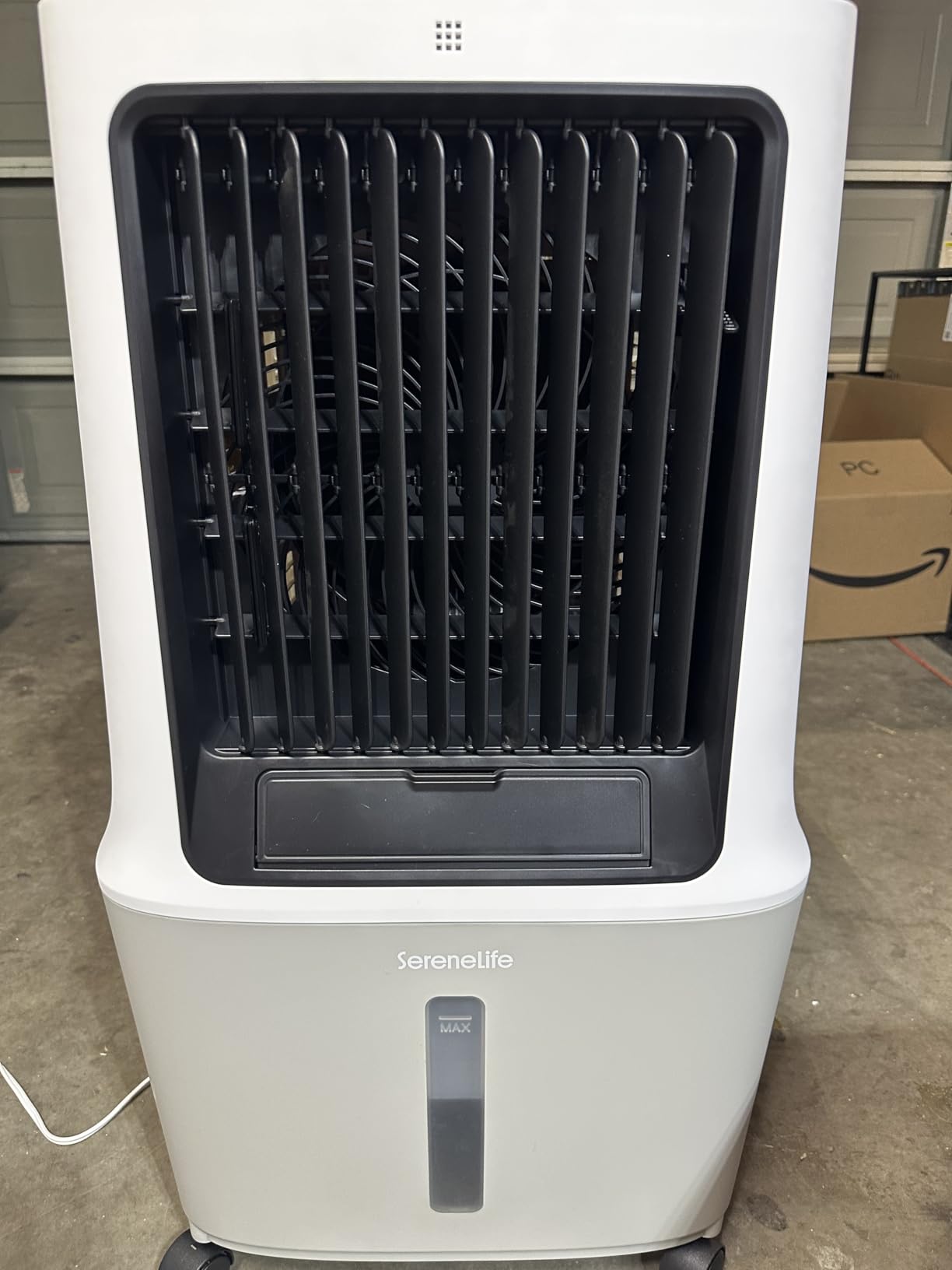
The dominant complaints are mechanical. Owners report internal clogs and leaking from the top reservoir within months, and a pump that cannot fully drain the tank leaves standing water behind. Standing water in a warm tank is exactly how you get algae and mineral scale, so plan to tip it out manually.
There are no handles on the top section and the casters are not smooth, so moving the unit full causes water to slosh and spill. The top-fill port is small enough that refilling is tedious without a hose. Only two ice packs are included and reaching them means separating the unit into sections.
Owners in humid regions report it makes spaces stuffier rather than cooler, and only a 400 square foot claim against much larger competitors. Sleep mode simply duplicates normal speed and natural mode jumps randomly between speeds, which are odd behaviours for a unit sold on automation.
900 CFM airflow
Covers 300 sq ft
2.8 gallon tank
Runs on 18V and 20V tool batteries
The Hessaire DC18 is the odd one out on this list and we included it deliberately. It runs on any 18V or 20V tool battery, which means if you already own a battery platform you can run a cooler on a deck with no outlet anywhere near it.
At 900 CFM covering about 300 square feet, it is a personal to small-area cooler. Owners describe it as a job-site and camping cooler rather than a patio appliance, and rate it highly for exactly that: strong, quiet airflow powered by a battery you already have on hand.
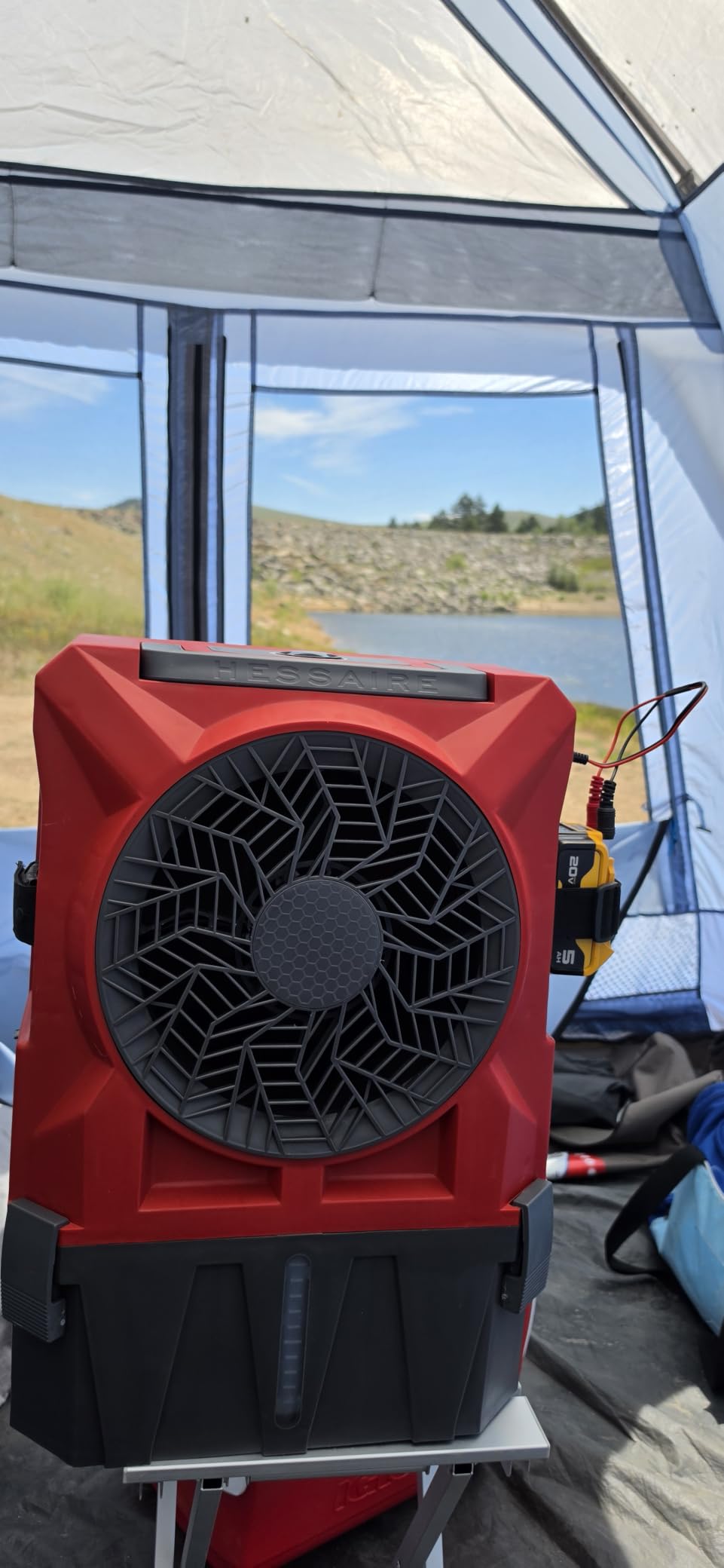
One owner reports holding a trailer near 75 degrees during 95 degree outdoor heat using the DC18, and several note that ice water noticeably improves the evaporative output. Setup and refilling are straightforward, and the 2.8-gallon tank is sized for that use rather than an evening of continuous patio cooling.
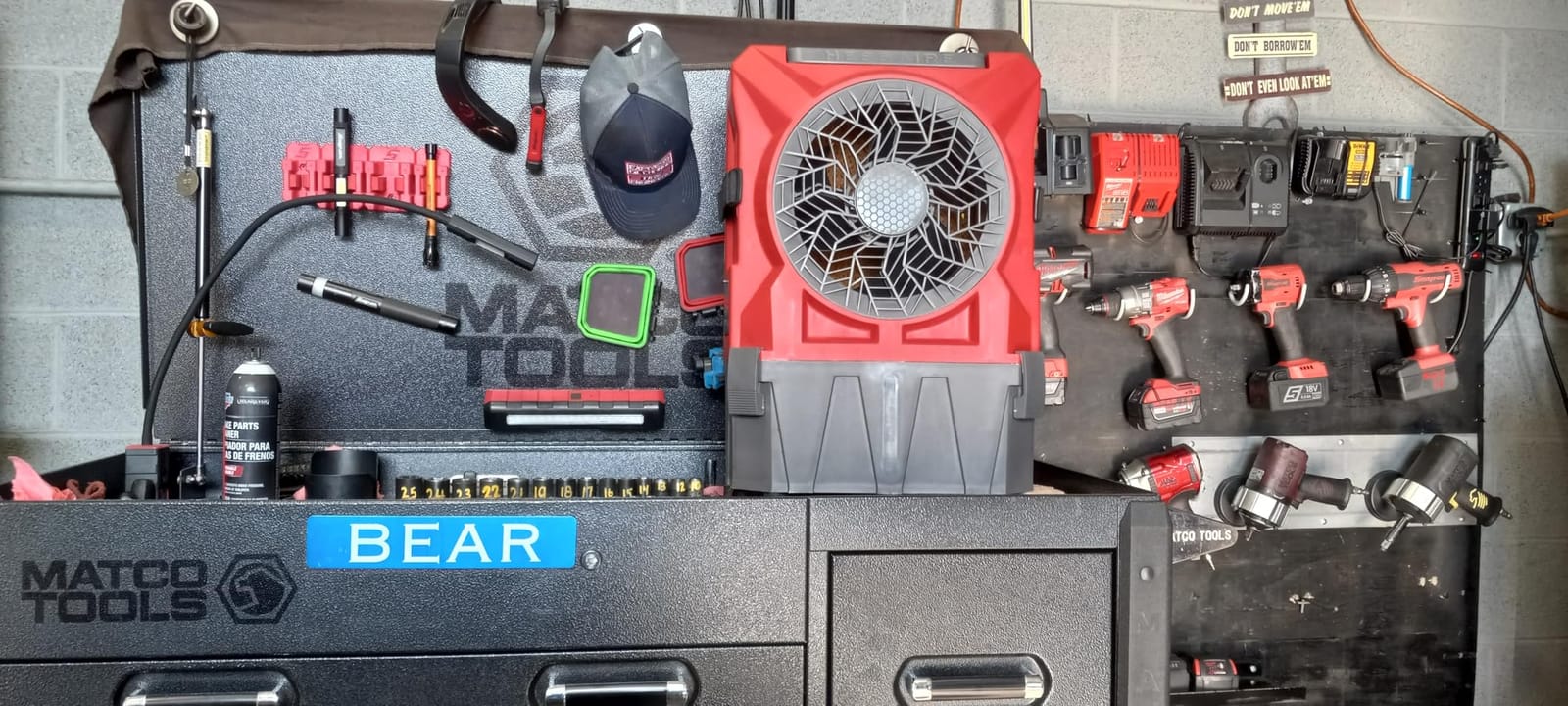
The battery is not included, so this is a two-purchase decision. The included AC adapter outputs 24V while the manual warns against batteries over 20V, which is a confusing specification that reviewers call out directly. A full battery gives roughly a couple of hours of running.
The 42-pound listed weight on a compact 23.5-inch chassis is the largest discrepancy we found in this group, and it is why we do not recommend this for patio use despite the strong rating. It also uses water fairly quickly, which is a poor pairing with a battery-powered design that is meant to avoid carrying supplies.
If you have a tool battery and no outlet, it is a clever solution. For a normal patio with a GFCI socket, choose a mains-powered cooler instead.
4000 CFM airflow
Claims 700 sq ft
13.5 gallon tank
120 watts
45 dB noise
On tank volume, this is the winner. A 13.5-gallon detachable reservoir filled at the tap means you can run a long evening without a refill, and at only 120 watts with a claimed 45 dB it is among the quietest large-capacity units we measured. Four ice packs and a 12-hour timer extend that further.
The feedback on this listing is the most polarized we saw. One detailed reviewer measured a 10-degree drop from 75F to 65F without ice and 12 degrees with the ice packs, and called it excellent. Others report failures across the board and say switching to a heavier, thicker-pad competitor made a night-and-day difference.
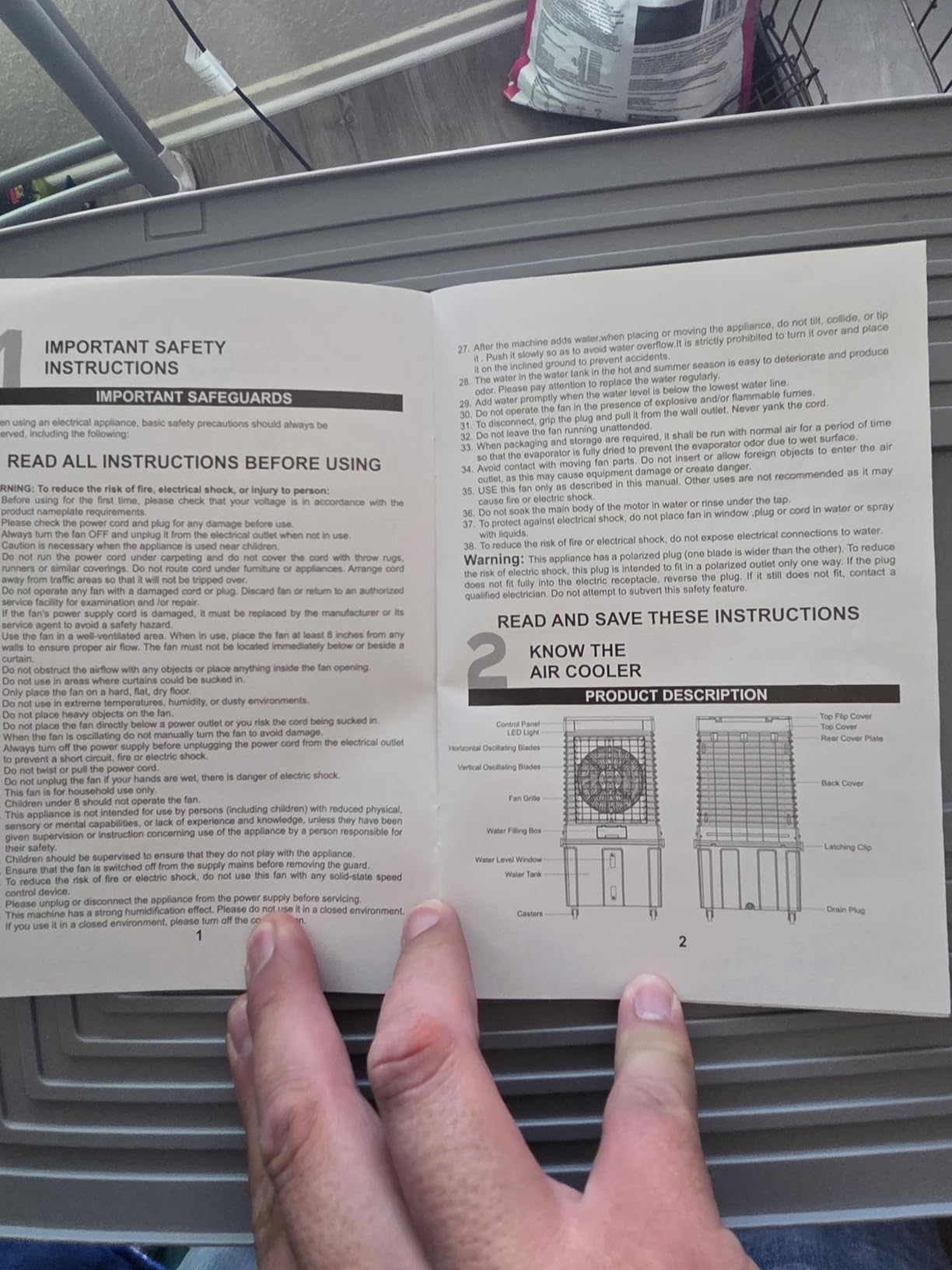
Three refill methods are genuinely useful: the top tank, a hose port, or removing the bottom tank entirely. Four wheels with two brakes and a visible water line help on uneven ground. Dry-run protection stops the pump when water runs low.
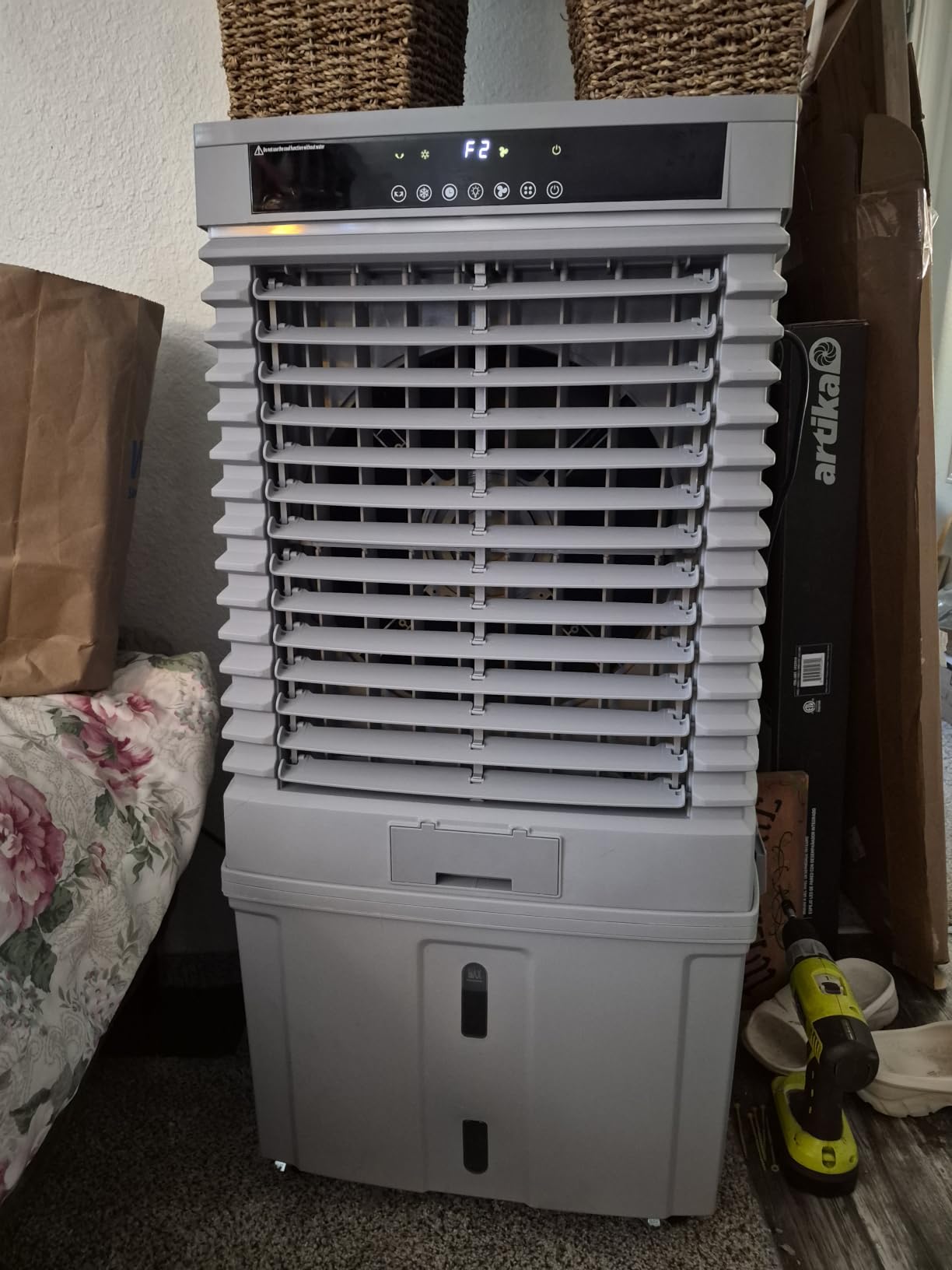
Cooling pads here are thin, and airflow drops sharply once they are wet, which is precisely when you need them most. Buyers moving to a heavier, thicker-pad competitor report the difference immediately. The pump can also fail to engage, or stop while the tank is still half full.
At 3.1 stars with a 33 percent one-star share, it is the least reliable unit we reviewed. Owners report fans continuing to run after switch-off until unplugged, upper basins cracking out of the box, and plastic clamps that feel flimsy. There is no float switch, so continuous hose fill must be managed by hand.
The included ice packs are hollow shells with expanding gel beads that can leak. If you are buying for a season of daily patio use, the tank size is not worth this reliability profile.
1500 CFM airflow
Claims 700 sq ft
4 gallon tank
80 watts
65 dB noise
11 pounds
The SereneLife SLACLW15 wins on one narrow axis: logistics. At 11 pounds it is among the lightest evaporative coolers we reviewed, and its 29.9-inch chassis folds into a garage shelf or a closet between seasons without drama. If your patio is far from storage, that is worth paying attention to.
Everything else is average to poor. It claims 1500 CFM and 700 square feet, with a detachable 15-litre tank, four ice packs, 60-degree oscillation, three wind modes and a 12-hour timer.
So why do buyers stay? The 80-watt draw is genuinely low, operation is quiet enough for small spaces, and the water shortage alarm protects the pump. Owners using it as a compact personal cooler or a garage air mover are satisfied.
Several owners say it makes a small room warmer and more humid because the fan cannot move enough air to evaporate water off the pad. It blows little better than a basic box fan, and is frequently described as functioning as a fan or humidifier rather than a cooler. A 32 percent one-star share reflects that disappointment.
At 65 dB it is one of the louder models here, which is a poor fit for an evening patio. Removing and refitting the ice packs requires separating the upper and lower sections, and the assembly instructions are unclear. Some listings show a bladeless tower fan this unit does not have, so check what actually arrives.
Choose this one for weight and storage. Choose a 3100 CFM model if you want to cool the patio itself.
Yes, but only in dry air with cross-ventilation. A portable evaporative cooler pulls warm outdoor air through a water-soaked pad, and as that water evaporates it absorbs heat from the airstream. The air leaving the unit is cooler and slightly more humid, which is why a swamp cooler works well in the desert and poorly on a humid Gulf Coast patio.
The critical number is relative humidity. Below roughly 40 percent, a properly maintained cooler with fresh aspen pads performs well. Between 40 and 60 percent, output drops noticeably. Above 60 percent you are adding moisture to already-muggy air, and the patio will feel worse, not better. Forum consensus on r/HVAC puts the ideal figure at around 30 percent, and the Predator Masters forum notes that improvement increases steadily as you drop below 40 percent.
Second requirement is airflow through the space. An open-air patio, a covered deck with a wall at each end, or a screened room all give the humidified air somewhere to go. A three-walled patio enclosure with no opening traps the moisture and kills the effect within an hour. If you cannot get cross-ventilation, an evaporative cooler is the wrong tool.
Owners in r/homeowners report that evaporative cooling works well up to 100F and beyond when it is sized properly, so extreme heat is not itself a disqualifier. High humidity is what disqualifies it. If you want a fuller explanation of the mechanism, our effectiveness guide covers the thermodynamics in detail.
Measure the space you actually sit in, not the whole property. For a dining patio with a roof and at least one open side, 1400 to 3100 CFM covers a seating area of about 300 to 550 square feet. Above that, 3100 CFM and up is the right class, and 4000 to 4800 CFM is for genuinely large covered patios. Manufacturer coverage figures assume ideal airflow, so discount them by roughly a third for a real deck.
Coverage claims also do not account for the wet pad itself, which slows the air. Reviews of the highest-CFM model here repeatedly argue that advertised numbers overstate real performance. Treat CFM as a class indicator rather than a promise.
A 10-gallon tank runs roughly three to four hours. Most patios are used for the last two or three hours of daylight, so 10 gallons or more means one fill per session. Below 5 gallons, you will be refilling mid-evening, and forum complaints about constantly topping up small tanks are among the most common complaints in this category.
If a hose bib is within reach, continuous fill through a float valve solves this permanently. The Hessaire MC37M, MC37V and OEMTOOLS 23968 all support it. Coolers without a float switch, including two of the Uthfy and SYUDTY models, need manual attention on the connection.
Evaporative coolers draw between 30 and 250 watts. A 250-watt unit running four hours a night uses about one kilowatt-hour, which is a trivial cost. That power gap versus a portable air conditioner is the single strongest argument for evaporative cooling on an outdoor space where an AC’s exhaust hose is impossible.
Noise matters more than most buyers expect. Measured figures here run from 45 dB to 68 dB. Below 50 dB you can hold a conversation with it running; above 65 dB it competes with one. For evening dining, weight the decibel rating as heavily as the CFM figure.
Look for UV-resistant resin or metal housing, a rust-resistant motor, stainless steel fasteners, and a GFCI-protected plug. These are what separate coolers that survive four seasons outdoors from those that chalk, warp and crack. The OEMTOOLS 23968 with its UL-listed GFCI plug and UV-resistant resin, and the MC37V with stainless screws, are the two builds we would trust on a permanent patio.
Also check for a drain plug or drain port. You will be emptying the tank more often than you expect, and tipping a 40-pound machine into a lawn is unpleasant.
If you also run indoor evaporative units, our dry-climate roundup covers the indoor side, while our evaporative humidifier picks explain when adding moisture is actually what you want.
Placement does more for performance than any spec on the box. Work through these six steps before your first fill, and adjust them as the sun moves through the evening.
Keep the unit in shade. Sun on the housing raises the intake air temperature and defeats much of the evaporative effect. A covered patio wall or an umbrella side is ideal.
Position it upwind and to the side. Most patios have a light breeze direction. Put the cooler where its output crosses the seating rather than blowing parallel to the table.
Aim the louvers at people, not at the floor. Adjustable vertical louvers and horizontal oscillation exist to target seated height. Locking casters let you move the unit as the shade line shifts.
Open the opposite side. Cross-ventilation is non-negotiable. Prop open a door, a gate or a screen so the humidified air has somewhere to exhaust instead of pooling.
Hook up continuous fill if a hose is available. A float valve and adapter turn a mid-evening chore into a set-and-forget install, and they reduce the risk of the pump running dry.
Run it in the last two to three hours of daylight. That is when the air is hot, dry enough and still moving. Running it at midday in peak humidity wastes water and electricity.
For a rooftop patio, the physics are less favourable. Higher surfaces receive more direct sun, hotter air rises past your seating level, and there is usually less cross-ventilation than at ground level. Placement matters more there, and a pergola or shade sail makes a measurable difference to whether a rooftop cooler is worth running at all.
For a very large covered patio, two coolers spaced apart and aimed at opposite ends beat one unit in the centre. One cooler blows a defined cone; two overlapping cones cover the space.
An evaporative cooler is the right choice for a dry, open-air patio with no outlet near the seating and a low tolerance for electricity use. It fails in three situations: high humidity, enclosed spaces with no ventilation, and anywhere you need the air temperature below about 70F rather than merely more comfortable.
Evaporative cooler — cools an open covered patio in dry air. Draws 30 to 250 watts, needs refilling, and adds moisture. Fails above roughly 60 percent relative humidity.
Portable AC — actually refrigerates, so it works in any climate and in enclosed spaces. Requires a hot exhaust hose, uses far more electricity, and is impractical for most open patios because the exhaust air has nowhere to go.
Misting fan — chills the skin rather than the air, needs no tank refill, and costs the least. Effective only where you are sitting directly in the mist, so it suits a table, not a patio.
If you are choosing between evaporative cooling and air conditioning, never run both in the same enclosed space. Homeowners on r/HomeImprovement are clear that they work against each other, with the AC removing the moisture the cooler depends on. Our evaporative versus ultrasonic humidifier comparison covers the related moisture question in more detail.
A full 10-gallon tank is the water budget for one evening session, so a season of nightly patio use adds up to hundreds of gallons. That is the main ongoing cost, and it is water rather than electricity. Continuous fill from a hose does not reduce consumption; it only stops you from thinking about it.
Four maintenance habits keep a patio cooler working past its first summer:
Empty and dry the tank daily. Standing warm water is what produces algae and mineral scale. Tipping the tank out takes a minute.
Dry the pad overnight. Run the pump on for the last ten minutes of the session with the fan off, then leave the housing open. A pad still soaking picks up a smell within days.
Rinse the pad monthly. Hard water deposits block the media and reduce output. A mild vinegar rinse restores flow.
Store it dry and covered. Drain fully, wipe the housing and keep it under cover through winter. Do not leave it with water inside in freezing weather.
Owners who skip the daily empty are the ones who end up with coolers that smell permanently and pads that never recover. This is the single easiest way to avoid regret with any of the twelve models here.
Yes, on an open patio where the air is dry. A portable evaporative cooler pulls warm air through a water-soaked pad, and evaporating water absorbs heat, so outgoing air can be 10 to 20 degrees cooler than ambient. They add moisture, so they need cross-ventilation to exhaust humidified air and they perform poorly above roughly 60 percent relative humidity.
No. Below about 40 percent relative humidity a well-maintained cooler performs well. Between 40 and 60 percent, output drops noticeably. Above 60 percent you are adding moisture to already-muggy air and the patio will feel worse, not better. If you live in a humid region, a portable air conditioner or a misting fan is the better patio investment.
Swamp cooler and evaporative cooler are the same thing, and yes, they are good outdoors. A covered patio with at least one open side gives the humidified air somewhere to go, which is the condition evaporative cooling needs. Keep the unit in shade, aim the louvers at seated height, run it in the late afternoon and evening, and keep it out of direct sun.
A 10-gallon tank is roughly one evening session, and most patio coolers run three to four hours per full tank. Models with a 13.5-gallon reservoir last a full night. If a hose bib is within reach, a float valve and adapter allow continuous fill, which removes the need to monitor the tank rather than reducing how much water it consumes.
The main drawbacks are added humidity, constant water refilling, and noise. It cannot refrigerate air, so in a humid or enclosed space it makes conditions feel worse. Tanks need daily emptying to prevent algae and mineral scale, and the fan is often audible above 65 dB. Its cooling also weakens as the pad wets, so output drops through a long session.
Measure the area you actually sit in, not the whole outdoor area. For a covered dining patio, 1400 CFM covering roughly 550 square feet is realistic. Above that, choose 3100 CFM or higher. Treat manufacturer coverage figures as a ceiling, discount them by about a third, and pick a unit with a 10-gallon or larger tank plus a GFCI plug and UV-resistant housing.
If you want the best overall patio cooler in 2026, the Hessaire MC37M is the pick. Its 3100 CFM airflow, 950 square feet of stated coverage and 10.3-gallon tank are backed by more verified reviews than any other model here.
If you plan to leave the unit outside every night from spring to autumn, choose the Hessaire MC37V. The stainless steel fasteners and rust-free construction are what separate it from the plastic that warps after two seasons. For a workshop or garage that doubles as a covered patio space, the OEMTOOLS 23968 adds a GFCI plug, UV-resistant resin and a tool tray.
For a very large covered patio, the Uthfy JH-40BI moves more air than anything else on this list, though its iron frame is offset by pads that need reseating. For a medium patio on a fixed budget, the VEVOR JH-310J at 13.4 pounds is the one you can move with one hand. For a single seat, the Ashihoti FK2402Y runs six speeds on 45 watts and lasts 10 to 12 hours per tank fill. For a balcony with no outlet, the Arctic Air cordless model removes the extension cord entirely.
Before any of them work, check your humidity. Below roughly 40 percent relative humidity, any of these will earn its keep on an open patio. Above 60 percent, none of them will, and a portable air conditioner or a misting fan is the better buy. Measure first, place it in shade, open the far side of the patio and you will have a usable outdoor space for a fraction of the running cost.