Physical Address
304 North Cardinal St.
Dorchester Center, MA 02124
Physical Address
304 North Cardinal St.
Dorchester Center, MA 02124

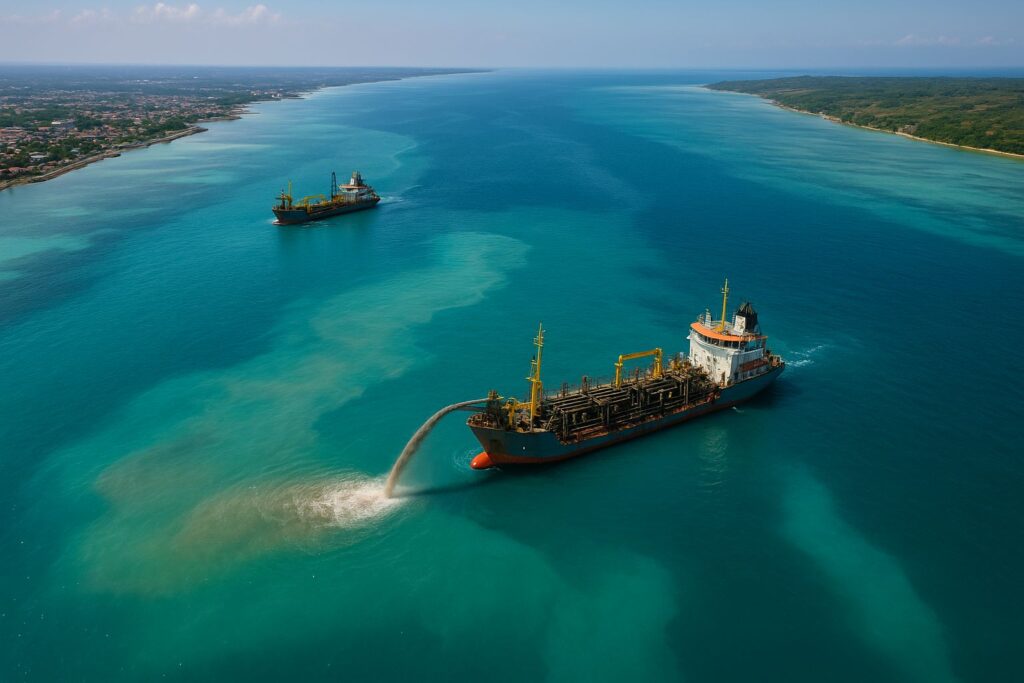
A routine sand mining operation off the coast of Java has turned into one of the most significant paleoanthropological discoveries in Southeast Asian history.
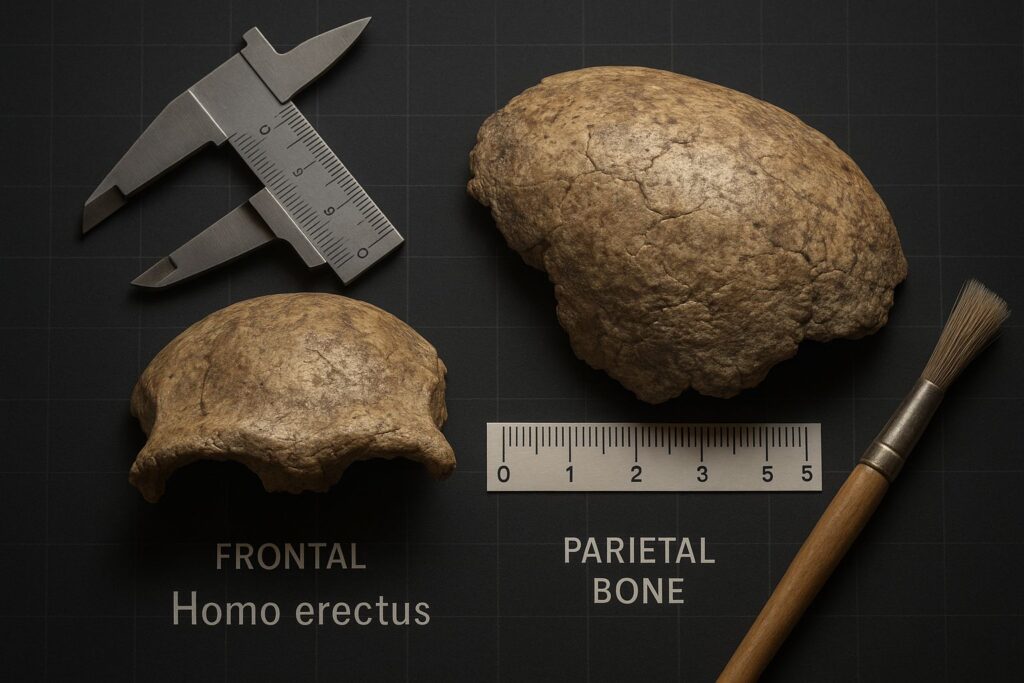
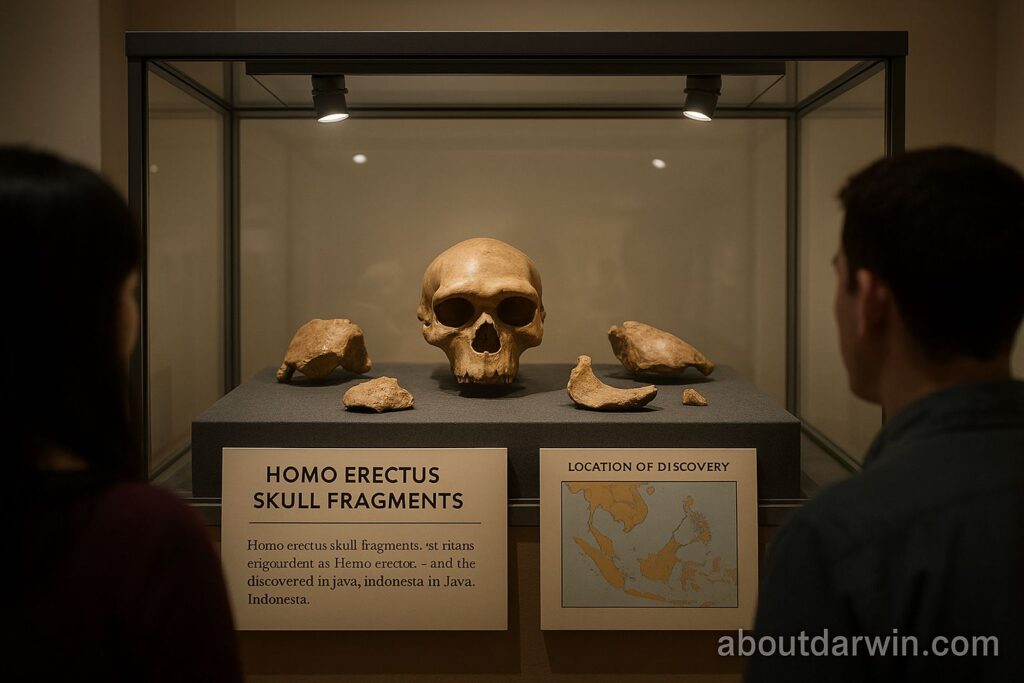
According to research published in Quaternary Environments and Humans, archaeologists have recovered the first-ever underwater Homo erectus fossils from the Madura Strait — two skull fragments that have been buried beneath the ocean for over 100,000 years.
But here’s what makes this discovery truly extraordinary: these aren’t just random bones on the seafloor.
The story begins in 2011 when commercial sand miners working near Surabaya inadvertently pulled up fossilized bones from the seabed.
At first, nobody realized what they’d found.
It wasn’t until Harold Berghuis from Leiden University and his international team analyzed the specimens that the true significance emerged: frontal and parietal skull fragments matching the morphology of Homo erectus, dated between 163,000 and 119,000 years ago using Optically Stimulated Luminescence.
What the scientists uncovered goes far beyond human remains.
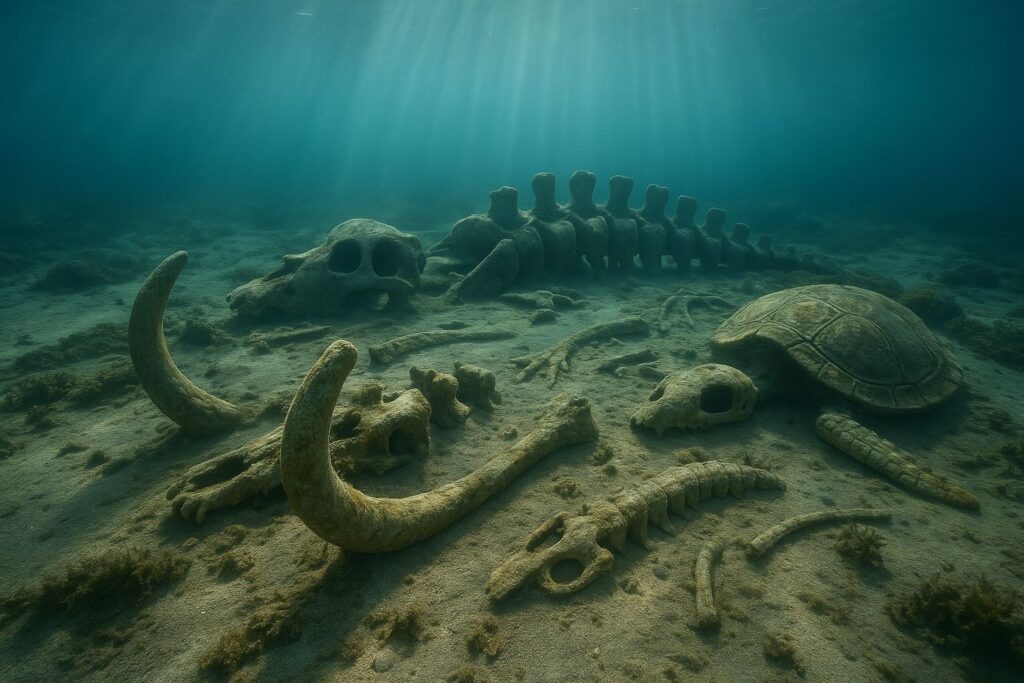
The team recovered over 6,000 fossil specimens representing at least 36 different species — a complete ecosystem frozen in time beneath layers of marine sediment.
Among the discoveries: Komodo dragons, buffalo, deer, and the towering Stegodon, an extinct elephant-like herbivore that stood over 13 feet tall.
“This makes our discoveries truly unique,” Berghuis explained. “The fossils come from a drowned river valley, which filled up over time with river sand.”
The bones tell a story that challenges decades of assumptions about human evolution.
Cut marks on water turtle bones and broken bovid bones point to active butchery — evidence that these Homo erectus populations weren’t passive scavengers but organized hunters who processed their kills for meat and bone marrow.
Even more intriguing: the hunting techniques match those of more modern human species from the Asian mainland, not the isolated Javanese Homo erectus populations scientists previously studied.
This suggests something revolutionary.
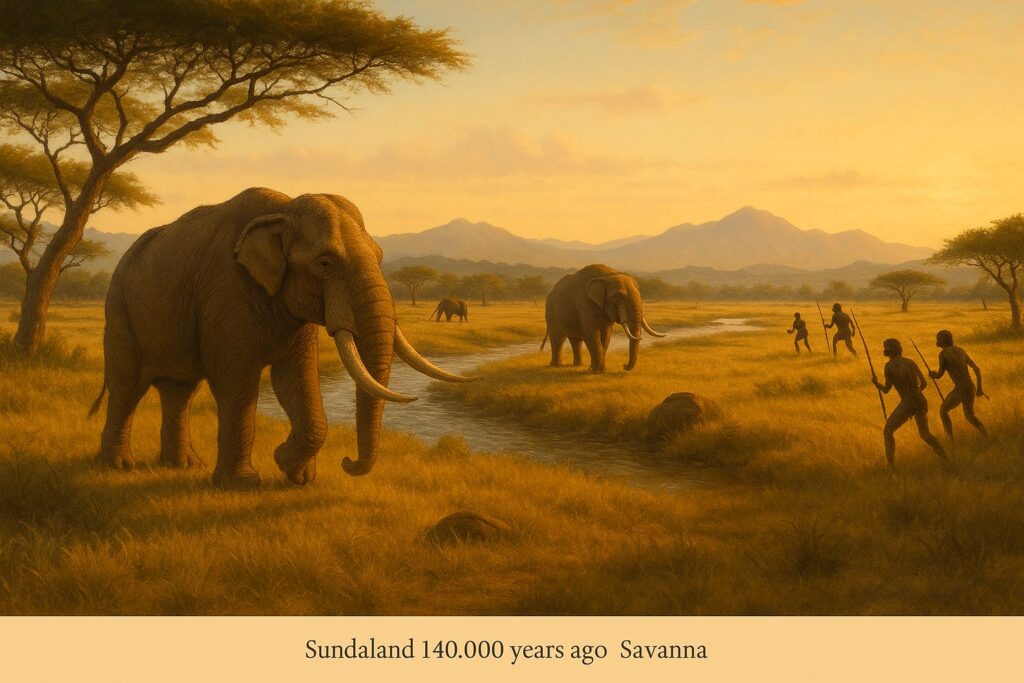
During the penultimate glacial period 140,000 years ago, sea levels were 100 meters lower than today.
What’s now ocean between Indonesia’s islands was Sundaland — a vast savanna-like plain similar to modern African grasslands, complete with flowing rivers and megafauna.
The Solo River system, now submerged beneath the Madura Strait, once provided an ecological highway for both animals and early humans.
“Here they had water, shellfish, fish, edible plants, seeds and fruit all year round,” notes Berghuis.
For years, scientists believed Javanese Homo erectus lived in isolation, cut off from other hominin populations.
These underwater fossils tell a completely different story.
The sophisticated hunting techniques and strategic use of resources suggest cultural exchange — possibly even interbreeding — with other Asian hominin groups.
Researchers from Leiden University spent five years analyzing the site, creating what they call “a unique window to the drowned Sundaland of 140,000 years ago.”
The Madura Strait fossils expand the known range of Homo erectus in Asia and prove these early humans were highly adaptive.
From river valleys to savanna-like lowlands, they thrived in diverse environments during periods of dramatic climate change.
The discovery adds critical depth to our understanding of the late Middle Pleistocene, particularly Marine Isotope Stage 6, when glaciers covered much of the Northern Hemisphere.
This isn’t just about fossil discoveries — it’s about understanding how humans survived and spread across the planet during Earth’s most challenging periods.
The transition from terrestrial to marine environments between 14,000 and 7,000 years ago, as glaciers melted and sea levels rose, sealed these fossils in ideal preservation conditions.
Now, for the first time, we can study a complete prehistoric ecosystem that’s been hidden beneath the ocean for over 100,000 years.
The fossil collection is now housed in the Geological Museum in Bandung, Indonesia, where researchers continue their analysis.
Unlike typical paleoanthropological publications that focus only on the most attractive finds, the team has published four comprehensive articles documenting every aspect of their discovery.
From the smallest turtle bone with cut marks to the massive Stegodon remains, each fossil adds another piece to the puzzle of human evolution in Southeast Asia.
As underwater archaeology technology advances, researchers expect more revelations from the submerged lands of Sundaland.
This discovery proves that some of humanity’s most important stories lie not in caves or ancient settlements, but beneath the waves — in places we’ve only just begun to explore.
The two skull fragments from the Madura Strait have done more than add names to the fossil record.
They’ve revealed an entire lost world and fundamentally changed how we understand early human life in Southeast Asia.
The complete research findings were published in multiple papers in Quaternary Environments and Humans (2025), representing a decade of collaborative work between researchers from the Netherlands, Indonesia, Australia, Germany, and Japan.