Physical Address
304 North Cardinal St.
Dorchester Center, MA 02124
Physical Address
304 North Cardinal St.
Dorchester Center, MA 02124

Astronomers using the Gemini South telescope just captured something that shouldn’t exist — a comet tail pointing the wrong way.
The interstellar visitor 3I/ATLAS, racing through our solar system at 130,000 mph, has developed a 35,000-mile tail stretching directly opposite the Sun. This teardrop-shaped feature, detected on August 27, 2025, defies what we typically see with comets.
And that’s just the beginning of this cosmic mystery.
Perched atop Cerro Pachón in the Chilean Andes, the 8.2-meter Gemini South telescope captured what no one expected to see.
The tail measures 56,400 kilometers long.
It points southeast, away from our star — exactly where it shouldn’t be.
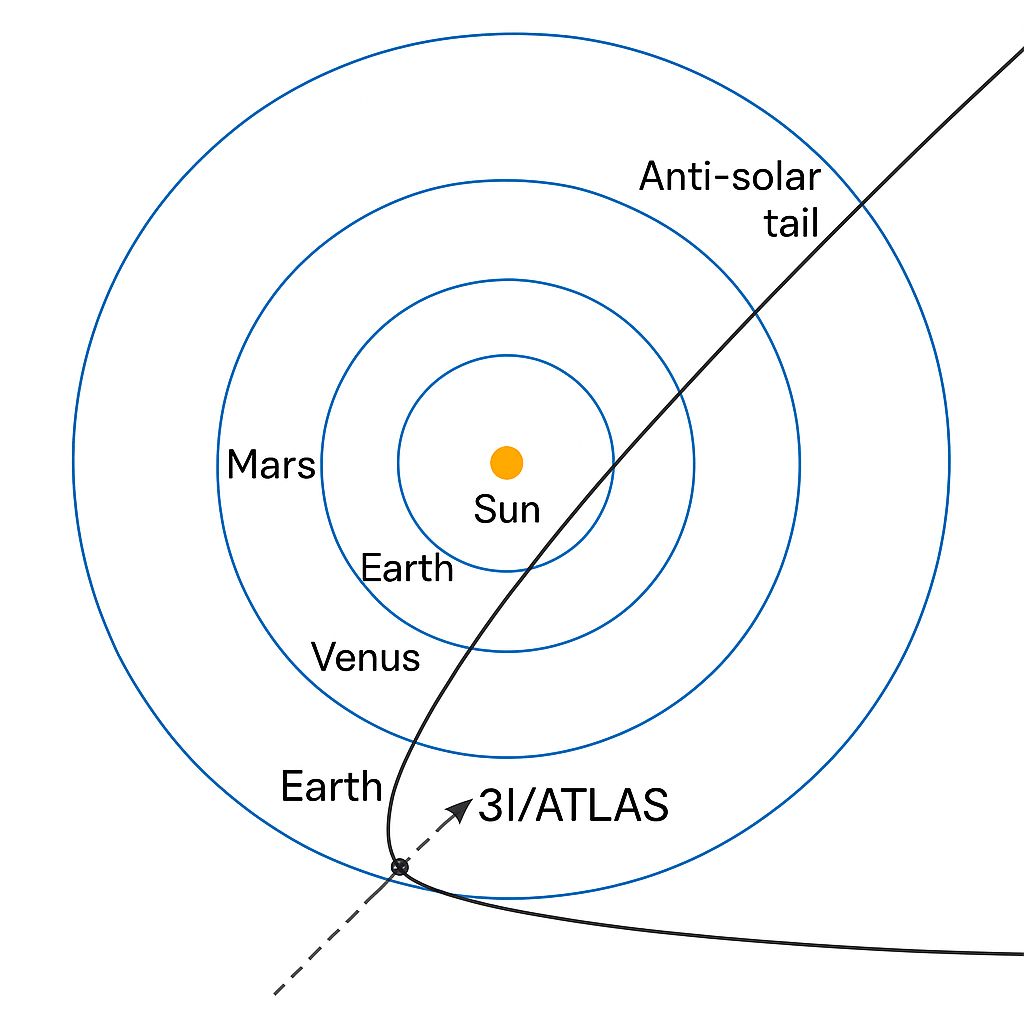
Harvard physicist Avi Loeb calculated that this unusual configuration happens where “the ram-pressure of the solar wind equals the ram-pressure of the CO2 outflow.” The surrounding gas envelope spans 18,800 kilometers — significantly larger than observations from just weeks earlier in July.
This isn’t your typical comet behavior.
In fact, everything about 3I/ATLAS challenges what we thought we knew about interstellar visitors.
The James Webb Space Telescope revealed something extraordinary about this cosmic wanderer.
The object spews carbon dioxide at 130 kilograms per second.
Water? Just 6.6 kilograms per second — a mere 5% of the CO2 output.
NASA’s SPHEREx mission mapped this massive CO2 plume extending an incredible 348,000 kilometers from the nucleus. To put that in perspective, that’s nearly the distance from Earth to the Moon. Carbon monoxide adds another 14 kilograms per second to the mix, creating a chemical signature unlike any comet we’ve studied before.
Water typically dominates cometary activity in our solar system.
Not here.
This CO2-dominated composition suggests 3I/ATLAS formed under vastly different conditions than our local comets — conditions that existed in another star system entirely.
SPHEREx data from August 8-12 dropped a bombshell on the scientific community.
The object could measure 46 kilometers across.
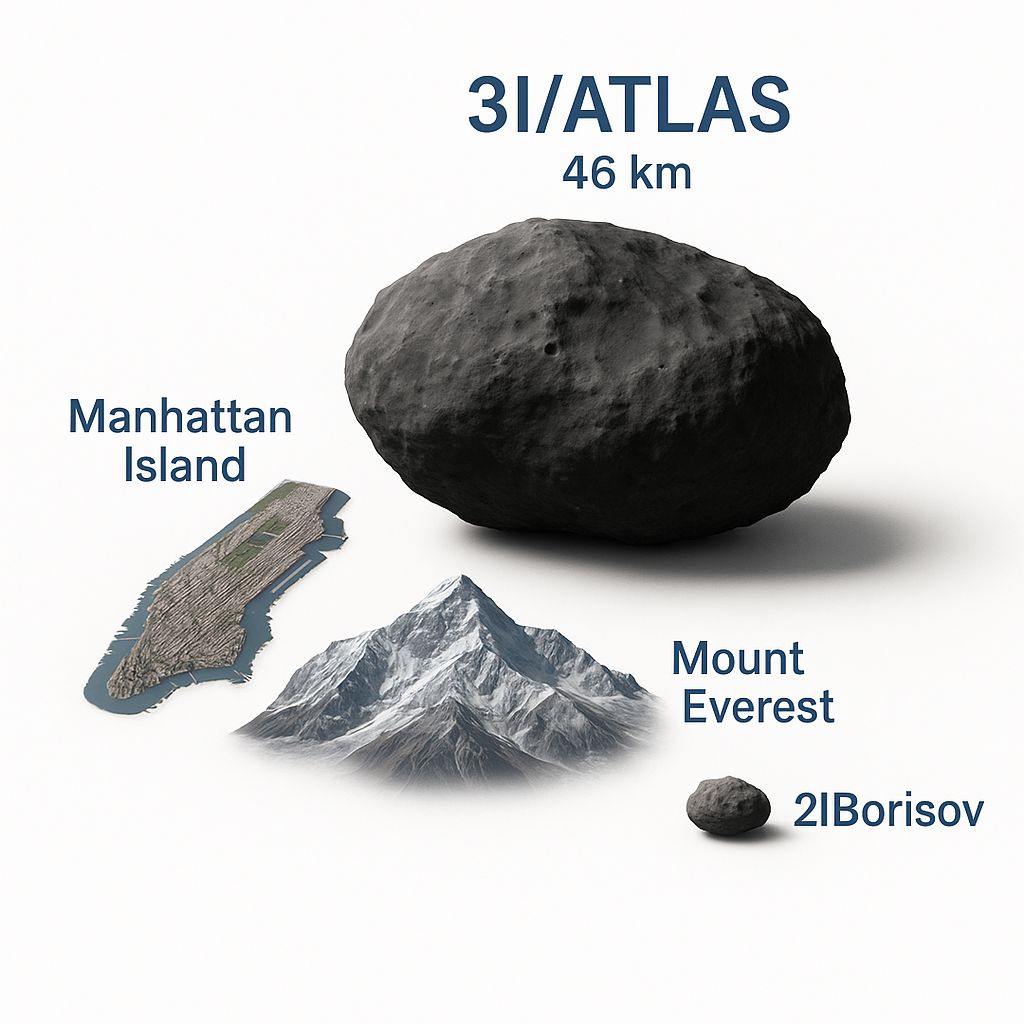
If confirmed as a solid body, this makes 3I/ATLAS a million times more massive than the previous interstellar comet 2I/Borisov. Current astrophysical models predict we should have detected thousands of smaller objects before finding something this huge wandering between the stars.
As Loeb pointed out in his analysis, the density of rocky interstellar material is 10,000 times too low to produce an object this size within the detection window of the ATLAS survey.
The math doesn’t add up.
Unless this visitor wasn’t random at all.
Spectroscopic data from the Very Large Telescope revealed something that made scientists do a double-take.
Cyanide and nickel in the outgassing plume.
But no iron.
This separation is virtually unknown in natural astrophysical environments. Iron and nickel typically form together in supernovae — finding one without the other resembles industrial alloy production more than cosmic chemistry.
NASA’s TESS mission observed a persistent glow around the object as early as May 2025, when it was still six astronomical units from the Sun. At that distance, water ice can’t sublimate. The activity must be driven by CO2 or other low-temperature volatiles that shouldn’t be this active.
3I/ATLAS doesn’t approach from a random angle like most interstellar objects.
Its trajectory aligns almost perfectly with our solar system’s ecliptic plane — the flat zone where all planets orbit. This alignment represents a coincidence of about 1 in 500 for a random occurrence.
The object will reach perihelion on October 29, 2025, passing within 203 million kilometers of the Sun.
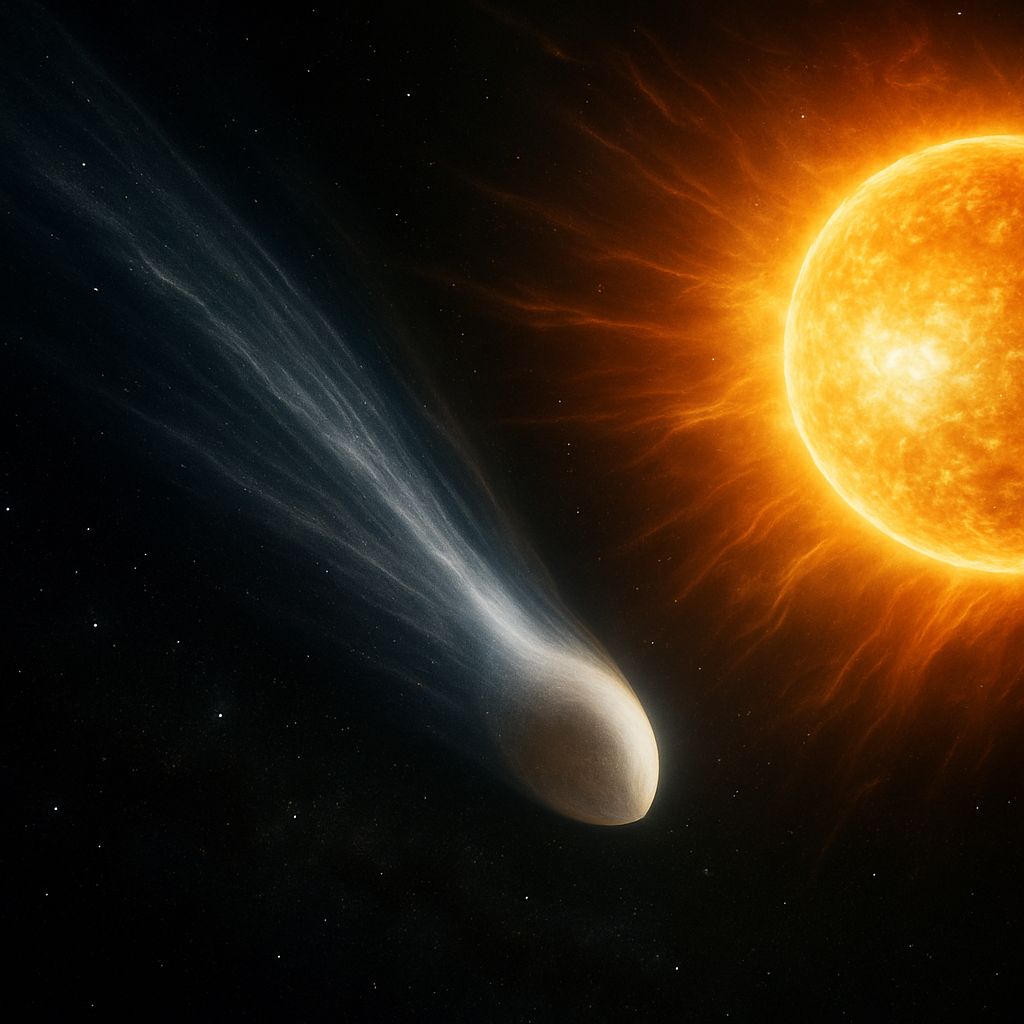
As it swings around our star at 68 kilometers per second, the increasing heat and radiation will create what Loeb calls “a high stress environment” that “elicits confessions.”
Mars will get a front-row seat on October 3, when 3I/ATLAS passes within 29 million kilometers of the Red Planet. The HiRISE camera aboard the Mars Reconnaissance Orbiter will capture images with 30-kilometer resolution.
After perihelion, 3I/ATLAS becomes visible again in November 2025, appearing in the pre-dawn sky.
Amateur astronomers with decent telescopes should be able to spot it moving through the constellations Virgo and Leo during December, though its brightness will fade below magnitude 12.
Professional observatories worldwide have trained their instruments on this enigmatic visitor. Each new observation adds another piece to a puzzle that’s rewriting our understanding of interstellar objects.
The anti-solar tail continues to grow.
The CO2 plume expands.
And the questions multiply faster than answers arrive.
We’ve now confirmed three interstellar visitors: ‘Oumuamua in 2017, Borisov in 2019, and now 3I/ATLAS in 2025.
Each one has challenged our assumptions.
‘Oumuamua accelerated without visible outgassing. Borisov looked almost normal — until you examined its carbon monoxide levels. Now 3I/ATLAS arrives with its backwards tail, industrial chemical signatures, and mass that defies statistical probability.
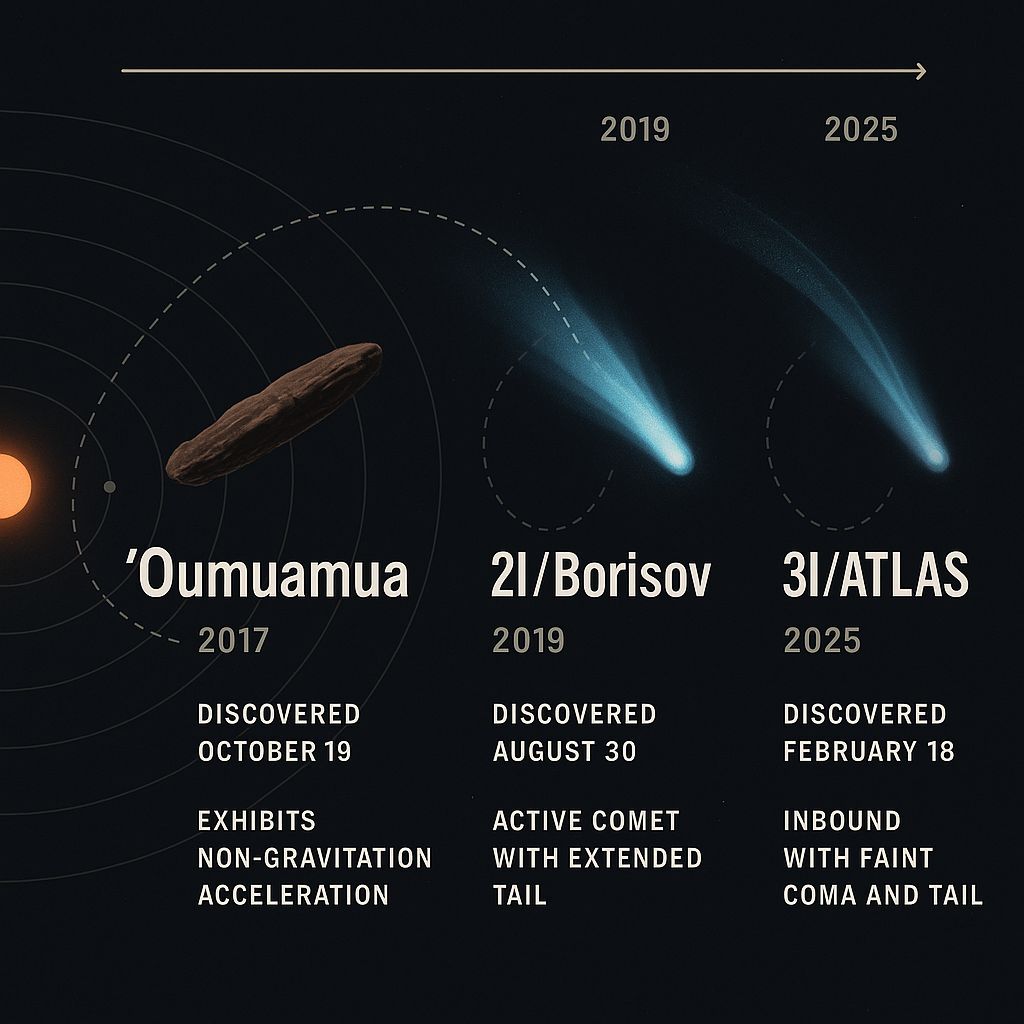
These visitors carry secrets from other star systems — chemical compositions forged under alien suns, trajectories shaped by gravitational dances we’ve never witnessed, and perhaps signatures of processes we haven’t yet imagined.
3I/ATLAS originated from the direction of Sagittarius, near our galaxy’s center, where stellar density reaches its peak. It traveled for millions, possibly billions of years through the darkness between stars before arriving at our doorstep.
The millimeter-thick layer of CO2 ice ablating from its surface represents just the outer skin of something much larger. What lies beneath remains unknown.
As this interstellar messenger continues its journey through our solar system, every telescope capable of observing it has joined the effort. The coming weeks before it disappears behind the Sun represent our only chance to decode its mysteries.
Because once 3I/ATLAS swings past the Sun, it returns to the vast emptiness between stars.
And it’s never coming back.