Physical Address
304 North Cardinal St.
Dorchester Center, MA 02124
Physical Address
304 North Cardinal St.
Dorchester Center, MA 02124

Population genetics serves as the mathematical bridge between Mendel’s laws of inheritance and Darwin’s theory of evolution by natural selection. In 2026, this field has become more relevant than ever as millions of people explore their ancestry through DNA testing and as scientists race to understand genetic factors behind diseases. This guide explains the fundamental principles, historical development, and real-world applications of population genetics in clear, accessible terms.
Understanding population genetics helps us grasp how genetic diversity arises, why certain traits appear more frequently in specific groups, and how human populations have migrated and adapted over millennia. Whether you are a student beginning your genetics journey or simply curious about the science behind ancestry tests, this comprehensive guide will walk you through everything you need to know about how genes behave across populations.
Population genetics is a subfield of genetics that studies how allele frequencies change within and among populations over time. Unlike Mendelian genetics, which focuses on individual inheritance patterns, population genetics examines entire gene pools and the evolutionary forces that shape genetic diversity at the group level. This science builds upon the foundations laid by Charles Darwin’s theory of evolution, which explains how species change through natural selection.
At its core, population genetics answers fundamental questions about biological diversity. Why do some populations have higher rates of certain genetic diseases? How do species adapt to new environments? What is the minimum population size needed to maintain genetic health? These questions have profound implications for medicine, conservation, and our understanding of human history.
Before diving deeper, let us establish the essential terminology that forms the foundation of population genetics:
Understanding how DNA is passed down through generations helps explain how gene pools maintain diversity over time. If you want to explore your own genetic connections, learning about how much DNA family members share provides practical context for these theoretical concepts.
The relationship between genotype and phenotype is not always straightforward. Some traits follow simple dominant-recessive patterns, while others involve multiple genes (polygenic inheritance) or show incomplete dominance. Environmental factors also influence how genes express themselves, creating the complex tapestry of human variation we observe today.
The Hardy-Weinberg equilibrium, independently formulated by G.H. Hardy and Wilhelm Weinberg in 1908, provides the mathematical foundation for population genetics. This principle describes a hypothetical population where allele frequencies remain constant across generations, creating a baseline against which real populations can be measured.
The Hardy-Weinberg equation expresses the expected genotype frequencies in a population:
p^2 + 2pq + q^2 = 1
Where p represents the frequency of one allele (typically the dominant allele) and q represents the frequency of the alternative allele. The equation components describe:
Consider a practical example. In a population where the frequency of the recessive allele for a particular trait is 0.3 (q = 0.3), the dominant allele frequency would be 0.7 (p = 0.7, since p + q = 1). Using the Hardy-Weinberg equation, we can predict that 49% of the population will be homozygous dominant (p^2 = 0.49), 42% will be heterozygous (2pq = 0.42), and 9% will be homozygous recessive (q^2 = 0.09).
For a population to remain in Hardy-Weinberg equilibrium, five specific conditions must be met:
While no natural population perfectly satisfies these conditions, Hardy-Weinberg equilibrium serves as an essential theoretical model. Deviations from expected frequencies reveal which evolutionary forces are actively shaping a population, allowing scientists to quantify the effects of selection, drift, or migration in real-world scenarios.
The field of population genetics emerged in the early 20th century when mathematically-minded biologists solved a critical puzzle: how do Mendel’s discrete inheritance patterns reconcile with Darwin’s continuous evolutionary change? This synthesis, known as the Modern Synthesis or Neo-Darwinian Synthesis, unified genetics and evolution into a coherent mathematical framework.
Three pioneering scientists established the mathematical foundations of population genetics between 1918 and 1932. Ronald Fisher, an English statistician and biologist, published his landmark work “The Genetical Theory of Natural Selection” in 1930. Fisher’s Fundamental Theorem of Natural Selection mathematically proved that the rate of increase in fitness of a population equals its genetic variance in fitness at any given time.
J.B.S. Haldane, a polymath who also made contributions to biochemistry and philosophy, published a series of papers titled “A Mathematical Theory of Natural and Artificial Selection” beginning in 1924. Haldane calculated the rate at which beneficial mutations spread through populations and demonstrated the mathematical relationship between selection intensity and evolutionary change.
Sewall Wright, an American geneticist, introduced the concept of random genetic drift and developed F-statistics for measuring population structure. Wright’s “shifting balance theory” proposed that evolution proceeds most efficiently when populations are subdivided into partially isolated groups, allowing different adaptive peaks to be explored before spreading through the larger population.
Theodosius Dobzhansky, a Russian-American geneticist, brought these mathematical theories to experimental validation through his 1937 book “Genetics and the Origin of Species.” Working with fruit flies (Drosophila), Dobzhansky demonstrated that natural populations harbor far more genetic variation than previously assumed. His famous assertion that “nothing in biology makes sense except in the light of evolution” has become a cornerstone of biological education.
Ernst Mayr contributed the biological species concept, defining species as groups of interbreeding natural populations reproductively isolated from other such groups. Motoo Kimura later revolutionized the field in 1968 with his neutral theory of molecular evolution, proposing that most evolutionary changes at the molecular level result from random genetic drift rather than natural selection.
Japanese researchers have made particularly significant contributions to population genetics, as highlighted in recent reviews of the field’s development. Their work on molecular phylogenetics and genome evolution has advanced our understanding of how genetic variation accumulates across species and populations.
Evolution within populations occurs through five fundamental mechanisms that alter allele frequencies across generations. Understanding these forces provides the framework for explaining biological diversity, adaptation, and the distribution of genetic traits among human populations and other species.
The following comparison summarizes how each evolutionary force operates:
Table: Comparison of Evolutionary Forces
| Force | Mechanism | Effect on Variation | Population Size Impact |
|——-|———–|———————|————————|
| Natural Selection | Differential survival and reproduction | Reduces variation (directional) or maintains it (balancing) | Effective in all sizes |
| Genetic Drift | Random sampling of gametes | Reduces variation over time | Strongest in small populations |
| Gene Flow | Migration between populations | Increases variation | Depends on migration rate |
| Mutation | Random changes to DNA | Increases variation | Constant across sizes |
| Non-random Mating | Mate selection based on traits | Changes genotype frequencies only | Variable effects |
Natural selection remains the primary adaptive force in evolution. When individuals with certain genotypes survive and reproduce more successfully than others, their advantageous alleles increase in frequency over generations. This process drives adaptation to environmental conditions and explains the intricate fit between organisms and their habitats.
Selection operates through several distinct patterns:
Fitness, measured by reproductive success, determines which alleles natural selection favors. However, fitness depends on environmental context. Alleles beneficial in one setting may become disadvantageous when conditions change, explaining why genetic diversity remains valuable even when some variants seem currently less advantageous.
Genetic drift refers to random fluctuations in allele frequencies due to chance events during gamete formation and offspring survival. Unlike natural selection, drift operates without regard to adaptive value, causing non-adaptive evolution especially pronounced in small populations.
Two special cases of genetic drift have particular biological significance:
Over extended periods, genetic drift can lead to allele fixation, where one variant becomes the only allele present for a particular gene. This process reduces genetic variation within populations while potentially increasing divergence between isolated groups. Effective population size, which accounts for factors like unequal sex ratios and reproductive variance, better predicts drift’s impact than census population counts.
Gene flow, also called migration or gene migration, involves the transfer of genetic material from one population to another through interbreeding. This process introduces new alleles, increases genetic variation within recipient populations, and reduces genetic differences between populations over time.
Gene flow through mating patterns determines how much DNA relatives share, from siblings to distant cousins. Understanding these connections helps explain why small isolated populations develop distinctive genetic profiles while cosmopolitan populations show greater diversity. If you are curious about specific relationships, exploring DNA sharing between relatives provides concrete examples of how genetic material moves through populations.
The homogenizing effect of gene flow can either promote or prevent speciation depending on circumstances. When populations exchange genes frequently, they remain genetically similar despite occupying different environments. Conversely, restricted gene flow allows populations to diverge genetically, potentially leading to reproductive isolation and speciation.
Human history provides numerous examples of gene flow’s effects. The mixing of Neanderthal and Denisovan DNA with modern human populations in Eurasia, detected through ancient DNA analysis, demonstrates how prehistoric gene flow contributed to present-day genetic diversity. Modern transportation and migration patterns continue to increase gene flow between previously isolated human populations, reshaping global genetic structure.
Mutation represents the ultimate source of all genetic variation, creating new alleles by altering DNA sequences. While mutation rates vary across organisms and genomic regions, this force operates independently of population size and introduces the raw material upon which other evolutionary forces act.
Types of mutations relevant to population genetics include:
Most mutations are either neutral or slightly deleterious. Beneficial mutations, though rare, provide the adaptive variation that natural selection promotes. The balance between mutation introducing new variation and selection or drift removing it determines equilibrium genetic diversity levels within populations.
Non-random mating occurs when individuals choose mates based on specific traits, changing genotype frequencies without necessarily altering allele frequencies. This mechanism violates Hardy-Weinberg assumptions and can significantly impact population structure.
Types of non-random mating include:
Inbreeding depression, the reduced fitness observed in inbred populations, results from increased homozygosity of harmful recessive alleles. Conservation biologists carefully monitor effective population size and inbreeding coefficients to maintain genetic health in threatened species populations.
Population genetics transforms abstract evolutionary theory into practical tools with far-reaching applications across medicine, forensics, conservation, and personal ancestry exploration. These real-world implementations demonstrate how understanding genetic variation at the population level solves concrete problems and answers questions about our shared human heritage.

Population genetics provides powerful methods for reconstructing human history and migration patterns. By analyzing genetic variation across contemporary populations, scientists can infer ancestral relationships, trace prehistoric movements, and quantify the contributions of ancient hominin groups to modern human genomes.
Tracing migration patterns relies on identifying genetic markers that distinguish populations. Mitochondrial DNA, passed exclusively from mother to offspring, has been instrumental in tracing maternal lineages back to “Mitochondrial Eve,” a woman who lived approximately 200,000 years ago and whose descendants carry the common ancestor of all present-day human mitochondrial DNA. Similarly, Y-chromosome analysis traces paternal lineages.
Whole-genome approaches now provide far more detailed pictures of ancestry. Admixture analysis estimates the proportions of ancestry derived from different source populations, revealing the complex genetic history of groups like African Americans, Latin Americans, and Central Asians who descend from multiple continental origins. If you are interested in exploring your own ancestry, there are several genetic genealogy websites that apply these population genetics methods to trace individual roots.
Commercial DNA testing services like 23andMe apply population genetics methods to estimate your ancestry composition. These services compare customer DNA against reference panels representing different populations worldwide, calculating the most likely ancestral origins. While commercial tests have limitations compared to academic research, they bring population genetics concepts to millions of people curious about their heritage. For a detailed look at one popular service, see our 23andMe review.
John Novembre’s research at UCLA exemplifies how population genetics illuminates human history. His team uses genetic variations among Europeans to uncover intricate details about historical migrations, population expansions, and isolation events. Such work demonstrates the field’s power for reconstructing demographic history beyond what written records can provide.
Population genetics significantly contributes to medical research by identifying disease-associated genes and understanding how genetic risk varies across populations. This knowledge drives personalized medicine, improves public health strategies, and guides therapeutic development.
Gene-disease associations discovered through population-scale genomic studies have transformed our understanding of inherited conditions. By comparing genomes from affected individuals against population controls, researchers identify variants statistically associated with diseases. The Huntington’s disease gene, HTT, exemplifies how population genetics approaches revealed the genetic basis of Mendelian disorders.
Genome-wide association studies (GWAS) have identified thousands of genetic variants linked to complex diseases including diabetes, schizophrenia, and various cancers. These studies require large, diverse population samples to detect subtle genetic effects while avoiding population stratification artifacts. The Broad Institute’s initiatives cataloging genomic differences through large-scale human sequencing represent significant progress in understanding genetic contributions to disease.
Pharmacogenomics applies population genetics to customize drug treatments based on individual genetic profiles. Different populations carry varying frequencies of alleles affecting drug metabolism, efficacy, and adverse reactions. Understanding these patterns helps clinicians prescribe safer, more effective medications tailored to genetic backgrounds.
Epidemiological applications extend population genetics principles to public health resource allocation. Populations with high consanguinity rates show increased frequencies of recessive genetic diseases, guiding screening program implementation. Similarly, understanding how pathogens evolve through population genetic mechanisms helps predict and combat infectious disease outbreaks.
Evolutionary medicine examines how human evolutionary history explains disease susceptibility. The thrifty genotype hypothesis suggests that alleles promoting efficient energy storage became common during human evolutionary history but now contribute to diabetes and obesity in modern environments with abundant food. Such insights emerge directly from population genetic analyses of human genetic variation.
Conservation genetics applies population genetics principles to preserve biodiversity and manage threatened species. By assessing genetic diversity, inbreeding levels, and population structure, conservation biologists develop strategies to maintain evolutionary potential and avoid extinction.
Small populations face severe genetic challenges. Genetic drift erodes variation, inbreeding increases homozygosity for harmful recessives, and reduced effective population size limits adaptive potential. The 50/500 rule suggests that populations need at least 50 individuals to avoid short-term inbreeding depression and 500 to maintain long-term evolutionary potential, though these numbers vary by species.
Genetic management strategies include translocating individuals between isolated populations to restore gene flow, captive breeding programs designed to minimize inbreeding, and identifying genetically distinct populations that warrant separate conservation priority. California condor recovery illustrates how genetic monitoring can guide successful conservation.
Population genetics also helps identify cryptic species, evolutionary significant units, and priority areas for protection. Molecular markers can reveal hidden diversity within seemingly uniform populations, ensuring conservation efforts capture the full spectrum of genetic heritage.
Forensic genetics applies population genetic principles to criminal investigations and legal proceedings. DNA profiling relies on population frequencies of genetic markers to calculate match probabilities, while population databases provide the reference data for these calculations.
Short tandem repeat (STR) analysis, the standard forensic DNA method, examines highly variable regions where allele frequencies differ among populations. Accurate frequency estimation requires appropriate reference databases accounting for population structure, as allele frequencies vary across ethnic groups.
Forensic genetic genealogy combines traditional DNA profiling with public genetic databases to identify unknown individuals from crime scenes or cold cases. This approach has solved numerous previously unsolvable cases but raises privacy and ethical questions about genetic surveillance.
Technological advances have revolutionized population genetics, enabling analyses that were impossible just decades ago. High-throughput sequencing, sophisticated computational methods, and massive datasets now allow researchers to study genetic variation at unprecedented scales and resolutions.
Next-generation sequencing (NGS) technologies have transformed population genetics by dramatically reducing costs while increasing throughput. What once required years of laboratory work now takes days, enabling studies with thousands of individuals sequenced at whole-genome resolution.
Whole-genome sequencing provides complete genetic information, detecting not just common variants but rare mutations, structural variations, and population-specific polymorphisms. This comprehensive view reveals patterns invisible to older methods that examined only small genetic regions.
Single nucleotide polymorphisms (SNPs), the most common type of genetic variation, serve as markers for association studies and population structure analysis. SNP arrays can genotype millions of variants simultaneously, making large-scale population surveys feasible and affordable.
Genome-wide association studies (GWAS) scan the entire genome for variants associated with traits or diseases. By comparing allele frequencies between cases and controls across millions of SNPs, researchers identify genetic regions influencing everything from height to disease susceptibility. Over 100,000 trait-variant associations have been discovered through GWAS.
Ancient DNA analysis represents perhaps the most revolutionary advance. By extracting and sequencing DNA from archaeological remains, researchers directly observe genetic variation from past populations. This field has revealed Neanderthal and Denisovan contributions to modern humans, traced the spread of agriculture and languages, and documented prehistoric population replacements.
Bioinformatics, the intersection of biology and computer science, manages the enormous datasets generated by modern genomic methods. Population genetics now requires sophisticated computational approaches to process, analyze, and interpret genetic data from thousands of individuals.
Population structure analysis software like ADMIXTURE and STRUCTURE uses multilocus genotype data to infer ancestry proportions and population assignments. These tools help identify cryptic population structure, detect admixture events, and correct for stratification in association studies.
Phylogenetic reconstruction tools build evolutionary trees showing relationships among populations or species. These analyses reveal divergence times, migration patterns, and historical gene flow events. Coalescent theory, which models how genealogical lineages merge backward through time, provides the mathematical framework for these inferences.
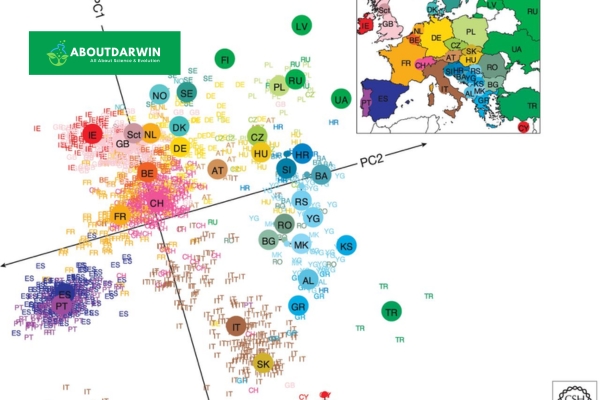
Principal component analysis (PCA) and other dimensionality reduction techniques visualize genetic relationships among individuals. Genetic distance matrices can place individuals on maps reflecting their genetic similarity, often recovering geographic patterns with remarkable precision. Novembre’s genetic map of Europe showed that genetic variation closely mirrors geography, with PCA axes corresponding to north-south and east-west gradients.
Machine learning approaches increasingly supplement traditional statistical methods in population genetics. Neural networks detect complex patterns in genomic data, predict phenotypes from genotypes, and classify individuals into populations. These methods complement rather than replace classical population genetics theory while handling datasets of unprecedented size.
Population genomics, the large-scale study of genetic variation within and among populations, has become central to biological research. Projects like the 1000 Genomes Project, the Human Genome Diversity Project, and numerous species-specific initiatives generate public resources that advance both basic science and practical applications.
Understanding population genetics requires familiarity with specialized terminology. This glossary defines essential terms for readers new to the field:
Population genetics is a subfield of genetics that studies genetic variation within and among populations. It examines how allele frequencies change over time through evolutionary forces including natural selection, genetic drift, gene flow, mutation, and non-random mating. The field bridges Mendelian inheritance with Darwinian evolution, using mathematical models to understand patterns of genetic diversity.
Population genetics can be challenging due to its mathematical components, but the fundamental concepts are accessible without advanced calculus. Many students succeed by focusing on conceptual understanding first, using worked examples of Hardy-Weinberg calculations and probability. Free resources like Khan Academy and introductory genetics textbooks provide step-by-step explanations. The difficulty depends on course level; introductory courses emphasize concepts while advanced courses require sophisticated mathematical modeling.
The 50/500 rule provides general guidance: populations need at least 50 breeding individuals to avoid short-term inbreeding depression and 500 to maintain long-term evolutionary potential. However, these numbers vary by species. Effective population size, which accounts for factors like unequal sex ratios and reproductive variance, matters more than census count. Endangered species management typically aims for effective population sizes exceeding 100 to preserve genetic diversity and adaptive potential.
Natural selection is a non-random process where alleles conferring survival or reproductive advantages increase in frequency, producing adaptive evolution. Genetic drift is random fluctuation in allele frequencies due to chance events during reproduction. Selection operates based on fitness differences between genotypes, while drift operates regardless of adaptive value. Selection is predictable and directional, whereas drift is stochastic and particularly powerful in small populations where chance events can significantly alter gene frequencies.
Forensic genetics uses population genetic principles to interpret DNA evidence. DNA profiling examines highly variable genetic markers where allele frequencies differ among populations. Match probabilities calculate how likely random individuals share a DNA profile using population reference databases. Forensic genetic genealogy combines DNA profiling with public genetic databases to identify unknown individuals from crime scenes. Population structure must be accounted for in calculations, as allele frequencies vary across ethnic groups.
Effective population size (Ne) is the size of an idealized population that would experience the same amount of genetic drift as the actual population under study. Real populations often have effective sizes smaller than their census counts due to factors like unequal sex ratios, non-random variation in reproductive success, and population size fluctuations. Conservation biologists focus on Ne because it better predicts genetic diversity maintenance and inbreeding risk than simple population counts.
Inbreeding increases homozygosity in small populations, exposing deleterious recessive alleles that were masked in heterozygotes. This inbreeding depression reduces fitness through decreased fertility, higher juvenile mortality, and reduced disease resistance. Small populations also lose genetic diversity through drift, limiting their ability to adapt to environmental changes. Conservation programs manage inbreeding through genetic monitoring, maintaining pedigrees, and occasionally introducing unrelated individuals to restore gene flow.
Population genetics provides fundamental understanding of biological diversity, evolution, and genetic disease. Applications include tracing human ancestry and migration history, identifying disease-associated genes for medical research, managing endangered species conservation, interpreting forensic DNA evidence, improving crop and livestock breeding, and developing personalized medicine approaches. The field connects molecular biology with organismal biology, explaining how genetic variation produces the diversity of life on Earth.
Population genetics stands at the intersection of mathematics, molecular biology, and evolutionary theory, offering profound insights into the forces that shape genetic diversity. From the foundational work of Fisher, Haldane, and Wright in the early twentieth century to today’s genomic revolution, this field has transformed our understanding of how life evolves and adapts.
The five evolutionary forces—natural selection, genetic drift, gene flow, mutation, and non-random mating—provide a complete framework for explaining genetic change within populations. The Hardy-Weinberg principle offers a mathematical baseline against which real populations can be measured, revealing which forces actively shape particular biological systems.
Practical applications of population genetics now touch nearly every aspect of biological research and human welfare. Medical breakthroughs trace disease-causing mutations through population studies. Conservation biologists use genetic tools to preserve endangered species. Ancestry testing connects individuals to their heritage using principles first developed to understand fruit fly populations. Forensic science applies population frequencies to interpret DNA evidence in criminal investigations.
Modern techniques including whole-genome sequencing, ancient DNA analysis, and sophisticated bioinformatics continue expanding the field’s capabilities. As datasets grow and analytical methods advance, population genetics will increasingly inform our understanding of human history, disease susceptibility, and biological diversity.
Population genetics explained in its full scope reveals how mathematical principles illuminate the living world. Whether applied to understanding why some populations carry higher rates of genetic diseases or reconstructing the migrations of ancient humans, this science demonstrates the power of quantitative thinking in biology. As genetic technologies become more accessible and widespread, population genetics literacy will serve an essential foundation for informed citizenship in an age of genomic medicine and personal DNA testing.


