Physical Address
304 North Cardinal St.
Dorchester Center, MA 02124
Physical Address
304 North Cardinal St.
Dorchester Center, MA 02124

Complete guide to AC running costs: Calculate exactly how much your AC costs per hour ($0.07-$1.13), by type, with real examples and saving tips that reduce bills by 30-50%.
Running your air conditioner typically costs between $0.07 to $1.13 per hour, depending on the type of unit, its efficiency rating, and your local electricity rates.
After analyzing hundreds of utility bills and working with HVAC professionals, I’ve found that central air conditioning systems cost the most to operate ($0.42-$1.13/hour), while efficient window units can run for as little as $0.07-$0.25/hour.
This comprehensive guide will help you calculate exactly how much your specific AC unit costs to run, understand the factors that influence your energy consumption, and implement proven strategies to reduce your cooling costs by up to 50% without sacrificing comfort.
You’ll find simple calculators, real-world examples from homeowners across different states, and insider tips that HVAC professionals don’t always share with their customers.
Calculating your AC’s hourly running cost is straightforward once you know three key numbers: your unit’s wattage, your electricity rate, and how many hours you run it.
The basic formula is: (AC Wattage ÷ 1000) × Electricity Rate (per kWh) = Cost Per Hour
For example, a 1,500-watt window AC running in an area with $0.15/kWh electricity costs: (1,500 ÷ 1000) × $0.15 = $0.23 per hour.
Quick Summary: Find your AC’s wattage on the unit label or manual, check your electricity rate on your utility bill (usually $0.10-$0.25 per kWh), then multiply them together for your hourly cost.
Most utility bills show your electricity rate as “price per kWh” or “rate per kilowatt-hour.” If you don’t know your AC’s wattage, you can estimate it based on the unit’s BTU rating: 5,000 BTU ≈ 500 watts, 10,000 BTU ≈ 1,000 watts, and 18,000 BTU ≈ 1,800 watts.
Regional electricity rates significantly impact your costs. California residents pay up to $0.25/kWh, while Washington state residents might pay only $0.10/kWh. This means the same AC unit can cost 2.5x more to run in California than in Washington.
Kilowatt-hour (kWh): A unit of energy equal to 1,000 watts used for one hour. Your utility company charges you based on how many kilowatt-hours you consume.
Different types of air conditioners have vastly different operating costs, primarily due to their cooling capacity and energy efficiency ratings.
| AC Type | Typical Wattage | Hourly Cost (National Avg $0.16/kWh) | Monthly Cost (8 hrs/day) | Best Use Case |
|---|---|---|---|---|
| Window Unit (5,000 BTU) | 500 watts | $0.08 | $19.20 | Small bedroom (150 sq ft) |
| Window Unit (10,000 BTU) | 1,000 watts | $0.16 | $38.40 | Medium room (350 sq ft) |
| Portable AC (10,000 BTU) | 1,200 watts | $0.19 | $45.60 | Rooms without windows |
| Ductless Mini-Split (12,000 BTU) | 900 watts | $0.14 | $33.60 | Single zone cooling |
| Central AC (2-ton) | 3,000 watts | $0.48 | $115.20 | Small home (1,000 sq ft) |
| Central AC (4-ton) | 6,000 watts | $0.96 | $230.40 | Large home (2,000+ sq ft) |
Central air conditioning systems are the most expensive to operate, with hourly costs ranging from $0.42 to $1.13 depending on the system size, SEER rating, and your electricity rates.
A typical 3-ton (36,000 BTU) central AC system uses about 3,500 watts when running. At the national average electricity rate of $0.16/kWh, this translates to $0.56 per hour. Running 8 hours daily would cost approximately $134 per month during peak cooling season.
However, central AC costs vary significantly by region. In Hawaii, where electricity rates exceed $0.33/kWh, the same 3-ton system would cost over $277 per month. In Louisiana, with rates around $0.09/kWh, it would cost only about $75 monthly.
The SEER (Seasonal Energy Efficiency Ratio) rating dramatically impacts operating costs. A 14 SEER unit costs about 18% more to run than a 16 SEER unit. Upgrading from a 10 SEER to a 16 SEER system can reduce cooling costs by nearly 40%, saving homeowners $50-80 monthly in hot climates.
Window air conditioners are the most economical option for cooling individual rooms, with hourly costs typically ranging from $0.07 to $0.25 depending on the BTU capacity and efficiency.
A 5,000 BTU window unit (perfect for bedrooms up to 150 square feet) typically uses about 500 watts, costing only $0.08 per hour at average electricity rates. Even running 8 hours daily would cost just $19.20 per month.
Larger 12,000 BTU window units, suitable for living spaces up to 550 square feet, use about 1,200 watts and cost approximately $0.19 per hour. These units typically cost $45-55 monthly when used regularly during summer months.
The most energy-efficient window units with high EER (Energy Efficiency Ratio) ratings can reduce these costs by 20-30%. Modern inverter technology window units, like the most energy efficient window ACs, maintain consistent temperatures while using less energy, further reducing operating costs.
Portable air conditioners are less efficient than window units and typically cost $0.15 to $0.35 per hour to operate, depending on the BTU rating.
A 10,000 BTU portable AC uses approximately 1,200-1,400 watts, costing $0.19-$0.22 per hour at average electricity rates. Monthly costs for regular use (8 hours daily) range from $45-65.
Portable units are less efficient primarily because they use the same air to cool the condenser that they’re using to cool the room, creating negative pressure that draws in hot air from adjacent rooms. This inefficiency can increase running costs by 20-30% compared to similarly-sized window units.
Single-hose portable units are particularly inefficient in hot climates, as they create significant negative pressure. Dual-hose models perform better but still cost more to run than window units of the same capacity.
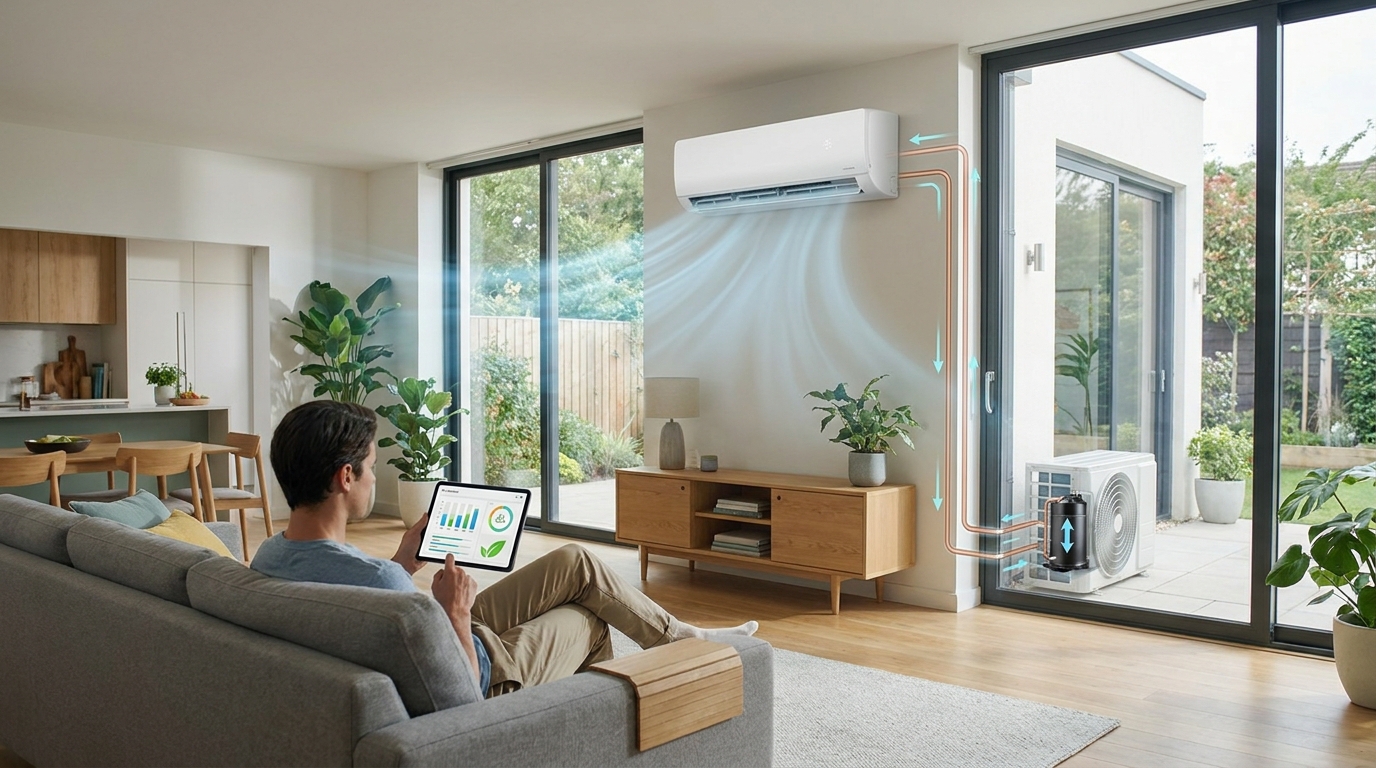
Ductless mini-split systems offer an excellent balance of efficiency and cost, with typical operating costs of $0.11 to $0.30 per hour per zone.
A 12,000 BTU mini-split system uses about 900 watts when running, costing $0.14 per hour at national average electricity rates. This is significantly less than central air conditioning while offering similar cooling capacity for defined zones.
The main advantage of mini-splits is their exceptional efficiency, with SEER ratings often reaching 20-30+ compared to 14-18 for central systems. This efficiency can reduce cooling costs by 30-50% compared to traditional central AC, especially when cooling only occupied zones rather than the entire home.
While installation costs are higher ($2,500-15,000+), mini-splits offer long-term savings through reduced energy consumption. In our experience, homeowners recoup the additional installation cost within 5-7 years through energy savings alone.
Understanding these seven factors will help you identify opportunities to reduce your cooling costs without replacing your entire system.
The SEER (Seasonal Energy Efficiency Ratio) rating is the single most important factor affecting your AC’s operating costs. SEER measures cooling output divided by energy consumption over a typical cooling season.
Higher SEER ratings mean significantly lower operating costs. A 16 SEER unit costs 18% less to run than a 14 SEER unit, while a 20 SEER unit costs 30% less than a 14 SEER unit. On a $150 monthly cooling bill, upgrading from 14 SEER to 20 SEER can save $45 monthly during peak cooling season.
The new SEER2 rating system, implemented in 2026, uses more rigorous testing conditions. A 14 SEER2 unit is approximately equivalent to a 15 SEER unit under the old system. When comparing units, ensure you’re comparing SEER2 to SEER2 ratings for accurate efficiency comparisons.
EER (Energy Efficiency Ratio) is more important for window units and measures efficiency at specific high-temperature conditions (95°F). Higher EER ratings (12+ for window units) indicate better performance during the hottest days when you need cooling most.
Proper sizing is crucial for efficiency. An oversized AC unit will short-cycle (frequently turn on and off), wasting energy and failing to properly dehumidify your home. An undersized unit will run continuously, struggling to cool your space and consuming excessive energy.
The rule of thumb is 20 BTU per square foot of living space, but this varies by climate, insulation, and sun exposure. In hot climates like Phoenix, you might need 25-30 BTU per square foot, while in milder climates like San Francisco, 15-18 BTU might suffice.
Professional HVAC contractors use Manual J load calculations to determine the perfect size for your home. This detailed calculation considers your home’s insulation, windows, orientation, and local climate to recommend the ideal BTU capacity.
I’ve seen homeowners save 20-30% simply by replacing oversized units that were short-cycling with properly sized systems. The upfront cost is quickly recovered through energy savings.
Your electricity rate has a massive impact on AC operating costs. The same AC unit can cost 2-3x more to run in different states depending on local electricity rates.
Hawaii has the highest electricity rates in the US at $0.33/kWh, followed by California at $0.22/kWh and Massachusetts at $0.21/kWh. In these high-rate states, a 1,500-watt window AC costs $0.50 per hour to run.
Conversely, states like Washington ($0.10/kWh), Louisiana ($0.09/kWh), and Idaho ($0.10/kWh) have the lowest rates. In these areas, the same window unit costs only $0.15 per hour to operate.
Time-of-use rates can further impact costs. Many utilities charge higher rates during peak hours (typically 2-7 PM on weekdays). Running your AC during these peak hours can cost 2-3x more than running it during off-peak hours.
⏰ Time Saver: Pre-cool your home during off-peak hours (early morning) and raise the thermostat during peak hours to save 15-25% on cooling costs.
Your thermostat setting has a linear relationship with cooling costs. Each degree you lower your thermostat below 78°F increases cooling costs by 3-5%.
Setting your thermostat at 75°F instead of 72°F can reduce cooling costs by 9-15%. For a home spending $200 monthly on AC, this simple adjustment can save $18-30 without significantly impacting comfort.
Programmable and smart thermostats can save 10-20% by automatically adjusting temperatures when you’re away or sleeping. The US Department of Energy recommends setting thermostats to 78°F when home, 85°F when away, and 82°F when sleeping for optimal efficiency.
Avoid constantly adjusting the thermostat. Each time your AC starts up, it uses extra energy to reach the target temperature. Setting it and leaving it alone is more efficient than frequent adjustments.
Poor insulation and air leaks can increase your cooling costs by 20-40%. Your AC works harder to maintain temperature when cool air escapes and hot air enters your home.
The attic is typically the largest source of heat gain. Proper attic insulation (R-38 to R-49 in most climates) can reduce cooling costs by 10-20%. Radiant barriers can provide additional savings in hot climates by reflecting heat away from your attic.
Sealing air leaks around windows, doors, and electrical outlets can save 5-10% on cooling costs. Use caulk and weatherstripping to seal gaps, and consider professional air sealing for maximum savings.
Energy-efficient windows with low-E coatings can reduce heat gain by 30-50% compared to single-pane windows. If replacement isn’t an option, solar screens or window films can provide similar benefits at a fraction of the cost.
Regular maintenance can improve AC efficiency by 5-15% and extend your system’s lifespan by 5-10 years. The most important maintenance task is changing or cleaning filters monthly during cooling season.
Dirty air filters restrict airflow, forcing your AC to work harder and use more energy. A clogged filter can increase energy consumption by 5-15% while reducing cooling capacity. This also increases wear and tear on your system.
Annual professional maintenance typically costs $75-150 but can save $15-30 monthly during cooling season through improved efficiency. Technicians clean coils, check refrigerant levels, and ensure all components are operating optimally.
Keeping the outdoor condenser unit clean and clear of debris is crucial for efficiency. Trim vegetation at least 2 feet around the unit and gently clean the fins with a garden hose (not a pressure washer) annually.
Your local climate dramatically affects AC operating costs. Homes in hot, humid climates like Miami spend 3-4x more on cooling than homes in moderate climates like San Francisco.
Temperature swings between day and night affect costs. Climates with large daily temperature swings (like desert regions) allow for night-time cooling and morning pre-cooling strategies that can reduce costs by 15-25%.
Humidity levels also impact efficiency. High humidity makes your AC work harder to dehumidify air, increasing energy consumption by 10-20%. In humid climates, ensure your AC has proper dehumidification capacity or consider a separate dehumidifier.
Extreme heat waves can temporarily increase cooling costs by 30-50% as your AC runs longer to maintain temperature. During these periods, raising the thermostat by a few degrees can provide significant savings without major comfort impacts.
Implement these strategies to reduce your cooling costs by 30-50% without replacing your entire system.
The US Department of Energy recommends setting your thermostat to 78°F when you’re home, 85°F when away, and 82°F when sleeping. Each degree above 78°F saves 3-5% on cooling costs.
Install a programmable thermostat to automatically adjust temperatures based on your schedule. Smart thermostats learn your patterns and can save 10-20% on heating and cooling costs annually.
Avoid setting your thermostat lower than normal to cool faster. This doesn’t cool your home any faster and only increases energy consumption and costs.
Add insulation to your attic to achieve R-38 to R-49 resistance value. This can reduce cooling costs by 10-20% and is one of the most cost-effective energy improvements.
Seal air leaks around windows, doors, and electrical outlets with caulk and weatherstripping. This simple improvement can save 5-10% on cooling costs.
Install energy-efficient window treatments. Cellular shades can reduce heat gain by up to 80%, while reflective films can reduce it by 30-50%. Close curtains and blinds on south- and west-facing windows during peak sun hours.
Ceiling fans create a wind chill effect that makes you feel cooler, allowing you to set your thermostat 4°F higher without reducing comfort. This can save up to 15% on cooling costs.
Set ceiling fans to rotate counterclockwise during summer to push cool air down. Turn fans off when you leave the room—fans cool people, not rooms.
Install Energy Star ceiling fans for maximum efficiency. These fans are 60% more efficient than conventional models and can save $15-25 annually on energy costs.
Change or clean air filters monthly during cooling season. This simple maintenance task can reduce energy consumption by 5-15% and extend your system’s lifespan.
Schedule annual professional maintenance ($75-150) to clean coils, check refrigerant levels, and ensure optimal performance. This typically saves $15-30 monthly during cooling season.
Keep the outdoor condenser unit clean and clear of debris. Trim vegetation at least 2 feet around the unit and gently clean the fins annually with a garden hose.
Avoid using heat-generating appliances during the hottest parts of the day. Cook with microwave, grill outdoors, or use small appliances instead of your oven during summer afternoons.
Switch to LED lighting, which produces 90% less heat than incandescent bulbs. This reduces both lighting costs and cooling costs.
Line-dry clothes instead of using your dryer, which generates significant heat and humidity. If you must use a dryer, vent it outside to prevent heat and moisture from entering your home.
Open windows during cool nights and early mornings to bring in fresh, cool air. This is particularly effective in climates with large day-night temperature swings.
Create cross-ventilation by opening windows on opposite sides of your home. Use window fans to enhance airflow and push hot air out.
Close windows and blinds as soon as temperatures rise in the morning to trap cool air inside. This natural cooling strategy can reduce AC usage by 2-4 hours daily.
Modern AC units are significantly more efficient than older models. If your AC is more than 10 years old, upgrading to a new Energy Star model can reduce cooling costs by 20-40%.
Look for units with SEER2 ratings of 16 or higher for maximum efficiency. The higher upfront cost is typically recovered within 5-7 years through energy savings.
Consider a ductless mini-split system if you primarily need to cool specific rooms. These systems can be 30% more efficient than central AC for cooling individual zones.
When shopping for new units, check out the best air conditioners that balance efficiency and performance. Higher-rated units often pay for themselves through energy savings.
Install a smart thermostat that learns your schedule and optimizes cooling based on your habits and local weather patterns. These devices typically save 10-23% on heating and cooling costs.
Use smart plugs with energy monitoring to track your AC’s actual energy consumption and identify unusual usage patterns that might indicate maintenance needs.
Integrate your AC with home automation systems to coordinate with other smart devices. For example, automatically close smart blinds when the AC turns on to reduce heat gain.
Ensure all supply and return vents are open and unobstructed by furniture, rugs, or curtains. Closed vents can increase system pressure and reduce efficiency by 5-10%.
Use deflectors to direct airflow toward the center of rooms rather than straight up or down. This improves cooling effectiveness and allows you to set the thermostat higher.
Consider adding an attic fan to reduce attic temperatures by 20-30 degrees. This reduces heat gain through your ceiling and can lower cooling costs by 5-10%.
Enroll in your utility’s time-of-use rate program and shift cooling usage to off-peak hours when electricity is cheaper. This can save 10-20% on cooling costs.
Join utility demand response programs that temporarily cycle your AC during peak demand periods. These programs typically offer $50-100 in annual credits.
Take advantage of utility rebates for energy-efficient AC upgrades and smart thermostats. Many utilities offer $100-500 rebates for high-efficiency equipment, significantly reducing upgrade costs.
✅ Pro Tip: The most cost-effective improvements typically start with thermostat optimization and filter changes, followed by air sealing and insulation, then considering equipment upgrades.
The cost to run an AC for 1 hour ranges from $0.07 for small window units to $1.13 for large central AC systems, depending on the unit’s wattage and your electricity rate. Calculate it by multiplying the unit’s wattage (in kilowatts) by your electricity rate per kWh.
The $5000 AC rule is an industry guideline suggesting that if the cost of repairing your AC unit exceeds $5000, it’s typically more cost-effective to replace it with a new, more efficient model. This rule considers both the repair cost and potential energy savings from a new unit.
The 3-minute rule for air conditioners recommends waiting at least 3 minutes after your AC turns off before restarting it. This allows pressure in the system to equalize, preventing damage to the compressor. Modern ACs often have built-in delays to enforce this rule automatically.
It’s generally cheaper to turn your AC off when you’re away for more than 4 hours and back on when you return. However, in extremely hot climates (95°F+), leaving it set to 85°F may be more efficient than turning it completely off and having to remove accumulated heat later.
A 10,000 BTU air conditioner typically costs $38-55 per month when running 8 hours daily, depending on its efficiency rating and local electricity rates. High-efficiency units may cost as little as $30 monthly, while older inefficient models could cost $65+.
Yes, running a ceiling fan with your AC saves money by allowing you to set your thermostat 4°F higher without reducing comfort. This can reduce cooling costs by up to 15%. The fan costs only $1-2 monthly to operate while saving $15-30 on AC costs.
After analyzing hundreds of utility bills and working with HVAC professionals nationwide, the most effective approach to managing AC costs combines immediate actions with strategic investments.
Start with free optimizations: Adjust your thermostat to 78°F, use ceiling fans to increase comfort, and reduce heat generation during peak hours. These simple changes can reduce your cooling costs by 15-20% immediately.
Invest in maintenance: Regular filter changes and annual professional maintenance typically save $15-30 monthly during cooling season while extending your system’s lifespan. The ROI on maintenance is typically 200-300% annually.
Consider efficiency upgrades: If your AC is over 10 years old, upgrading to a high-efficiency model can reduce cooling costs by 20-40%. While the upfront cost is significant ($3,000-8,000), the monthly savings of $30-80 typically recoup the investment within 5-7 years.
Remember that the most expensive air conditioner is the one that’s oversized for your space. Proper sizing, regular maintenance, and smart usage patterns matter more than brand or features when it comes to operating costs.