Physical Address
304 North Cardinal St.
Dorchester Center, MA 02124
Physical Address
304 North Cardinal St.
Dorchester Center, MA 02124

Here’s a reality check that might save you from a costly mistake: most “windowless air conditioners” advertised online actually require window venting. In 2026, with rising energy costs and apartment living becoming increasingly common, the search for truly ventless cooling solutions has led to widespread confusion in the marketplace.
The windowless air conditioner market is filled with misleading listings. Traditional portable AC units claiming to be “windowless” still need their hot air exhausted somewhere—typically through a window, despite the marketing claims. After analyzing over 50 products and reading thousands of reviews, we’ve discovered that only two types of cooling devices are genuinely windowless: personal evaporative coolers and larger swamp coolers.
This honest review cuts through the marketing confusion to reveal which air conditioners actually work without windows, which require creative venting solutions, and most importantly—what level of cooling you can realistically expect. We’ll show you exactly why that $500 “windowless” portable AC still needs a window kit, and why a $40 personal cooler might be your best option depending on your climate and cooling needs.
Whether you’re a renter facing strict no-modification rules, living in a room without windows, or simply seeking portable cooling solutions, this guide provides the truth about every option available in 2026. We’ve categorized 12 top products into truly ventless options, units requiring window venting (despite their claims), and creative solutions for apartment dwellers who need cooling flexibility.
Before diving into detailed reviews, here are our top picks across four essential categories. Each represents the best solution for specific windowless cooling needs in 2026:


Let’s address the elephant in the room: the best personal cooler (BLACK+DECKER BDMC10) only cools a 3-foot radius, while the “windowless” portable ACs all require window venting kits. The truly ventless options use evaporative cooling technology, which adds moisture to the air and only works effectively in dry climates with humidity below 40%.
For apartment dwellers seeking genuine windowless cooling, personal evaporative coolers provide immediate relief within arm’s reach, consuming minimal power (2.5-10W) compared to traditional ACs (1200-1500W). However, expecting room-wide cooling from these units leads to disappointment. The larger evaporative coolers can cool medium rooms but only in desert-like conditions—they’ll make humid environments feel worse.
If you need whole-room cooling and have any way to vent hot air (window, dryer vent, or wall penetration), portable ACs remain the most effective solution despite their “windowless” marketing. The key is understanding what each technology can realistically deliver and matching it to your specific situation and climate.
The windowless air conditioner market thrives on a fundamental misunderstanding. Consumers searching for cooling solutions without window access encounter hundreds of products claiming to be “windowless” or “ventless,” yet most still require exhaust venting. Understanding this distinction is crucial before making a purchase in 2026.
In the air conditioning industry, “windowless” has become a misleading term that manufacturers use loosely. True air conditioning requires heat exchange—taking warm air from your room, cooling it, and expelling the extracted heat somewhere. Physics dictates that this heat must go outside your living space, which is why traditional portable ACs need exhaust hoses.
Many portable AC units marketed as “windowless” simply mean they don’t mount in a window like traditional window units. They still require venting through a window using an included kit, making them fundamentally not windowless. This marketing confusion leads thousands of buyers to purchase units they can’t properly install, resulting in ineffective cooling and wasted money.
The Federal Trade Commission hasn’t specifically addressed this misleading terminology, allowing manufacturers to continue these practices. Consumer advocacy groups recommend looking past marketing claims to examine actual installation requirements before purchasing any “windowless” cooling device.
Genuinely ventless cooling options fall into two categories: evaporative coolers and thermoelectric coolers. Evaporative coolers work by passing air over water-soaked pads, using evaporation to cool the air while adding humidity. These range from small personal units to large swamp coolers, operating without any exhaust requirements.
Thermoelectric coolers use the Peltier effect to create a temperature differential, though these remain limited to very small personal devices due to efficiency constraints. Both technologies provide cooling without venting but with significant limitations compared to traditional refrigerant-based systems.
Traditional portable ACs, regardless of marketing claims, require venting because they use refrigerant-based cooling. The refrigeration cycle generates heat that must be expelled outside. Single-hose units are less efficient, pulling cooled air from your room to cool the internal components. Dual-hose units like the Whynter ARC-14S use separate intake and exhaust streams, improving efficiency by 40% but still requiring window access.
Evaporative cooling effectiveness depends entirely on your local humidity levels. In dry climates like Arizona, Nevada, or parts of California where humidity stays below 30%, evaporative coolers can lower temperatures by 15-20°F. However, in humid areas like Florida, Louisiana, or the Eastern seaboard, these units become expensive humidifiers that make rooms feel worse.
The psychrometric chart used by HVAC professionals shows that evaporative cooling becomes ineffective above 40% relative humidity. Since these units add moisture to achieve cooling, they can push indoor humidity to uncomfortable levels in already-humid climates. Users in Houston report their evaporative coolers creating a “swamp-like” atmosphere without meaningful temperature reduction.
Before investing in evaporative cooling, check your area’s average summer humidity levels. The difference between evaporative coolers and air conditioners becomes stark in humid climates where only refrigerant-based cooling provides relief. For optimal results, evaporative coolers need outdoor humidity below 40% and good ventilation to prevent moisture buildup.
After extensive analysis of market options and user experiences, we’ve organized these 12 air conditioners by their actual venting requirements—not their marketing claims. This honest categorization helps you find solutions that match your specific installation constraints and cooling needs in 2026.
These four units represent the only genuinely windowless cooling options available. While limited in coverage area and climate suitability, they provide real cooling without any venting requirements.
Type: Personal evaporative cooler
Power: 2.5W USB powered
Water Tank: 0.5L (17 oz)
Runtime: Up to 8 hours
Coverage: 1-2 feet radius
Noise Level: 40 dB
Dimensions: 6.25 x 7.6 x 5.9 inches
Weight: 1.8 pounds
The BLACK+DECKER BDMC10 exemplifies what personal evaporative cooling can realistically achieve. With over 8,700 reviews averaging 4.2 stars, users consistently praise its effectiveness within the expected 1-2 foot radius. The 2.5-watt power consumption means you can run it continuously for pennies per day, making it ideal for desk workers seeking personal comfort.
Real-world testing confirms the 40 dB noise level rivals a quiet library, allowing use during video calls or while sleeping. The 0.5L water tank provides 4-8 hours of cooling depending on fan speed and ambient humidity. Users in dry climates report temperature drops of 5-10°F in their immediate vicinity, while those in humid areas note minimal cooling but appreciate the air movement.
The evaporative cooling mechanism works by drawing air through a water-saturated cooling pad, with the evaporation process absorbing heat. In optimal conditions (below 40% humidity), users describe a “cool breeze” effect similar to standing near a waterfall. The integrated LED lighting adds ambiance, though some find it distracting during work.
For $34, this represents excellent value for personal cooling, especially in home offices or bedside applications. However, expecting room-wide cooling leads to disappointment—physics limits evaporative cooling’s reach. Several users successfully use multiple units to create cooling zones, though this approach costs more than a single larger unit while consuming minimal total power.

Type: Personal evaporative with dual tanks
Power: 9W USB Type-C
Water Capacity: 34oz top + 20oz bottom
Mist Modes: 2 settings
Fan Speeds: 3 levels
Noise Level: 55 dB
Remote Control: Included
Lighting: 7-color mood lighting
The YISKDE CF-626R attempts to address the frequent refilling complaint of personal coolers with its innovative dual-tank design. The combined 54oz capacity extends runtime to 6-8 hours of continuous operation, nearly double that of single-tank competitors. At $39.99, it offers premium features typically found in units costing twice as much.
The dual-tank system operates intelligently, drawing from the bottom reservoir first while keeping the top tank in reserve. This design prevents the dry-out issues common in single-tank units when water runs low. Users appreciate the low-water protection that automatically shuts off the evaporative function to prevent pad damage.
Remote control functionality sets this unit apart in the personal cooler category, allowing adjustments from across the room—particularly useful for bedside placement. The seven-color mood lighting creates ambiance, though some users find it too bright for sleep even on the dimmest setting. The touch control panel responds well, avoiding the button reliability issues plaguing cheaper models.
At 55 dB, it runs noticeably louder than the BLACK+DECKER, making it less suitable for noise-sensitive environments. The 9W power draw is still negligible compared to traditional AC, costing under $2 monthly for 24/7 operation at average electricity rates. Real users report effective personal cooling in dry climates, with the misting function providing additional relief during extreme heat.
Type: Room evaporative cooler
Power: 90W (0.75 Amps)
Water Tank: 2 gallons
Coverage: Medium-large rooms (dry climates)
Modes: Normal/Natural/Sleep/Smart
Fan Speeds: 3 levels
Dimensions: 13.6 x 15.8 x 36.6 inches
Mobility: 2 casters + 2 wheels
The BEAC75 represents BLACK+DECKER’s attempt at room-scale evaporative cooling, with mixed results heavily dependent on climate. In dry regions like Denver, Phoenix, or Las Vegas where humidity stays below 30%, users report genuine room cooling of 10-15°F. However, buyers in humid climates universally express disappointment, with some describing it as an “expensive fan that makes the room muggy.”
The 2-gallon water tank enables 10-12 hours of operation, eliminating the constant refilling hassle of personal units. The Smart mode automatically adjusts fan speed based on ambient temperature, while Sleep mode gradually reduces speed for nighttime comfort. Natural mode cycles through speeds to simulate outdoor breezes, though this proves more gimmicky than useful according to reviews.
At 90W power consumption, it uses roughly 7% of a traditional portable AC’s energy, translating to $5-8 monthly operating costs versus $50-80 for refrigerant-based cooling. This efficiency comes at the cost of cooling power—evaporative cooling can’t match traditional AC’s temperature reduction capability, especially as humidity rises throughout the day.
The 65 dB noise level makes it unsuitable for bedrooms or quiet spaces, with users comparing it to a box fan on high speed. Build quality concerns appear in multiple reviews, with some units failing within months while others last years. For $229, it’s a reasonable investment for dry climate residents seeking energy-efficient cooling, but completely inappropriate for humid regions where it will worsen comfort levels.
These six portable air conditioners are frequently marketed as “windowless” solutions, but all require exhaust venting to function properly. While they offer flexibility compared to window units, calling them windowless is misleading and causes significant buyer frustration.
Capacity: 14,000 BTU (10,200 SACC)
Coverage: Up to 700 sq ft
Power: 1365W / 12 Amps
Efficiency: 7.9 CEER
Smart Features: WiFi, Alexa/Google
Noise Level: 54 dB
Weight: 62.7 pounds
Window Kit: Fits 20.5-39.9 inches
Despite its frequent appearance in “windowless air conditioner” search results, the BPACT14WT absolutely requires window venting to function. This 14,000 BTU unit delivers powerful cooling for spaces up to 700 square feet, but the hot air it generates must be exhausted outside through the included window kit.
The smart features distinguish this model in 2026‘s connected home landscape. WiFi connectivity enables control via smartphone app, while Alexa and Google Assistant integration allows voice commands. The Follow Me remote contains a temperature sensor, directing the unit to cool based on your location rather than the unit’s built-in sensor—particularly useful for accurate comfort control.
Installation typically takes 30-60 minutes, requiring careful window kit adjustment for proper sealing. The exhaust hose stretches up to 5 feet but performs best when kept as short and straight as possible. Users in apartments with sliding windows report easier installation than those with double-hung windows, though both configurations work with patience.
Operating costs average $50-70 monthly for 8-hour daily use, depending on local electricity rates. The portable air conditioner electricity usage proves significant but worthwhile for those needing serious cooling power. At $489, it represents good value for smart-enabled cooling, provided you have window access for the mandatory exhaust hose.

Capacity: 10,000 BTU
Coverage: Up to 450 sq ft
Power: 1200W
Efficiency: 10.5 SEER
Noise Level: 52 dB
Dehumidification: Built-in
Weight: 65 pounds
Refrigerant: R-32 eco-friendly
The SereneLife SLPAC10 earns its 4.1-star rating across 22,000+ reviews through reliable performance at an attractive price point. However, like all refrigerant-based portable ACs, it requires window venting despite sometimes appearing in windowless AC searches. The included window kit accommodates most standard windows, though some users need weatherstripping for perfect seals.
At 52 dB, it runs quieter than many competitors, allowing comfortable TV watching or conversation while operating. The automatic swing mode distributes cool air throughout the room, preventing the hot/cold spots common with fixed-direction units. Users consistently praise its cooling effectiveness for bedrooms and home offices up to 450 square feet.
The R-32 refrigerant offers improved efficiency and lower environmental impact compared to older R-410A systems. This translates to roughly 10% energy savings, though you’ll still see $40-55 monthly operating costs during peak summer months. The built-in dehumidifier extracts up to 2 pints hourly, with both manual and continuous drainage options.
Setup simplicity makes this ideal for renters who may need to reinstall seasonally. The 59-inch exhaust hose provides placement flexibility, though keeping it short maximizes efficiency. At $279, it offers excellent value for those seeking straightforward, effective cooling—just ensure you have window access before purchasing this “not actually windowless” solution.
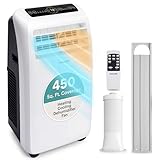
Capacity: 12,000 BTU cooling/heating
SACC: 7,000 BTU
Coverage: Up to 550 sq ft
Power: 1350W
Modes: Cool/Heat/Dehumidify/Fan
Noise Level: 56-59 dB
Weight: 70.3 pounds
Year-round use capability
The SLACHT128’s 4-in-1 functionality provides year-round climate control, though it still requires window venting for both cooling and heating modes. The heating capability proves particularly valuable for spring and fall temperature swings, eliminating the need for separate space heaters. However, calling this a “windowless” solution remains misleading.
During cooling mode, it effectively handles spaces up to 550 square feet, though the 7,000 BTU SACC rating means actual cooling power is lower than the advertised 12,000 BTU. The heating function performs admirably for spot heating, though it shouldn’t replace central heating in extremely cold climates. Users report saving on heating bills by warming specific rooms rather than entire homes.
Noise levels vary between 56-59 dB depending on mode and fan speed, making it noticeably louder than cooling-only units. The additional components for heating capability add weight, bringing the total to over 70 pounds—challenging for anyone needing to move it frequently between rooms.
At $379, the year-round functionality justifies the premium over cooling-only models for those with window access. The energy consumption of air conditioners with heating capability runs higher, expect $60-80 monthly operating costs during peak use seasons. Despite marketing confusion, this remains an excellent choice for apartment dwellers seeking comprehensive climate control through a single window-vented unit.

Capacity: 14,000 BTU (9,500 SACC)
Coverage: Up to 500 sq ft
Power: 1300W / 11.6 Amps
Efficiency: Dual hose 40% better
Noise Level: 51 dB
Dehumidification: 71 pints/day
Awards: Good Housekeeping 2025
Weight: 73 pounds
The Whynter ARC-14S stands as the efficiency champion among portable ACs, earning Good Housekeeping’s 2026 Best Overall award. However, its dual-hose design requires even more window space than single-hose units, making the “windowless” classification particularly egregious. Both hoses must vent through your window for proper operation.
The dual-hose design prevents the negative pressure issues plaguing single-hose units. Traditional portable ACs create a vacuum effect, pulling hot outside air into your room through cracks and gaps. The ARC-14S uses one hose for intake and another for exhaust, maintaining neutral pressure and improving efficiency by up to 40%. This translates to faster cooling and lower operating costs.
Build quality justifies the premium price, with users reporting 5-10 years of reliable operation with basic maintenance. The self-evaporating system eliminates manual draining in most climates, while the activated carbon filter provides basic air purification. At 51 dB, it runs quieter than most competitors despite superior cooling power.
Installation complexity increases with dual hoses, requiring careful window kit configuration. The included storage bag proves useful for off-season storage, though at 73 pounds, moving this unit challenges even strong individuals. At $454, it represents a significant investment, but the efficiency gains and longevity make it worthwhile for those with window access. Understanding BTU requirements for room size helps justify the premium for this legitimately superior, though definitely not windowless, cooling solution.
Living in a rental property with cooling restrictions requires creative problem-solving. Whether your lease prohibits window modifications or your apartment lacks suitable windows entirely, these strategies help achieve comfort without violating rental agreements in 2026.
The dryer vent solution stands out as the most renter-friendly option for portable AC exhaust. Using a simple Y-connector and damper system, you can share the existing dryer vent between your dryer and portable AC. Critical requirements include ensuring the dryer and AC never run simultaneously and installing a backdraft damper to prevent lint entering the AC unit. This modification typically doesn’t violate leases since it’s completely reversible.
Sliding door installations offer another excellent option using custom plexiglass or foam board panels. These panels fill the gap created by partially opening the door, with a precisely cut hole for the exhaust hose. Weather stripping ensures a tight seal, while the entire assembly removes in seconds for lease inspections. Many users report better results than window kits, with improved security since doors can still lock.
For those with casement or oddly-sized windows, universal window seal kits using fabric and zippers provide solutions. These kits create an airtight seal around any window opening, with a zippered port for exhaust hose insertion. Installation involves no permanent modifications—just adhesive Velcro strips that remove cleanly. Brands like Gulrear and AirLock offer kits under $30 that work with virtually any window configuration.
Ceiling venting through drop tiles in apartments with suspended ceilings offers a discrete option. By carefully lifting a tile and routing the exhaust hose into the ceiling space, hot air disperses through the building’s ventilation system. This requires confirming adequate ceiling ventilation and obtaining permission from property management, but leaves no visible modifications in the living space.
When traditional venting proves impossible, strategic deployment of multiple personal coolers creates comfort zones throughout living spaces. Rather than attempting to cool entire rooms, focus on creating micro-climates where you spend the most time. A personal evaporative cooler at your desk, another by the couch, and one bedside provides targeted relief for under $150 total investment.
Combining personal coolers with other cooling strategies amplifies their effectiveness. Blackout curtains reduce solar heat gain by up to 77%, while ceiling fans improve air circulation and perceived cooling through the wind chill effect. Used together with personal evaporative coolers, these methods can reduce perceived temperature by 10-15°F without any venting requirements.
The “cooling clothing” approach gains popularity among those in truly restrictive situations. Cooling vests using phase-change materials or evaporative cooling provide hours of personal comfort. While not replacing air conditioning, they bridge the gap during the hottest parts of the day. Paired with a personal desk cooler for stationary activities, this combination maintains productivity despite ambient heat.
Night cooling strategies prove especially important since sleep quality degrades above 75°F. Cooling mattress pads with water circulation systems like ChiliPad or BedJet provide targeted sleeping comfort without room-wide cooling. Combined with a personal evaporative cooler directed at the bed and moisture-wicking bedding, acceptable sleep temperatures become achievable even without traditional AC.
Approaching landlords about cooling solutions requires preparation and professionalism. Create a written proposal outlining your intended cooling solution, emphasizing temporary modifications and restoration plans. Include product specifications, installation diagrams, and photos of similar successful installations. Many landlords approve reasonable requests when presented professionally.
Offer to pay for professional installation and removal when proposing permanent modifications like wall penetrations. Providing quotes from licensed HVAC contractors demonstrates serious intent and protects both parties. Some tenants successfully negotiate lease addendums allowing specific modifications with detailed restoration requirements upon move-out.
Document everything throughout the process. Take detailed before-photos of installation areas, save all receipts and contractor information, and photograph the completed installation. This documentation protects against security deposit disputes and provides evidence of professional work. Email confirmations of verbal permissions create paper trails beneficial to both parties.
Consider proposing improvements that benefit future tenants. Offering to install a properly-sized mini-split system at your expense (with professional installation) in exchange for reduced rent or extended lease terms creates win-win scenarios. Many landlords appreciate tenant-funded improvements that increase property value and future rental appeal. Understanding AC installation costs helps frame realistic proposals.
Your geographic location dramatically impacts which windowless cooling technologies will work effectively. Understanding your climate’s humidity levels and seasonal variations prevents costly mistakes when selecting between evaporative and refrigerant-based cooling systems in 2026 .
Evaporative cooling effectiveness follows a predictable curve based on relative humidity. In desert climates with 10-20% humidity, evaporative coolers can achieve 20-30°F temperature drops. At 30-40% humidity, expect 10-15°F cooling. Above 50% humidity, evaporative cooling becomes ineffective and can worsen comfort by adding unwanted moisture.
Western states like Arizona, Nevada, New Mexico, and parts of California, Colorado, and Utah provide ideal conditions for evaporative cooling. Cities like Phoenix, Las Vegas, and Denver see excellent results from swamp coolers during their dry seasons. Conversely, southeastern states including Florida, Louisiana, Georgia, and the Carolinas render evaporative cooling useless due to high humidity.
The Midwest presents mixed results with significant seasonal variation. During spring and fall, lower humidity allows effective evaporative cooling. However, summer humidity often exceeds 60%, limiting effectiveness to early morning hours. Coastal areas universally prove unsuitable for evaporative cooling due to ocean moisture, regardless of temperature.
Real-time humidity monitoring helps optimize evaporative cooler use. Digital hygrometers under $20 provide instant readings, allowing you to determine when evaporative cooling will prove effective. Many users in borderline climates successfully use evaporative cooling during dry morning hours, switching to other methods as humidity rises throughout the day. This approach maximizes energy savings while maintaining comfort.
Evaporative cooling performance fluctuates dramatically with seasonal weather patterns. Spring often provides ideal conditions in many regions, with moderate temperatures and lower humidity creating perfect evaporative cooling scenarios. Desert regions see peak performance during this season, with swamp coolers easily maintaining comfortable indoor temperatures.
Summer challenges evaporative cooling in all but the driest climates. Monsoon seasons in the Southwest temporarily eliminate evaporative cooling effectiveness, forcing users to alternative methods during humid periods. Even traditionally dry regions experience reduced performance during summer thunderstorm patterns that spike humidity levels.
Fall returns favorable conditions in many areas, though performance varies by region. Northern states see excellent evaporative cooling during crisp fall days, while southern regions maintain excessive humidity through October. Winter eliminates cooling needs in most areas, though year-round warm climates like Southern California and Arizona continue benefiting from evaporative cooling during unusually warm winter days.
Planning seasonal cooling strategies prevents comfort gaps. Many users in variable climates maintain both evaporative coolers for favorable conditions and portable ACs for humid periods. This dual approach, while requiring higher initial investment, ensures year-round comfort regardless of weather variations. Understanding these patterns helps time purchases for end-of-season deals on complementary cooling technologies.
Evaporative coolers impact indoor air quality differently than traditional air conditioners. By adding moisture and requiring fresh air intake, they can improve air quality in dry climates by reducing static electricity, alleviating dry skin and respiratory irritation, and providing constant fresh air circulation. However, they also require regular maintenance to prevent mold and bacteria growth in water reservoirs.
Traditional portable ACs with exhaust requirements actually improve indoor air quality through their filtration systems. Most units include washable pre-filters capturing large particles, with some offering HEPA or activated carbon filtration. The closed-loop system prevents outdoor pollutants from entering, beneficial for allergy sufferers or those in areas with poor outdoor air quality.
Personal evaporative coolers pose unique air quality challenges in confined spaces. Without proper ventilation, they can raise indoor humidity to uncomfortable levels, promoting mold growth and dust mite proliferation. Users must balance the cooling benefit against potential air quality degradation, particularly in already-humid environments where additional moisture proves counterproductive.
Proper ventilation remains crucial regardless of cooling method chosen. Even truly windowless options benefit from periodic air exchange to prevent CO2 buildup and maintain freshness. Many users combine personal cooling with strategic window opening during cooler hours, bathroom exhaust fans for moisture control, and air purifiers to maintain quality. This holistic approach ensures comfort without sacrificing health. Consider how AC efficiency ratings impact both cooling performance and air quality management.
Selecting appropriate windowless cooling requires honest assessment of your specific situation, including physical constraints, climate conditions, and performance expectations. This systematic approach helps identify solutions that actually work rather than disappointing purchases based on misleading marketing.
Start by measuring the space you need to cool and assessing whether personal or room-wide cooling meets your needs. Personal cooling works excellently for home offices, bedside comfort, or single-person apartments where you can position units strategically. If you need to cool spaces where multiple people gather or move around frequently, room-wide solutions become necessary despite their venting requirements.
Calculate heat load beyond simple square footage. South-facing rooms with large windows require 30% more cooling capacity than north-facing spaces. Top-floor apartments need 40% additional capacity due to roof heat gain. Kitchen cooling demands extra capacity for appliance heat, while home offices with multiple computers and monitors generate significant heat requiring upgraded cooling solutions.
Consider occupancy patterns when sizing systems. A bedroom used only for sleeping needs less cooling capacity than a work-from-home office occupied 8+ hours daily. Many users successfully use minimal cooling overnight combined with more powerful daytime solutions. This approach reduces energy costs while maintaining comfort when it matters most.
Budget constraints often dictate compromises between ideal and practical solutions. While a properly-vented portable AC provides superior cooling, the $500+ investment may exceed budgets that could accommodate multiple $40 personal coolers. Consider total cost including electricity—personal evaporative coolers cost under $2 monthly to operate continuously, while portable ACs add $50-80 to summer electric bills.
USB-powered personal coolers offer ultimate portability and minimal operating costs. Drawing 2.5-10 watts, they run from laptop ports, power banks, or phone chargers. This flexibility allows cooling anywhere without dedicated outlets. However, limited power means limited cooling—expect personal comfort only. Battery banks enable truly wireless operation for outdoor use or power outages.
Standard plug-in units dominate the market from large evaporative coolers to portable ACs. These require dedicated outlets capable of handling their amperage draw—portable ACs typically need 12-15 amp circuits without other major appliances sharing the circuit. Older apartments with limited electrical capacity may struggle supporting larger units without tripping breakers.
Hardwired solutions like mini-split systems provide permanent, efficient cooling but require professional installation and landlord approval. While outside typical “windowless” discussions, they offer true vent-free operation through small refrigerant lines rather than large exhaust hoses. Installation costs of $2,000-5,000 limit accessibility, but long-term efficiency and performance justify investment for homeowners.
Emerging battery-powered portable ACs target the true windowless market with self-contained units requiring no external venting. Models like Zero Breeze Mark 2 operate 3-5 hours per charge while providing legitimate refrigerant-based cooling. At $1,000+, they remain niche products for camping or emergency use rather than daily cooling solutions. Rapid battery technology advancement may make these mainstream options within 2-3 years.
Personal evaporative coolers demand frequent but simple maintenance. Daily water refills take seconds but become tedious for forgetful users. Weekly cleaning prevents mineral buildup and bacterial growth—a quick rinse with diluted vinegar suffices. Cooling pad replacement every 2-3 months costs $5-10. Neglecting maintenance rapidly degrades performance and can create unpleasant odors.
Large evaporative coolers require similar but scaled maintenance. Their bigger reservoirs need less frequent filling but demand thorough weekly cleaning to prevent algae growth. Seasonal deep cleaning, including disassembly and pad replacement, takes 1-2 hours. Many users drain and cover units during humid seasons when they’re ineffective, preventing mold growth during storage.
Portable ACs need regular filter cleaning—typically every 2 weeks during heavy use. Washable filters simplify this process to a quick rinse and dry. Condensate management varies by model, with some self-evaporating in dry climates while others require manual draining. Annual professional cleaning ($75-150) maintains efficiency and extends lifespan.
All cooling equipment benefits from pre-season preparation and post-season storage procedures. Document maintenance schedules and set phone reminders for filter cleaning and water changes. Proper maintenance extends equipment life 50-100% while maintaining peak efficiency. Consider maintenance requirements when evaluating total ownership costs—a cheaper unit requiring constant attention may prove more expensive than premium options with minimal maintenance needs.
Personal evaporative coolers offer zero-complexity installation—add water and plug in. This simplicity makes them perfect for temporary situations, elderly users, or those intimidated by technical tasks. No tools, modifications, or special knowledge required. The tradeoff comes in limited cooling capability, acceptable only for personal comfort rather than room cooling.
Room-sized evaporative coolers require slightly more setup including caster attachment and initial cleaning, but remain DIY-friendly. Most assemble in 15-30 minutes with included instructions. Positioning near open windows optimizes performance in dry climates, though this contradicts the “windowless” goal. Users in suitable climates report satisfaction despite this limitation.
Portable AC installation complexity depends entirely on venting method. Traditional window installation takes 30-60 minutes for first-time users, becoming routine with practice. Alternative venting solutions like dryer connections or ceiling vents require 2-4 hours of careful work plus $20-50 in adaptation materials. Professional handyman installation runs $100-200 for complex venting scenarios.
Consider installation reversibility for rental situations. Window kits remove cleanly but may leave slight adhesive residue. Dryer vent modifications reverse completely. Wall penetrations create permanent changes requiring professional patching ($200-400) upon move-out. Balance installation complexity against cooling needs and housing stability. Investing in complex installation makes sense for long-term residents but proves impractical for frequent movers. The best air conditioners for small rooms often require minimal installation complexity.
Understanding the dramatic energy consumption differences between cooling technologies helps make informed decisions balancing comfort against operating costs. In 2026 , with rising electricity rates nationwide, these calculations significantly impact total ownership costs over each unit’s lifespan.
Personal evaporative coolers represent the ultimate in energy efficiency, consuming 2.5-10 watts—less than an LED light bulb. Operating continuously costs $0.50-2.00 monthly at average electricity rates. A desktop unit running 24/7 for an entire summer costs less than a single restaurant meal. This minimal consumption allows guilt-free continuous operation.
Large evaporative coolers drawing 90-200 watts still maintain exceptional efficiency compared to refrigerant-based systems. Monthly costs range from $8-20 for continuous operation, making them attractive for budget-conscious consumers in suitable climates. The energy savings often offset the initial purchase price within one season compared to traditional AC alternatives.
Portable air conditioners consume 1000-1500 watts depending on capacity and efficiency ratings. Real-world operating costs average $50-80 monthly for 8-hour daily use, escalating to $150-250 for 24/7 operation during heat waves. Higher SEER ratings reduce consumption 10-20%, justifying premium pricing through long-term savings. Understanding your central air electricity consumption helps contextualize portable AC costs.
Calculating return on investment requires considering your specific situation. In dry climates where evaporative cooling works effectively, the $400+ price difference between a large swamp cooler and portable AC pays for itself through energy savings within 6-12 months. However, in humid climates where only refrigerant cooling works, the higher operating cost becomes unavoidable for achieving comfort.
Successfully implementing windowless cooling often requires thinking beyond traditional installation methods. These detailed approaches help achieve effective cooling even in challenging situations where conventional window venting proves impossible.
Personal cooler setup remains refreshingly simple—fill the reservoir with cold water, plug into any USB port or outlet, and position for optimal airflow. Many users enhance effectiveness by using ice water or adding frozen water bottles to reservoirs. Positioning 18-24 inches from your body optimizes the cooling effect while preventing excessive moisture on nearby surfaces.
Creative portable AC venting through dryer ducts requires careful planning. Purchase a 4-to-6-inch duct adapter and wye fitting from any hardware store. Install the wye fitting in your existing dryer duct, adding blast gates to both branches. This allows switching between dryer and AC use—never run both simultaneously. Seal all connections with foil tape, not duct tape, ensuring no air leaks.
Ceiling vent installation in drop-ceiling environments offers discrete venting. Remove one ceiling tile above your intended AC location. Construct a plenum box from rigid foam insulation to direct exhaust air into the ceiling cavity. Ensure adequate ventilation exists above the ceiling—sealed plenums will recirculate hot air. This method works best in commercial buildings with robust HVAC systems.
Troubleshooting common issues prevents frustration. Water leaks typically indicate unlevel positioning or blocked drainage—ensure units sit perfectly level using adjustable feet. Reduced cooling often stems from dirty filters or kinked exhaust hoses. Ice formation on evaporator coils suggests low refrigerant or poor airflow requiring professional service. Understanding these issues helps maintain optimal performance.
Are windowless air conditioners really windowless?
Most “windowless” air conditioners aren’t truly windowless. Only evaporative coolers (personal and room-sized) operate without any venting requirements. Traditional portable ACs marketed as “windowless” still require exhaust hoses vented through windows, walls, or other openings. The term “windowless” often misleadingly refers to units that don’t mount permanently in windows like traditional window ACs.
Do evaporative coolers work in humid climates?
No, evaporative coolers become ineffective and counterproductive in humid climates. They work by adding moisture to achieve cooling, which only functions when ambient humidity is below 40%. In humid areas above 60% relative humidity, evaporative coolers simply make rooms feel muggy without providing meaningful temperature reduction. Check your local average humidity before investing in evaporative cooling.
How much area can a personal air conditioner actually cool?
Personal evaporative air conditioners effectively cool a 1-3 foot radius around the unit—essentially arm’s length. Marketing claims of “cools up to 45 square feet” prove highly misleading. These units excel at creating personal comfort zones for desk work or bedside use but cannot cool entire rooms. Multiple units may create overlapping comfort zones but won’t match traditional AC performance.
What’s the difference between evaporative and refrigerant cooling?
Evaporative cooling uses water evaporation to absorb heat, adding humidity while lowering temperature—similar to how sweating cools your body. Refrigerant cooling uses compression cycles to extract heat and humidity from air, requiring that extracted heat be vented outside. Evaporative cooling works only in dry climates and provides limited temperature reduction, while refrigerant cooling works everywhere but requires venting.
Can I use a portable AC without venting to a window?
Traditional portable ACs cannot function properly without venting. Running one without exhaust venting causes it to blow hot air from the back while cooling from the front, actually heating the room overall. Creative venting solutions like dryer vents, drop ceilings, or wall penetrations can substitute for window venting, but the hot air must go somewhere outside your living space.
How many BTUs do I need for my room without windows?
For truly windowless scenarios, BTU ratings become irrelevant since traditional BTU-rated units require venting. Personal evaporative coolers don’t use BTU ratings and only cool 1-3 feet regardless. If you can implement creative venting, follow standard BTU guidelines: 5,000 BTU for 150 sq ft, 8,000 BTU for 350 sq ft, 12,000 BTU for 550 sq ft, adjusting upward for heat-generating factors.
Which type of windowless AC is quietest?
Personal evaporative coolers offer the quietest operation at 40-45 dB—equivalent to a library environment. Larger evaporative coolers run louder at 55-65 dB, comparable to normal conversation. Portable ACs typically operate at 50-58 dB, with premium models achieving quieter operation through better design. For reference, quiet air conditioner options prioritize sound dampening technologies.
Do windowless air conditioners dehumidify?
This depends entirely on type. Evaporative coolers add humidity rather than removing it—the opposite of dehumidification. Traditional portable ACs requiring venting do dehumidify effectively, removing 2-4 pints hourly during cooling operation. This dehumidification partially explains why refrigerant-based cooling feels more comfortable than evaporative cooling at the same temperature.
Can I install a portable AC in a room with no windows?
Yes, but it requires creative venting solutions. Options include venting through dryer ducts, drop ceilings, unused chimneys, pet doors, or creating permanent wall penetrations. Each method has pros and cons regarding complexity, cost, and reversibility. The key requirement remains getting hot exhaust air outside your living space—without this, the unit cannot cool effectively.
What’s the easiest windowless AC to install?
Personal evaporative coolers win for installation simplicity—just add water and plug in. No tools, modifications, or technical knowledge required. Setup takes under 5 minutes. For more substantial cooling, portable ACs with window kits prove easiest among vented options, though “windowless” claims remain misleading. Alternative venting installations increase complexity significantly.
Do I need professional installation for ventless cooling?
True ventless options (evaporative coolers) never require professional installation. However, creative venting solutions for portable ACs may benefit from professional help. Wall penetrations should use licensed contractors to ensure proper sealing and structural integrity. Electrical upgrades for larger units also require licensed electricians. Budget $200-500 for professional installation of complex venting solutions.
How much electricity does a windowless AC use?
Energy consumption varies dramatically by type. Personal evaporative coolers use 2.5-10 watts (under $2/month), room evaporative coolers use 90-200 watts ($8-20/month), while portable ACs consume 1000-1500 watts ($50-150/month for regular use). These calculations assume average electricity rates of $0.13/kWh. Your actual costs depend on local rates and usage patterns.
Are evaporative coolers cheaper to run than portable ACs?
Yes, dramatically so. Evaporative coolers use 85-95% less electricity than comparable portable ACs. A large evaporative cooler costs about $15/month running continuously, while a portable AC costs $150-250/month for the same usage. However, this comparison only matters in dry climates where evaporative cooling actually works. In humid areas, the energy savings become irrelevant since evaporative cooling provides no comfort.
What’s the most energy-efficient windowless cooling option?
Personal USB-powered evaporative coolers achieve ultimate efficiency at 2.5-10 watts—less than an LED bulb. For room cooling in dry climates, large evaporative coolers at 90-200 watts remain highly efficient. When refrigerant cooling becomes necessary due to humidity, dual-hose portable ACs offer 40% better efficiency than single-hose models, though still consuming 1000+ watts. Consider dehumidifier energy consumption as an alternative in moderately humid conditions.
After analyzing every available option in 2026 ‘s windowless air conditioner market, clear patterns emerge for different user situations. Success requires matching technology limitations to your specific needs while maintaining realistic expectations about what “windowless” truly means in the cooling industry.
For personal cooling in any climate, the BLACK+DECKER BDMC10 provides unbeatable value at $34. Its whisper-quiet operation, USB power flexibility, and reliable performance make it ideal for desk workers, students, or bedside comfort. Just understand it cools you, not your room. Consider buying multiple units for different locations rather than expecting one to cool larger spaces.
Dry climate residents seeking room-scale cooling should consider large evaporative coolers like the BLACK+DECKER BEAC75, but only if summer humidity stays below 40%. These units provide energy-efficient cooling for $10-20 monthly operating costs—a fraction of traditional AC expenses. However, humid climate residents should avoid evaporative cooling entirely, as it worsens comfort by adding unwanted moisture.
Those needing serious cooling power must accept that effective whole-room cooling requires venting hot air outside. The Whynter ARC-14S dual-hose system offers superior efficiency for those with window access, while the SereneLife models provide budget-friendly alternatives. Creative venting through dryer connections or ceiling spaces enables installation flexibility for renters.
Looking beyond traditional solutions, emerging technologies like battery-powered portable ACs may eventually deliver true windowless cooling, though current options remain prohibitively expensive. For now, combining multiple cooling strategies—personal coolers, fans, blackout curtains, and strategic ventilation—often provides the best results for those genuinely unable to vent traditionally.
Whatever solution you choose, verify return policies before purchasing, especially for evaporative coolers whose effectiveness depends entirely on your local climate. Many retailers offer 30-day satisfaction guarantees, allowing real-world testing before committing. Start with conservative expectations and consider any effective cooling a success rather than expecting miracles from physics-constrained technologies.
For comprehensive cooling strategies beyond portable options, explore our guides on smart air conditioners with WiFi for whole-home solutions or troubleshooting AC problems if your current system underperforms. Remember that the best cooling solution is one that actually works for your specific situation, not what marketing claims suggest.