Physical Address
304 North Cardinal St.
Dorchester Center, MA 02124
Physical Address
304 North Cardinal St.
Dorchester Center, MA 02124

The best office chairs for hardwood floors are the ones that ship with soft polyurethane or rubberized casters instead of the hard nylon wheels most factory chairs use. A soft wheel deforms slightly on contact and spreads your weight across a wider patch of finish, while a hard nylon wheel concentrates it into a few square millimeters and leaves a scratch or a dull, shiny burnished patch that no amount of cleaning removes.
That is the whole problem in one sentence, and it matters more than any other spec on these chairs. Comfort, lumbar support, armrests, headrests, and warranty all matter for how you feel after eight hours, but the casters decide whether your floor is still salvageable in 2026. Refinishing solid hardwood is one of the most expensive repairs in a home, and against that cost, a full set of replacement casters is nearly nothing.
We spent weeks evaluating ten chairs with hardwood specifically in mind, looking at the wheel material in the listing, the stated weight capacity, the base construction, and how the seating actually holds up over a long working day. The methodology is simple and worth stating plainly. We did not measure microns of scratch depth on a lab rig. We read the specs, we weighed the claims against owner reviews, and we sorted the damage modes each design is actually exposed to. Where a chair ships with carpet casters, we say so plainly rather than pretending otherwise.
One point of consensus deserves emphasis before the list, because every buying guide we studied arrived at it independently. The caster, not the chair, is the primary point of floor failure. The seat, the back, the gas lift, none of them touch the floor. Your entire body weight passes through five small wheels, and whatever those wheels are made of is what your finish has to survive. That is why this roundup is organized around wheel material first and everything else second.
If you are still choosing flooring rather than a chair, our guides to engineered hardwood flooring and hardwood for living rooms cover what each finish can take.
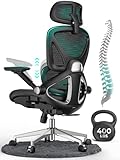
Three chairs stand out from the field for different reasons. The YFO leather desk chair is the most complete package for a hardwood home office, with a wide cushioned seat and casters the maker rates for wood. The CAPOT mesh task chair is the one to buy if you need real adjustability and a 400 lb rating. The BERYTH bentwood chair is the compact option that costs the least floor footprint of the three.


Long-term owner reports are worth more here than spec sheets, and the forums make that point constantly. A two-year-old thread on the WellTrainedMind forum describes office chairs used on real dark-finish hardwood with zero scratches, which is a far more useful signal to a buyer than a printed 550 lb capacity claim.
Every chair below comes with either rubber, polyurethane, or a hard carpet-rated caster, and the table makes the difference plain. Read the wheel material column first. It is the only spec on this list that touches your floor.
| Product | Features | |
|---|---|---|
| YFO Leather Desk Chair with Rubber Casters |
|
Check Latest Price |
 OSP Banker’s Wood Desk Chair OSP Banker’s Wood Desk Chair |
|
Check Latest Price |
| CAPOT Ergonomic Mesh Task Chair |
|
Check Latest Price |
| BERYTH Armless Bentwood Chair |
|
Check Latest Price |
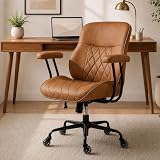 BEWISHOME Brown Leather Office Chair BEWISHOME Brown Leather Office Chair |
|
Check Latest Price |
 JULYMON Mid-Century Leather Desk Chair JULYMON Mid-Century Leather Desk Chair |
|
Check Latest Price |
 ALLFONIS Mid Century Bentwood Chair ALLFONIS Mid Century Bentwood Chair |
|
Check Latest Price |
 WUPOTO Walnut Bentwood Desk Chair WUPOTO Walnut Bentwood Desk Chair |
|
Check Latest Price |
 REONEY Armless Walnut Swivel Chair REONEY Armless Walnut Swivel Chair |
|
Check Latest Price |
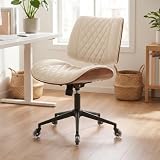 FervorFurn Beige Armless Chair FervorFurn Beige Armless Chair |
|
Check Latest Price |
We earn from qualifying purchases. CERTAIN CONTENT THAT APPEARS ON THIS SITE COMES FROM AMAZON. THIS CONTENT IS PROVIDED 'AS IS' AND IS SUBJECT TO CHANGE OR REMOVAL AT ANY TIME.
One row deserves a flag now rather than at the end. The OSP banker’s chair is the only one in this roundup that ships with carpet-rated dual-wheel casters, which are among the hardest and least forgiving wheel types on bare hardwood. It is a genuinely good chair and we include it for that reason, but it needs a caster swap before it touches wood.
Rubber casters rated for wood and marble
22 inch wide seat
Removable armrests
300 lb capacity
This is the chair we put at the top of the list, and the reason is unusually direct. The casters are rubber, and the manufacturer rates them for wood, carpet, and marble, which is the exact trifecta of floors a home office actually has. That rating appears in the listing rather than in a marketing line we had to dig for.
Everything else about it is built around long sessions. The seat is 22 inches wide and 20 inches deep, which is wide enough that a tall person can sit back without their thighs running off the front edge. Underneath the sponge is a wooden board with elastic spring packs, so the cushion compresses under you and comes back rather than bottoming out by hour three.
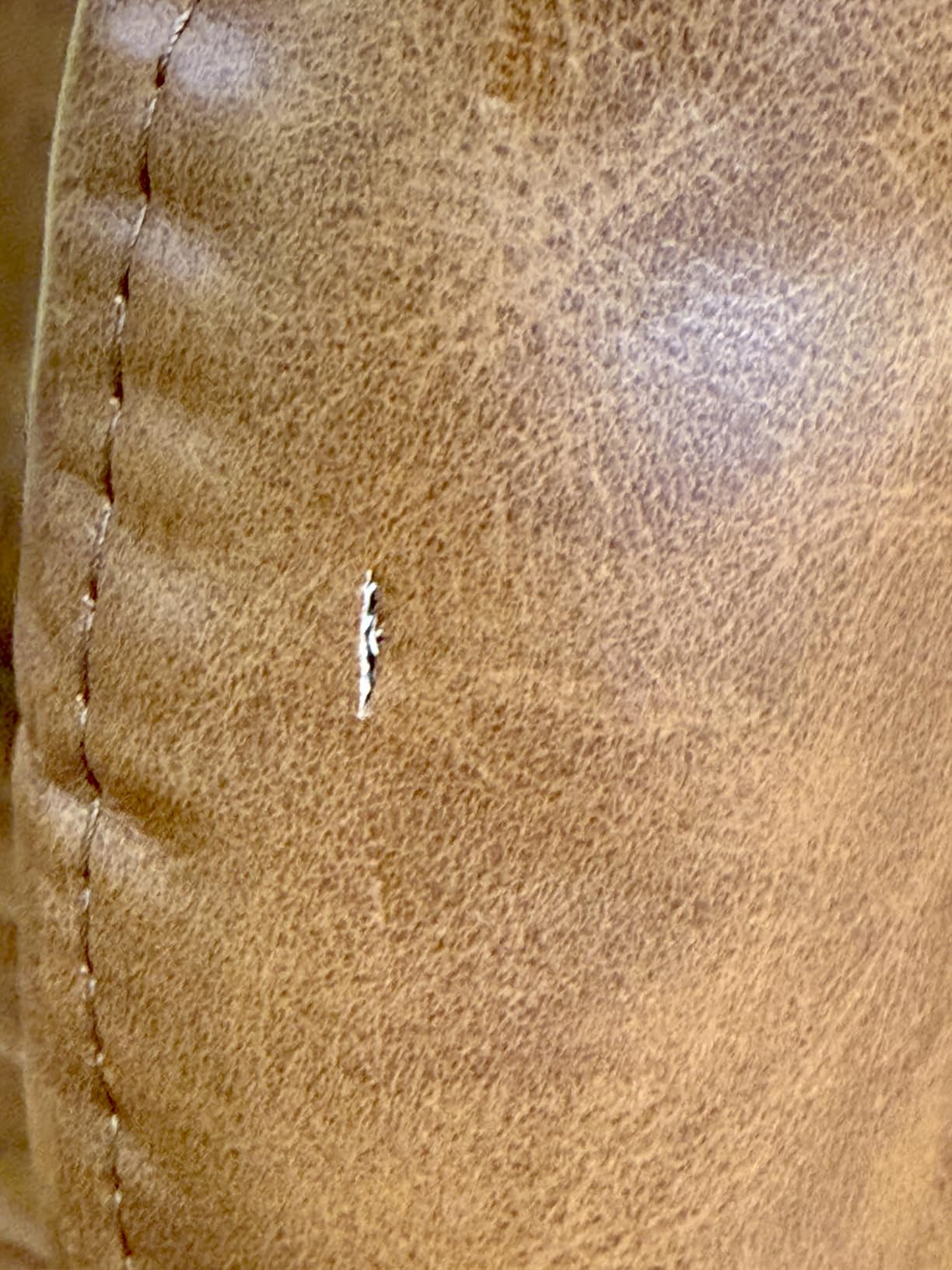
The armrests are the detail I did not expect to care about and now recommend. They bolt on and off, so if you spend part of your day cross-legged or folded into another position, you can strip them in a couple of minutes and reclaim the space. Chair dimensions are 20.47 by 22.44 by 18.5 inches and the listed weight is 19.07 kg, which is a manageable load to wrestle through a doorway with two people.
For the floor question specifically, the rubber tread is the reason this is our pick. A 300 lb maximum weight recommendation puts it in the same band as most of the leather executive chairs here, and the rubber wheel spreads that load rather than concentrating it.
The rubber tread on these casters is the soft category of wheel, sitting alongside polyurethane as the two materials that behave well on a sealed finish. The tread deforms under load, so the contact patch widens and the finish underneath feels a broader, gentler pressure.
It also matters that the maker names wood explicitly. Too many chairs claim to be all-surface when the base listing quietly says carpet, and a buyer who trusts the headline gets a floor mark in week one.
A 22 inch seat is the most generous measurement in this roundup among the leather chairs, and it is the number that decides whether you can work a full day without shifting position every twenty minutes. The depth of 20 inches gives you real leg room underneath the desk rather than a shallow perch.
Armrest height of 8.3 inches is a useful reference point. Measure the underside of your desk first, because a fixed armrest that is too tall will stop you from tucking in properly.
The lumbar support is a fixed sponge insert, which is the main compromise here. There is no dial, no slider, no travel, so if the factory position does not match your lower back, you are adding a cushion rather than adjusting.
Seat height adjusts and there is a single recline position, so you get range of motion but not a multi-position tilt lock like the mesh chairs offer. The leather surface is wipe-clean, though owners note it takes on wear over years and needs occasional conditioning.
Buy this one if you want a conventional executive-desk look, a wide seat, and rubber wheels, and if your weight is within the 300 lb figure. It is also the right answer for anyone who switches between upright work and a relaxed posture, because the removable arms make both possible.
Skip it if you need adjustable lumbar, a headrest, or a 400 lb rating. If you plan to sit cross-legged for hours, fit the armrests in reverse and take a different chair. The rubber casters and wide seat carry this one; the fixed support is the limit.
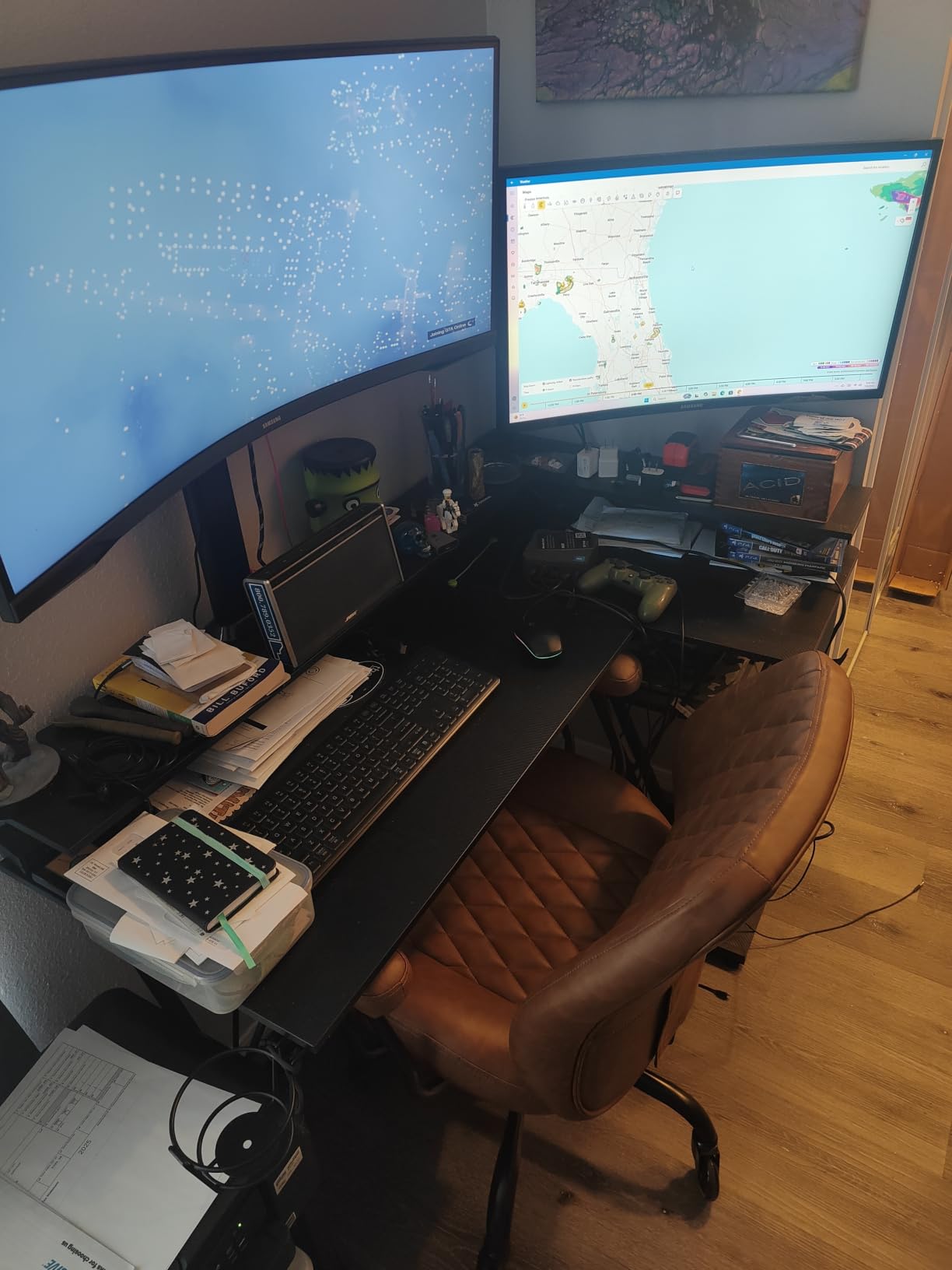
Silent PU wheels safe for hard floors
8 level lumbar and 3D headrest
400 lb stainless base
60 month parts warranty
This is the only chair in the roundup with a 400 lb rating, and it is the one to look at if you are a larger user or if two people share a desk chair. The stainless steel base and the SGS-certified gas lift are the parts you would expect to be the weak link on a chair this size, and they are specified rather than implied.
The wheels are the reason it belongs in a hardwood roundup at all. They are described as silent polyurethane and explicitly claimed to roll on hard floors without leaving marks, and the listing names hard floor as the recommended surface. Polyurethane is the same soft-tread family as the rubber wheels elsewhere in this list, and it is the current standard for hard flooring for the same reason.
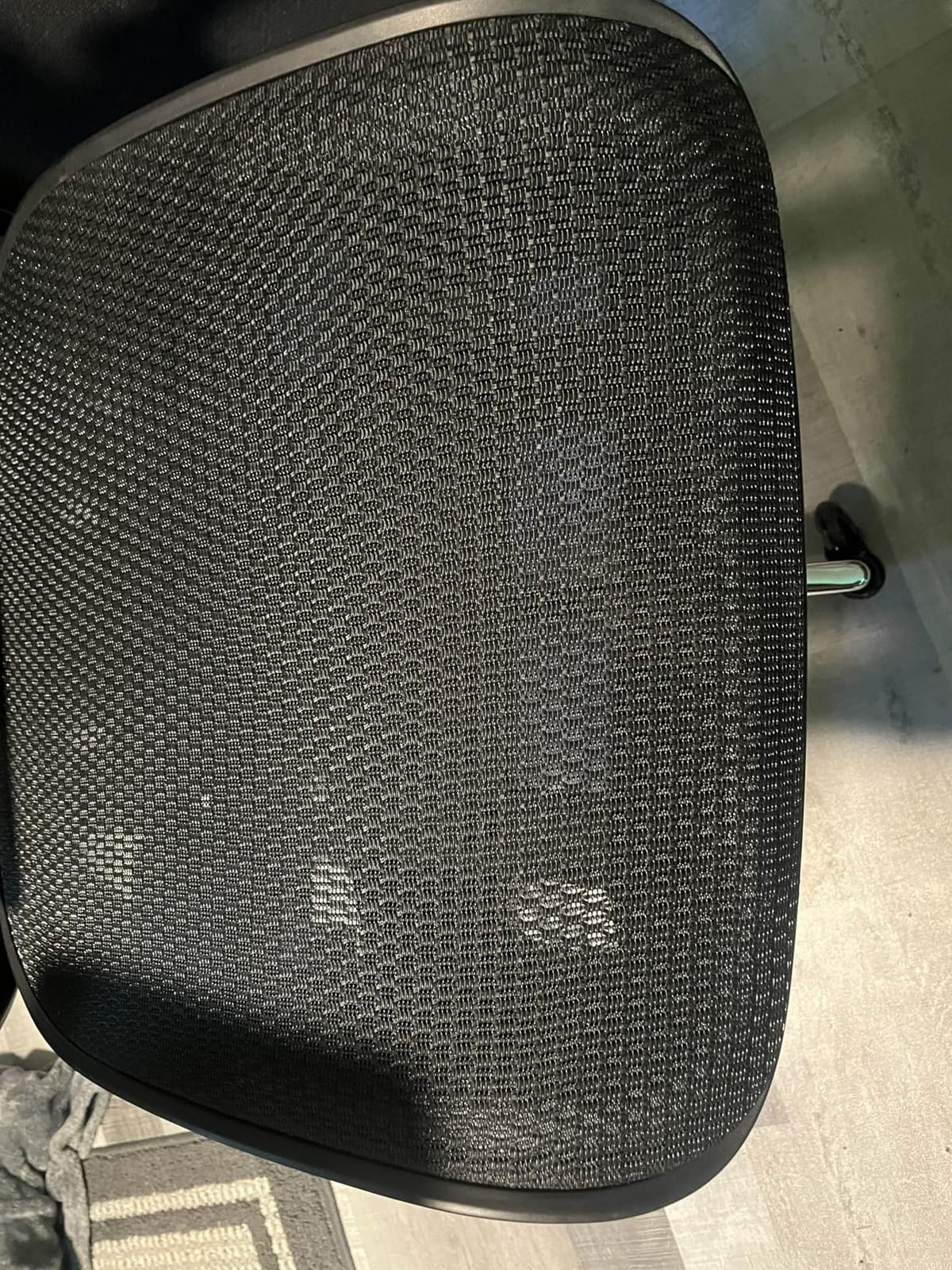
Owner feedback is warm on the adjustability. The lumbar system moves through eight levels across two inches of travel, which is real range rather than a decorative knob, and the headrest adjusts in both height and depth so it can meet your actual neck rather than a generic point in space.
Two inches of travel sounds small until you compare it to a fixed foam block. On a chair with a fixed insert, a lumbar support that is a half inch off can be a full working day of low back compensation. The recurring complaint here is that the adjuster does not always hold its setting once you lean back, so treat it as something to re-check rather than set once.
The Aerovith mesh is genuinely breathable and keeps a long sitting cool, but mesh frames have a known failure mode at the edges. Owners above roughly 220 pounds report the side of the seat and the back edge pinching, which turns a breathable back into a pressure complaint by the end of the day.
If you are well over that range, look for a contoured foam seat instead of a flat mesh pan. That is a cushion material decision, not a quality judgement on the chair.
The backrest locks at 90, 110, and 125 degrees, which covers everything from upright typing to a genuine recline. The 3D headrest moves in height and depth, and the flip-up armrests let the whole chair slide under a desk when you need to reach a drawer or use a second surface.
Flip-up arms are the feature that gets overlooked in spec lists and then noticed every day. On a chair with a deep 22 by 25.2 inch footprint, being able to slide in means the difference between using the desk and working around it.
Chair dimensions are 22 by 25.2 by 40 inches and the listed weight is 38 pounds, which is the heaviest in this group. Heavier bases resist tipping when you lean back, and the five-star stainless base is what carries a 400 lb figure without flex.
Assembly takes roughly 30 minutes and the tools are included. Owners consistently mention the packaging quality, which matters more than it sounds when the base arrives as a heavy component rather than a finished chair.
This is the pick for anyone over 300 pounds, for anyone who wants a genuine three-position tilt, or for anyone who values a 60 month free parts warranty over a leather executive look. The soft PU casters mean you can put it straight onto hardwood with no mat and no modification.
Pass if you are a wide-hipped user who has been bitten by a mesh edge before, or if you want a plush cushion rather than a breathable frame. The floor safety here is settled; the cushion geometry is the open question.
5-blade rubber wheels rated for hard floors
Seat height 19.3 to 23.3 inch
360 swivel and rocking
300 lb capacity
This chair answers a problem most roundups ignore, which is that hardwood floors are often in the smaller rooms. A studio apartment office, a bedroom converted to a workspace, a dorm. There, an armless profile is not a style preference, it is the difference between the chair fitting and not.
The wheels are the other reason to like it. The base uses five rubber blades and the listing names hard floor as a recommended surface, so it is floor-safe as supplied with no conversion and no mat. That is a real advantage over chairs that ship with carpet casters and leave it to you to notice.
The fit range is genuinely wide for a small chair. Seat height adjusts from 19.3 to 23.3 inches, giving 3.9 inches of travel, which covers a much wider range of users than the shorter-range chairs later in this list.
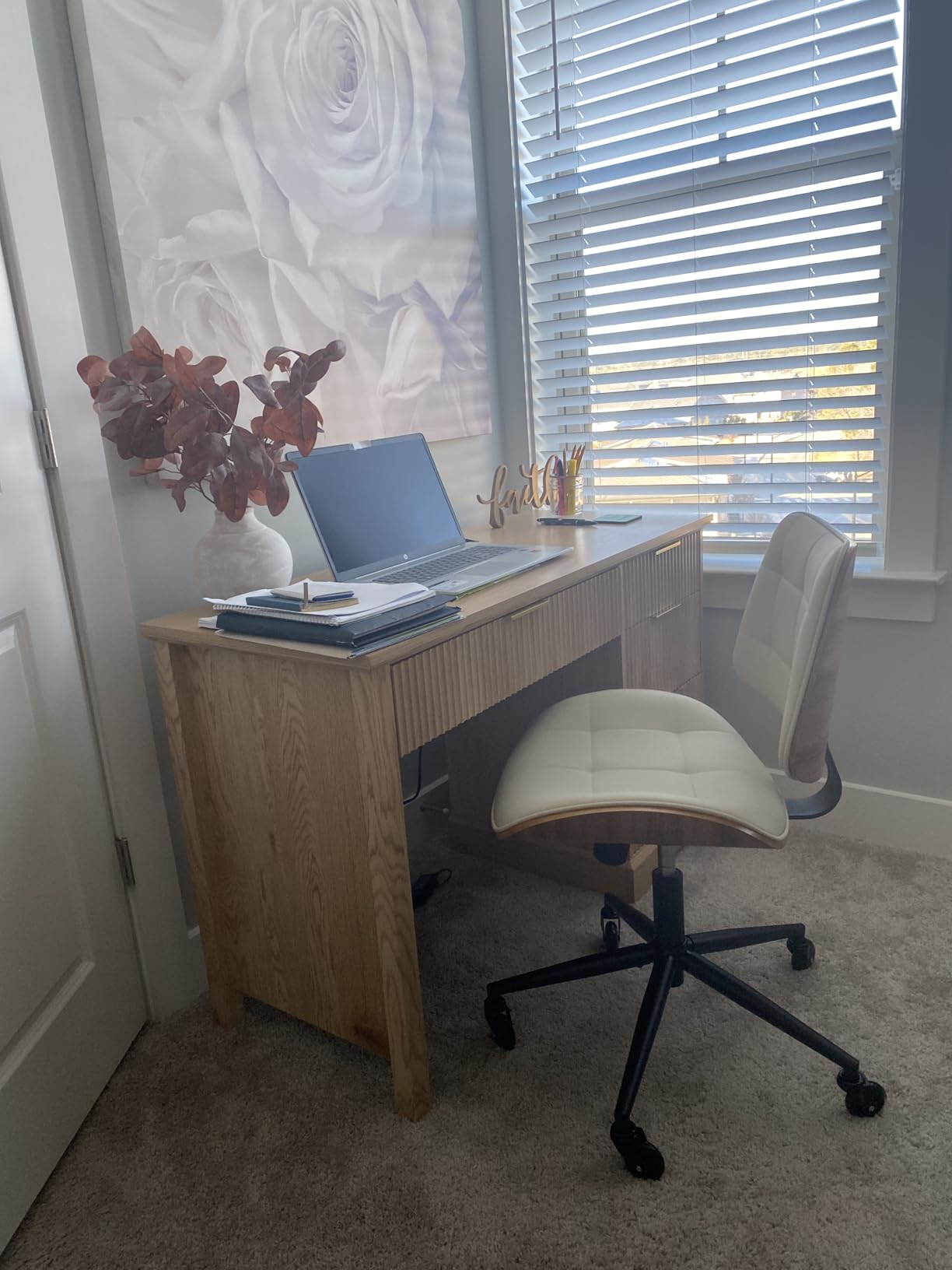
There is no side clearance requirement when there are no arms, so the chair slides in until it hits the seat pan. In a room where the desk faces a wall two feet from the edge, that is the difference between a usable chair and a chair you have to pull out every time.
The bentwood frame gives it a walnut-look curve that reads far better in a living-adjacent space than a black mesh back does. If your office is a corner of a room rather than a closed door, that matters.
The swivel is a full 360 degrees with a rocking function that runs from 90 to 135 degrees and a tilt tension knob underneath. Rocking is more useful than it sounds for anyone who changes posture through the day, because it lets you shift position without standing up.
Dimensions are 20.5 by 21.9 by 35.8 inches at 28 pounds, so it is light enough to move between rooms without a fight.
The seat is PU leather over foam and it is water-resistant and wipes clean, which is the practical choice in a room that doubles as living space. Real leather would age more gracefully, but PU is the right trade when crumbs and coffee are likely.
Assembly is the weak point, at 30 to 40 minutes with written instructions and a video. Owners do not complain about quality of the finished product, only about the time the build takes.
Buy it for a small or awkward room, for a home office that has to look presentable when guests arrive, or for anyone who works cross-legged and wants the arms gone permanently rather than by removal. The rubber wheels make it hardwood-ready on arrival.
Pass if you need upper back or neck support. A mid-back design with no headrest and no arms is a lower-support chair by design, and a ten-hour day is not its purpose.
All-floor quiet casters rated for hardwood
21.6 inch wide seat
120 degree locking recline
320 lb capacity
The 120 degree recline is the headline number here, and it is the deepest in this roundup. Most executive chairs stop around 110 degrees, which feels generous until you compare it to a chair that lets you get genuinely back off your spine.
The casters are advertised as quiet and safe on hardwood, carpet, and marble, and the listing names hard floor among the recommended surfaces. Soft-tread wheels in a reclining chair matter slightly more than in an upright one, because the back load shifts rearward as you lean and concentrate more of your weight on the trailing casters.
It is also the fastest build in the group. Owners report 10 to 15 minutes from box to usable, with no tools beyond what is included.
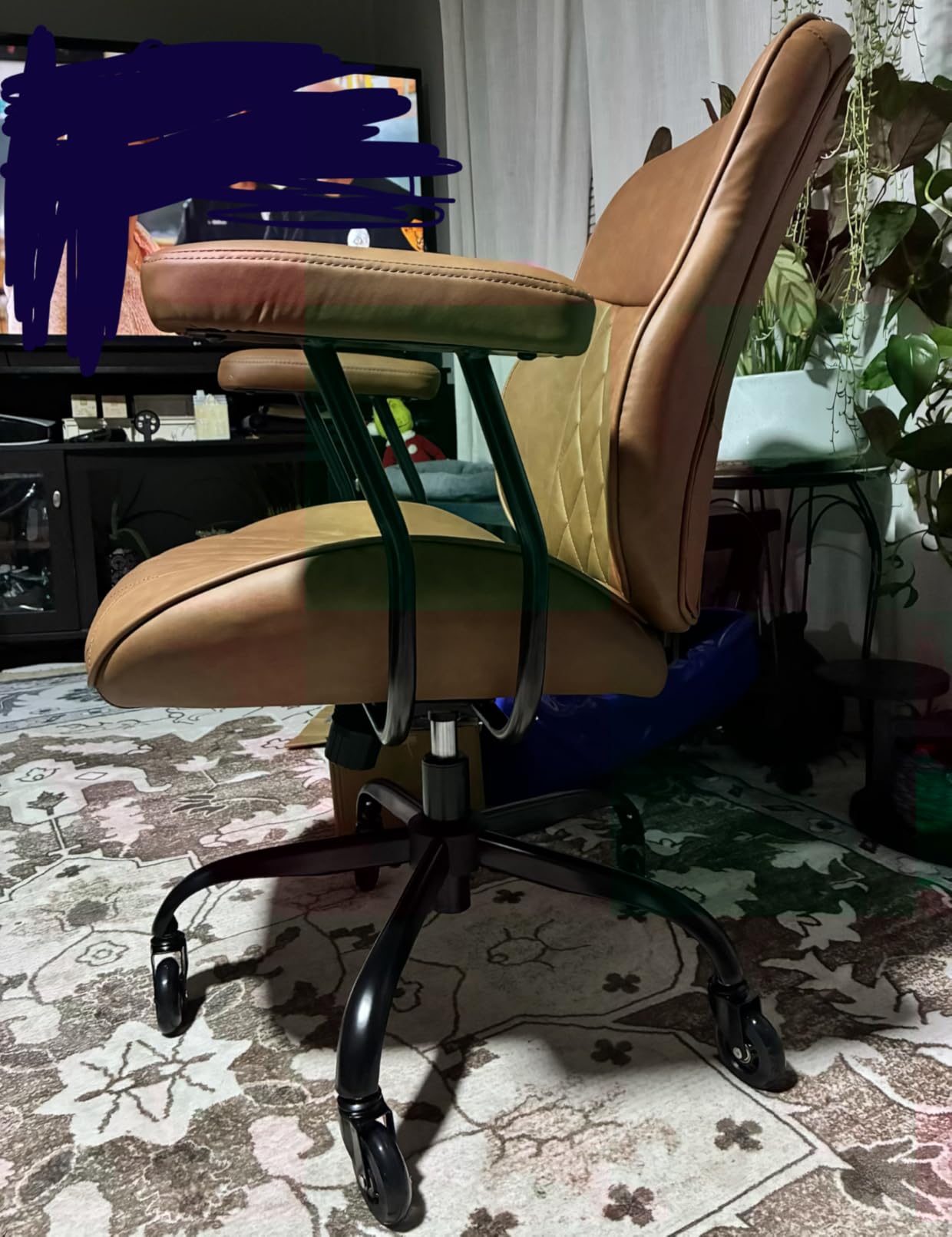
A 120 degree backrest with a locking position is genuinely useful for reading, calls, and thinking work. The caution is that the backrest pitch is fixed, so there is no tensioned angle that holds you at 100 degrees for upright typing. You get full recline or you get whatever the default is.
Several owners add a lumbar pillow for exactly this reason. If your desk work is upright and long, treat that as a likely add-on rather than a surprise.
The seat is 21.6 inches wide, which is properly generous, and the backrest interior height is 20.5 inches. Armrest height is 7.9 inches, and the recurring complaint is that the arms sit wide enough to stop the chair sliding under a narrow desk opening.
Measure the gap between your desk legs before you order. If it is under about 24 inches, this chair will not tuck in, and that is a dealbreaker in a small office.
Capacity is listed at 320 pounds with a feature description reaching 320 to 380 lb depending on configuration. At 40 pounds it is the second-heaviest chair here, which contributes to a stable base and a planted recline.
The armrest welds are the reported weak point. A minority of owners report them breaking after a few months, so if you habitually lean hard on the arms, this is not the chair for you.
Choose it if you take calls in the chair, read in the chair, or genuinely want to lean back, and if the all-floor casters let you move between hardwood and carpet without thinking about it.
Pass if your desk opening is narrow, if you need an adjustable back angle, or if you push off the armrests to stand. The recline and the wide seat are the strengths; the fixed pitch is the limit.
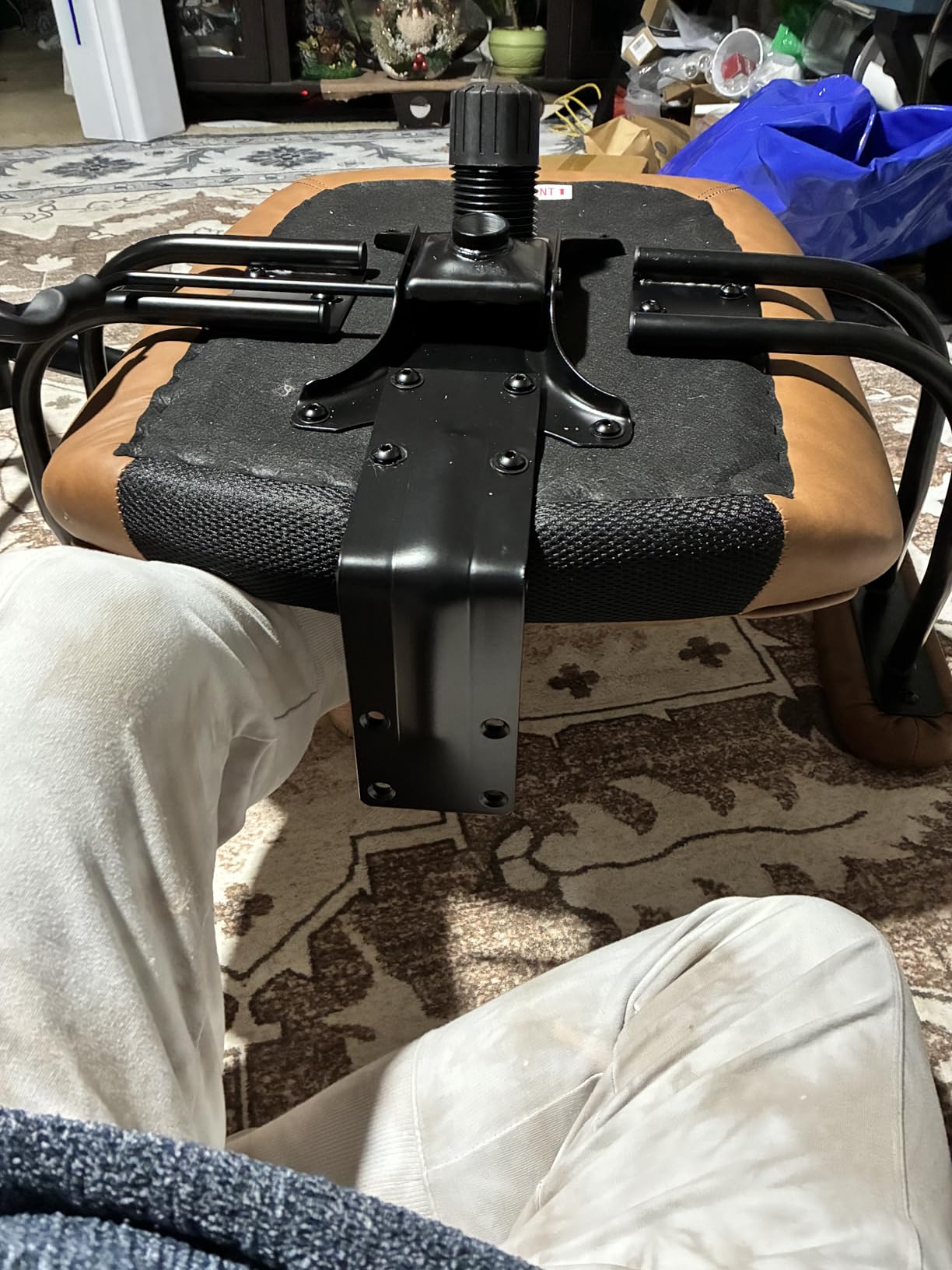
Carpet dual-wheel casters as supplied
32 to 36.5 inch height range
Locking tilt with tension
200 lb capacity
This is the exception in the roundup, and we are including it because skipping it would be dishonest. It is a good chair with a large, long-established review base, and it is the only one here that arrives with carpet-rated dual-wheel casters. Carpet casters are the hard dual-wheel nylon type. On bare hardwood they are the single most common cause of the shiny scuffed patches people discover in their home offices.
The fix is straightforward and inexpensive. Replace the casters with soft polyurethane rollerblade or rubber wheels before the chair touches wood. It is a five-minute job with a rubber mallet, and it converts an excellent writing chair into a hardwood-safe one.
Dual-wheel carpet casters use two small hard wheels per leg, which gives them a narrow contact patch and a hard tread. That combination concentrates pressure and does not deform on contact, so the finish takes the full load. It is also why they roll so well on carpet and so badly on wood.
No amount of careful rolling prevents it. This is a material mismatch, not a technique problem.
Where this chair genuinely wins is a writing desk or drafting surface. A wood seat at 21 inches with a ladder back is stable and upright, it does not swivel away mid-stroke, and there is no mesh pressing against you while your arms are forward on the table.
Pneumatic height adjustment runs from 32 to 36.5 inches overall and the locking tilt has adjustable tension, so you can set the resistance rather than having a fixed hinge.
The 200 pound rating is the lowest in this roundup and it is a genuine limit, not a formality. The seat is also fixed wood with minimal padding, which is comfortable for an hour and tiring for six.
If your day is writing and drawing, that trade is worth it. If your day is email and spreadsheets, look at the mesh or padded options instead.
Buy it if you write, draw, or study at a desk and you like traditional furniture, and if you are willing to spend five minutes swapping the casters. That last condition is not optional on hardwood.
Pass if you are over 200 pounds, if you need an all-day padded seat, or if you want zero floor risk out of the box. This is the only chair here I would not place directly on a hardwood floor as shipped.
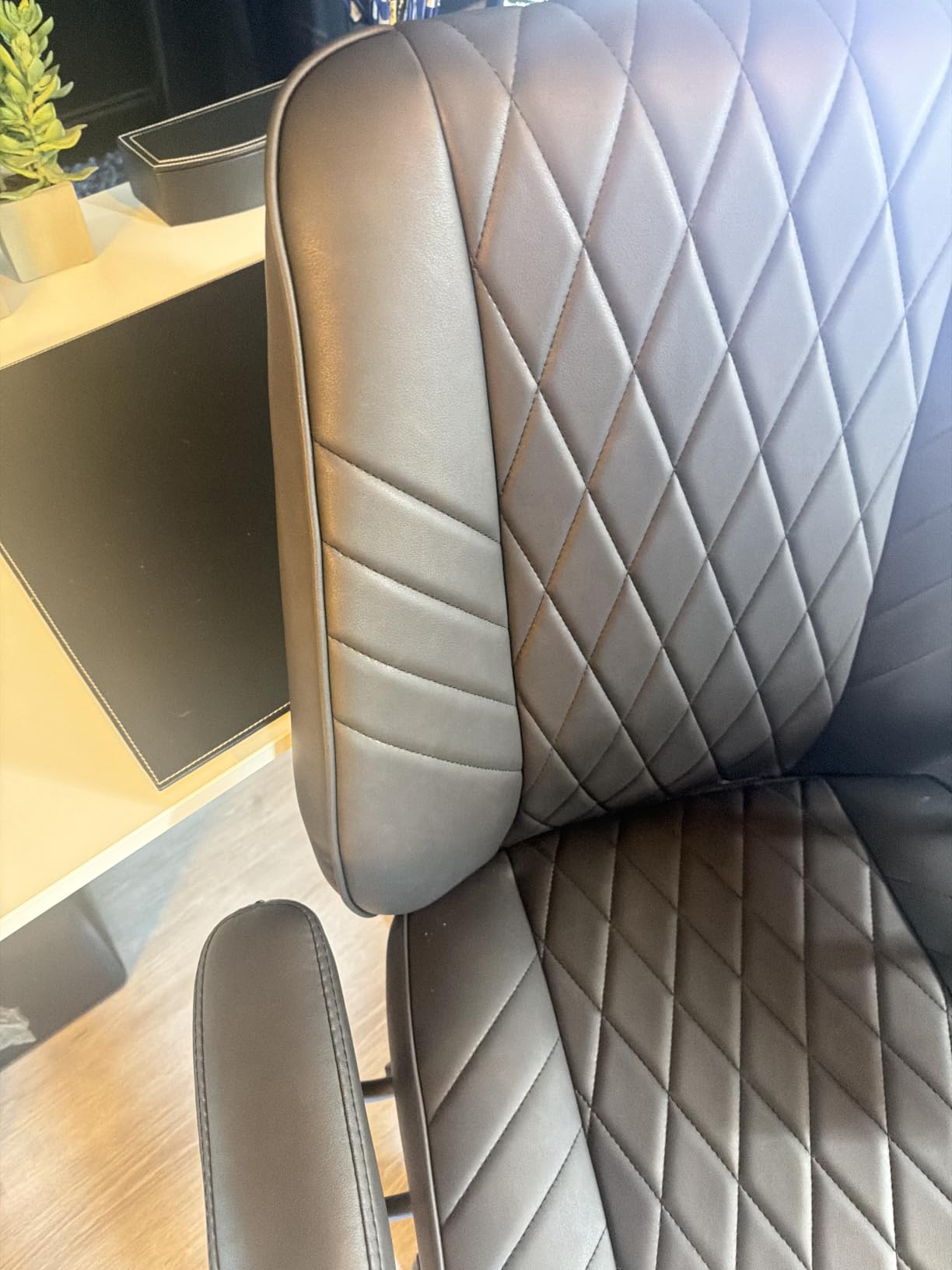
Silent rubber wheels for wood floors
Fits users 5 foot 0 to 6 foot 3
360 swivel and rocking
350 lb capacity
The wheels are the reason this chair is here rather than purely for the styling, and owners single them out repeatedly. They are rubber rather than plastic, and the recurring comment is that they glide over wood floors without marking. That is exactly the claim we are looking for, and it is consistent across the reviews rather than appearing once in an enthusiastic review.
The listed fit range of 5 foot 0 to 6 foot 3 is one of the broader ones in this roundup, and at 350 pounds rated it handles more users than most of the leather chairs here.
The cushion is firm rather than plush, and the foam is specified for anti-deformation and rebound rather than for a sinky executive feel. That is a deliberate choice in a mid-century silhouette, and it holds shape over years where soft foam flattens.
There is a small inconsistency worth flagging. The wheel material is rubber and owners confirm floor-friendly rolling, but the listed surface recommendation is carpet, so hardwood performance is not formally rated by the maker.
We are comfortable including it because the tread material is the physical answer, and rubber is one of the two safe categories. But if you want a listing that explicitly names hard floor, the CAPOT and BERYTH chairs do.
The seat is 21 inches wide and 20 inches deep at 19 inches high, with a 19 inch backrest interior height. That is a properly proportioned mid-back rather than a shallow stool-back, and it supports through long sessions without a headrest.
Swivel is 360 degrees with a rocking function. The arms are removable, which is a nice touch for cross-legged work and for sliding in under a desk.
Assembly is a five-step illustrated process and takes about 40 minutes for one person, longer with two when attaching the back to the seat.
One practical warning: buyers of the black variant report that it renders as dark brown. If colour accuracy matters to you, order the brown deliberately and do not expect black.
Buy it for a study, a den, or a bedroom office where the chair is visible and the look matters as much as the function. The rubber wheels make it kind to wood, and the removable arms handle the cross-legged days.
Pass if you want a deeply padded executive seat or if you will be spending nine hours a day in it. The firm cushion is a design decision, not a flaw, but it is firm.
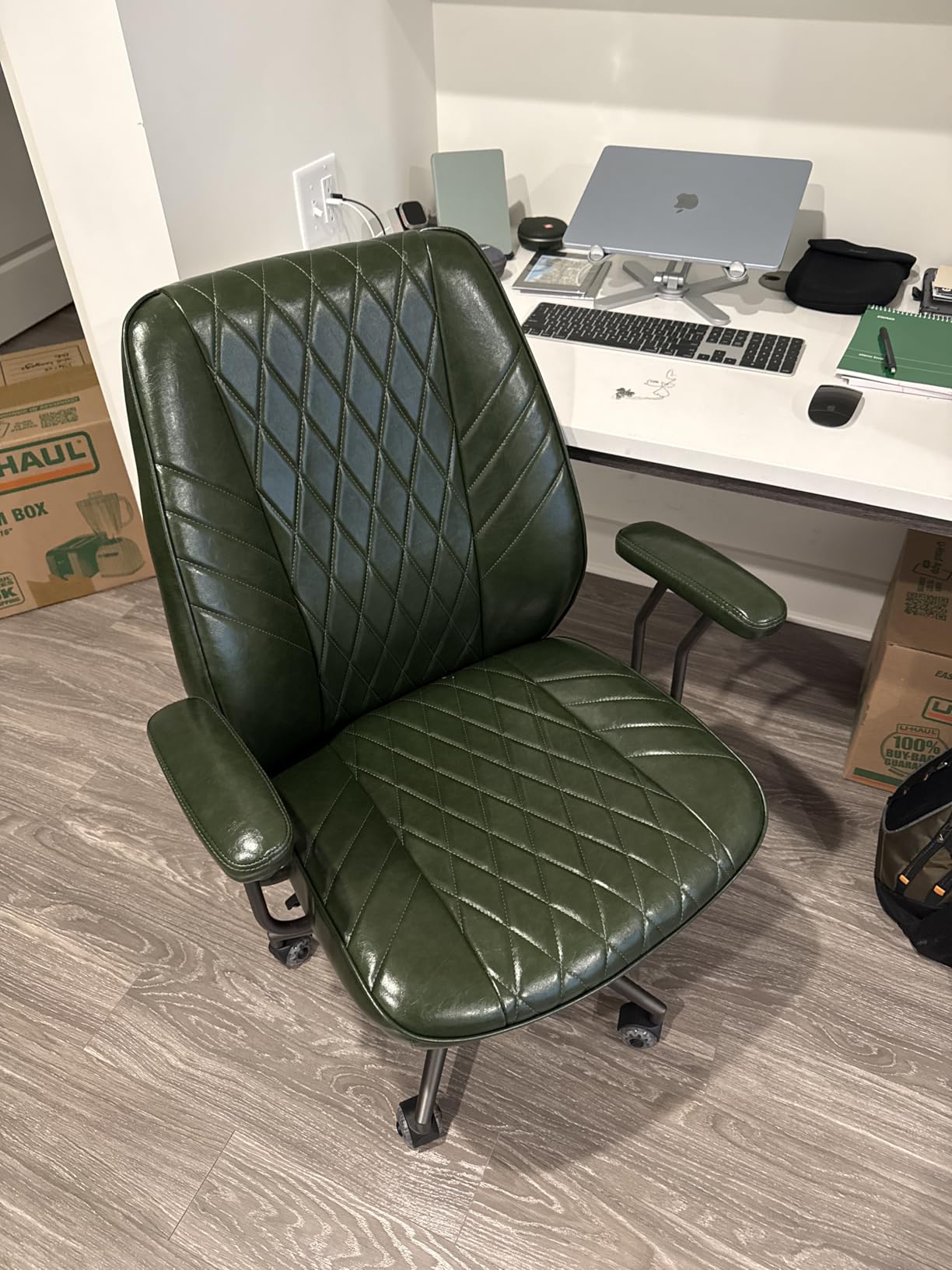
Floor protective silent casters
Bentwood frame rated to 350 lb
Seat height 19.09 to 22.83 inch
360 swivel and rocking
The casters on this chair are named for the job in the listing itself, which is a good sign about how the product was positioned. Floor protective silent casters, paired with a 360 degree swivel and a rocking function, is an unusually explicit combination of floor safety and everyday movement.
The bentwood frame is reinforced and rated to 350 pounds, which is one of the higher capacities among the mid-century chairs in this roundup. Wood frames are stiffer than powder-coated steel under load, so the rating holds with less flex in the base.
At 24 pounds it is the second-lightest chair here, and that shows in the assembly time of 15 to 30 minutes with tools included.
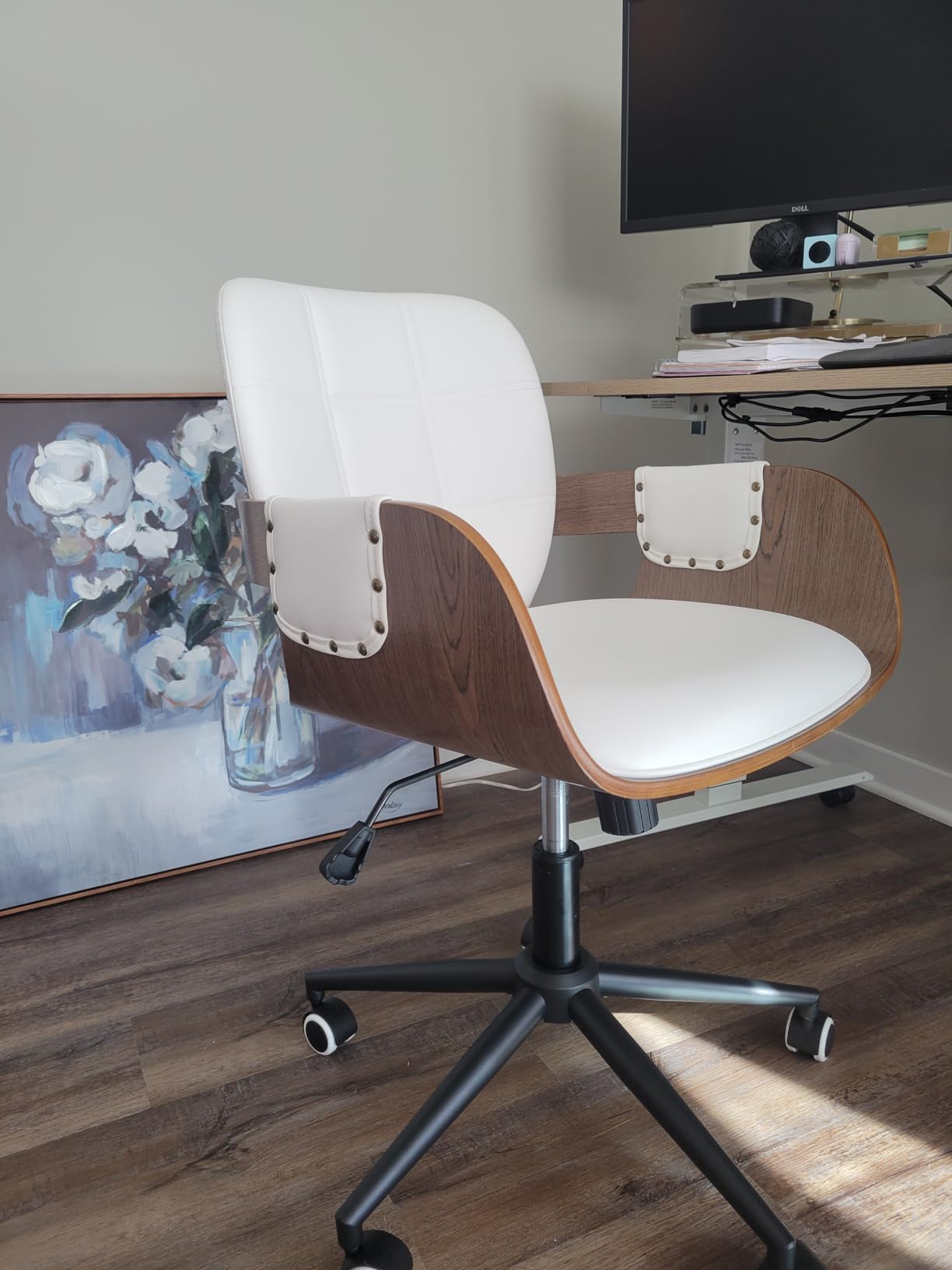
There is a trade-off with a wood-framed swivel base that owners mention honestly. It is heavier and less mobile than a full metal five-star base, so when you roll across a long stretch of hardwood to reach another part of the room, the effort is higher.
What you get in return is a base that does not flex, does not creak, and looks like furniture rather than equipment. For a stationary desk setup, that is a good exchange.
Seat height adjusts from 19.09 to 22.83 inches and the seat is 22.24 by 17.32 inches, deeper than it is wide. That depth is unusual and it is why the chair suits taller users sitting with proper leg support rather than perching.
The curved backrest is 17.32 by 16.14 inches, which is a supportive mid-back. There is no headrest and no armrest adjustment, so the support stops at the shoulder blade.
Choose it if the chair is part of the room rather than hidden in a corner, if you sit at a fixed desk, and if you want a wood floor-safe base with a visible 350 lb rating behind it. The walnut finish and curved back are genuinely handsome.
Pass if you need a headrest, adjustable arms, or a lightweight base you can move around easily. And if you are a very large user, the narrower seat dimension is the constraint to check before you commit.
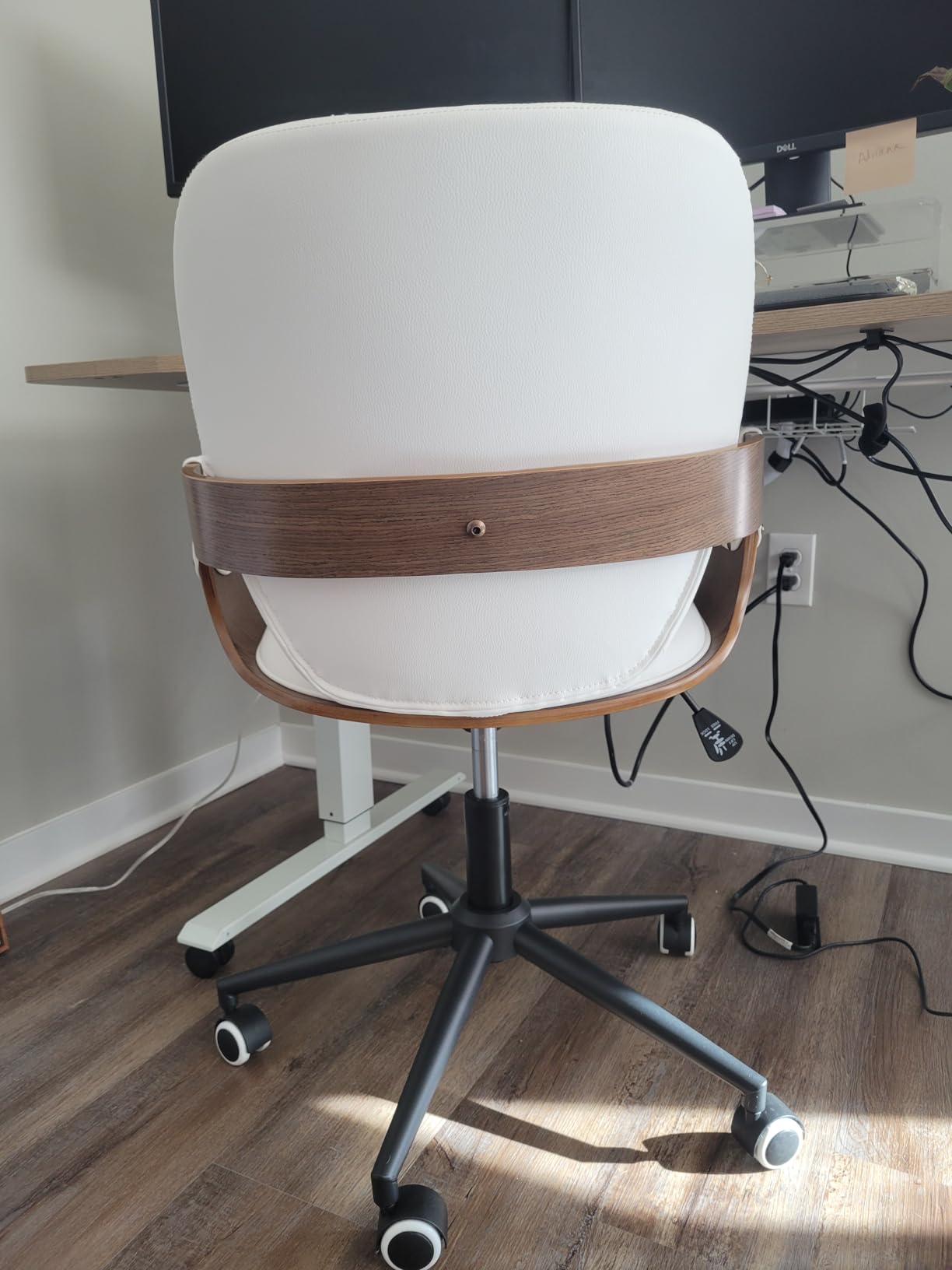
Silent casters rated for hardwood, tile and carpet
350 lb on a 25.3 lb frame
Seat height 19.6 to 22.6 inch
360 degree swivel
This listing names hardwood, tile, and carpet together as surfaces the casters are designed for, and it does so in the technical description rather than in a headline. That specificity is worth something, because it is the claim that is easiest for a manufacturer to make and hardest for a buyer to verify.
The unusual engineering detail here is the weight-to-capacity ratio. A 350 pound rating on a 25.3 pound chair means a high strength-to-weight frame, and a light chair is one you can move between rooms yourself rather than dragging with a second person.
Dimensions are 24.4 by 21.6 by 33.2 inches, which makes it the most compact footprint in this roundup, and that is where its hardwood value is highest. Small floor area, small chair, no mat needed.
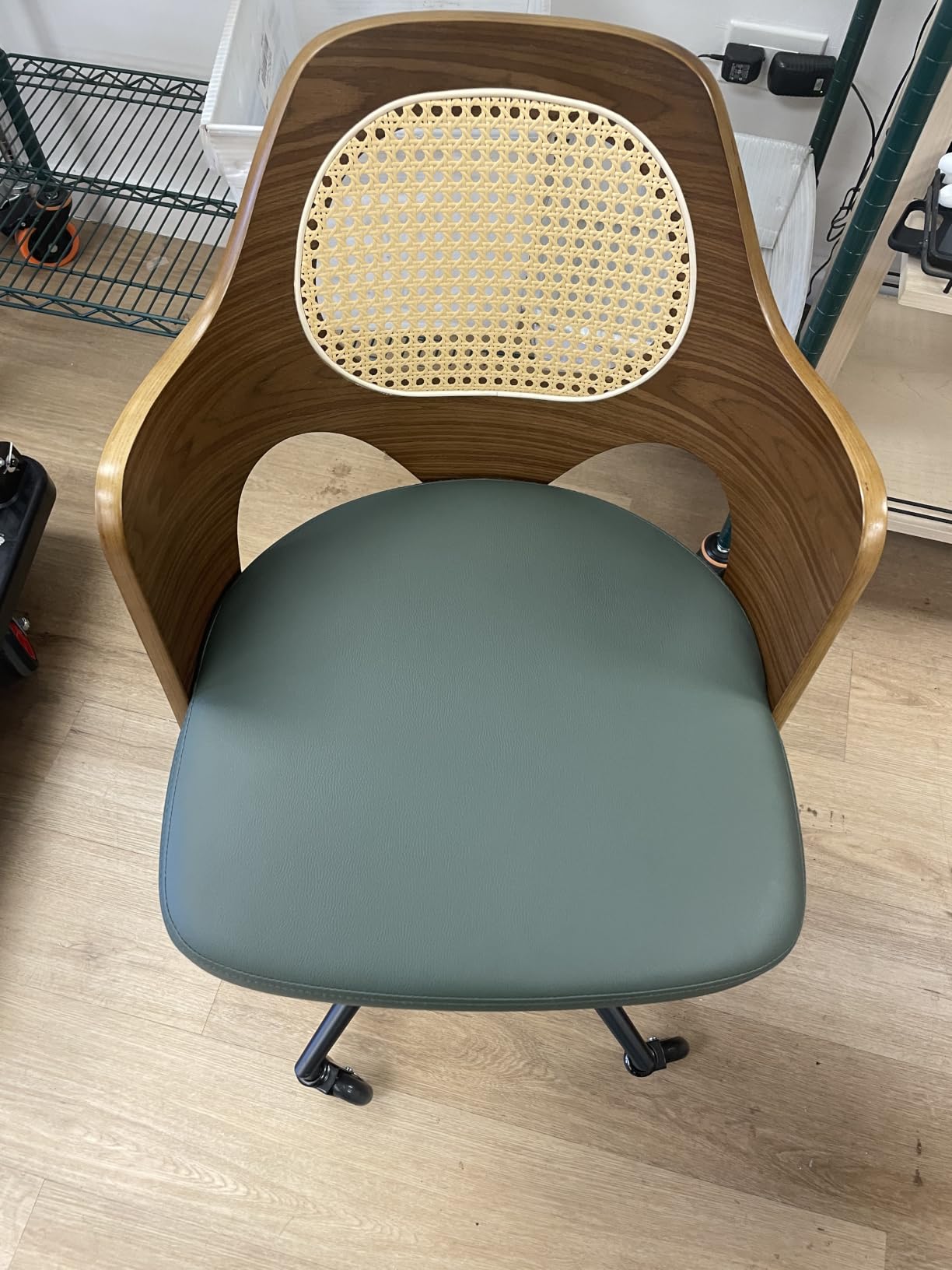
Soft-tread casters that work on hardwood and carpet in the same chair remove the decision entirely. Most people have a hard floor in the office corner and carpet in the rest of a room, and a chair that needs one wheel type for one surface and another for the other is a permanent minor annoyance.
The claim is about silence as much as about marks. Soft treads absorb the tick of a hard wheel against a sealed floor, and in a quiet room at night that difference is the one you notice.
Seat height runs from 19.6 to 22.6 inches with a 20 by 18.1 inch seat, and the back is 15.7 inches tall. That is a proper padded mid-back rather than a decorative shell, and owners cite it as supporting longer sessions.
The 360 degree swivel on a bentwood base gives you the turning range of a task chair with a frame that looks like a dining chair. It is the main ergonomic argument for this silhouette.
The arms are the limitation worth being blunt about. Bentwood arms are part of the visual design, and a consequence is that the chair cannot tuck in under a desk as closely as an armless model. In a small room where desk clearance is tight, that is a real constraint.
There is no armrest height adjustment and no headrest, so the support range stops at the mid-back.
Buy it for a compact home office, an apartment, or a study where you want hardwood-safe casters and a chair you can carry between rooms yourself. The 350 lb rating is a genuine plus at this weight.
Pass if you need a headrest, adjustable arm height, or a chair that slides fully under a desk. And read the reviews with the small sample in mind. The ratings are excellent, but long-term durability data is thin at this volume.
PU casters tested for 50000 rotations
Armless design saves about 30 percent
330 lb steel pipe base
15 minute assembly
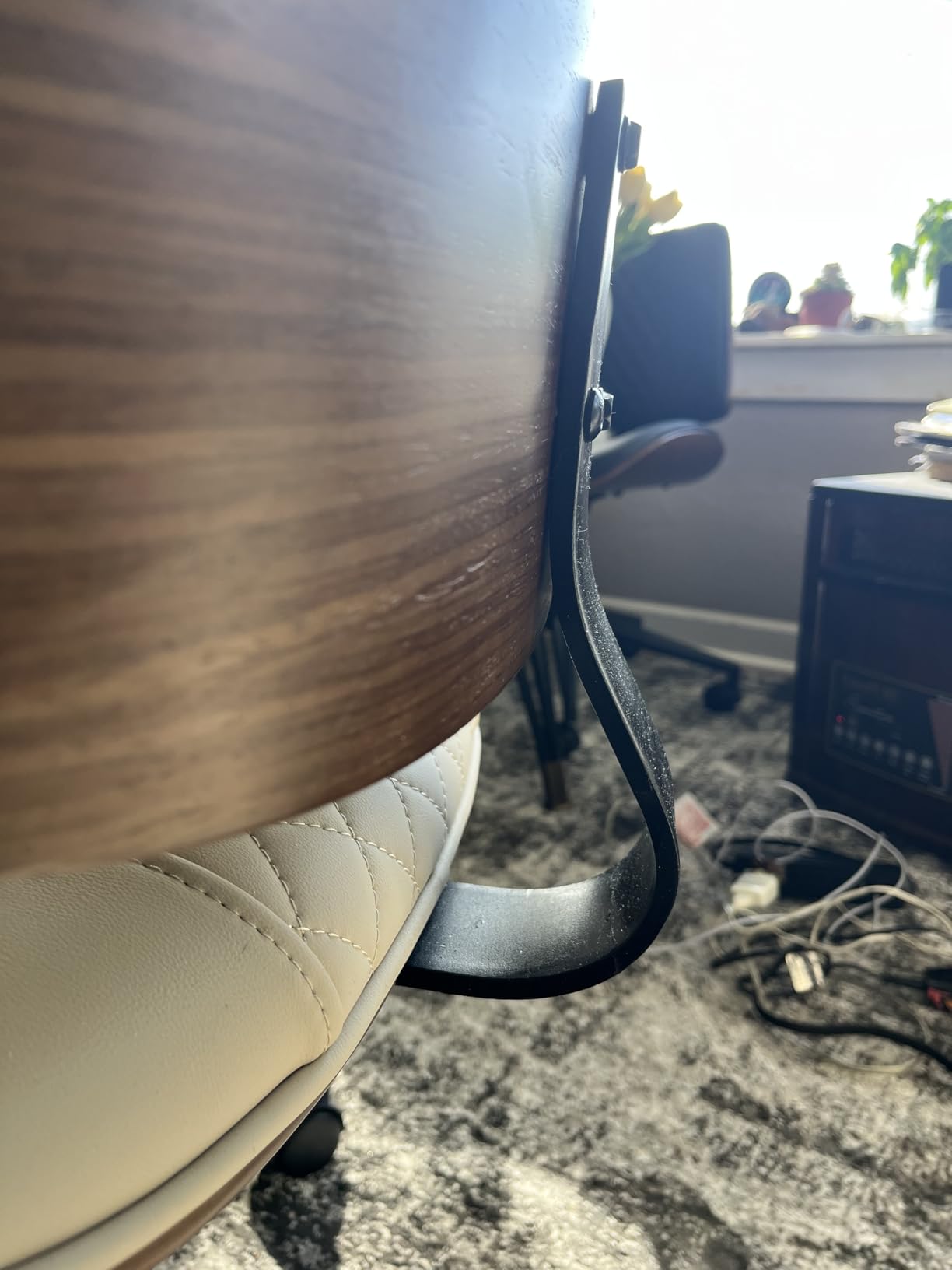
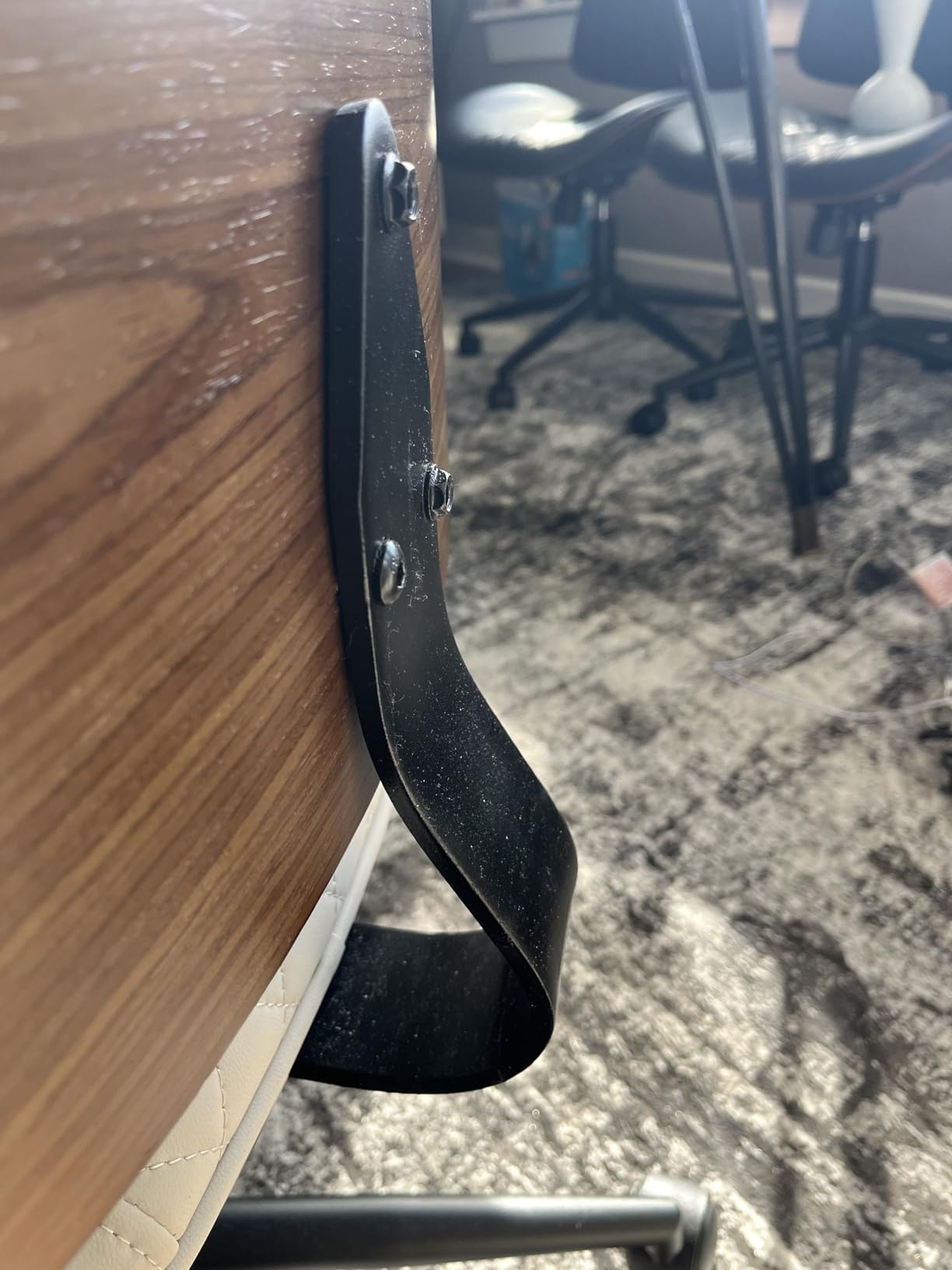
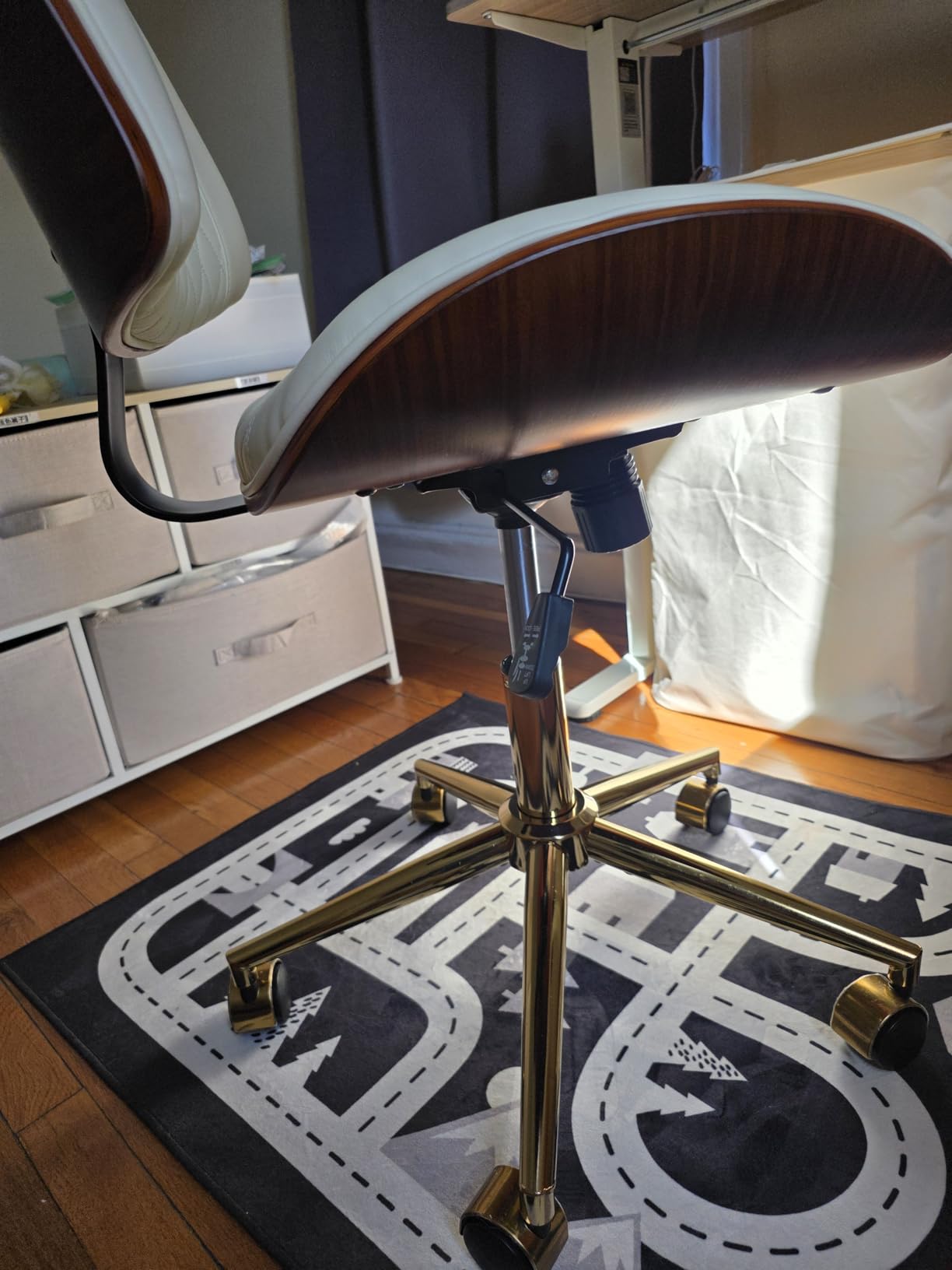
The most concrete claim in this roundup sits on this chair. The 2.5 inch polyurethane casters are stated to have been tested for more than 50000 rotations. Every other soft-tread wheel in this list is described as quiet or floor-safe, but this one comes with a cycle count attached, which is a different category of claim.
Polyurethane on a hard floor is the pairing we would make by default, and at 2.5 inches the wheels are large enough to roll over a board seam or a slight unevenness in an old floor without catching. Small hard wheels snag on the lip between planks. Larger soft ones bridge it.
Dimensions are 18.1 by 20 by 36.6 inches at 21 pounds, the smallest footprint here, and the armless frame is said to save roughly 30 percent of the floor space a full chair needs.
Polyurethane is the workhorse material for hard floors, sitting between soft rubber and hard nylon on the hardness scale. It is quieter than nylon, far more abrasion-resistant than plain rubber, and it does not polish a finish the way a hard wheel does.
A 50000 rotation claim is not a lifetime guarantee, but it is a meaningful number. It is the kind of detail that tells you the wheel was actually run rather than simply described.
The recline runs from 90 to 135 degrees, which is a wide range on a budget-class armless chair. The catch is that the backrest angle is fixed and cannot be locked upright by any adjustment, which owners flag as the most common complaint.
That is a genuine ergonomic limitation. A chair that cannot hold you upright when you type is a chair you will end up slouching in by hour four.
The base is 1.5mm thickened steel pipe rated to 330 pounds, which is a real capacity for a light frame. The cushion is 2.4 inch high-density sponge, and the seat is wide for the overall footprint.
The recurring complaint is screws needing a tighten after a few weeks and some squeaking. The walnut panels are FSC-certified wood with a water-resistant PU leather that wipes clean quickly.
Choose it if the floor space is tight, if you want the smallest hardwood footprint in this roundup, and if you sit at a desk low enough that a low seat suits you. The casters alone justify the floor-safety case.
Pass if you are a tall user, since it sits low, or if you need a backrest that locks upright. Also expect a firming-up period where you check the screws.
Rubber wheels rated under 25 dB
Seat height 17.72 to 21.65 inch
90 to 120 degree rocking
300 lb capacity
This chair carries the only decibel figure in the roundup. The rubber wheels are rated under 25 dB, which is a soft-tread specification with a number attached, and the difference from a hard nylon caster is not subtle. A hard wheel ticks against a sealed floor on every rotation. A soft wheel absorbs that impact.
It matters most in the situations people actually work in. A shared apartment, a night shift, a household where someone is sleeping in the next room. Quiet rolling is a comfort feature, not a luxury, and it is one the spec sheet rarely quantifies.
The build is also quick. Fifteen minutes with numbered parts and included tools, which is the fastest assembly here alongside the BEWISHOME.
Seat height adjusts from 17.72 to 21.65 inches, and that maximum is the lowest in this roundup. If you are tall or you have a high desk, you will run out of adjustment before you run out of legroom, and no amount of gas lift quality fixes that.
Measure your desk height and the underside clearance before ordering. This is the one hard number that can disqualify the chair faster than any comfort preference.
The rocking range of 90 to 120 degrees gives a decent spread of positions, and the foam padding over a wooden board holds its shape better than a slab of loose foam.
Support stops at the mid-back. There is no headrest and no lumbar adjustment, so this is a chair for eight-hour days rather than for anyone who needs a specific support configuration dialled in.
The armless walnut-look design is built to push under most desk heights, which is the practical reason to choose it. Backrest width is 18.7 inches and the overall footprint is 20.28 by 20.28 inches, so it stays compact in a small room.
Rubber wheels and a hard-floor surface recommendation mean it is ready for hardwood as supplied, with no modification.
Buy it if noise is your main concern, if you work in a quiet shared space, and if you need a chair that disappears under the desk. The rubber wheels on a hard floor are the reason it earns a place here.
Pass if you are tall, since the 21.65 inch ceiling is the binding constraint, or if you need a headrest or lumbar adjustment. The floor safety is settled; the seat height decides the rest.
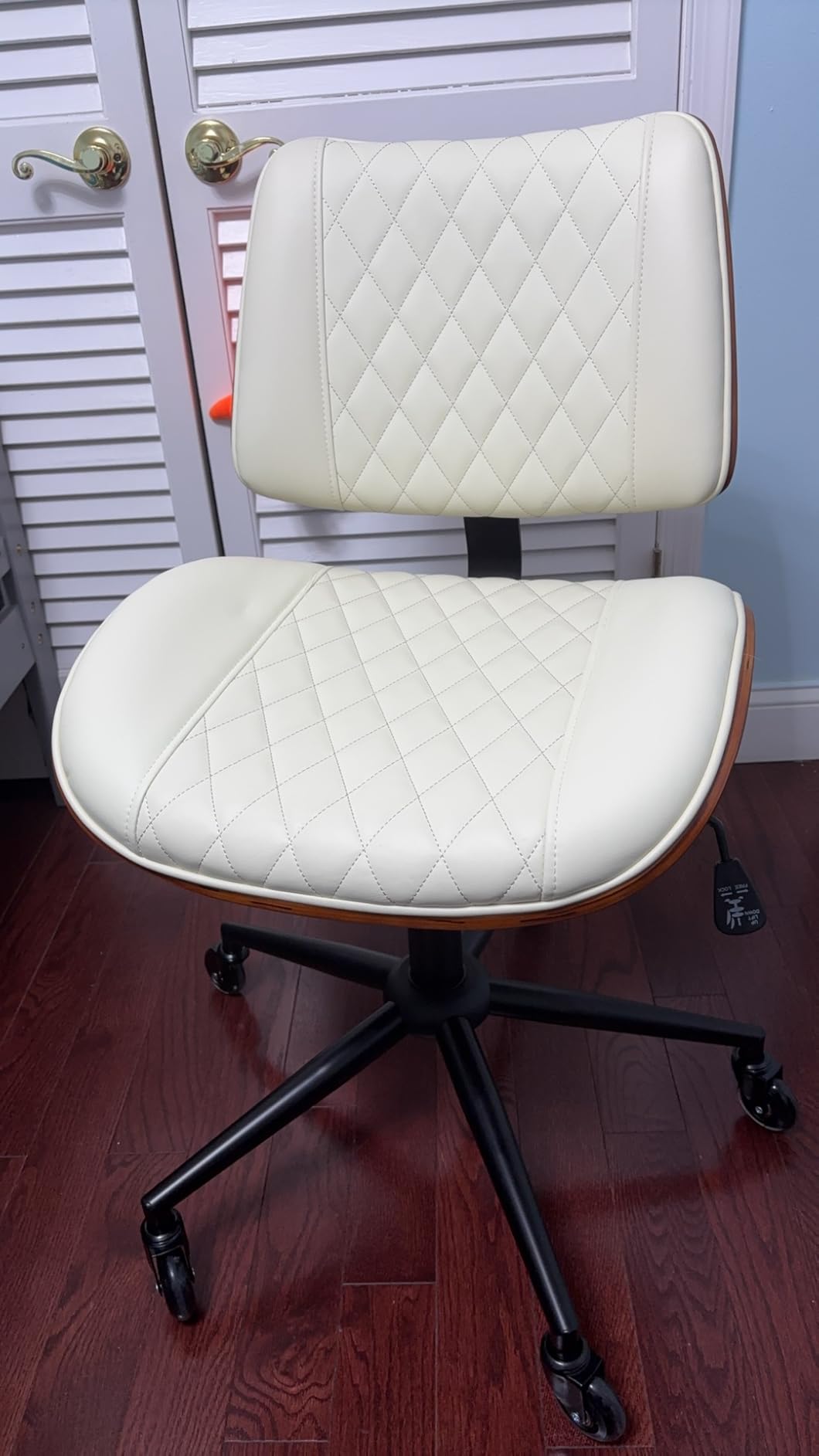
Everything in this guide comes back to one principle: a hard wheel concentrates your weight into a tiny contact patch, and your finish absorbs all of it. Understanding the damage modes tells you which failure you are actually at risk of.
Scratching is the deepest and most permanent. Grit trapped under a wheel acts as abrasive, and a hard wheel presses it into the finish along the grain.
Scuffing is a surface-level black or grey mark, usually left by rubber that has picked up debris. It is often removable with a cleaning product.
Burnishing is the one people do not expect. Repeated rolling under load gradually dulls a hard finish into a dull, shiny patch. It is not a scratch and no cleaning removes it. Users on r/malelivingspace describe exactly this, chairs that burnish the floor where they slide around and leave shiny spots, and the consensus advice there is that softer casters are the answer.
Indentation comes from a caster that is too small or too hard for the load, and from a chair that does not distribute weight evenly across five wheels. A wobbling or unbalanced chair concentrates everything onto one leg.
Soft polyurethane or urethane rollerblade casters are the hardwood-safe standard. The tread deforms slightly on contact, widening the contact patch and absorbing grit that would otherwise grind into the finish. The second safe category is soft rubber, which is quieter but wears faster on hard surfaces than polyurethane does.
Hard nylon and polyamide wheels are the problem. Dual-wheel carpet casters are usually nylon, and phenolic and plastic wheels sit in the same danger zone. On the Ars Technica Civis forum the standard advice is that urethane casters are made for hard floors, and the reason most people still have damage is that their chair shipped with cheaper nylon casters.
One more spec worth knowing: wheel diameter. Something in the 60 to 70 mm range rolls over uneven boards and plank seams without catching. Very small hard wheels snag on the lip between boards and then jump, and that repeated impact is what gouges.
Material first. Soft polyurethane, rated Shore 55A to 65A, or soft rubber. This is a hard filter. Do not compromise on it for any other reason.
Stem size second. The standard US office chair caster stem is 11mm by 22mm, a friction-fit grip-ring design that covers the large majority of chairs sold in this country. IKEA and many European chairs use a 10mm stem and will not accept the 11mm replacements. Measure before you buy a full set.
Diameter third. 60 to 70 mm is the comfortable range for wood, large enough to bridge plank seams.
Weight capacity fourth. Match it to your weight plus a margin. A 300 lb chair rating is not a 300 lb limit, it is a point at which the gas lift and frame are no longer tested.
Bearing type last. Precision ball bearings roll smoother and last longer than plain sleeve bearings. On a five-star base with ten wheels in contact with the floor, smoothness compounds.
1. Upgrade the wheels. Soft polyurethane or rubber casters, correct stem size, correct diameter. This is the highest-leverage action and the cheapest. On the Home Improvement Stack Exchange the canonical answer to protecting wood floors is a two-option choice, replace the casters with rubber ones, or use a floor protector mat, and the caster route is the one that leaves your floor visible and your room looking right.
2. Use a chair mat. Valid, with trade-offs. Plastic and PVC mats protect well but trap grit underneath, which then works on the floor anyway, and they are visually loud in a living space. Felt mats are quiet and gentle but can slide. Bamboo matches a wood floor visually. Tempered glass is hard-wearing and completely clear, and the question people ask about it, whether glass chair mats shatter, comes up because the concern is real enough to search for. Thickened safety glass of the kind sold for this purpose is rated to take rolling furniture weight, but a chipped or cracked pane should be replaced rather than trusted.
3. Clean the rolling zone. Vacuum or sweep under and around the chair weekly. Grit under a caster behaves exactly like sandpaper, and this is the single most overlooked step in floor protection.
Our guides to protective mats for hardwood floors and mopping methods for hard floors cover the cleaning half of the routine properly.
Before you buy a new chair, try this. Most damage comes from a factory wheel, not a bad chair, and the wheel is a fifteen-minute part.
1. Flip the chair over and lever the old caster out of the socket with a flat screwdriver and a rubber mallet. Pull, do not twist, or you can crack the socket in the base plate.
2. Measure the stem. It is either 11mm by 22mm or something else, usually 10mm on European chairs. Buy to the measurement, not to the brand of chair.
3. Clean the socket with a damp cloth and let it dry. Grit in the socket is what makes a new caster wobble and bind.
4. Press the new caster in with the stem and a mallet. It should seat firmly. A caster that needs force to remove and gentle pressure to install is a correct friction fit.
5. Test the swivel in all directions at floor level, then sit and roll the full range of motion to check the wheel spins freely and the chair sits level.
Two cautions. Swapping casters can affect your warranty, so check the chair maker’s terms first. And buy a full set of five identical casters, because mixed wheel types on one base produce uneven loading and that uneven loading is one of the four damage modes above.
Surface-finish oil and matte finishes have no hard top layer, so a wheel that would only burnish a lacquered floor can physically dent an oiled one. Use soft polyurethane or rubber on all of them, but pay particular attention on oiled and waxed floors, which have the least protection.
Factory polyurethane and lacquer finishes are the most common in modern homes and the most forgiving. Even so, burnishing shows on them under repeated load, so a soft tread still matters.
Engineered wood and wood veneer under about 12mm should get the same soft casters. The shorter decision rule: the softer the top layer of your floor, the softer the wheel you put on it.
Weekly, vacuum the rolling zone. Monthly, check each caster for flat spots, wobble, or a swivel that does not spin freely. Every 60 days, inspect the wheels and the stem fit. Every three to five years, expect to replace the casters on a regularly used chair, sooner if you run a soft rubber set on a hard floor, since rubber wears faster than polyurethane there.
That rubber versus polyurethane tradeoff is the one that catches people. Rubber is quieter and gentler. Polyurethane lasts longer on hard flooring. If your priority is the floor, polyurethane is the better long-term choice.
Soft polyurethane or urethane rollerblade casters are the best choice for hardwood floors. The soft tread deforms slightly on contact, spreading your weight across a wider patch of finish and absorbing grit that would otherwise grind into the wood. Hard nylon, plastic, and dual-wheel carpet casters concentrate pressure into a tiny contact patch and cause scratches, scuffs, and dull burnished patches that cleaning cannot remove.
Hard wheels will scratch a wood floor, and soft wheels are the answer. Damage shows up in four forms. Scratching is the deepest and permanent, usually caused by grit trapped under the wheel acting as sandpaper. Scuffing is a surface mark that a cleaning product may remove. Burnishing is a dull, shiny patch where repeated rolling has polished the finish, and it is not repairable by cleaning. Indentation comes from undersized wheels or a chair that does not sit level.
There are three actions that work. First, replace the casters with soft polyurethane or rubber wheels in the correct stem size, usually 11mm by 22mm, with a 60 to 70mm wheel diameter. Second, use a chair mat if you prefer, keeping in mind plastic and PVC mats trap grit underneath and felt mats can slide. Third, vacuum or sweep the rolling zone weekly, because grit under a caster behaves like sandpaper and does more damage than the wheel material alone.
Caster wheels are safe on hardwood only when they have a soft tread. Soft polyurethane and soft rubber casters are both suitable because they deform on contact and spread weight. Hard nylon, polyamide, phenolic, and plastic casters are not, and the dual-wheel type fitted to most chairs for carpet is the worst offender. Check the listing for a hard floor surface recommendation, and replace the wheels if the chair shipped with carpet casters.
Replace the casters. A full set of soft polyurethane wheels costs a fraction of a floor refinishing and leaves your hardwood visible, which matters in a room that doubles as a living space. A mat is a valid second option, but plastic and PVC mats trap debris underneath that then works on the floor anyway, and a large mat changes the look of a room. A caster swap takes about fifteen minutes with a screwdriver and a mallet.
Thickened tempered glass chair mats of the kind sold for this purpose are safe and will not shatter under rolling furniture weight, and the glass is completely clear so the floor pattern shows through. The concern is real on cheap untempered panels, which can crack. Inspect for chips or cracks before use and replace a damaged pane rather than trusting it. Many buyers in r/Flooring recommend glass specifically because nothing else stays clear and unmarked over time.
If you want one chair and no further decisions, the YFO leather desk chair is the pick. Wide 22 inch seat, removable armrests, 300 lb rating, and rubber casters the maker rates for wood, carpet, and marble. It is the balance of comfort, floor safety, and proven owner satisfaction that we came back to.
If you are a larger user or you want real adjustability, go with the CAPOT mesh task chair. It is the only 400 lb chair here, the PU wheels are named for hard floors, and the eight-level lumbar is the best support specification in the group. The one caution is mesh pressure for wider users.
If the room is small, the BERYTH armless bentwood chair gives you hardwood-safe rubber wheels and the tightest footprint that still has a swivel and a rocking function. If noise is the issue, the FervorFurn chair is rated under 25 dB on rubber wheels, provided the 21.65 inch seat height ceiling works for you.
And if you already own a chair you like, do not replace it. Buy a set of soft polyurethane casters in the right stem size and put your money into the floor instead. The best office chairs for hardwood floors are not a shopping decision at all. They are a fifteen-minute hardware swap, and the only thing standing between your finish and five hard wheels is a rubber mallet and ten minutes on the weekend.