Physical Address
304 North Cardinal St.
Dorchester Center, MA 02124
Physical Address
304 North Cardinal St.
Dorchester Center, MA 02124

The best metal swing sets for small yards are compact powder-coated steel A-frames whose footprint, plus the 6 feet of safety clearance they need on every side, still fits a modest backyard. My overall pick is the Trekassy 440lbs set, a 64.6 by 86.6 inch frame with a 32 inch saucer swing and a belt swing that holds 440 lbs total and includes ground anchors.
Most small yards do not fail on budget. They fail on clearance. A set that looks compact in a product photo can swallow a modest backyard once you add the empty space in front of and behind the swing arc, which is where most injuries actually happen.
I compared all ten sets in this roundup on published dimensions, frame material, coating type, swing configuration and real buyer feedback, and I worked out the total clearance footprint each one needs before you buy. Every measurement in this guide comes from the manufacturer’s listed dimensions, not from marketing language like “space saving.”
Two decisions shape everything else: how much clear ground you actually have, and whether the ground is level. Get those two answers first and the right set picks itself. If you are still working out how much lawn you have, start with our electric riding mower guide since mower access and swing set clearance usually compete for the same square footage.
The fastest way to buy the wrong swing set is to measure the frame and stop there. Frame dimensions tell you how much metal you own. They do not tell you how much lawn you need.
Safety guidance for residential swing sets calls for a minimum of 6 feet of clear space around all sides of the equipment, and more than that in front of and behind the swing path, since that is the direction a child travels. For a rectangular set, the total footprint equals the set length plus 12 feet and the set width plus 12 feet. That formula is the single most useful thing in this guide, so run your own numbers first.
Here is the six-step routine I use:
Measure the usable rectangle. Mark the corners of the area that is level and free of fences, trees, downspouts, utility lines, grills and swing-away obstacles. Do not measure to the property line, because you want room from the fence, not just room on paper.
Subtract 12 feet from each usable dimension. Whatever is left is the largest frame you can buy. If you have 20 by 30 feet of usable space, your maximum frame footprint is 8 by 18 feet, and most of the sets below are well inside that.
Check the level. A frame built level on a slope will rack the joints and eventually fail there, and users in DIY communities consistently report that leveling matters more than the set cost. If your usable area tilts, look for a set with adjustable or spiral ground stakes rather than pouring footings.
Confirm the swing path, not just the frame. The belt swing and the saucer swing need clear air in front of and behind them. A 32 inch saucer carries further and needs a longer run than a belt seat.
Plan the ground surface inside the same rectangle. A rubber mulch or engineered wood fiber bed needs roughly 7 to 9 feet in the swing direction, and on a very tight lot that competes directly with your clearance. Pea gravel and pavers need more area but no annual top-up.
Decide the anchoring method last. Ground stakes and packed gravel keep the set removable, which matters if you rent. Concrete anchors hold longer and trap less water at the ground line, but they mean you will not be moving the set or repairing the lawn underneath it.
For orientation, a compact A-frame like the Trekassy is 64.6 inches deep by 86.6 inches wide, so it wants roughly a 7.4 by 9.2 foot clear area once clearance is added. The wide 110 inch three-seat sets need closer to 7.6 by 11.2 feet. If your usable rectangle is under 10 feet in either direction, the narrowest set in this guide is the better starting point.
One more siting note that belongs in the measurement stage: dark powder-coated steel and plastic slides get hot in direct sun, and a shade sail over the swing zone solves the problem while also keeping the seat fabric cooler to sit on. A reader of a safety-placement guide we referenced suggested exactly that, and it is the simplest fix in this article. If your only clear area is in full afternoon sun, budget for a canopy, a sail on four posts, or simply place the set where it gets shade by 2 p.m.


All three top picks share one trait that matters more than any feature list: the frame is narrow enough that the clearance math still works in a modest backyard. Each one also arrives with its own anchoring hardware, which removes the most common reason a new set ends up wobbly in month two.
| Product | Features | |
|---|---|---|
| Trekassy 440lbs Saucer and Belt Swing Set |
|
Check Latest Price |
| Lunafun 440lbs A-Frame Swing Set |
|
Check Latest Price |
 Amictoy 440lbs Saucer and Belt Set Amictoy 440lbs Saucer and Belt Set |
|
Check Latest Price |
 HLC 3-in-1 Metal Kids Swing Set HLC 3-in-1 Metal Kids Swing Set |
|
Check Latest Price |
 Hapfan 3-Seat Saucer and Belt Swing Set Hapfan 3-Seat Saucer and Belt Swing Set |
|
Check Latest Price |
 Hapfan Double Tree Swings Set Hapfan Double Tree Swings Set |
|
Check Latest Price |
 Hapfan 3-in-1 Toddler Platform and Belt Set Hapfan 3-in-1 Toddler Platform and Belt Set |
|
Check Latest Price |
 Costzon 550lbs All Steel A-Frame Stand Costzon 550lbs All Steel A-Frame Stand |
|
Check Latest Price |
| JYGOPLA 2-Seat Compact Swing Set |
|
Check Latest Price |
 Outsunny Metal Swing Set with Glider Outsunny Metal Swing Set with Glider |
|
Check Latest Price |
We earn from qualifying purchases. CERTAIN CONTENT THAT APPEARS ON THIS SITE COMES FROM AMAZON. THIS CONTENT IS PROVIDED 'AS IS' AND IS SUBJECT TO CHANGE OR REMOVAL AT ANY TIME.
Two columns in that table deserve a word before the individual reviews. First, the width is the number that decides whether a set fits, since the length direction usually has more slack. Second, the 110 inch-wide sets look similar to the 86 inch ones on a spec sheet but require roughly two extra feet of total clearance on every side, which is often the difference between a set that fits and one that does not.
440 lbs capacity
64.6 x 86.6 x 66.9 inch frame
Powder-coated alloy steel
32 inch saucer plus belt swing
With 1,499 owner reviews behind it, this is the best-documented set in the roundup, and the documentation is unusually consistent. Buyers describe quick assembly with clear instructions and no missing parts, a frame sturdy enough for two children swinging at the same time, and a footprint small enough for a small yard. That combination of evidence volume and steady results is why it takes the top spot.
The physical design is the reason it works in a tight lot. The A-frame measures 64.57 inches deep by 86.61 inches wide and 66.93 inches tall, so with the 6-foot clearance added all around you need roughly a 7.4 by 9.2 foot clear area. That is a modest rectangle, and it leaves usable lawn on every side.
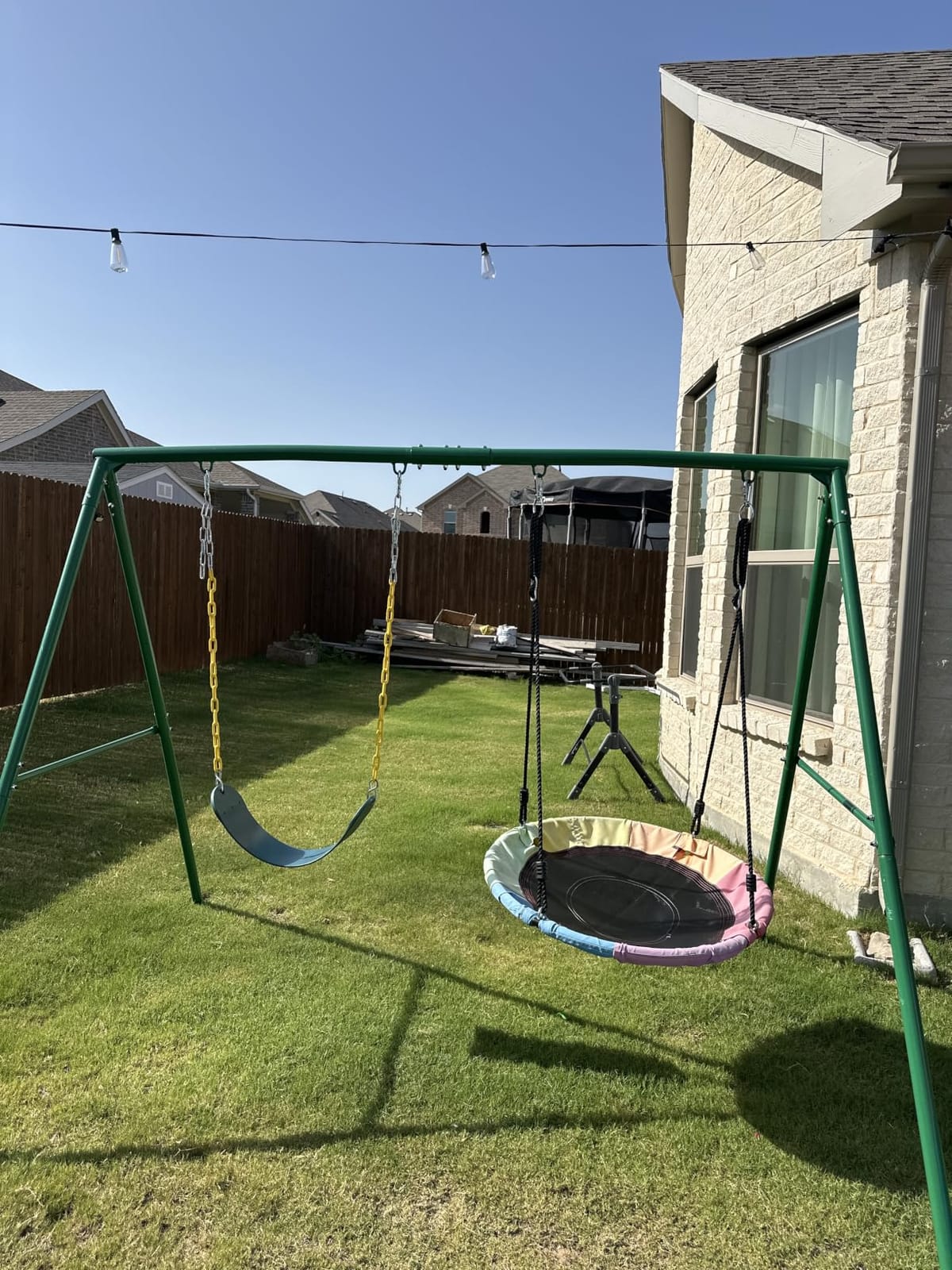
The finish is powder-coated alloy steel with reinforced support bars, and the hardware includes zinc-plated chains described as rust-resistant. Chains are the part of any swing set that fails first, so that detail matters more than the marketing copy suggests. The included ground anchors are a real bonus, since a set that arrives without them is the set most likely to rock.
The stated 440 lbs is a frame total, not a per-child number, and it is the same figure carried by most sets in this category. What matters more for a family is how many riders use it at once and how high they swing. The set is rated for a maximum of two compatible seats, so two children on a belt plus a saucer seat sits comfortably inside that envelope.
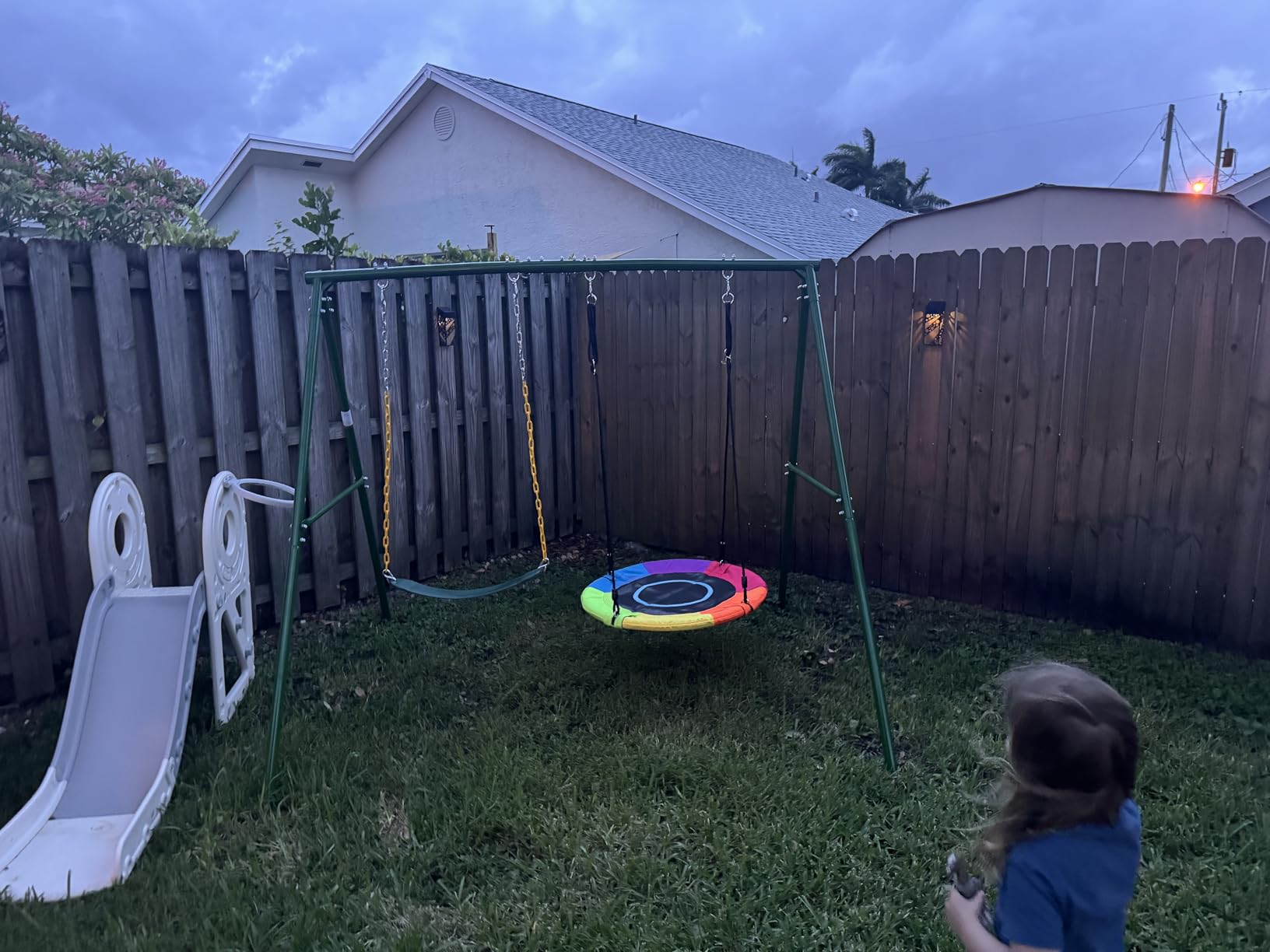
The swing bay is arranged so the 32 inch saucer and the belt seat run on the same beam, which is why a 64.6 by 86.6 inch footprint covers two swings. The carabiner system makes seat height a tool-free adjustment, so a toddler seat can sit lower in the first year and move up as the child grows without dismantling anything.
This is the section that decides the purchase for a small backyard. Buyers single out the compact footprint as a top reason they bought it, and the frame sits low enough at 66.93 inches that it does not block a view line or a fence. Add the safety perimeter and the total clear area is about 7.4 feet deep by 9.2 feet wide.
That fits comfortably beside a house wall, along a back fence with a little buffer, or in a corner of a 20 by 30 foot usable rectangle. If your clear zone is shallower than 7 feet, this set will not work and you should look at the narrower options further down.
Owners report about an hour of assembly with clear instructions, which is realistic for a two-seat A-frame. The recurring negative notes are honest ones: the ground stakes are difficult to drive into rocky or heavily compacted soil, and the frame can lift slightly at the legs if children swing at full height without strong anchors.
That second complaint is the one to solve before assembly day, not after. In DIY communities the consistent recommendation is a dedicated swing set anchor kit with packed gravel or pebble fill rather than a bare stake, because it fixes the legs without turning the site into concrete. If your soil is rocky, buy a ground anchor kit with screw-in auger stakes, and pre-dig or pre-water hard ground the day before.
440 lbs capacity
59.6 x 70 x 70.9 inch frame
Alloy steel with galvanized chain
32 inch saucer plus belt seat
This is the set to look at first if your constraint is depth rather than width. At 59.6 inches deep and 70 inches wide it is the shallowest frame in the group, and with 6 feet of clearance on each side that is the smallest usable rectangle of any set here. Buyers describe the compact size as ideal for grandparents’ yards and for small children.
It is also the one set in this roundup where the steel frame itself gets called out as well built, with reinforced steel hardware joints and a stated 440 lbs capacity. The saucer seat is textilene with galvanized chains, a combination buyers repeatedly list as holding up against wear, fading and weather.
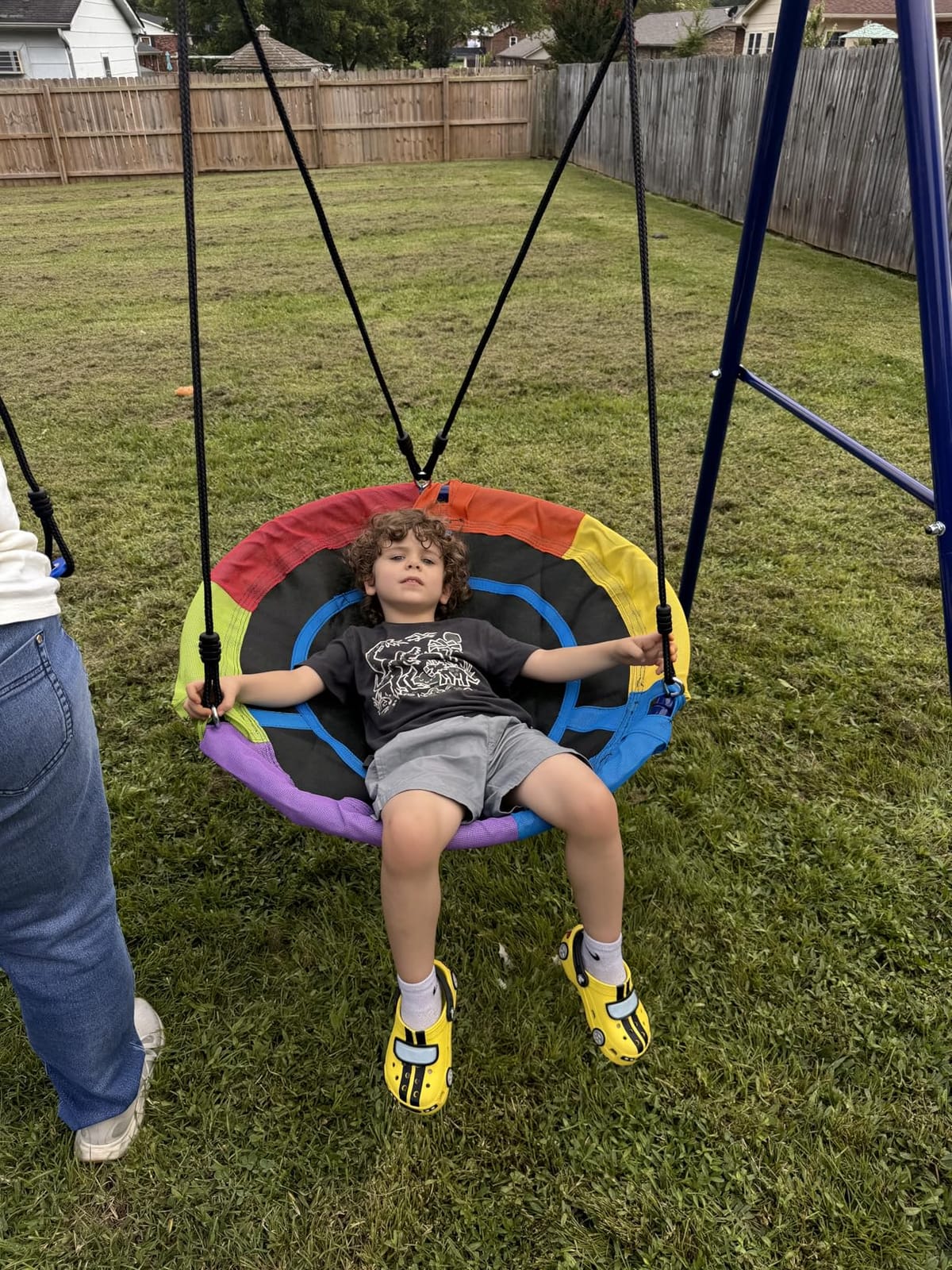
Assembly is described as straightforward, and the carabiner design means seats are easy to install and remove, which helps when one child is on the saucer and another is on the belt.
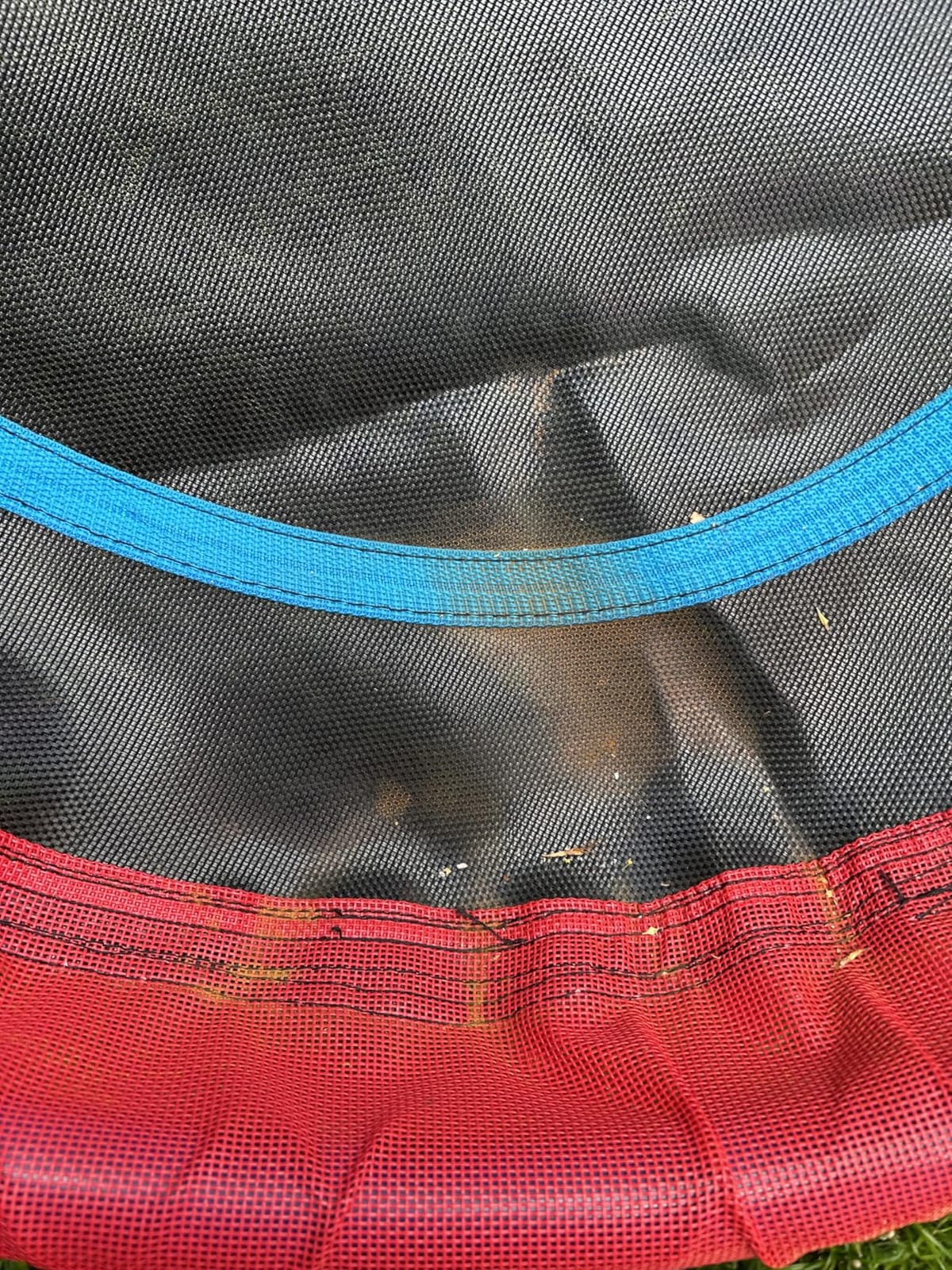
The complaint that appears most often is that the saucer swing seat rusted from the inside, and that the rust can stain clothing. This is a material issue rather than a frame issue: the textilene seat and the fasteners inside the fabric pocket are the exposed parts, and the frame finish does not protect them.
If you buy this set, inspect the saucer seat at the two- or three-month mark, keep it dry by positioning it where morning sun dries dew, and treat any early rust with a rust-inhibiting spray before it spreads. Reviewers also note the saucer hangs from three anchor points, which can make it swing slightly unevenly, a quirk that bothers some children and not others.
A second recurring note is that the swings are bolted on and cannot be removed without cutting the rope, which limits how you can use the frame later. If your plan is to swap in a different seat or a net swing, plan on a replacement rope or a fresh set of chains. It is a minor cost, but it is a real difference between this frame and the carabiner-equipped sets.
Buyers report the frame can rock or lift a leg under vigorous swinging even with standard anchors. In a small yard that matters, because a smaller use area often means swinging closer to a fence line. Anchor before the children use it, not after the first complaint, and re-check the legs after the first heavy week of use.
The honest summary is that the frame is the strong part and the seats are the weak part. Buy the seats, keep them dry, and you have a compact two-seat set that fits where most full-size playsets cannot.
440 lbs capacity
60 x 80 x 72 inch frame
32 inch saucer plus 26.2 inch belt seat
Quick-drying Teslin fabric
If your kids are two to five, this is the set that gets the most enthusiastic owner feedback in the group. The 4.6 average comes with a 79 percent five-star share, and reviewers repeatedly name sturdiness, compact size and tool-free assembly as the reasons they would buy it again. A total footprint of 60 by 80 inches means a clear area of roughly 7.0 by 8.7 feet.
The frame is a metal A-frame rated to 440 lbs, which is 45 kg in the manufacturer’s own listing. The two swing types differ deliberately: a 32 inch saucer for a child who wants to lie down and a narrower 26.2 inch belt seat with a non-slip surface for an older sibling.
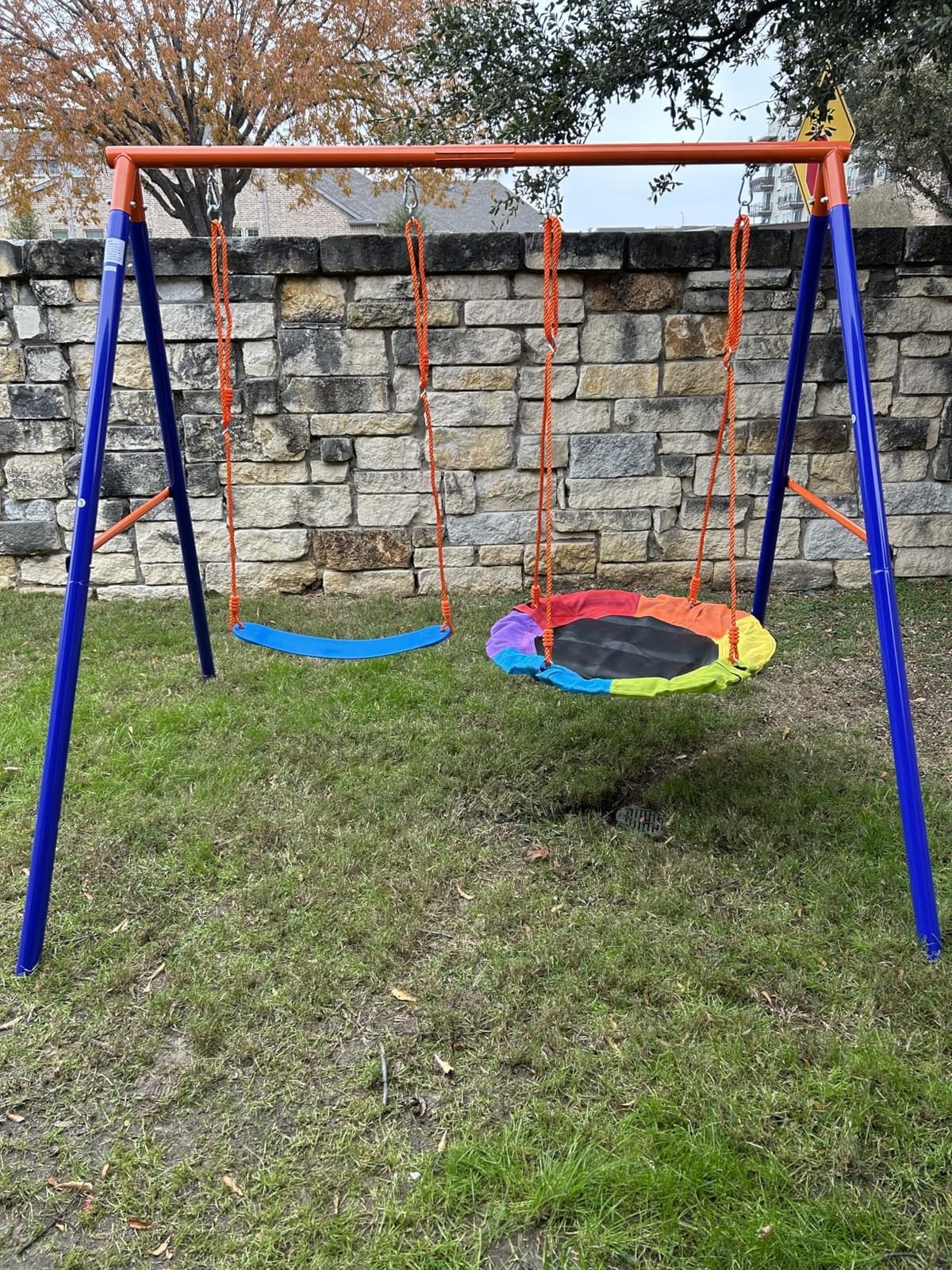
The trade-off that matters most here is height. Owners praise the low seat height for toddlers and note the short swing height means children outgrow it around ages 6 to 8. That is a feature in a household with a two-year-old and a five-year-old, because both can use the set on day one, and a limitation if you are buying for a nine-year-old.
Several owners also mention HOA yards with height restrictions, which is a nice secondary benefit. The whole frame stands 72 inches tall, so it stays under the sightline rules that some neighborhoods apply.
The finish is lacquered with anti-rust paint, and the most common complaint is that the glossy finish and orange paint fade after a month or two of sun and rain. Expect a color change, and treat the frame as functional rather than decorative. A powder-coated frame holds its color noticeably longer, which is the main reason to choose one when appearance matters to you.
One more positive note: owners report that the seller replaced worn metal connectors when contacted. That kind of response matters for a metal product where connector wear is the first thing to show up after a season of heavy use.
Assembly takes about an hour and needs no tools, but owners flag that the nuts and bolts look nearly identical, which makes the build confusing the first time. Sort the hardware into labeled groups before you start, and follow the part order in the manual rather than the pile order. The frame is also easy to move solo, which is unusually helpful in a small yard where the set may need to move for mowing.
440 lbs total capacity
120 lbs per seat
60.6 x 122.8 x 72.8 inch frame
Three activity positions
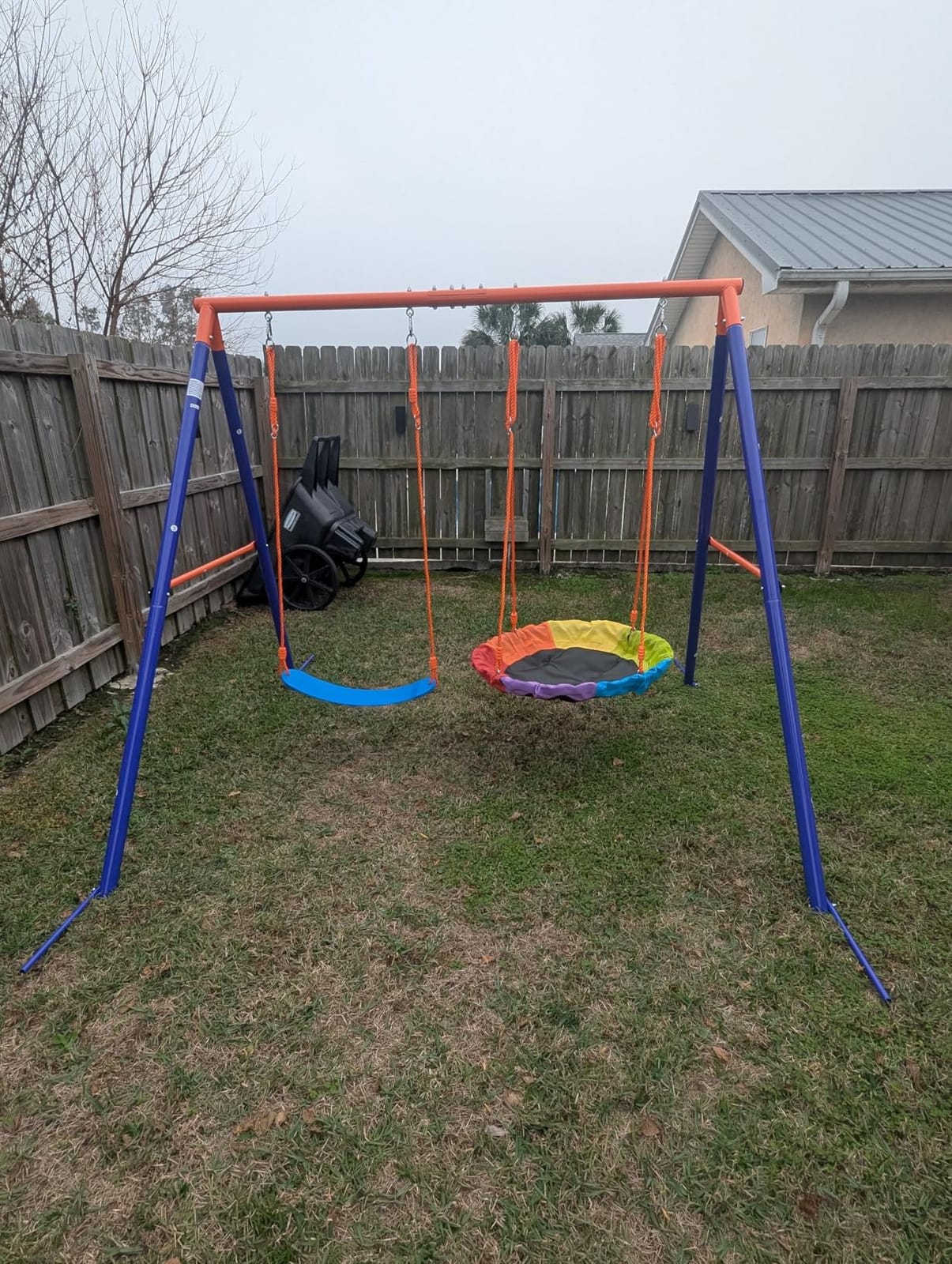
This is the only set here with four usable positions, and that changes the math for busy families. It carries two separate seats plus a glider attachment, rated at 120 lbs per seat and 440 lbs across the frame, and it includes a U-shaped toddler seat with footrests and a harness under the glider. Parents of mixed ages mention the harness as the reason they feel comfortable leaving a younger child on it unsupervised.
The catch is width. At 60.6 inches deep by 122.8 inches wide, it needs roughly a 7 by 12.2 foot clear area, which is the largest footprint in this roundup. In a small yard that is a real commitment, and it is the first thing to check before anything else on this set.
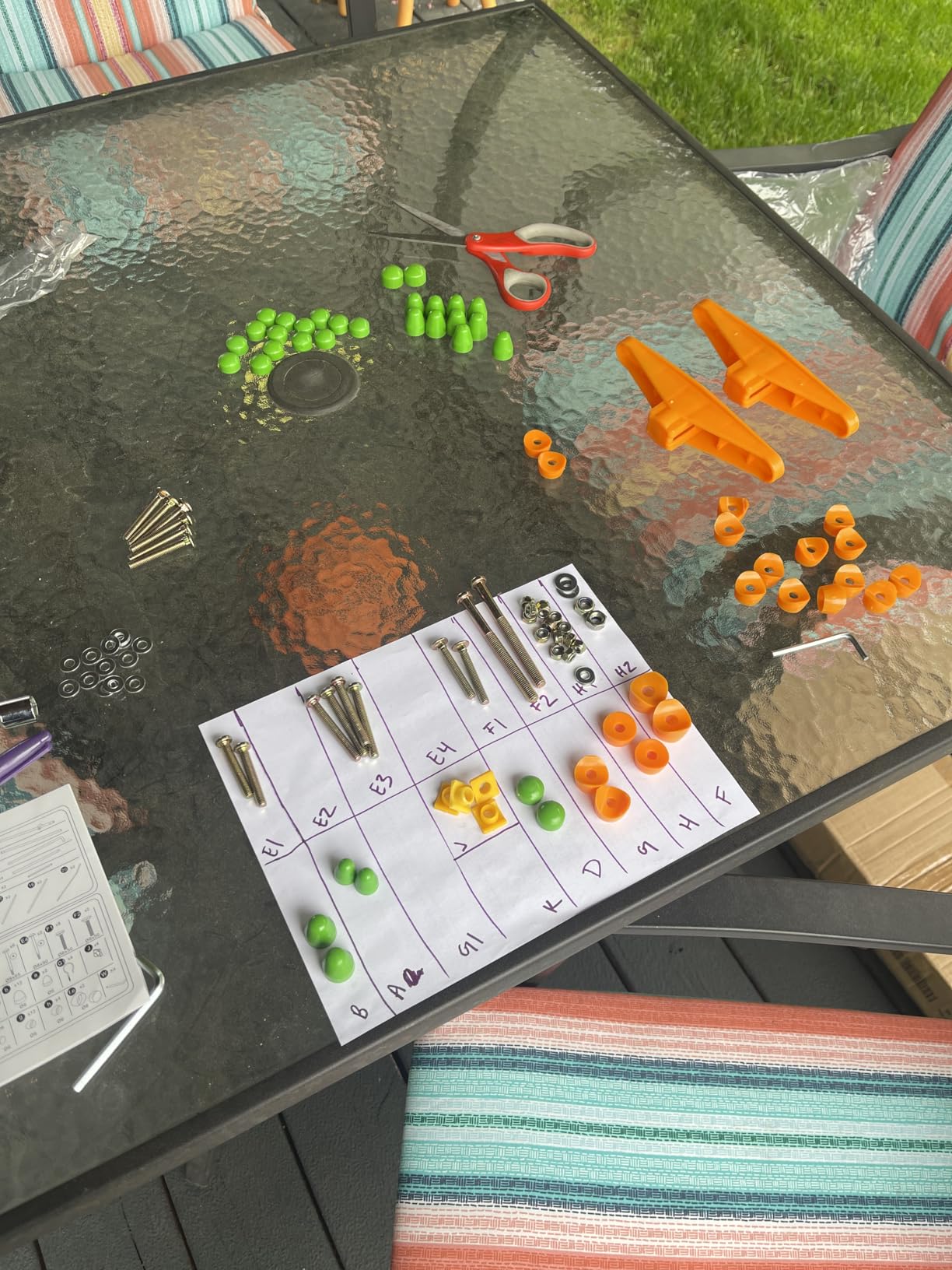
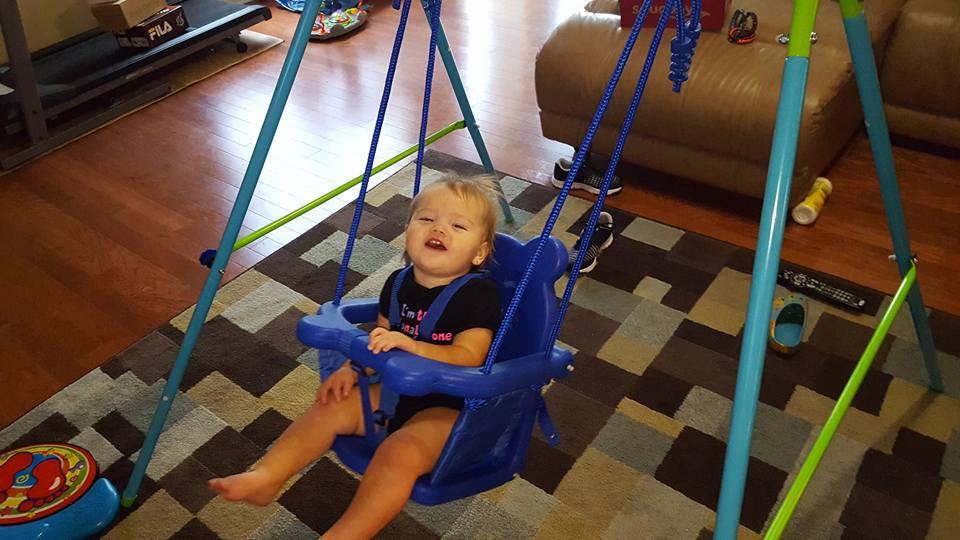
Owners report quick assembly, often around 15 minutes, with numbered and labelled parts, and several say the set is compact enough to use indoors on hot days or in a small yard. Against that, reviews note the base can rock when used by a three-year-old and that joints can feel loose and begin to bend under heavier children. With 440 lbs across four positions, each child should be well under the 120 lbs per-seat figure for the frame to behave.
The triangle structure with ground hooks adds stability compared with a plain A-frame, so anchoring matters less here than on the two-seat sets, though the same anchor guidance applies. If you are using it on a hard patio surface, a grip mat underneath the feet is a small addition that helps.
A three-activity layout earns its width when you have regular visitors, siblings with a large age spread, or a child who tires of a plain swing. Two seats plus a glider means one child can swing, one can ride the glider, and a toddler can be strapped into the bucket position without competing for the same hardware.
It is the wrong call for a family of two in a very tight lot, because the extra 3 feet of width over the compact two-seat sets translates to 6 extra feet of total clearance. Measure your usable rectangle first, and if the answer comes back under 12 feet wide, this set is out.
Some units arrive with missing hardware and mislabelled parts bags, which is the most common complaint in this set’s reviews. Open the boxes and count the parts against the manual before you start building, because discovering a gap after the frame is up means partly dismantling it. The included tools are a genuine plus for a set in this tier.
500 lbs total capacity
110 lbs per swing
67.3 x 110 x 70.8 inch frame
32 inch saucer plus two belt swings
This set carries 500 lbs across the frame with a stated 110 lbs maximum per swing, and most owners report it handles adults and older kids alongside young children. Two of the sets in this roundup reach 500 lbs and 550 lbs, which is the range the 440 lb frames cannot cover. That is why this one is worth the extra width for a household where a parent uses the swing with a child.
The frame uses 2-inch powder-coated steel tubes, and reviewers describe the tubing as thicker and sturdier than expected for a set in this class. Dimensions are 67.3 inches deep by 110 inches wide by 70.8 inches tall, so budget a clear area of about 7.6 by 11.2 feet.
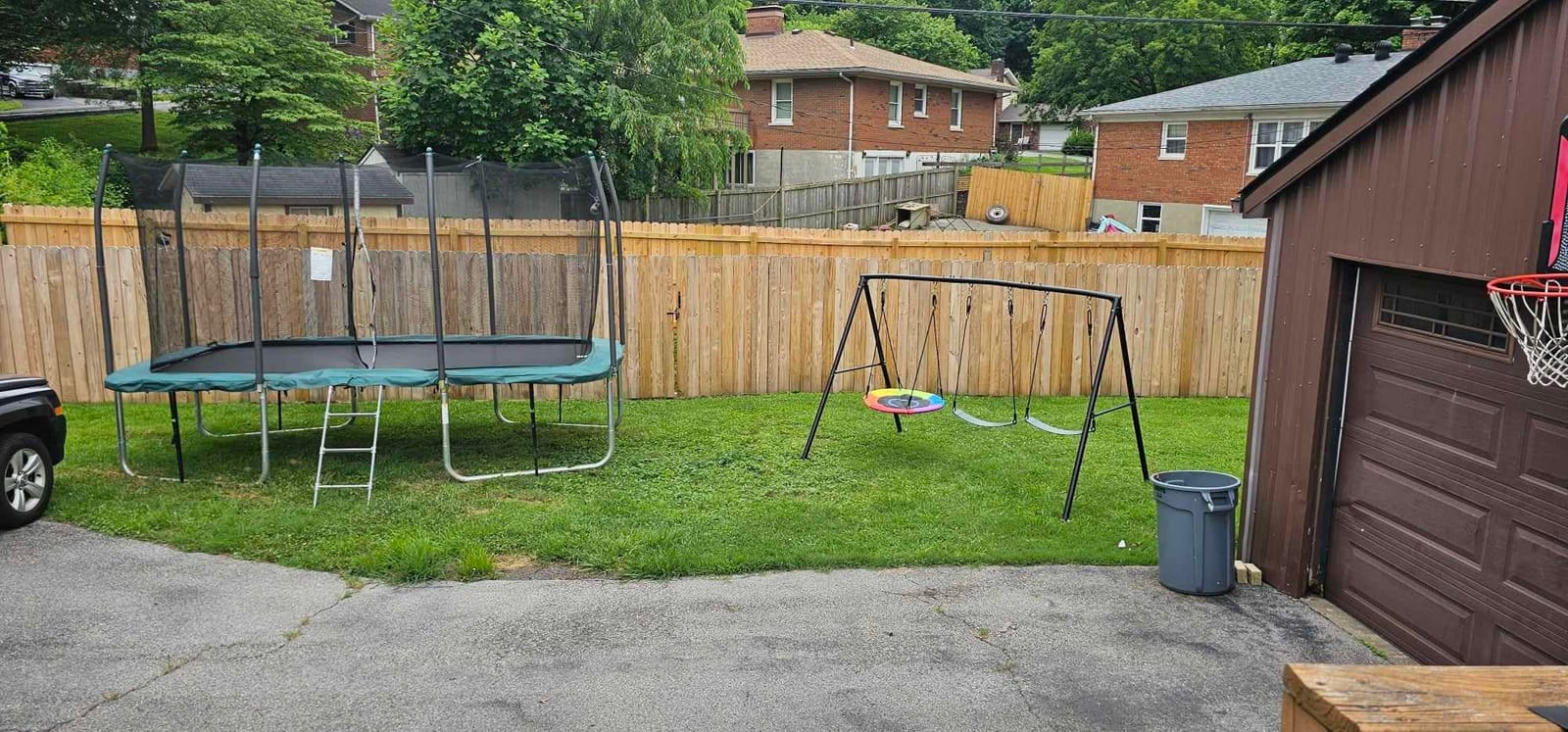
Three swing positions on a 110 inch beam means the seats sit closer together than on a two-seat set, and that shows up in reviews as tight spacing between seats and a feeling that the belt seats are small for children under 6. Owners also note the swings sit low. If you have a four-year-old and a twelve-year-old, this is workable. If you have three children all under six, the two-seat sets serve better.
The belt swing uses PE rope on an EVA seat to protect hands, and the seat height is adjustable. That combination lets a parent lower the seats in summer and raise them as the children grow without swapping hardware.
A higher capacity does not mean a bigger frame, and it does not mean the set is rated for adults jumping from the top bar. What it means is that the tube gauge and joint hardware are built for heavier loading, so an adult plus a small child on the same swing is within the envelope. Weight capacity claims across this category are laboratory figures, and treating them as a reason to skip supervision is the wrong read.
For joint longevity, check the bolts at the two leg-to-beam connections every spring, and look for any paint blistering at those joints, which is where stress shows first.
Two practical notes from owner feedback. The included ground stakes have sharp ends that stay exposed and bend easily, so cap them or drive them fully and check them before the first play session. And the black powder coat can arrive with scratches that need touch-up, which is normal with dark finishes. The black colorway does blend into landscaping well, which several owners specifically liked.
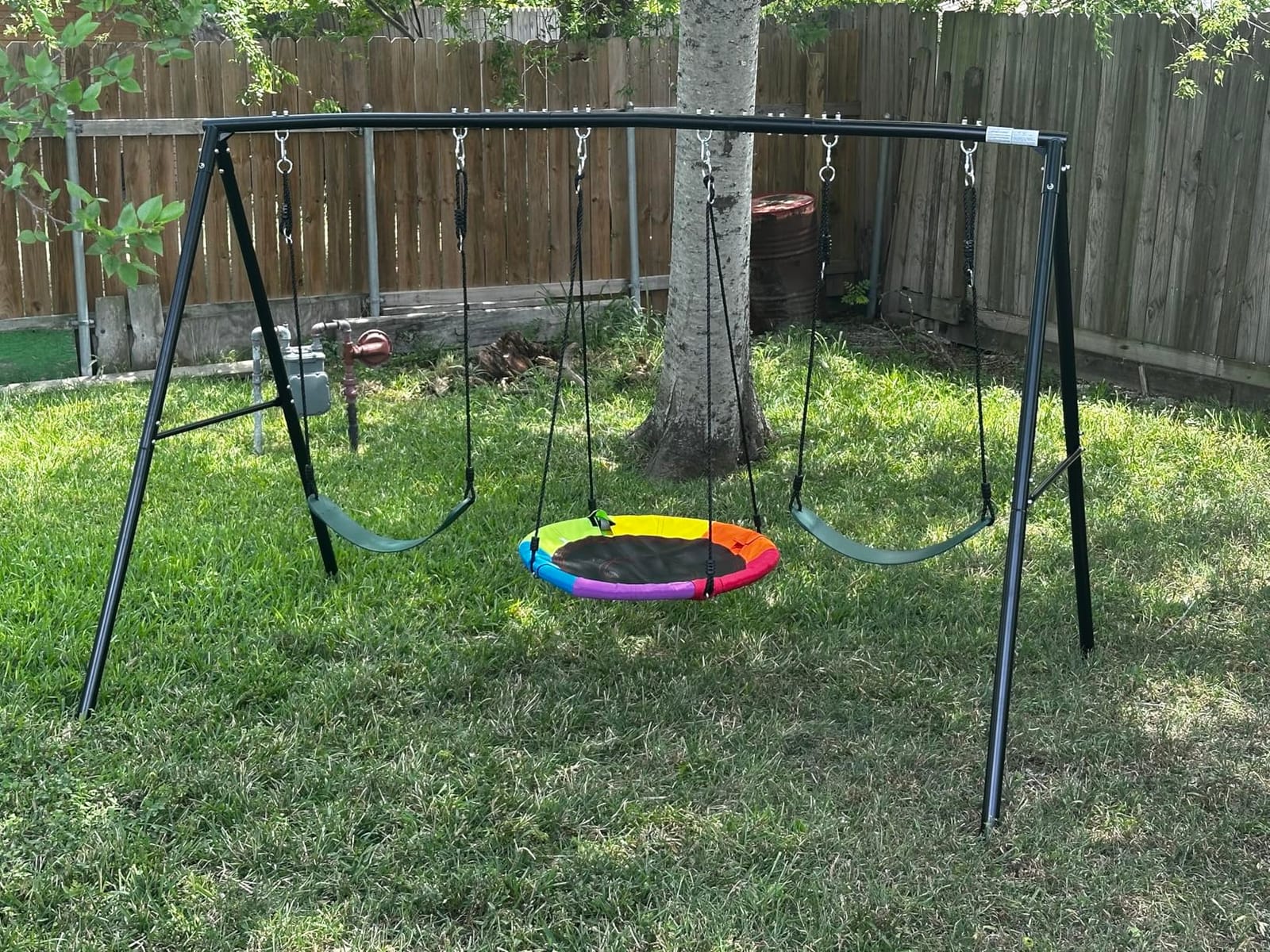
This set meets or exceeds ASTM safety standards, and four ground stakes are included, so the compliance and the anchoring hardware are both accounted for in the box.
440 lbs capacity
65.8 x 86.6 x 69.7 inch frame
45 x 32 inch platform swing plus belt swing
4 spiral ground stakes
The reason this set is interesting for a small backyard is the swing type rather than the frame. A 45 by 32 inch platform swing with a belt strap holds a toddler flat and steady without a bucket, which means a child under three can swing independently while an older sibling uses the belt seat next to them. The 4.6 owner rating reflects that arrangement working as intended.
The frame is 65.76 inches deep by 86.61 inches wide and 69.69 inches tall, so the total clear area lands at about 7.5 by 9.2 feet. The wider side stance and four spiral ground stakes are the stability answer, and owners report that the anchors attach easily.
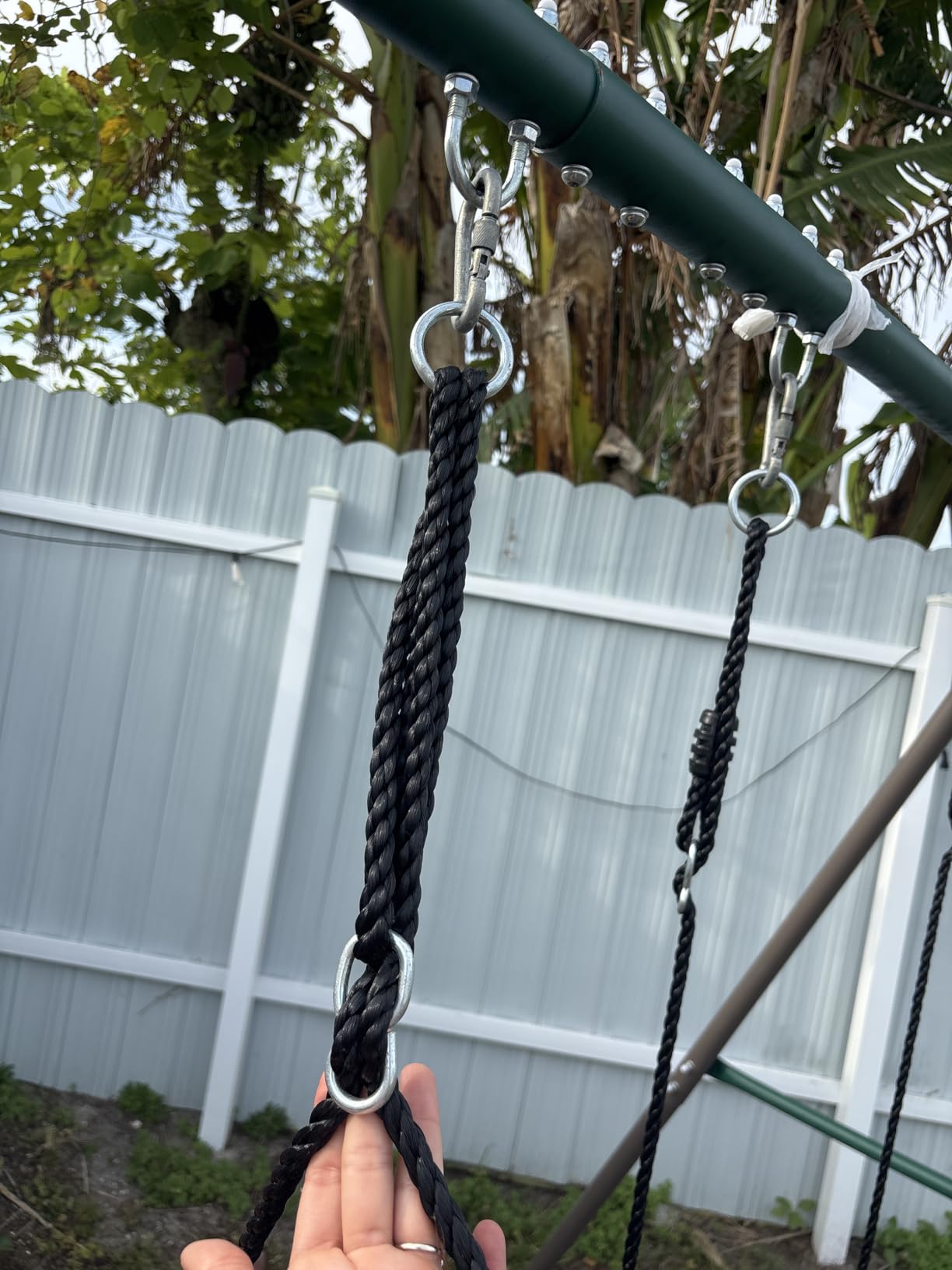
A platform swing holds a toddler with a belt rather than a molded bucket, and it is lighter than a bucket seat. The trade-off is that the restraint is a strap rather than a shell, so it suits a child who can already sit steadily. Owners describe the frame as holding up with daily use, and the green and brown powder-coated colorway blends into a backyard better than bright primary colors.
Seats can be swapped for other accessories, which means this frame can change purpose as the family changes. A frame whose seats you can change out is a longer-lived purchase than one fixed to a three-seat layout.
This is a 47 lb set, light enough that owners note it shifts if moved without removing the anchors first. In a small yard that is both a benefit and a hazard. It is easy to reposition for mowing, and it is easy for a child to shove sideways if it is not staked. Always remove the stakes before moving the frame and reinstall them afterward.
Powder-coated tubes resist rust and need no daily maintenance, which is the recurring advantage of a coated frame over a painted one. Wipe the tubes with a damp cloth in spring and check the coating at the ground line, where soil contact is highest.
Owners note that older siblings may find the swing height modest. The frame tops out at 69.69 inches, so a taller child gets a lower arc than they would on a full-size playset. In a small yard this is the correct compromise, because the trade is a shorter swing height for a footprint that leaves you real lawn.
440 lbs capacity
67.3 x 110 x 70.8 inch frame
2 inch powder-coated steel tubes
Three adjustable swing heights
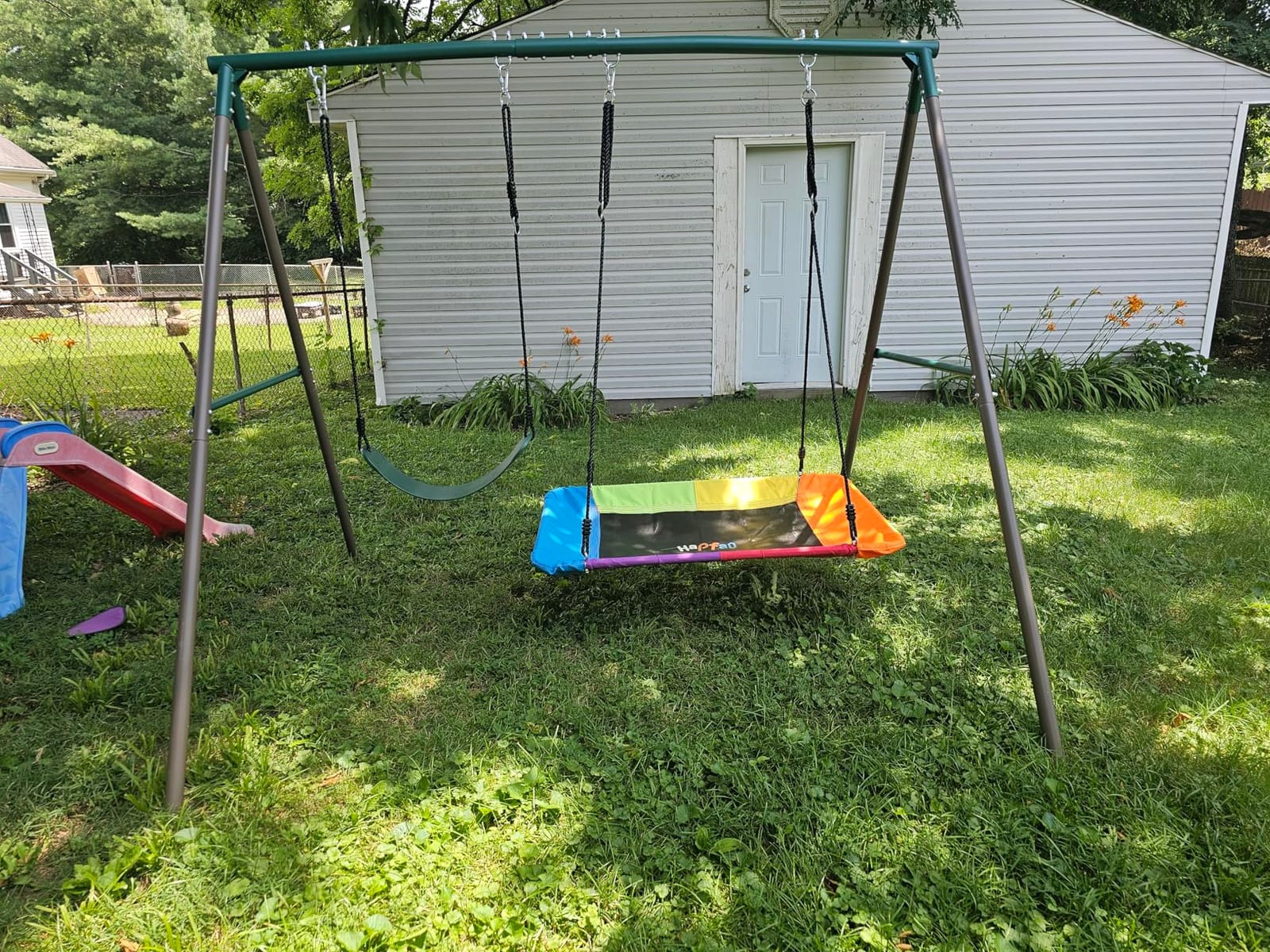
This is the most complete swing configuration in a compact metal frame, with three separate stations: a toddler seat, a platform swing and a belt swing. Each height is adjustable, and the carabiner design lets seats be replaced rather than rehung. Buyers highlight the sturdy 2-inch steel frame and the fact that three swing types keep toddlers, older kids and adults all occupied at once.
It is also the heaviest set we covered at 60 lbs, and it shares the 110 inch width of the other three-seat frames, so the clear area is about 7.6 by 11.2 feet. Treat those two numbers as the deciding factors before you fall for the three-swing layout.
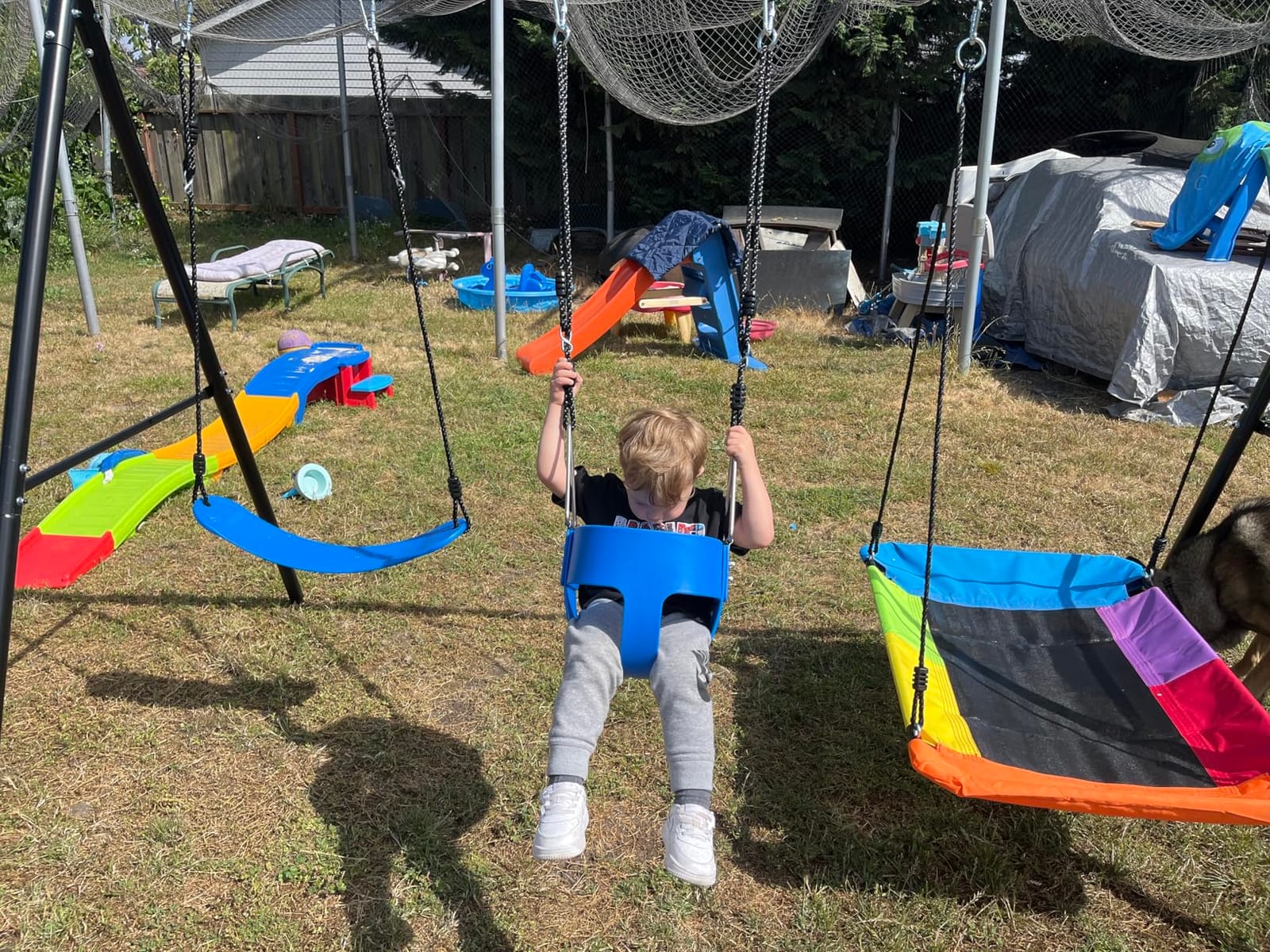
Going from a 1.5 inch tube frame to a 2 inch tube frame changes three things you can feel. The frame deflects less at full swing, which reduces the wobble older children notice. The joints carry more load before loosening. And the set stays planted, which matters on a lawn where the legs sit close to a used path.
The manufacturer lists this set as meeting or exceeding ASTM safety standards with CPSC safety compliance. Tools and pre-drilled components are included, and the manufacturer age range is 0 to 12 years. The soft PE ropes on the seats protect little hands from pinching.
Three adjustable swing heights is the feature that extends this set’s usable life. A toddler seat set low in year one becomes a platform swing raised in year three, and the belt seat moves up as the oldest child grows. On a fixed-height set, the youngest child stops being able to use it and the oldest outgrows it at the same time.
Plan the setup so the toddler station is on the end with the most clearance, since a bucket or platform seat on the outside of the frame needs no running clearance at all. The belt and platform seats want clear air fore and aft.
This frame is the heaviest of the ten, and it shares the 110 inch width with two other sets. A 60 lb frame is difficult to reposition around a yard alone, and at 110 inches wide it takes up a lot of lawn. In exchange you get the most swing variety and the least joint movement under load.
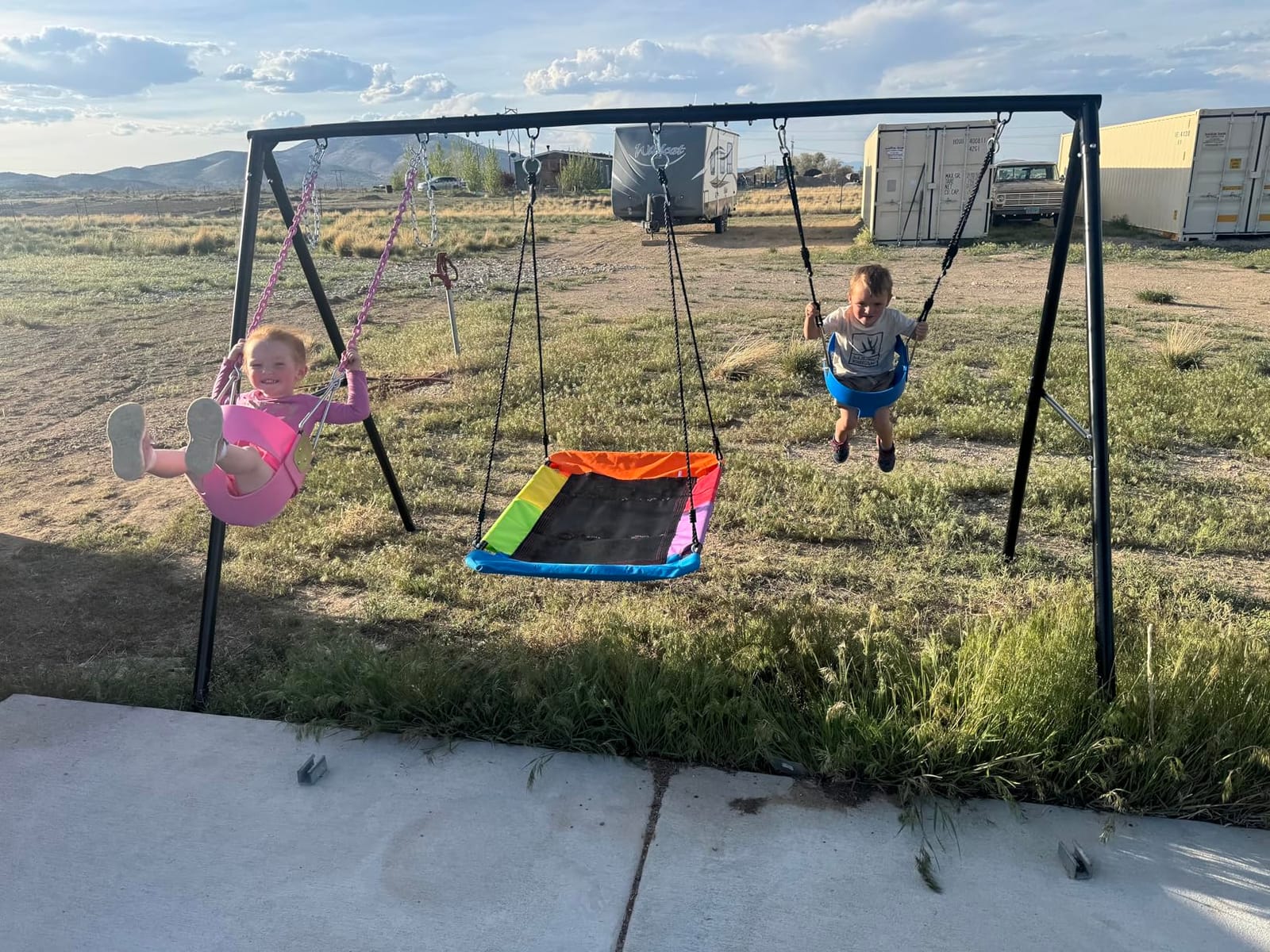
550 lbs capacity
73 x 76.5 x 71 inch frame
1.5 inch iron tube A-frame
4 ground stakes included
This is a stand rather than a set, and that distinction makes it the most flexible option here. The A-frame uses 1.5 inch diameter iron tube, and the 550 lbs figure is the highest stated capacity in this roundup. The universal loops accept net swings, saucer swings, patio swings and even a yoga belt. Owners commonly use it as an add-on, or as a stand upgrade over a lighter frame they already own.
At 73 inches deep by 76.5 inches wide and 71 inches tall, the clear area comes to about 8.1 by 8.4 feet. The base is wider than most small stands, and reviewers note the roomier feel compared with narrow two-seat frames.
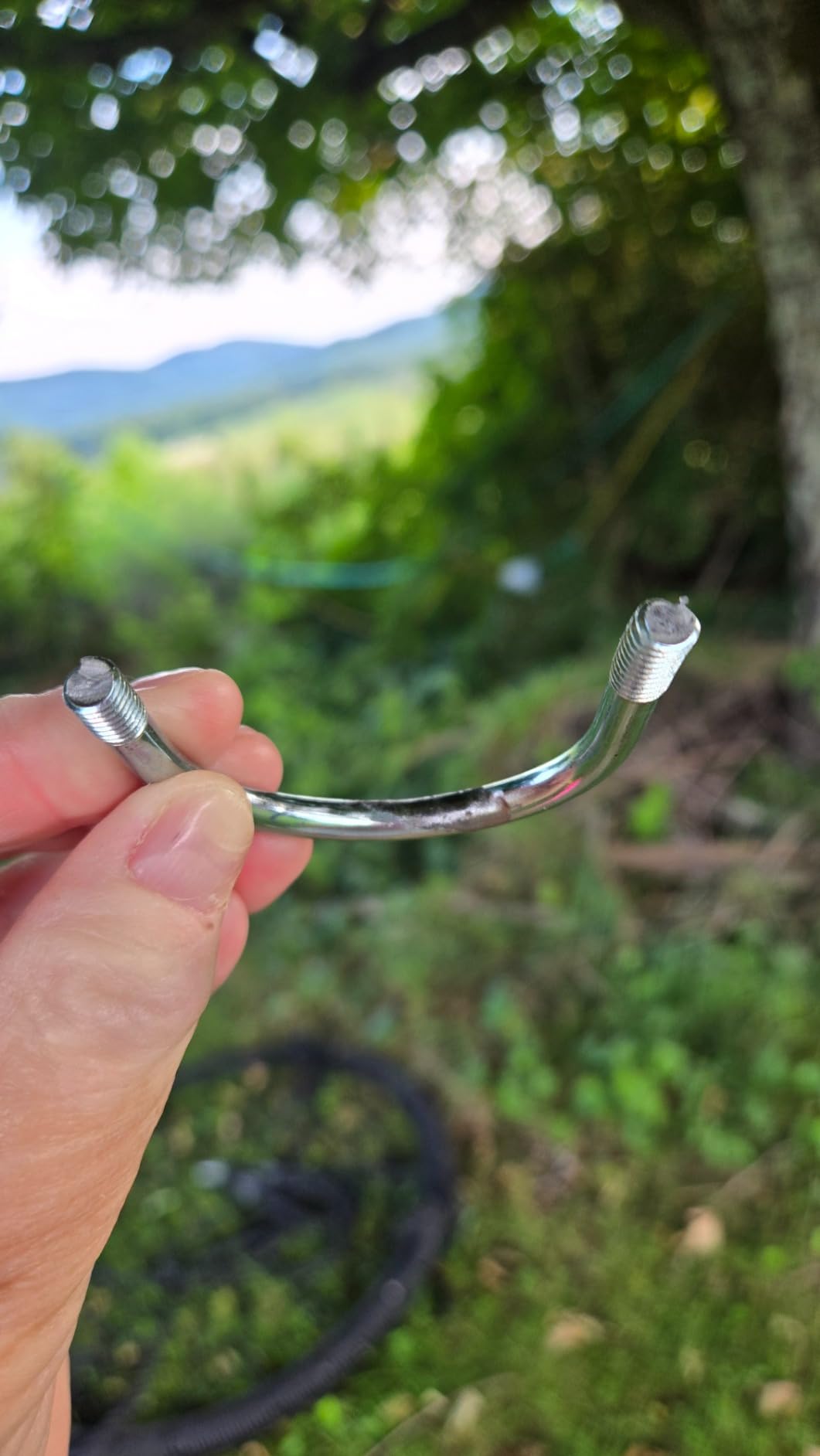
Buy this if you already own a saucer swing, a net swing, or a replacement seat whose chains are in good shape, and you want a heavier stand than your current one. It also makes sense for teens and adults who want a single heavy swing rather than a children’s set, since 550 lbs is the figure that supports that use case.
If you are starting from nothing, you will need to source a separate seat, and check that the swing you pick uses chains or loops rather than a rigid top bar, because universal loops will not accept every attachment. The included hardware and tools make the frame build itself straightforward.
The finish is painted with an anti-rust coating rated for all-weather outdoor use, which is a slightly different approach from a powder coat. Paint on a 1.5 inch tube is thinner, so inspect the frame annually at the ground line, where the tube enters the soil and stays wet longest.
Owners also note the adjustable rope length has no height limit, so seat placement needs measuring before you hang anything. Measure the seat height your child needs, subtract from the beam, and set the ropes once. All tools and hardware are included, and four ground stakes come in the box for anchoring into grass or soft ground.
A 550 lb rating is a load figure, not a safety certification. Metal A-frames of this size are used by adults in backyards every summer, and they perform, but the swing arc still needs clear ground in front of and behind, and a single adult on a narrow stand should stay within a modest arc. Our own rule for adult use is: one rider at a time unless the set is rated for more, and a clear run of ground of at least twice the seat height in both directions.
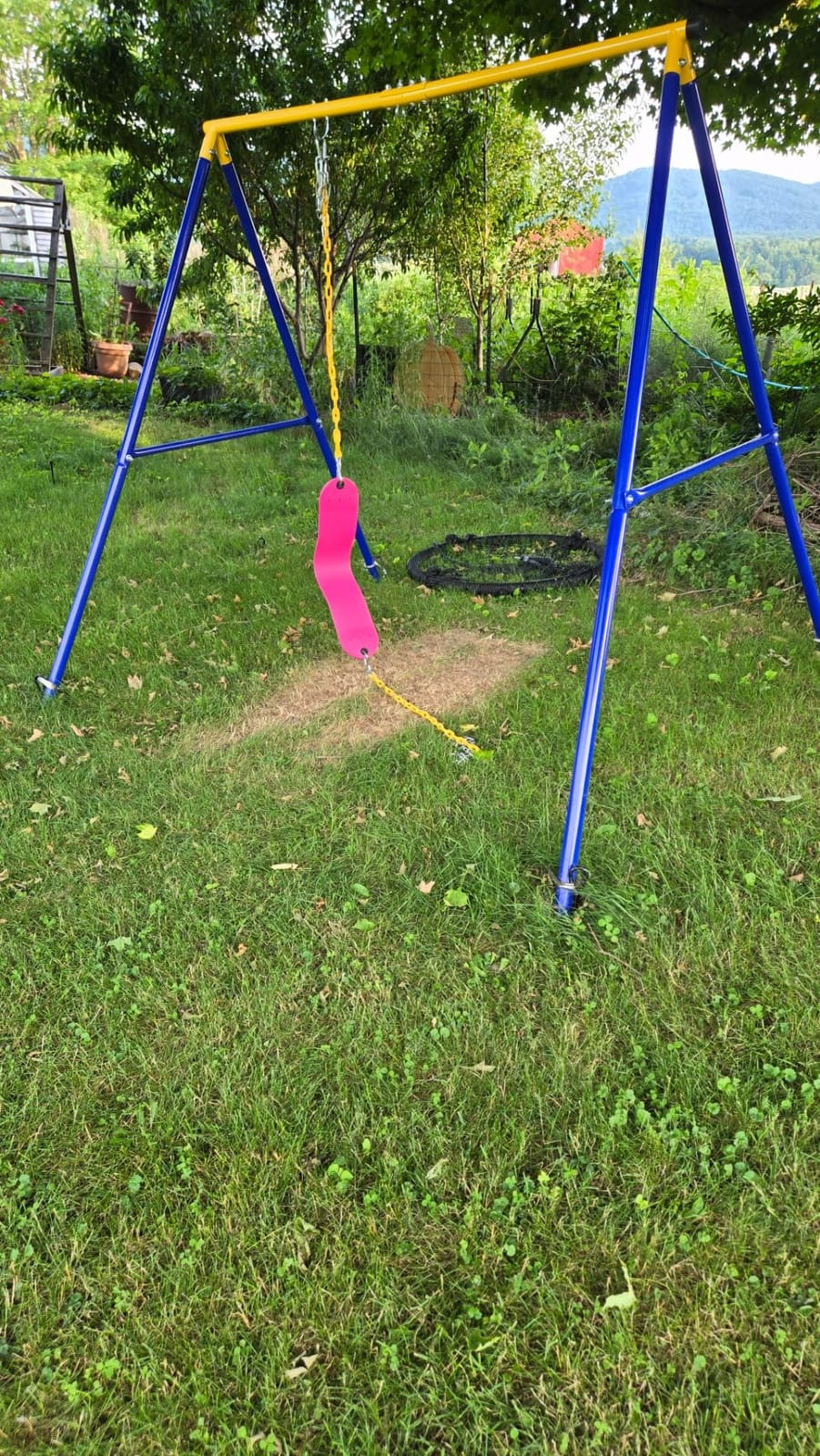
440 lbs capacity
85 x 55 x 72 inch frame
55 inch narrow width
32 inch saucer plus adjustable belt swing
If your yard is wide but shallow, or fenced on three sides, this is the set that solves the problem. The 55 inch width is the narrowest of any frame here, giving a total clear width of about 6.6 feet, which is close to the theoretical minimum for a safe swing zone. The depth is a generous 85 inches, so the set uses a long, narrow strip of lawn rather than a square block.
Owners focus on exactly that: the narrow design works for smaller backyards, the belt swing adjusts with a safety handle so it grows with the child, and the frame has an anti-rust, anti-corrosion coating. The manufacturer age range is 36 months to 12 years.
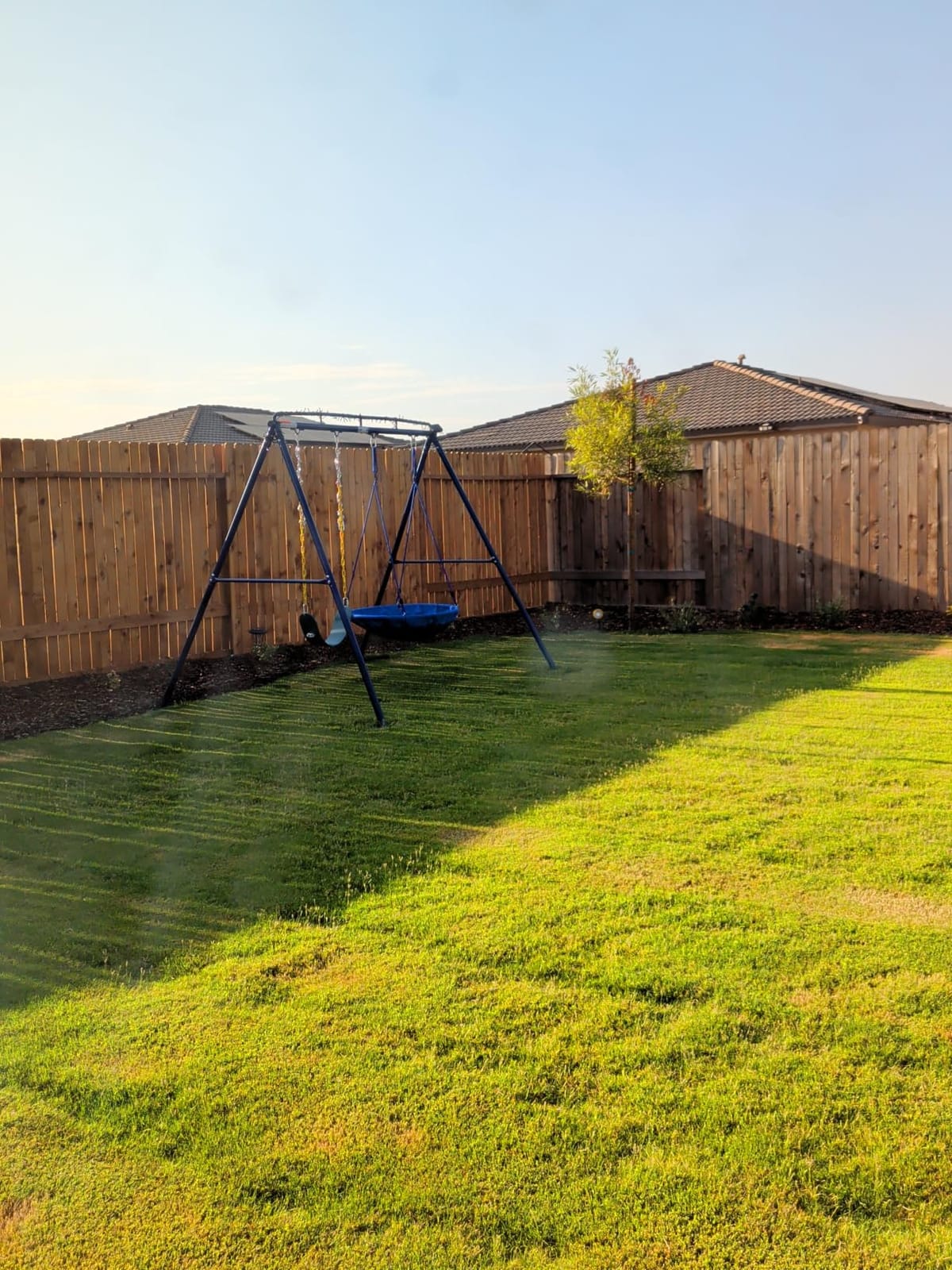
Compact A-frames achieve their narrow width by making the beam long and the legs close together, so the swing run sits in the depth direction. The 32 inch saucer seat lets two to three children ride together, and the high-density textilene seat is UV resistant with galvanized chain. That combination is durable for year-round outdoor use.
The safety handle on the belt swing is a small feature with real value. It gives a younger child something to hold while an older child pushes, and it is the reason several owners describe the belt as usable from the toddler years upward.
The manufacturer recommends cement anchoring for this set, which is a stronger instruction than most sets in this class carry. If you rent, or you want to keep the option of moving the set, use a ground anchor kit with packed gravel instead, and note that a 36 lb set is light enough to reposition once the anchors are out.
A fair share of one-star reviews concern damage in transit and finish wear, so inspect the frame and coating on arrival and photograph any dents before assembly. Powder-coated frames survive a scuff better than painted ones, but a bent tube still needs replacing.
Think of this set as a strip rather than a square. It suits a side yard, a fenced corner, a narrow back lot, or a yard where a fence, a shed or a raised patio already limits one direction. It is the wrong shape for a yard that is deep and open, where a squarer frame would leave more usable grass.
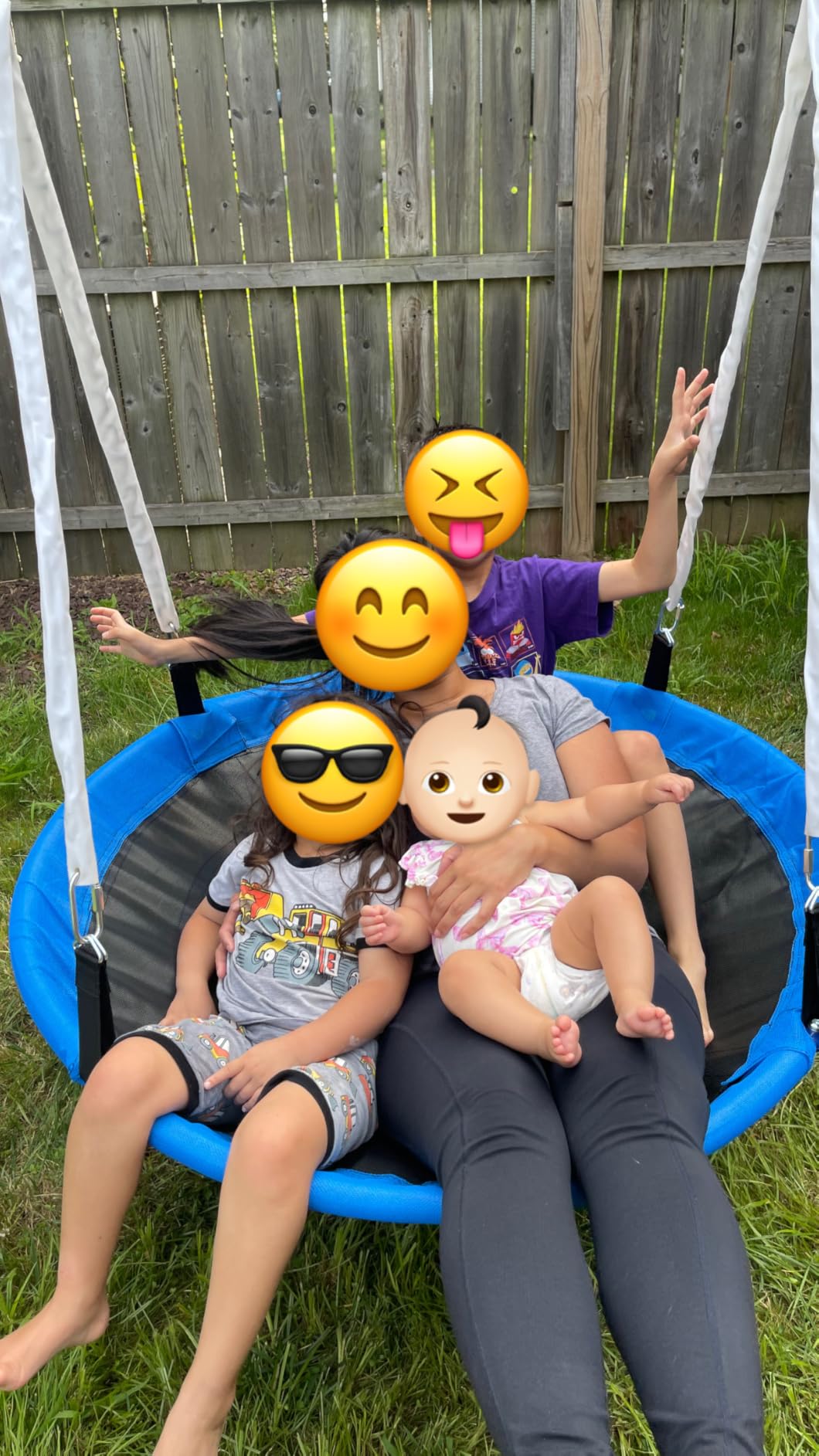
396 lbs overall capacity
55 x 110.25 x 70 inch frame
Two seats plus glider
ASTM F963 and CPSIA certified
The distinguishing feature is the glider attachment, which turns a two-seat set into a shared-ride toy. Owners like having more play options than a plain two-seat frame, and the adjustable hanging rope height means the seats can suit different ages without tools.
It carries the ASTM F963 and CPSIA certification stated on the listing, and at 41.8 lbs it is light enough to move around a yard without help. The trade-off is the rating: at 4.1 with 239 reviews it sits lowest of the ten, and the rating spread includes a higher share of one-star feedback than the other sets here.
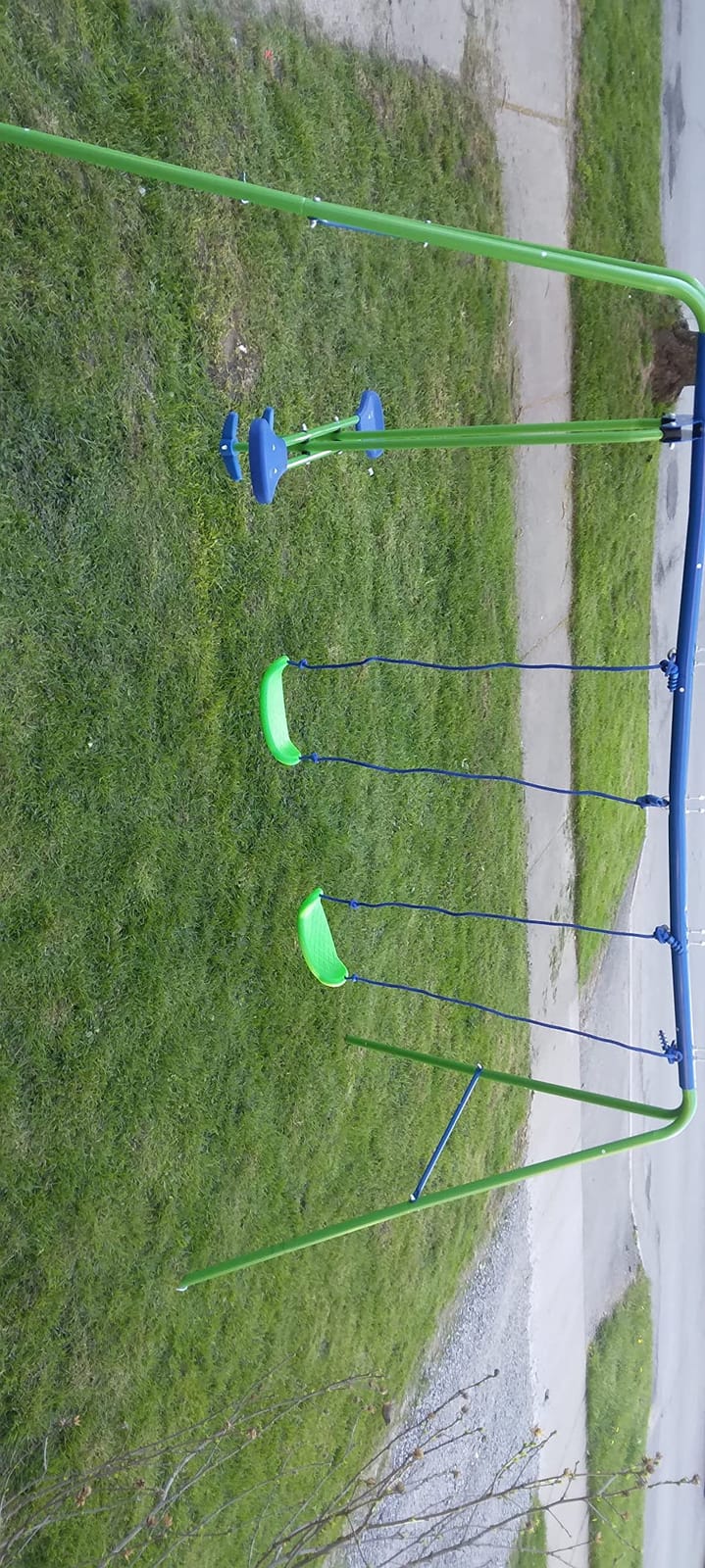
A glider seat is best for two children of similar age who want to ride together, and it is a poor choice for a large age spread because the seat is fixed and shared. If you have one child under five and one over nine, the three-station sets or the two independent seats serve better. If you have two children within about two years of each other, the glider becomes the most-used seat on the set.
The overall capacity is 396 lbs across the frame, and the four metal poles with crossbars form an A-shape for stability. The individual seat size is 13.75 by 6.75 inches, which is where the small-seat complaints come up for older children.
At 110.25 inches wide and 55 inches deep, the set is wide and shallow, so the clear area is roughly 6.6 by 11.2 feet. That is the same depth advantage and width disadvantage as the JYGOPLA, and the same rule applies: measure the usable rectangle, then pick according to which direction you are short on.
Owners report that the base can feel less settled than the sturdier sets, and that stability complaints are the main driver of the lower average rating. Anchor it properly before first use, and check the legs after the first heavy week, because a glider concentrates swinging force at the ends where the seats hang.
Skip it if your priority is a long service life, a heavy frame, or swing capacity for adults. At 396 lbs total and a 4.1 owner rating with a wider spread of complaints than the rest of this group, it is the pick to make when a shared glider seat matters more to you than frame gauge. The two-seat sets in this roundup rate higher and hold up better over time.
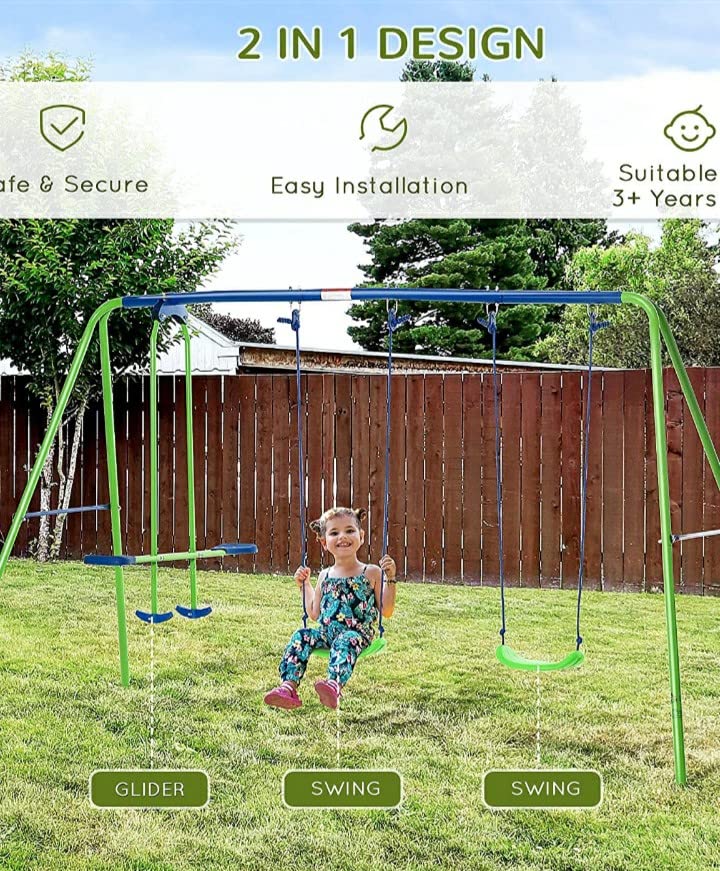
Once you have the usable rectangle measured, the rest of the decision is a short list of trade-offs. These are the ones that actually change which set ends up in your yard.
A multi-activity set that does not fit is worth nothing in your specific yard, while a two-seat A-frame that fits leaves room for a trampoline, a garden bed or a second swing later. Judge every set by the clear area it demands, which is the frame plus 12 feet in each direction, and treat any listing that does not publish dimensions with suspicion.
Width is the number that decides most purchases because yards are usually constrained on two sides by fences. The 55 inch frame is the most forgiving, the 86.6 inch frames are a reasonable middle, and the 110 inch three-seat sets need a genuinely open rectangle.
Powder coating is a dry finish baked onto the tube and it holds color and resists rust better than paint. Painted or lacquered frames are simpler to touch up, but owners report visible fading after a month or two of direct sun and rain. On a set that will sit in full sun all day, powder coating is the finish to look for.
Chains and seat fabric are the parts that fail first regardless of the frame finish. Zinc-plated or galvanized chains resist rust; plain steel chains do not. Wipe seats dry in spring, and check the fabric pockets for rust from the inside, which is the single most repeated complaint across the sets here.
Steel fails at the ground line first, because that is where the tube is half-buried, permanently damp, and touching alkaline soil. A ground anchor kit with packed gravel lifts the joint slightly and lets you drain water, and it keeps the set removable, which matters for renters and for repairing a lawn. A concrete pour is stronger and is what the JYGOPLA manufacturer recommends, but it is permanent and it traps moisture against the tube.
If you notice rust early, clean the spot, dry it, and coat it with a rust-inhibiting paint before it spreads under the coating. One user on a DIY forum reported anchoring in concrete only to watch the metal deteriorate at the base, which is the failure mode to plan around rather than the reason to pour more concrete.
A swing fall zone needs a surfacing material that absorbs impact, and on a small lot the surfacing competes with your clearance. Rubber mulch and engineered wood fiber work best in a loose-edged bed about 7 to 9 feet in the swing direction, and they can be contained with a low border. Pea gravel and pavers need more depth and more area but never need topping up.
On bare compacted grass, you can still use a set, but the ground gets hard by midsummer and the fall surface gets worse each year. Since several sets here arrive with ground stakes and are moved once or twice, plan a surfacing approach you can reassemble with the set rather than a poured pad you cannot move.
Dark powder-coated steel and plastic slides reach uncomfortable temperatures in direct sun, and a metal frame concentrates heat on the places a child grips: the top beam, the chains, the slide entry. Safety guidance for swing set placement calls this out explicitly. Place the set where it gets shade by early afternoon, or add a shade sail or a canopy on four posts over the swing zone.
A shade structure is also the simplest upgrade on this list. It keeps the seat fabric cooler, cuts fading on the finish, and creates a spot children will actually use during the hottest hours, which is when a bare metal frame is at its least inviting.
Reported build times range from 15 minutes for the simplest three-position frame to about an hour for a compact two-seat set, and 90 minutes to two hours for the three-seat frames. Add an hour for leveling and anchoring, and plan a full day for anything wider than 90 inches.
Level before you build, not after. Sets that arrive unlevel and then get re-dug after a long build are a recurring regret in owner feedback, and a set installed on a slope racks the joints until it fails there. If you are not confident with a level and a spade, a couple of hours of labor before assembly is easier than a rebuild.
Saucer swings appeal to children who like to lie flat and can take a wider seat. Belt swings suit children who want a faster, more conventional arc and are the easiest to adjust as a child grows. Platform and bucket swings keep toddlers stable, either with a belt harness or a molded seat with footrests. A glider is a shared ride for two children of similar age and nothing else.
Our rule of thumb after working through these ten: a two-seat set covers most households from about age 2 to 8, a three-station set extends that to 12, and an adult using the set alongside a child is what makes a 500 lb frame worth the extra width. If you rent, check your lease and local noise rules before a set goes in, since tightly packed lots are where complaints originate.
For the rest of your yard planning, our snake repellent guide and deer feeder guide cover the other pieces of outdoor equipment that compete for the same limited space.
A compact powder-coated steel A-frame is usually the best type for a small backyard, because a two-seat design fits inside roughly a 7 by 9 foot clear area once you allow 6 feet of safety clearance on every side. Add a slide only if the extra 2 to 3 feet of depth does not push the total past your usable rectangle.
Total space equals the set footprint plus 12 feet in each direction, because safety guidance calls for at least 6 feet of clear space around all sides of the equipment and more in front of and behind the swing arc. A frame listed at 60 by 80 inches therefore needs a clear area of about 7 by 8.7 feet.
Metal swing sets are good for small yards for three reasons: the frames are narrower than wooden playsets, the powder coating resists rust with no annual staining, and the joints are rated for higher loads. The trade-offs are that dark steel and slides get hot in direct sun, the finish fades over time, and the metal corrodes at the ground line if it is not anchored well.
The top-rated compact metal sets in this roundup are the Trekassy 440lbs A-frame at 4.5 stars from 1,499 owners, the Amictoy 440lbs set at 4.6 stars from 354 owners for toddler use, and the Hapfan double tree swing set at 4.6 stars from 103 owners for mixed ages. Rating alone is less useful than checking the published footprint against your clear area.
Drive the included ground stakes or a dedicated swing set anchor kit at each leg, then backfill and pack the hole with gravel or compacted soil rather than leaving it loose. Check that the frame is level before tightening, and re-check the anchors after the first heavy week of swinging. Concrete anchors hold best but make the set permanent and can trap moisture at the ground line.
Measure first, then buy. Once you know the usable rectangle and the 6-foot perimeter rule, the pick is nearly automatic for most households.
If you want the strongest all-round combination of a narrow footprint, adjustable hardware and a large body of owner feedback, the Trekassy 440lbs set is the one to buy. If depth is your binding constraint, the Lunafun at 59.6 inches deep is the shallowest frame we covered. If width is the problem, the JYGOPLA at 55 inches wide is the only set here that fits a truly narrow strip of lawn.
For a household with a toddler and an older child, the Amictoy fits low seat heights and the Hapfan double tree set keeps a preschooler occupied on a platform swing without a bucket. Families who need four riding positions at once should look at the HLC, provided the width measures out. If adults will use the set with a child, the Hapfan 3-seat frame at 500 lbs is worth the extra space, and the Costzon stand at 550 lbs is the flexible choice if you already own the swings.
Two final points before you commit. Anchor the set properly on the day you assemble it, because almost every stability complaint in owner reviews traces back to skipped anchoring. And if your clear area is in full sun, add a shade sail early, since hot dark metal is the one metal-specific safety issue that a buyer cannot fix after the fact.
Measure the ground, pick from the list that fits, and check the current listing for the model you choose before ordering.