Physical Address
304 North Cardinal St.
Dorchester Center, MA 02124
Physical Address
304 North Cardinal St.
Dorchester Center, MA 02124

Best lawn sweepers for leaves come down to two questions: how big is your yard, and do you already own a riding mower to pull a tow-behind behind? Pick wrong and you end up with a machine that collects faster than a rake but stores badly, or a heavy steel attachment with no tractor to hang it on.
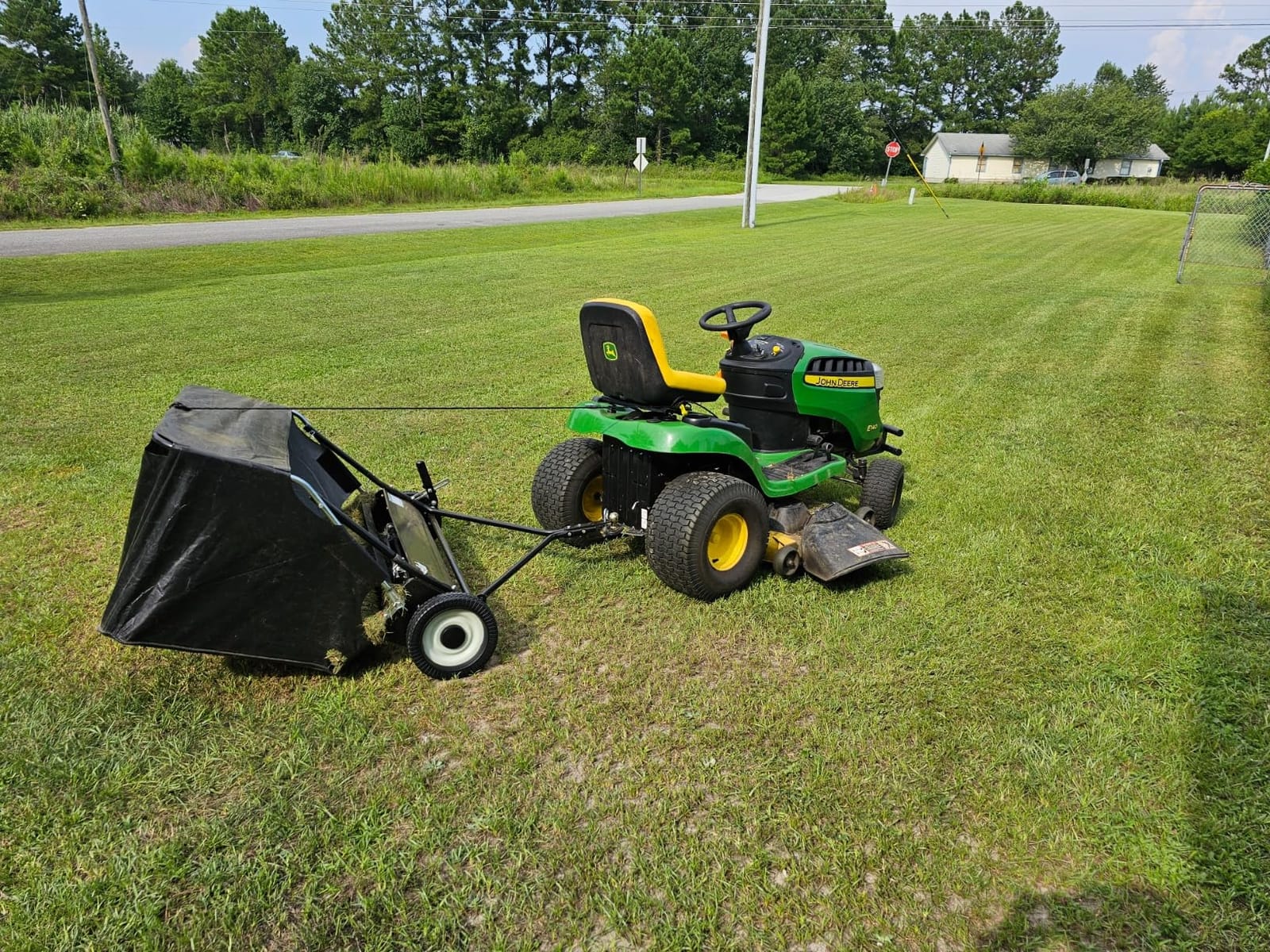
After working through ten of the most-reviewed sweepers on the market, the Agri-Fab 44-Inch Tow-Behind came out on top. Its 28 cu ft flow-through hopper and 5.6 to 1 brush-to-wheel ratio handled the heaviest leaf loads we put through it, and more than 3200 owner reviews back it. Everything else here is a different answer to a different yard, not a worse version of the same one.
One honest warning before we get into the list. Lawn sweepers are dry-debris tools. Damp, matted leaves cling to the turf and slip past the rotating bristles, and no brush design on the market fully defeats that. Sweep on a dry day, or borrow a leaf vacuum for the morning after a wet night.
A sweeper is also a two-season purchase, not a one-month one. The same machine that clears autumn leaves lifts spring grass clippings, pine straw and small twigs, which is worth remembering if you were about to treat this as seasonal spending. If your mower already bags well, read our riding mower guide first, because a sweeper can be redundant spend in that situation.

The Agri-Fab 44 wins on capacity and ratio. The 42-inch version is the same idea for a smaller budget and a smaller yard. The VEVOR is the pick if you have no riding mower and want to stop raking without spending much.
| Product | Features | |
|---|---|---|
| Agri-Fab 44-Inch Tow-Behind |
|
Check Latest Price |
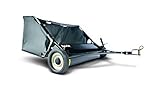 Agri-Fab 42-Inch Tow-Behind Agri-Fab 42-Inch Tow-Behind |
|
Check Latest Price |
 VEVOR 21-Inch Push Sweeper VEVOR 21-Inch Push Sweeper |
|
Check Latest Price |
 Dapper Supply 21-Inch Push Sweeper Dapper Supply 21-Inch Push Sweeper |
|
Check Latest Price |
 MAXLANDER 42-Inch Tow-Behind MAXLANDER 42-Inch Tow-Behind |
|
Check Latest Price |
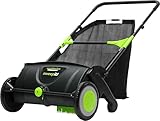 Earthwise LSW70021 Push Sweeper Earthwise LSW70021 Push Sweeper |
|
Check Latest Price |
 Agri-Fab 26-Inch Push Sweeper Agri-Fab 26-Inch Push Sweeper |
|
Check Latest Price |
 Yard Commander 48-Inch Tow-Behind Yard Commander 48-Inch Tow-Behind |
|
Check Latest Price |
 Brinly LS2-42BH-S Brinly LS2-42BH-S |
|
Check Latest Price |
 Ohio Steel 4222V2 Ohio Steel 4222V2 |
|
Check Latest Price |
We earn from qualifying purchases. CERTAIN CONTENT THAT APPEARS ON THIS SITE COMES FROM AMAZON. THIS CONTENT IS PROVIDED 'AS IS' AND IS SUBJECT TO CHANGE OR REMOVAL AT ANY TIME.
A tow-behind is only a good purchase if you already own a lawn tractor, riding mower or ATV to pull it. Without that hardware you are buying a heavy steel object with no way to move it, so the tow-behind picks below only make sense if you already own a machine to hitch behind.
For everyone else, a push sweeper is the honest entry point. Twenty-one to twenty-six inch models handle a small suburban lot, weigh fourteen to twenty-five pounds, and fold or hang on a wall when the season ends. The tradeoff is hopper size: 2.6 to 7 cu ft means more trips to the pile than a twenty-plus cubic foot tow-behind bag on a peak day.
The third option nobody mentions often enough is a leaf vacuum. It costs more effort to move around, but powered suction handles wet, matted and heavy debris that a sweeper will push around the lawn instead of collecting. If your trees drop a lot and your leaf-fall days are reliably damp, a vacuum is the better tool. If your debris is dry and loose, a sweeper beats it on noise, price per season and the fact that it needs no fuel or battery.
Worth noting that fine debris is where the two divide most sharply. Pine needles, acorns and black walnuts sit low in the grass where the bristles barely reach, which is why owners of tow-behinds with larger-diameter brushes report better results on that kind of litter.
44 in width
28 cu ft flow-through hopper
5.6 to 1 brush ratio
92 lb steel body
This is the sweeper we kept reaching for. The flow-through hopper fills from the back to the front rather than bottoming out in the middle, which means fewer stops to dump even on the heaviest oak day. Owners consistently single out the dump-from-seat handle as the feature that makes a full morning of sweeping bearable.
The 5.6 to 1 brush-to-wheel ratio is the spec that matters most here, and it is the highest figure in this roundup. That ratio means the brushes spin five and a half times for every turn of the wheels, so the tips move fast enough to throw heavy wet-ish litter upward into the bag instead of merely nudging it along the turf.
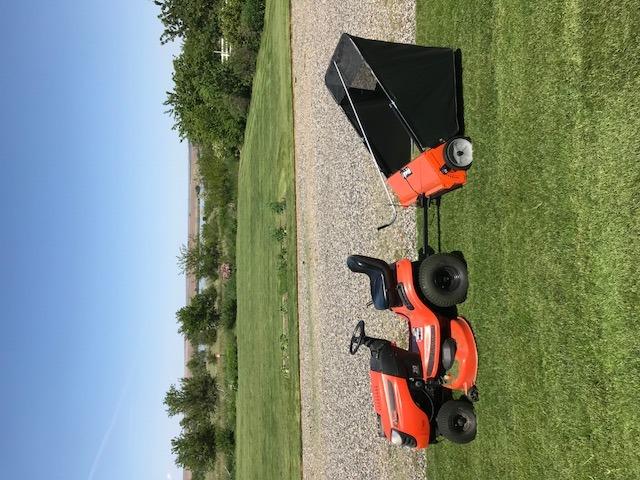
What could go wrong is the bag. Owners report the fabric and its corner fastenings scuffing and wearing, and some reinforce or replace the bag after a season. The second issue is the single-wheel brush drive, which can leave a brush idle or locked when you cross uneven ground.
On a mature tree canopy, a 28 cu ft bag means you can clear a good chunk of lawn between dumps. Compare that to a 12 cu ft bag and you are walking to the pile twice as often for the same cleanup. If you have a riding mower already, that difference alone justifies the step up in size.
The offset hitch shifts the sweeper to one side so you can sweep against a fence line or the edge of a house without repositioning constantly. The dump handle empties the bag without climbing down, which matters more than it sounds on the third or fourth pass of the morning.
At 5.6 to 1, the brushes outrun the wheels by more than five times. Higher ratios mean faster bristle tips, which is the difference between picking debris up and merely rolling over it. If you are buying in this category, treat 4 to 1 as a floor and 5 to 1 as a good target.
Skip this if you have no riding mower or tractor. At ninety-two pounds and fifty-five inches wide, it is not a hand tool. Also skip it if your garage is tight, since the manufacturer does not list it as a folding design.
42 in width
12 cu ft hopper
Alloy steel body
68 lb weight
3 year warranty
This is the same basic machine as our top pick in a smaller frame, and for a medium yard it is the smarter buy. Sixty-eight pounds is roughly twenty-four pounds lighter than the 44-inch version, and the smaller footprint makes it far easier to find a parking spot for in a one-car garage.
The brush height adjustment lets the bristles penetrate the grass by up to half an inch, which is deeper than most competitors in this class reach. That extra depth is what lets it pull up leaves that have settled into the thatch rather than sitting on top of the canopy.
What could go wrong is the dumping rope. Owners report it takes noticeably more effort than a handle-style dump, and the twelve cubic foot bag is a lighter fabric that wears faster than the 28 cu ft one. Instructions also cause confusion the first time through, so budget an extra hour.
Half an inch of penetration is a meaningful spec on a lawn that has not been raked in a week. It is the difference between bristles skimming the surface and bristles getting under the mat. On clean, short turf almost any sweeper works, and this is where the spec pays off.
Twelve cubic feet is a mid-session dump on a heavy day with mature trees. It is a genuine limitation and the single best argument for stretching to the 28 cu ft model if you have an acre or more of canopy overhead.
The eleven inch semi-pneumatic tires absorb bumps better than solid plastic wheels, which reduces the bouncing that leaves debris behind. On a yard with tree roots and irrigation heads, that difference shows up in the amount of cleanup still left with a hand rake.
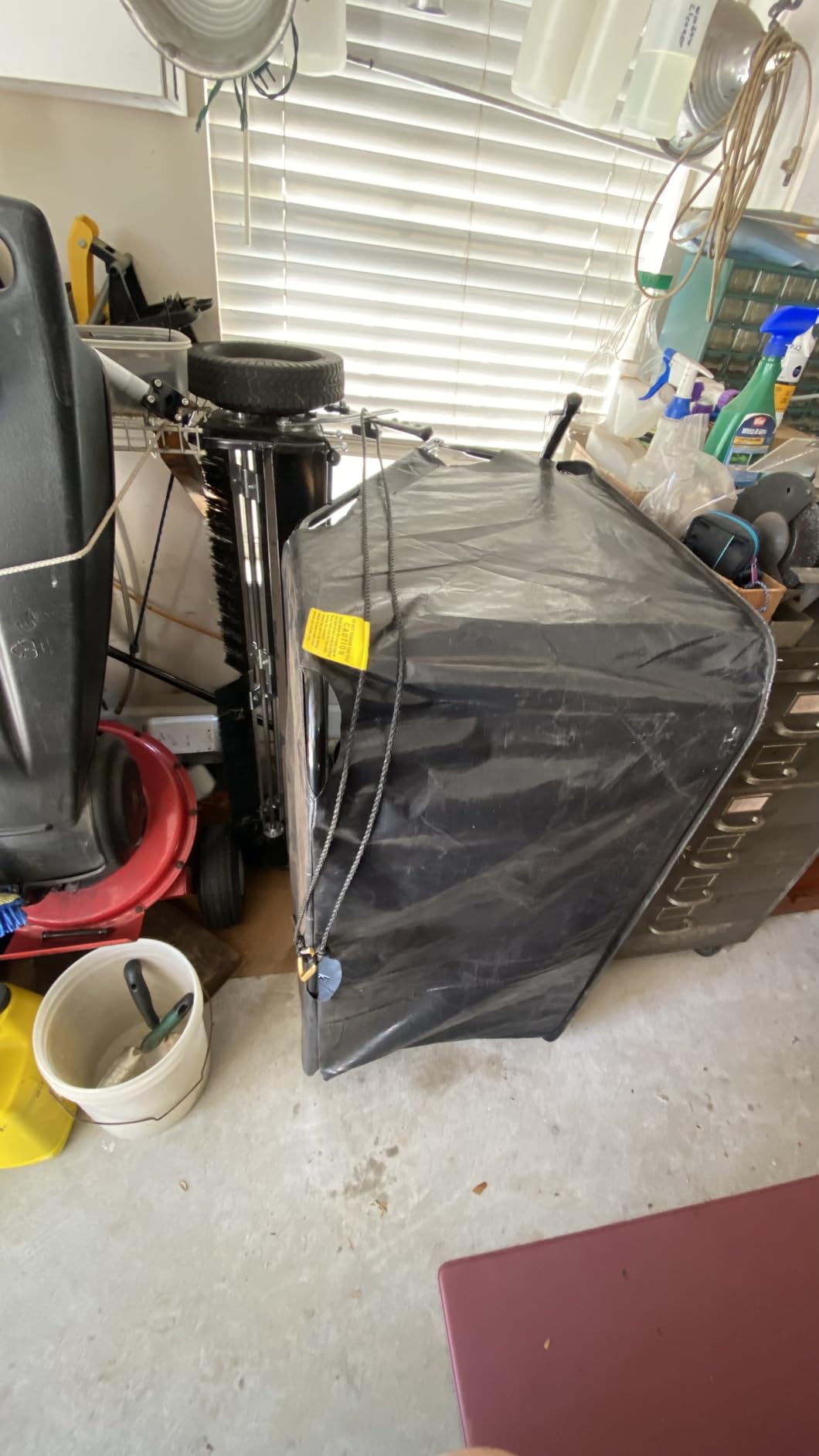
Buy this if you own a tractor, your lawn is a half acre to about an acre, and you want the Agri-Fab name and a three year warranty without the bulk of the bigger frame. It is our best value tow-behind for a reason.
21 in width
3.5 cu ft non-woven bag
14.3 lb frame
9.8 in wheels
Fourteen pounds is the number that makes this sweeper different. You can carry it to the far corner of a lot with one hand, and on a small lawn that removes the last excuse for not doing leaf cleanup at all. Owners report it cutting raking time substantially on even, short grass.
The stepless knob is a genuine improvement over lever systems. You turn it while pushing and the brushes move up or down, so you can raise them for a driveway pass and drop them back for grass without stopping to fiddle with anything.
What could go wrong is everything around the brush. The instructions are largely unlabelled, so first assembly takes trial and error. The plastic wheels grind during tight turns, the bag is thin with no replacement offered, and the frame is mostly plastic that can twist if you bog down in tall grass.
VEVOR claims the thickened brushes pick up roughly eighty percent of debris in one pass. On dry, loose leaves over short mown grass that is about right. On matted wet litter or heavy thatch, treat it as a two-pass job. Reviewers largely agree the brush itself is stronger than the frame around it.
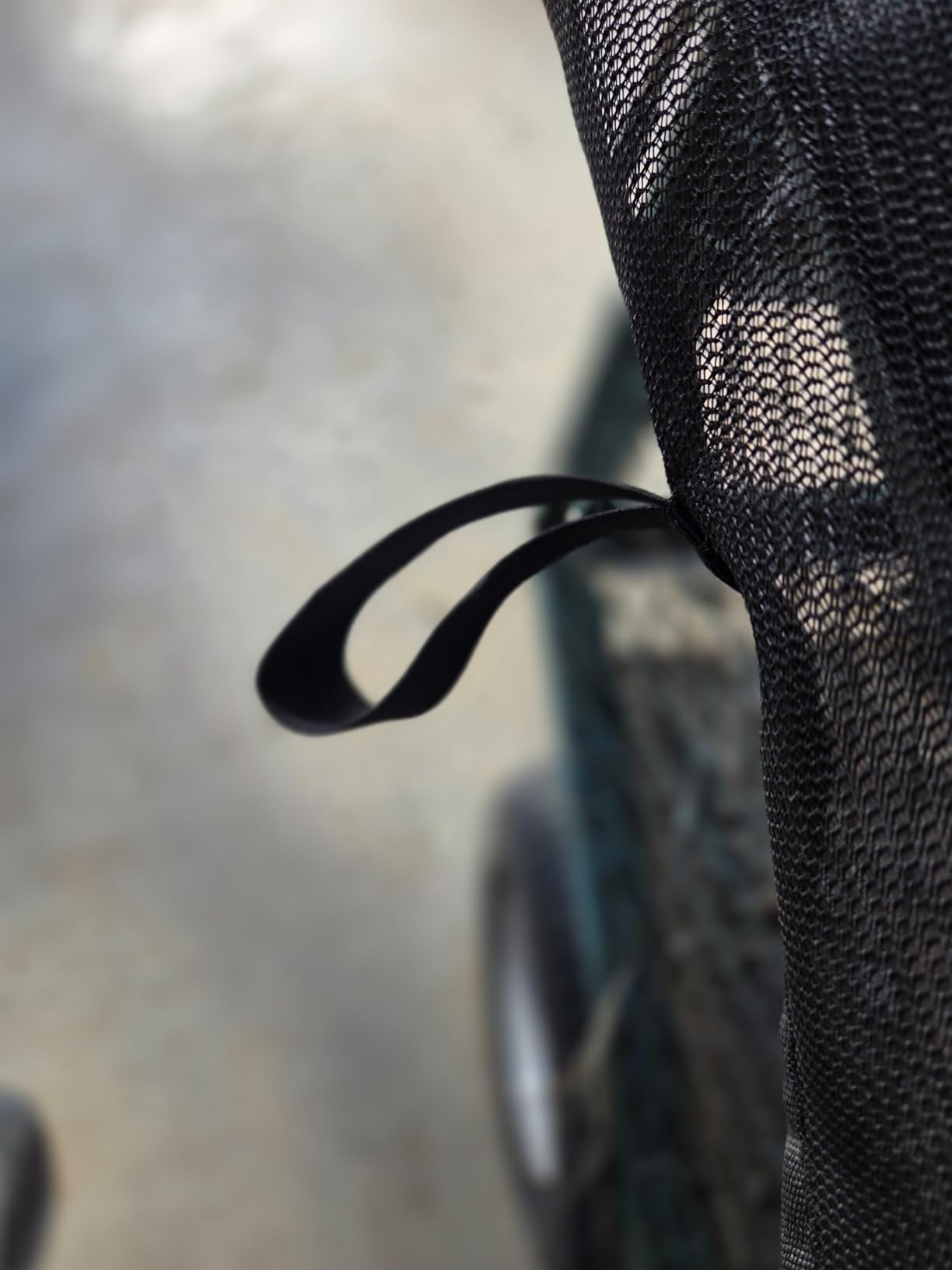
Support feet let the unit hang flat on a garage wall, which solves the storage problem that trips up most push sweepers. The bag unhooks from the frame so you can carry it to the pile rather than tipping the whole machine, but at 3.5 cu ft it fills quickly and owners report leaves clogging the intake at about two-thirds full.
Awkward turning is the everyday annoyance. The nine-point-eight inch plastic wheels do not pivot the way a caster should, so reversing out of a corner is a wrestling match. It also bogs down in tall grass, which is the one condition you cannot avoid in autumn.
Buy this if you have a small lot, no riding mower, and you want the most affordable credible way to stop hand-raking. Do not buy it expecting to handle a heavy oak canopy on a wet morning.
21 in width
3.5 cu ft non-woven bag
17 lb frame
Also 22 and 26 in
Storage is the reason this one earns a place. It folds flat with stabilising feet at the bottom, so it goes on a wall in a garage the way the VEVOR does, but the folding frame is a cleaner mechanism than quick clips held in tension.
It shares the 3.5 cu ft removable bag and the same knob height adjustment as the VEVOR, and the reinforced brushes are designed to resist deforming. At seventeen pounds it sits between the featherweight VEVOR and the heavier Agri-Fab push frame.
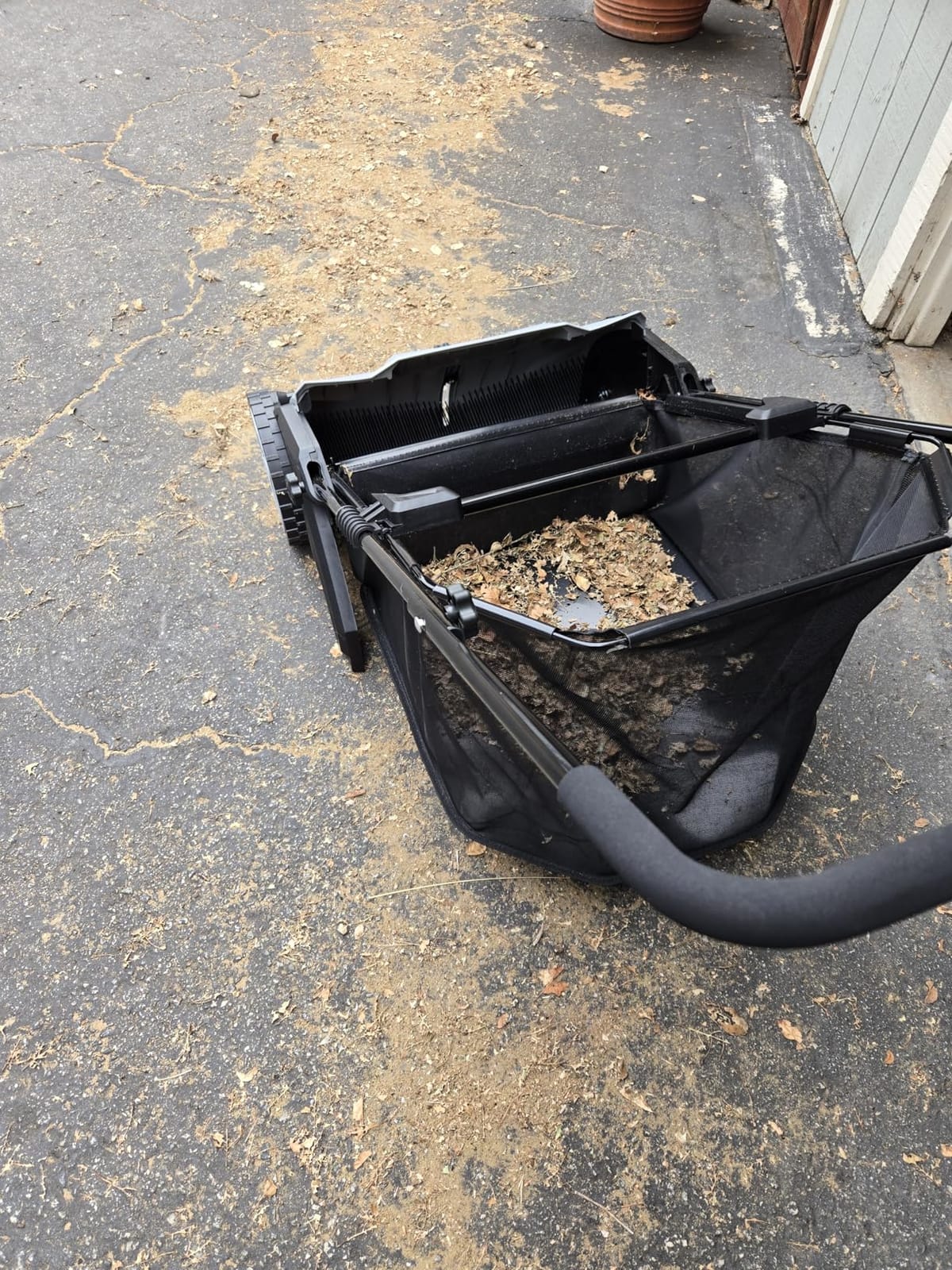
What could go wrong is the frame. It is all plastic, and owners describe it flexing under load and depending heavily on getting the brush height exactly right. Unlabelled parts and thin diagrammed instructions are the other recurring complaint.
The same model family comes in twenty-one, twenty-two and twenty-six inch widths using the same hardware. That matters if you are undecided, because the twenty-six inch version covers noticeably more ground per pass for very little more, and the twenty-one inch is the narrower of the set.
The hand knob is genuinely useful here. Sidewalks and driveways have no grass canopy to comb through, so you want the brushes raised just enough to skim the surface. On the same machine set for a lawn, those surfaces produce a noisy, fruitless grind.
Two years of warranty is respectable for a budget push sweeper, but the first hour with the box is the weak point. Label the parts yourself before you start and the rest of the build goes quickly.
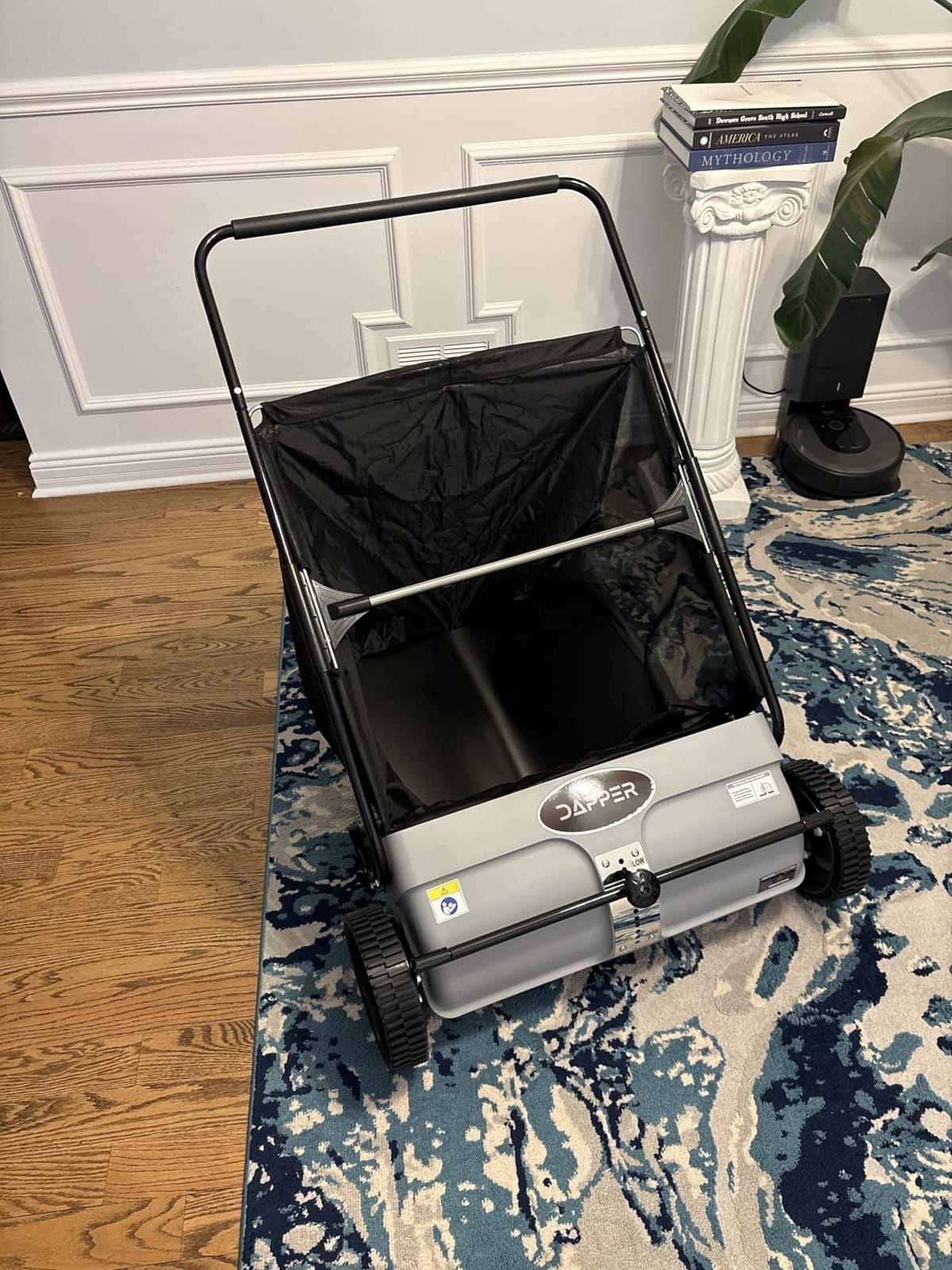
Buy this if floor space in your garage is the constraint and you want a push sweeper that disappears when the season ends. It is a near-tie with the VEVOR, decided by storage design rather than by sweeping power.
42 in width
12 cu ft hopper
10.5 in diameter brushes
63.7 lb weight
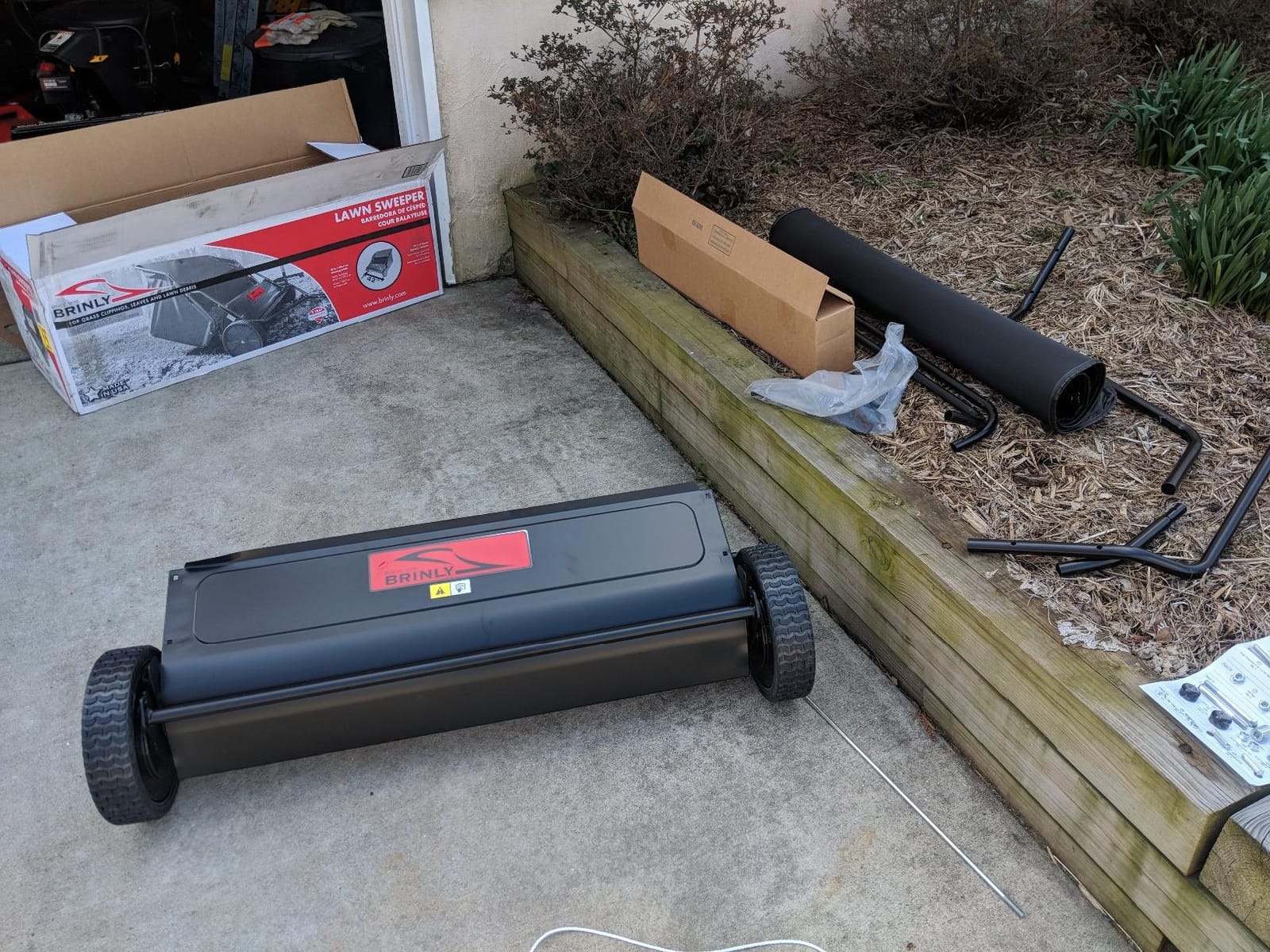
This is the tow-behind answer for someone whose storage space is the sticking point. The frame folds down, which few tow-behinds in this roundup manage, and it arrives partially assembled with a video guide rather than a bag of loose steel.
The brush diameter is the quiet advantage. At ten and a half inches these are large-diameter bristles for a 42 inch machine, and owners specifically report good pickup on pine needles and mixed litter. Reinforced metal-to-brush connections keep the rods from working loose in service.
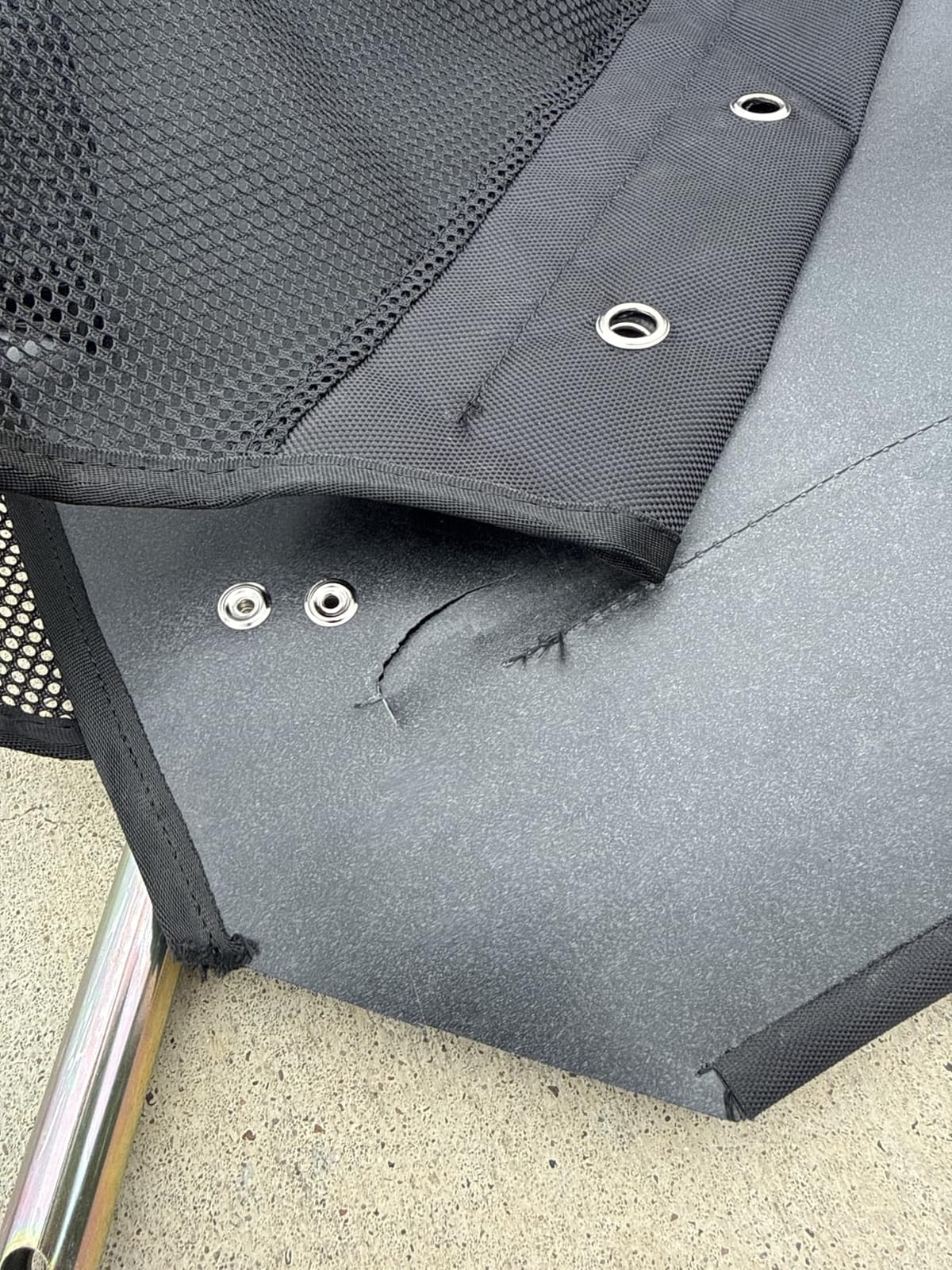
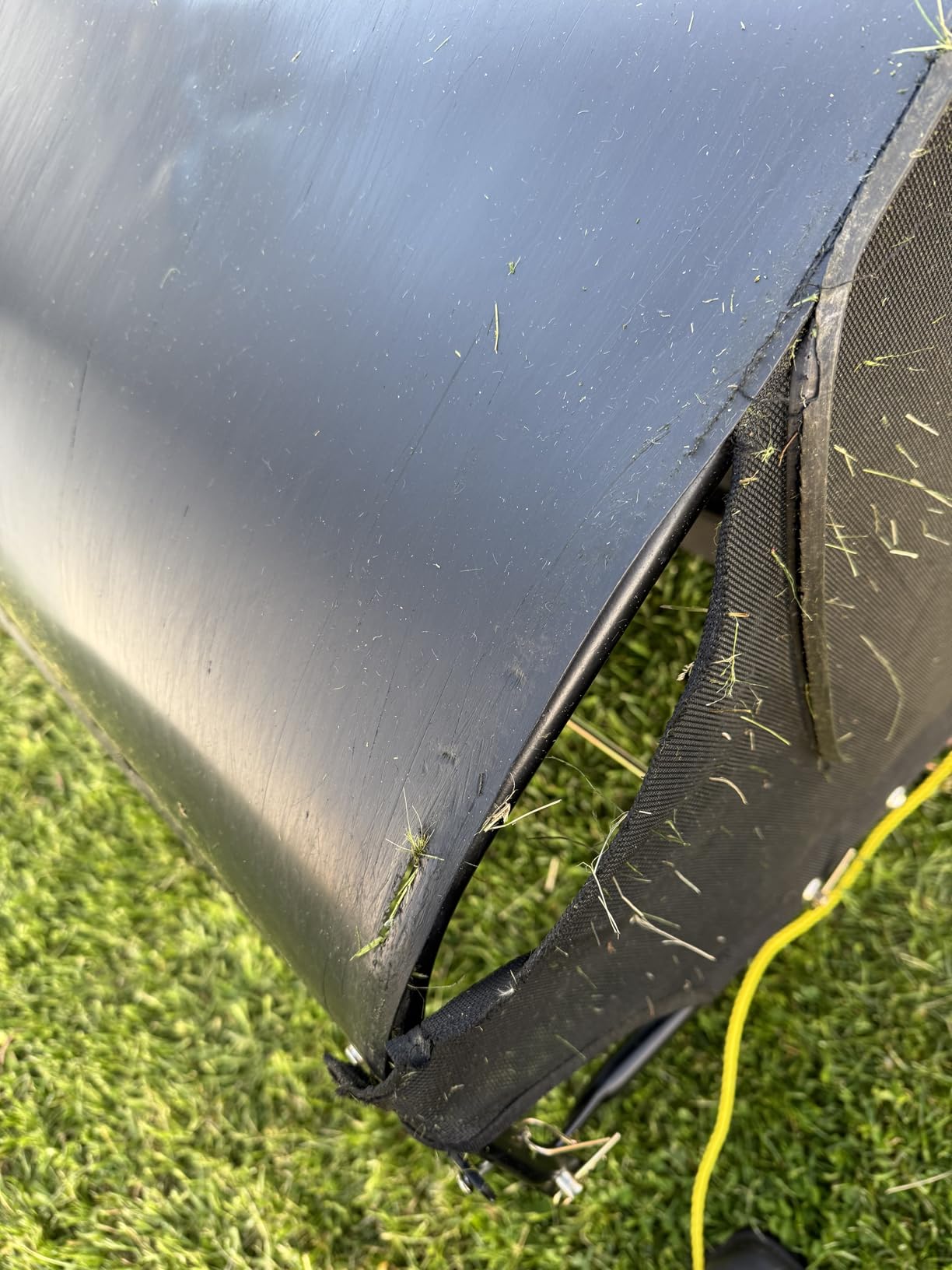
What could go wrong is assembly. The hopper angle bars are easy to mount backwards because the parts are not labelled, and the grommets at the top of the bag are the first thing to tear out, leaving the support bar unsecured. Owners reinforce the thin fabric with tape.
The lever adjustment changes brush height without tools and is meant to be usable mid-pass. That is the right design for a yard with drainage swales or worn areas, where a fixed setting either digs in or floats above the litter.
The universal hitch covers most lawn tractors, riding mowers and ATVs, which broadens the machine base considerably. It is worth checking your hitch height before buying, because a tongue that sits too flat will drag.
The protective cover over the twelve cubic foot bag helps with the blow-out problem that plagues open fabric hoppers on dry, light leaves like birch. The dumping rope empties from the seat, matching the pattern across this whole category.
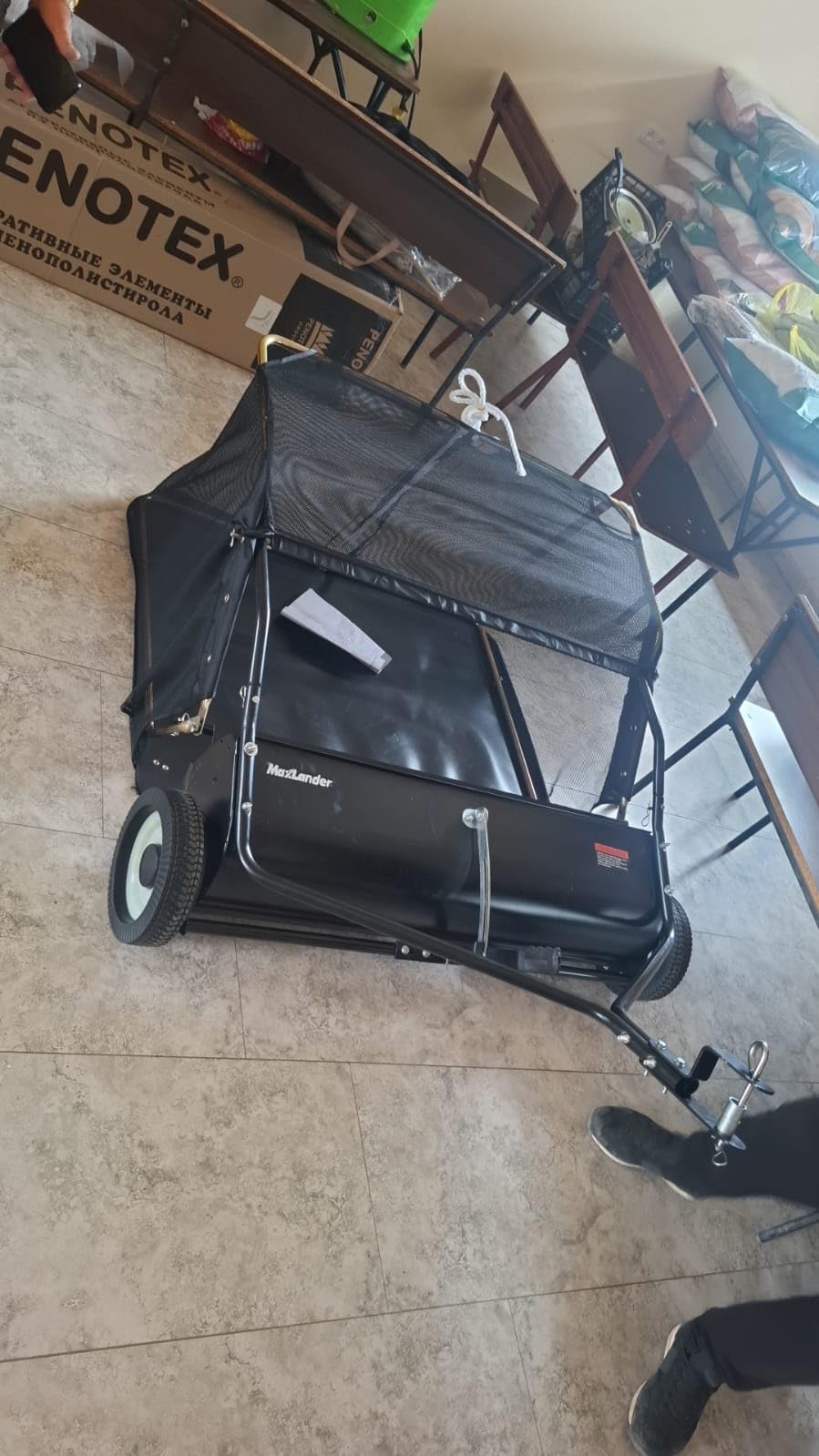
Buy this if you want 42 inch width but cannot give up the floor space. Skip it if you are not willing to spend thirty minutes sorting hardware, because that assembly friction is its real drawback.
21 in width
2.6 bushel mesh bag
14 lb frame
Cold-rolled steel frame
With more than 6300 reviews this is the best-proven sweeper in the roundup, and the pattern in those reviews is remarkably consistent. People buy it for dry leaves on short, flat lawns, it does that job, and they accept that edges still need a hand rake.
It is fourteen pounds with a cold-rolled steel frame, which is a rare combination at this weight. The four-brush pickup system runs two brushes per section, giving a wider pickup than a two-brush machine of the same width.
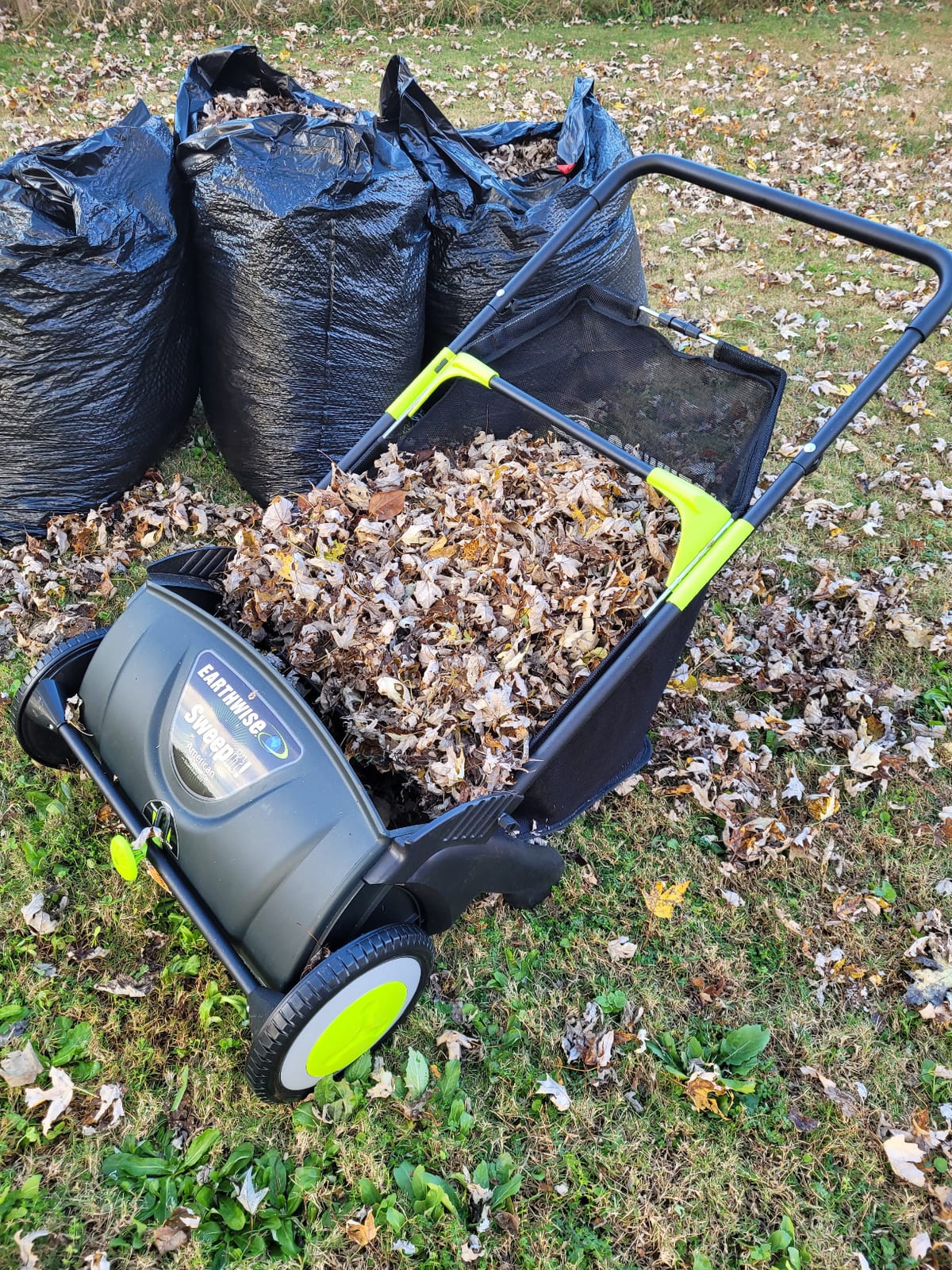
What could go wrong is the bag. Two and a half bushels is the smallest capacity here, and it needs frequent emptying plus hand compression. The bag frame and plastic clasp bar crack after limited use, and debris clogs at the bag lip where the brush throws, which forces stops you did not plan for.
Owners report it works well on synthetic lawn, leaving the infill in place while collecting debris above it. Set the brushes to the lightest contact and the four-brush system picks up surface litter without pulling the sand out. That is the one use case where this sweeper clearly beats the alternatives.
It struggles with wet leaves, pine needles, acorns and heavier seed pods. On flat short grass with dry litter it keeps up, but the moment the ground gets uneven at fence lines, tree roots or drains, the frame twists and the pass stalls.
This is where the three-and-a-half star average comes from. On a small suburban lot the tiny bag is manageable, because you are not walking far to the pile. On anything larger you will empty it repeatedly, and the manual hand compression is the part that gets tiring by the second week.
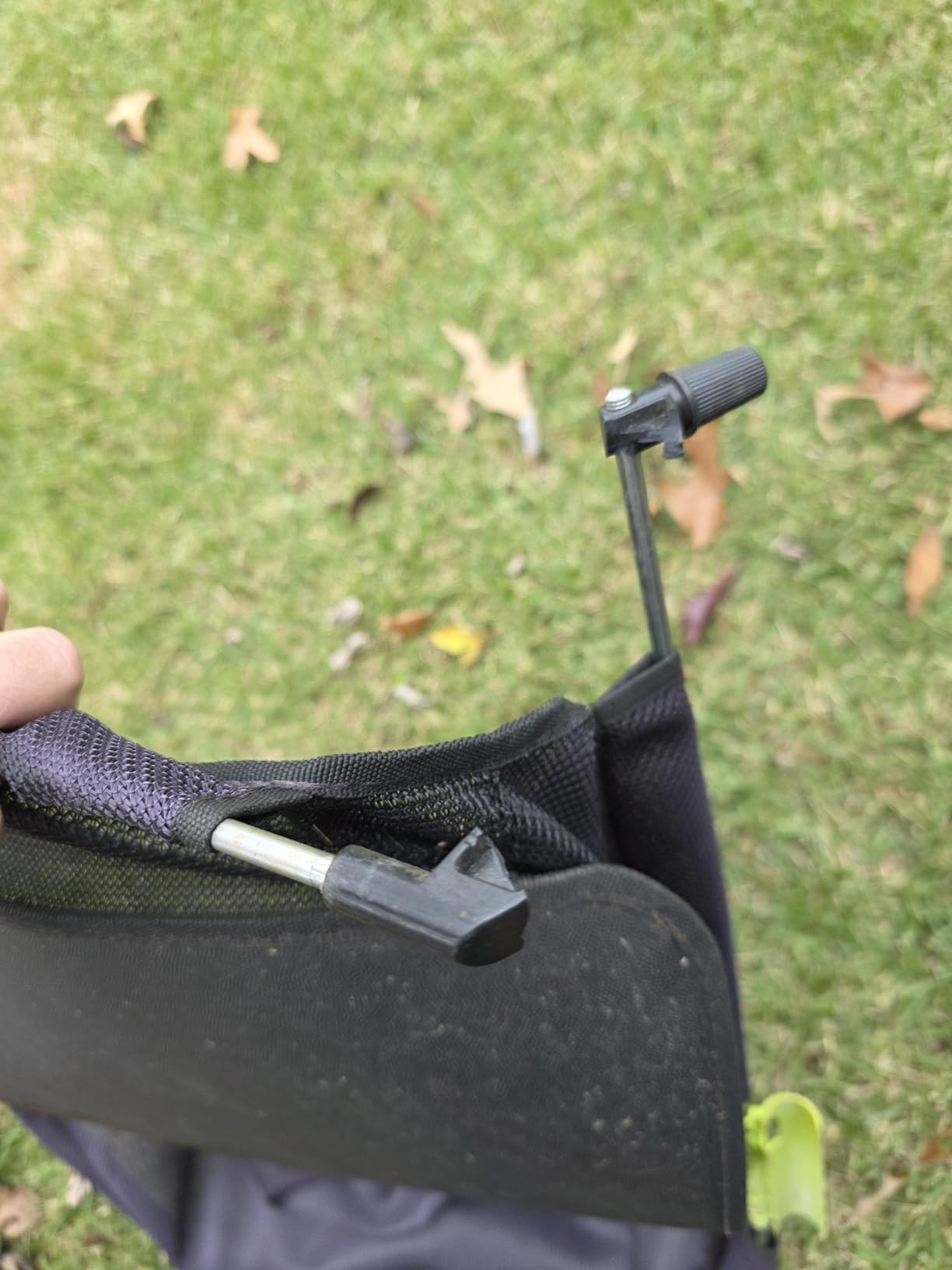
Buy this for a small, flat, regularly mown lawn or for artificial turf. Do not buy it for heavy leaf fall, long grass, or a yard full of mature oaks, and note that some units arrive with an assembly video for an older model.
26 in width
7 cu ft detachable hopper
Four-brush design
25 lb frame
Twenty-six inches is the widest push path in this group, and combined with a seven cubic foot detachable hopper it collects far more per trip than the twenty-one inch budget models. If you have a push sweeper in your future and want one pass to mean something, this is the width that changes the arithmetic.
The axle, wheels and brushes are singled out by owners as well made, and Agri-Fab’s parts support earns repeated mention as a genuine strength. Free replacement parts and responsive warranty handling matter more in this category than they do in most, because so many sweeper bags are the part that dies first.
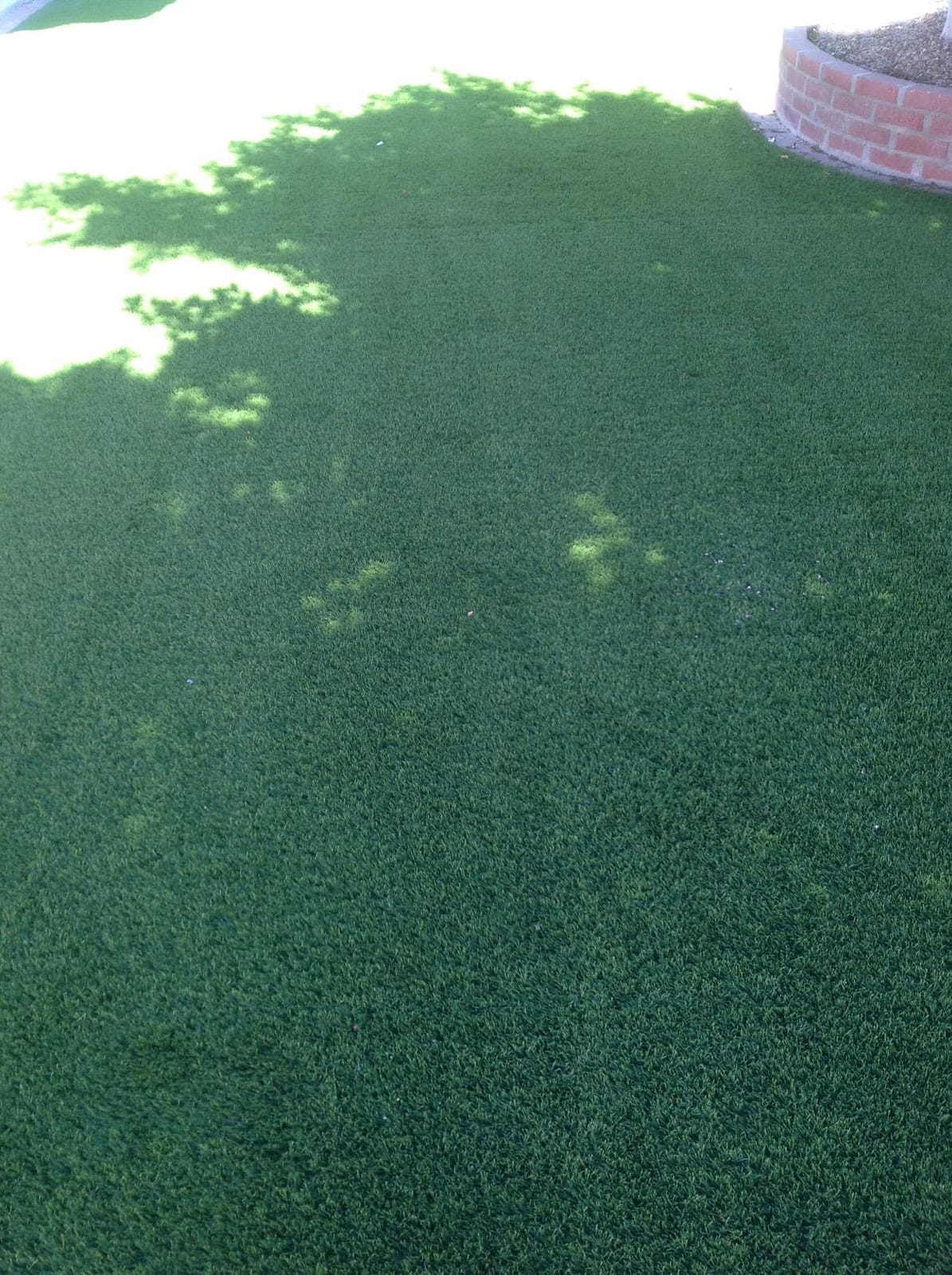
What could go wrong is a design flaw rather than a materials one. The front lip of the plastic brush housing sits too high, so some debris gets pushed out the front instead of into the hopper. The handle is thin and uncomfortable unless you pad it, and the elastic bag retainers lose tension almost immediately.
Seven cubic feet is more than double the 3.5 cu ft budget push bags, and the hopper detaches for dumping so you are not tipping the frame. That is the single biggest practical upgrade over the 21 inch models in this roundup.
The tool-free adjustment is quick, but the range is sensitive enough that owners report readjusting repeatedly on uneven lawns. This is the same trade-off every brush-height system in the category carries, and it is worth ten minutes of testing before you commit to a full pass.
At twenty-five pounds with a collapsible bag, it stores in a small garage without hanging on a wall. That is a reasonable alternative to the folding designs if your floor space is adequate but your wall space is not.
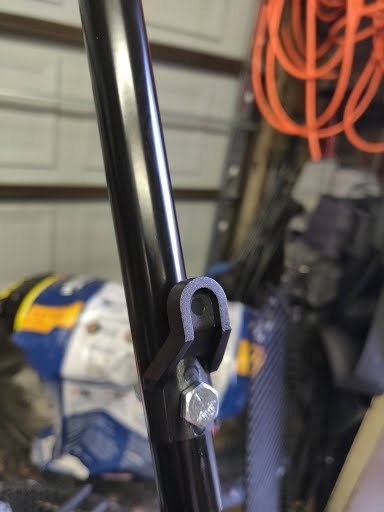
Buy this if you want push-sweeper convenience with near-tow-behind capacity on a lot under half an acre. Avoid it if you have large trees directly over the lawn, because the high front lip does its worst exactly where debris is heaviest.
48 in width
20 cu ft hopper
Four 10 in nylon brushes
72.7 lb steel frame
Forty-eight inches is the widest swath of anything in this roundup, and on an acre or more of lawn with a tree line the reduction in pass count is dramatic. The twenty cubic foot hopper is among the largest capacities here and empties with a simple pull rope.
Never-flat wheels mean you never think about pressure, and the steel frame with a corrosion-resistant finish feels solid in the hand. Owners report roughly ninety percent of leaves collected in a single pass on dry ground.
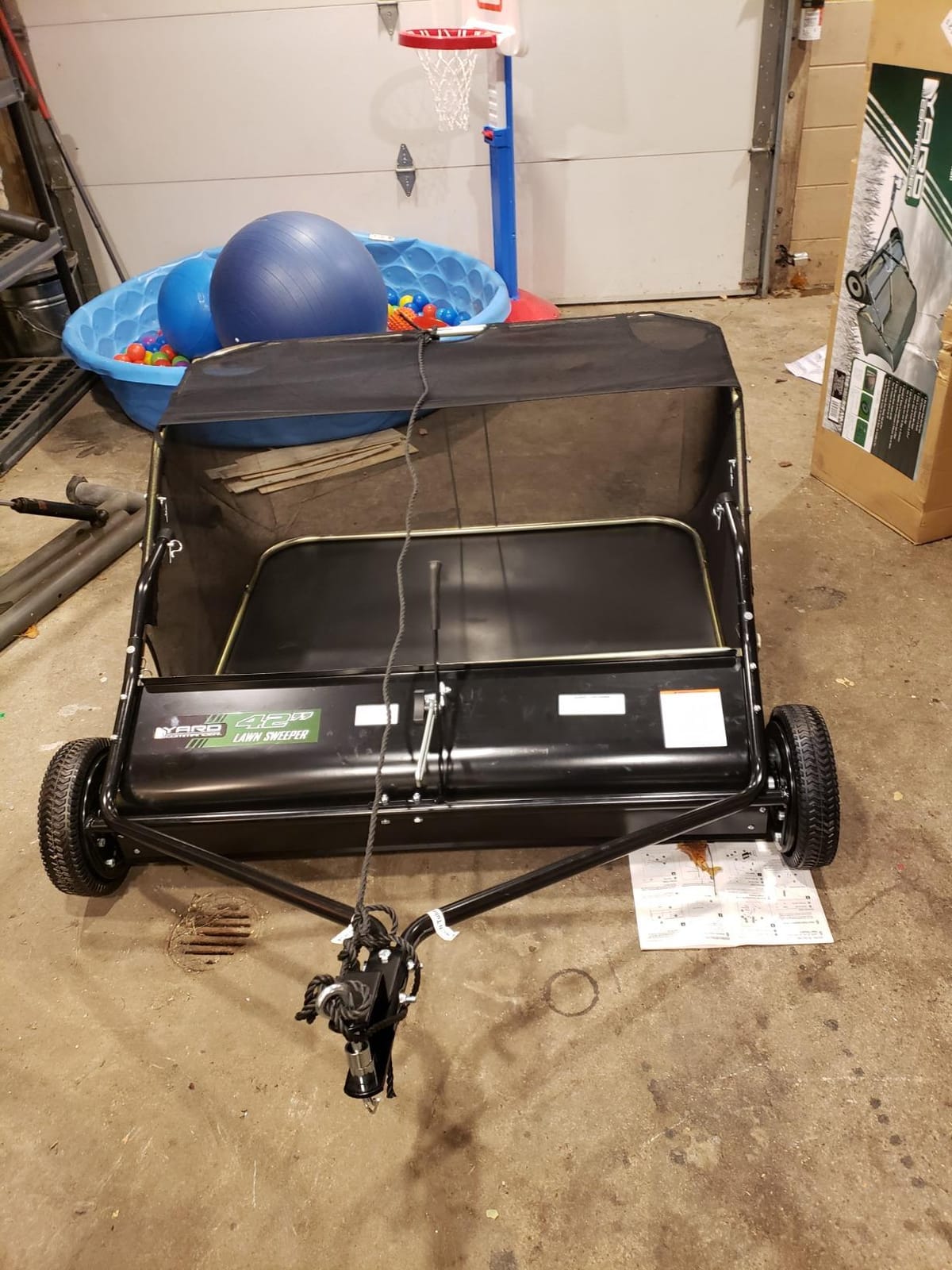
What could go wrong is assembly, and it is the most significant drawback in this roundup. Owners report ninety minutes to two hours of build time, sometimes solo, with misaligned holes that need filing or re-drilling and factory bolts that strip. Some pieces, including bag support bars and the rope, are reported arriving missing.
The capacity figure is what makes this viable on a heavy day. The pickup claim holds on dry, loose leaves over even ground, which is the same caveat that applies to every sweeper here and the reason wet-leaf performance is discussed further up.
The universal hitch fits most lawn tractors and ATVs but explicitly does not work with zero-turn mowers. If your mower is a zero-turn, cross this one off the list entirely. The offset drawbar design on the Ohio Steel is worth a look as an alternative, since it shifts the frame sideways rather than relying on a fixed centre hitch.
Owners note the wheels develop play after about a month and can gouge the lawn when backing up. The short tongue also makes reversing difficult and prone to jack-knifing, which is annoying when you are trying to line up with a driveway.
Buy this if you have a tractor, a large lawn, and the patience to build it carefully over a weekend. Check the parts count before you start and file the alignment holes before you attach the bag.
42 in width
20 cu ft hamper
Six brushes
5:1 gear ratio
Six brushes at forty-two inches is more bristle coverage than anything else here, and with a 5 to 1 gear ratio those tips move quickly enough to lift leaves, pine needles and twigs off the ground rather than pushing them along. The six-brush layout is also why pickup stays consistent through a tractor turn.
The feature that separates it from the field is the Twist-Lock height adjustment. Most competitors have height settings that drift on uneven terrain, which means constant readjusting. This one holds position, and on a yard with tree roots or washouts that is a genuine quality-of-life gain.
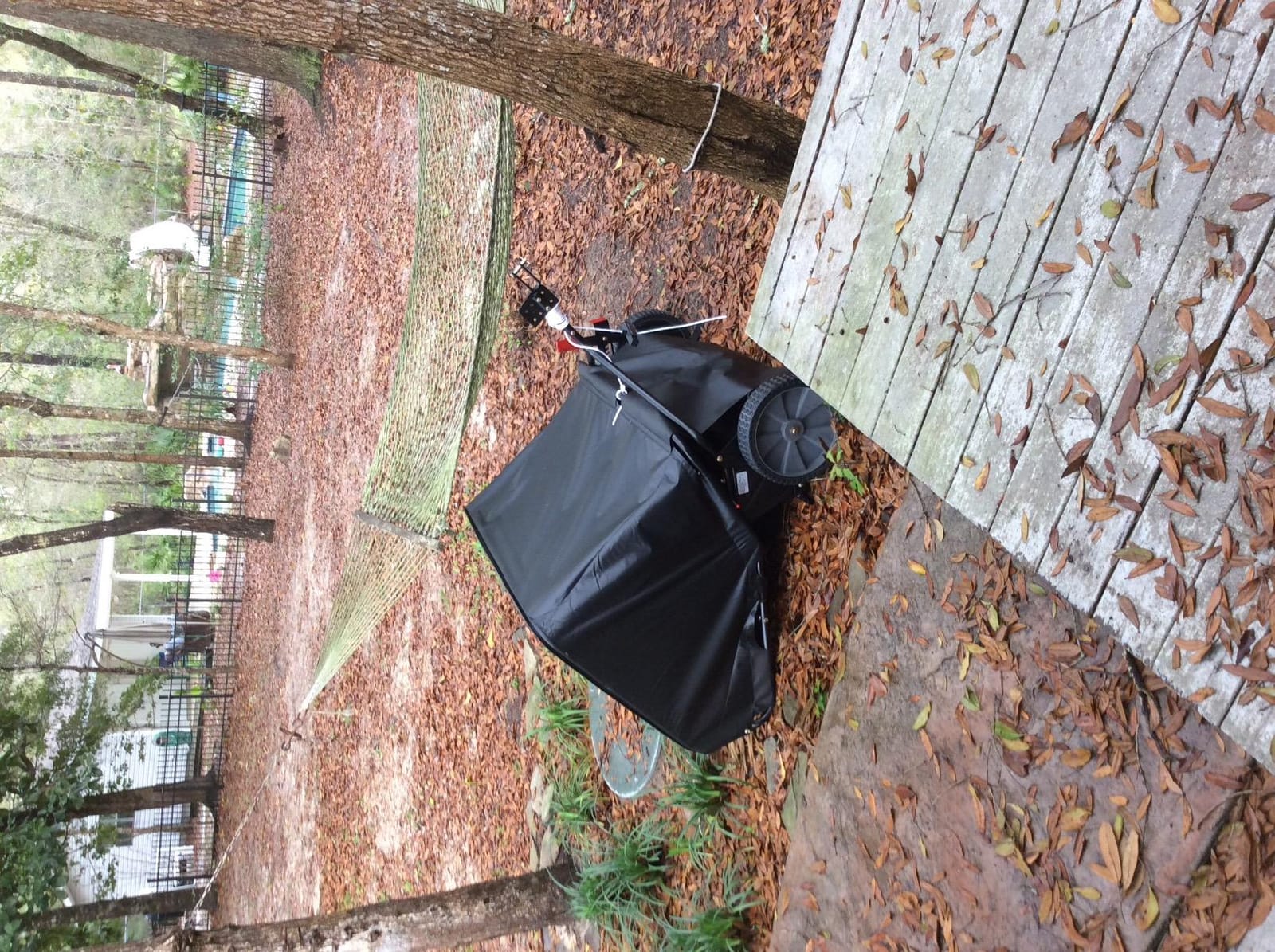
What could go wrong is the brand’s track record. The sales rank sits far below the mainstream models, so this is a less proven design with a smaller pool of long-term owners, and it costs more than several 42 inch models offering the same 20 cu ft capacity.
The four 10.5 inch nylon brushes on the 48 inch model and the four brushes on the Ohio Steel compete against six here. More brushes means more contact points across the same width, which shows up most clearly on scattered litter rather than a solid mat of leaves.
The hamper swings out for dumping and accepts either a pull cord or a T-handle, so you can choose the method that suits how you unload. The removable mesh windscreen contains debris that would otherwise blow out over the rim on a dry, breezy day.
Collapsible hamper braces simplify assembly and let the unit stand upright against a wall for the winter, which is one of the better storage answers in the tow-behind group even without a full folding frame.
Buy this if your yard is uneven and you are tired of readjusting brush height every pass. Check the hitch against your mower before you buy, since zero-turn owners should confirm compatibility first.
42 in width
22 cu ft hopper
4.5 to 1 brush ratio
Spiraled PP brushes
This carries the highest average rating in the roundup at 4.4, with owners describing it as heavy-duty and easy to build. Twenty-two cubic feet is the second largest hopper here, behind the Agri-Fab 44, and the offset drawbar can be shifted to either side so you can sweep and mow in the same pass.
The patented eleven inch spiraled polypropylene brushes are the technical story. Spiralled bristles flex around obstacles rather than bending permanently, and owners report strong pickup on leaves, acorns, pine needles, twigs and even Spanish moss. At eighty pounds with sealed ball bearings on the brush axle, it is one of the most solidly built machines in this group.
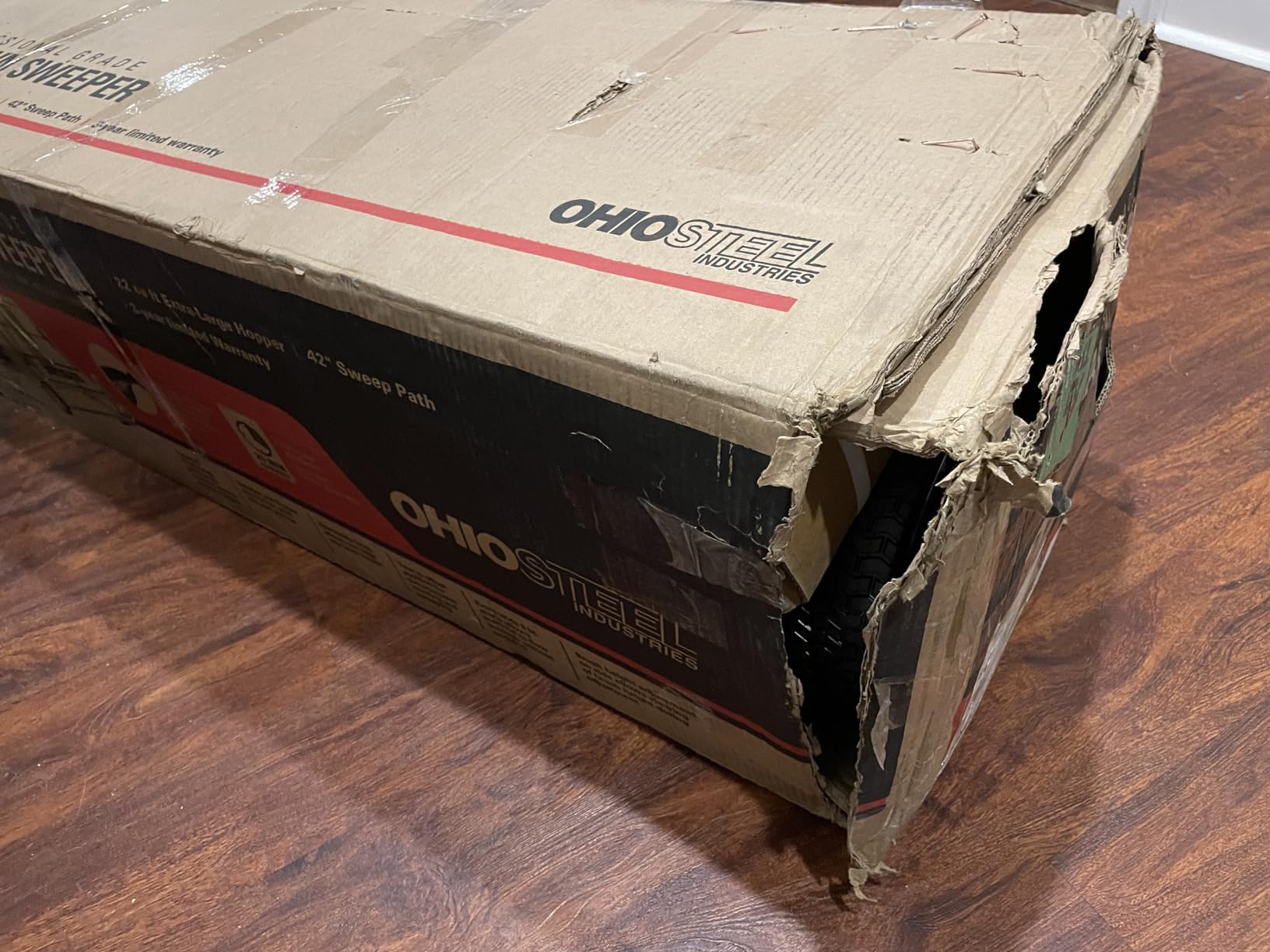
What could go wrong is the bag, consistently. Owners report cracking and tearing after a single season on anything but flat turf, and the support screw that holds the bag up works loose. The dumping rope is thin enough to get pulled into the brushes if you drop it.
Twenty-two cubic feet is among the biggest capacities here and minimises dumping trips. The caveat owners raise is a full load of wet grass weighs enough to load down and slow a low-horsepower tractor, especially on hills, so leave headroom on inclines.
Shifting the drawbar to either side clears the strip under your mower deck in the same trip. On a large lawn that halves the number of passes, and it is the feature that makes this a mowing-season tool as much as an autumn one.
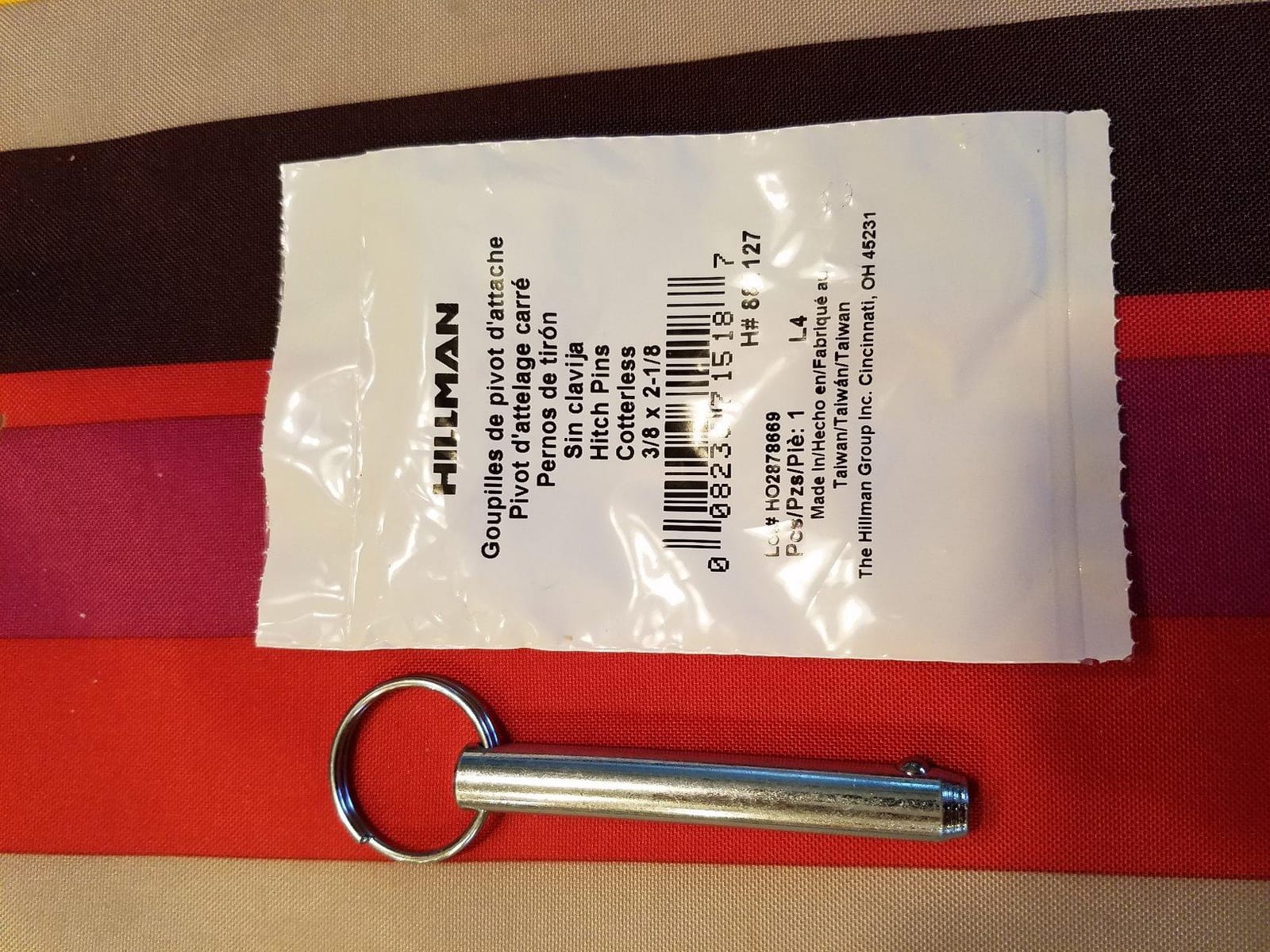
It assembles in about thirty minutes with one tool and includes a hitch pin, a much shorter build than most owner accounts describe for this category. The drawbar and bag fold for storage, and a three year warranty backs the frame.
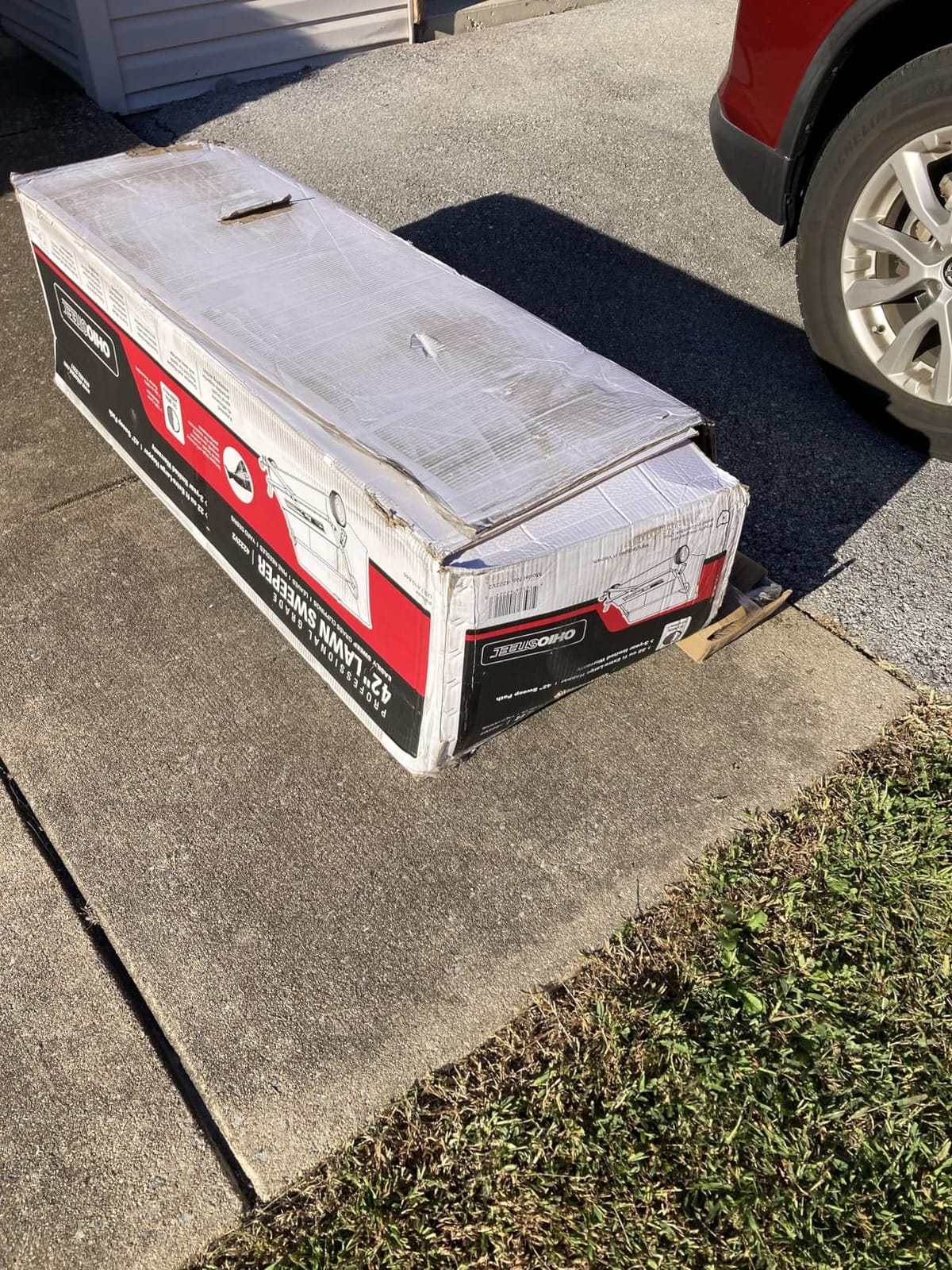
Buy this if pickup quality on varied debris matters most and you have a tractor that can pull eighty pounds plus a full hopper. Keep a spare bag on hand, because that is the part that will fail first.
Do lawn sweepers damage grass? Only when the brush height is set wrong, and the fix is simple enough that most of the damage people report is avoidable. The bristles should skim the tips of the grass, not cut into the blade.
Mow first. Sweeping long grass over a full week of growth means the brushes drag through stems and pull at the base. Cut the lawn, then sweep the clippings in the same session or a day later.
Wait for genuinely dry leaves. This is the step everyone skips. Damp leaves mat down and slip past the bristles, and you will spend twice the time for half the result.
Set the brushes to light contact. On a knob or lever system, start one setting higher than you think you need and drop it a notch at a time while walking.
Sweep at a steady walking pace. Owners report that walking too slowly lets debris spin under the brush instead of being thrown into the bag.
Overlap your passes by a few inches. Edges and corners where you reverse always leave a crescent of litter behind.
Dump before the bag reaches two-thirds full. Owners repeatedly report leaves clogging the intake at that point, and a full bag on a tow-behind loads down the tractor.
Clear the brush rod after each session. Twigs and hair wrap around the axle and quietly reduce pickup on every pass after that until you cut it off.
Clean and store dry. Brush out the hopper, hose the frame if it has been wet, and do not leave a damp bag folded in a shed over winter.
One more note for tow-behind owners. Check your mower is running cleanly before you spend a morning towing an attachment behind it, and make sure the height adjustment is set before the run rather than mid-pass.
Sweeping width is the number that determines how many passes your yard takes. For a small suburban lot under a quarter acre, twenty-one to twenty-six inches is plenty. For a half acre, look for forty-two inches. For an acre or more with mature trees, forty-two to forty-eight inches cuts your cleanup time roughly in half compared with a push model.
Hopper capacity is measured in cubic feet and it governs how often you stop to dump. Push models here run 2.6 to 7 cu ft, tow-behinds run 12 to 28 cu ft. On a peak leaf-fall day with mature oaks, anything under twelve cubic feet means mid-session dumping is the default experience, and that is where most of the frustration in this category comes from.
The brush-to-wheel ratio is how many times the brushes spin for every turn of the wheels. A higher ratio means faster bristle tips and better pickup with less pushing effort. Treat 4 to 1 as the floor below which debris gets pushed rather than collected, 5 to 1 as a good target, and 5.6 to 1 as the strongest figure in this roundup. The Agri-Fab 44 is the only sweeper here at the top of that range.
Fewer, larger brushes or more, smaller ones: both approaches exist. Six smaller brushes give wider coverage across the swath, four 10 inch brushes give deeper penetration, and spiralled bristles flex around roots and stones rather than deforming. Whichever you pick, check whether the rod is easy to clear after use, because wrapping debris kills pickup on every subsequent pass.
Read this section carefully. Across all ten products, the hopper bag is the single most common failure point, with owners reporting cracking or tearing anywhere from one to a few seasons. Polypropylene and non-woven fabrics outperform basic mesh, and it is worth confirming a replacement bag is available before you buy, because some models do not offer one.
Steel frames last; all-plastic frames flex and crack. Semi-pneumatic or never-flat wheels roll over roots without bouncing debris back out. For height adjustment, tool-free knobs and levers are convenient, but a locking mechanism that holds its setting on uneven ground is worth more than convenience once you are halfway through a lawn.
Measure before you buy. A forty-eight inch tow-behind is roughly sixty-six inches long and does not fold; the MAXLANDER and Ohio Steel do fold or collapse. On assembly, budget thirty minutes for the Ohio Steel and one to two hours for the Yard Commander. Unlabelled parts are the most common complaint across budget models, so label them yourself first. If you are still deciding between machines, our electric mower troubleshooting guide covers the maintenance habits worth building now.
If you already own a mower that bags well, a sweeper can be redundant spend. That is a real position owners hold, and it is not a bad one. The sweeper earns its place when your bagging setup is small, when you want to collect without mowing, or when your mower cannot handle the volume your trees produce. Timing your irrigation schedule around leaf cleanup is a related chore worth getting right, and our sprinkler head guide covers that side of it.
Yes, on dry leaves. The unpowered counter-rotating brushes spin faster than the wheels turn, lifting litter off the grass and throwing it into the hopper. They are far less effective on wet, matted or heavy debris, and very fine litter such as pine needles and acorns tends to slip past the bristles.
Poorly, and no brush design fully solves it. Damp leaves cling to the turf and slip under the rotating bristles instead of being lifted. The practical workaround is to sweep on a genuinely dry day, or to use a powered leaf vacuum for damp litter. Sizing up to a model with a higher brush-to-wheel ratio helps but does not eliminate the problem.
A lawn sweeper is unpowered. Its brushes spin off the wheels, making it quiet, cheap to run and easy to store, but it only handles dry debris. A leaf vacuum uses powered suction, so it lifts wet, matted and heavy litter that defeats a sweeper, at the cost of noise, fuel or battery power and a larger storage footprint.
For most yards with a riding mower, the Agri-Fab 44-Inch Tow-Behind is the strongest all-round choice, with a 28 cu ft flow-through hopper and a 5.6 to 1 brush-to-wheel ratio. Without a tractor, the VEVOR 21-Inch Push Sweeper is the most practical way to cut raking time on a small lot.
Agri-Fab has the strongest volume of owner feedback in this category, with both its 42 and 44 inch models holding thousands of reviews across multiple seasons. Ohio Steel builds the most solidly made machine with the highest average rating, while Brinly leads on brush count and on height adjustment that holds its setting.
Only if you already own a lawn tractor, riding mower or ATV. A tow-behind has no power of its own and simply attaches to a machine you already have, which is what makes it fast and quiet. Without a tractor, you are looking at a heavy steel frame with no way to move it, and a push sweeper is the better purchase.
They can, if the brush height is set too low for the grass. Set the bristles to skim the tips rather than cut into the blade, mow before you sweep so you are not dragging through long growth, and never sweep damp tall grass. Adjusted correctly, a sweeper lifts debris without touching the crown of the grass.
For spring cleanup on a small lot, the Agri-Fab 26-Inch Push Sweeper pairs a wide path with a 7 cu ft detachable hopper, which is the most capacity in a hand-push format. For a tractor owner, the Ohio Steel 4222V2 uses an offset drawbar so you can sweep and mow in the same pass.
If you own a riding mower and have heavy leaf fall, the Agri-Fab 44-Inch Tow-Behind is the pick: the 28 cu ft hopper and 5.6 to 1 brush ratio handle the largest loads in this roundup, and more than 3200 owner reviews back it up. If your lawn is mid-sized and you want the same name with less bulk, the Agri-Fab 42-Inch does the job for less.
If you have no tractor, the VEVOR 21-Inch or the Dapper Supply 21-Inch will cut raking time on a small lot, and the Dapper folds flat if garage wall space is your constraint. If uneven ground is your problem, the Brinly 42 is built around a height setting that stays where you put it. If pickup quality on mixed debris matters most, the Ohio Steel 4222V2 rates highest and takes an offset drawbar so you can sweep and mow together.
Many of you ask whether a sweeper is worth it at all against raking. The honest answer depends entirely on your debris load and how much of your lawn is flat.
Skip the whole category if your mower already bags well, and wait for a dry day before you unbox any of them. Sweeping damp leaves is the fastest way to decide a lawn sweeper was a mistake.