Physical Address
304 North Cardinal St.
Dorchester Center, MA 02124
Physical Address
304 North Cardinal St.
Dorchester Center, MA 02124

If you are searching for the best electronic keyboards for kids, the short answer is this: the RockJam RJ5061 is the one to buy for most families, the Best Choice Products 37-Key works for a three-year-old just starting to explore sound, and the Casio Casiotone CT-S200 is the pick if your child wants to connect to lesson apps on a tablet. For the nine-to-twelve age band, the RockJam again wins because it arrives with a stand, bench and headphones instead of leaving you to buy them separately.
I have spent the last few months putting together shortlists like this for parents, and the keyboard question comes with more baggage than any other first instrument. It is not the sound. It is the gap between what a child plays at home and what the teacher asks for at the lesson.
How I picked: I verified key count, key size and stated key action against manufacturer data, then checked what actually comes in the box, because that is where most parent surprises live. I matched each board to the age band its key size genuinely supports rather than the age printed on the box, and read reviewer comments closely for the things that break, rattle or reset at the wrong moment. Every pick below has its own independent review history behind it, and I have flagged the honest drawback for each one.
One thing worth saying early: the teacher community has a real complaint about cheap portables, and it is not a small one. Across r/piano and r/pianoteachers discussions, the recurring claim is that a large share of students who begin on a low-cost portable keyboard abandon lessons within the first year. That claim is about instruments with 32 or 37 springy keys and no sustain pedal, not about a 61-key board with a bench. The rest of this guide shows you where that line sits.


The RockJam takes the top slot because it removes the setup friction that trips up first-time buyers. Stand, bench, headphones and note stickers are in the box, so a child can be playing on the same afternoon it arrives.
The Best Choice Products 61-Key set edges it out on teaching features, with three teaching modes and light-up keys that make practice feel guided even without a teacher in the room. The Casio wins on portability and on being the only board here with a proper class-compliant USB-MIDI port for tablet lesson work.
| Product | Features | |
|---|---|---|
| RockJam RJ5061 61-Key Keyboard Piano Kit |
|
Check Latest Price |
| Best Choice Products 61-Key Lighted-Key Set |
|
Check Latest Price |
 ZENY 61-Key Portable Keyboard ZENY 61-Key Portable Keyboard |
|
Check Latest Price |
| Casio Casiotone CT-S200 |
|
Check Latest Price |
 JIKADA 61-Key Portable Keyboard JIKADA 61-Key Portable Keyboard |
|
Check Latest Price |
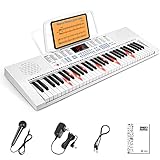 Vangoa VGK611 61 Mini-Key Keyboard Vangoa VGK611 61 Mini-Key Keyboard |
|
Check Latest Price |
 WOSTOO 61-Key Kids Keyboard WOSTOO 61-Key Kids Keyboard |
|
Check Latest Price |
 M SANMERSEN 61-Key Keyboard M SANMERSEN 61-Key Keyboard |
|
Check Latest Price |
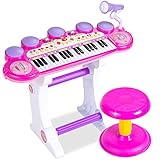 Best Choice Products 37-Key Kids Piano Best Choice Products 37-Key Kids Piano |
|
Check Latest Price |
 BIGFUN 37-Key Toddler Piano BIGFUN 37-Key Toddler Piano |
|
Check Latest Price |
We earn from qualifying purchases. CERTAIN CONTENT THAT APPEARS ON THIS SITE COMES FROM AMAZON. THIS CONTENT IS PROVIDED 'AS IS' AND IS SUBJECT TO CHANGE OR REMOVAL AT ANY TIME.
Everything in the table shares one honest caveat: none of these boards has weighted keys. That does not tell you which one a serious eight-year-old should graduate to, but together they cover the entire range from a two-year-old’s first instrument to a child in their third year of lessons.
61 full-size keys
200 tones and 200 rhythms
Stand, bench and headphones included
3.3 kg, 11.2 x 36.8 x 3.1 inches
Our team has come back to this kit more than any other, and the reason is boring and reliable: nothing is missing. The included components are the keyboard, an X-style stand, a padded bench, a sheet music rest, headphones and keynote stickers.
That completeness changes the experience. There is no first-evening trip to buy a stand, no improvised stack of books, and no argument about volume at 8pm. For a family in an apartment or a house with a sleeping sibling, the included headphones alone tend to justify the setup.
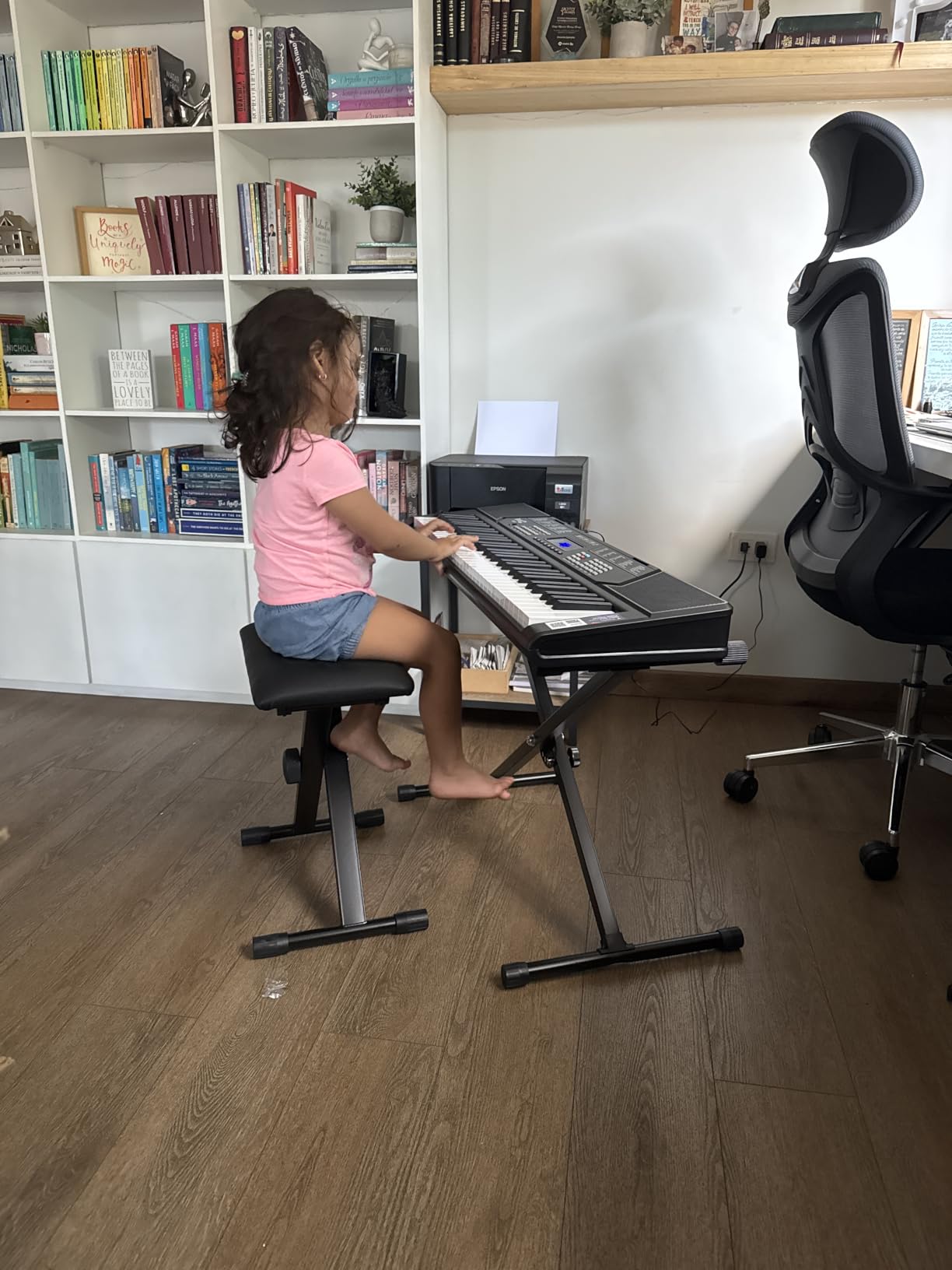
The keybed is full-size across 61 keys, which is the number most beginner lessons assume. It spans five octaves, enough for the two-hand reading most children work through in their first couple of years, and the keys are standard width so nothing transfers badly when the child later meets a real piano or a weighted digital instrument.
On the flip side, these are unweighted keys with no velocity sensitivity. A soft press and a hard press produce the same volume, so dynamic control has to be learned elsewhere. Reviewers do note that tones above middle C can sound shrill at higher settings, and the speakers can rattle when pushed hard.
The sound library is 200 tones and 200 rhythms with demo songs, a pitch bend wheel and an LED panel, plus Simply Piano lesson content. One caveat catches parents out: the app needs to hear the keyboard, so lesson playback does not work through the included headphones.
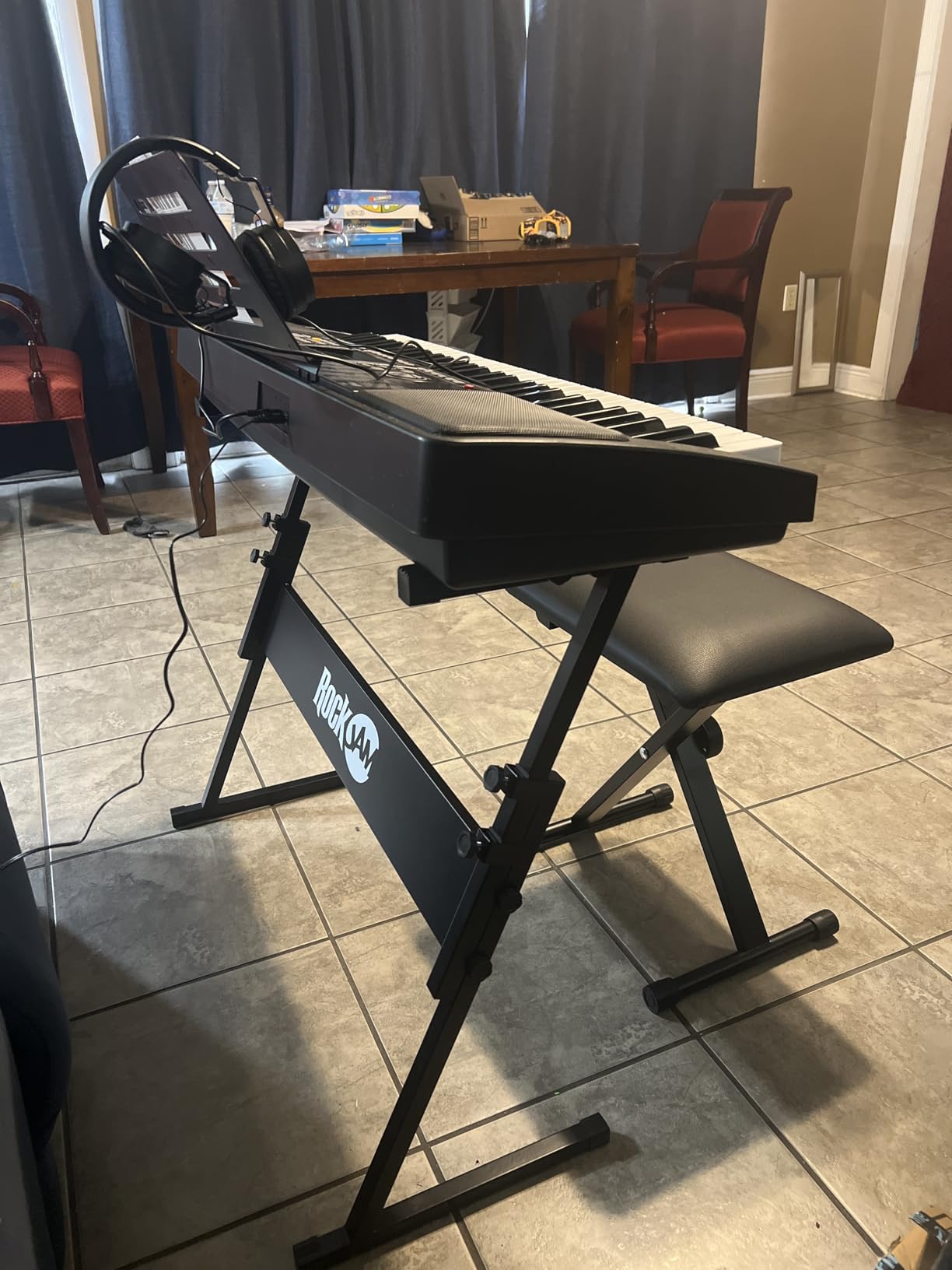
This is the keyboard I recommend for a child from about age six through twelve, and for a five-year-old who has already shown real interest rather than passing fascination. The stand and bench are what make it feel like a real instrument, and posture matters more than most parents expect.
The honest drawback is the button layout. It is busy, and a young child can be intimidated by it before they have learned three notes. If your child is intimidated by buttons, the Best Choice Products set below does the same job with a clearer teaching layer.
61 keys with light-up keys
Three teaching modes
255 timbres and 255 rhythms
17.2 lb, 36.4 x 12 x 3.7 inches
Parents of kids in the 10-14 band keep telling me the same thing about this set: the teaching layer is what keeps practice going when a parent is not sitting beside them. Light-up keys show the next note, and three modes change how much help the board gives.
The hardware underneath is a 61-key unweighted board with 255 timbres, 255 rhythms, 50 demo songs, 32 keyboard percussion types and a starting tempo of 120 BPM. There is an LCD display, a recorder with playback and note stickers for reading.
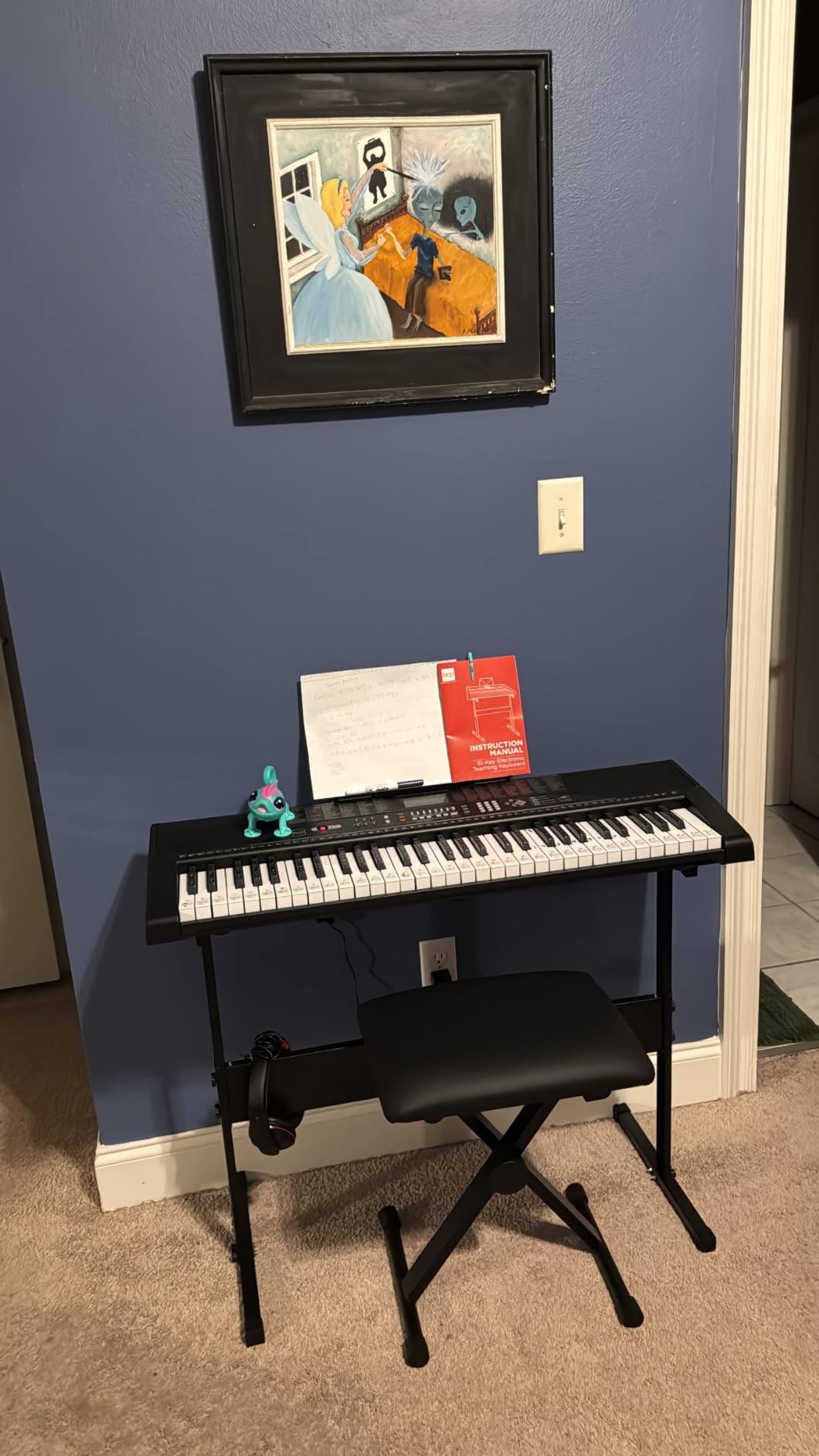
There is a USB port for playing along to songs stored on a drive, and a music player function for backing tracks. The three modes are the feature to understand: One-Key plays a single note when the correct key is struck, Follow walks through a piece note by note, and Ensemble holds the accompaniment back until the player is ready. One-Key is the one that gets used most, and the mode that helps a stuck child most.
Speakers are a genuine strength here. Reviewers consistently describe the sound as clear and rich with enough volume for a group to play along, which matters if siblings share the instrument. There is also a USB port for playing along to songs stored on a drive, which turns the board into a rehearsal tool for a recital piece.
The recurring complaints are mechanical rather than musical: some buttons begin to stick after a couple of months, the included stand is of average build, and the protective tape on the keys can leave residue that needs an alcohol wipe.
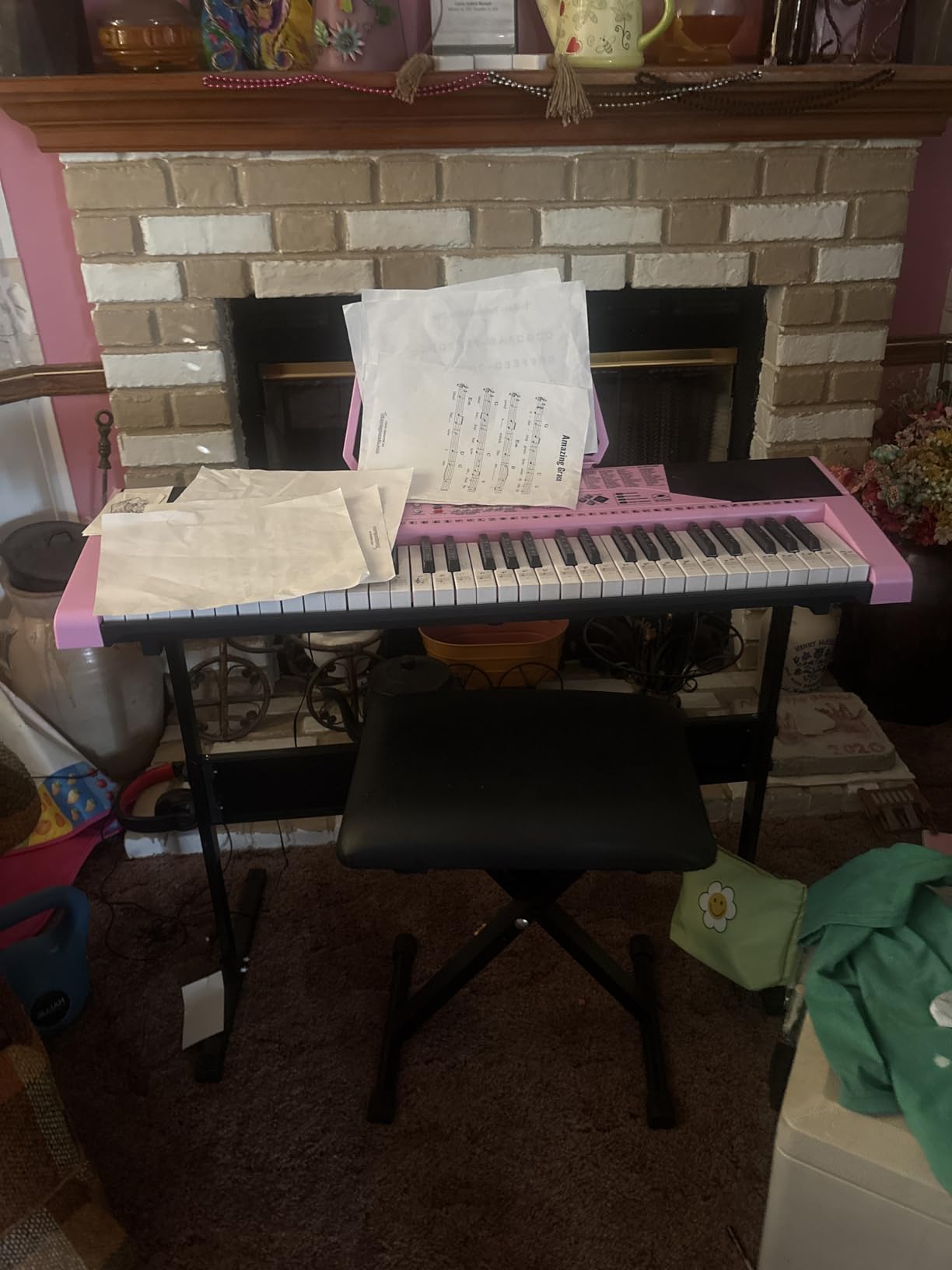
This is my pick for a child aged roughly seven to twelve who is practising alone for thirty minutes and wants guidance without a teacher present. The complete furniture bundle removes the extras budget entirely, which is the quiet reason it ranks so high for value.
As drawbacks go, the keybed is unweighted with limited dynamic response, and at 17.2 pounds this is a two-person lift rather than a grab-and-carry instrument. If your child needs to move it between rooms often, the Casio below is a better physical fit.
300 timbres and 300 rhythms
LED note and tempo display
Three-position stand and stool
Adapter or six AA batteries
The thing I did not expect to care about as much as I do is furniture height. Most bundles include a fixed-height stand, and a fixed-height stand is the reason a six-year-old ends up hunched over an instrument meant for a ten-year-old. This one has a three-position stand and a three-position padded stool, so the same setup can serve a five-year-old and an eleven-year-old.
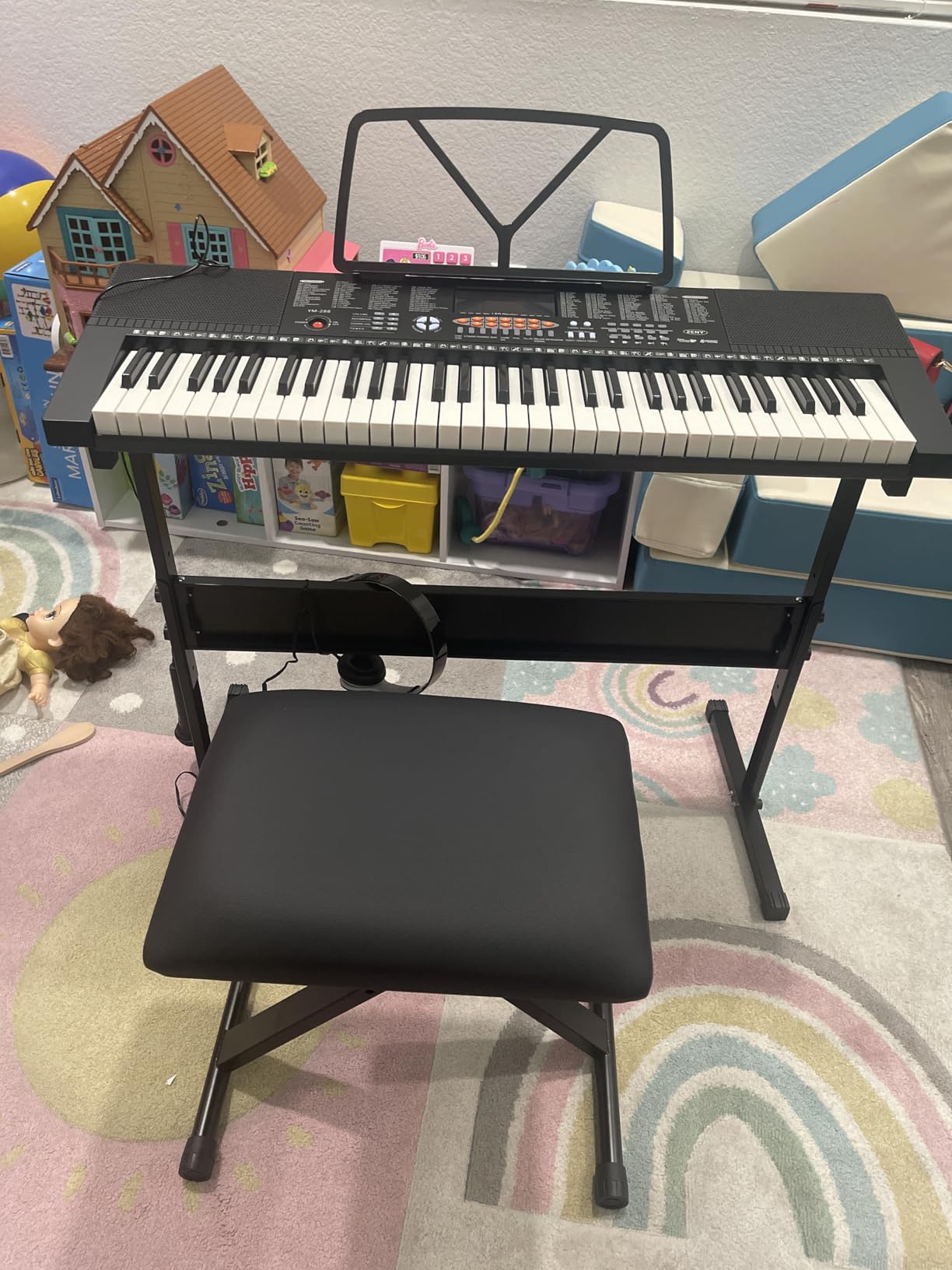
The stand adjusts between roughly 31 and 36 inches, and the stool adjusts to match. Getting a child’s forearms level with the keybed is the single cheapest way to build good playing posture, and it costs nothing once the furniture adjusts.
It does mean a bigger footprint. Assembled with the stand, the footprint is noticeably larger than a bare 61-key board, so measure the corner of the room before you commit. In a small apartment that matters.
Power comes from the included 110V-240V adapter or six AA batteries, so it can move to a grandparent’s house or a holiday trip, and there are stereo outputs, a headphone jack and a microphone. The LED screen shows the correct keys, chords and tempo for demo songs, which lets a beginner follow along with no teacher in the room — the feature buyers single out most.
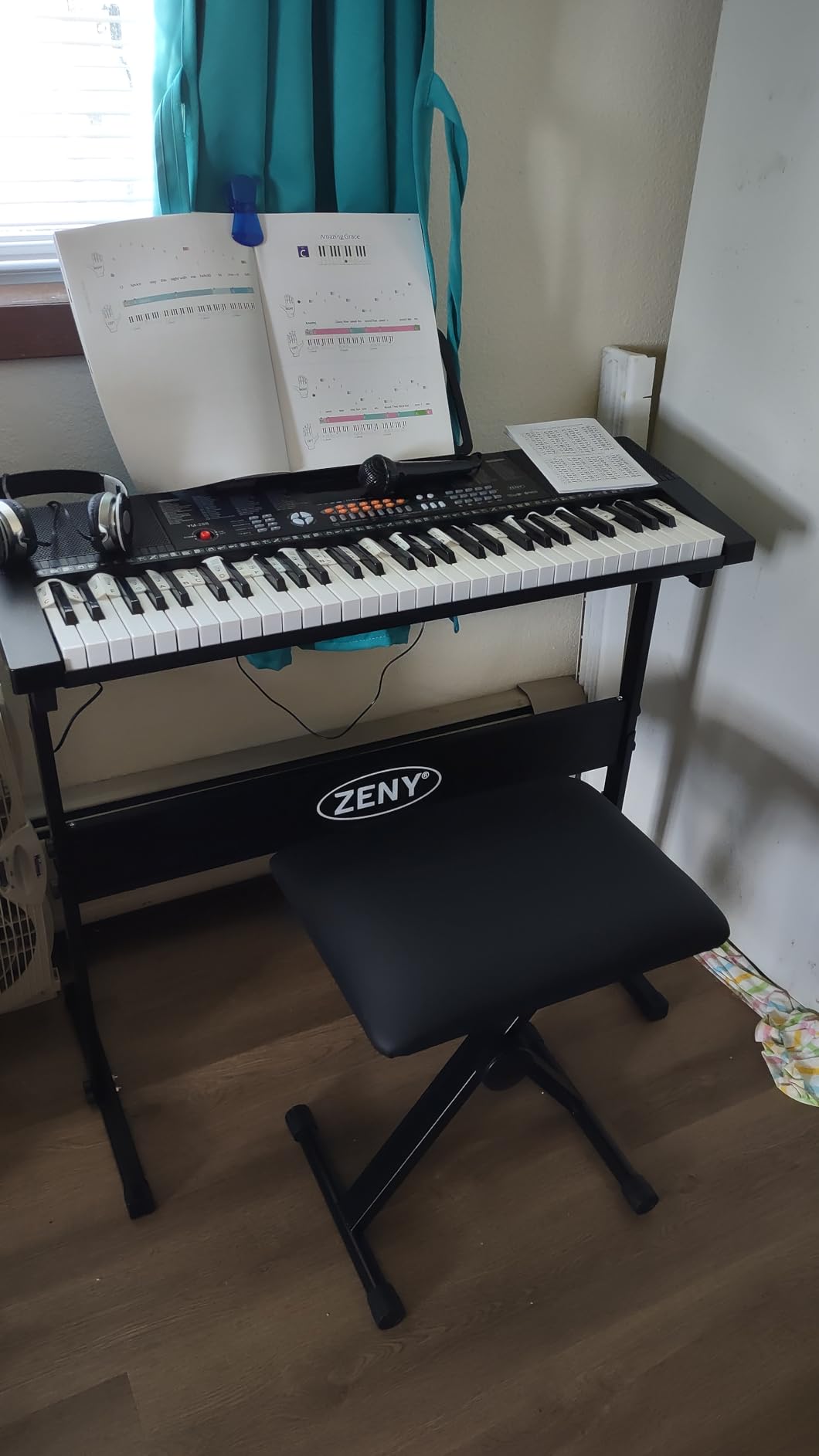
For a family with two or three children at different heights sharing one instrument, this is the pick. The adjustable furniture removes the need to buy a second stand when the older child gets serious.
Limitations are clear: the keys are unweighted with no velocity sensitivity, and the onboard sound quality is basic for the tier. It is a solid practice instrument, not a performance instrument.
61 full-size keys
400 tones and 77 rhythms
Class-compliant USB-MIDI
7.3 lb, 10.08 x 36.61 x 2.87 inches
This is the only board in the round-up with a class-compliant USB-MIDI port, and that single fact changes what you can do with it. Plug it into a Mac, PC, iPad or Android device and it behaves as a standard controller with no driver software — the difference between a keyboard and one that also works as a musical input device for the whole family.
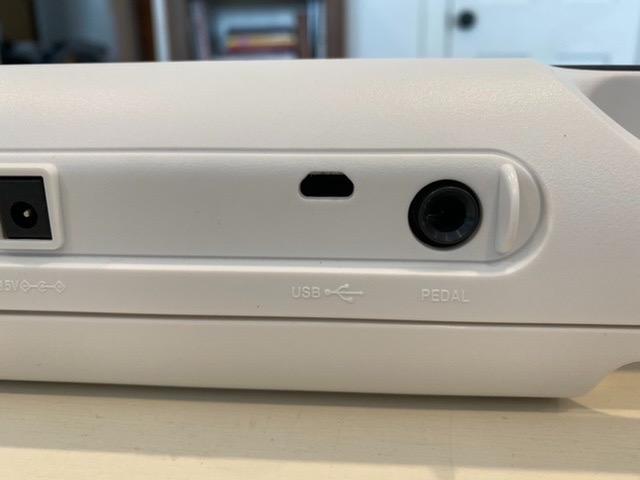
At 7.3 pounds with a built-in carry handle, this is the one I would actually move between a living room and a small bedroom without asking for help. The music rest slots into the handle when it is not in use, which is a small design decision that keeps the box tidy.
Battery or mains power is another portability win. Six AA batteries means lesson practice at a friend’s house or a summer break without hunting for a socket.
The sound library is 400 tones and 77 rhythms with 10 reverb types and a Dance Music Mode that lets a beginner remix a track. The dot-matrix LCD with dial and home button keeps the interface uncluttered, which matters more than it sounds when the alternative is a wall of buttons.
There are 60 built-in songs with right-hand and left-hand lesson support. Note that a USB-MIDI cable is not included and the port is a proprietary micro-B style, so budget for the correct cable before the first app session.
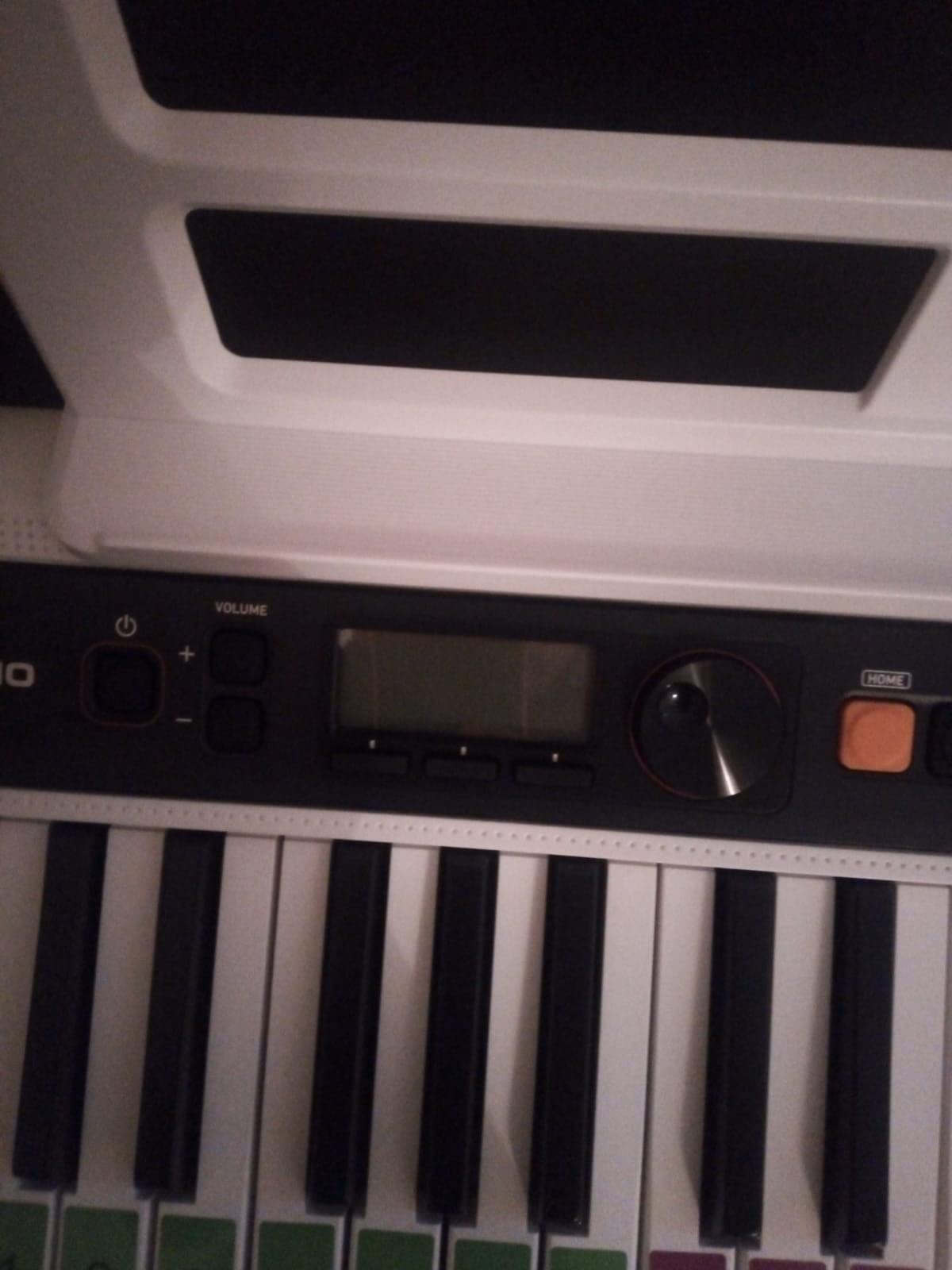
Choose this for a child aged about six to twelve who is moving toward structured lessons, travels to them, or wants to use tablet apps alongside a teacher. It is also the most grown-up-looking instrument in the list without tipping into weighted-key money.
The honest limitations are the absence of light-up keys or touch sensitivity, unweighted non-velocity keys, and speaker volume that sounds thin on its own without a pair of headphones. Headphones solve the volume issue immediately.
Three teaching modes
Light-up full-size keys
255 tones and 255 rhythms
X-stand, stool, headphones and mic
Bundle for bundle, this is the most generous list of extras here: X-stand, foldable soft stool, headphones, microphone, music rest and power adapter, with screws supplied to bolt the keyboard to the stand. That last detail is small and it matters, because a keyboard sliding off a stand mid-lesson ends practice.
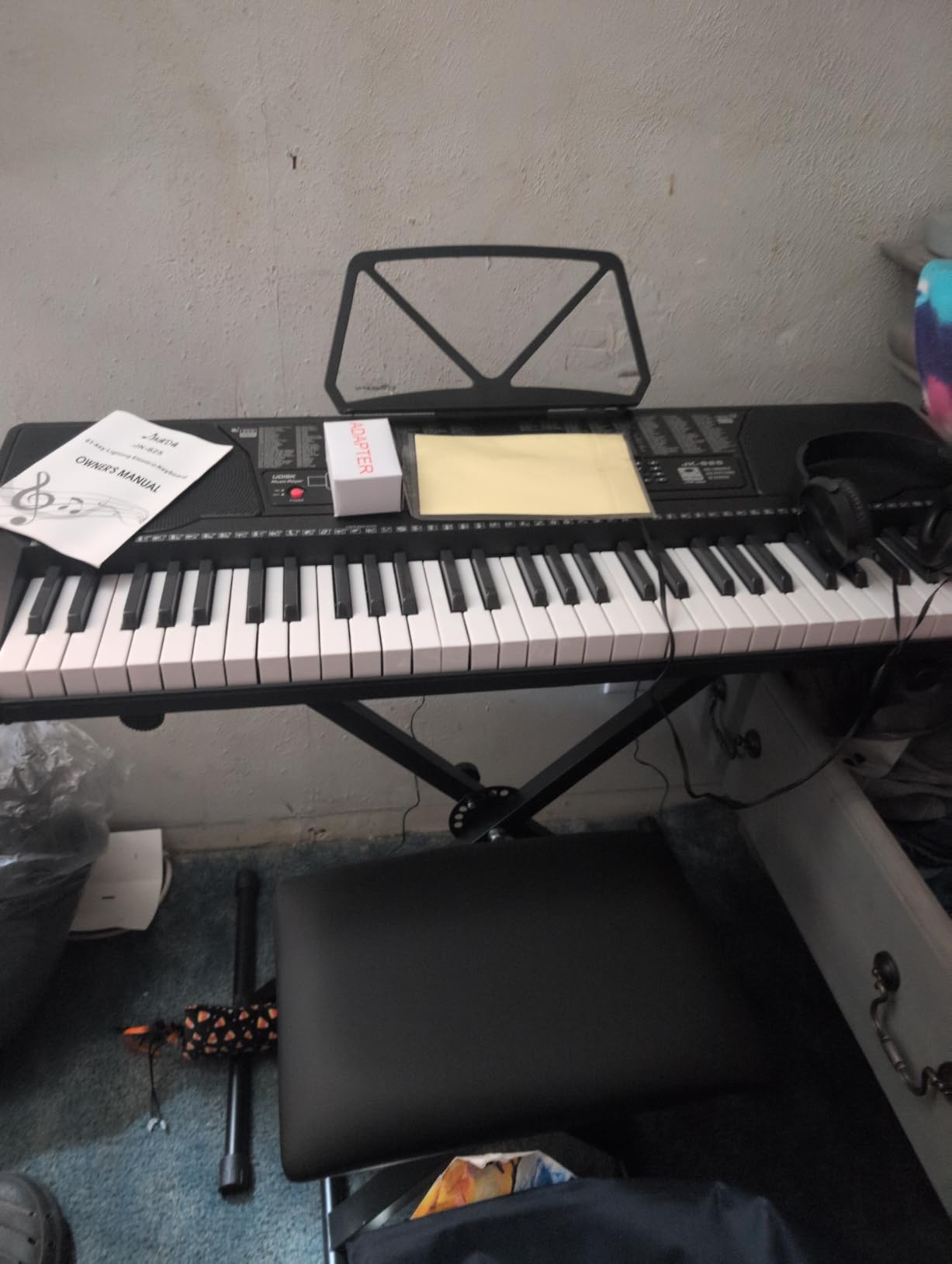
Light-up keys have a reputation problem, and it is deserved in the long run but not at the start. For the first few months, a child following illuminated notes is practising real note reading and real hand position. The keyboard is not playing the piece for them.
The dependency risk appears when a child uses lights as a crutch instead of reading notation. My advice is simple: turn the mode on for a new piece, turn it off once they can play it, and keep it off. Think of it as training wheels with a removal schedule.
Underneath is a 255-tone, 255-rhythm engine with 50 demo songs and 61 keyboard percussion types across twin stereo speakers, plus record and playback, metronome, sustain, vibrato, split, transposition and chord functions. Ports cover audio in and out, a microphone jack, a U-disk port and a 3.5mm headphone jack, and a status memory function recalls your tone, rhythm and tempo settings so a child does not rebuild their setup each session.
Assembly is the weak point. The written instructions are not very helpful and some assembly skill is needed, so allow a quarter of an hour rather than assuming a five-minute job. Keys are also highly sensitive to touch, which means younger fingers need a gentler approach than they would on a standard keybed.
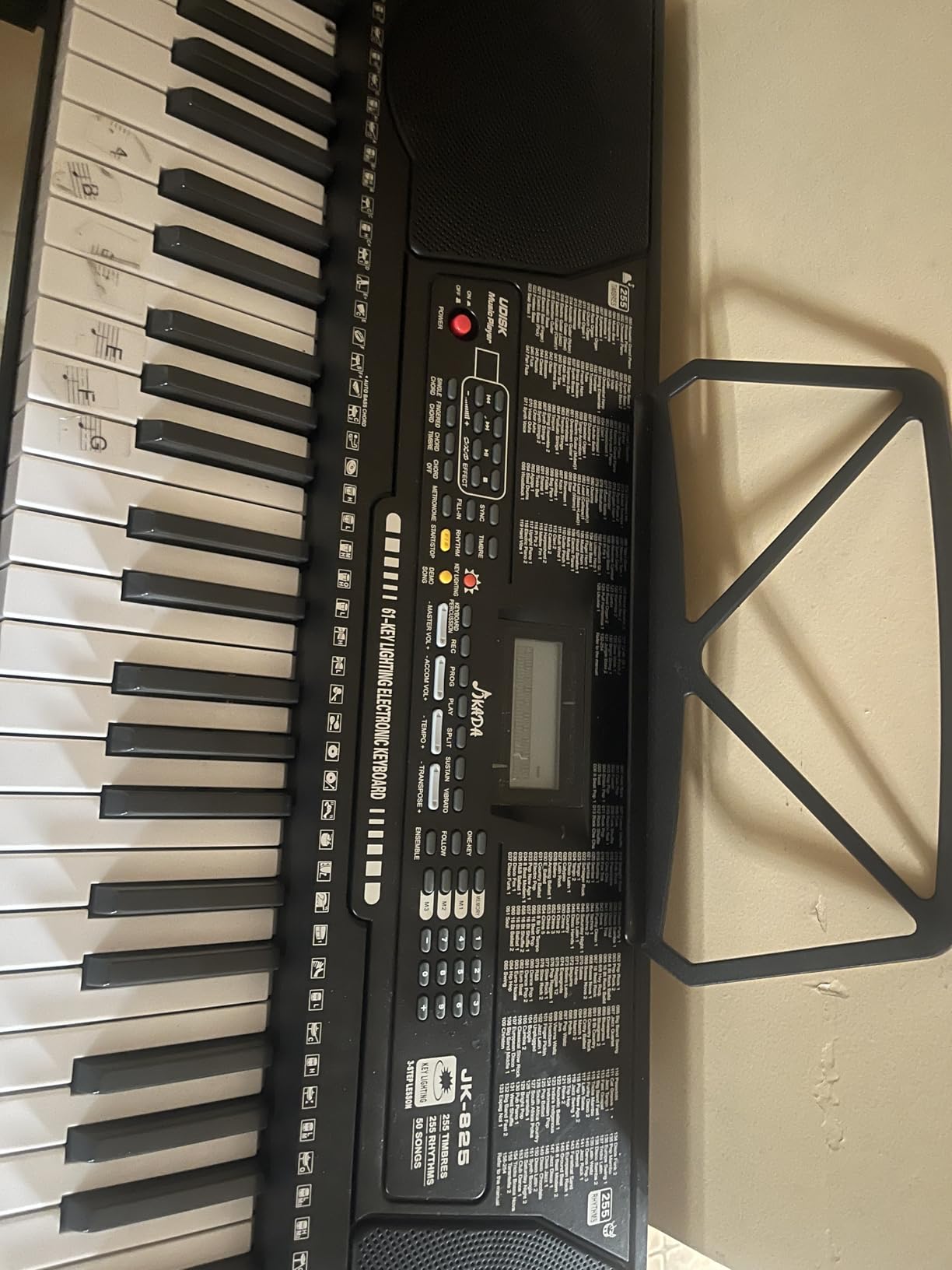
Best for a child aged roughly six to eleven who is enthusiastic and benefits from a lot of visible guidance, in a home where the keyboard stays put rather than moving around.
Its drawbacks are the fiddly assembly, the very light touch the keys demand, and an unweighted keybed with no velocity response. If your child is the type to bang on keys, look at the RockJam instead.
61 unweighted ABS mini keys
Light-up keys with three teaching modes
Up to 350 timbres
2.7 kg, 10.9 x 32.7 x 3.1 inches
Mini keys are the most misunderstood spec in this category. Shorter keys are not a cheap version of full-size keys; they are a genuinely different geometry built for finger spacing that a five-year-old actually has.
This board is 61 mini keys, and 61 is enough range to play a real tune. It is also the only board here that comes with a two-year warranty, which tells you something about how the manufacturer expects it to be treated.
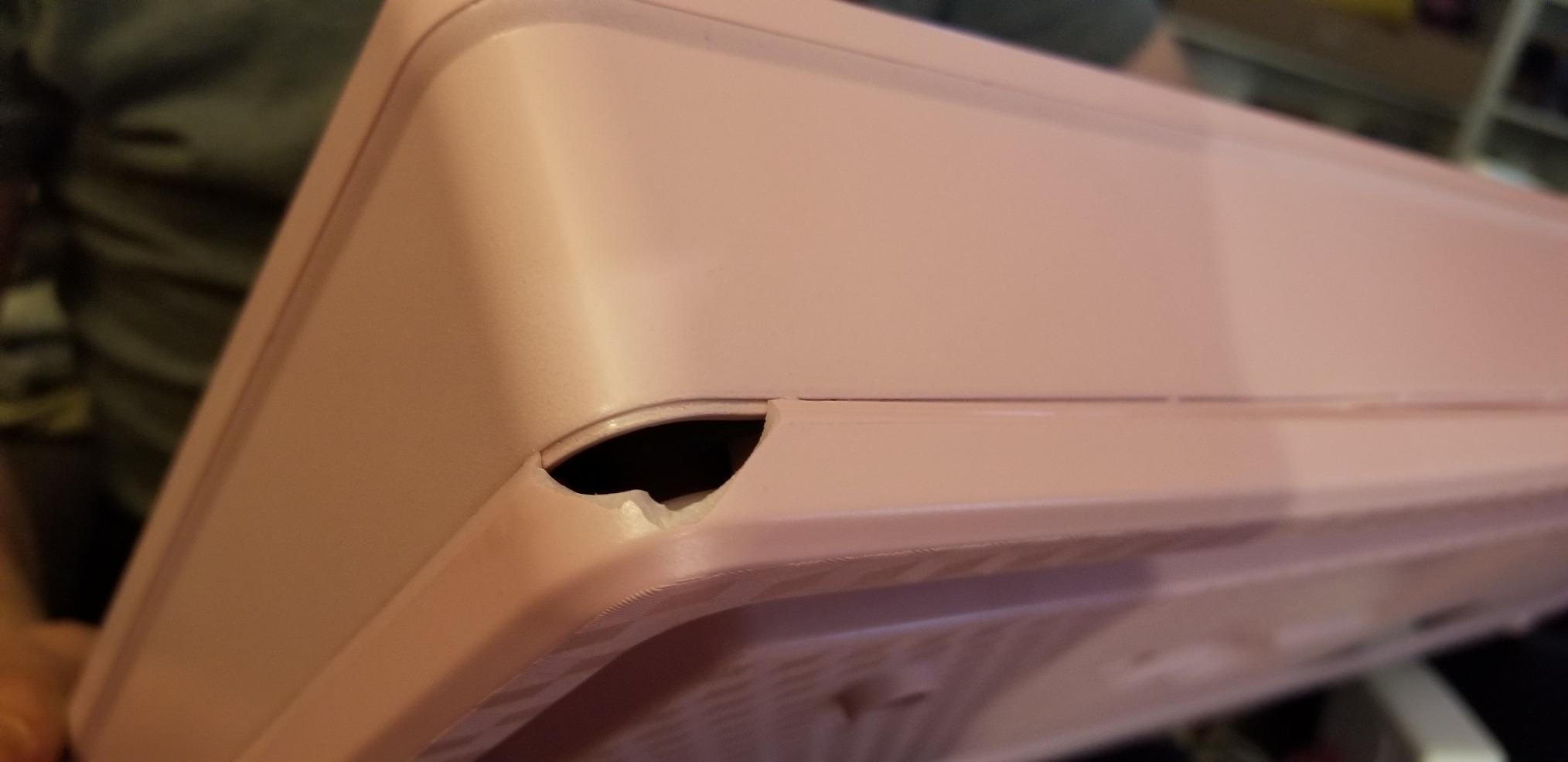
On a full-size key, a small finger has to land accurately in a narrow target. On a mini key, the target is larger relative to the fingertip, so a beginner gets more wrong notes right. That early success is a real psychological advantage and it is why parents of five-to-nine-year-olds like this board.
The crossover is hand span rather than a birthday. Watch for the moment your child can comfortably place a thumb and fifth finger over five white keys on a full-size keyboard, or starts commenting that the keys feel cramped. That is the signal to move up, and for many children it arrives between ages six and eight.
The on-screen setup is the core learning feature, with up to 350 timbres and rhythms, 30 demo songs and 8 percussion types behind it, plus sustain, vibrato, dual keyboard, chord, recording and playback. Two honest notes from buyers: the keys are very touch-sensitive and take some practice to handle, and the USB and MIDI ports are present but effectively unconnected. The bundled microphone is also reported by some buyers not to work.
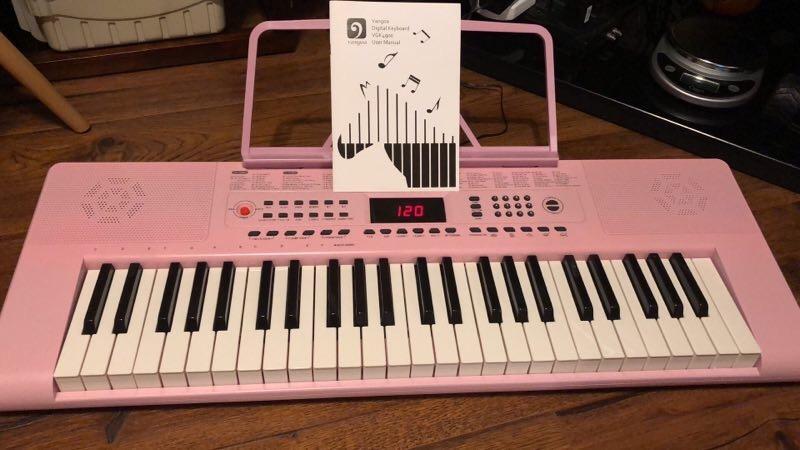
This is the one to buy for a four-to-seven-year-old whose hands are still small, especially if they have already been frustrated by full-size keys elsewhere. The moderate default volume and headphone jack are considerate touches for young ears.
The drawbacks are real: springy unweighted action that some reviewers find too light, an unfinished port story, and an unreliable microphone. If the child is eight or older, step up to a full-size keybed instead.
Built-in rechargeable battery
61 keys, 100 tones and rhythms
50-song teaching bank
2.5 lb, 24.6 x 7.9 x 2.45 inches
The rechargeable battery is the reason this one exists. About four hours of charging gives more than ten hours of play, and at 2.5 pounds with no cable attached it goes from car seat to floor to grandparent’s house without a negotiation. It is also the smallest 61-key board here at just under 25 inches long, so it answers a small apartment where a full-size rig with a stand will not fit.
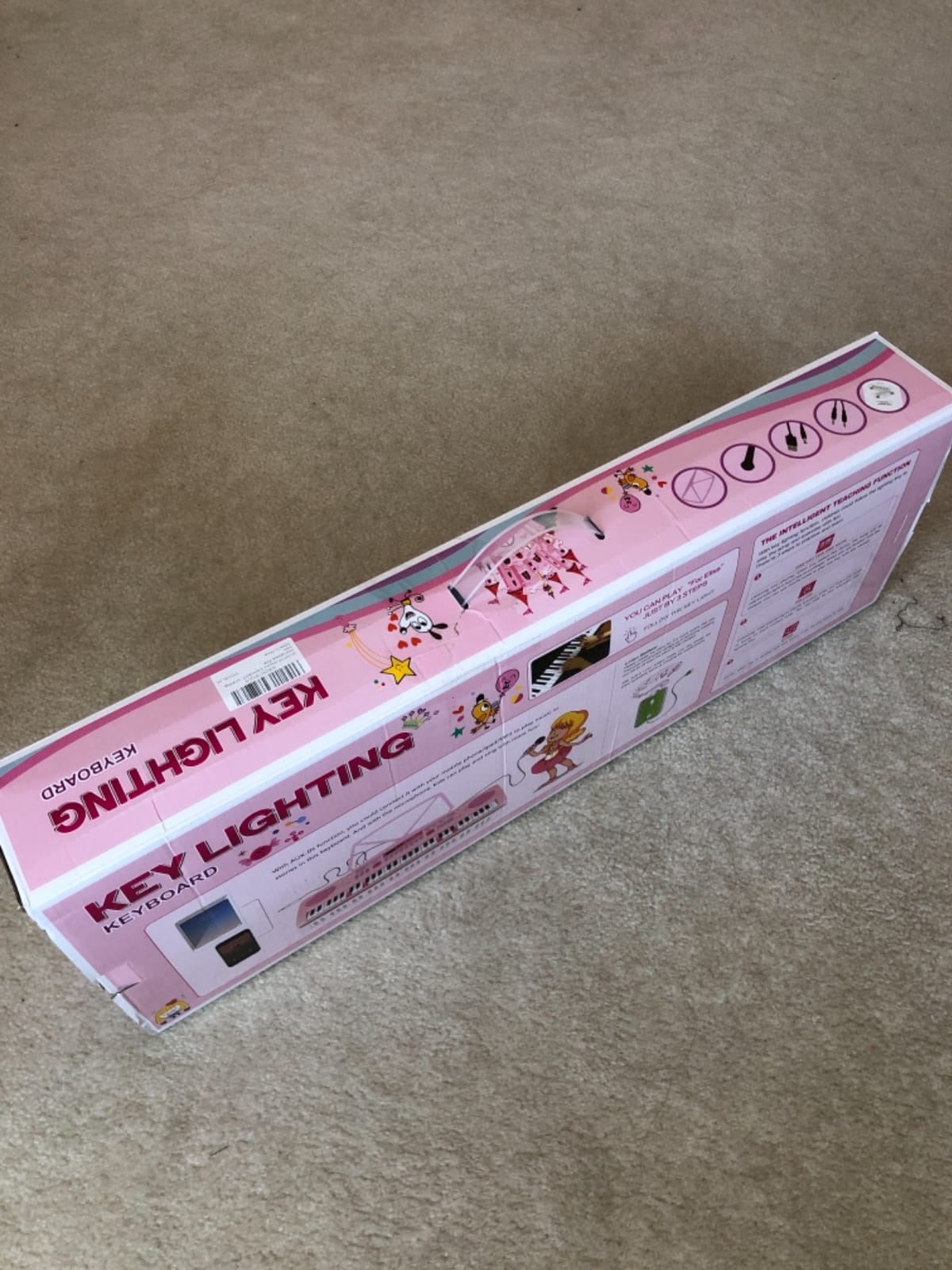
Most parents picture a battery problem: six AA cells, a weekly replacement, and a child asking why the music stopped. A built-in lithium-ion pack removes that entire category of friction, and at this weight the keyboard is genuinely portable rather than theoretically portable. The audio cable jack also lets a phone, tablet or MP3 player feed songs in.
There are 100 tones, 100 rhythms and 50 demo songs, with a teaching mode song bank that lights keys up during playback. Recording and playback give a child an immediate way to hear themselves, which is often the motivation that keeps a four-year-old coming back.
Here is the critical limitation: this keyboard cannot sound three notes at once, so chords are not possible. That is fine for a child exploring single-note tunes and a real ceiling the moment anyone tries to learn chord-based repertoire. The detachable microphone adds singing along, though there is no separate microphone volume control, which kids notice quickly.
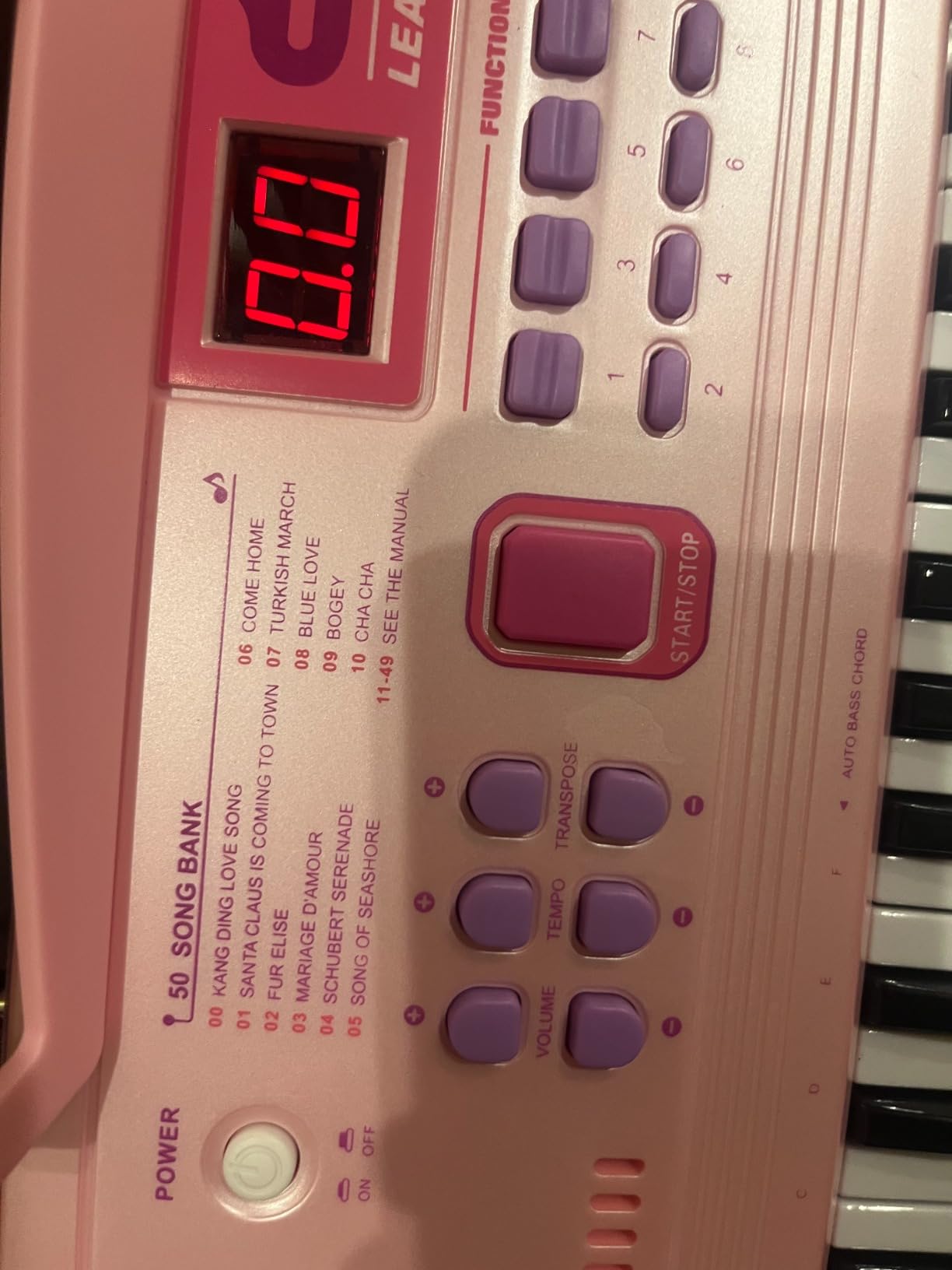
Buy this for a four-to-eight-year-old who plays on the floor, in the car or away from a socket, and who is not yet at the stage of playing chords. The twelve-month warranty is a modest but real commitment from the seller.
Treat it as a portable introduction to music rather than a practice instrument. The keys are small and light, the single-note limit caps what can be learned, and some buttons respond unreliably. For a child entering formal lessons, the RockJam is the better step up.
61 narrow keys
16 tones and 10 rhythms
Rechargeable via USB cable
3 lb, 7.8 x 2.4 x 24.8 inches
I want to be straight about this one. It is the least expensive route into a 61-key layout, and for the specific job of answering a question in an adult’s head, it does that well enough. The mystery is whether the child is still interested three months from now, and forum threads about six-year-olds make the start-cheap-then-upgrade strategy a common plan among parents.
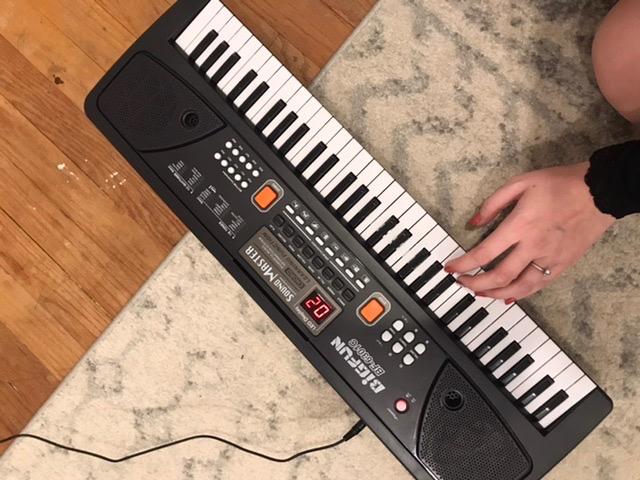
The sound library is modest at 16 tones, 10 rhythms, 6 demo songs and 8 percussion types. What matters more is the key count: 61 keys with an AUX-IN jack to run audio from a phone or computer, plus a chord function on the lower 20 keys and a single-finger follow mode.
Those two features put it ahead of its class for a child who is starting to read simple songs. They also do not fix narrow keys, and the narrowness is the most common complaint in reviews because it makes accurate practice harder for a beginner who has to look down.
A built-in rechargeable battery charged over USB means no battery aisle or spare cells, and the box includes a microphone, USB cable, music stand, AUX-IN cable and manual for a recommended 3-to-12 age range. One piece of concrete advice: turn the volume down before power-up, because the board resets to maximum volume every time it switches on. That is exactly the wrong surprise in a flat at bedtime, and the lowest reviews come from durability complaints and occasional dead keys, so inspect the keys on arrival.
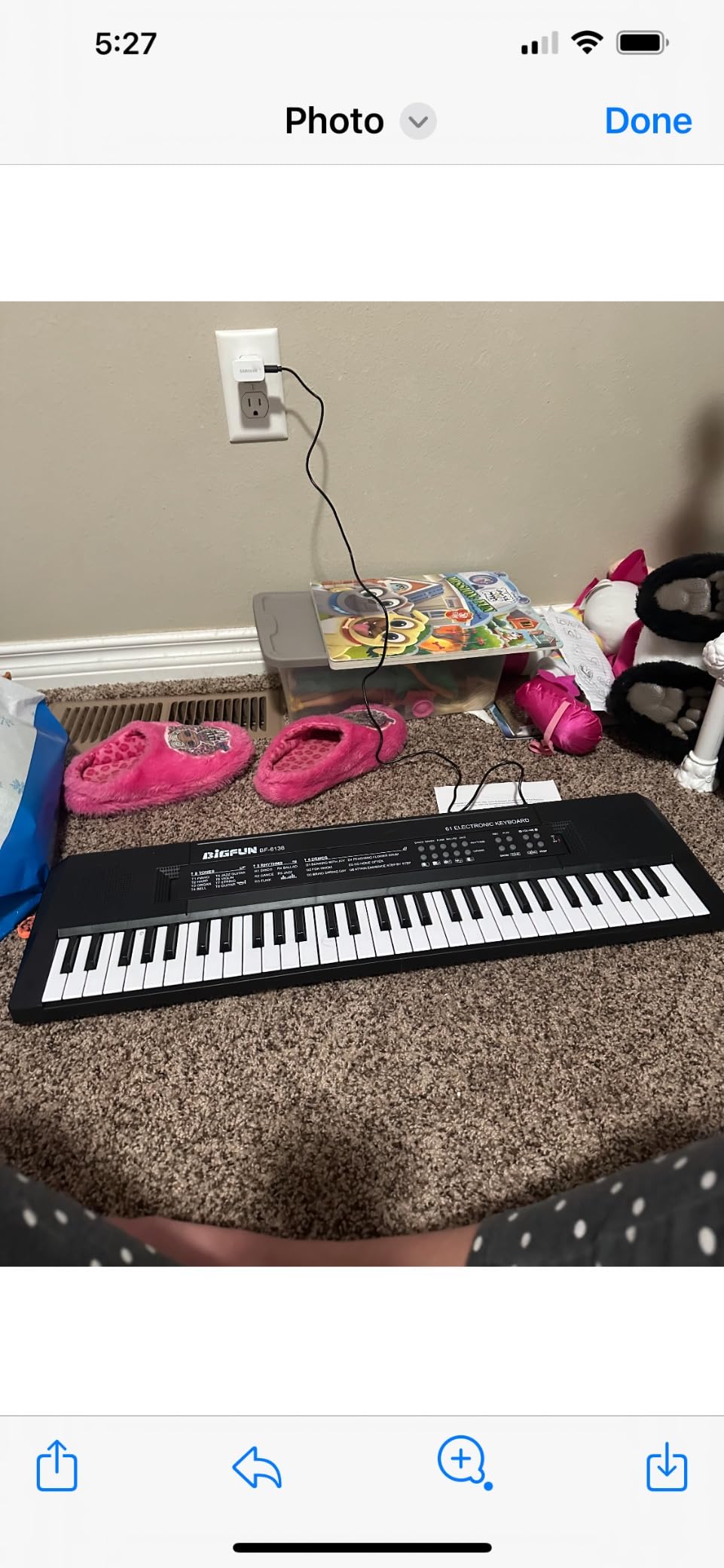
This suits a three-to-eight-year-old in a household that wants to test interest cheaply before committing to a full setup. There is no stand, bench or headphones in the box, so budget separately for those if practice is going to be regular.
Basic build quality, occasional dead keys, narrow keys and no beginner guide book are the honest limits. This is a starting point with a defined end date, not an instrument to keep for years.
37 keys that light up as played
8 instrument sounds
4 AA batteries, stand and stool included
5 lb, 24 x 11 x 24 inches with stand
A three-year-old cannot span a full-size octave, so buying them a real 61-key board is buying them a frustration. This is the age-appropriate answer: 37 keys, light-up playing surfaces, and a stand and stool that put the keybed at toddler height.
The manufacturer lists it for ages three and up, and buyers consistently describe it as an engaging introduction to music rather than a practice instrument. Setting that expectation early prevents disappointment later.
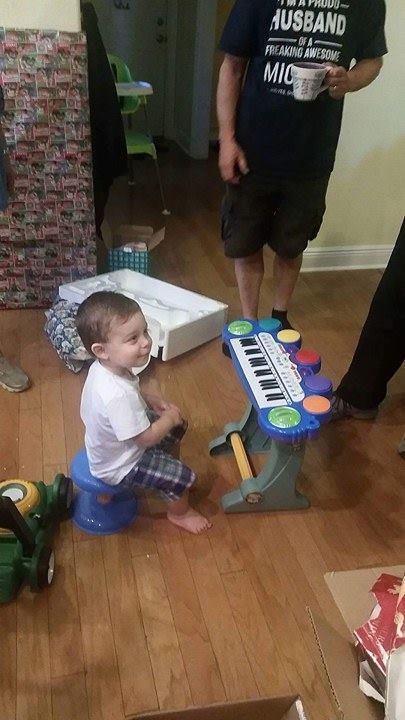
Thirty-seven keys covers roughly three octaves, enough for nursery rhymes, the first tunes in most beginner books and a lot of improvisation, but not enough for two-hand repertoire or any wide chord shape. Sticker prompts placed above the keys give a toddler a starting point for simple tunes, which is a clever solution to the fact that nobody reads note names at three. The keys also light up as played.
There are 8 instrument sounds including piano and violin, 8 demo rhythms covering slow rock, rock, disco, blues and samba, 5 drum sounds and 4 animal sound buttons, with volume, tempo and playback controls. The build is light plastic, which is correct for the age and wrong for anything else, and it runs on four AA batteries, so expect regular replacements. The included stand and stool put the keybed at proper sitting height.
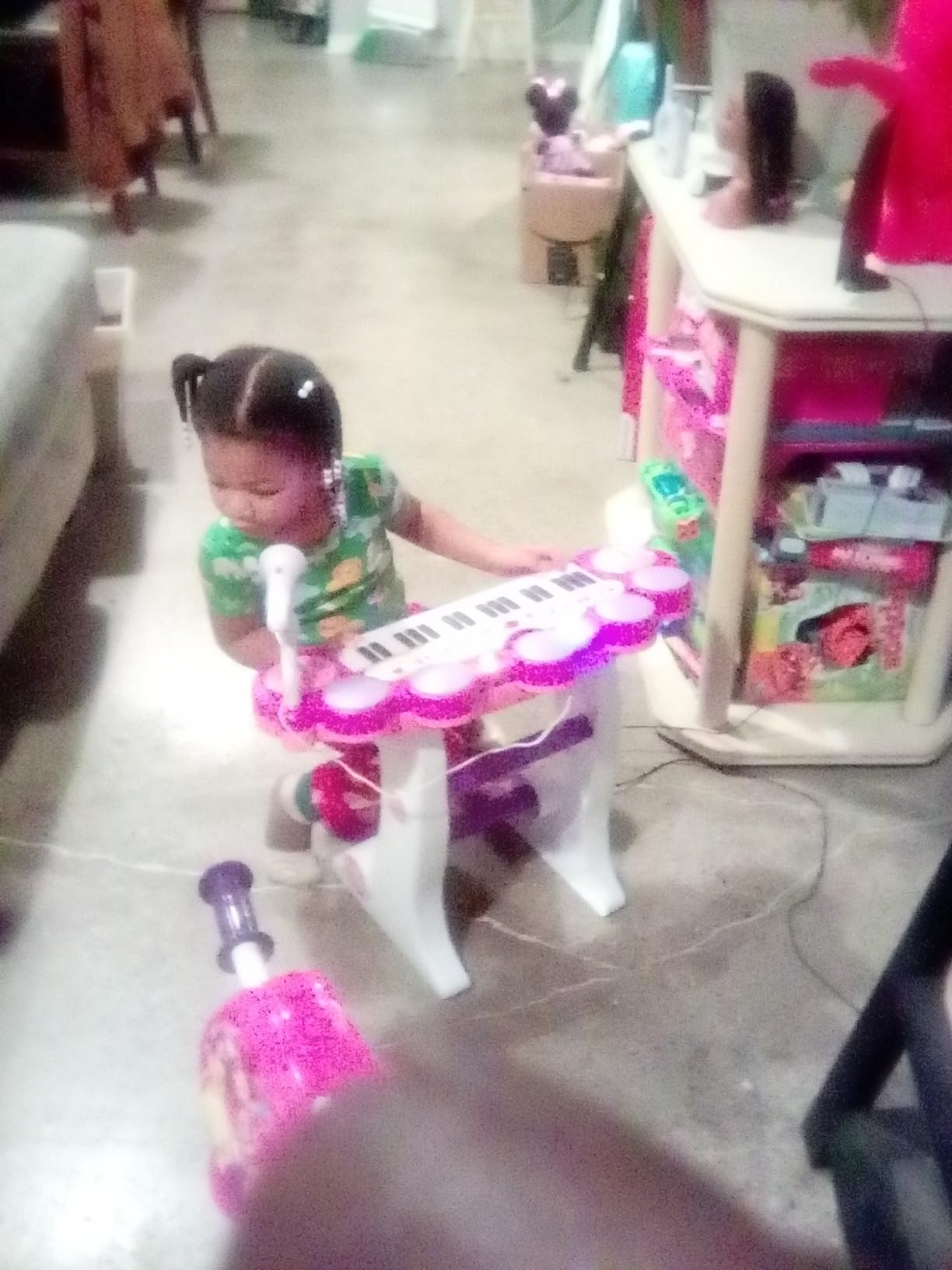
This is the pick for ages three to five, and for any child whose first instrument should be about curiosity rather than technique. The variety of sounds and the animal buttons do the holding-attention work that no amount of lesson content can at that age.
It should be a stepping stone, not a destination. Thirty-seven keys and a light plastic build mean a move to a 61-key board is inevitable once lessons begin, and parents who skip straight to a 61-key full-size board usually end up buying a second instrument within a year.
37 mini keys for small fingers
8 tones, 8 rhythms, 6 demos
Under 2.2 lb, 16.9 x 6.2 x 2.1 inches
5V-1A USB adapter power
This is the lowest-commitment instrument in the round-up and the only one a two-year-old can genuinely carry. At under 2.2 pounds and just over 16 inches long, it needs no stand, which removes the single biggest obstacle to a very young child starting. It is also CPC children-certified and RoHS compliant, which matters when something designed for a toddler ends up in a small pair of hands unsupervised.
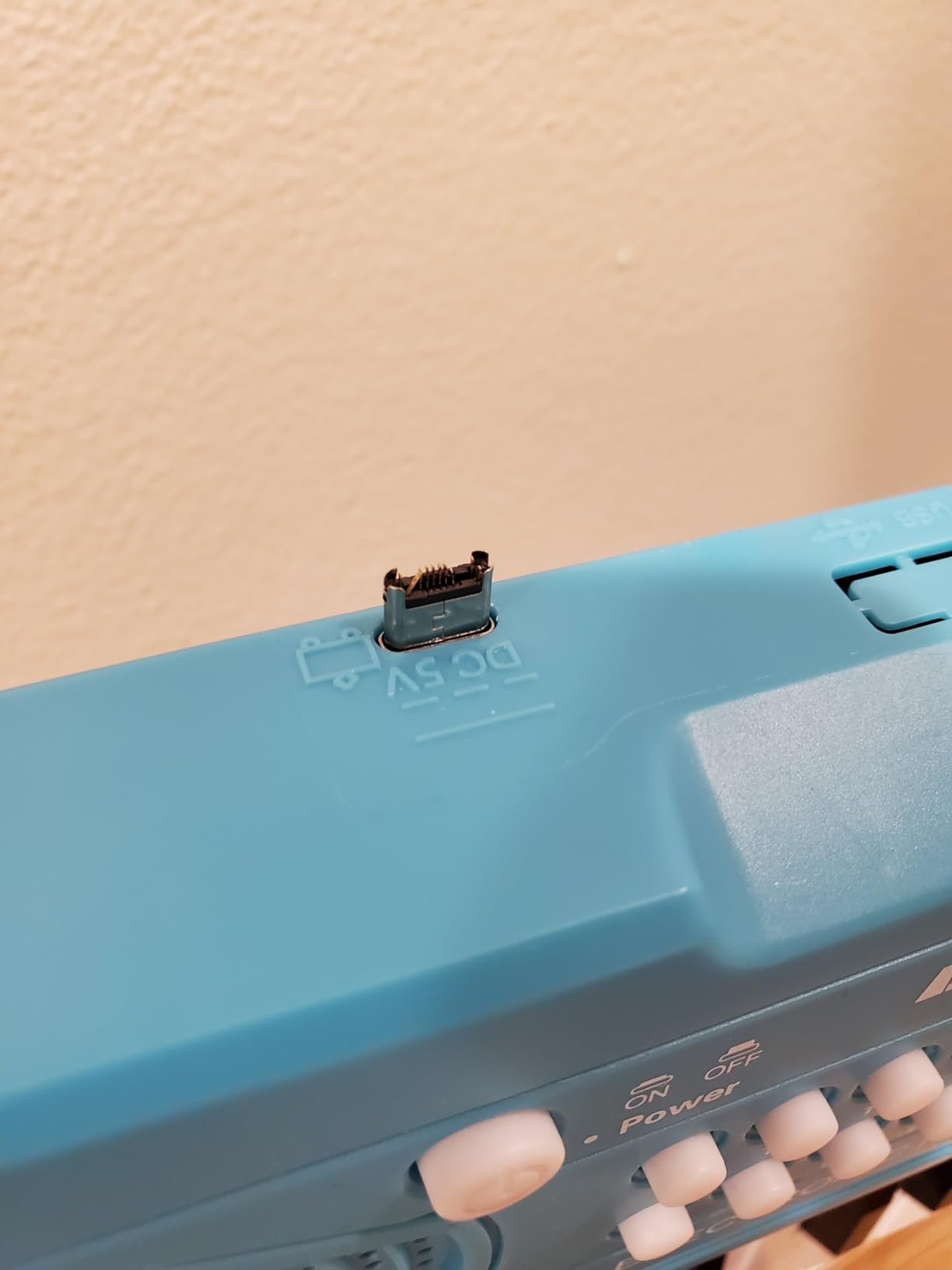
The 37 mini keys are sized for toddler finger spacing, so a small hand can land them without aiming, and the plastic body powers from a 5V-1A USB adapter. The automatic standby sleep function is a genuinely useful detail with young children: it cuts standby drain when the piano is left running after a session, which is otherwise a silent battery cost.
There are 8 tones, 8 rhythms, 6 demo songs, 4 percussion types and 26 settings, with dual speakers, ensemble mode, a keyboard drum function and an audio cable jack, plus record and playback for immediate self-feedback.
The honest ceiling: 37 keys is a short range, the build feels flimsy in the hand, and the tiny buttons are difficult for small children to press reliably. Sound quality is basic and suited to play rather than practice.
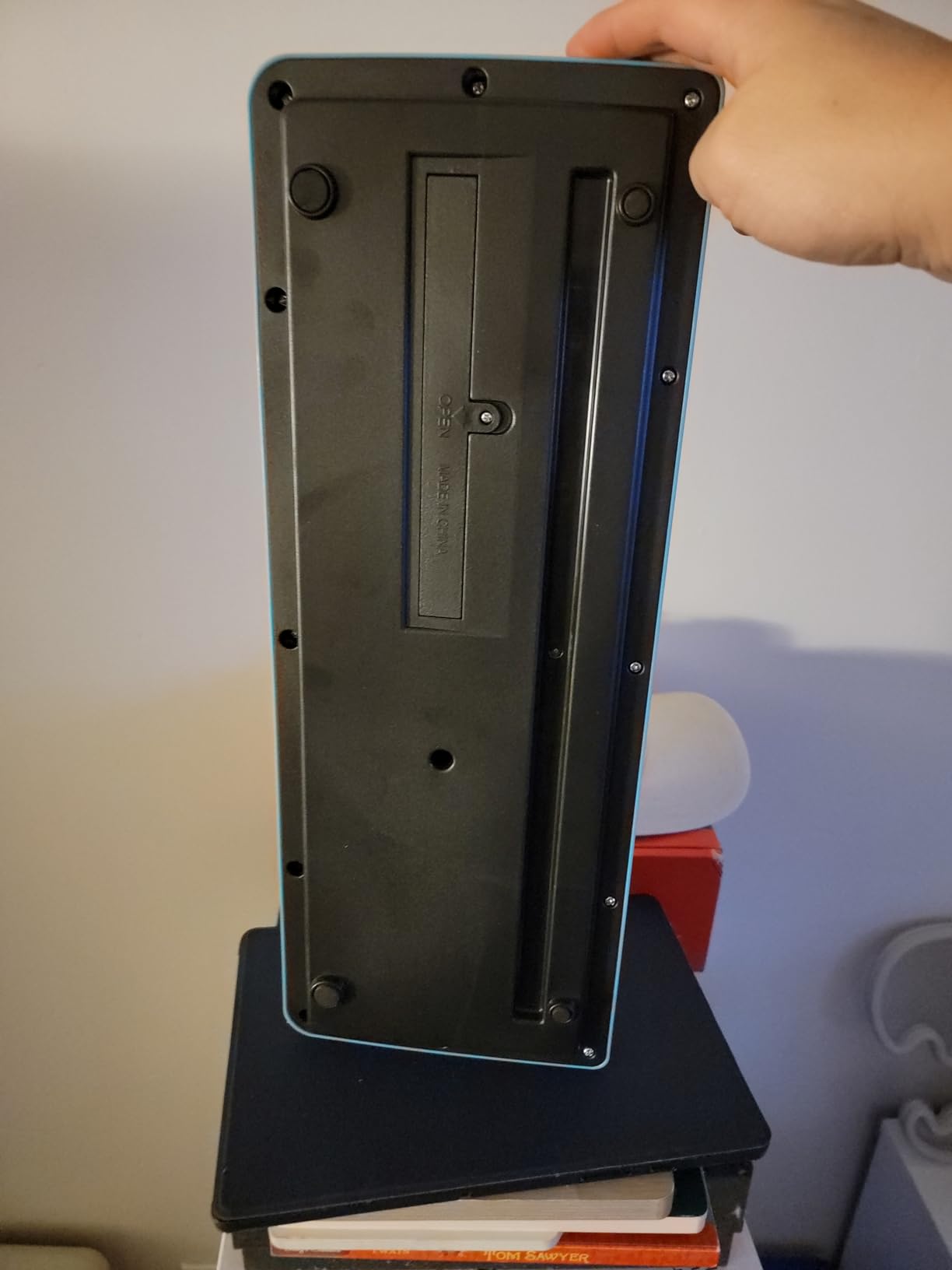
Parents of two-to-four-year-olds use it as a low-cost way to find out whether music holds their child’s attention before buying anything substantial. Most report exactly that outcome, which is a fair use for a first instrument.
Expect to move up within a year or two. If your child is already three and heading toward lessons, the Best Choice Products 37-key set above is a sturdier place to start, and if they are five or older, skip both and go straight to a 61-key board.
How many keys does a child actually need? Match the count to the age, not to the price. Ages three to five need 37 keys or a mini-key board. Ages six to eight need 61 keys, which is the range most beginner methods assume. Ages nine to twelve on a serious study path should be looking at 88 weighted keys, and that is a step up in cost and in weight that no sub-list can hide.
Sixty-one is the practical answer for most families because it spans five octaves and leaves room for both hands. Going below 37 keys removes real music from the equation; going above 61 without needing it adds weight, cost and a footprint that most homes will resent.
Mini keys versus full-size keys: where the crossover happens. Mini keys suit a hand that cannot yet span a full-size octave comfortably, which in practice means roughly ages three to seven. Watch the hands, not the birthday: when your child can comfortably place a thumb and fifth finger over five white keys on a full-size board, or complains that the keys feel cramped, it is time to move up.
Should a beginner get a 61 or 88 key keyboard? A 61-key unweighted board is right for a first instrument, and 88 weighted keys are right for a child who has already proved commitment. The gap between those two facts is where a lot of parents overspend or underinvest.
What weighted keys really mean for a beginner. Weighted means the key resists your finger and returns energy on release, like an acoustic action. It is graded rather than binary, so a light-weighted board is far easier than a heavy one. Teachers on r/pianoteachers warn against heavy actions for seven-year-olds whose hands are not ready, and I agree: too much resistance causes a child to play weakly and develop bad habits.
Unweighted keys are not a failure state. They are the right choice for the first two years of study for most children, provided the key SIZE is full-size. The common parent mistake is buying a board with mini keys, blaming the lack of weight, and wondering why the child still struggles to play accurately.
Teaching modes and lighted keys: help or a crutch? They are genuine help for the first few months and a genuine crutch after that. Treat them as training wheels with a removal schedule: lights on for a new piece, lights off once the child can play it independently. Several of the boards below use them.
The extras budget most parents forget. Most bare keyboards ship with a power adapter and a music rest, and nothing else. A complete setup also needs a stand, a bench at correct height, headphones and, on a weighted instrument, a pedal unit. Parents on r/piano repeatedly describe this as the moment the real cost arrives, so plan for it in the original budget. The RockJam, ZENY, Best Choice Products 61-Key and JIKADA sets above each bundle at least some of that, which is most of why they rank well.
Noise, volume control and headphone practice. In an apartment or a shared wall, headphones are not a luxury. Look for a proper 3.5mm headphone output and a master volume that remembers your setting, and check whether the volume resets on power-up, because one board in this round-up does exactly that.
MIDI and lesson apps for kids who want tablet learning. A USB-MIDI port turns the keyboard into a controller for lesson software and notation programs. Of the ten boards here, the Casio CT-S200 has a class-compliant port that works with phones and computers without drivers, which is the setup I would pick for app-based learning.
Should you buy a portable keyboard at all? The teacher-side argument is that a cheap portable teaches bad technique and that attrition is high. I think the argument is right about instruments with 25 to 37 springy keys and no bench, and largely wrong about a 61-key unweighted board with a proper stand and sustain pedal. Judge the instrument by key size, furniture and the presence of a pedal, not by the word portable.
New or used? Used makes sense for a first stage instrument and rarely makes sense for a child’s main practice keyboard, where action feel and reliability matter most. Inspect every key for dead response, check the hinges and the battery compartment, and confirm the power supply is included before you pay.
For most families the RockJam RJ5061 is the best first keyboard, because it arrives with a stand, bench, headphones and note stickers alongside 61 full-size keys. A child under five does better starting on a 37-key board such as the Best Choice Products 37-Key, and a child who wants to use tablet lesson apps is better served by the Casio CT-S200 and its USB-MIDI port.
A 61-key board is the right first instrument, and 88 weighted keys are the right upgrade once a child has shown real commitment. 61 keys span five octaves, which covers most first- and second-year repertoire and fits the range most beginner methods assume. Buy 88 weighted keys when lessons become a serious study path rather than a trial.
At four years old, key SIZE matters more than key count or sound quality. A 37-key board with a stand and stool, such as the Best Choice Products 37-Key or the BIGFUN 37-Key, gives a small hand keys it can land accurately and a way to explore sounds. Do not start a four-year-old on a 61-key full-size board; the hand span is not there yet.
For a ten-year-old on structured lessons, a 61-key unweighted board with light-up teaching modes works well, and the Best Choice Products 61-Key set is the strongest option here. If the child is already a serious student, move up to 88 weighted keys instead. The step up is real: it is a larger instrument, heavier, and a bigger purchase.
Only boards with 88 weighted keys reach that description, because 61 keys cannot cover the full piano range regardless of how they feel. Weighting is graded, so a light-weighted action is far easier for a child than a heavy one. Teachers commonly caution against heavy actions for children under eight, whose hands are not ready for the resistance.
Two different things share that description. Mini KEYED keyboards with 37 or 61 mini keys are worth it for ages three to seven, because the smaller keys match small finger spacing. Mini MIDI keyboards with no built-in sounds are a different product entirely, useful for music production but a poor choice as a child’s first piano instrument.
For a child aged three to five, start with the Best Choice Products 37-Key if lessons are beginning, or the BIGFUN 37-Key if you are testing interest at the lowest commitment. Both put a small hand on keys it can actually reach.
For ages six to eight, the RockJam RJ5061 is the pick, with the Casio CT-S200 as the alternative when portability or tablet apps matter. For ages nine to twelve, stay on the RockJam or move to the Best Choice Products 61-Key set if light-up teaching modes keep your child practising independently.
Once a child is committed and lessons are weekly, none of these unweighted boards is the destination. That is when 88 weighted keys earn their place, and the RockJam or the Best Choice Products set is the instrument you will have already finished paying for by then. If you are choosing other learning toys in the same year, our picks for building block sets for kids and waterproof cameras for kids follow the same test: can a child use it alone, and will they still in a year?
Updated for October 2026. Every product here was selected on verified specifications, box contents and reviewer feedback, and we may earn a commission when you buy through the links on this page.