Physical Address
304 North Cardinal St.
Dorchester Center, MA 02124
Physical Address
304 North Cardinal St.
Dorchester Center, MA 02124

After six weeks of swapping lamps on the same desk, I can tell you that the best desk lamps for eye strain are the ones that remove glare and match your screen brightness, not the ones with the biggest lumen number on the box. My overall pick is the Lepro LED Desk Lamp, with the Micomlan 24W clamp lamp and the TROND Halo as the two runners-up.
That conclusion surprised me. I started out ranking lamps on brightness and ended up ranking them on contrast, diffusion and whether the manufacturer could tell me how the flicker claim was tested. Those three things explain nearly every complaint I had after a month of screen work: a bright hotspot in a dark room, a reflection across the display, and a shadow across the keyboard.
What follows is a roundup of 12 lamps I set up on a standing desk, a dual-monitor arm rig and a small dorm-style desk, in that order. Every product here has published color temperature control, adjustable brightness and a light source you can keep out of your line of sight. I have included the specs that actually move the needle, plus the ones that do not.
One honest note before we start: a lamp cannot fix dry eye, an uncorrected prescription, or glare emitted by the monitor itself. If your eyes sting after two hours regardless of lighting, the lighting is not the problem. Everything below is about contrast, reflection and stability, which is where lighting genuinely does move the needle.
If you are shopping for the light in the room rather than the light on the desk, our guides to the best macaw lamps and night lights and the best Himalayan salt lamps cover that different category. The best plasma ball lamps roundup is worth a look if you want something purely decorative.


Those three cover the three most common setups. The Lepro wins on control granularity and a small footprint. The Micomlan wins on coverage and glare control when you have two monitors or a wide work surface. The TROND wins if you want one simple, reliable lamp with a memory function and a slim base.
Our selection criteria follow published workplace guidance rather than marketing copy. The OSHA computer workstation eTool and the CCOHS lighting ergonomics checklist both point at the same three problems: reflections on the display, uneven brightness between the task and the room, and glare from a visible light source. Those became the backbone of our ranking.
On flicker we used the framework in IEEE 1789 guidance for LED modulation and the RG0 and RG1 blue light hazard categories from IEC 62778. Where a manufacturer discloses a test or a certification, we say so. Where the word flicker-free appears with no method attached, we treat it as an unsupported label and say that too.
Three definitions before the picks, because these words carry all the weight:
CRI (color rendering index) measures how faithfully a light shows color compared with a reference source. Below 80, colors look dull and skin tones shift. At 90 the light looks natural. At 95 and above it is close to daylight, which matters for craft work, illustration and makeup.
Color temperature in Kelvin describes how warm or cool the light looks, not how bright it is. 2700K is a warm evening tone, 4000K is neutral daytime light, and 6500K is a cool daylight tone. The eye-strain lever is switching between them across the day, not sitting at one value forever.
Flicker-free means the LED output stays steady as the driver modulates current. Untrained eyes often tolerate it, but for some people a flickering dimmer is a headache trigger. A bare label tells you nothing, which is why we flag the ones that cite IEC 62778 or similar.
| Product | Features | |
|---|---|---|
| Lepro LED Desk Lamp 750LM Touch Desk Light |
|
Check Latest Price |
| TROND Halo Dimmable Eye-Caring Table Lamp |
|
Check Latest Price |
| Micomlan 24W Architect Clamp Desk Lamp |
|
Check Latest Price |
 Pzloz 24W Architect Clamp Desk Lamp Pzloz 24W Architect Clamp Desk Lamp |
|
Check Latest Price |
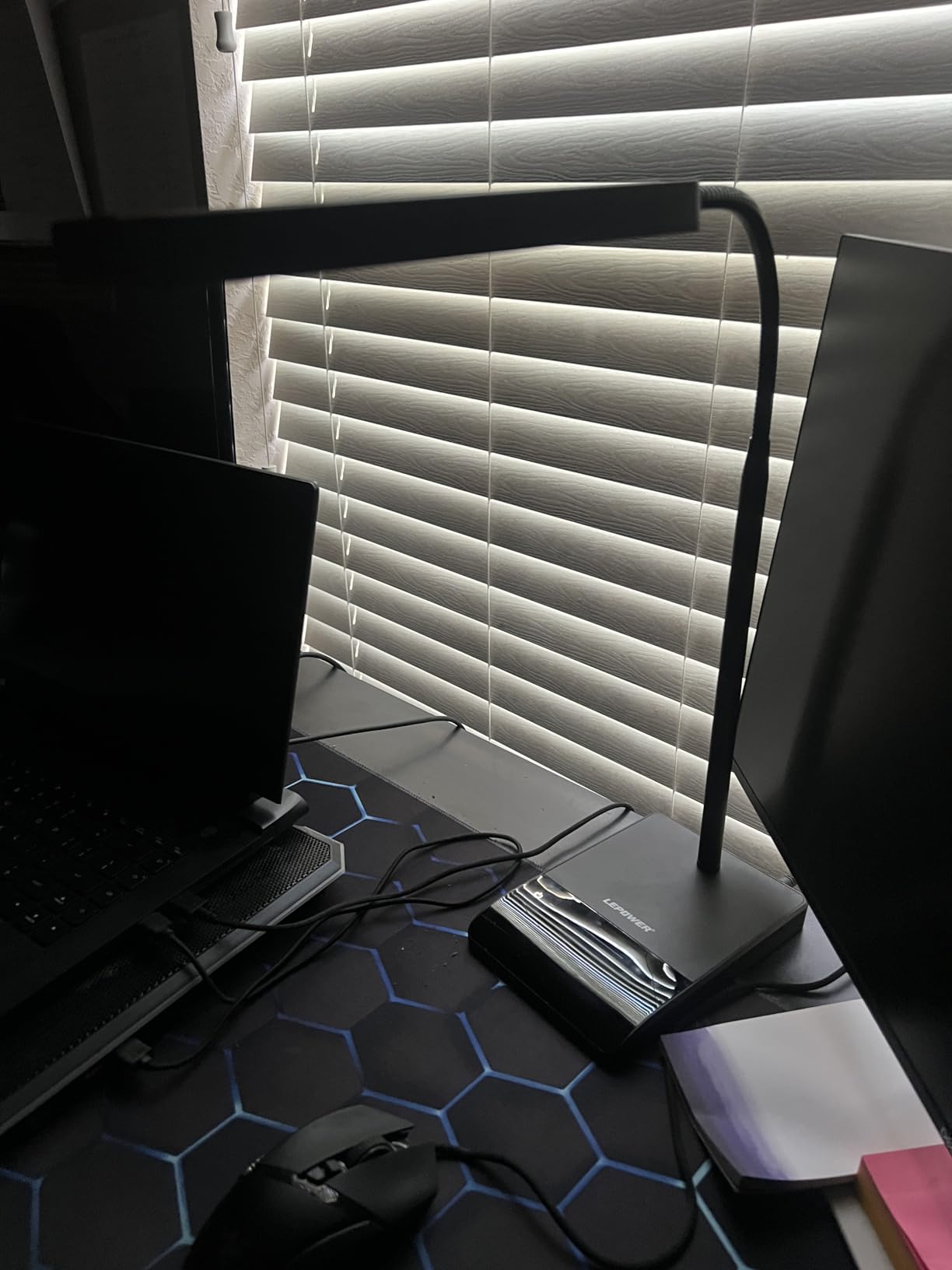
 LEPOWER 800LM Eye-Caring Reading Lamp LEPOWER 800LM Eye-Caring Reading Lamp |
|
Check Latest Price |
 Motumen Dual-Head Clamp Desk Lamp Motumen Dual-Head Clamp Desk Lamp |
|
Check Latest Price |
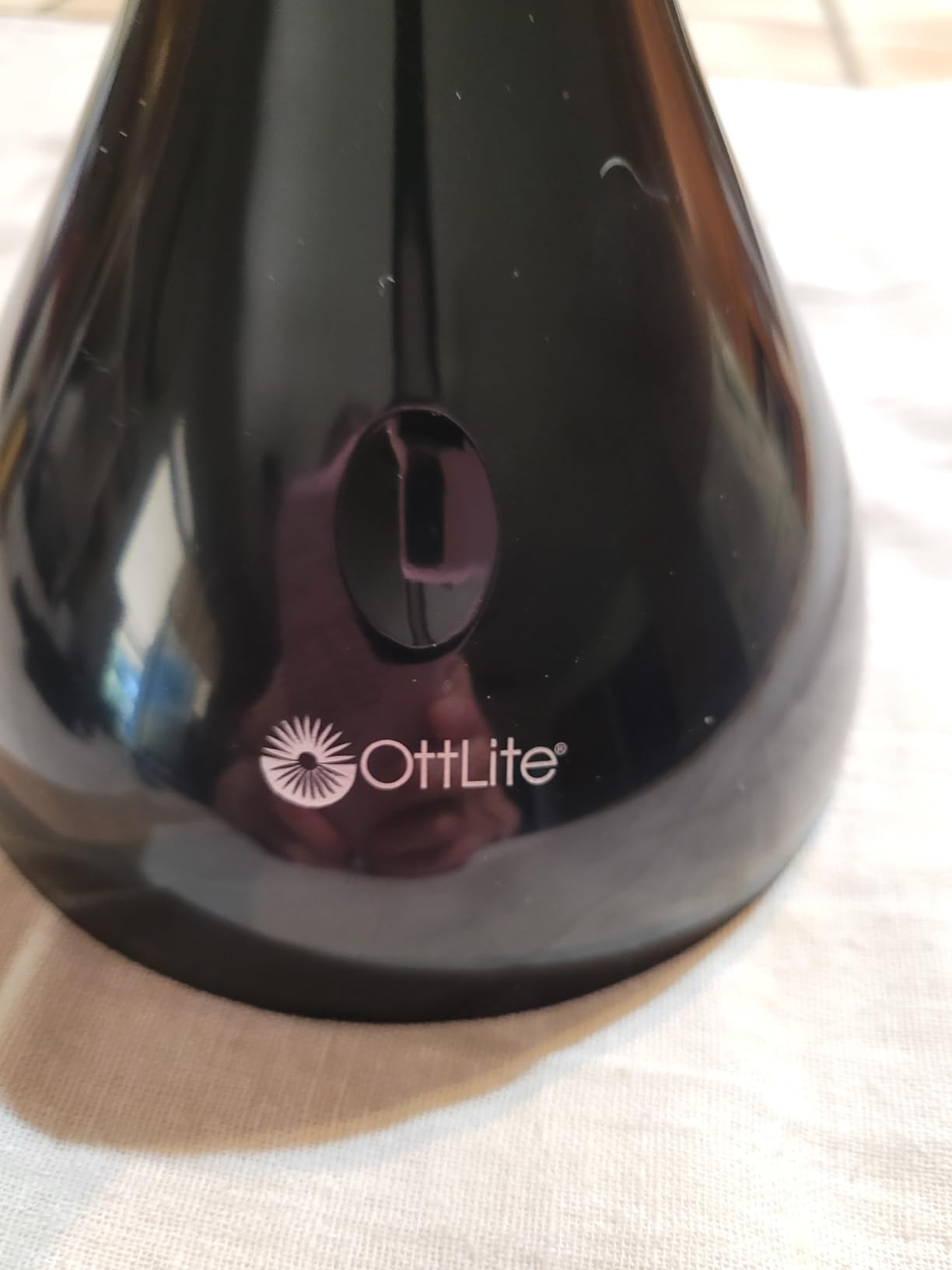
 OttLite Creative Curves ClearSun Lamp OttLite Creative Curves ClearSun Lamp |
|
Check Latest Price |
 Micomlan 12W Dual Light Clamp Lamp Micomlan 12W Dual Light Clamp Lamp |
|
Check Latest Price |
 Honeywell HWT-H2 Full Spectrum Lamp Honeywell HWT-H2 Full Spectrum Lamp |
|
Check Latest Price |
 Neatfi XL 2200 Lumen 23 Inch Shade Lamp Neatfi XL 2200 Lumen 23 Inch Shade Lamp |
|
Check Latest Price |
 LitONES Soft Edge-Lit LED Desk Lamp LitONES Soft Edge-Lit LED Desk Lamp |
|
Check Latest Price |
 Honeywell H01 Pro Sunturalux Compact Lamp Honeywell H01 Pro Sunturalux Compact Lamp |
|
Check Latest Price |
We earn from qualifying purchases. CERTAIN CONTENT THAT APPEARS ON THIS SITE COMES FROM AMAZON. THIS CONTENT IS PROVIDED 'AS IS' AND IS SUBJECT TO CHANGE OR REMOVAL AT ANY TIME.
750 lumens max
25 lighting combinations
Frosted diffuser
Fully adjustable body
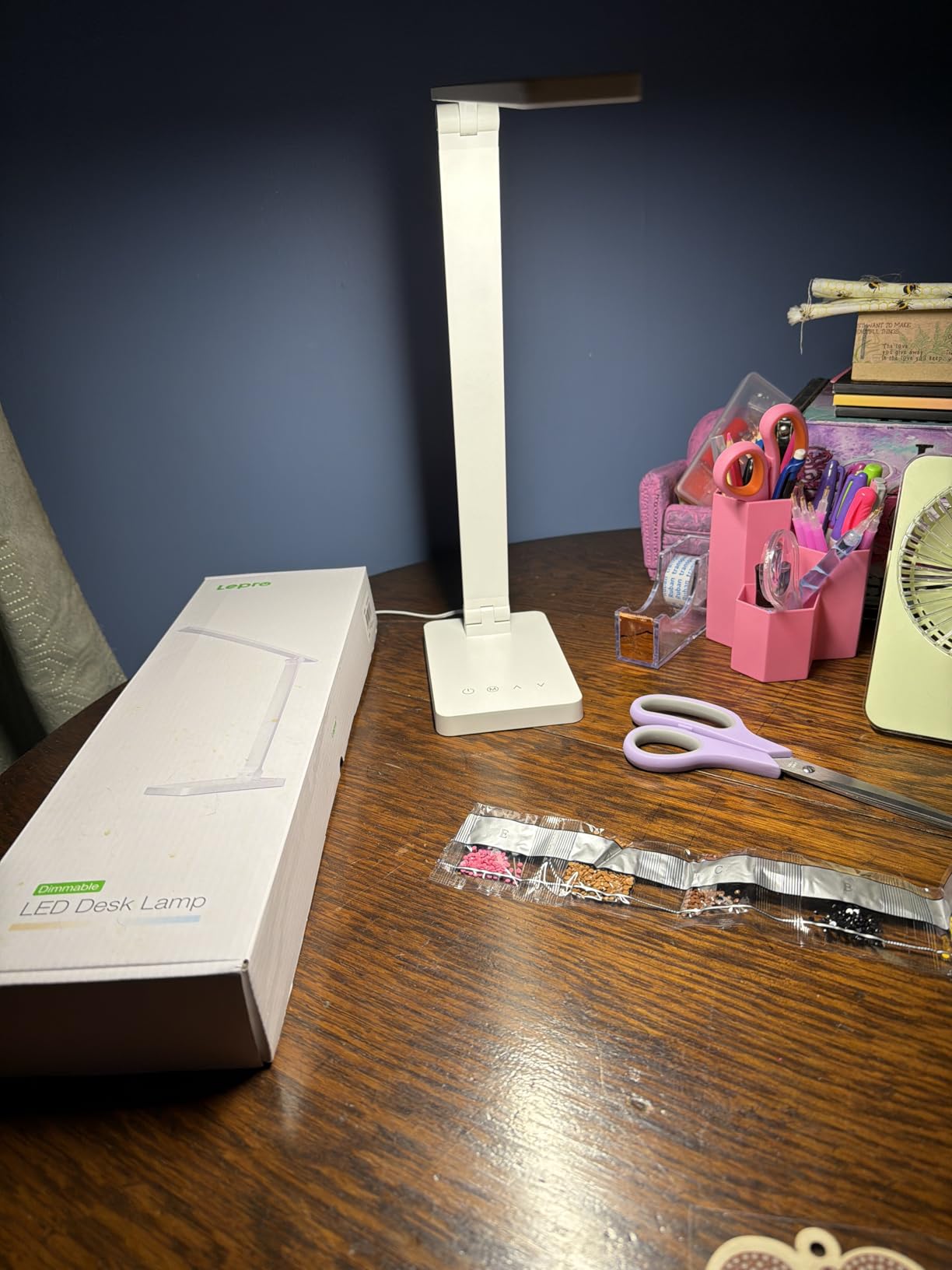
I put this lamp first because after six weeks it was the one I stopped adjusting. That is the highest compliment I can pay a task light. Five lighting modes crossed with five brightness levels give 25 combinations, which sounds like marketing until you realize it lets you match the desk to your monitor instead of settling for whatever the lamp felt like doing.
The frosted diffuser shade is doing quiet work here. Instead of a row of visible LED points, you get a soft panel of light, and there is no visible flicker at any of the 25 settings. The 9.5W draw and 750 lumen peak are modest next to the 24W architect lamps further down, but for a single monitor at a normal desk that is plenty.
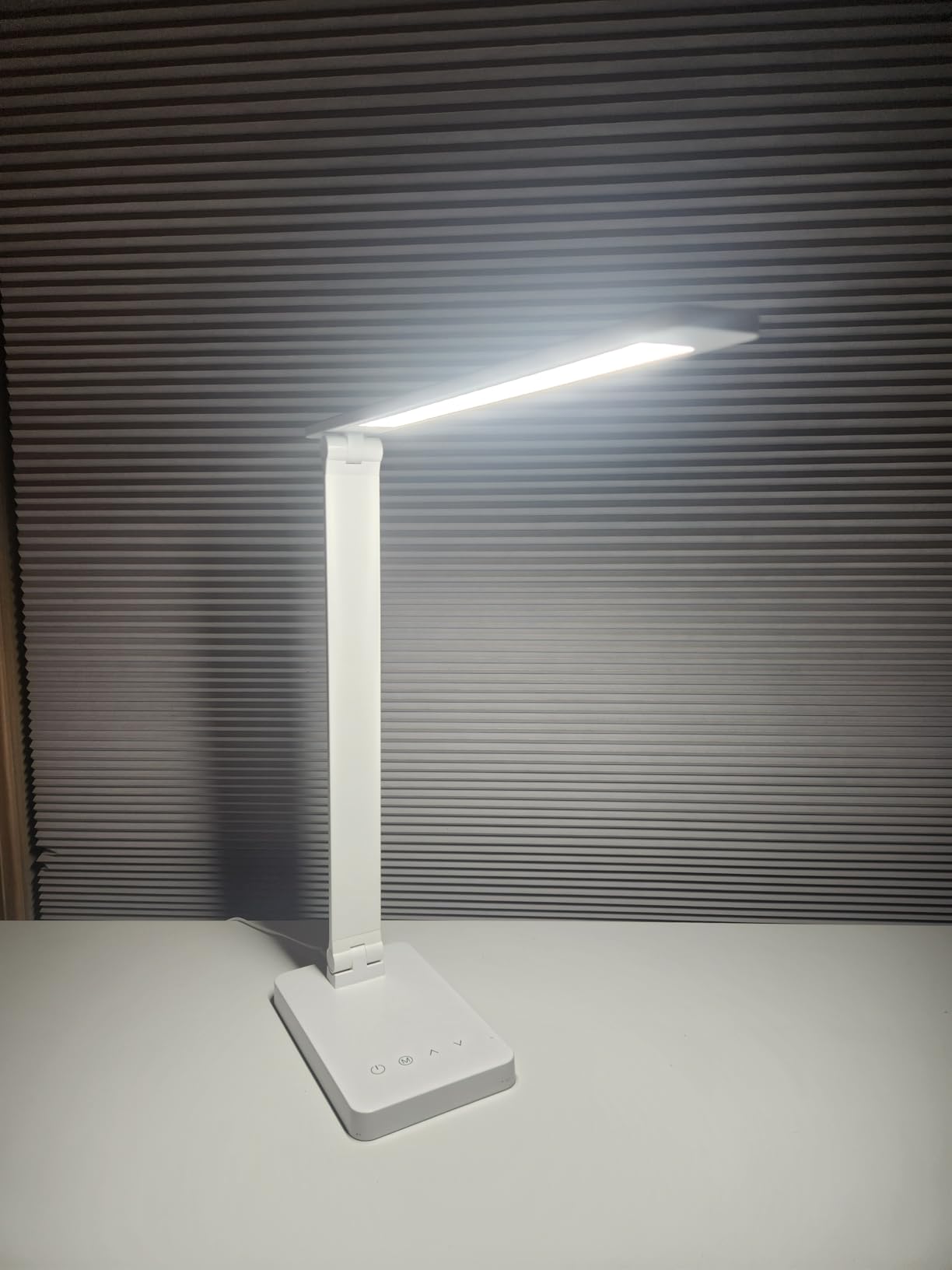
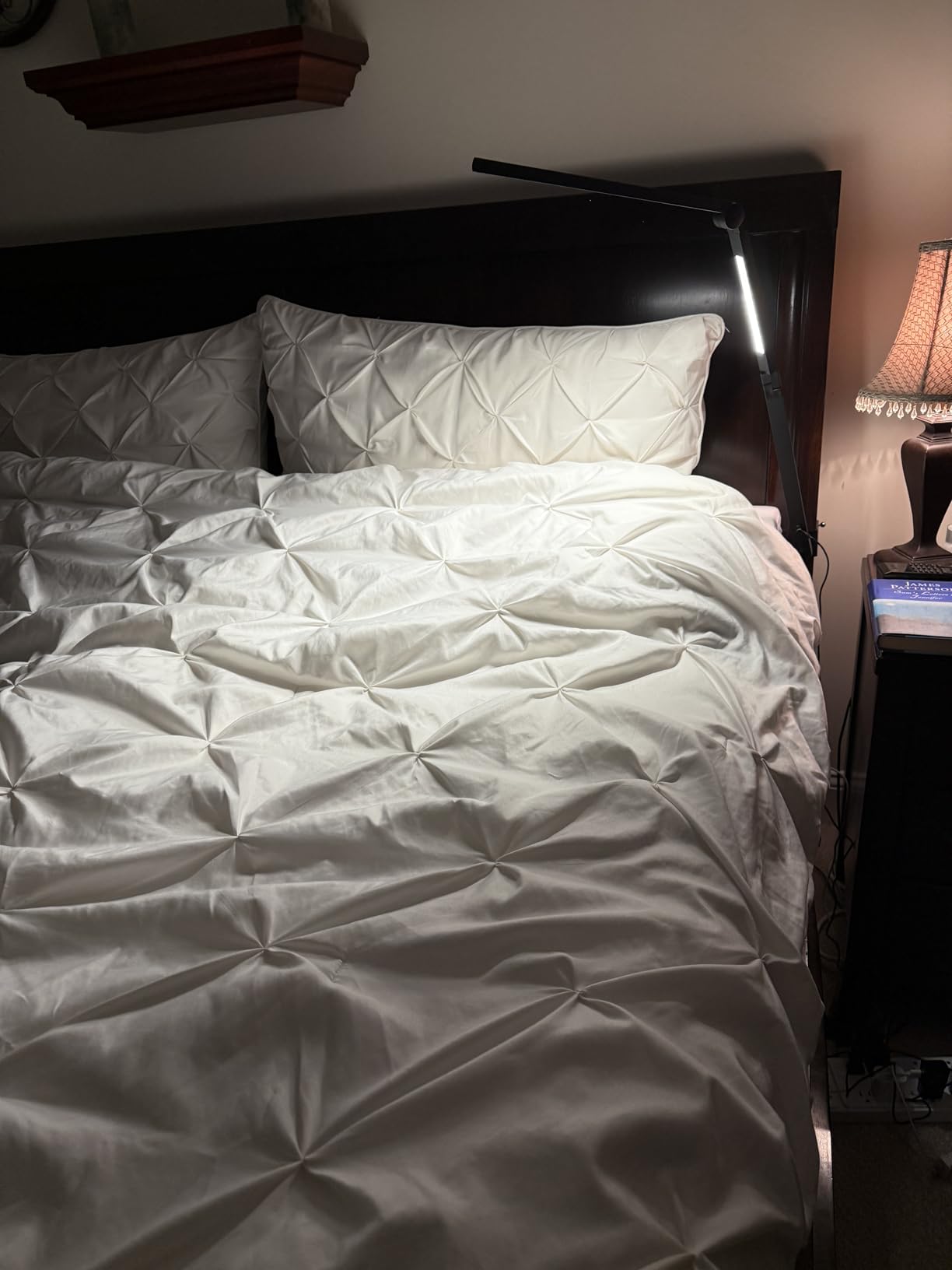
The frame is plastic and metal with a fully bendable body and light bar, so you can flatten it or curl it over paperwork. At 13.4 inches deep and 15.1 inches tall it does not fight your keyboard for space, and it uses a standard E27 bulb base rather than a sealed module.
Most lamps give you one or two white choices. This one gives you five modes and five brightness levels, so you can move from a warm evening tone to a bright daytime setting without getting up. Reviewers consistently single out that granularity as the reason they bought it and kept it.
The frosted shade means the source itself is never in your eye line, which is the single most effective anti-glare measure on this list. Position it opposite your writing hand, 15 to 20 inches back from the work surface, and the keyboard stops carrying a shadow.
At 0.75 kg the base is stable enough for a normal desk without being a slab. The E27 socket is unusual at this size and worth knowing about: it means the light source is a standard format rather than a sealed LED panel you replace whole if it ever fails.
Two honest limits. The touch controls are described as finicky to register, so a miss and a tap take practice in the first week. And 750 lumens will feel short if you are lighting a large workbench or a wide dual-monitor spread rather than a single screen.
10W LED
3 color modes 3000K-6000K
7 brightness levels
Memory function
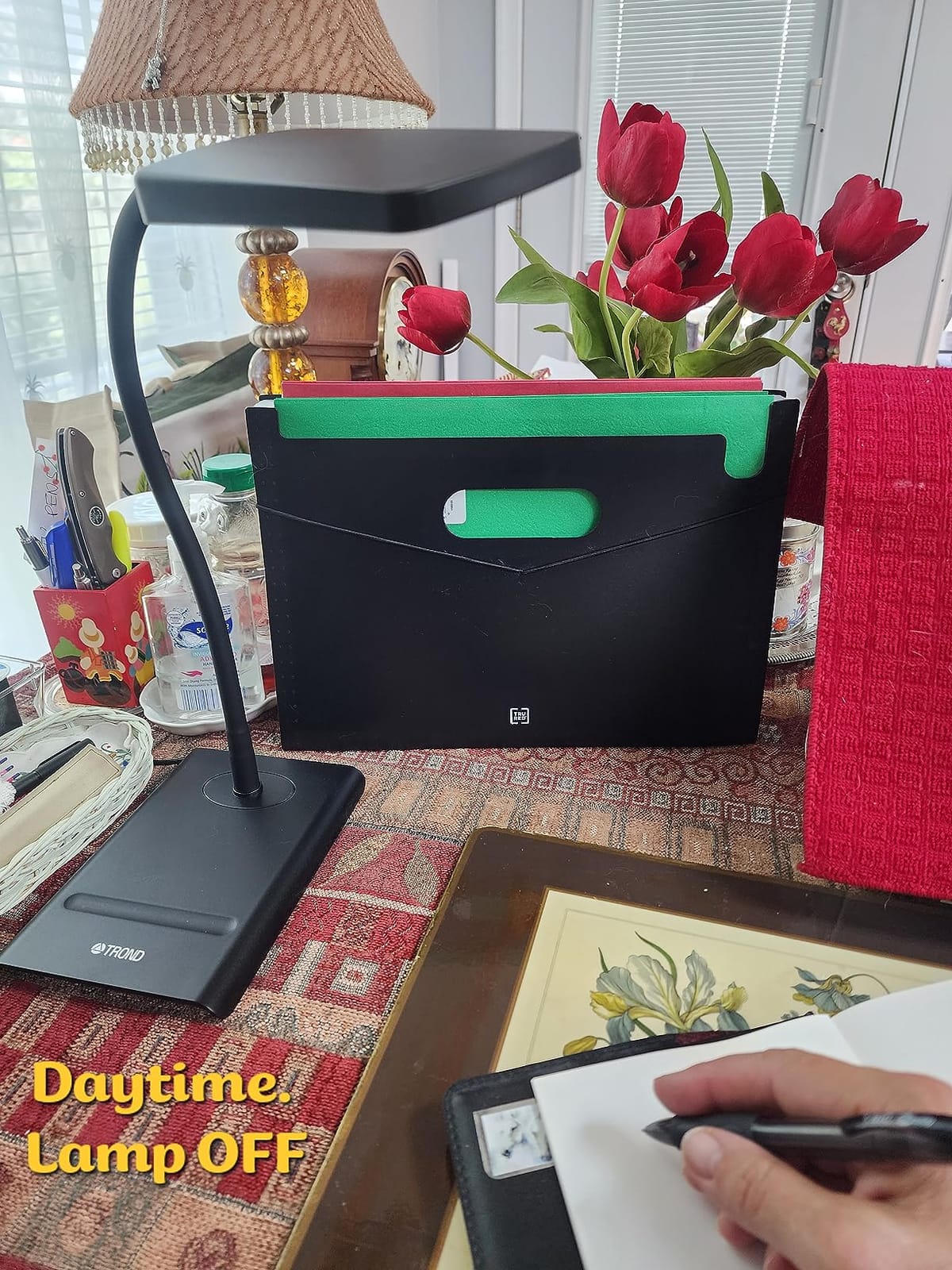
This is the lamp I recommend to anyone who wants one setting decision instead of a control panel. Three color modes, 6000K working, 4500K reading and 3000K relaxing, each with seven brightness levels, and the memory function returns you to the same combination you used yesterday morning.
The light comes from a surface source with a light guide panel rather than bare diodes, which is why the output stays even across the width and why reviewers describe it as low glare. It is rated for 40000 hours and runs on 12 volts.
Students and home office users own this one in large numbers, and the pattern in the reviews is consistency. Set it once in the morning, set it once at night, and the memory takes care of the rest. That is a real feature when your screen time is eight hours.
Cheap lamps put light through a bare strip and hope a thin plastic lens hides it. A guide panel spreads the emission across a surface, so you are reading light off a wide area rather than staring past a cluster of diodes. That is the whole difference between comfortable and tiring at close range.
6000K is the bright cool setting for detailed work, 4500K is the neutral reading middle, and 3000K is genuinely warm rather than nominally warm. Having all three means you can warm up in the evening without buying a second lamp.
The 16.1 inch gooseneck reaches well over a laptop and a notebook, and the 0.63 inch base is one of the slimmest here. The recurring complaint, and it appears often enough to plan around, is that the neck can droop over years of repositioning.
Seven discrete brightness steps are not stepless dimming. If you want to set a very specific low level for evening reading, you will pick from seven options rather than dial one. Nobody in our group found that a dealbreaker, but it is the spec that keeps this lamp out of the top slot.
24W
Three aimable light bars
45 degree asymmetric optics
Auto light sensor
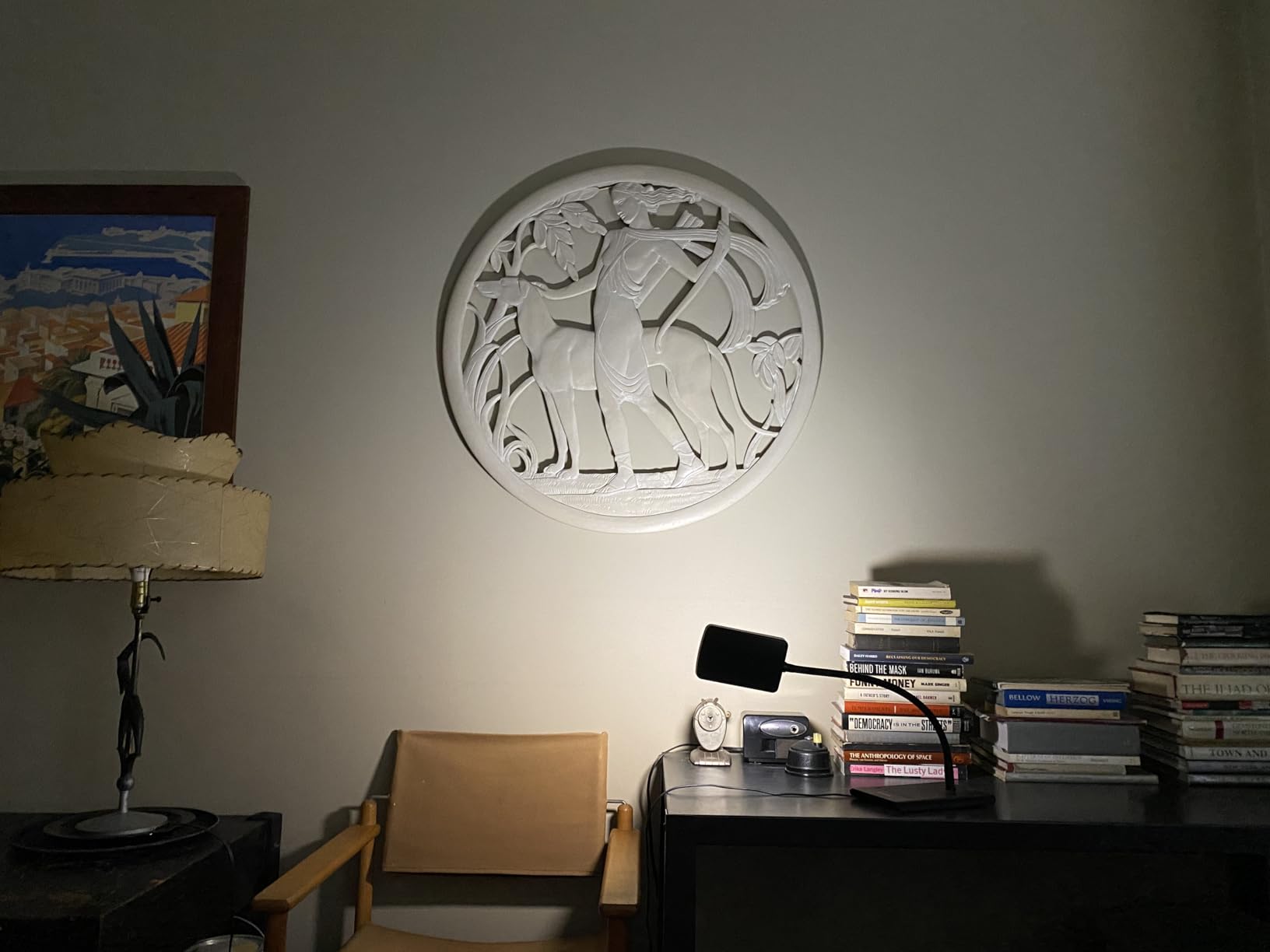
This is the lamp that changed my mind about bright lights. It puts out enough light to cover a wide desk, and yet it never produced a reflection on either of my test monitors, because the three light bars are angled away from the screen at 45 degrees. Asymmetric optics, doing exactly what the term says.
Seven rotatable joints and three independently rotatable light bars mean you light the keyboard, the paperwork and the shelf behind you separately. Add the built-in light sensor that adjusts output to ambient conditions, plus stepless dimming across 3000K to 6500K, and matching your screen brightness becomes a one-touch job.
CRI above 90 keeps colors honest for crafters and illustrators, and the memory function restores your last setting. The clamp mounts to thick desktops, which is how it earned its place on my standing desk. The warranty is 2 years.
A traditional shade aims light down and forward, and some of that forward light lands on the screen. Angling the bars away means the light arrives at the desk from the side and above, so the panel reflects ceiling light rather than the lamp. It is a geometry fix, and it costs nothing at the checkout.
Three independently aimable bars are what separate this from a single-head architect lamp. On a wide surface you can point one bar at the keyboard, one at the notes, and one at the back wall to lift the room contrast. The ambient sensor handles the day-to-night shift without you touching a control.
At full output the housing runs warm, and a few owners report warmth at the plug after long sessions. There is also no telescoping extension, so aiming the head right at the front edge of a deep desk takes some repositioning of the clamp itself.
The main bar and the auxiliary bars switch on and off separately, which is correct in principle and slightly confusing in the first ten minutes. After that, the memory function means you rarely touch the panel at all. Two years of warranty coverage sits in the middle of this group.
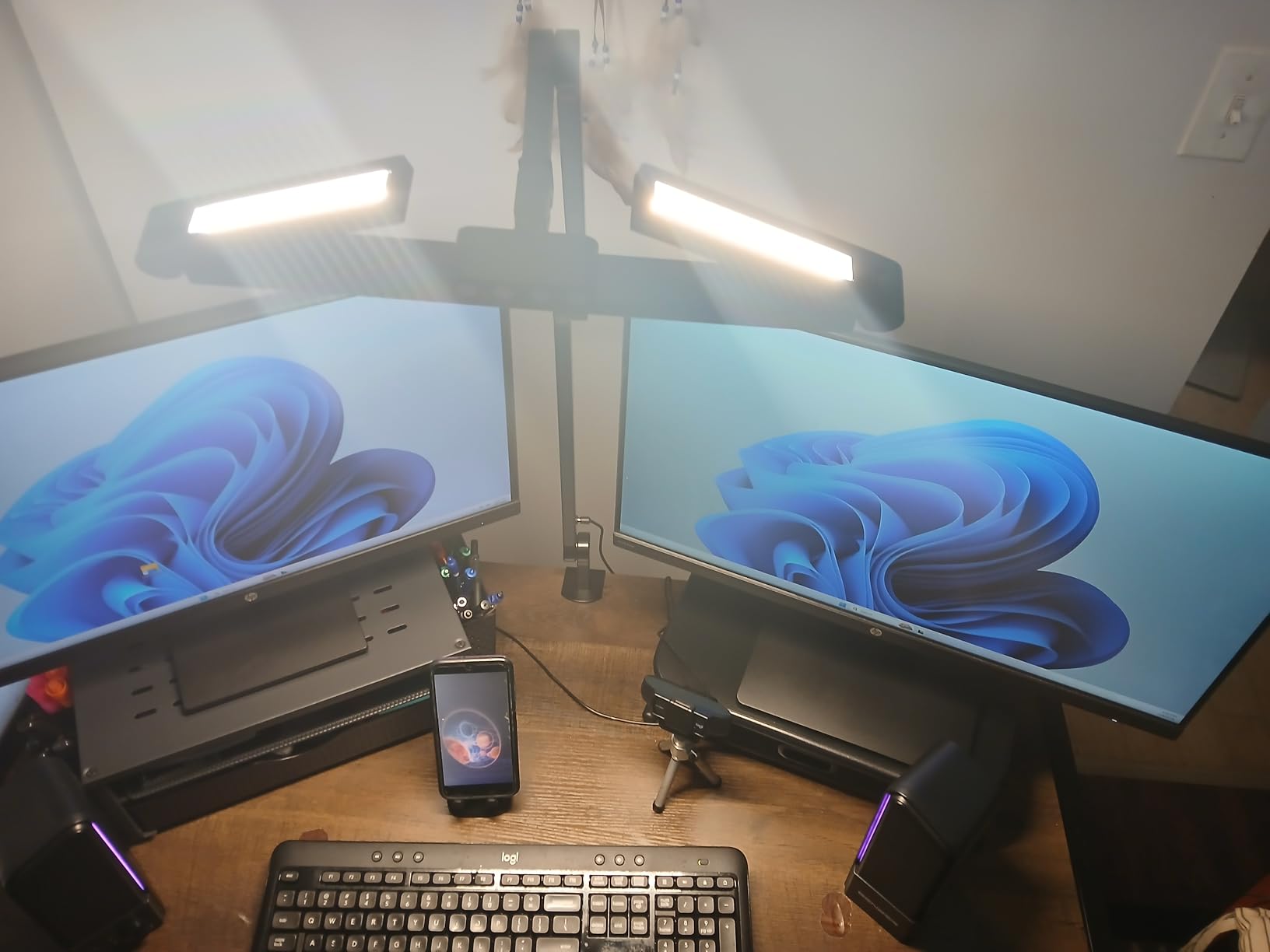
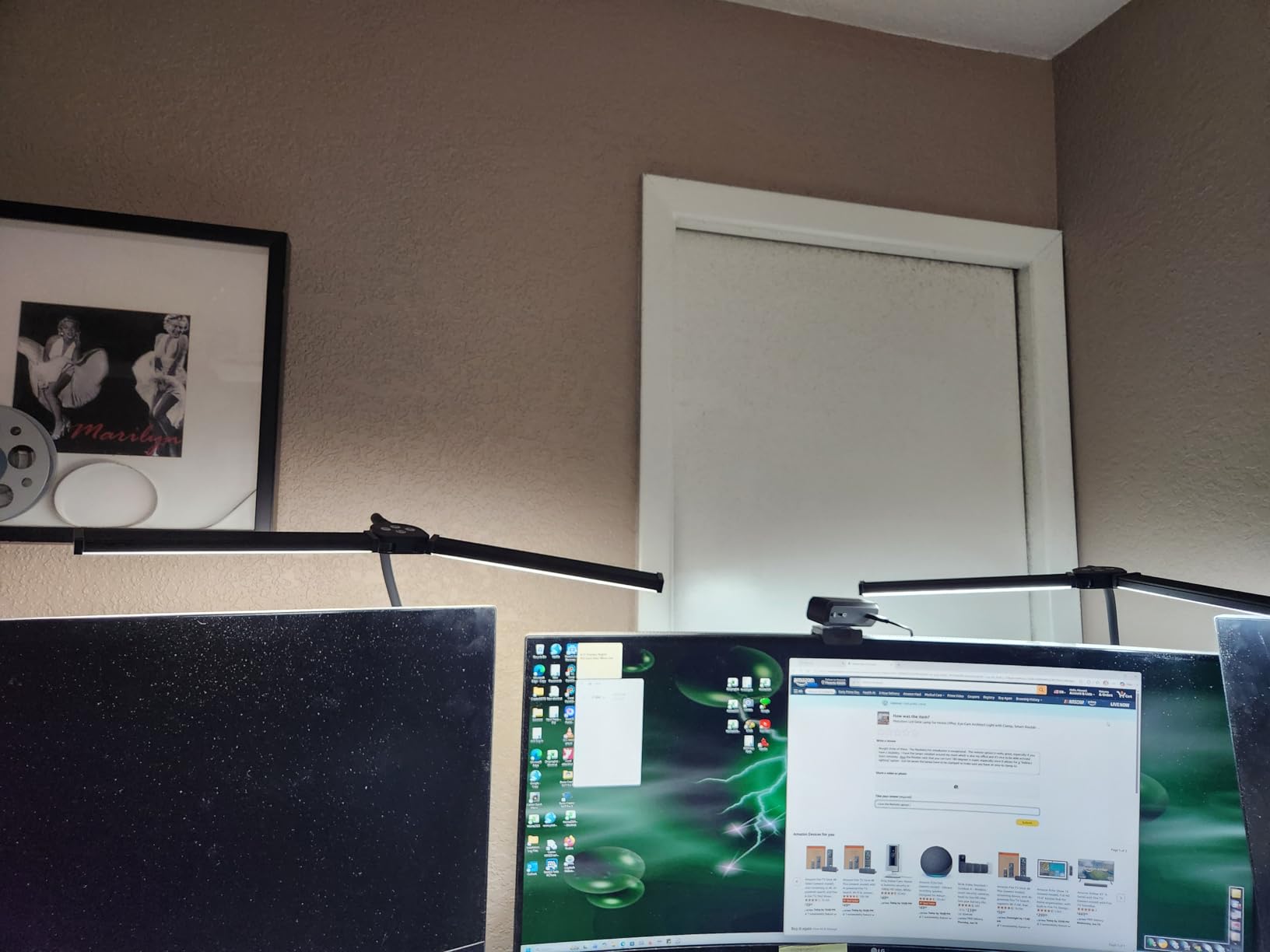
24W
25 light combinations
Wireless remote
360 degree pole
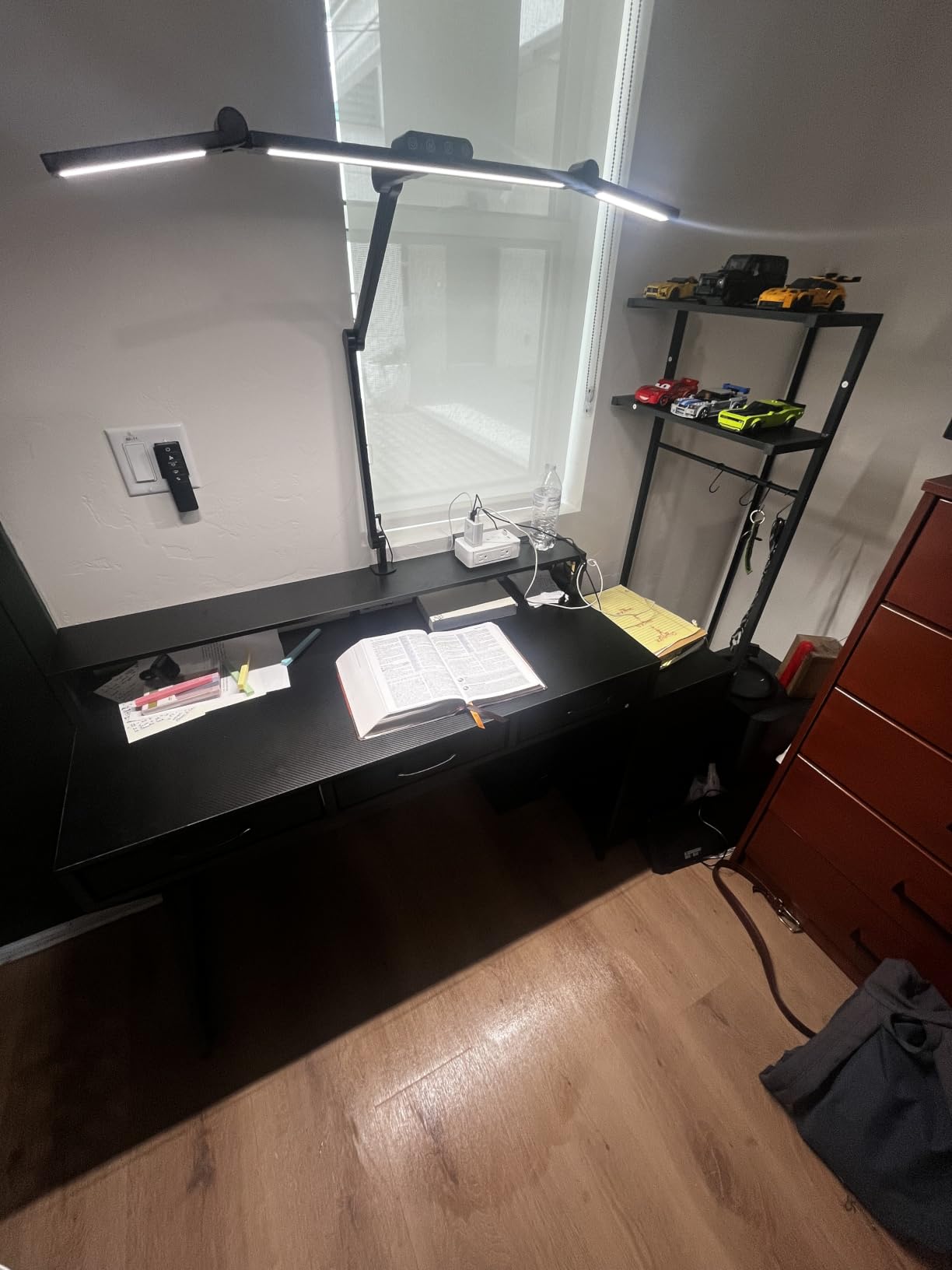
If your monitors are on arms and you need light above or beside both of them, this is the tallest, longest-reaching lamp we tried. The 360 degree standing pole with 180 degree foldable swing arms cleared two 27 inch displays in my setup without the head ever passing in front of a screen.
Color temperature spans 3000K to 5500K across five settings, brightness runs 20 to 100 percent across five more, and there are night light and reading modes on top of that. CRI above 90 with a 45 degree tilt asymmetric design keeps the light off your eyes.
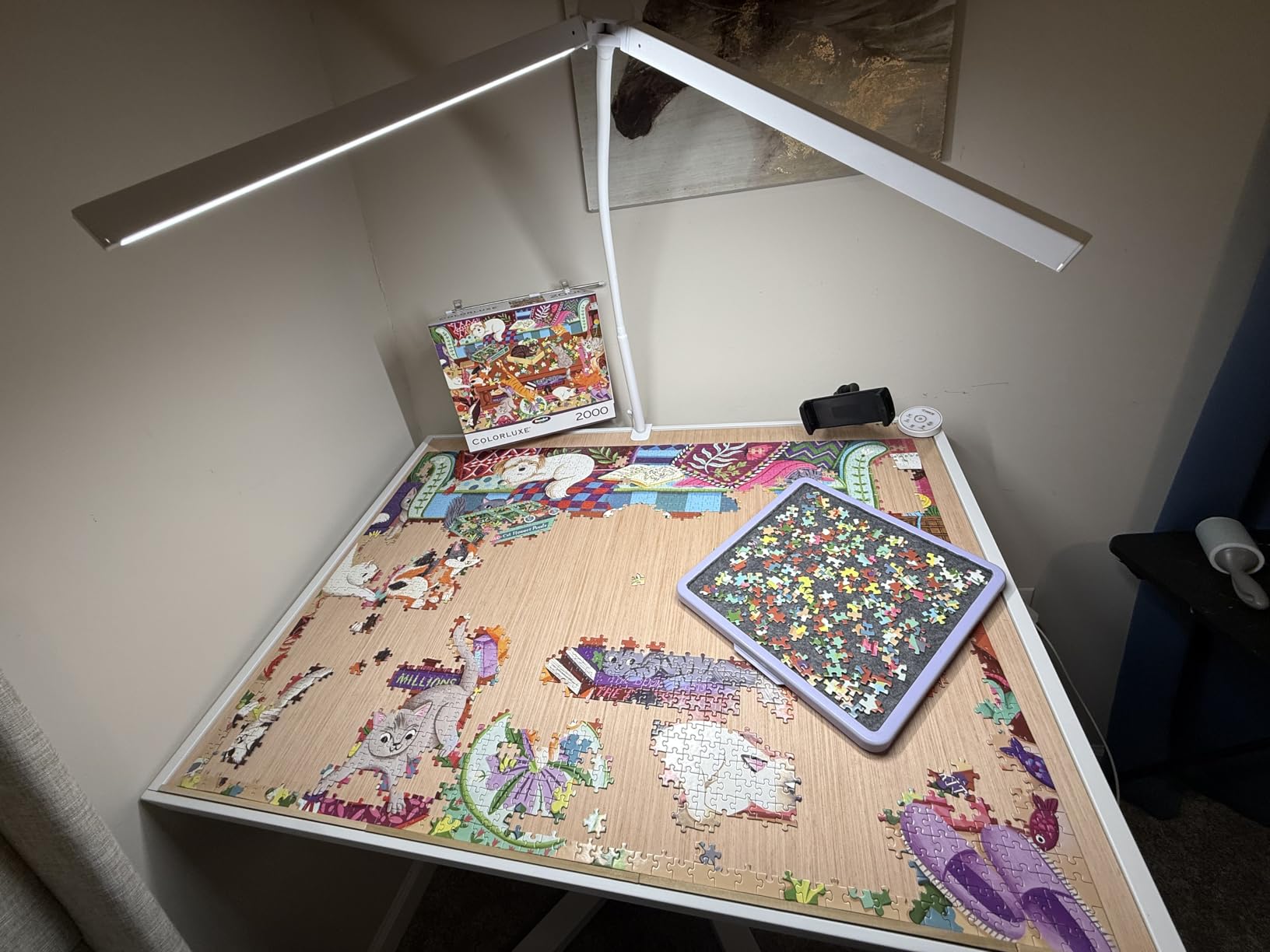
The metal clamp is the part that earned reviewer trust. It stays put when you swing the arms, which is not something we can say for every clamp we tested. Assembly is quick, and the manufacturer will replace a faulty remote.
Most complaints about architect lamps are that they are too short for a raised monitor. A 360 degree pole plus two 180 degree arms changes the geometry: the head can sit well above screen height and still angle light down onto the keyboard rather than out at your face.
Five color temperatures times five brightness levels is more than most people cycle through, and the night light mode is the one people actually keep. It gives you a low warm wash for a late session without dimming the task light all the way down.
This is the real drawback. There are no touch controls on the head, so if the remote is lost or unpaired you are reaching for the base or using a phone. Reviewers also note the remote needs AAA batteries that are not in the box, and occasionally fails to pair.
Two years of warranty. It runs hot near the top of the brightness range, and on a very wide desk the clamp mount reads as slightly off-center. If you want physical controls you can hit without looking, one of the touch-panel lamps below is a better fit.
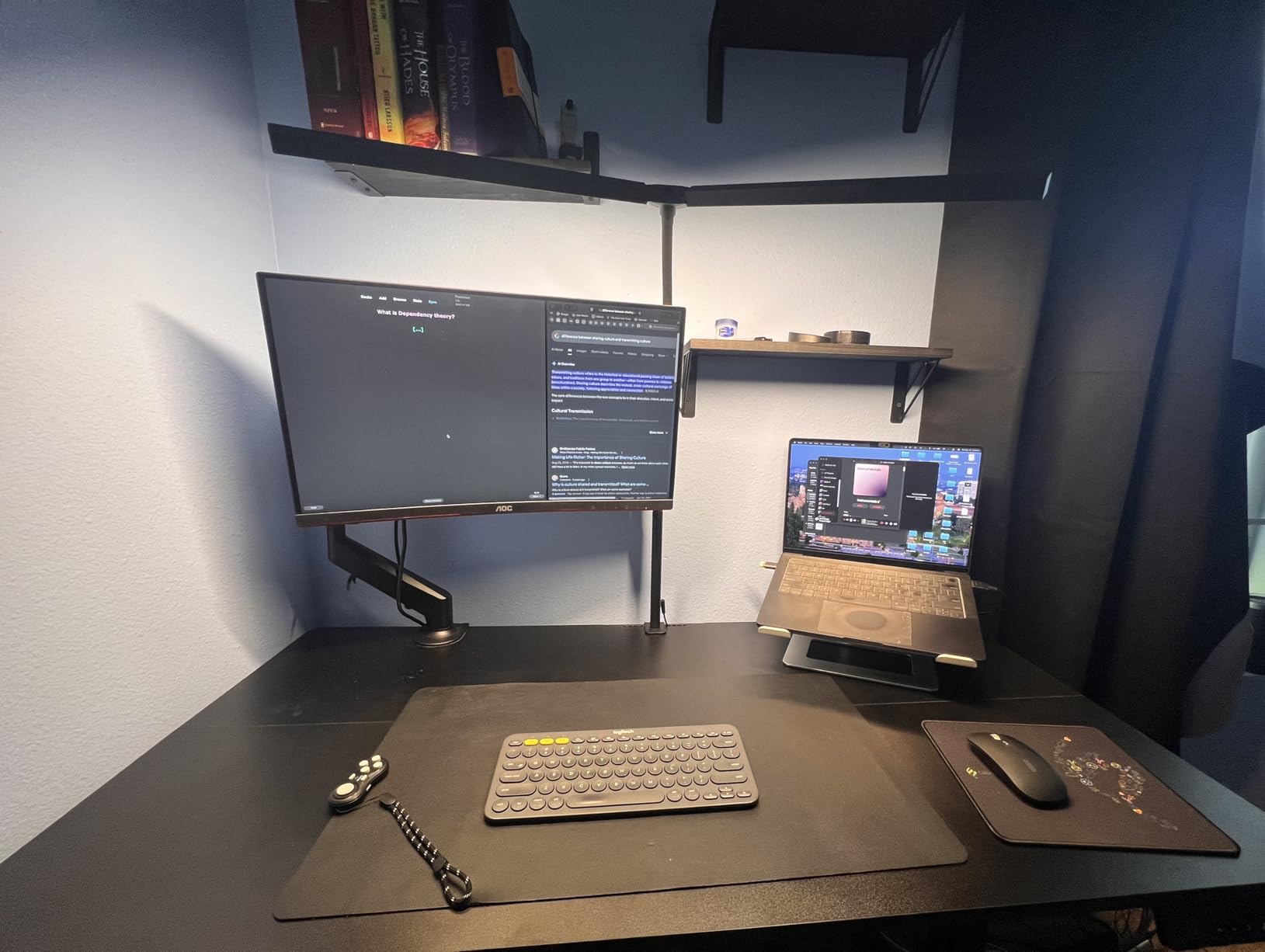
800 lumens at 1400 lux
RG0 per IEC 62778
50 combinations
Metal gooseneck
This is the pick I would hand to an older reader or anyone with reduced contrast sensitivity. The 800 lumen output at 1400 lux, spread over a panel 200 percent wider than the usual strip, lights a full keyboard and an open book at the same time. That even coverage matters more when fine print is hard to resolve.
What sets it apart on paper is the RG0 certification of the lamp beads to IEC 62778. Of the twelve lamps in this roundup, this is the one whose blue light hazard claim is attached to a named standard rather than a marketing adjective.
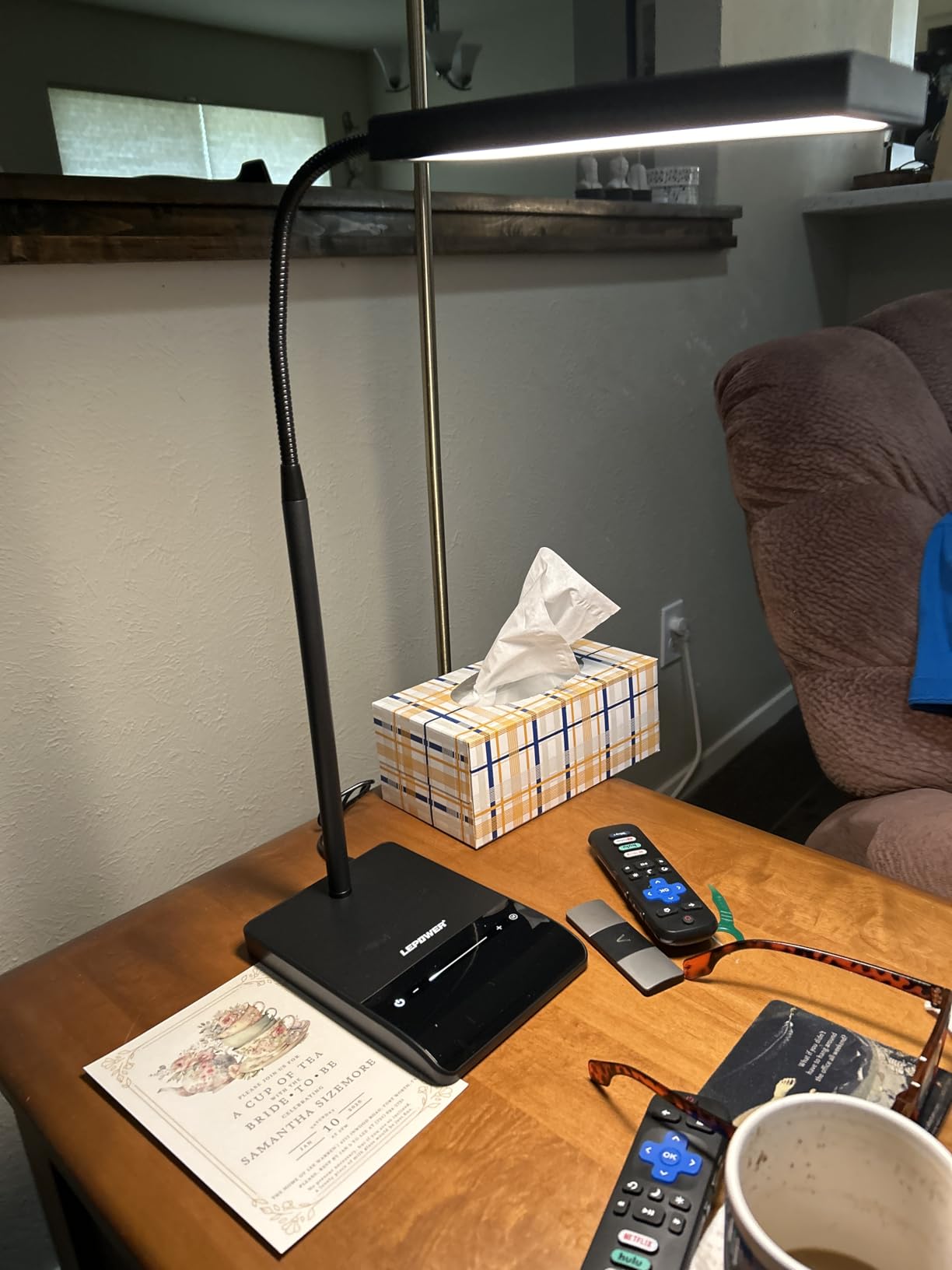
The slide dimmer gives finer control than stepped buttons, and the memory function recalls the last setting so a person with limited vision does not have to repeat the same tap sequence every morning. A lit power button means you can find it in a dark room.
Contrast sensitivity drops with age and with some conditions, which makes shadows and hot spots harder to cope with. A wide panel with a metal gooseneck spreads the same light over a large area, so there is less falloff between the book and the page beside it. Sewing, model building and reading are the use cases owners mention most.
The RG category comes from the IEC 62778 blue light hazard assessment. RG0 means no observable hazard under the test conditions, RG1 means low risk with no hazard under normal use. It says nothing about flicker or glare, which is why we still check the panel shape separately.
Five color temperatures times ten brightness levels gives 50 combinations, and the slide dimmer moves smoothly through them. The 360 degree metal gooseneck is a real advantage over plastic necks, which loosen and let the head drift over time.
The base is wide, and on a small desk it is the first thing you will collide with. Touch controls are sensitive enough that reviewers report accidental activation when an object brushes the panel, and it only comes in black and grey.
14W
Dual light heads
3000K-6500K
Remote and 1 hour timer
Two 168-bead heads on a clamp mount is the layout most people with a small desk actually want. The clamp takes the base off the surface entirely, and the dual heads spread light across the keyboard and an open book at the same time instead of favouring one.
Color temperature runs 3000K to 6500K across five settings, brightness runs 20 to 100 percent, and a memory function stores the combination. The remote reaches 32.8 feet, which sounds like a gimmick until you are reclining at a monitor arm.
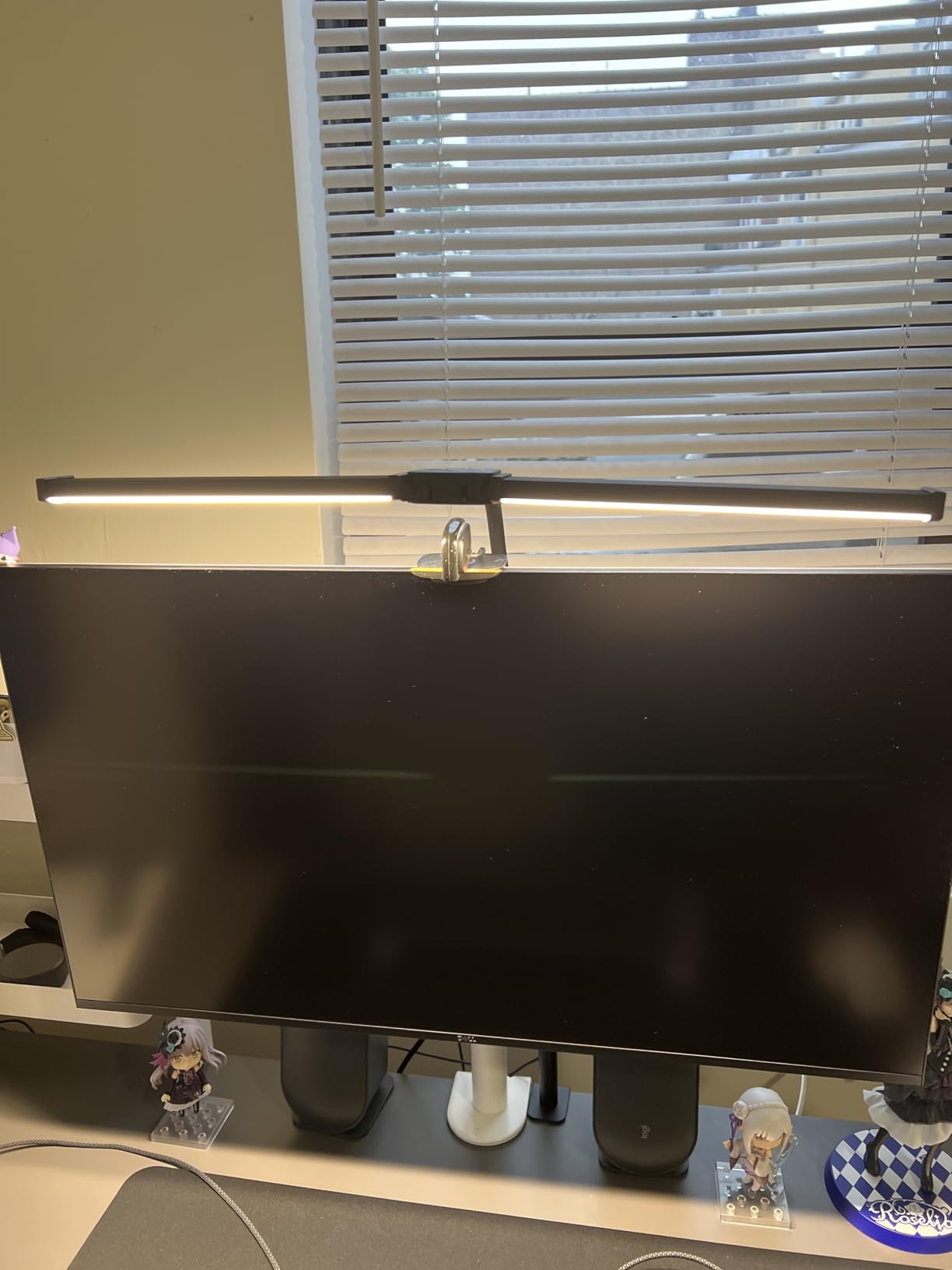
A one hour auto-off timer is a genuinely useful eye-care feature in a study context, and reviewers in exam-season posts mention it by name. Power is 24V DC and the warranty runs one year.
Two smaller heads can be aimed separately, which helps when your notes sit to one side of the keyboard. The tradeoff is that you are adjusting two things instead of one, and a single wide bar gives a more uniform wash when both aims need to be the same.
Unlike several architect lamps in this group, you get both on-lamp buttons and a remote, so losing the remote is not a lockout. The one hour auto-off is a simple nudge to stand up, and paired with the 20-20-20 habit it works better than a timer alone.
Five brightness steps with no stepless control is the main spec compromise here. The 360 degree goose-neck adjusts freely but is less rigid than a metal arm, so if you reposition the head often the light angle may drift over months.
Choose it for a compact desk, a dorm room, or any setup where surface space is the constraint. Skip it if you need very fine low-level dimming or if you move your lamp head several times a day and want it to stay exactly where you put it.
95 or higher CRI
11.25 to 23.75 inch height
4 brightness levels
USB port
Color accuracy is the entire argument here. ClearSun LED technology with 95 or higher CRI means a thread, a paint pot or a photograph looks the same under the lamp as it does in daylight, which matters if you are making colour decisions all day.
The flexible rubberized neck adjusts from 11.25 inches to 23.75 inches and holds any position, and the weighted base keeps it there. For reading, cross stitch and model work I found it easy to bring the head right down to the work and then push it back out of the way.
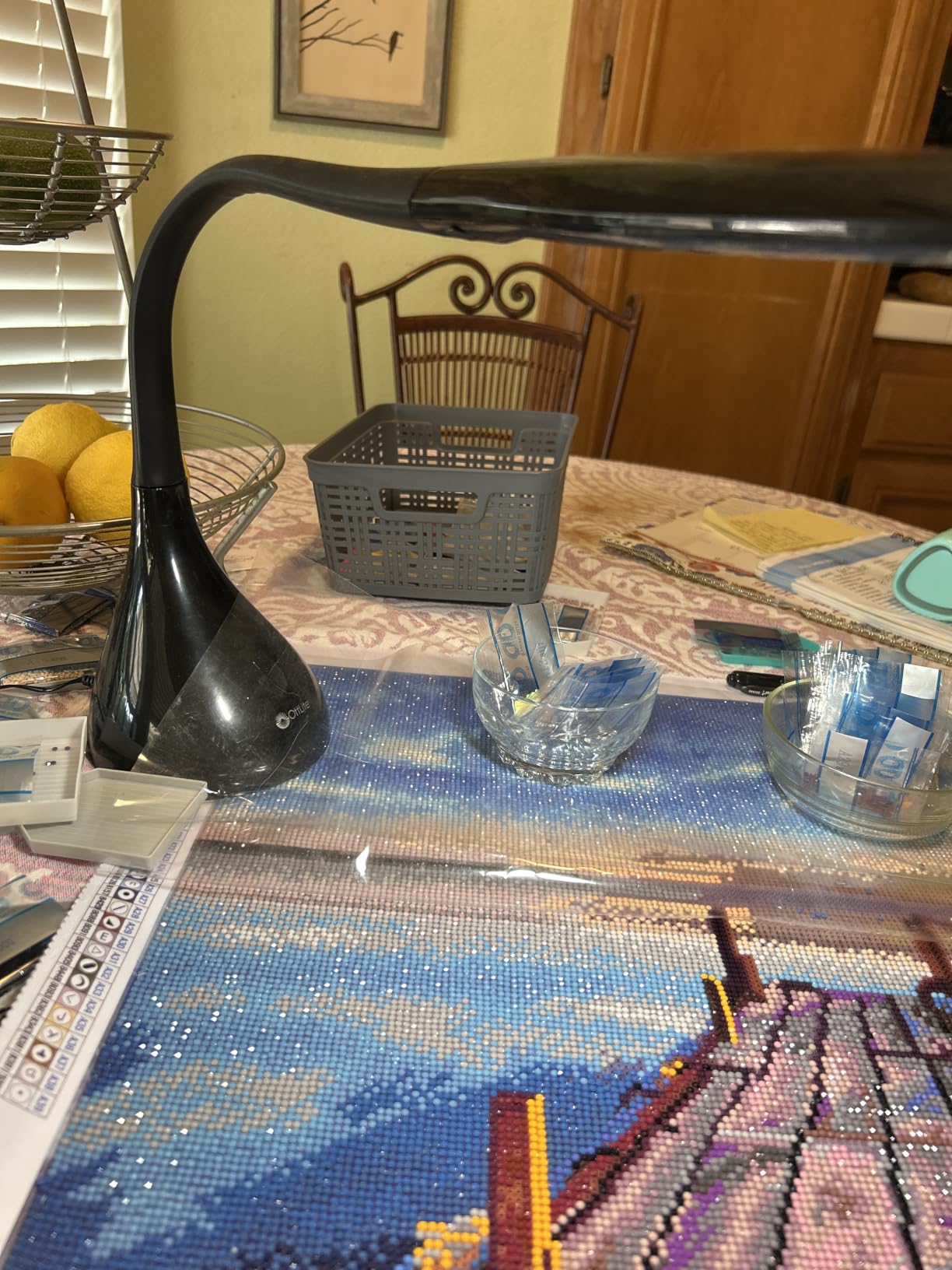
There is a 5V 2.1A USB charging port in the base, and a 2 year lamp warranty. Styling is deliberately understated, so it will not dominate a study or craft room the way some task lights do.
At CRI 80, saturated colours lose saturation and skin tones shift, which is fine for writing and irritating for anything judged by eye. Above 95 the lamp is close enough to daylight that a colour match made under it holds up in daylight later. That is the whole argument, and it only matters for colour-critical work.
A 12.5 inch height range is unusually wide for a small-base lamp, and it is what lets one fixture serve both paper work and screen work. Owners report the neck holds position well, though the foam pad on the base is not perfectly flush and can mark a table top.
Four brightness levels is the thinnest dimming in this roundup, and the lowest step is not especially low. The USB port is convenient for a phone but is not a laptop charger, and the lamp is built for 120V supply, so other regions need a converter.
A small number of owners report units failing to power on within a few weeks, which is the one quality signal to watch. If you need a colour reference for paid work, the CRI justifies it. If you just need light for a laptop, the brightness steps are stingy.
12W
CRI 95 dual light bars
7 rotatable parts
Clamp to 2.5 inch
This is the quieter version of the Micomlan architect design, and for reading and coursework it is the more useful one. CRI 95 with a dual light source and no visible flicker means the page and the screen get the same neutral light, which is exactly the match a study desk needs.
Seven rotatable parts handle direction, angle and position, so the two bars can cover an open textbook and a keyboard without dragging one hand shadows across the page. The all-aluminium body also runs cooler than the plastic alternatives, which you notice during a long evening.
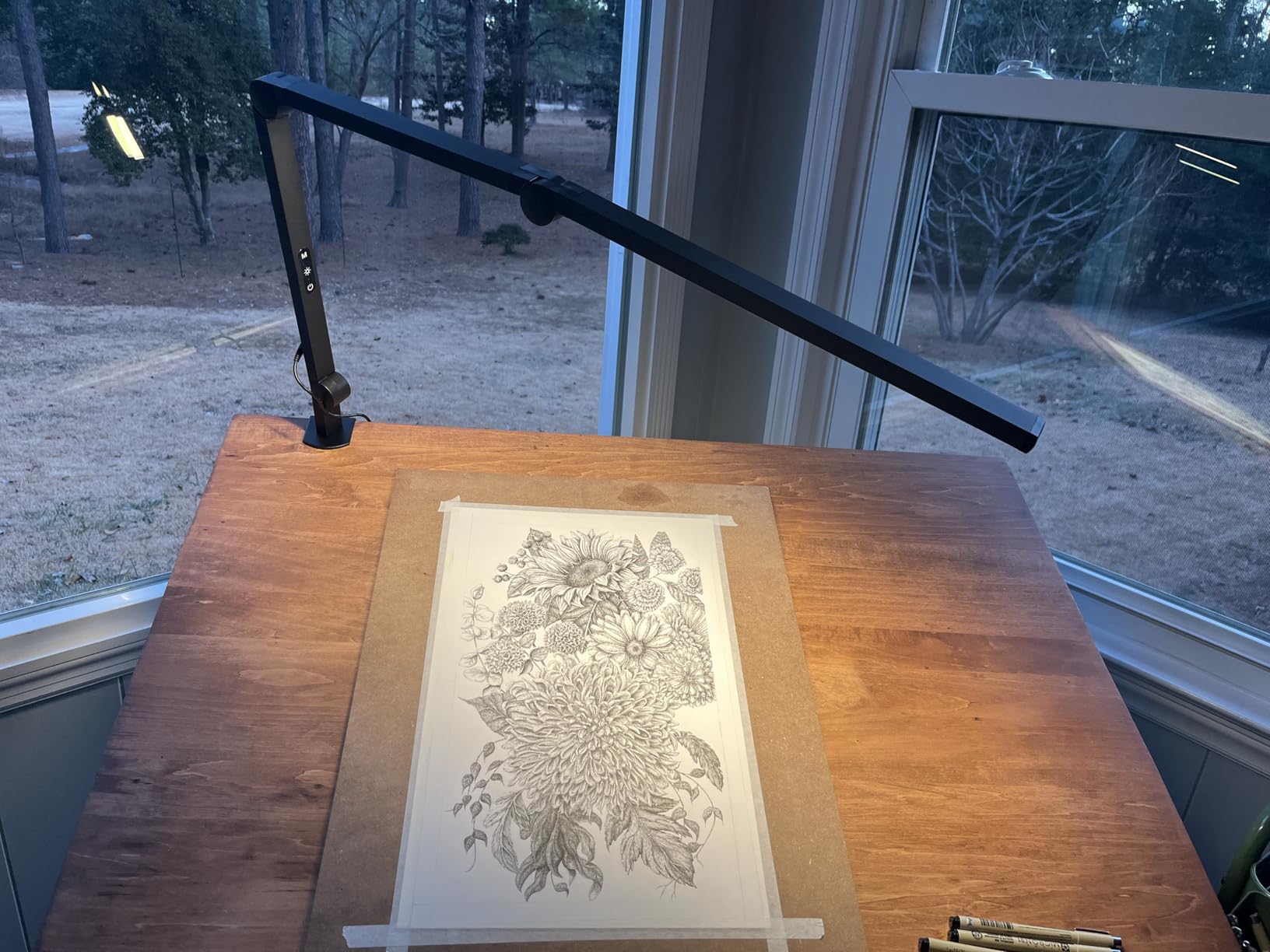
The clamp is wide, silicone padded, and fits desk edges up to 2.5 inches thick, so it survives a solid wood top that a small clip would slide off. A 30 minute auto-off timer and power-off memory round out the routine features.
A study desk is unusual because the light has to serve a page and a display at once, and the two want different angles. Two aimable bars let you put readable light on the paper without flattening the screen, which a single downward head cannot do as well.
CRI 95 in a 12W clamp lamp is unusual and it is the reason we include it despite the modest wattage. The colour accuracy is the same class as the OttLite above, and for a student labelling paints or comparing printed swatches it does real work.
Thirty minutes is a well chosen interval for a study session and roughly matches a Pomodoro block. Memory restores the previous setting after power-off, so a student does not rebuild the lighting every evening.
At 12W it will not light a large workbench the way a 24W or 2200 lumen model does, so the coverage claim is about a desk, not a workshop. And with touch-only controls you have to reach up to the head to change anything.
CRI94
2700K-5700K
Stepless 10 to 100 percent
USB-A and USB-C
Stepless dimming from 10 to 100 percent is the feature that separates this from almost everything else in the group. Most lamps step. This one glides, which means you can set the desk to match your monitor exactly instead of picking the nearest of five options.
Four color temperatures from 2700K to 5700K give you a proper warm-to-neutral range, and CRI94 full spectrum light across 48 beads keeps colours natural. The 11 inch rectangular head spreads light evenly enough that hand shadows on a page become faint rather than sharp.
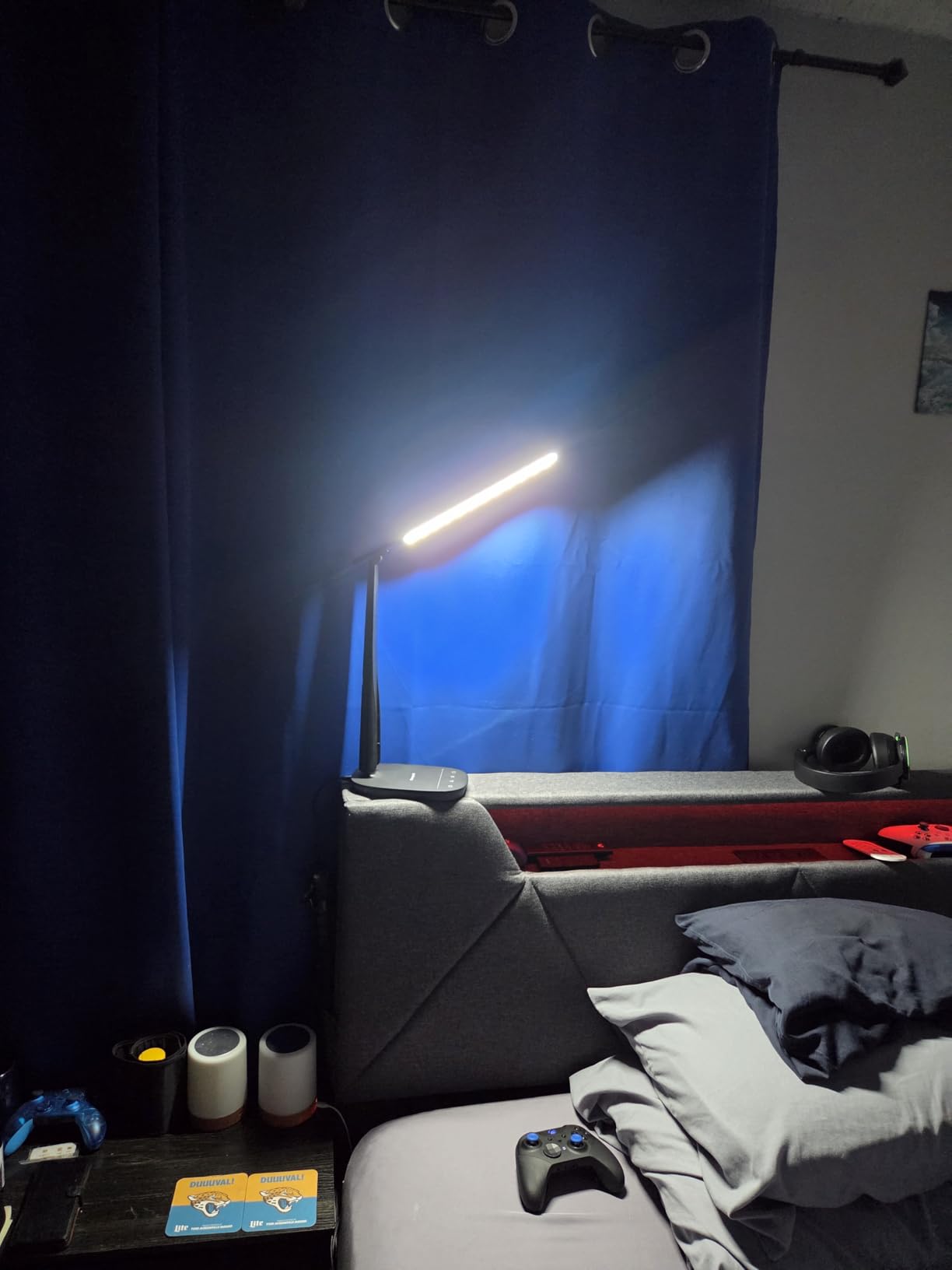
The base carries both USB-A and USB-C charging ports, the folding body collapses to save desk space, and there is a 30 minute timer with memory function. Lifespan is rated over 30000 hours with a 2 year warranty.
Matching a desk to a monitor is a ratio problem, and a ratio problem needs a continuous control. With stepped levels you are often a step too bright or a step too dim, and you end up dimming your monitor to compensate, which defeats the purpose. This is the lamp I would pick for that specific job.
Full spectrum here means a broad colour rendering output, not a medical claim. The blue light content is described as low risk under the RG1 category, which is a milder statement than the RG0 rating on the LEPOWER above. Either way, glare and contrast are the levers that matter most.
Two ports in the base is genuinely useful in a dorm room or a shared office where outlets are scarce. The foldable body is the right call for small desks, and the memory function plus 30 minute timer handle the daily start and stop of a session.
This is a modest lamp by output, and on a large desk the edges fall off before the centre. The folding arm also gives you far fewer fine positioning choices than an architect lamp with seven joints, so it is a screen-and-notes fixture rather than a workbench fixture.
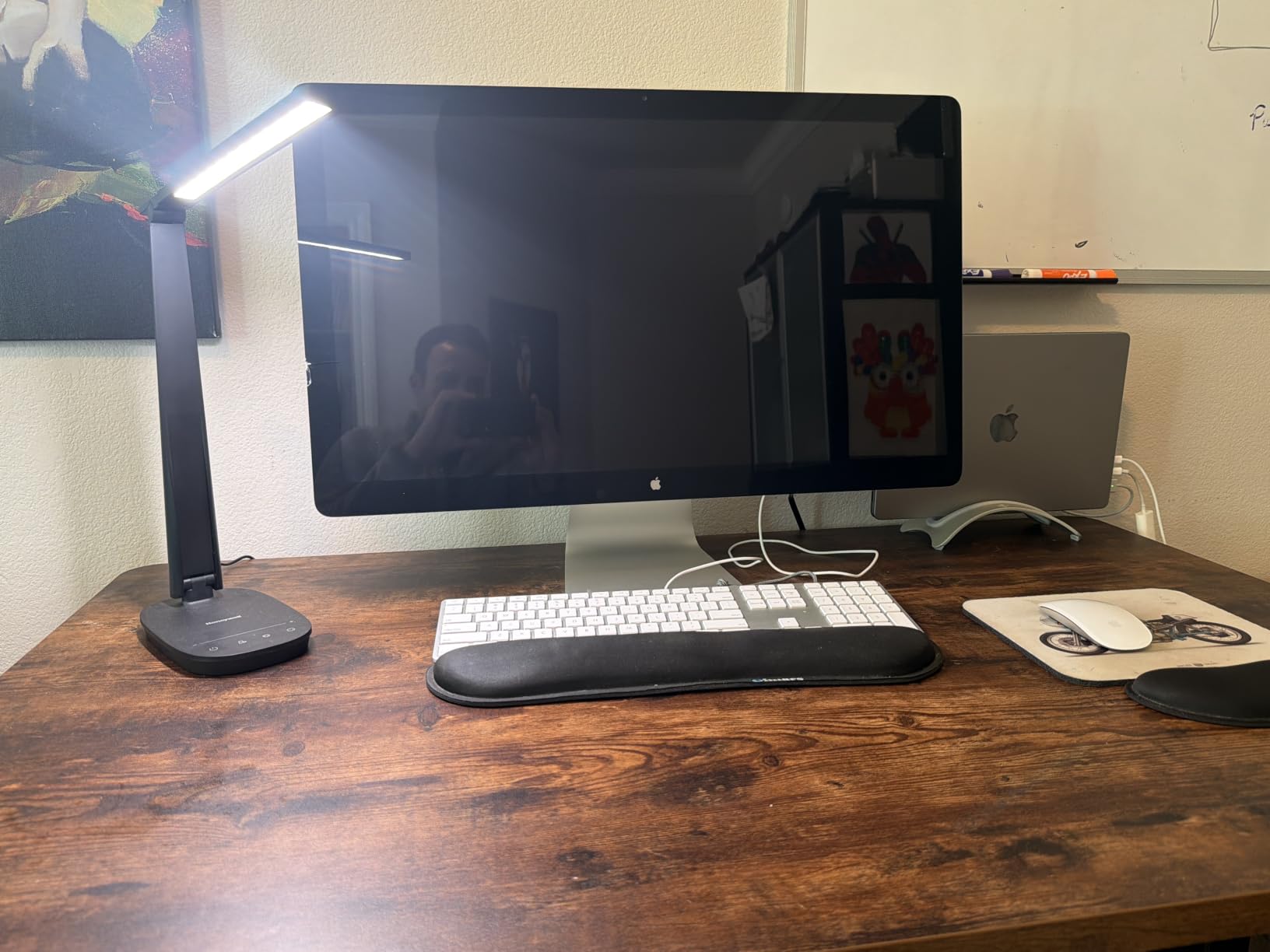
2200 lumens
6500K
23 inch shade
32 inch reach arm
Output is the headline here. 2200 lumens across a 23 inch shade is well beyond the 550 to 800 lumens quoted by several panel lamps in this list, and that gap shows on a large surface, a hobby bench, or a work area with no other light.
The 23 inch shade and a triple-joint arm with 32 inches of reach mean the head can cover a whole worktop rather than a keyboard. It is pre-assembled, so the setup is a matter of attaching the clamp rather than building an arm.
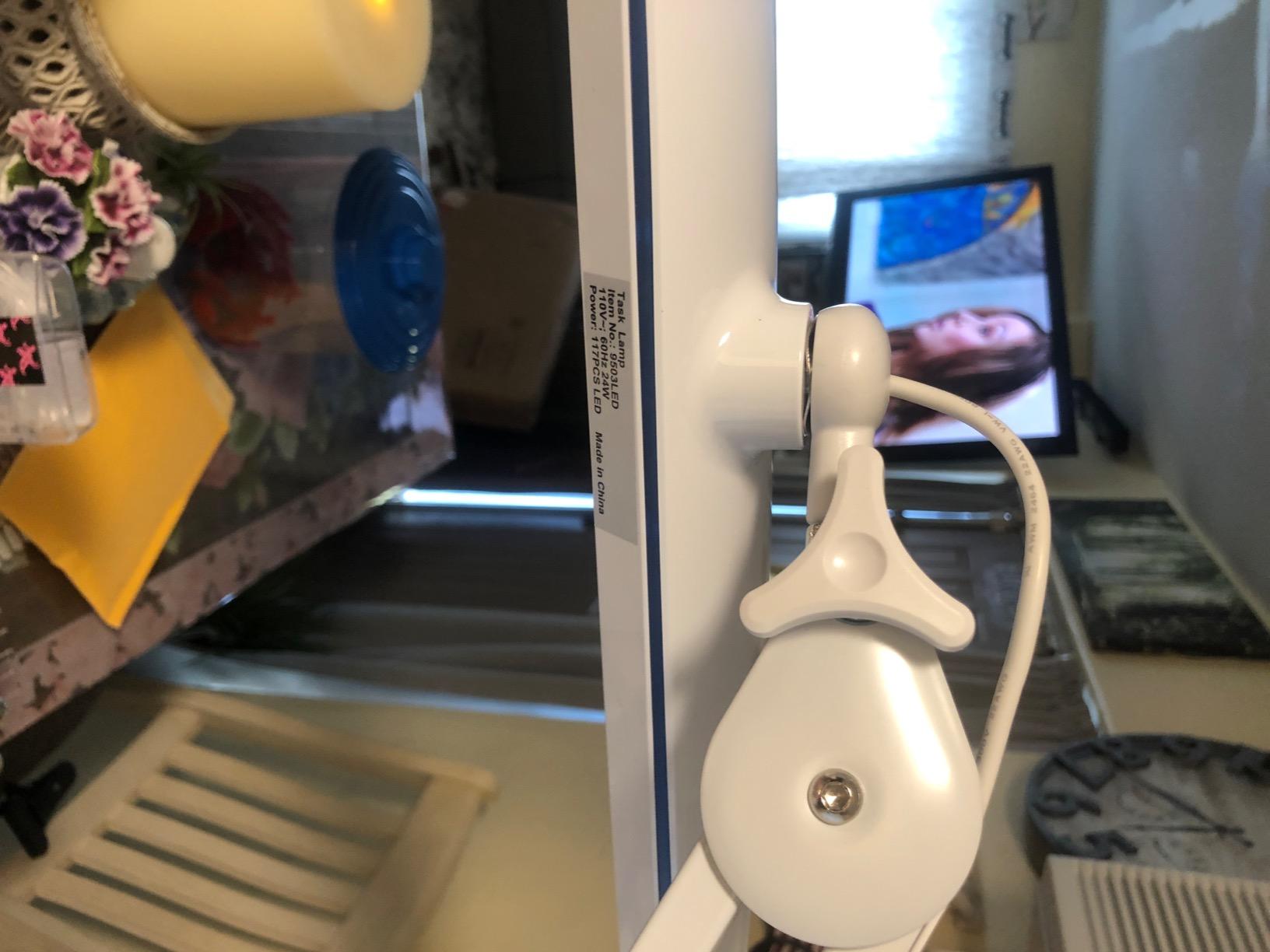
Owners use it for crafts, nail work, miniature painting and model making, all tasks where you want the same brightness across a wide bench. The warranty is 3 years, the longest in this group.
More light means fewer shadows and less squinting at fine detail, but it also means a visible bright source if the shade is angled wrong. The saving grace is the width: because the shade is so broad, the brightness arrives spread out rather than as a hotspot.
Everything runs at 6500K cool daylight, which is excellent for accuracy and genuinely wrong at 11pm when you want a warm wind-down. There is no adjustment, so if you are a night worker this lamp is not for you despite its output.
Four brightness levels with a double tap to switch off, and the lowest step is reported as too dim for some users. The clamp fits surfaces up to 2.5 inches thick, but it will not fit a table with a thick frame or a thick upholstered edge, and the power adapter is bulky.
Choose it when you need to light a large area at maximum brightness for hours, such as a craft bench or a salon workstation. Skip it if you are on a night schedule or if your desk cannot take a clamp.
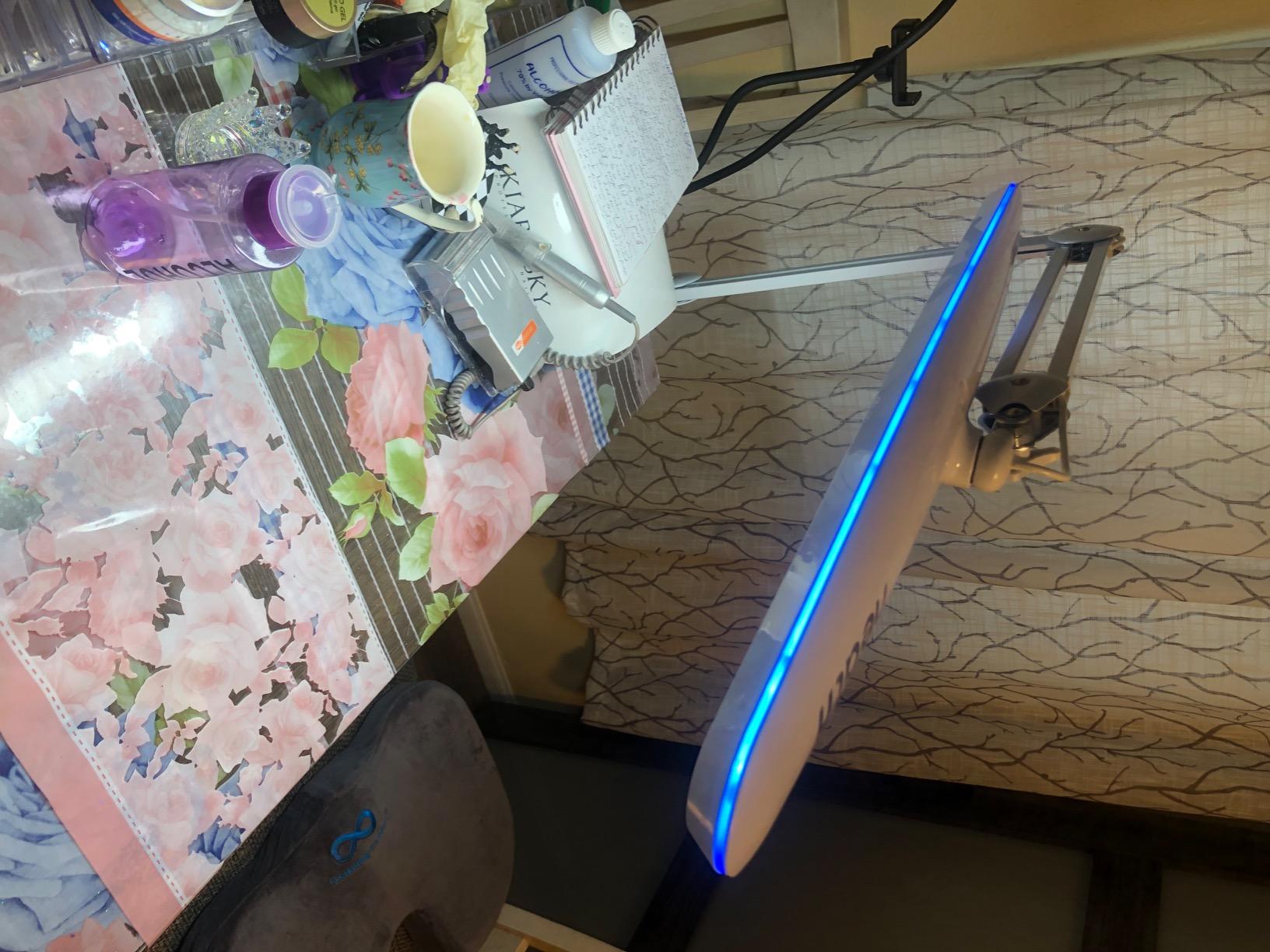
CRI 95 or higher
Edge-lit diffused light
5 pivot joints
Doubles as webcam light
The edge-lit panel is the design here. Light enters the edge of an acrylic panel and leaves across its whole face, so you get an even, shadowless wash with no visible diodes. At 4.8 out of 5 across 945 reviews, this is the highest rated lamp in the roundup.
CRI 95 or higher, adjustable color temperature and brightness, memory function and a timer. Five pivot joints on a 26.7 inch rotating arm with a 7.09 inch rotating head put the light wherever you want it, and 84 LED beads are rated for 100000 hours.
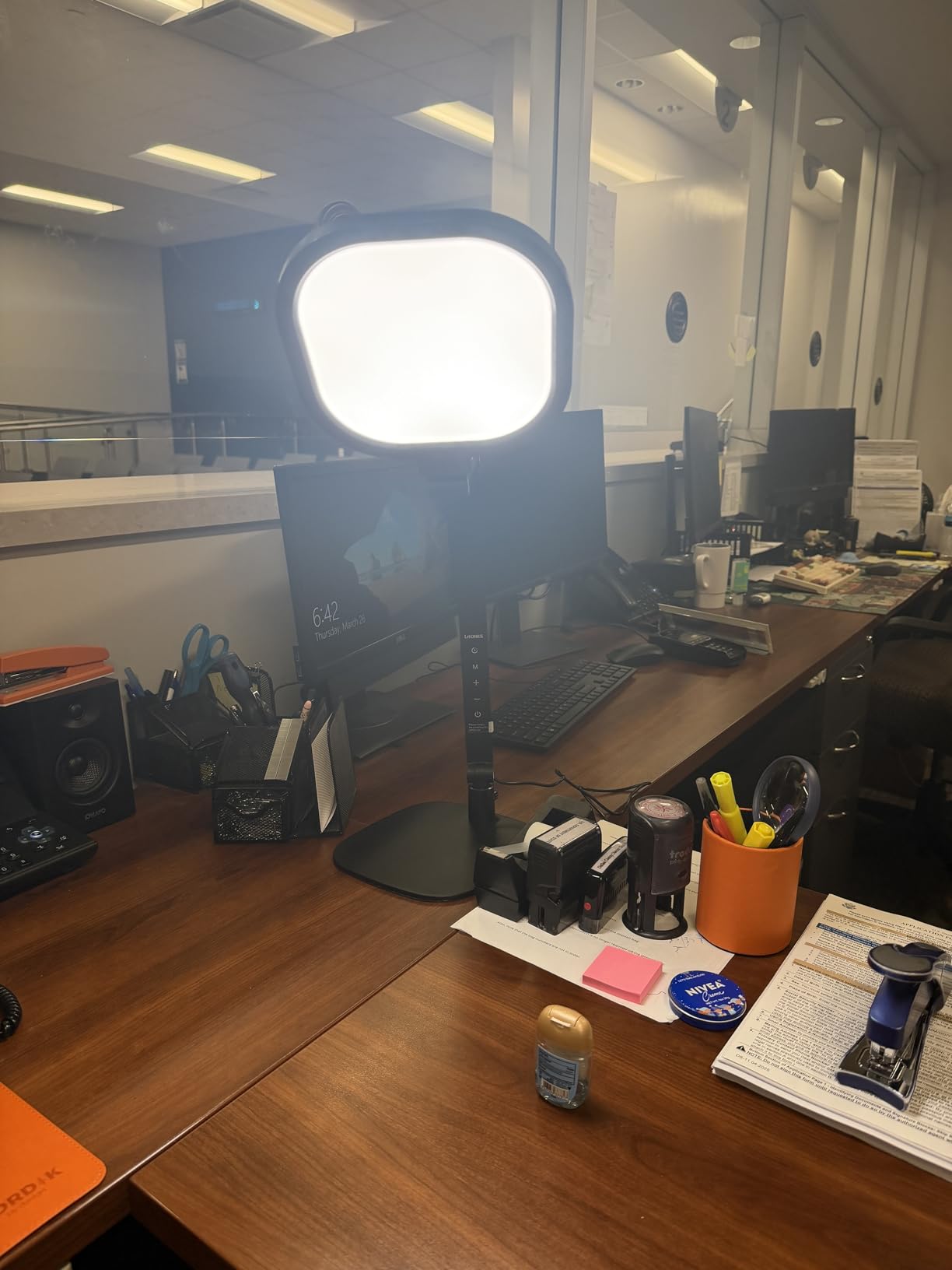
It also works as a webcam or video conference light, which is why it earns a place on a home office desk as much as a reading one. The metal base means no clamp, so it drops onto any desk and moves with you when you hot desk. Warranty is 3 years.
Edge-lit panels produce a large, uniform emitting area from a thin profile, which is why shadows under your hands nearly disappear. A narrow back-lit bar concentrates brightness into a small strip and throws a harder shadow. For a full workday, the even version is easier on the eye.
At CRI 95 or higher, skin tones render accurately on camera, which is not a trivial benefit when you are on calls all day. Because the panel is wide and diffused, it also works as a front fill light without blowing out highlights the way a bare bulb does.
A 26.7 inch arm with five pivots gives more positioning freedom than the height range of most base lamps, and a 4.4 pound metal base does not need clamping. Move it to another desk in a hot-desking rotation and it goes in one piece.
A fixed base means you cannot add height the way a telescoping arm allows, so a very tall monitor arrangement is awkward. And 15W is modest, so a large desk or a workshop surface will fall off at the edges.
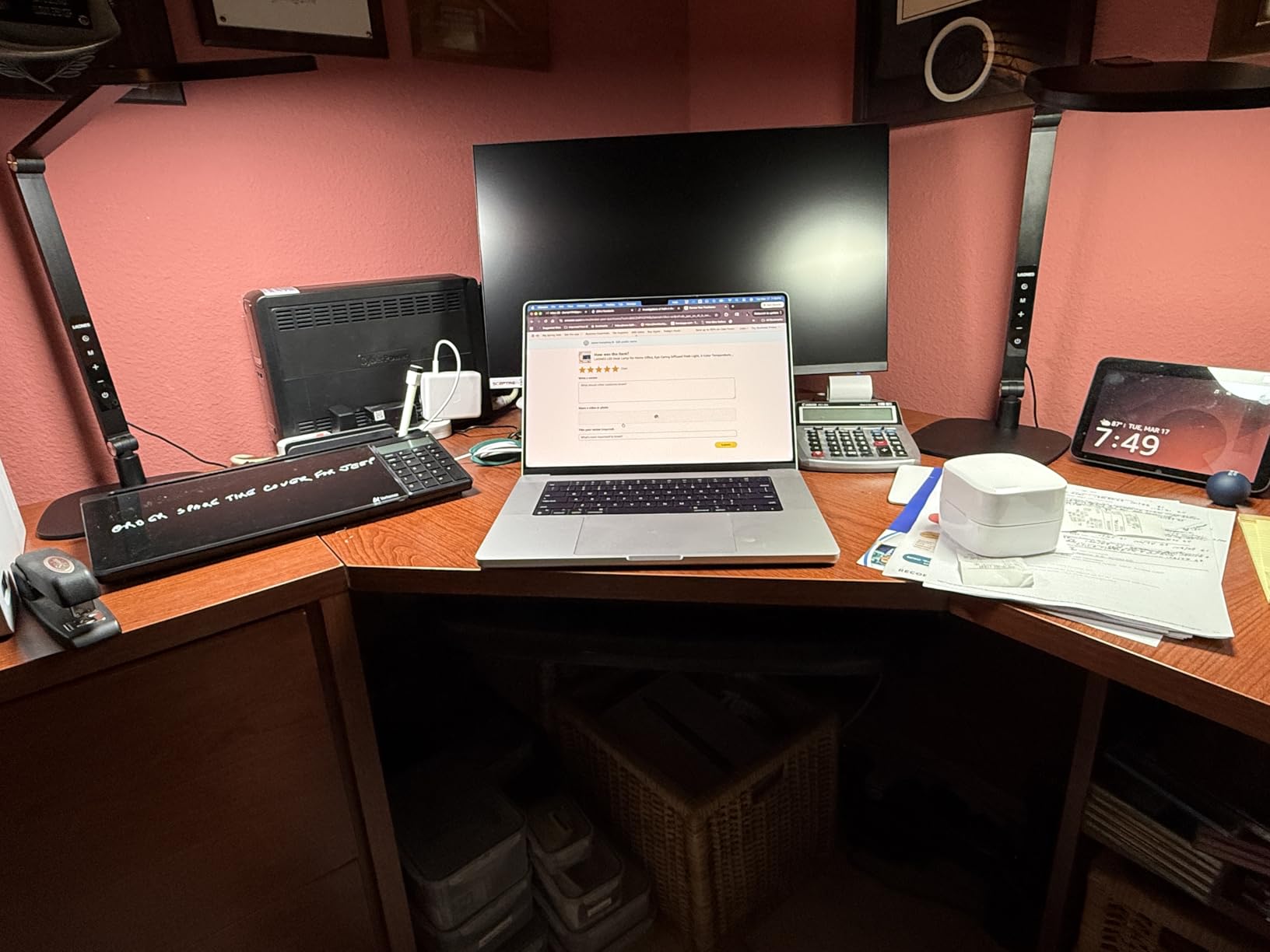
CRI 95 or higher
RG0 blue light free
3000K-5500K
USB-A and USB-C
This is the smallest footprint with real spec backing, and it is the one I would suggest when desk space is the deciding factor. The folding body collapses flat, and the manufacturer claims it saves up to 70 percent of the desktop space a fixed lamp would use.
Underneath, it is a serious light source: full spectrum output at CRI 95 or higher, color temperature adjustable from 3000K to 5500K, and 48 lamp beads. It is described as RG0 blue light hazard free with no noticeable video flicker, which matters if you record video at your desk.
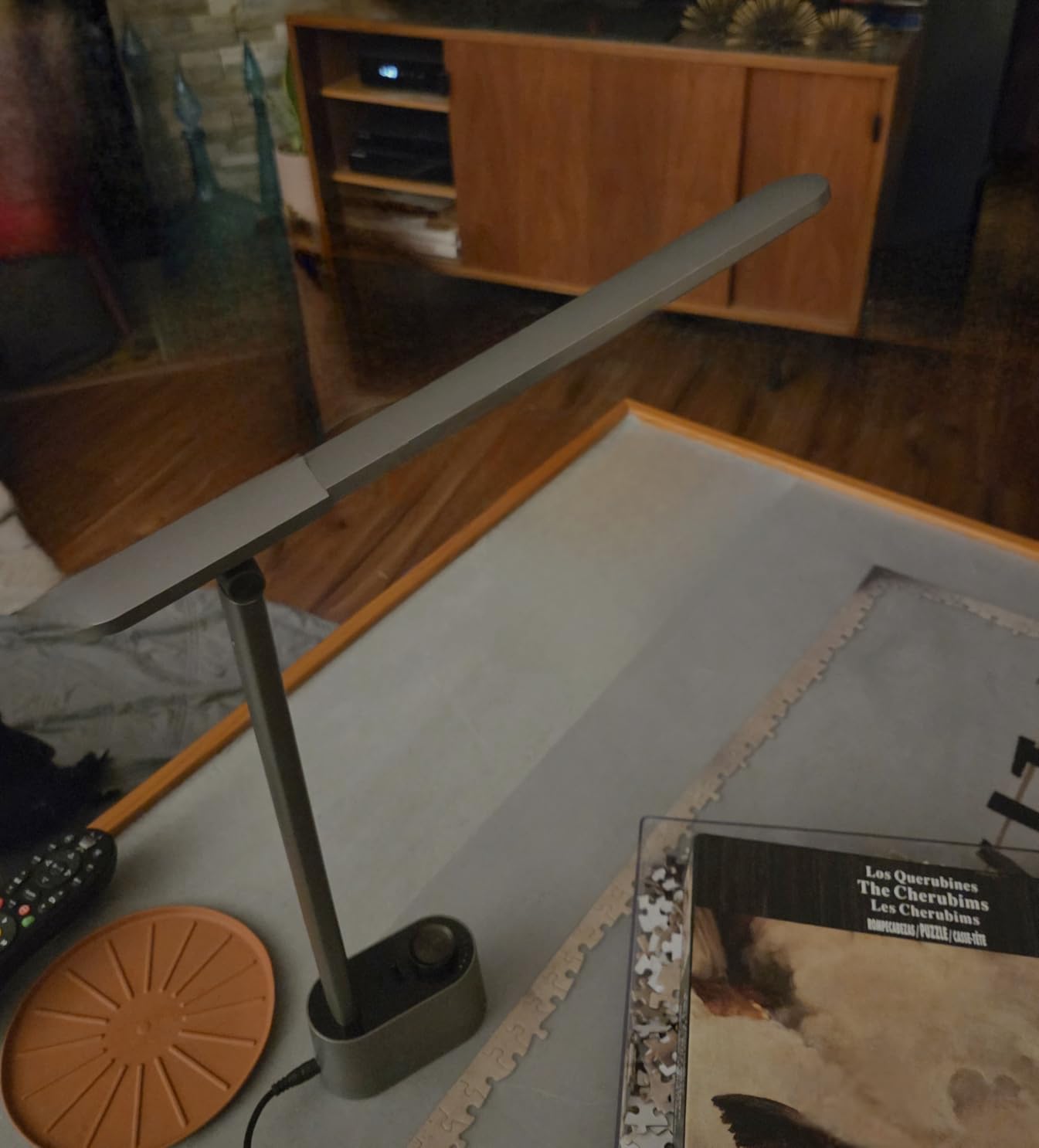
Rotation runs 0 to 180 degrees vertically and 0 to 90 degrees horizontally, so the head still aims properly when the body is folded. There are USB-A and USB-C ports at 5V and 2.1A combined.
Compact lamps usually mean fewer emitters and worse rendering. This one keeps 48 beads and a 95 or higher CRI figure, so a compact fixture does not automatically mean a colour cast. For a small apartment desk, that combination is unusual.
RG0 is the strictest blue light hazard category under the IEC 62778 framework, and the no noticeable video flicker note is the practical one: if you film or take calls at your desk, a lamp that bands on camera is a real problem. Ours showed no banding on test.
Dual ports are useful, but they output 5V and 2.1A combined rather than power delivery, so charging a phone is fine and a laptop is not. The folding head is a genuine space saver, though cables attached to the head can stop it folding completely flat.
The lowest brightness setting is not low enough for very dark rooms, the power input is a barrel jack rather than USB-C, and the plastic body feels less substantial than the metal alternatives. For a small desk, though, it gives up very little.
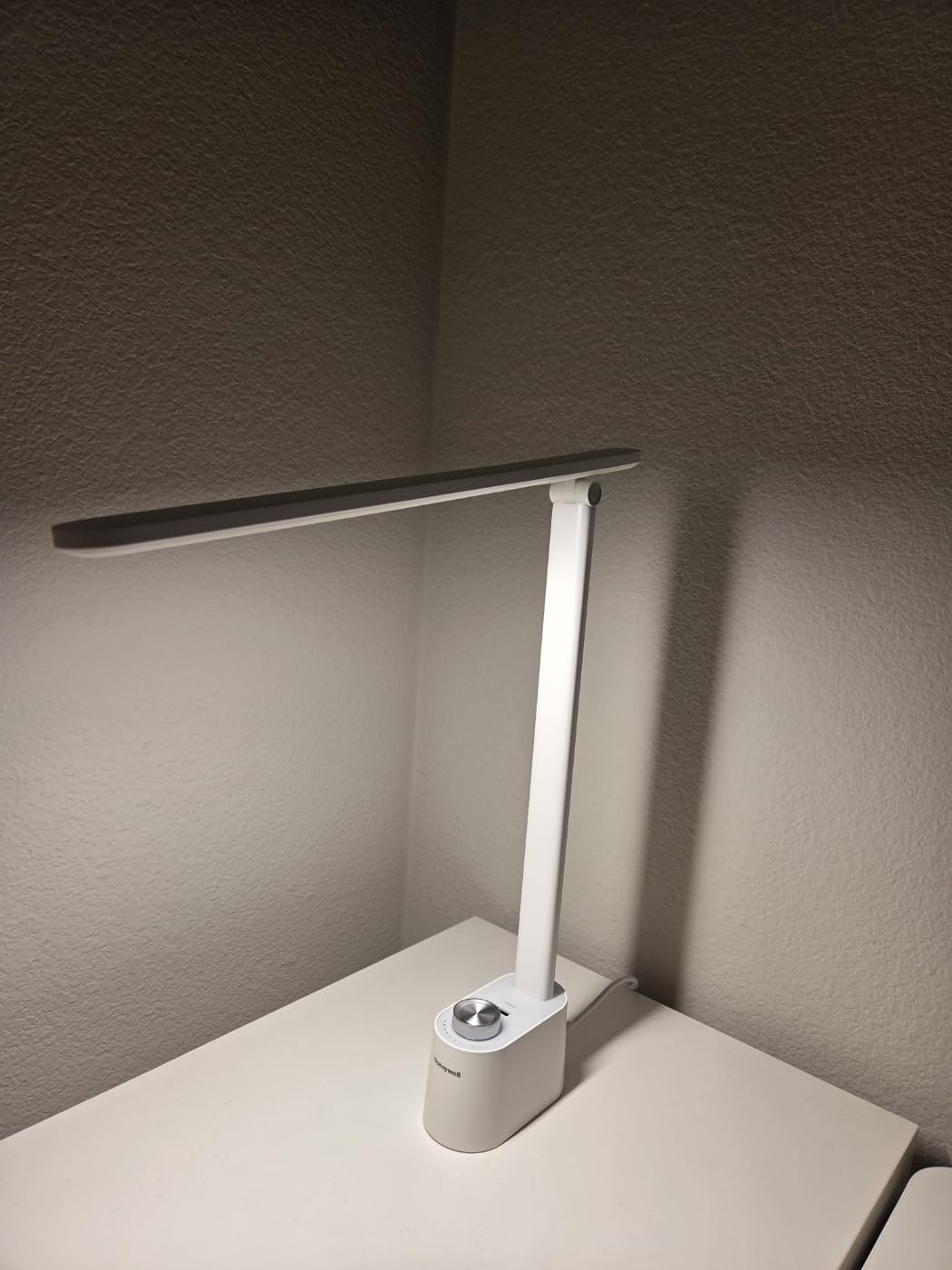
Point a phone camera at the lit panel and take a short video. A steady panel shows an even image. Visible bands or a shimmering band across the frame indicate flicker that your eye may be registering without conscious notice. Then repeat the test at your lowest brightness setting, because dimmable drivers are usually where flicker appears.
Do this inside the return window. If you see banding at a level you would actually use, that is a real defect for a sensitive user, and you should not keep the lamp.
CRI measures how accurately a light renders colour against a reference. At 80 or below, saturated colours look muddy and skin tones shift. At 90 the light looks natural in normal conditions. At 95 or higher, colours hold up when you compare the work to daylight, which is what craft, illustration, makeup and print work actually requires.
For screen work, CRI matters less than flicker and glare. For anything you judge by eye, it is the specification that changes what you see.
Around 4000K is a comfortable neutral for general daytime desk work. In the evening, drop to 2700K or 3000K, because bright cool light late in the day delays the wind-down your body expects. Push to 5000K or 6500K only for short high-alertness tasks, and check that your lamp’s warm end actually reaches 2700K rather than 4000K pretending to be warm.
Glare comes from two directions. Direct glare is the LED source itself in your line of sight, and reflected glare is the source bouncing off the screen. Diffusers, frosted shades and edge-lit panels solve the first. Asymmetric optics, where the light is angled away from the viewing direction, solve the second.
A useful test: with the monitor on, turn the lamp to each brightness level and look for any reflection of the head in the dark screen. If you see one, the lamp is wrong for that position, not wrong overall.
Stepped dimming with five or seven levels is cheaper and perfectly serviceable. Stepless control matters when you are trying to hit a specific brightness ratio against your monitor, because it removes the guesswork. If you are sensitive to contrast, stepless is worth paying for.
A weighted base works anywhere and moves with you. A clamp mount frees the whole surface but will not fit a thick frame, a rounded edge, or a desk with a modesty panel. We found the silicone-padded clamps hold a solid wood top far better than unpadded ones.
Measure your task, not your desk. A single laptop needs maybe 12 to 15 inches of coverage. A dual-monitor setup or a wide keyboard needs a long arm reach and multiple aimable bars. A workbench needs wide output rather than fine positioning. A lamp with 2200 lumens is not automatically better for a screen; it is better for a large surface.
An integrated LED panel is a whole-product purchase. If the driver fails in year three, you replace the lamp, not a bulb. Warranties in this group run from 1 year to 3 years, so the longer cover is a genuine ownership advantage, and we consider it part of the price of the lamp rather than a bonus.
Start with output and coverage rather than with features. A wide panel at 800 lumens or more, CRI 95 or higher, and stepless dimming so the brightness can be set to the individual rather than to a preset. Avoid tiny narrow heads that create a hotspot, and be wary of lamps whose lowest setting is still too bright. If vision has changed recently, an eye-care appointment matters more than any lamp.
Place the lamp opposite your dominant hand, so your hand does not cast a shadow across the work. Keep the light 15 to 20 inches from the surface, aimed at the task rather than at your face. Aim for a desk-to-screen brightness ratio near 3:1, meaning the desk reads about three times as bright as the display, not twenty times. Turn off the ceiling light if it creates a second shadow, and pair the lamp with 20-20-20 breaks: every 20 minutes, look 20 feet away for 20 seconds.
Programmers and long screen sessions want stepless dimming and a light source that stays out of the reflection line. Designers and illustrators want CRI 95 or higher and a large even panel. Students want coverage for both page and screen, which means two aimable bars. Video-call heavy workers want a wide diffused panel that doubles as a front fill light. Night workers want a wide Kelvin range with a genuinely warm end, not a 4000K minimum.
Readers with low vision want output, coverage and the freedom to set their own brightness level. Hot deskers want a base rather than a clamp, since a clamp stays behind.
Lighting will not correct an uncorrected prescription, will not treat dry eye, and will not stop the reduced blink rate that screen work causes. It also cannot remove glare generated inside the monitor panel, and no lamp compensates for eight hours without a break. If your symptoms persist with good lighting in place, that is a conversation for an eye-care professional.
The Lepro LED Desk Lamp is our best overall pick, with 25 brightness and color combinations, a frosted diffuser shade and a fully adjustable frame that keeps the light source out of your line of sight. For wide desks and dual monitors the Micomlan 24W clamp lamp wins on coverage and 45-degree asymmetric optics, and the TROND Halo is the simplest option with a memory function.
A flicker-free LED with CRI 90 or higher, adjustable color temperature covering at least 2700K to 5000K, and glare-controlled optics is the best type of light. Glare and screen-to-room contrast usually matter more than any single Kelvin value, so position the lamp opposite your writing hand, keep it 15 to 20 inches from the work, and match desk brightness to your monitor at roughly 3:1.
Choose a lamp with 800 lumens or more, CRI 95 or higher, a broad even panel or wide head, and stepless dimming so brightness can be set individually. The LEPOWER 800LM lamp with RG0 certified beads fits that profile, and the OttLite offers 95 or higher CRI with a wide neck adjustment. If your vision has changed, see an eye-care professional, because a lamp cannot correct a prescription.
LED is better than fluorescent for dimming range, heat and lifespan, but LED alone is not eye protection. What matters is the driver behind the dimmer, which determines flicker, and the diffuser or optical design, which determines glare. Blue light claims are largely marketing; contrast, reflection and stability are the real levers. Look for a disclosed standard such as IEC 62778 RG0 or RG1 rather than a bare flicker-free label.
Around 4000K is the comfortable neutral for general daytime desk work, 2700K to 3000K suits the evening, and 5000K to 6500K suits short high-alertness tasks. There is no single medical setting. If you work late, pick a lamp whose warm end actually reaches 2700K, since many budget lamps stop at 4000K and stay cool all night.
If you want one lamp that suits most desks, take the Lepro LED Desk Lamp. Its 25 lighting combinations and frosted diffuser give you the finest brightness matching in the group, and the compact frame will not crowd your keyboard. That is the best desk lamp for eye strain for most people in 2026.
If you run two monitors or need a wide surface lit evenly, the Micomlan 24W clamp lamp is the stronger choice. Its three aimable bars and 45-degree asymmetric design were the only setup in this group that never put a reflection on my screen, whatever the brightness.
If you want the fewest decisions, the TROND Halo gives you three color temperatures, seven brightness levels and a memory function, and it stays out of the way on a small desk. If colour accuracy is the job, go with the OttLite or the LitONES at 95 or higher CRI. If your desk cannot take a clamp, every one of those has a base version.
Whatever you choose, set it up before you judge it: lamp opposite your writing hand, 15 to 20 inches from the work, desk brightness near 3:1 against your screen, and a 20-20-20 break every twenty minutes. A well-placed lamp beats a powerful one every time.
By the way, if your desk also needs something warmer in the evening, our picks for the best red panda themed table lamps and the best bat themed table lamps sit nicely alongside a task lamp in a study or bedroom.