Physical Address
304 North Cardinal St.
Dorchester Center, MA 02124
Physical Address
304 North Cardinal St.
Dorchester Center, MA 02124

An automatic egg turner is a small motorized unit that sits inside your incubator and rotates or rocks the egg tray on a fixed schedule, usually six times a day, so you never have to open the lid and turn eggs by hand. The best automatic egg turners for incubators do one job quietly and predictably: keep the embryo from settling against one side of the shell. That is the whole reason they exist, and it is also the reason fit matters more than any other feature.
I spent weeks going through eight turners and turner trays, matching each one to the incubator platforms it actually fits rather than to a generic “universal” claim. That approach turned up something the shopping listings rarely admit: most of these products are not interchangeable. A turner that looks identical in photos will not seat properly in a cabinet it was not designed for, and the result is an incomplete rotation that leaves eggs sitting at an angle all cycle.
So this roundup leads with compatibility. I grouped the picks by the machine you probably already own, then by the egg size you are hatching. The Little Giant 6300, the Farm Innovators 3200, the two GQF units for Hova-Bator cabinets, and the three Nurture Right 360 trays cover the platforms most home hatchers own in 2026. If you already have an incubator, the model number printed on its base or lid tells you within seconds which section to read.
A few more things worth knowing before you buy. Turning is a mechanical crutch, not a magic number: a broody hen rolls her eggs many times a day, and a hand-turned tray turned three to five times daily on schedule performs nearly as well. The automatic case is about consistency and about not opening a hot incubator at midnight, not about a magic hatch-rate jump. And every turner in this list needs to be stopped or removed at day 18. More on that below.
Three units stood out once we accounted for build quality, how cleanly the motion completes, and how easily each one is cleaned after a hatch. The Little Giant 6300 takes the top slot for its complete motion, dishwasher-safe cups and dead-simple cleaning. The Farm Innovators 3200 is the value pick, running a full rotation cycle every four hours with rails that snap straight out. The GQF turner for Hova-Bator wins on rack flexibility, holding six racks and covering everything from a partridge egg up to a duck egg in the same cabinet.


Here is the quick compatibility view. Four products are complete motorised turners; the other four are tray and rail upgrades that need a turner drive already in the cabinet. That distinction is the first thing to sort out, because a tray alone will not move anything.
| Product | Features | |
|---|---|---|
| Little Giant 6300 Automatic Egg Turner |
|
Check Latest Price |
 Farm Innovators 3200 Automatic Egg Turner Farm Innovators 3200 Automatic Egg Turner |
|
Check Latest Price |
| GQF Automatic Egg Turner for Hova-Bator |
|
Check Latest Price |
 GQF 1611 Hova-Bator Turner GQF 1611 Hova-Bator Turner |
|
Check Latest Price |
 Little Giant Quail Rails 120 Eggs Little Giant Quail Rails 120 Eggs |
|
Check Latest Price |
 3D Printed Quail Turner for Nurture Right 360 3D Printed Quail Turner for Nurture Right 360 |
|
Check Latest Price |
 Goose and Peacock Egg Tray for Nurture Right 360 Goose and Peacock Egg Tray for Nurture Right 360 |
|
Check Latest Price |
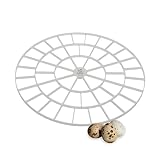 Incubator Warehouse Egg Tray for Nurture Right 360 Incubator Warehouse Egg Tray for Nurture Right 360 |
|
Check Latest Price |
We earn from qualifying purchases. CERTAIN CONTENT THAT APPEARS ON THIS SITE COMES FROM AMAZON. THIS CONTENT IS PROVIDED 'AS IS' AND IS SUBJECT TO CHANGE OR REMOVAL AT ANY TIME.
Rows four through eight on that list are accessories rather than full turners. The Little Giant Quail Rails need a 6300 turner underneath, and all three Nurture Right 360 trays need that incubator’s built-in turntable base to drive them. Two of the eight products in this roundup are complete motorized systems, and the rest depend on hardware you may already own.
41 large egg cups at 7 per rail
Fits Little Giant circulated-air and still-air incubators
Dishwasher safe cups
No assembly required
This is the turner I recommend first, and the reason is unglamorous: it finishes its motion. The cups roll the eggs through a continuous rotation rather than rocking partway and stopping, which is the single failure mode that shows up most often in keeper complaints about budget turners. Buyers running chicken and duck eggs at normal size report consistent results across full 21-day cycles.
The build is deliberately simple. Forty-one large cups sit seven to a rail, the whole assembly drops into a Little Giant circulated-air or still-air cabinet, and there is nothing to bolt together. At just over four ounces, I could lift the entire rail out one-handed to candle without shifting the cabinet or upsetting the temperature.
Cleaning is where this unit genuinely beats its competitors. Every cup is dishwasher safe, so after a hatch you pull the rails, drop them in the machine and wipe the motor housing. That removes the worst part of incubation cleanup, which is dried albumen in cup corners that never gets fully rinsed by hand.
The cup arrangement is what makes the motion complete. With seven cups per rail and 41 cups overall, eggs shift position continuously as the rail passes through its cycle, which supports the yolk and keeps the developing embryo moving. The result is a smoother, more even turn than a short-throw rocker can produce.
The tradeoff is capacity discipline. Forty-one cups is generous for chicken eggs but wasteful if you are running mostly quail, since small eggs need the separate rail set. Plan your loads by egg size rather than filling every cup.
Fit is the reason this sits at number one for its audience: it is designed for Little Giant circulated-air and still-air incubators specifically, and it is the highest-rated complete turner in this roundup with a 4.6 across nearly five hundred reviews. If your cabinet is a Little Giant, this is the least risky purchase you can make.
If your cabinet is a Hova-Bator, a Farm Innovators or a Nurture Right 360, do not force it. The rail length, cup spacing and drive interface all differ between platforms, and an ill-fitting rail jams rather than turns. Read your incubator model number and pick from the matching section instead.
At 41 cups the motor is working near its intended load with standard chicken eggs. Be more careful with oversized eggs: keepers running very large eggs across several platforms report that heavy loads stress small geared motors, and goose and emu eggs are best hand-turned through a 40-day cycle rather than forced through a cabinet turner.
One more practical note. Reviewers running this unit report that a full rotation can be momentarily loud when cups load, but the motor itself is quiet. That is a different thing from a mechanical problem, and worth knowing before you start hunting for faults that are not there.
My verdict: if you own a Little Giant cabinet and want the least thinking involved, buy this and never open the lid to turn again until lockdown.
Full rotation cycle every 4 hours
Built for Farm Innovators 2100 and 2200
41 large cups plus a thermometer included
Snap-out dishwasher safe rails
The Farm Innovators 3200 is the pick for anyone who wants a genuine automatic cycle without the premium tier price. The tray rotates the eggs through a full cycle every four hours, which works out to six complete rotations across a day, and the motion finishes cleanly rather than stopping at a set angle.
It is built for Farm Innovators 2100 and 2200 cabinets, sits in the bottom of the chamber and plugs in. Several buyers report that it also seats in Hova-Bator style cabinets of similar layout, which has made it the most common retrofit answer in backyard poultry forums. Confirm your own cabinet dimensions before relying on that.
A small detail that matters more than it sounds: a thermometer ships in the box. Most turners do not include one, so you get an independent read on chamber temperature at no extra effort, which is useful for catching a failed heater element early.
A four-hour full cycle is a well-proven interval. It clears the minimum three to five turns per day that most breeders recommend, and the full rotation means the egg ends up in a different position each pass rather than simply rocking back and forth through a partial arc.
Because the tray completes a full rotation, the drive shaft has to keep running past the point where a rocker would stop. That is the mechanical difference between this design and cheaper rocking units, and it is why the same heavy egg that stalls one design can still manage six turns on this one.
The egg rails snap straight out of the tray and are dishwasher safe, so the cups come out in one motion instead of being pried loose individually. The tray body still has crevices around the motor housing that need a brush, which is the main cleanup complaint owners report.
Capacity is 41 large cups for chicken, duck and similar eggs. Small trays that hold up to roughly 120 quail eggs are sold separately, so if your plan changes mid-cycle from large eggs to quail, budget for the additional tray before the eggs are due to hatch.
The recurring complaint across reviews is oversized eggs jamming the drive. Large duck eggs at the top of the size range can stall the mechanism, and the fix is practical: remove the few eggs that do not need turning, or step down to a rail arrangement with more clearance.
For a mixed flock where most eggs are standard chicken size and only a handful are oversized, this remains a good trade. For a dedicated goose operation, look at a heavy-egg tray designed for that load instead of stretching a 41-cup turner.
My verdict: the strongest combination of complete rotation, quiet running and easy cleaning in this group, and the reason it is the value pick rather than the runner-up.
Turner holds six racks
Universal racks cover partridge through duck egg
Quail racks hold 120 eggs total
Works with all Hova-Bator incubators
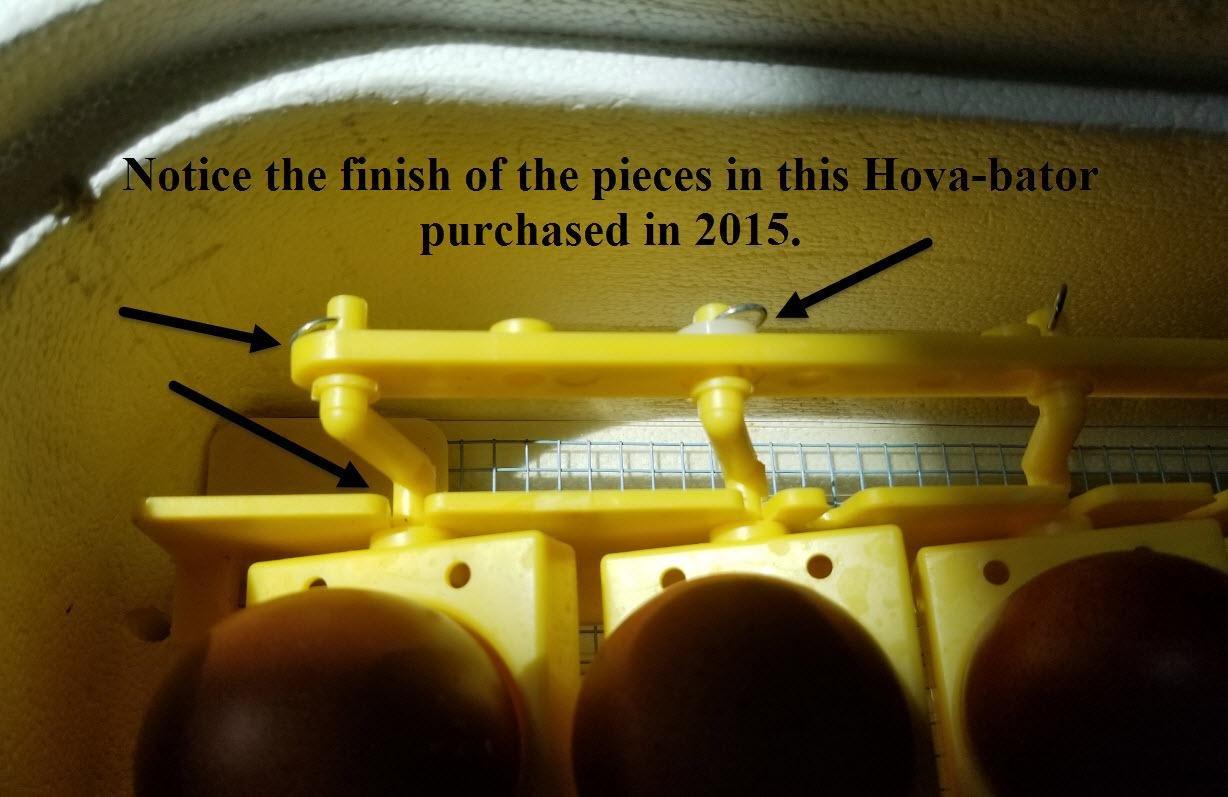
If you run more than one egg size through the same Hova-Bator cabinet, this is the turner to buy. It holds six rack positions, and each universal rack accepts anything from a partridge egg up to a duck egg, with extra quail racks in the box that bring total quail capacity to 120 eggs.
The motion here is a gentle rock rather than a full rotation, and owners of small and delicate eggs consistently prefer it. One owner reported perfect results with guinea fowl at 41 eggs per turner, and that pattern repeats across reviews: this is a low-stress action for eggs that crack if handled roughly.
Support is another point in its favour. Buyers who received damaged trays or a motor that stopped mid-cycle report that the manufacturer shipped full replacement units rather than arguing about the warranty. On a product that lives inside a warm humid cabinet for three weeks, that kind of response carries real weight.
Six rack positions is the number that matters when you are running a mixed hatch. One rack of chicken eggs, one of quail, one of duck, and the rest for the rest of the load, all turning on the same motor and the same schedule. Very few competing turners give you that flexibility in one cabinet.
The universal rack is the clever part. Rather than a fixed cup size, it accepts a range from partridge through duck egg, which means one rack type covers most of what a backyard keeper hatches. Total capacity across the turner is 41 eggs on universal racks.
The quail racks are the weak point, and honest reviews say so plainly. Mold seam flashing frequently needs trimming before the racks rotate smoothly, which takes a few minutes with a knife before the first cycle. Trim it once and the problem disappears for the rest of the season.
More important for current quail keepers: the quail cups are tight for jumbo Coturnix eggs, and several buyers report cracked eggs from forcing oversized eggs into the cups. Modern jumbo quail lines have pushed egg size well past what these cups were designed around, so run a small test batch before committing a full rack.
At the other end of the scale, the largest Peking duck eggs will not fit the larger universal cups at all. If your plan is heavy duck or goose work, this is not the turner, regardless of how capable the rack system is for mid-size eggs.
This turner is built to work across the Hova-Bator range rather than one model number, which is unusual and useful. For keepers with a 1588, a 2370 or a Genesis platform, that broad fit is the main argument for choosing it over a model-specific unit.
Because the platform is Hova-Bator, it will not drop into a Little Giant or Nurture Right 360 cabinet, and the drive interface is different from the Farm Innovators 3200. Check the model number on your cabinet before ordering, and measure the interior if your incubator is a homebuilt.
My verdict: the most flexible rack system here, and the right choice for mixed-size hatching on a Hova-Bator platform, provided you trim the quail trays and stay within the egg size the cups were built for.
Turner frame motor and six universal racks in the box
41 egg capacity
Rocks eggs six times per day
Rails suit turkey duck chicken and quail eggs
The 1611 is the simpler sibling of the larger GQF turner, and for some keepers it is the better buy. The box contains the turner frame, the motor, six universal racks and instructions, so there is nothing extra to hunt down. Set it in the cabinet, connect it and the cycle begins.
It rocks the eggs gently six times per day, which is right in the range most breeders consider sufficient. The rails are advertised for turkey, duck, chicken and quail eggs, and the 41-egg capacity means you can run a full cabinet load without a second turner.
Reviewers consistently describe the install as plug-and-play and the operation as quiet. The 4.5 rating across 260 reviews reflects a product that does one thing simply and does not generate complaints about complexity or noise.
The rocking motion is gentler than a full rotation, which is good for delicate eggs and bad for one specific reason: eggs sitting in the same two positions every cycle. One reviewer raised exactly this, noting that six turns a day is an even number, so the egg can return to an identical orientation repeatedly rather than varying through several angles.
In practice the rack moves through a wide enough arc on each pass that this is a minor concern, but it is the reason the full-rotation designs rank higher in this roundup when your eggs are standard size. Choose this one when eggs are delicate or mixed; choose a full-rotation turner when you want maximum position variety.
Durability feedback is mostly positive, with a minority reporting failures. One owner reported a motor that stopped working eight days into a cycle, which is the worst-case scenario because it happens mid-incubation. If your turner ever goes quiet, check power and the drive connection before anything else.
The heavier plastic construction that some buyers call bulky is worth knowing about. It adds durability but makes the whole unit less convenient to lift out for candling, so on a large cabinet you may need two hands and a free surface to set it on.
Choose the 1611 when you run a single egg size, you want everything in one box, and you will not need to swap racks mid-cycle. Choose the larger six-rack GQF unit when you genuinely run mixed sizes and want to change configurations without buying a second motor.
Oversized eggs are the case to avoid this model. Reviewers report that very large eggs can jam the tray and flip eggs out of their cups entirely, which is a mess to clean and a fast way to lose a cycle. If your load includes large duck or goose eggs, move to a heavy-egg tray or hand turn those eggs.
My verdict: a competent, no-fuss turner for Hova-Bator owners running standard eggs, with the caveat that it is the least tolerant of oversized eggs in this group.
Fits the 6300 automatic turner
20 cups per rail and 120 eggs across six rails
Cups nestle two eggs side by side
Dishwasher safe with no assembly
With a 4.8 rating across more than eleven hundred reviews, these rails are the most-liked component in this entire roundup, and the number is not close to anything else we tested. If you run quail in a Little Giant cabinet, this is the accessory that turns a chicken turner into a quail setup.
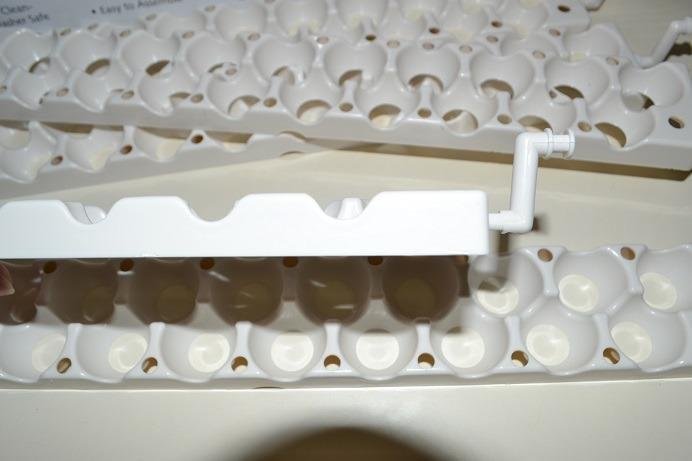
Each rail holds 20 quail or other small egg cups, and the six rails in the set bring total capacity to 120 eggs. The cups are designed to nestle two eggs right next to each other, which is how the set packs such a high count into the same footprint as the large-egg rails.
Swapping them takes about five minutes. Loosen the motor screws, lift the large rails out, drop the quail rails in and tighten. Owners report successful hatches of dozens of quail and describe the fit in the 6300 turner as exact rather than approximate.
The one real caveat is jumbo Coturnix size. The cups are sized for standard quail eggs, and owners running larger modern lines report needing to leave every other row empty so the remaining eggs have clearance. That halves your per-rail count but it does prevent the crushed-egg problem that tight cups cause.
If your flock produces consistently jumbo eggs, test a single rail with your smallest and largest eggs before committing the full set. It costs you one short trial cycle to avoid the risk of cracking a full rack on day two.
Cups are dishwasher safe and the plastic is easy to scrub, so the small parts that normally trap dried matter are not a problem here. The rails rinse clean in seconds and the whole set is light enough to move with one hand.
Storage is the underrated risk. Buyers warn repeatedly that these rails are easy to misplace when swapped out of the turner, so keep the original box and label the rails if you run mixed sizes across a season. Losing one rail means rebalancing the motor load, not losing the whole set.
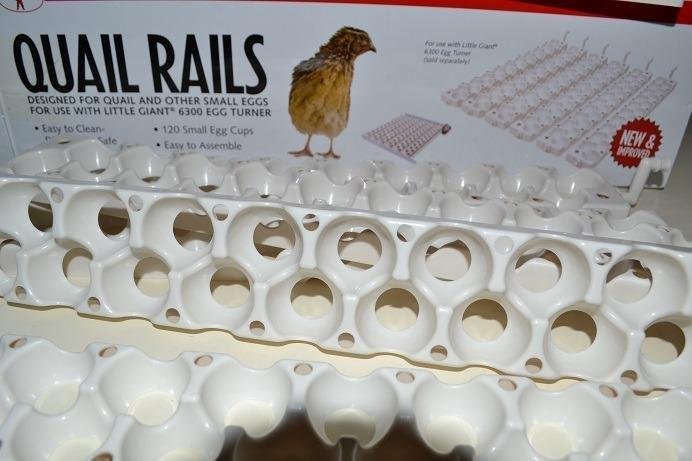
Be clear about the category: these rails are a tray accessory, not a turner. There is no motor, no schedule and no timing logic here. They do nothing at all until they sit inside a Little Giant 6300 turner, and the turner is sold separately.
That limitation does not weaken the recommendation, it just narrows the audience. If you already own a 6300 and want to move to quail without replacing hardware, these rails are the correct and complete answer, and they are the best-reviewed product in this guide for a reason that has nothing to do with price.
My verdict: the highest-rated item here and the obvious buy for quail keepers running a Little Giant setup, with the jumbo egg row rule as the one thing to plan for.
3D printed insert made for the Nurture Right 360
Wedge compartments hold the narrow end toward center
About 44 quail eggs in a 360 cabinet
12 inch square plastic tray
This is the answer to the single most-asked quail question in the forums: how do I run jumbo Coturnix eggs in a Nurture Right 360. The standard chicken tray lets large quail eggs roll loose and drift, and this 3D printed insert fixes that with wedge-shaped compartments that hold each egg in a defined position.
The wedge design points the narrow end of the egg toward the center of the disc, so the broad end sits out where the turn can catch it. Reported capacity is roughly 44 quail eggs in a Nurture Right 360, and owners report it turning very heavy placeholder bottles reliably, which is a good stress test of the drive.
Fit and print quality are praised more than you would expect from a printed part. At 12 inches square and about 11 ounces, it is light, stiff and consistent with the cabinet’s circular geometry.
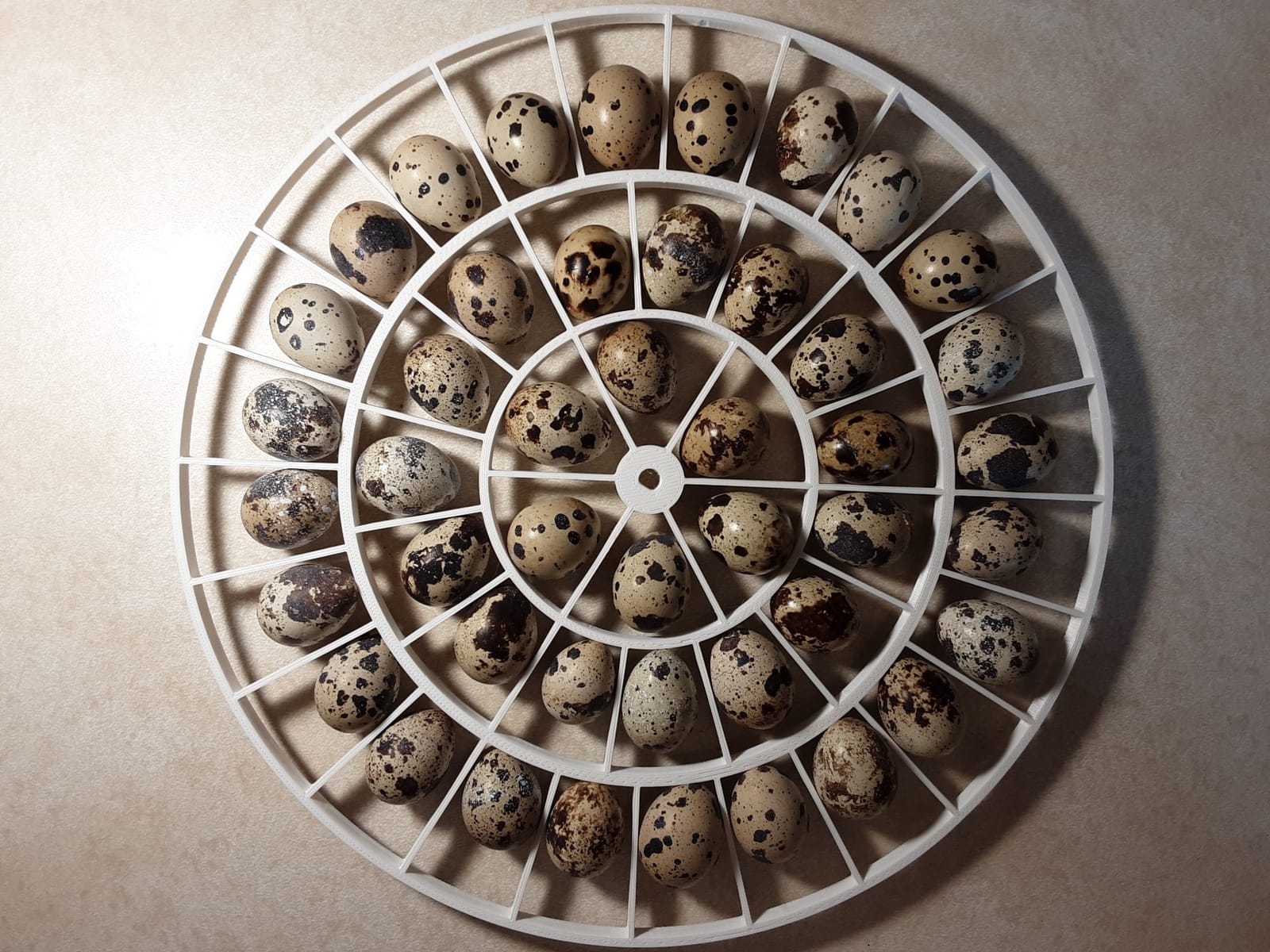
Quail eggs are nearly spherical, and that is the whole problem. A round egg in a round cup has nothing to grip, so it rolls during the turn, ends up anywhere and may not invert at all. Wedges solve this by constraining the egg to a fixed slot with a defined direction, so every turn actually moves it.
That is also the source of the product’s main complaint. Rounder or fatter eggs can wedge in the narrow end of the slot and stop moving, which is a jam rather than a failure. If your eggs are unusually round, inspect the tray during the first cycle and free anything that is sitting tight.
The center drive hole can be slightly too large on some units, and one owner reported a tray that would not rotate against the drive pin at all. This is a fitment variation rather than a design fault, so check that the tray engages the pin fully before you set eggs.
The six center positions also move very little, because there is almost no travel at the axis of rotation. Most owners leave those slots empty, which means your realistic capacity is a bit below the headline number. Count your usable slots before ordering eggs, and do not plan on a full disc.
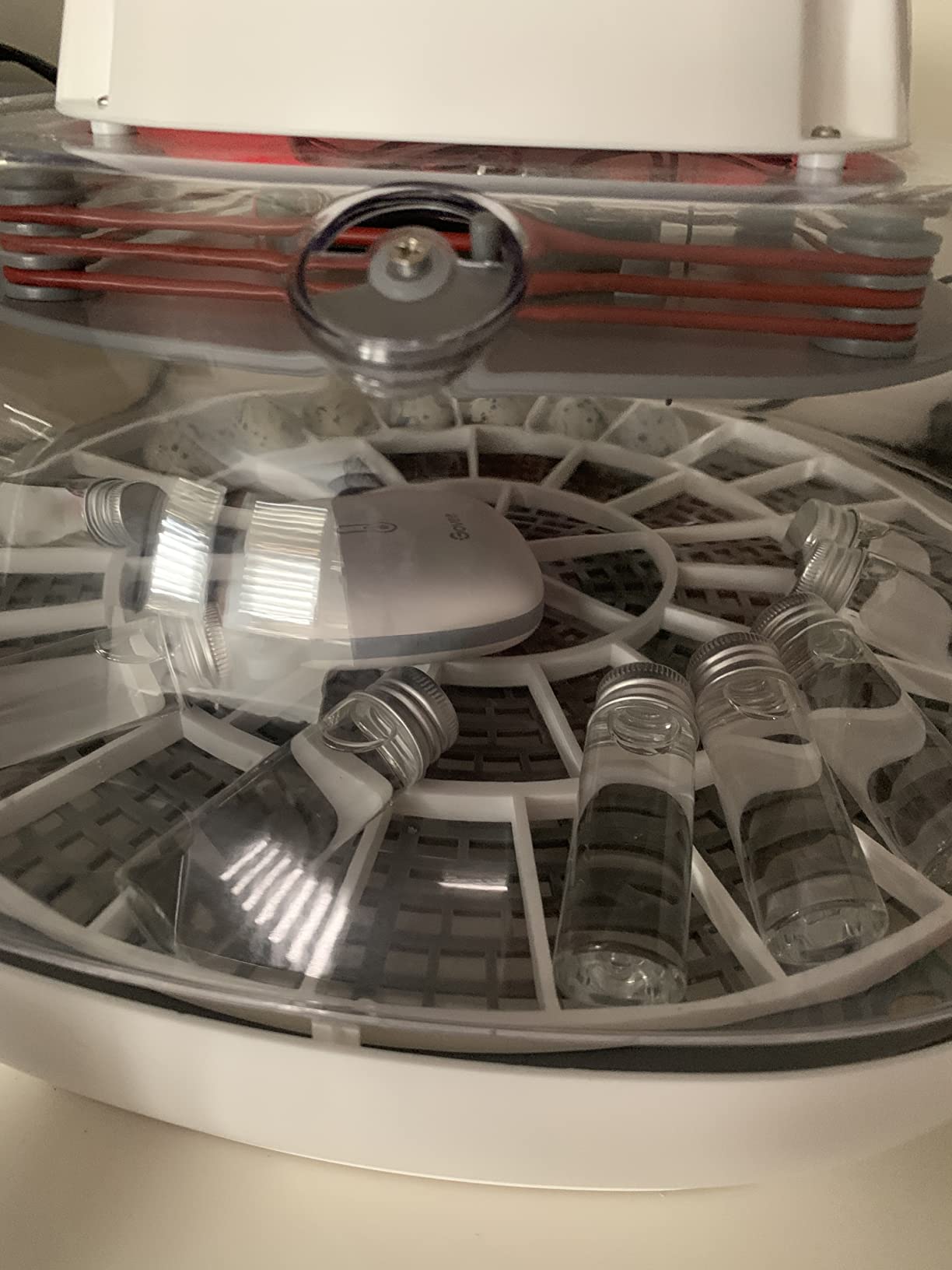
Skip it if your eggs are standard-size quail in a cabinet where a dedicated 48-slot tray already works, because the printed wedge will slow you down without improving results. This tray earns its place specifically when egg diameter exceeds what a loose cup can turn reliably.
It also only works in a Nurture Right 360. The dimensions and center drive are specific to that cabinet’s turntable, and it will not fit other platforms regardless of how similar the layout looks.
My verdict: a genuinely clever fix for jumbo quail in a 360 cabinet, and the pick for keepers whose eggs simply will not turn in the standard tray.
Fits the Nurture Right 360 turning base
Holds 10 jumbo goose eggs
Flexible silicone measuring about 12-3/8 inches wide
Hand washable and serviceable
Most trays assume eggs are light and roughly egg-shaped. This one assumes the opposite and is built for the heaviest eggs you are likely to hatch on a home setup: goose, peacock and other jumbo heavy breeds. The flexible silicone cups grip an egg that a rigid plastic cup would simply push out of position.
It drops straight into the Nurture Right 360 turning base and holds 10 jumbo goose eggs per tray. Buyers describe the fit and flexing behaviour as exactly as expected, and care is as simple as it gets, since the tray is hand washable and serviceable.
Ten eggs sounds small until you run a flock that produces eggs this size. A single tray that holds ten goose eggs is a serious hatch compared with losing most of them in an ill-fitting rack.
The physics is simple. A rigid cup sized for a chicken egg either grips a large egg too tightly, which adds motor load, or holds it loosely, which lets the egg move out of the turn path. A flexible silicone cup conforms to the egg, keeps the centre of mass aligned and lets the turn happen without a stall.
That flexibility is why this tray is a sensible companion to a turner that otherwise has trouble with heavy loads. Rather than asking a small geared motor to move ten heavy eggs in a rigid rack, you let the cups absorb the difference.
Ten eggs per tray is the clear tradeoff. Any full-size rack holds several times that, so if you have a large batch of goose eggs you will need multiple trays and multiple turns, and a full 360 cabinet will not be filled from a single load.
This tray is also useless outside its niche. It does not hold chicken eggs or quail eggs usefully, and it does nothing on its own without the Nurture Right 360 turner drive underneath it. Buy it for a specific heavy-egg job, not as a general upgrade.
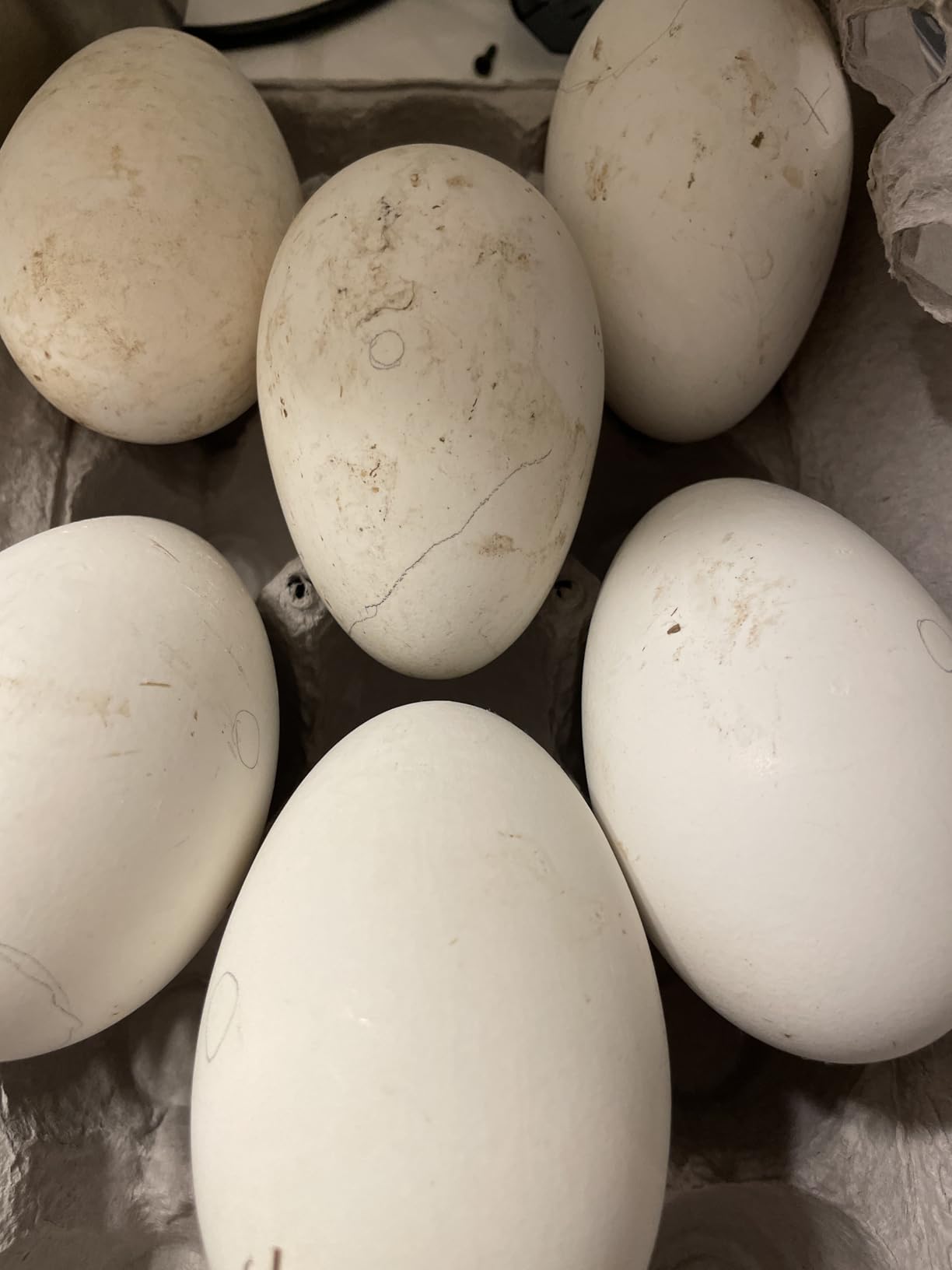
A word of caution that applies to every heavy-egg setup. Goose and emu eggs run 35 to 45 day cycles, and across keeper communities the standard advice for the largest species is still to hand turn, partly because a small motor under sustained heavy load is the most likely part to fail. Many long-cycle hatches mix approaches, turning mechanically early and by hand at the end.
For a 28-day goose cycle, this tray makes mechanical turning workable. For emu, plan on hand turning and use the tray only if you want help through the first weeks.
My verdict: a narrow, well-made solution to a specific problem, and the correct answer when a rigid rack simply cannot hold the eggs you are hatching.
Made for the Nurture Right 360 incubator
Holds 48 small quail or bird eggs
Circular layout for airflow and drainage
Available in flat and raised variants
Where the printed wedge tray solves one egg size, this one solves spacing generally. Forty-eight small quail or bird eggs sit in a circular layout with even spacing, which is what lets jumbo Coturnix eggs over 20 grams roll freely instead of jamming against a neighbour.
The spacing claim is the reason quail keepers pick it. Reviews repeatedly compare it favourably against denser 60-slot trays, noting that more slots sounds like more capacity but actually reduces the clearance each egg needs to complete a turn. Fewer, better-spaced slots win for the eggs that are hardest to turn.
Buyers also describe the build as sturdy, several noting it feels better made than cheaper alternatives at the same general purpose. It is also reported to work with other turner bases, including the Harris Farms Mamma Pro, which adds flexibility if you change cabinets.
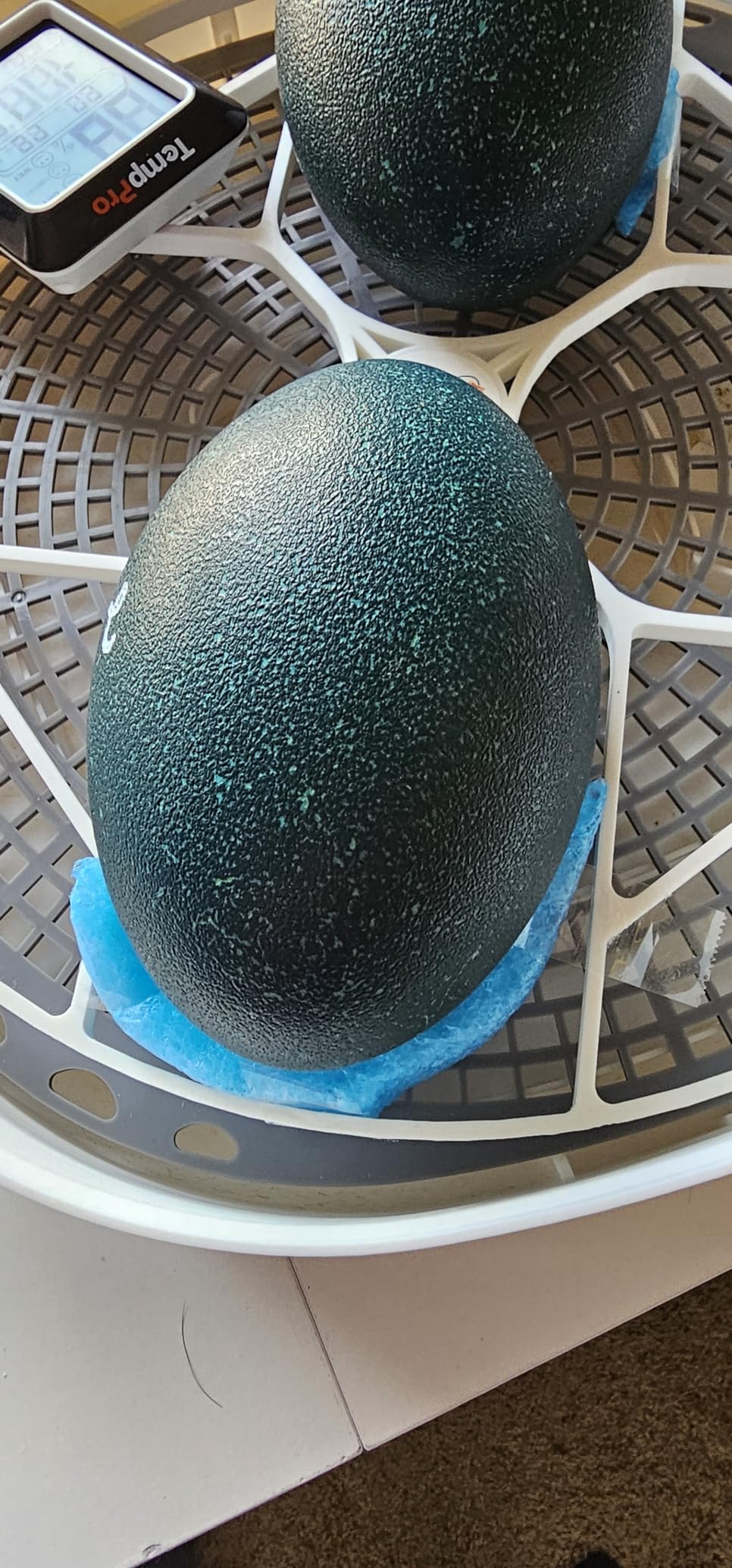
The circular layout is doing real work here. Eggs are placed at even intervals around the disc, which supports three things at once: airflow across the whole tray, drainage if a egg breaks, and stable positioning so nothing shifts out of the turn path when the disc moves.
That last point is what separates it from a tray where eggs wander. Even spacing means every egg travels the same distance and rotates at the same rate, so the whole batch gets an equivalent turn rather than some eggs getting more movement than others.
The tray comes in a flat 12.25 inch version and a taller 13 inch riser variant. The taller one is the option to choose if you want more clearance for very large eggs, but reviews are candid that even the riser version still lacks the side height to roll very large emu eggs properly.
For quail and standard small bird eggs, the flat version is the right pick. Reach for the riser only when your eggs sit low against the rim, and do not expect it to solve emu handling.
Two practical notes. First, the fit is tight: it goes on and off with some resistance until you learn to ease the rim rather than pressing straight down, so expect a small learning curve. Second, it is hand wash only, not dishwasher safe, which is a downgrade from the snap-out rails on the complete turners in this roundup.
Even with those caveats, the cross-platform reports are useful. If you run more than one cabinet, a tray that works with more than one turner base is worth more than one that is marginally better in a single machine.
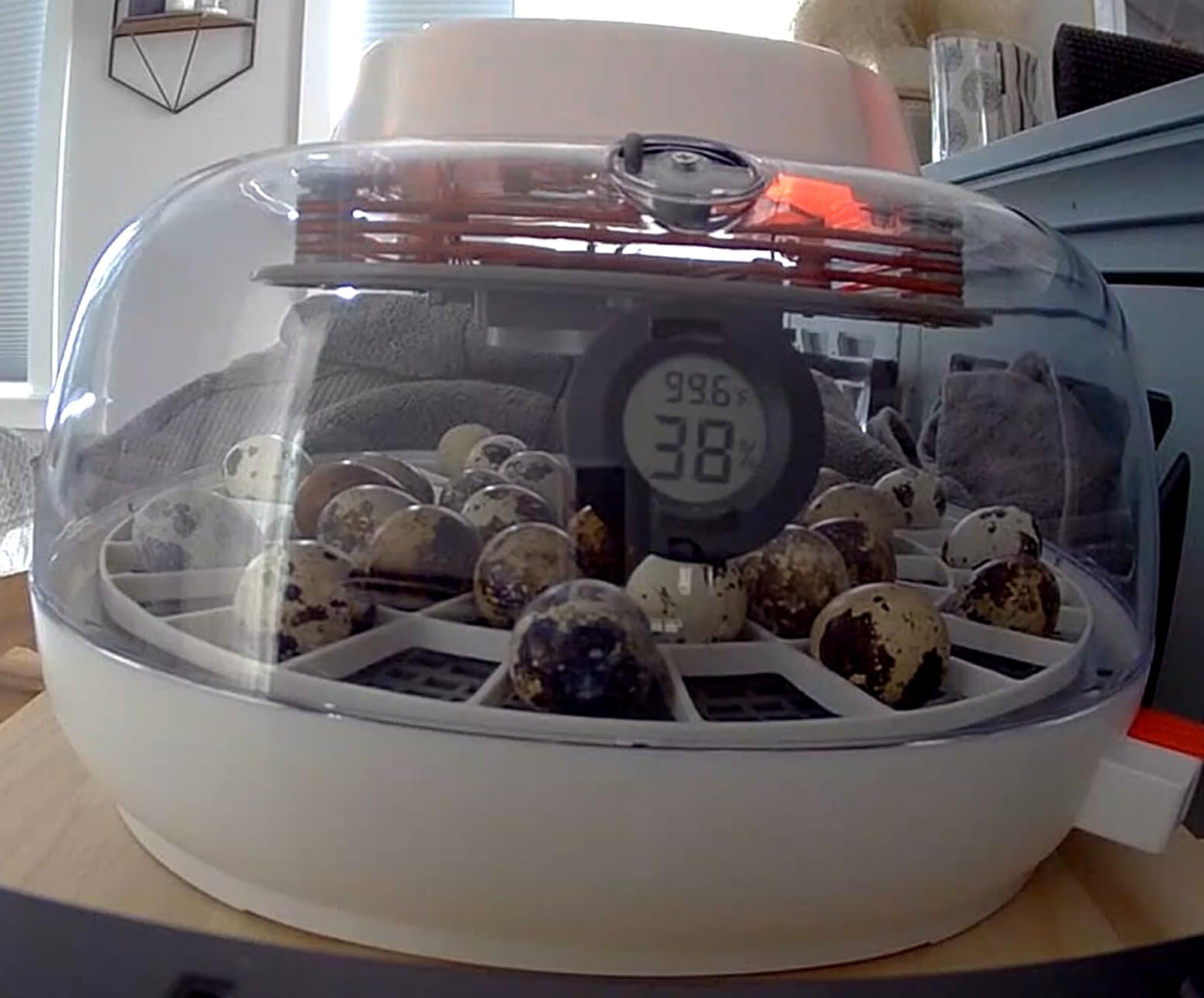
My verdict: the best general small-egg tray here, and the pick for quail and small bird breeders who want even spacing and reliable rolling over maximum slot count.
Compatibility is the only decision that cannot be revised after eggs are in the cabinet, so work through it in this order. Everything else on the list is a preference; platform fit is a requirement.
Most units use a small 12V DC geared motor driving one of three mechanisms. A side-rolling tray moves the whole egg tray back and forth along rails, tipping eggs to roughly a 90 degree angle on each pass. A turntable spins a circular disc, which is what the Nurture Right 360 trays in this roundup rely on. A tilting rack rocks the entire frame on a pivot, the mechanism behind both GQF units here.
The functional difference is how completely the egg changes position. A rolling tray and a turntable move an egg through new orientations repeatedly. A rocking unit moves it between two positions. All three are legitimate, and the gentle rock is often preferable for delicate or oversized eggs, while the full rotation gives the widest position variety for standard eggs.
Start from the machine you own, not from the turner you want. The Little Giant 6300 fits Little Giant circulated-air and still-air cabinets. The Farm Innovators 3200 is built for Farm Innovators 2100 and 2200 units, with several owners reporting it also seating in comparable Hova-Bator style cabinets. Both GQF units work across the Hova-Bator range, including the 1588, 2370 and Genesis platforms.
For a Nurture Right 360, you already have a turntable drive, so you are buying trays rather than a motor. That is a completely different purchase, and it is why three of the eight products here are trays. If you do not own that cabinet and want automatic turning, the turners in positions one through four are the relevant shortlist.
Homebuilt incubators need a physical measurement rather than a model number. Measure the interior width, the clearance height above the tray and the space available for the motor, then check the product dimensions against those figures. If the tray overhangs its rails by more than a few millimetres, the turn will not complete.
Match the cup geometry to your eggs, not the other way round. Chicken and duck eggs are the easy case, and every complete turner here handles them. Quail eggs need dedicated small-egg cups, and these are sold separately for most platforms, so factor the second purchase into your plan before eggs are due.
Goose and turkey eggs are where motor load and cup geometry bite. Rigid cups sized for chicken eggs either jam the drive or let large eggs slip out mid-turn, which is the complaint behind nearly every reliability issue we found. Flexible heavy-egg trays or a smaller load of large eggs on a full-rotation turner are the practical answers. Emu eggs are the hardest case, and a 40-day cycle with hand turning remains the more reliable choice.
Be honest about which category you are shopping in. A complete turner includes a motor, a schedule and the rails, and it costs meaningfully more than a tray. An accessory tray includes no motor and does nothing on its own, but it is the correct and cheaper purchase if your cabinet already has a working turntable.
This distinction is where first-time buyers waste the most effort, because marketing photos for both categories look nearly identical. Check the box contents list for a motor before you order, and you will never be confused by this again.
Turning stops on day 18 of incubation, and every keeper forum converges on the same protocol. The long-standing consensus is to stop the motor and lay the eggs horizontally on their sides, raise humidity to roughly 60 to 70 percent, and leave the lid closed for the final three days. Some keepers ask whether day 17 is acceptable; the answer is that it is workable but non-standard, and day 18 is the safer choice.
The reason is mechanical. The chick needs to push against the shell from the large end, and an air cell that keeps shifting under a rolling tray makes that harder. The most common hatch-day mistake, and one repeatedly shared in forums, is simply forgetting to disable the turner at lockdown and opening a hatch that was three days from finishing.
Set a calendar reminder for day 18 the day you set the eggs. Do not leave it to memory, and do not assume your turner will stop itself unless it has a documented auto shut-off, because most do not.
Honest reliability notes matter more here than marketing claims, because the community already knows what fails. The four recurring complaints across thousands of reviews are: a motor that stops mid-cycle, an incomplete rotation that leaves eggs at a compromised angle, a motor running warm enough to concern keepers about nearby eggs, and motor strain under heavy goose or emu loads.
Most of these are preventable. Incomplete rotation usually means a tray is not seated correctly or a rack is not clipped in, so watch the first cycle closely. Warm motors are a load problem, so reduce the egg count per rail. Strain under heavy loads is why large-egg trays exist as a separate category. And a mid-cycle failure is what the emergency protocol is for: stop, diagnose power and connection first, then hand turn the remaining days, which breeders say still produces a usable hatch when the eggs were well started.
Adding automatic turning to a cabinet you already own is the most common recommendation across poultry forums, and for good reason. The dominant pattern is to keep a working Hova-Bator and add a turner rather than replace a machine that already holds temperature correctly.
The practical checklist is short. Identify the platform from the model number, confirm the tray footprint matches the cabinet interior, verify the turn interval and rotation count meet your needs, and check that a small-egg or large-egg rail is available for your species. If your incubator is a DIY build, measure first, since a homebuilt interior rarely matches a catalog dimension exactly.
One caution on electrical safety. A turner motor and its wiring live inside a humid enclosure next to a water reservoir, so keep connections above the water line, use a low-voltage drive where possible, and never work on wiring with the incubator plugged in. This is worth taking seriously rather than treating as an afterthought.
Stop the turner and lay the eggs flat on day 18 of incubation, then leave the incubator closed until hatch. Raising humidity to roughly 60 to 70 percent during the final three days helps the chick pip and rotate inside the shell. Do not open the incubator during lockdown, and set a calendar reminder when you set the eggs so the turner is never left running into hatch day.
Most automatic egg turners run six rotations per day, which is the common figure in manufacturer specifications and keeper practice. The Farm Innovators 3200 completes a full cycle every four hours, and the GQF units rock the eggs six times daily. The general minimum recommended by breeders is three to five turns per day, so anything at six or above comfortably covers the requirement.
They are worth it for consistency, not for a dramatic hatch-rate jump. A broody hen rolls her eggs many times a day, and a hand-turned tray turned three to five times daily on schedule performs very similarly. Automation removes the midnight opening of a hot incubator and eliminates missed sessions, which is why many production-style keepers rely on it. For a small batch on a relaxed schedule, hand turning is a perfectly reasonable choice.
Usually yes, provided you match the platform. Turners are not universal: the Little Giant 6300 fits Little Giant cabinets, the Farm Innovators 3200 is built for models 2100 and 2200, and the GQF units are designed for Hova-Bator incubators. If your cabinet already has a turntable, such as a Nurture Right 360, you need only a replacement tray rather than a motor. For a homebuilt incubator, measure the interior and check the drive clearance before ordering.
Work through these checks in order. Confirm the power connection and that the tray is fully seated on its rails or drive pin. Check that every rack is clipped in and that no egg cup is jammed or holding an egg that is too large. Inspect the drive coupling for debris, and confirm the motor hums when powered. If the motor runs but the tray stalls, the load is usually the cause, and removing oversized eggs clears it. If there is no hum at all, the motor or its power supply has failed.
If you run a Little Giant cabinet, the 6300 is the pick, and add the quail rails if quail is part of your plan. If you run a Farm Innovators 2100 or 2200, the 3200 gives you a full four-hour cycle and the least fuss of the complete units here.
If you hatch on a Hova-Bator and mix egg sizes, the six-rack GQF turner gives you the flexibility; if you run a single egg size and want everything in one box, the 1611 is simpler. For a Nurture Right 360, you need a tray rather than a motor: the 48-slot tray for general quail and small birds, the printed wedge tray for jumbo Coturnix, and the silicone tray for goose or peacock eggs.
Whatever you choose, check the model number on your cabinet before you order, watch the first cycle to confirm the tray completes its motion, and set a day-18 reminder the day you set the eggs. Those three habits prevent nearly every problem we found reported about turners in 2026.
Before you go, a couple of related reads worth your time: our automatic feeder picks cover the same kind of timed-hardware reliability for aquariums, and hanging egg chairs round out the yard equipment side of a small flock setup. If you are buying for someone rather than for yourself, our bowl turner gift ideas and pen turner gift picks cover the woodworking side of the hobby.