Physical Address
304 North Cardinal St.
Dorchester Center, MA 02124
Physical Address
304 North Cardinal St.
Dorchester Center, MA 02124

A carpool-ready backless booster is a belt-positioning seat with no headrest and no harness, chosen because it is light, narrow, and moves between cars in one hand. The non-negotiable is this: the booster restrains nothing. It lifts your child and shapes the seat so the vehicle’s own lap-and-shoulder belt lands on the hips and shoulder instead of the abdomen.
That distinction is what makes carpool research harder than buying a car seat for your own back seat. A backless booster that fits beautifully in your sedan can fail in the carpool minivan, and a seat that works fine with a parent doing the install can defeat a seven-year-old standing in a driveway with a backpack on. I read every published spec, manual and review summary for the eight seats below, then judged each one against three things: does it stay anchored when empty, can a child put it in, and does it fit next to two other seats.
One transparency note before we start. We did not crash-test any of these boosters, and no independent lab publishes a per-model booster scoreboard anymore. Every rating and spec quoted here comes from the manufacturer listing and the customer review record. The safety framework comes from the American Academy of Pediatrics, NHTSA and the federal FMVSS 213 standard, which is the legal bar every booster on this list clears.
If you are not sure where to start, three inputs decide almost everything: your child’s age, weight and height; whether the destination cars have working lower anchors; and whether you need three seats across a back row. If the answer to the first one is no, skip the shopping and read our readiness section first.


| Product | Features | |
|---|---|---|
| Cosco Topside Backless Booster |
|
Check Latest Price |
| Graco TurboBooster 2.0 Backless |
|
Check Latest Price |
| Chicco GoFit Plus Backless |
|
Check Latest Price |
 Diono Solana 2 XL Backless Diono Solana 2 XL Backless |
|
Check Latest Price |
 mifold Comfort Grab-and-Go mifold Comfort Grab-and-Go |
|
Check Latest Price |
 PEG Perego Viaggio Shuttle PEG Perego Viaggio Shuttle |
|
Check Latest Price |
 Diono Connect3 RXT Pack of 2 Diono Connect3 RXT Pack of 2 |
|
Check Latest Price |
 Baby Trend Protect Slim Backless Baby Trend Protect Slim Backless |
|
Check Latest Price |
As an Amazon Associate we earn from qualifying purchases, at no additional cost to you. CERTAIN CONTENT THAT APPEARS ON THIS SITE COMES FROM AMAZON. THIS CONTENT IS PROVIDED 'AS IS' AND IS SUBJECT TO CHANGE OR REMOVAL AT ANY TIME.
40-100 lbs and 43.4-57 inch
100% polyester
Extra-plush padded cover
Seat-friendly base
This is the booster we recommend first, and the reason is unglamorous: it is the least likely of anything on this list to be the reason a carpool falls apart. It weighs so little that a child can carry it out to a driveway, and the 43.4 to 57 inch range covers most of the carpool years rather than a single preschool stage.
Owner feedback on the Cosco Topside is unusually consistent. Buyers point to the same three things: how easily it moves between vehicles, how compact it is when stored, and that it fits three across in a single row, which is exactly the multi-child carpool configuration. The same reviewers describe it as sturdier than its tier suggests.
The seat-friendly base underneath is a small detail that pays off in someone else’s car. It helps keep the vehicle upholstery unmarked during the twenty minutes your child is in the back seat on the school run, and it routes the belt under the armrests so the booster resists shifting while the belt is being buckled.
What you give up is anchoring. There is no LATCH on this seat, so it relies on the vehicle belt and its own base to stay put. In our view that is an acceptable trade for a seat light enough to travel, but it is the reason a car with a bumpy back seat can leave an empty booster drifting around.
The 40 to 100 pound range and 43.4 to 57 inch height range are the numbers that decide whether a booster survives the whole carpool run. Parents on the r/CPST forum raise a recurring worry about buying a cheap backless and watching the child outgrow it by height long before they are ready to leave booster mode, and this range is wide enough that most children clear it on maturity rather than on a birthday.
The upper height limit is the one to watch. A child whose seated shoulders already reach past the top of the shell will slide forward and lose belt position, and that is a growth-stage problem, not a defect.
The most common carpool problem is width, not safety rating. Three-across parents report the same frustration in forum threads, and the practical answer is that seat footprints differ more than the product photographs suggest.
The Cosco Topside’s narrow footprint is repeatedly named in reviews as the reason it works three across, and reviewers describe fitting it in a single row in vehicles where a wider booster left no room for the neighbouring buckle. If your carpool involves two siblings plus a car seat, this is the shape of seat that makes the geometry work.
There are no cup holders, and that comes up more than any other complaint in the record. Parents on long school runs or grandparent pickups end up with a cup in a cup-holder-less footwell, or a bottle wedged against the armrest.
Reviewers also note the armrests feel hard and thin for older, larger children, and that the cover is less plush than expected for long trips. The pad is described as extra-plush in the listing, so the gap is one of expectation rather than quality. For a child under about eight on a short carpool, neither issue is a dealbreaker.
40-100 lbs up to 57 inch
Graco ProtectPlus crash engineering
Height-adjustable armrests
For ages 4-10
The Graco TurboBooster 2.0 is the second seat we put in a car, and for one reason above the rest: at over 12,000 reviews averaging 4.8 stars with 87 percent five-star ratings, it carries one of the strongest owner satisfaction records in this group. That is not a popularity contest on its own, but combined with the price tier it lands, it is very hard to argue past.
Child Passenger Safety Technicians and parents both gravitate to this seat for a straightforward reason: the height-adjustable armrests let the belt path sit where it needs to for a five-year-old and a nine-year-old using the same seat. In a carpool that matters twice, because you are not optimising for one child in one car.
Graco’s ProtectPlus engineering is framed around frontal, rear and rollover angles, and the manufacturer states the seat was additionally tested against New Car Assessment Program protocols and for extreme interior temperatures. We did not verify those claims independently, so treat them as manufacturer statements rather than third-party scores.
There is a genuine limit worth stating up front. The IIHS booster evaluation program ended, so any badge you see attached to this listing that references a BEST BET designation is pointing at old belt-fit data from a program that no longer runs. Judge the seat on fit and geometry, not on that sticker.
The TurboBooster 2.0 is specified for children ages 4 to 10, 40 to 100 pounds, up to 57 inches tall. That 57 inch limit is lower than the 59 and 63 inch ceilings on some seats in this roundup, and it is a common reason parents end up buying twice.
A child who is tall for their age will pass 57 inches while still years from being ready to leave a booster, because belt readiness is about sitting position and maturity, not height alone. If you can see that coming, look at the 63 inch seats further down instead of planning a replacement purchase in eighteen months.
Correct belt fit is the entire job of a booster, and adjustable armrests are how a fixed-shell seat adapts. The lap belt needs to sit low across the upper thighs and the pelvis, and the shoulder belt needs to cross the middle of the shoulder and the chest. Armrests that are too low push the belt into the abdomen; too high and the child slides forward.
This is the feature that separates the TurboBooster 2.0 from the cheapest shells, and it is why the armrest adjustment, rather than the crash engineering language, is the detail we would cite first in a carpool decision.
Like the Cosco, this seat has no anchor of any kind. Nothing stops it sliding across a back seat while an adult loads bags and children, and nothing stops it sliding during hard braking.
The practical implication is that the seat needs the child in it, or a foot on it, before you drive. A booster that stays in the car and stays in position is the reason some parents pay more for an anchored design, and we will get to that shortly.
40-110 lbs and 44-57 inch
One-hand quick-release LATCH
ErgoBoost double foam padding
Built-in carry handle
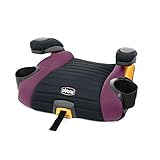
This is the highest-rated booster in our set at 4.9 stars across close to 5,000 reviews, with 91 percent five-star ratings and almost no one- or two-star reviews to speak of. It is also the one that solves the specific carpool failure mode the other seats share: a booster that slides around the back seat while nobody is in it.
Because the GoFit Plus has lower anchors and a one-hand quick-release latch handle, it can be left attached to the vehicle seat between trips. The driver loads groceries, wrangles other kids, and the booster is still exactly where it was latched. For a carpool where the second car is not yours, that is worth more than almost any comfort feature.
It also carries a built-in handle on the back, and that single detail is the difference between a child carrying their own seat to the driveway and an adult making two trips. Carpool advocates consistently rank self-installation as a top criterion, because the whole point is that another family is doing you a favour.
Contoured double foam padding is the most commonly praised comfort detail in the whole set, and the two fold-away dishwasher-safe cup holders that disappear when unused keep the back seat tidy, which matters when you share a row with two other children.
One hand is enough to release the latch. That is a deceptively small design decision with a large practical effect: the driver does not need to kneel in the back seat with two keys and a flashlight to release a connector before the child can climb in.
It also means the booster can live permanently in one car, or move between cars with a single motion. The included lap belt guides and shoulder belt clip then handle the restraint side, and the removable machine-washable seat pad handles the fact that carpool booster seats get considerably messier than boosters that stay in one vehicle.
The padding is the most-praised comfort feature in the whole set. Owners describe older children sitting comfortably for long drives, which matters on a school run that turns into a weekend errand chain.
There is one honest limitation that a carpool family will run into: this seat has no back support. A child who falls asleep will slump forward, because there is no headrest to lean against. If your carpool routinely includes a sleeping passenger, that changes the calculation and points you toward a highback instead.
The handle, the one-hand latch release and the fold-away cup holders together make this the seat a child is most able to manage alone. The buckle sequence is simple, the seat is light enough to carry, and there is no assembly step.
The one fiddly part is the shoulder belt guide, which reviewers describe as awkward to position the first few times. Practise it with the child in the driveway before the first real handoff, which is the same advice carpool advocates give for any seat with a guide or a strap.
40-120 lbs up to 63 inch
3.1 lb seat weight
Dual steel LATCH connectors
Retractable cup holder and tray
The Diono Solana 2 XL exists because a specific group of children cannot sit comfortably in a narrow booster. Parents of chunkier six- to eight-year-olds describe the wide seat as the reason they bought it, with a cushion that does not squeeze the hips over a 30 minute school run.
On weight, this is one of the longest-lasting seats in the set: 40 to 120 pounds and up to 63 inches tall. Combined with the quick-release LATCH straps and the 3.1 pound seat weight, it is a rare combination of range and portability. You are not buying a second seat in three years.
The dual automotive steel LATCH connectors come with two adjustable straps and a quick release, which is a more substantial anchor system than the webbing on most boosters in this price tier. The shoulder belt positioner and easy-access buckle on the seat do the belt-routing work on the child’s side.
Retractable 2-in-1 cup holder and snack tray is a nice touch for a carpool where the child eats on the way home from a sleepover, and the contoured fabrics with layered foam lift out for machine washing.
Only two seats on this list reach 120 pounds and 63 inches, and that range is what makes this seat worth a second look if you have a tall or heavy child. The Solana does not force a height-based replacement, which is the churn problem raised repeatedly in carpool forums.
The trade is footprint. The manufacturer states plainly that this is an XL width and is not suitable for three-across arrangements. If your carpool involves one booster, this is a strong pick. If it involves two boosters plus a car seat in a back row, keep reading to the Connect3.
Roughly three pounds is remarkably light for a seat with steel connectors and deep cushioning, and it is the number that decides whether a child carries it themselves. A seat a parent has to carry is a seat a child gets dropped off without.
The quick-release straps let a driver swap it between two cars fast, and the dual connector design gives you more attachment options in vehicles where the lower anchor bars sit close together or far apart. Reviewers note the seat stays put during hard stops, which is the specific complaint that drives people toward an anchored design in the first place.
Two reviews patterns recur and both are about space. Parents say the wide footprint makes three-across impossible, and separate owners report it blocking seat belt buckle access in small hatchbacks, which is its own small crisis when you have a child trying to reach the buckle.
The padding is also described as thinner underneath than the surface suggests, with some parents adding their own cushion. Test it with your child sitting for twenty minutes before committing.
40-100 lbs and 43.5-59 inch
Fits a backpack or glove box
No installation required
Included Compact Comfort cushion
If the carpool handoff is the problem rather than the seat, this is the product built for it. The mifold Comfort folds down small enough to live in a standard backpack or a glove box, and there is no installation step at all, so a child can go from your driveway into a neighbour’s car in a single motion.
That solves the problem nobody else addresses properly. Most backless boosters need to be carried, positioned, and latched, and in a carpool the carrying usually falls on whoever is least qualified to do it. This one eliminates the sequence.
The listing also includes a Compact Comfort padded seat cushion, and the updated shell carries anti-slip pads on the base that keep the seat from walking around during hard stops. The shoulder belt guide is described as easy to use, and it works with any vehicle three-point belt.
There is a design philosophy here worth understanding before you commit. Most boosters lift the child up to the adult belt. This one works the other way, routing the adult belt down toward the child. That is why its fit is not identical to a conventional booster, and it is the single most common criticism in the record.
Backpack portability is a real category, not a marketing flourish. Carpool advocates point to folding backless boosters and lightweight vests as the practical answer for a child who rides in several different vehicles a week, and the mifold is the only seat in this group whose stated purpose is bag-level portability.
It is also the most forgiving on timing. There is no latch to release, no anchor to find, and no belt routing to get wrong in a stranger’s driveway in the rain. The only thing your child has to do is sit down and buckle the vehicle belt.
Because the seat pulls the adult belt down to meet the child rather than raising the child to the belt, belt geometry is more vehicle-dependent than with a conventional booster. The destination car’s seat pan depth and shoulder belt anchor both matter more.
That is a genuine carpool risk: a seat that fits one car beautifully and needs adjusting in another. If your carpools involve two or three different vehicle types, the conventional boosters on this list are the safer bet, and this one is the choice for a single familiar setup or for travel.
This is the lowest-rated booster in our set at 4.2 stars with 63 percent five-star ratings, and the reasons are consistent. Critics point to the price, to the fact that it is bulkier in practice than the compact marketing suggests, and to the belt-lowering fit mechanism.
Supporters, meanwhile, describe it as the only booster their child could carry themselves. If that single capability decides your carpool, the rating distribution matters less than the workflow it unlocks.
Up to 120 lbs and 63 inch
Integrated rigid LATCH
Blind Lock System
Retractable LATCH arms
What sets the Viaggio Shuttle apart is how the anchors are built. The rigid LATCH arms are moulded into the booster rather than attached as webbing. The arms click straight into the vehicle anchor bars and stay there, so the seat is a fixed object between trips rather than a loose item on a cushion.
For a carpool this is the strongest anchoring story available. The Blind Lock System is designed to resist inadvertent release, and owners describe the practical effect simply: the seat does not slide, and it does not become a loose object in the back of the car.
The 120 pound and 63 inch ceiling makes this a long-life seat for a taller child, and the shoulder strap that controls belt height helps position the adult belt on a child who has grown into the range. Made in Italy with an easy-wipe leather-look finish on the armrests, which is a sensible surface in a car that eats snack spills.
The narrower side profile is worth a second look for buckle clearance. Owners report it solving buckle access problems in vehicles where wider boosters left a child unable to reach their own buckle, which is a small thing until a seven-year-old is stranded in the back seat.
Rigid LATCH arms are a single moulded path from the booster shell into the vehicle anchors. Webbing LATCH on a conventional booster is a strap whose length and tension you set by hand each time, and it can sit tighter in one car than the next because the anchor bar spacing differs.
When the same booster goes into three different cars a week, the rigid version behaves the same way every time. That consistency is what we would pay extra for in this specific use case, and it is why this seat earns a place on a carpool list rather than a general booster list.
Older vehicles may have no working lower anchors at all, and a seat with permanently protruding arms can be a problem in the middle position or against a seatback. The Viaggio Shuttle’s LATCH arms retract back into the shell for latchless use, so the same booster works in an older car.
The shoulder strap controlling belt height is the next layer. It lets you fine-tune where the lap belt sits across the hips rather than accepting the armrest position as fixed, which is the main adjustment a growing child needs.
With 359 reviews at a 4.6 average, this is one of the least battle-tested boosters here. The rating is strong and the review themes are consistent, but you have far less long-term owner data to lean on than with the Graco or the Cosco.
A minority of owners report that the swiveling cup holder spills easily and that the padding is thinner than ideal on long drives. Both are fixable with a different cup or a small cushion, and both are the kind of thing you can check in the driveway before the first handoff.
40-120 lbs, under 17 inch wide
Pack of 2
EasyPath belt guides and EasyReach buckle access
LATCH connectors
The Connect3 RXT is the only booster in this roundup that publishes a width, at under 17 inches, and it was built for the exact scenario that dominates carpool forums: three children in a back row where the seats will not fit. Owners report using it three across in mid-sized sedans and SUVs, including alongside an infant car seat.
It also arrives as a pack of two, which quietly solves the budget question nobody else on this list addresses. Carpool families rarely want one booster. They want one in the second car, or they want a spare for a grandparent pickup. Here you are not buying a second one separately.
The EasyPath lap belt guides and EasyReach buckle access contour do the ergonomic work of routing the belt into place and keeping the buckle reachable for the child. In a packed back row, buckle reach is a real problem, and this seat was designed around it rather than around a spec sheet.
The cup holders are the detail reviewers mention most warmly. They nest between seats when in use and stow underneath the booster when not, which is a genuinely thoughtful answer to the question of what a cup holder does to an already-crowded row.
Width is the number that decides a three-across purchase, and it is almost never printed. The Diono Connect3 states under 17 inches wide, and the manufacturer is direct about the intended result: three across in many mid-sized sedans and SUVs.
That is a narrower promise than you might assume, and it is worth checking against your own back seat before buying. Three seats under 17 inches each is more than 50 inches of child seat, and a sedan back row is not always that wide once you account for seatback bolsters and door contours. Measure the flat span of your back seat, not the total vehicle width.
The LATCH connectors here have three attachment points and front-accessible release straps. More attachment options matter specifically in a carpool, because different vehicles position the anchor bars differently and you want a seat that can reach them without a strap that will not tighten enough.
The built-in carry handle keeps this seat portable despite the slim profile, and reviewers describe it as light but sturdy enough for long road trips. One reviewer does note the rigid LATCH arms are tricky to click into place the first time, which is exactly the sort of thing to practise before the first school run rather than during it.
Most carpools involve a second vehicle eventually. A grandparent pickup, a second family car, a weeknight run in the other direction. Buying two seats at once is simpler and more coherent than discovering in six months that you need a second booster, and this pack is structured for exactly that.
The weight range of 40 to 120 pounds means the pair can see two children through the same stage, and the 2TexFoam padded base and the nesting cup holders handle the ordinary comfort and mess of daily use.
Slim and lightweight shell
Belt-positioning guides
Dual cup holders
Cushioned seating, 100% polyester
The Baby Trend Protect Slim is a budget pick, and it earns its place for one specific reason: cup holders. One of the cheapest seats here has none at all, and a booster without cup holders on a long carpool run is a setup for a spilled drink across the seat pad.
At 586 reviews and a 4.5 average with 77 percent five-star ratings, the owner satisfaction is solid rather than exceptional. The listing highlights a slim, lightweight design, belt-positioning guides that support correct belt placement, dual cup holders and cushioned seating.
The slim profile is the other reason to consider it. In a crowded back row, a narrow shell leaves room for an adult to reach past it to buckle a neighbouring child, and that is not a small convenience when three children are boarding at once.
It also weighs little enough to move between your car and someone else’s on a regular basis. The 100 percent polyester cover is straightforward to keep clean after a week of snack transport.
Of the backless seats here, the cheapest option has no cup holders at all, and the Graco’s spec listing does not mention them either. Two cup holders, one for a water bottle and one for a snack, sounds minor until you spend an afternoon watching a carpool child with nowhere to put a juice box.
The cushioned seating and slim frame also work better for younger riders than the wider, higher-range seats. A seven-year-old will find this comfortable; a twelve-year-old approaching 63 inches probably will not.
The belt-positioning guides do the basic job of steering the lap belt low across the hips, which is the minimum a booster should do. There is no LATCH, no rigid arm, and no lock-off clip, so the seat stays where the belt and friction put it.
That is acceptable when the child is in the seat for the whole trip. It is a problem when the booster lives in a car, so read the handoff checklist below before you commit to an unanchored design.
The honest gap here is that this listing does not publish a weight or height range. Every other seat in this roundup states its limits, and the absence matters, because belt fit depends on the child’s size relative to the shell.
What we would do: check the label moulded into the seat itself and confirm it against the manufacturer’s current manual before you buy, then sit your child in it for twenty minutes and check belt position. The slim build suggests it is designed for the younger end of the booster range.
A booster is a step down in restraint, not up. A forward-facing seat with a five-point harness holds a child in place with five points of contact. A booster holds a child with the adult vehicle belt, which only works if the child sits correctly for the entire trip. Readiness is therefore a combination of body size and behaviour, and neither one alone is enough.
The size gate is straightforward. Child Passenger Safety guidance is consistent that a child under age four, or under 40 pounds, should stay in a five-point harness. After that, the physical requirements are that the child can sit with their back against the vehicle seat, knees bent at the seat edge, the lap belt low across the upper thighs, and the shoulder belt centred on the shoulder and chest.
The maturity gate is the one parents skip. A child who cannot hold that position for the whole ride will slide out of it. On a four-block school run that takes ten minutes, they might manage. The reason technicians push back on the idea that a short carpool trip is low risk is that the majority of crashes happen at under 30 miles per hour, and a 30 mph crash is severe regardless of how short the journey was.
Use the same test in both directions. It tells you when to start booster use, and it tells you when the child is finally ready to move to a seat belt on its own, which is usually around 4 feet 9 inches and a demonstrated ability to hold belt position.
Never use a shield booster. Not a used one, not a borrowed one, not one at a garage sale. It is the single point of universal agreement among child passenger safety technicians, and it is worth restating because a shield booster turning up in a carpool is not as unlikely as it should be.
If a carpool parent asks you to use a shield booster, that is the moment to say no politely and bring your own seat. The design has no meaningful ability to manage the forces involved in a crash.
Four reasons carry this recommendation, and none of them involve crash performance. First, weight: a backless booster is a cushion, not a seat with a frame, and a child can carry one to a neighbour’s car without an adult making two trips. Second, footprint, which we will quantify in the three-across section below. Third, price per car, since you may need more than one.
The fourth is that a backless booster has no headrest to leave behind in someone else’s car. A highback has to be carried at an awkward angle, takes more space, and offers a side-impact advantage that matters most on a long highway drive. On a twenty-minute school run, that trade changes shape.
We want to be careful here, because this is the area of booster research most often oversold in both directions. An Insurance Institute-associated side-impact study cited in child passenger safety communities found a substantial reduction in injury risk for four- to eight-year-olds in highback boosters, with no statistically significant reduction for backless boosters.
The nuance matters. That study measured side-impact injury risk. It did not measure frontal crash protection, which is what FMVSS 213 tests, and there is no study showing backless boosters are less safe in a frontal crash. Forum members have raised exactly this distinction. If your carpool is school-run and urban, backless is a defensible choice. If it includes long highway stretches or high-speed roads, a highback is worth reconsidering.
Another rule that gets broken in carpools: a booster cannot be used to carry a child who is too small for a booster, and a car seat cannot be replaced by a booster before the harness limits are reached. A child under 40 pounds or under four belongs in a five-point harness, full stop.
Because a carpool handoff happens in a hurry, the safest policy is that your child brings their own seat, always, and rides in it regardless of who is driving. Every carpool family we know agrees on this and only argues about the price.
This is the most misunderstood point in the entire category, so we will state it plainly. LATCH on a booster seat has nothing to do with how the child is restrained. The child is restrained by the vehicle’s lap-and-shoulder belt, exactly as they would be with no booster at all. The lower anchors hold the booster cushion to the vehicle seat.
So what does anchoring actually buy you? It keeps the booster from sliding around an empty back seat, it stops it becoming a loose object in the car, and it makes installation repeatable so the belt path ends up in the same place every time. It does not make the child safer while riding. The belt does that.
That reframing changes how you read the roundup. The Cosco, the Graco and the Baby Trend have no anchors, and their owners mostly do not care, because the booster is light and lives in a bag. The Chicco, the Dionos and the PEG Perego have anchors, and their owners care for a specific reason: the seat can stay in the car between trips.
Rigid LATCH means moulded arms fixed to the booster that click into the vehicle anchor bars. This is the PEG Perego Viaggio Shuttle’s design, and the arms retract into the shell for latchless vehicles. Rigid is the most consistent when you move between cars, because there is no strap tension to reset.
Webbing LATCH means adjustable straps attached to the booster that you tighten by hand. Most boosters use this, including both Dionos in our set. It works, and the Diono Solana 2 XL offers multiple attachment points for vehicles with unusual anchor spacing, but the tension can differ from car to car.
A belt lock-off clip is a small clip that holds the lap belt tight against the booster so you do not have to hold it with your hand while you buckle the shoulder. It is a convenience feature for vehicles without working lower anchors, and it is not a substitute for anchoring.
One hard rule follows from all of this: a booster with anchors still requires a lap-and-shoulder belt, never a lap belt alone. Cars with no lower anchors are not a reason to skip the belt.
When three children need the back seat, parents ask the same question in forum after forum: what is the most narrow backless booster? The frustrating answer is that almost no manufacturer publishes the number you need. Product photographs are not measurements, and three-across fit is decided by millimetres.
Of the eight seats in this roundup, exactly one publishes a width. The Diono Connect3 RXT states under 17 inches and is explicitly designed for three across in many mid-sized sedans and SUVs. The Diono Solana 2 XL states the opposite, that its XL width is not suitable for three-across arrangements. That is unusually honest and unusually useful in the same breath.
Measure the flat span of your back seat at the level where the boosters will sit, not the vehicle’s interior width. Then measure the widest point of each seat you need to place, including anything that overhangs, and add them up. If the total exceeds your flat span, the middle position is where it fails first.
Watch the middle position in particular. It is the narrowest, it is often where a manufacturer advises against certain positions, and it is where the seat belt buckle often sits, which a wide booster armrest can block. Several owners of wider boosters report exactly this problem in small hatchbacks, where the child cannot reach their own buckle.
The most expensive mistake in carpool booster shopping is picking the seat first and the car second. Belt geometry is vehicle-specific, so a booster that positions the belt perfectly in your sedan can leave the shoulder belt hitting the child’s neck in a neighbour’s SUV. Check the cars first, every time, and treat the vehicle as the fixed point.
Five checks, in the order that matters:
Do this in every car in the rotation, not just your own. A booster that fails step three in one vehicle and passes it in another is a booster that will surprise you on the day.
Print this one. The separation of responsibility is the point: the driver owns the car, the booster rider owns the seat, and the handoff is where that usually blurs.
On a first handoff, sit in the back seat with the child and walk through the whole sequence. It takes five minutes and removes most of the carpool arguments we have heard about.
Hand-me-down boosters are extremely common in carpools, because the seat only has to survive a short window of a child’s size. That is exactly why used boosters need inspection rather than trust. Five checks, in order.
One more caution about the listings you will see. The Insurance Institute for Highway Safety booster evaluation program ended, so any BEST BET badge attached to a booster description is referencing data from an earlier era. It is not a current rating, and treating it as one is how a family ends up ranking seats on belt-fit evidence that was gathered years ago.
Backless is the right default for carpools, and it is wrong in a few specific situations. A highback earns its extra bulk when the child regularly falls asleep, because a backless booster cannot support a sleeping head and a slumped child loses belt position entirely.
It also wins when the destination vehicle has no adjustable head restraint, when belt geometry in the carpool car cannot be corrected by moving the seat, and when a young rider needs a reminder that they are expected to sit properly. A highback with a connected harness can hold a smaller child in position; a backless booster cannot hold anyone.
A third case is a long or high-speed commute. The side-impact research discussed earlier measured a meaningful advantage for highbacks, and a 45 minute motorway run is a different risk profile from a 12 minute school run. If the carpool includes highway driving several times a week, a highback is the better call even though it is heavier to carry.
Everything else, on a short urban carpool with a head restraint and a lap-and-shoulder belt, a backless booster is the lighter, narrower and more workable answer.
Usually yes, if size and behaviour both line up. A seven-year-old who weighs at least 40 pounds and sits correctly for the entire trip can use a backless booster safely. Check all five steps: back against the seat, knees bent at the edge, lap belt low on the upper thighs, shoulder belt centred on the shoulder and chest, and able to hold that position the whole way. A child under four or under 40 pounds stays in a five-point harness regardless of age.
No. Child passenger safety guidance is that a child under age four, or under 40 pounds, should remain in a forward-facing seat with a five-point harness. A booster is a step down in restraint because the child is held by the adult vehicle belt rather than by the seat. A three-year-old is not developmentally ready to hold correct belt position, and a booster cannot be used to move a child forward through the stages early.
Among the eight seats we reviewed, the Diono Connect3 RXT is the only one that publishes a width, at under 17 inches, and it is designed for three across in many mid-sized sedans and SUVs. The Diono Solana 2 XL states the opposite, that its extra-wide build is not suitable for three-across arrangements. Measure the flat span of your own back seat before ordering, because a photograph is not a measurement.
No, a backless booster does not require LATCH. The child is restrained by the vehicle lap-and-shoulder belt, never by the lower anchors. Anchoring, where a seat has it, only keeps the booster from sliding around an empty back seat. What every booster does require is a lap-and-shoulder belt rather than a lap belt alone, and that the child sits correctly belted for the entire trip.
Yes, if the booster is designed for it. Many backless boosters have lower anchors built in, and attaching them keeps the booster fixed to the vehicle seat, which stops it sliding while nobody is in it. Note that rigid LATCH arms and webbing LATCH straps behave differently when you move between cars, and that anchoring never replaces the vehicle belt for restraining the child.
A backless booster is safe for a carpool when the child is the right size, sits correctly, and the destination car has an adjustable head restraint and a lap-and-shoulder belt. Child passenger safety technicians do not treat short trips as lower risk, since the majority of crashes happen at under 30 miles per hour and those crashes are severe. The relevant checks are belt fit and the five-step sitting test, not the distance.
If you want one recommendation, take the Cosco Topside Backless. It carries the highest review count in the set, it is light enough for a child to move between cars, and its footprint works three across. If your carpool involves a second car or a second child, the Graco TurboBooster 2.0 gives you adjustable armrests and the largest review base after our top pick.
If the seat stays in a car you do not own, anchoring changes the argument. The Chicco GoFit Plus is the pick for a one-hand quick-release latch and a built-in carry handle, and the PEG Perego Viaggio Shuttle goes further with integrated rigid LATCH arms that behave the same in every vehicle. For a taller or heavier child, the Diono Solana 2 XL runs to 120 pounds and 63 inches, at the cost of a wide footprint that rules out three across.
For the crowded back seat, the Diono Connect3 RXT is the only seat here that publishes a width, and it arrives as a pair. For the child who carries their own seat to the driveway, the mifold Comfort Grab-and-Go is the one that fits in a backpack. If cup holders are the deciding factor, the Baby Trend Protect Slim has two of them at a lower weight class.
One practical note: if you are also upgrading other parts of the car, the fit-and-spec discipline here is the same one we use across our bidet toilet seat testing, so the same measuring-first approach applies.
Whichever you choose, run the five-step test in the actual carpool vehicle before the first handoff, and bring the seat to every trip. That habit, more than any model on this list, is what makes a carpool work, and it is the same testing discipline we apply to our garden kneeler seat picks and our duct booster fan testing.