Physical Address
304 North Cardinal St.
Dorchester Center, MA 02124
Physical Address
304 North Cardinal St.
Dorchester Center, MA 02124

Packing a child restraint for a flight is easy to get wrong, and the wrong choice usually shows up at the jet bridge. After working through ten of the most requested travel car seats for airplanes, the Diono Radian 3R is the one we would put in a carry-on, and it is the only seat in this group whose specifications state outright that it is approved for airline use. For babies, the Safety 1st Ellaris handles rear-facing from 5 lb; for big kids who just need the belt moved down, the Cosco Topside is the simplest answer.
Three checks decide almost everything before you buy. First, look for the label on the seat shell that reads “This restraint is certified for use in motor vehicles and aircraft” — that sentence, not the brand name, tells you whether a seat can go in the cabin. Second, weight: anything under 10 to 12 pounds is dramatically easier to carry down a jet bridge with a toddler in your other arm. Third, width: a standard narrow-body economy seat gives you roughly 17 to 18.5 inches of usable space, and a restraint wider than that will fight you the entire flight.
Three questions narrow the search further. How old is your child, and what are their weight and height limits? Do they need to stay rear-facing for the trip, and are you willing to accept a forward-facing harness only if the flight demands it? And are you installing in the cabin or gate-checking the seat for use in a rental car at the other end?
We built this list around the constraints that actually decide a trip: seat weight, footprint, whether the manufacturer documents airline approval, the child’s weight and height range, and how the restraint behaves in a seat belt that has no LATCH anchors and no top tether. Every product below was assessed on published specifications and on what buyers report after carrying it through an airport.
Two things are worth saying plainly before the picks. Approval for aircraft use is granted model by model, not brand by brand, so a sibling model in the same line can be entirely different. And the most-recommended travel seat in parent forums is also the most argued-about one, which is why we list real drawbacks next to every recommendation rather than hiding them.
A note on the harness question that dominates parent forums: we consulted child passenger safety guidance, and the honest answer is that a rear-facing restraint in an aircraft seat is legal and the safer default, but it does take planning. We cover that trade-off in full in the buying guide below.
The Radian 3R takes the top slot because it is the rare seat that is genuinely narrow, converts through four modes, and folds flat, so it can move between a home car seat and airline use without a second purchase. The Cosco Topside is the value pick for a child who is past the harness stage and just needs a lift to the right belt position. The Graco Slimfit earns its badge for families whose real constraint is fitting three seats across a back row.
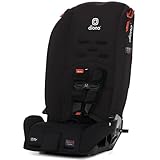


The table below lists every seat we covered, with the specifications that decide whether it works in an aircraft cabin. Weight range and orientation tell you who it fits; the feature column tells you what makes it portable.
| Product | Features | |
|---|---|---|
| Diono Radian 3R Convertible |
|
Check Latest Price |
| Cosco Topside Backless Booster |
|
Check Latest Price |
| Graco Slimfit 3-in-1 Convertible |
|
Check Latest Price |
 Safety 1st Ellaris 3-in-1 Safety 1st Ellaris 3-in-1 |
|
Check Latest Price |
 Britax Skyline 2-Stage Booster Britax Skyline 2-Stage Booster |
|
Check Latest Price |
 Mifold Hifold High Back Booster Mifold Hifold High Back Booster |
|
Check Latest Price |
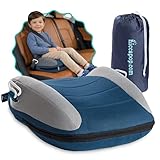 Hiccapop UberBoost Inflatable Hiccapop UberBoost Inflatable |
|
Check Latest Price |
 BubbleBum Inflatable Travel Booster BubbleBum Inflatable Travel Booster |
|
Check Latest Price |
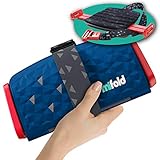 Mifold Comfort Grab-and-Go Booster Mifold Comfort Grab-and-Go Booster |
|
Check Latest Price |
 RideSafer Gen 5 Travel Vest RideSafer Gen 5 Travel Vest |
|
Check Latest Price |
As an Amazon Associate we earn from qualifying purchases, at no additional cost to you. CERTAIN CONTENT THAT APPEARS ON THIS SITE COMES FROM AMAZON. THIS CONTENT IS PROVIDED 'AS IS' AND IS SUBJECT TO CHANGE OR REMOVAL AT ANY TIME.
4 modes: rear-facing, forward-facing, high-back and backless booster
5-120 lb
Folds flat, FAA approved
The Radian 3R is the answer when a family plans to fly more than once and does not want a separate travel-only seat. One unit runs rear-facing up to 50 lb, forward-facing with a harness, then converts to a high-back booster and finally to a backless booster at 120 lb, which is roughly a ten-year service life for a single purchase.
What separates it from the other convertibles here is the fold. The seat folds flat for travel or compact storage, and its specifications state that it is approved for airline use. That means the same seat you use at home can go into an aircraft seat, and a family arriving without a rental car can use it immediately on the ground.
The Radian 3R is marketed and reviewed as a genuinely slim convertible, and the three-across claim is the one parents repeat most often. That slimness does double duty on a plane: a narrow restraint fits a standard economy seat without shoving the armrest into the aisle, and it means you can seat two children plus an adult in a typical row without negotiating.
The reinforced automotive-grade high-strength steel core is the reason the seat holds its shape across four modes, and it is also the reason it is heavy. That weight is the central trade-off on a travel seat, and it is worth confronting before you commit.
Owners consistently praise the durability and dislike the weight. Moving this seat between cars is a two-person job in most homes, and a parent carrying a toddler and a bag through an airport will feel that on the first trip.
If your travel is occasional, the fold-flat design means you carry it once rather than maintaining two seats. If you fly monthly with a small child and no checked vehicle seat at the destination, the load is harder to justify and one of the lighter boosters further down the list may serve you better.
Four modes also mean four configurations to learn. Reviews note that installation and mode-switching are more complex than most seats, with real opportunities to misuse it if you do not follow the manual closely. A certified child passenger safety technician check is the recommendation most owners repeat after a few months of ownership.
Rear-facing mode also reclines far back, which in a vehicle means moving the front seat forward. In an aircraft cabin that recline is a separate question entirely, and it is one reason families often plan a forward-facing harness seat for the flight itself and rear-facing on the ground.
ComfortPlus memory foam is included, and the steel frame keeps the shell stable when the seat is belted down, which matters more than usual in a cabin where the adult belt is the only restraint available. The cover removes for machine washing, which matters more than it sounds on a trip that involves juice and snacks.
The one comfort complaint that recurs is the depth of the side bolsters. Some parents feel their child is held in rather than held, particularly once the child is forward-facing and tall enough to notice the space.
If a single seat that spans an entire childhood and can go in the cabin sounds like the right trade, this is the pick. If weight at the airport is your dominant worry, keep reading to the lighter options.
Backless belt-positioning booster
40-100 lb and 43.4-57 in
Extra-plush padded seat
Hand-wash fabric cover
The Cosco Topside is the simplest item on this list and the one most families end up buying. It does one job: it raises a child so the vehicle seat belt sits correctly across the hips and shoulder. There is no harness, no headrest, no installation hardware and nothing to buckle.
With more than 15,000 ratings behind it, this is also the most thoroughly road-tested booster in the group. Buyers are consistent about the priorities: portability, simplicity and comfort for the child, in that order.
The range is 40 to 100 lb and 43.4 to 57 inches tall. That 57-inch ceiling is the single most important fact, because a backless booster stops working the moment the child’s shoulders outgrow the seat’s raised position and the belt stops routing correctly.
If you are buying at the upper end of the range, measure first. A child near 57 inches will outgrow this quickly, and the Britax Skyline later in this list handles up to 63 inches with head support.
Extra-plush padding is the feature owners mention most, and on a six-hour flight it is a real difference against thin plastic boosters. The backless form is also what makes this seat easy to stow: it slides into luggage without a frame to fold.
What you give up is support. A backless seat has no headrest, so during takeoff, landing or turbulence the child’s head and torso are unrestrained above the shoulder. Experienced safety guidance treats that as acceptable only for a child old enough and mature enough to sit properly for the whole flight.
The cover is 100% polyester and hand-wash only. That is a genuine limitation compared with the machine-washable pads on the convertible seats here, and on a trip you will want to wipe the seat down at the destination rather than wash it.
The seat is described as lightweight and compact for moving between vehicles, and it is designed to help keep upholstery unmarked, which makes it a reasonable addition to a rental car.
A belt-positioning booster needs only a lap and shoulder belt, which an aircraft seat has. That makes installation close to instant: place the child, run the belt through the guides, buckle. The absence of LATCH means there is nothing to attach and nothing to forget.
The catch is that this product’s listed specifications do not carry an aircraft approval statement, so confirm the label on your specific unit before you fly with it in the cabin.
For a child in the 40 to 100 lb range who can sit correctly without help, this is the least complicated way to fly and the least to carry. For anything younger, or for a taller child, the next few picks cover the gap.
3-in-1: rear-facing 5-40 lb, forward-facing 26.5-65 lb, high-back booster 40-100 lb
No-rethread harness
10% slimmer than standard
The Slimfit is the seat repeat buyers describe as the default across their kids, and it holds the highest average rating of anything in this roundup. It runs rear-facing from 5 to 40 lb, forward-facing with a harness from 26.5 to 65 lb, and high-back booster from 40 to 100 lb.
Its defining feature is the No-Rethread Simply Safe harness, where the headrest and the harness straps move together in one motion. On a plane, where you are working one-handed with a belt rather than LATCH anchors, that single adjustment is worth more than it would be in a car.
The design is roughly 10% slimmer than standard models, and owners report fitting three across in a back row or using it in a small pickup where a wider convertible simply will not go. In an aircraft cabin, that slimness translates directly into not fighting the armrest or the seat beside you.
Dual integrated rotating cup holders are unusual on a slim convertible and more useful on a flight than in a car, because there is nowhere to set a cup down once everyone is belted in.
The single-motion headrest and harness adjustment is the feature the reviews praise most. A conventional convertible needs the harness threads pulled back through the seat after every height change, which is exactly the kind of fiddly task you do not want at a gate.
Graco ProtectPlus engineered side-impact protection is built to newer side-impact testing standards, and the 10-position headrest gives real room for growth inside the harness stage.
Two complaints recur and both are fixable. The rear-facing recline initially feels too shallow for a newborn until it is properly adjusted, which is a setup step rather than a defect. The second is ventilation: openings at the back of the seat let cabin air blow directly at the child’s legs, and the thick padding can run warm without air conditioning.
On a summer flight that is a real consideration, and parents who have used it report that light clothing and a repositioning break the issue quickly.
Owners report doubling it as a lightweight travel seat for airports, and the machine-washable, dryer-safe pad is a genuine advantage on a trip. The seat installs with hook-style LATCH in a vehicle, which has no bearing in an aircraft cabin where the belt does all the work.
As with the other convertibles here, check the aircraft approval label on the specific unit before planning to carry it on board.
Choose this when you want one seat for the full toddler and preschool years, a harness that adjusts without rethreading, and a footprint narrow enough for a tight cabin row.
Rear-facing 5-30 lb infant stage
Forward-facing 30-65 lb
5-position headrest
Airplane ready
The Ellaris is the pick here for the youngest travelers. It has a dedicated rear-facing infant stage from 5 to 30 lb, extends to 40 lb rear-facing for a toddler, and then runs forward-facing from 30 to 65 lb, which makes it a genuine three-stage convertible rather than a short-term infant seat.
It is described as airplane ready with a compact travel design, which is why it earns a place in a roundup about flying even though several other seats in this list make no aircraft claim at all.
Most parents underestimate how long rear-facing lasts, and a seat that tops out at 30 lb rear-facing sends you shopping again at 18 months. Splitting the range into an infant stage of 5 to 30 lb and a toddler stage of 30 to 40 lb keeps the same seat in service through the phase where most families get pressured to turn forward.
The 5-position headrest is the adjustment that makes the forward-facing stage usable, moving the harness as the child grows rather than relying on strap tension alone.
The most common complaint is that the seat is wider than buyers expect, and some owners could not fit three across a back row. In an aircraft cabin, width is the number that decides whether the seat is comfortable, so measure your row before committing if the middle seat is your plan.
Buyers who have used it describe it as still bulkier than a true dedicated travel seat, which is the trade for a full three-stage convertible with no separate purchase later.
The seat pad is machine-washable and dryer-safe, and there are two removable, dishwasher-safe cup holders. Many buyers use it as a spare seat for grandparents’ houses and for travel, precisely because it moves between vehicles without any reconfiguration.
Hook-style LATCH makes vehicle installation straightforward, though it has no role in a cabin, where the aircraft seat belt is the only available restraint.
An approved restraint goes in a forward-facing aircraft seat, never an exit row, and never on a bulkhead row without a window. Those rules apply whatever the child weighs, and a rear-facing infant stage is no exception in terms of where the seat may be placed.
Install with the plane’s seat belt routed through the seat’s belt path. LATCH and top tethers do not exist in an aircraft, so any product that depends on them will not install on a plane at all.
If your child is under two, this is the seat to start with. If your child is already forward-facing and older, the lighter options further down will be far easier to carry.
High-back and backless belt-positioning booster
40-120 lb and up to 63 in
10-position one-hand headrest
Color-coded belt guides
The Skyline is the booster to buy if your child is already large. At 40 to 120 lb and up to 63 inches, it covers more growth than any other belt-positioning booster here, which means one purchase lasts rather than forcing an upgrade when your child hits a height ceiling.
It is also a two-stage seat, running as a high-back booster and then converting to backless once the child outgrows the harness position, so the head and torso support stays in place for exactly as long as it is needed.
Most backless boosters top out around 57 inches, and that limit catches families badly. A child who outgrows a backless booster before they can ride without it is the worst outcome, because the belt no longer routes correctly and there is no harness to fall back on.
The 63-inch ceiling removes that risk for most children, and the high-back stage covers the years either side of it.
The 10-position headrest adjusts with one hand, which matters when you are trying to change the fit in the back of a taxi or on a plane rather than in a driveway. Color-coded belt guides show the correct path for the lap and shoulder belt, and that is a real time-saver on a first install.
Reviewers also note that it is easy to install and easy for kids to buckle themselves in, which reduces the fussy pre-flight negotiation that ruins the start of a trip.
The seat pairs a protective shell with a foam-lined headrest for energy management, and it meets FMVSS 213, the federal standard these products are tested to. The recurring complaint is cushioning: several owners find the seat thinner and less plush than premium boosters, which is noticeable on a long flight.
The footprint is also larger than the inflatable travel boosters, so if cabin width is tight this is not the most space-efficient choice.
An inflatable booster is unbeatable for packing volume and unbeatable at nothing else. The Skyline is the step up for a child who needs side support through the shoulder-belt stage, or who is tall enough that a backless inflatable would be a poor fit.
For a family with two children of different ages, this is often the seat that goes on the older child so everyone fits in one row.
If height range is the deciding factor, the Skyline removes the most common booster regret. If packing volume matters more, the inflatable options are two sections down.
High-back belt-positioning booster
243 adjustment settings
Folds to 10.7 x 13.5 in
10 lb with built-in carry strap
The Hifold is the only high-back booster in this roundup that folds flat, dropping to 10.7 by 13.5 inches. That fold is what separates it from a portable backless booster: you keep the head and torso support and still get a seat that fits in a carry-on or a stroller basket.
It is recommended for children 4 and up, 40 to 100 lb and 43.5 to 59 inches tall, and it adjusts in four areas including seat, body, head width and height through Multi-Fit technology with 243 individual settings.
Unfolded it stands 24.7 inches high and measures 12.8 inches wide in its smallest setting, which is worth noting for narrow cabin rows. Folded, it compresses to roughly a third of its size and weighs 10 lb with a built-in carry strap.
Ten pounds is heavier than the inflatable and vest options here, but the fold is genuine compression rather than deflation, and the seat keeps its full structure when you set it down.
The seat meets or exceeds NHTSA FMVSS 213b and is approved for use in most regions worldwide except Australia and Taiwan. For a family flying between continents, or one that will rent a car overseas, that cross-border approval removes a genuine headache.
For flights, this is a car-seat-first product: the listed specifications do not include an aircraft approval statement, so treat it as a booster for ground use and check the label before carrying it into the cabin.
It is a belt-positioning booster with no harness, and it does not fit children under 40 lb, 43.5 inches tall, or 4 years old. A child who is not reliably sitting properly without help is also a poor match, because the seat positions the belt rather than holding the child.
Reviewers consistently treat that narrow fit range, plus the price, as the reason the average rating sits below the more flexible options in this list.
Lightweight EPE foam provides the impact resistance, and the multi-fold system is what allows a high-back booster to compress this far without a hinge that snaps under load. The seat is built for a 4 to 12 year age range rather than a narrower band, which is unusual in this category.
Choose this when you want a real high-back booster that lives in your luggage, and international travel is part of the plan. For something lighter, the inflatable options are simpler and smaller.
Inflatable backless booster
Inflates in under 20 seconds
Deflates into its own travel bag
Meets or exceeds FMVSS 213
The UberBoost solves packing volume better than anything else on this list. It inflates by mouth in under 20 seconds, and deflating it rolls it into its own travel bag small enough for a carry-on, a purse or a backpack.
For a family who flies to a destination with no rental car and wants a booster for taxis and ride-shares, that is a genuinely different proposition from hauling a 10 to 20 lb seat through an international terminal.
Buyers describe setup in under a minute in a rental car or a ride-share, which is the entire point of the design. There is no installation: you place the child on it and route the vehicle lap and shoulder belt through the positioning clips.
The non-skid base keeps it stable on leather, vinyl or cloth seats, and several owners report using it comfortably for a week-long trip without needing to reinflate.
This is a backless booster, and experienced parents are consistent that it requires close adult supervision and does not replace a forward-facing harness seat for younger children. A child who will not leave the belt alone disqualifies it outright, no matter how convenient it is.
The positioning clips keep the lap belt across the thighs, which is the single most important thing a booster does, and getting that right takes a few attempts the first time.
The inflatable chamber can slowly lose air after a few days of use and needs reinflating, which is the main complaint owners report. On a long international itinerary that means checking it partway through rather than packing it once and forgetting it.
Care is also needed when zipping the cover, since a stray zip or a pet claw can puncture the chamber. That is a small thing to know before you need the seat.
The narrow design allows three across a back seat, which makes it useful in a compact car at the destination. The booster comes with a lifetime warranty and free replacement cushions, one of the stronger ownership packages in this category.
Its listed specifications do not include an aircraft approval statement, so check the label on your specific unit before carrying it on board.
Pick the UberBoost when volume is the constraint and your child can sit properly. If your child still needs a harness, stay with a convertible.
Backless inflatable booster
40-110 lb and ages 4-11
Deflates to 12 x 6 x 4 in
Inflates in about 20 seconds
The BubbleBum is the inflatable with the most clearly documented sizing: 40 to 110 lb for ages 4 to 11, and a deflated size of 12 by 6 by 4 inches. That published range is what makes it easy to confirm it will fit your child and your bag before you commit.
It is independently crash tested to exceed FMVSS 213 and is secured with the vehicle’s standard three-point belt, so there is no LATCH, no top tether and no installation step of any kind.
Twenty seconds by mouth is the difference between a booster you use for the whole trip and one that stays in the trunk. When you land in a city where you will use taxis, ride-shares and rental cars for a week, that convenience compounds quickly.
Because the seat deflates just as fast, it fits into a day bag rather than a checked suitcase, and it never has to be searched for at security.
The average rating in this group reflects reservations about fit and belt positioning rather than safety. The lap belt must sit flat across the thighs, which takes care to arrange, and an inflatable has no head or side support at all.
There is also no adjustment for growth. Unlike the Britax Skyline or the Mifold Hifold, an inflatable booster cannot be reconfigured as a child gets taller, so it is a fixed fit for a fixed size range.
The backless design requires a mature child who will not unfasten or reposition the belt. Experienced safety guidance treats close adult supervision as a condition of using any backless booster, and inflatable construction makes that supervision more important because there is no shell to prevent slumping.
Parents of restless or newly weaned toddlers consistently report the inflatable as the wrong choice, not because of quality but because the child cannot stay positioned.
The slim profile fits three children across a back row, and the soft cushion is reported as comfortable on long drives with a lifetime support commitment behind it. It is easy to wipe clean after snacks, which is a genuine advantage over fabric-covered seats on a trip.
As with the other inflatable and portable options here, confirm the aircraft approval label on your specific unit before planning cabin use.
The BubbleBum is a strong pick for a child between 4 and 11 who travels light and uses ground transport at the destination. It is a companion to a car seat, not a replacement for one.
Backless grab-and-go booster
4+ years, 40-100 lb, 43.5-59 in
Fits a regular backpack
Includes padded cushion
The Mifold Comfort is built around one idea: a booster you can forget about until you need it. It fits into a regular backpack or a glove box, which no other seat in this roundup manages while still including a padded cushion.
It is aimed at children 4 and up, 40 to 100 lb and 43.5 to 59 inches tall, and it requires no installation at all — the seat adjusts the adult belt down onto the child rather than being anchored to anything.
Storage is the real product. A booster that lives in the car gets used every day; a booster that lives in a garage does not. For families splitting time between two vehicles, or moving between a home car and a borrowed one, a seat that fits in a glove box removes the biggest objection to owning a booster at all.
It is the same logic that makes it a reasonable companion for travel, where the alternative is checking a rigid seat in baggage.
Because nothing anchors it, the seat must hold the child in position for the belt to end up in the right place. Children must sit properly for the belt positioning to work, which puts the responsibility squarely on the adult in the front.
Anti-slip pads keep it stable in the back seat, and a shoulder belt guide keeps the lap belt low, but the backless form gives less head and side support than a high-back booster.
At 4.2, this carries the lowest average rating in the group, and the reasons are consistent: the backless form, and belt positioning that varies depending on how the child is sitting. Some owners also report mixed experiences with the shell and included cushion.
That is not a dealbreaker for a mature child in the middle of the size range, but it is a reason to look at a high-back booster if your child slouches or moves around.
The Compact Comfort padded cushion is what separates this from the cheapest backless boosters, and it is the reason it stays comfortable on a longer ride. Buyers who mainly carpool or use ride-shares report the no-installation design and glove-box portability as the deciding factors.
It works with any standard three-point belt, which includes an aircraft seat belt, though the listed specifications do not include an aircraft approval statement.
The Mifold Comfort is the answer to a specific problem: a family that needs a booster available everywhere without wanting to store a real seat. If your child needs head support, choose a high-back model instead.
Vest-type restraint, not a car seat
2.9 lb
17 x 11 x 4 in
80-110 lb in X-Large
Certified to FMVSS 213
Read this section before anything else: the RideSafer is a vest-type restraint certified to FMVSS 213, and its own specifications state that it is not FAA approved for use in an airline seat. The child must ride in a seat with the vehicle belt. It is a ground-travel solution, and it belongs in this roundup because the way people use it during a trip is often misunderstood.
What it does is remarkable. At 2.9 lb with a 17 by 11 by 4 inch footprint, it folds into a small bag that fits in a backpack, and it secures the child using the vehicle’s own three-point seat belt, so there is no separate install per car.
Because the vest is not FAA approved, it cannot be installed in an aircraft seat. That is a hard stop, not a preference, and it is the reason this vest cannot replace a harness seat for a flight.
Where it does work is the moment you land. If you are taking taxis, ride-shares or a rental car and do not want to arrive with a rigid seat, a vest that lives in a backpack until the car appears is a genuinely elegant answer.
Owners are near-universal on one point: children cannot climb out of or remove the vest on their own. In a rideshare, that is worth more than side-impact structure, because the failure mode is a child undoing a buckle in an unfamiliar car.
It can also fit three children across a single vehicle row, and the X-Large size is recommended for ages 3 and up and 80 to 110 lb.
Reviewers caution that it is not the most crash-resistant option, which is the honest reason it complements a full harness seat rather than replacing one. The inner crotch strap is fiddly to secure and remove, especially once the child is already seated, and the lap belt positioner does not always lay flat across the child’s lap.
Sizing has also changed between production runs, and some recent vests arrive without the neck pillow that fits a smaller child properly.
The construction is 95% polyester with 5% CRS, and care is airdry or a light surface wash with mild soap and water. That simplicity suits travel, where a seat that needs a washing machine is a seat that stays dirty in a suitcase.
If you need a weightless solution for ground legs of a trip, this is it. If you need a restraint in the cabin, go back to the Radian 3R or the Graco Slimfit.
The RideSafer is a car and taxi solution, not an aircraft one, and the most common mistake with it is assuming otherwise. Pairs well with a lightweight booster you can pack for the flight itself.
Most parents start with a brand name. The four checks below are faster, and they are the ones that decide whether a trip goes smoothly.
1. The label. Read the orange or white label on the seat shell and look for the sentence stating that the restraint is certified for use in motor vehicles and aircraft. Approval is granted model by model, not brand by brand, so two seats from the same line can differ entirely. A seat without that sentence can still be used in a taxi at your destination, but not in an aircraft seat.
2. The weight. Under 10 to 12 lb is the practical threshold. You will already be carrying a child and a bag, and most terminals involve a long walk, a security line and sometimes a tram or train between the jet bridge and the gate.
3. The width. A standard narrow-body economy seat offers roughly 17 to 18.5 inches of usable space. A restraint wider than that will press against the armrest, crowd the passenger beside you, or simply not install. This is why the Mifold Hifold’s 12.8-inch unfolded width and the inflatable options are so popular with frequent flyers.
4. The expiration date. Every car seat carries a manufacture date stamped on the shell and a printed limit. An expired seat is refused in a rental car and can be refused at the gate, so check before you leave home rather than at the jet bridge.
Aircraft seats have no LATCH anchors and no top tether, so install with the plane’s own seat belt routed through the seat’s belt path. Most modern seats carry a label showing the belt path for aircraft installation, usually in blue or marked for airplane use.
Route the lap belt low across the child’s hips and the shoulder belt through the shoulder guide or the back of the seat as the label directs. Buckle, then pull the shoulder portion of the belt up until it is snug. Check the belt at the child’s shoulder and at the belt line, because a slack aircraft belt is the most common install error.
For a convertible in rear-facing mode, follow the seat’s specific aircraft installation instructions, which will involve the belt in a different path. If your child is too heavy for the forward-facing harness stage, the seat is not appropriate for the flight, and that is a reason to buy a booster at the destination rather than to improvise.
Three rules cause nearly every problem at the jet bridge. An approved restraint must be installed in a forward-facing aircraft seat only. It may not occupy an exit row. And it may not be used in a row against a bulkhead without a window.
On top of that, the child needs their own ticket and their own seat. A restraint never substitutes for a purchased seat, and a lap infant is a separate legal category with its own conditions.
If a gate agent questions your seat, the conversation goes better if you can point at the label yourself. Know where it is on the shell before you board, and keep your child’s ticket and the seat’s documentation together.
Three scenarios cover almost every family. A lap infant under 2 flies free on an adult’s lap, one lap infant per adult, and has no restraint at all during turbulence. An own seat with an approved restraint is the safest option and the only one that protects your child in the air. A gate-check means you bring the seat to the jet bridge, check it, and use it in a rental car at the other end.
Gate-checking removes the seat from the cabin, and families describe the anxiety of it vividly: the fear that it will be lost, that it will be damaged, or that the gate agent will refuse it. If you do gate-check, use a durable gate-check tag, photograph the seat before you hand it over, and confirm at your destination that it arrived before you leave baggage claim.
Buying your own seat in the cabin is the better answer when the child will actually use it, which mostly depends on how long the flight is and whether the child sleeps strapped in.
Parent forums are full of advice to forward-face on a plane, and that advice creates real guilt because it contradicts what parents are told everywhere else. Here is the actual position: a rear-facing restraint is not prohibited in an aircraft seat, and the safety guidance favours keeping a child rear-facing for as long as their seat allows.
The practical obstacles are real rather than theoretical. A rear-facing seat takes a large amount of legroom in an economy row, the child cannot see out, and a reclined rear-facing shell is harder to install with an aircraft belt than a forward-facing harness. Some families find it unbearably cramped, and forcing a cramped arrangement produces a worse outcome than a properly installed forward-facing harness.
The honest recommendation is to keep rear-facing in the vehicle where you have room to do it properly, and to plan the flight segment around a forward-facing harness seat that fits your child’s size, then return to rear-facing on the ground. That is a compromise, not a rule, and the most important thing is that whatever you choose is installed correctly.
This concern comes up constantly in parent forums and is almost never addressed in buying guides. Car seats must pass federal flammability requirements, which manufacturers traditionally met partly through added flame retardants in the foam. Plenty of parents are uncomfortable with that and filter accordingly.
Be realistic about what you can change. The federal standard is the standard, and a seat you buy for travel will generally contain the same materials as any other seat in its class. If material sourcing matters to you, the practical filters are the presence of a published materials statement from the manufacturer and whether the cover is removable and washable, which extends the life of a seat you keep for years.
Weight is a more actionable filter: a seat you are willing to carry is one you will actually use rather than check without thinking.
Families caring for children with medical needs, adaptive equipment or higher body weights run into constraints none of the ten seats here address, and the honest answer is that this roundup is not built for them. Adaptive equipment generally requires a child restraint designed for it, and airlines accommodate approved adaptive restraints differently from car seats.
What you can do is contact the airline’s special assistance desk in advance, provide the equipment dimensions and weight, and ask which aircraft on your route can accommodate them, because a wide-body and a narrow-body are not equivalent. For heavier children, look for a seat with a higher published weight limit and confirm it with a certified child passenger safety technician before you travel.
Travel light is the goal, and it usually means fewer pieces rather than smaller ones. A carrying strap or a dedicated seat bag matters more than people expect, because a bare seat shell is awkward to grip on its own. A gate-check tag and a bungee cord for a car seat in a vehicle trunk are the two small items travelers regret not packing.
Board early when you can, so the installation is not done in a queue. Keep the label photograph on your phone as a fallback. And if you are packing gifts, practical travel gear tends to survive the trip better than anything bulky. Our picks for travel gifts for men and travel gifts for women skew compact for the same reason.
Only car seats and child restraints that carry a label stating the restraint is certified for use in motor vehicles and aircraft are acceptable in an aircraft seat. Approval applies model by model, not brand by brand. The seat must be installed in a forward-facing aircraft seat, never an exit row, using the aircraft seat belt routed through the seat’s belt path, because aircraft have no LATCH anchors and no top tether.
Look for the label on the seat shell and read the wording. The FAA uses the phrase this restraint is certified for use in motor vehicles and aircraft. If that sentence is present, the seat can be used in a cabin. If it is absent, the seat is still legal in cars but cannot be installed in an aircraft seat. Also check the manufacture date and the printed expiration date before you fly.
It is worth it when your child is under 2, when the flight is long, or when you will use the seat in a rental car at the destination. A child under 2 can otherwise fly free as a lap infant with no restraint during turbulence. If you bring a seat, choose one that folds or deflates, keep it under 12 pounds, and install it in a forward-facing aircraft seat using the plane’s seat belt.
The lightest options in this roundup are the inflatable backless boosters, which deflate to about 12 by 6 by 4 inches and inflate by mouth in roughly 20 seconds, and the 2.9 lb RideSafer vest, which is not approved for aircraft use. For a full harness seat that folds flat and documents airline approval, the Diono Radian 3R is the pick, though it is heavier than any booster.
It depends on the specific model, because FAA approval is granted per model rather than per brand. Check the label on the seat shell for the wording stating the restraint is certified for use in motor vehicles and aircraft. The Graco Slimfit in this roundup is a slim 3-in-1 with a no-rethread harness that owners use for airport travel, but its listed specifications do not include an aircraft approval statement, so verify the label on your unit.
If you want one seat that covers a whole childhood and can go in the cabin, the Diono Radian 3R is the pick, and its fold-flat design plus documented airline approval is what puts it ahead of the field in 2026. If your child is already past the harness stage, the Cosco Topside carries the lowest effort and the least weight, and a tall kid in a back row fits the Britax Skyline up to 63 inches. An infant still needs rear-facing, so start with the Safety 1st Ellaris. Three across is the problem to solve, and the Graco Slimfit or the Diono solves it.
And if the real constraint is what you can lift, a fold-flat booster or an inflatable solves it in a fraction of a second, while the RideSafer vest handles taxis and ride-shares at the other end of the trip. Check the label before you fly, install with the plane’s seat belt, and read our travel gift guides for the small items that make a long trip easier.