Physical Address
304 North Cardinal St.
Dorchester Center, MA 02124
Physical Address
304 North Cardinal St.
Dorchester Center, MA 02124

A workshop in July is the worst room in most homes to spend an afternoon in. Steel tools hold heat, sawdust traps warmth near the ceiling, and a detached garage can sit uncomfortably warm because there is no ducted return to move heat out. If you have been searching for the best swamp coolers for workshops, the reason you are looking is that an air conditioner quote felt like too much metal and too much permanent cost for a room you only cool while you are working.
A swamp cooler moves air instead of manufacturing cold. A fan pulls warm air through water-saturated cooling pads, the water absorbs heat as it evaporates, and the cooled air comes out the other side on a single pass. There is no refrigerant and no compressor cycle, which means no refrigerant line to install and very little electricity to run. It also means the unit adds moisture to the room, which is the one condition that decides whether this purchase works or fails.
Here is the honest caveat first, before any product: evaporative cooling depends on dry air. Once relative humidity climbs past roughly 60 percent, there is little capacity left in the air to absorb water vapor, and the temperature drop collapses to a few degrees. Shop owners in humid regions report measuring only 3 to 4 degrees on marginal days. If your shop sits in a Gulf Coast or Gulf South summer, read our disqualifier section before you buy anything.
We built this roundup by reading spec sheets for nine units and cross-checking them against several thousand owner reviews, then scoring them against workshop-specific criteria that most roundups ignore: whether the casters lock, whether the pump has dry-run protection, whether the tank takes a garden hose, whether the noise level allows you to hear a welding lead or a radio, and whether the controls survive being handled with dusty hands. We did not measure airflow ourselves in a controlled chamber, so where reviewers did measure, we report their numbers and flag them as independent measurements rather than treating them as lab data.
If you are still weighing this against a compressor-based unit, our swamp cooler versus air conditioner guide lays out the running cost and installation differences side by side.

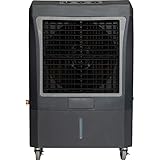

The Hessaire MC37M takes the top slot because it has the largest body of owner feedback in this group, and the feedback is overwhelmingly from dry-climate garage and shop use. The MC37V edges it on satisfaction score and adds locking casters and stainless fasteners, which is why it carries the Top Rated badge instead of the Editor’s Choice. The MC92V is the pick when you have a real shop rather than a one-car bay.
| Product | Features | |
|---|---|---|
| Hessaire MC37M 3100CFM Evaporative Cooler |
|
Check Latest Price |
| Hessaire MC37V Mobile Evaporative Cooler |
|
Check Latest Price |
 OEMTOOLS 23968 Portable Swamp Cooler OEMTOOLS 23968 Portable Swamp Cooler |
|
Check Latest Price |
 Uthfy 40 Inch 4800 CFM Swamp Cooler Uthfy 40 Inch 4800 CFM Swamp Cooler |
|
Check Latest Price |
 SereneLife 12000 CFM Industrial Evaporative Cooler SereneLife 12000 CFM Industrial Evaporative Cooler |
|
Check Latest Price |
 Hexago 7500 CFM Evaporative Air Cooler Hexago 7500 CFM Evaporative Air Cooler |
|
Check Latest Price |
 Uthfy 6000 CFM Swamp Cooler Air Conditioner Uthfy 6000 CFM Swamp Cooler Air Conditioner |
|
Check Latest Price |
| Hessaire MC92V Evaporative Cooler 11000 CFM |
|
Check Latest Price |
 Big Ass Fans Cool-Space 300 Evaporative Cooler Big Ass Fans Cool-Space 300 Evaporative Cooler |
|
Check Latest Price |
We earn from qualifying purchases. CERTAIN CONTENT THAT APPEARS ON THIS SITE COMES FROM AMAZON. THIS CONTENT IS PROVIDED 'AS IS' AND IS SUBJECT TO CHANGE OR REMOVAL AT ANY TIME.
Every unit in this roundup was scored on the same six criteria, weighted toward workshop conditions rather than patio use.
Airflow verified against claims. Headline CFM numbers vary wildly in this category, and two units here were measured by owners with instruments that came in far below their stated output. We treat the rated figure as useful for comparison but flag every case where an independent measurement contradicts it.
Water logistics. A tank you have to babysit is a tank that will run dry during a shift. We looked at tank volume, garden hose connection, and whether the pump has any protection at all when the water is gone.
Pad configuration. Three-sided pads expose the wet media on more faces, which increases evaporative surface. Single-sided units limit how much of a shop you can actually reach.
Mobility under shop conditions. Concrete floors, extension cords, and units being bumped. Locking casters matter more in a workshop than anywhere else.
Noise at working distance. We used published decibel figures and reviewer observations about whether they could work beside the unit.
Durability signals. Warranty length, whether parts and service exist in the United States, and long-term owner reports about motors and plastic housings.
We earn a commission when you buy through links on this page, at no additional cost to you, and that does not change the ranking order.
3100 CFM
950 sq ft
10.3 gal tank
250W at 115V
59 dB
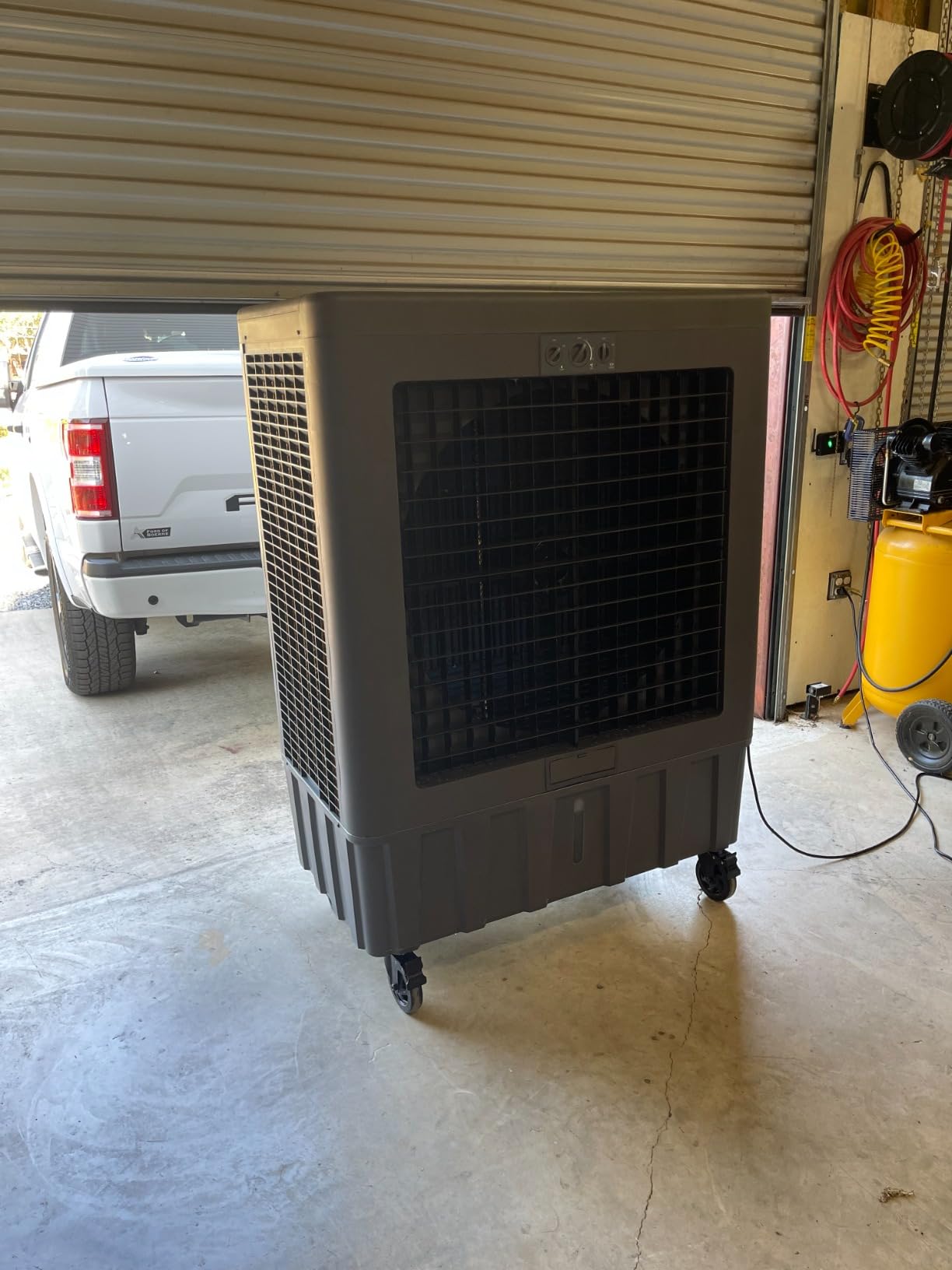
The MC37M is the unit we kept coming back to while building this list. Four thousand seven hundred owner reviews is more field history than any other evaporative cooler in this roundup, and the pattern in it is remarkably consistent: dry-climate owners in Southern California, southwest Colorado, the desert Southwest, and California’s central valley report large and believable temperature reductions inside garages and covered bays.
What makes it work as a shop tool rather than a patio toy is the three-panel evaporative intake and the continuous water flow system with a float valve and garden hose adapter. In a one-car bay, the honest use case is spot cooling: you point it at the bench where you are standing rather than trying to condition the whole room. Several long-term owners describe running two or three summers before replacing pads, which tells you something about the media and the plastic housing.
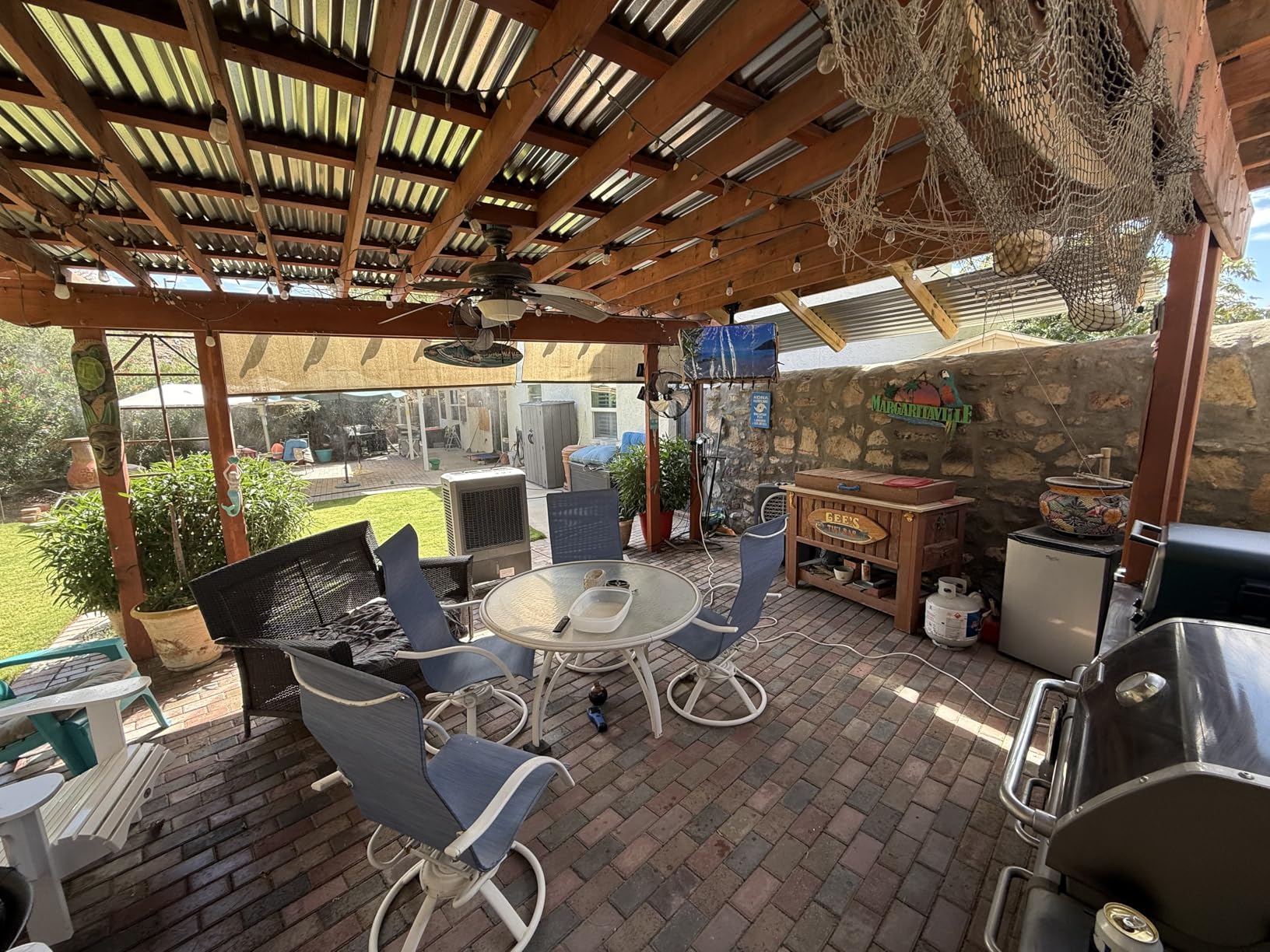
At 3,100 CFM and a rated 950 square feet, this sits in the class of unit that genuinely fits a single-bay garage or a hobby shop with one work position. The three-panel intake means air is drawn across a wide wet face rather than a narrow strip, and that is what separates a shop cooler from a small desktop unit.
Owners in genuinely dry air report drops of 25 degrees or more. In moderate humidity the same unit lands somewhere far less dramatic, and that gap between climates is the single most important thing to understand before you buy anything.
The 10.3 gallon reservoir gives roughly three to four hours of runtime per fill, and the float valve and hose adapter let you run it continuously without topping up. In a workshop that matters more than the headline runtime figure, because you are not going to stop mid-cut to carry a jug of water across the floor.
One weakness here is genuine: there is no low-water shutoff on this unit. If the pump runs dry it keeps running, so the unit should not be left unattended overnight or over a weekend.
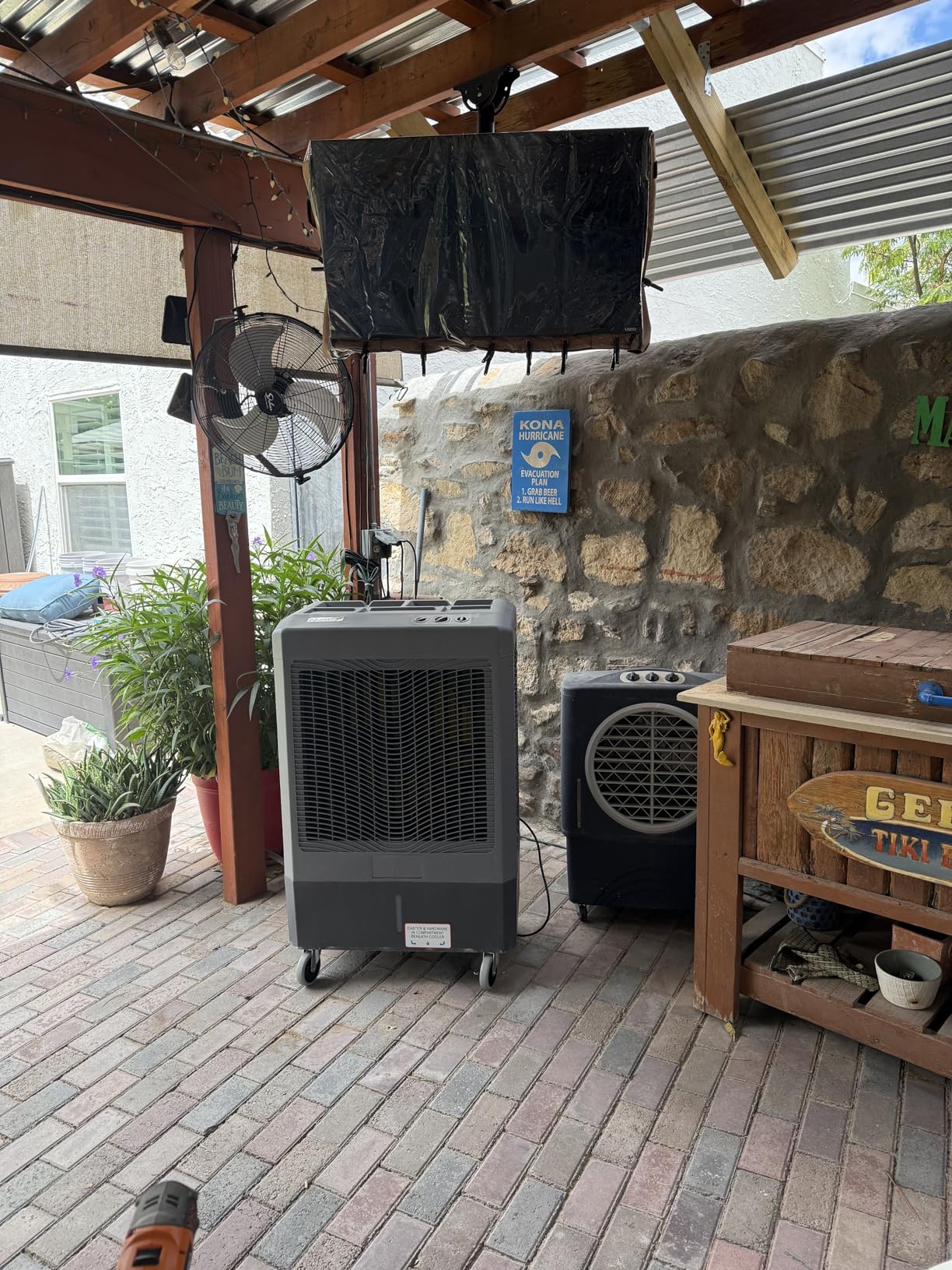
At 59 dB this is not a silent unit, and reviewers describe it as audible on low and quite loud on high, with one reviewer finding it too loud for indoor use. In a shop where you are running a grinder or a compressor that will not compete with it, that is acceptable. If you want to work quietly and listen to music, this is not the one.
The roto-molded polypropylene body is a real advantage in a shop: it will not rust, and it shrugs off the damp concrete splash that kills a metal cabinet. The recurring complaints are cosmetic rather than structural, with owners pointing to mediocre fit and finish, a small plastic fill-door latch that can break, and a float valve that can develop a pinhole leak. Several owners also mention plastic-on-plastic creaking from the oscillation gears.
On a forum, shop owners running multiple Hessaire portable units across several locations describe them as a very good product, which lines up with what we see in the review data.
3100 CFM
950 sq ft
10.3 gal tank
3-sided rigid pads
Four locking casters
The MC37V is the same basic platform as our top pick with a handful of changes that matter specifically in a working space, and it scores higher with owners at 4.6 out of 5, with 82 percent of ratings at five stars. The difference is the hardware: four heavy-duty locking casters instead of plain molded wheels, and stainless steel screws instead of plated fasteners.
That combination matters more in a workshop than it does on a patio. A cooler you can roll across a slab, position at the workbench, and lock in place will actually stay where you put it, and fasteners that will not streak with rust are a real advantage in a damp bay.
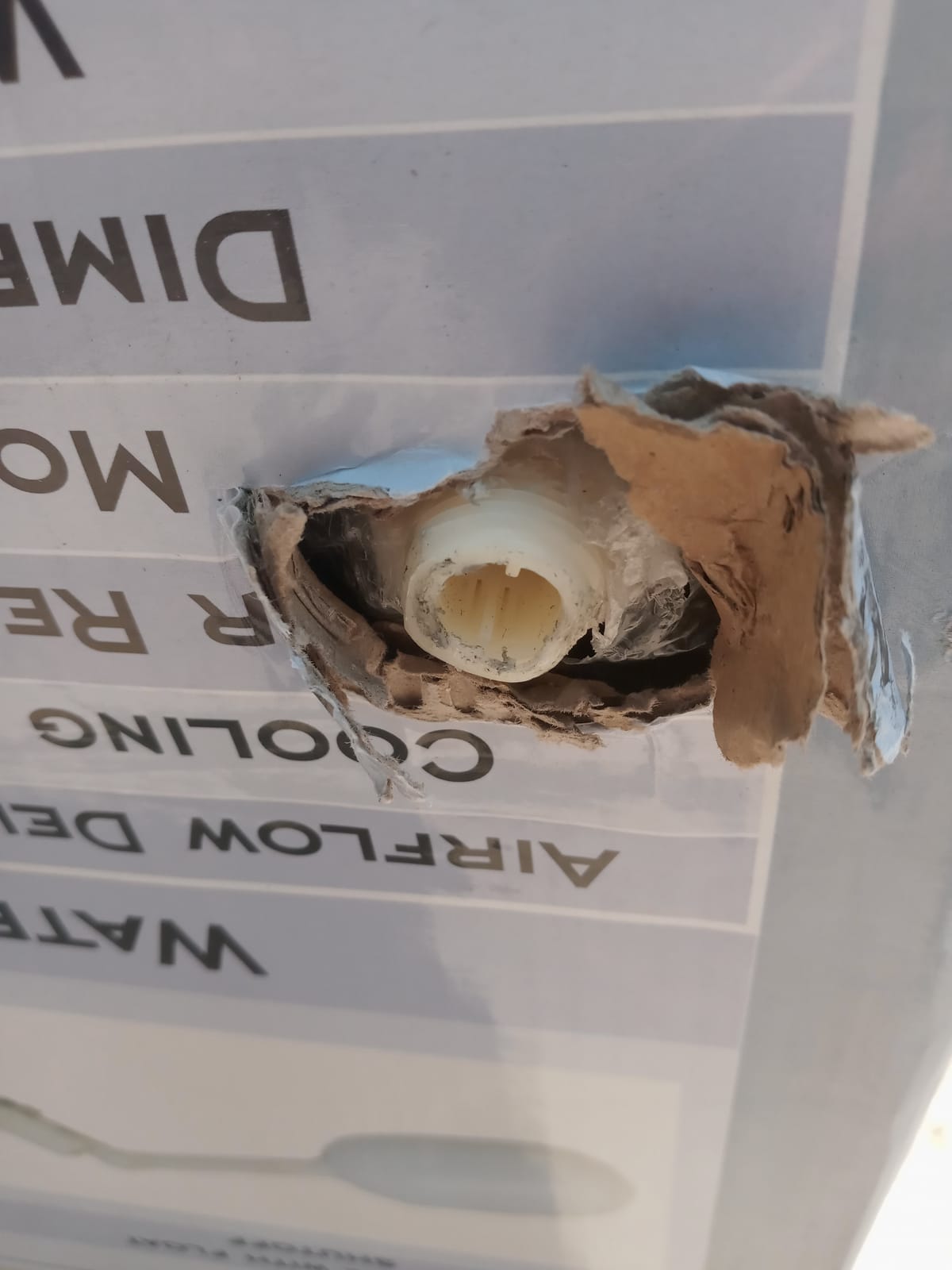
The casters are the reason to choose this over the MC37M. A shop is rarely one room. You want the cooler at the welding bench in the morning and at the assembly table in the afternoon, and locking swivel wheels are the difference between that being a two-minute job and a two-day job.
At 21 by 15 by 35 inches, the footprint is compact enough to move through a standard door without planning the move in advance.
This unit uses independent rotary controls for the fan, the pump, and the oscillation motor, rather than a single switch. For a shop that is a genuine convenience, because you can run the pump continuously at low fan speed to hold temperature without blasting air across the whole bay.
The three-sided rigid high-density pads give more evaporative surface than a single-sided panel, and the oscillating louvers spread the output so you are not standing in one cold stripe and one warm stripe. Continuous fill is available through the included float adapter and a household hose.
A two-year owner credits the stainless fastener construction for the unit still looking new, and garage and workshop owners report it makes a real difference in hot weather. The recurring complaint is noise on the higher settings, described by some users as loud for the cooling delivered.
The most serious negative in the review set is a single report of a unit that arrived coated in an unidentified white powder with a strong chemical smell and a difficult return. One report is not a pattern, but it is worth inspecting any unit the moment it arrives before you fill it with water.
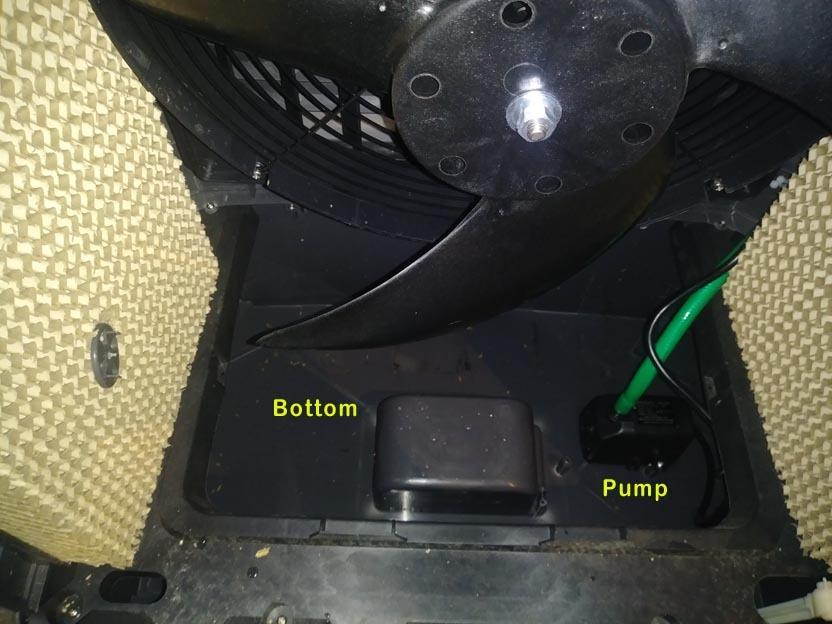
3100 CFM
950 sq ft
10.3 gal reservoir
1/5 HP 3-speed motor
68 dB
Where the two Hessaire units are general-purpose coolers adapted to a shop, the OEMTOOLS 23968 was designed around a working garage. It has an integrated tool tray, casters, and a UL-listed GFCI plug, which tells you the people who specced it expected it to be plugged into a shop circuit with sawdust and metal dust in the air.
The GFCI plug is a small detail that matters more than it looks. A standard two-prong plug in a damp concrete bay is a nuisance, and a GFCI-equipped cord removes one failure mode entirely.
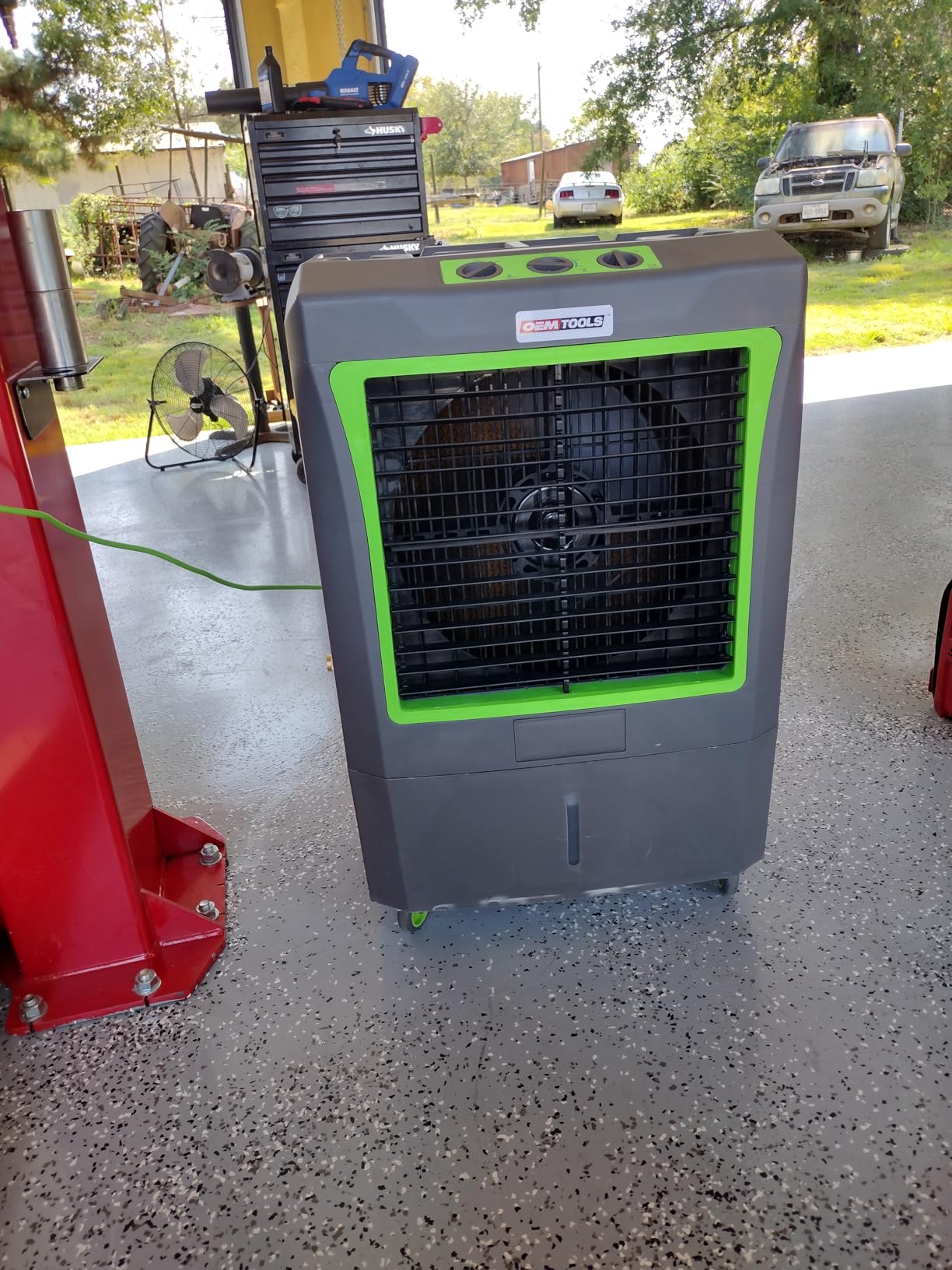
The integrated tray is the feature that no other unit in this roundup offers. In practice it is a small flat surface on the unit where you can set a socket, a flashlight, or a pair of gloves without dropping them in the sawdust. It also gives you a defined place to stage the small parts you are working on.
At 41.3 pounds and 45 inches tall, this is a full-height cabinet cooler. That height means a longer air throw than a squat portable unit, and the oscillating airflow pattern is aimed at eliminating hot spots across a shop floor rather than cooling one spot.
The patented axial propeller is designed to move air quietly and further than a typical centrifugal shop fan, which is the right target when the cooler sits across the room from where you work. The high-density media panels claim 80 percent more surface area for evaporation, which in practice means the pads saturate and begin cooling faster after startup.
The motor is a 1/5 HP three-speed unit drawing 250 watts on 115 volts and pulling about 1.3 amps, so it will run on a standard household circuit without any dedicated wiring.
At 68 dB, this carries the highest published noise figure in the roundup. That sits at the top of the scale for residential-size shop coolers, and it is the main reason we did not place this unit higher.
The other limitation is evidence rather than performance. With 69 ratings, the long-term durability picture is not well documented, and you are buying into a smaller support base than the Hessaire units offer. For a shop where the cooler runs eight hours a day through several seasons, that is a real consideration.
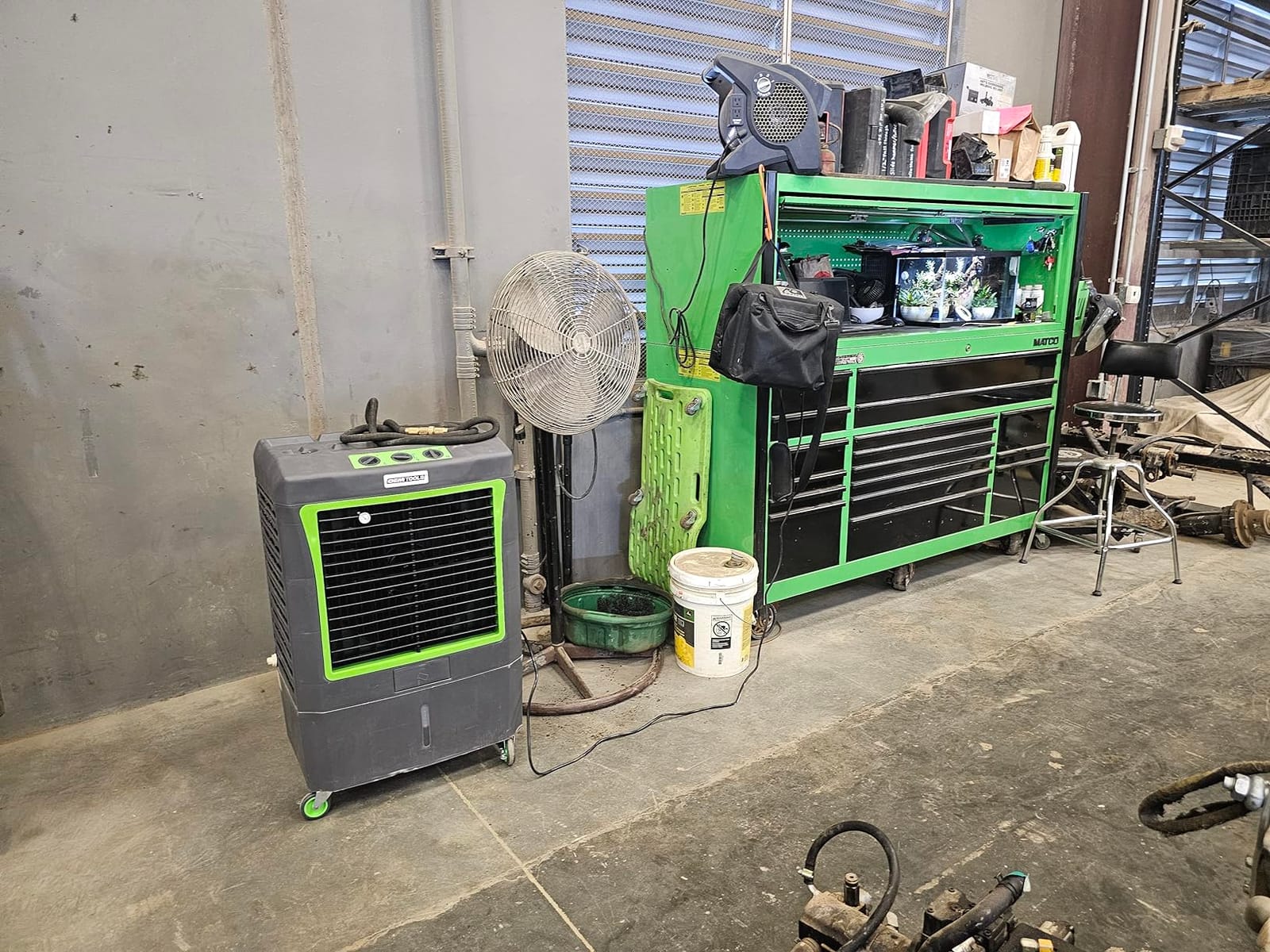
4800 CFM
970 sq ft
11 gal tank
50 dB
Galvanized iron frame, copper motor
The Uthfy 40 inch unit is the one to look at when you have a bay larger than 950 square feet and you want metal rather than plastic. It has a galvanized iron frame, a copper motor, and a rated 4,800 CFM, which puts it well ahead of the 3,100 CFM class on paper.
The construction choice is the differentiator. Almost everything else at this size is a molded plastic shell, which is light and will not rust but flexes and cracks over seasons of shop use. A galvanized frame with a copper motor is closer to what a commercial unit looks like.
A copper motor is a real efficiency and longevity upgrade over the cheaper steel motor used in many import units. It runs cooler, draws less power at the same output, and tolerates the long duty cycles a shop imposes. The 200 watt draw here is lower than the 250 watts on both Hessaire 3,100 CFM units while moving nominally more air.
At 50 dB, this is also a low noise figure for a unit this size, which is a pleasant surprise given the airflow claim. Reviewers respond to the specification rather than to marketing language, which is a good sign for the honesty of the listing.
The 11 gallon reservoir is a large tank for a unit of this airflow class, and it pairs with a built-in drain port for off-season storage and manual top fill plus continuous auto-refill options. For an all-day shop run, that volume means one fill at the start of the shift rather than a mid-afternoon water run.
The 3-in-1 design lets it operate as an air cooler, a plain fan, or an ice-enhanced cooler with three included ice packs and a four-in-one composite ice curtain. Be realistic about the ice function: packs must be frozen well ahead of time, and adding cold water to a pad does not dramatically increase the cooling, because the cooling comes from evaporation rate rather than water temperature.
The 4.0 average with a 4,800 CFM claim reflects a genuinely split buyer base. Only 58 percent of ratings are five-star, and 15 percent sit at three stars, which points to buyers who found the cooling weaker than the airflow number implies.
There is also a broader pattern worth naming: in this product family, sellers sometimes quote CFM figures that do not match measured output. If you care about real delivery rather than the number on the box, the practical approach is to size up rather than sizing to the specification.
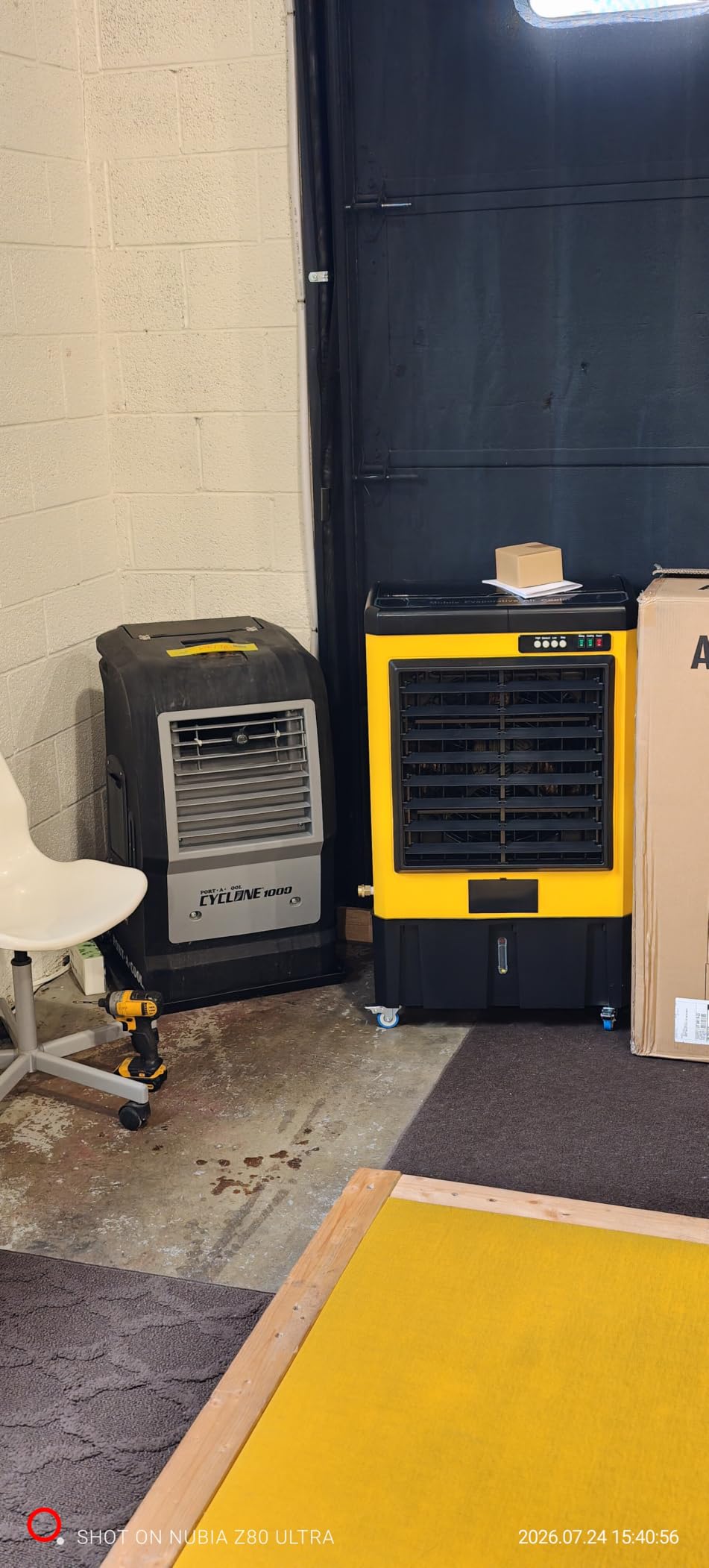
12000 CFM claimed
150 liter tank
800W motor
Wi-Fi, remote, 12-hour timer
65 dB
The SereneLife unit is the odd one out in this list, and it earns its place for a specific reason: it is the only unit here with app-based control over Wi-Fi. A remote, a touch panel, and a programmable one-to-twelve hour timer mean you can start cooling before you arrive and have it running when you open the door.
For a shop that runs on a fixed weekday schedule, that is a genuine convenience that no mechanical-timer unit in this roundup offers. The two wind modes, three speeds, and adjustable vertical plus horizontal airflow also let you aim the output at a standing work position rather than the middle of the floor.
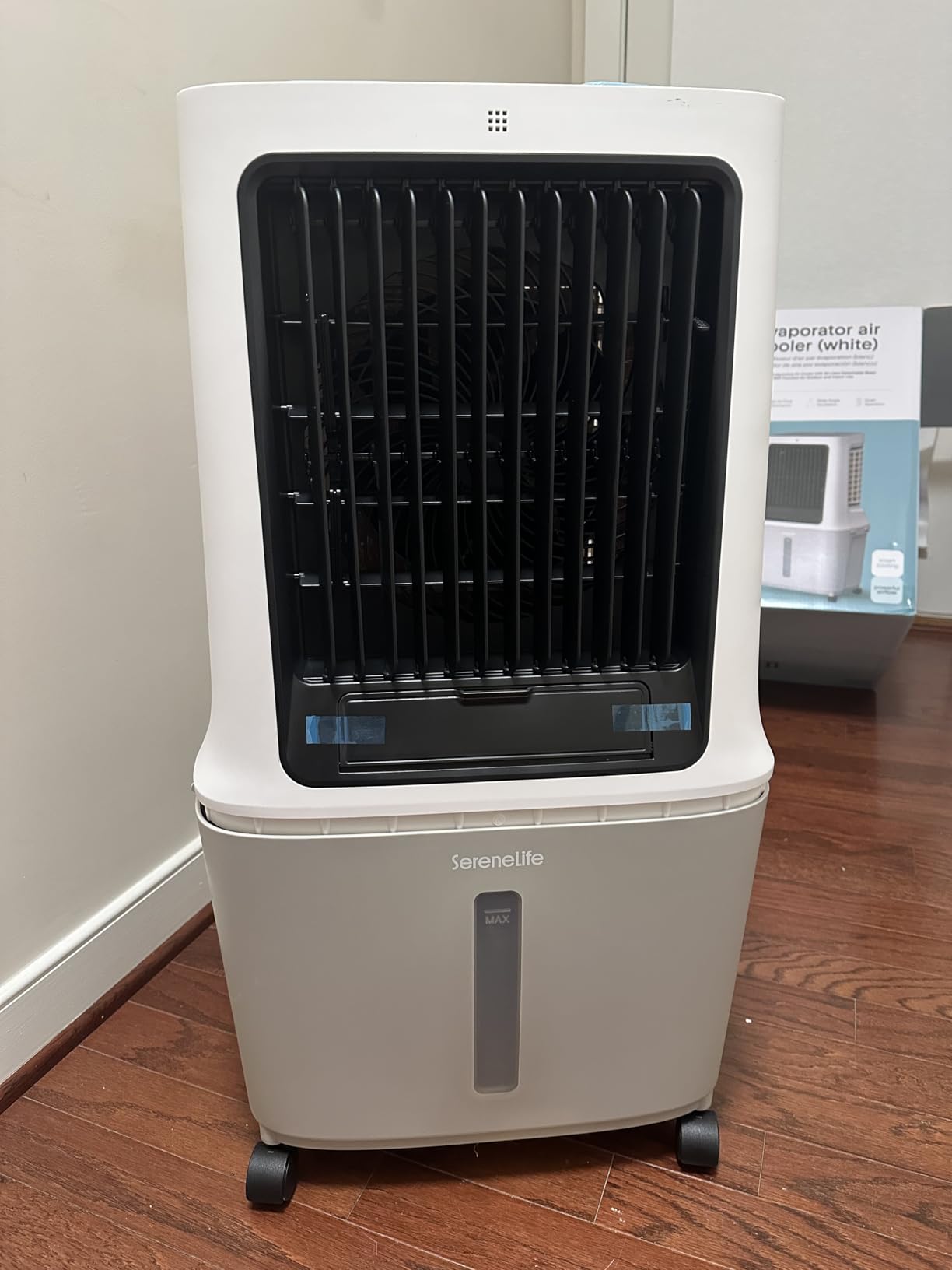
At 150 liters, this is the largest reservoir in the roundup, well ahead of the 32.8 gallon tank on the largest Hessaire. In a warehouse or a multi-bay space where you do not want to walk water across the floor mid-shift, that volume solves a real problem.
The water shortage alarm and pump protection matter for exactly the same reason they appear high on the forum wish lists: consumer-grade units with no dry-run protection fail when the water runs out. This one tells you first.
The control suite is the reason this unit is here. A remote reaching across the shop floor, a programmable timer, and app control through Wi-Fi together cover the case where the cooler is in a sealed room you do not want to enter, or where you want it to shut down at end of shift without walking over to it.
Two wind modes and three speeds give finer control than the fixed three-speed switches on the plastic units, though for most shop work the difference matters less than the scheduling does.
At 69.4 pounds and 62 inches deep, this is a large object that needs floor space, and it comes on rolling wheels rather than proper locking casters. There is no tool tray, which in a working bay is a missed convenience.
More importantly, this unit carries one of the lower satisfaction scores in the roundup at 3.3, with 27 percent of ratings at one star. The core complaint is the gap between the 12,000 CFM claim and what owners report actually coming out. At 65 dB it is among the louder units here. Buy it for the tank and the scheduling, not for the airflow number.
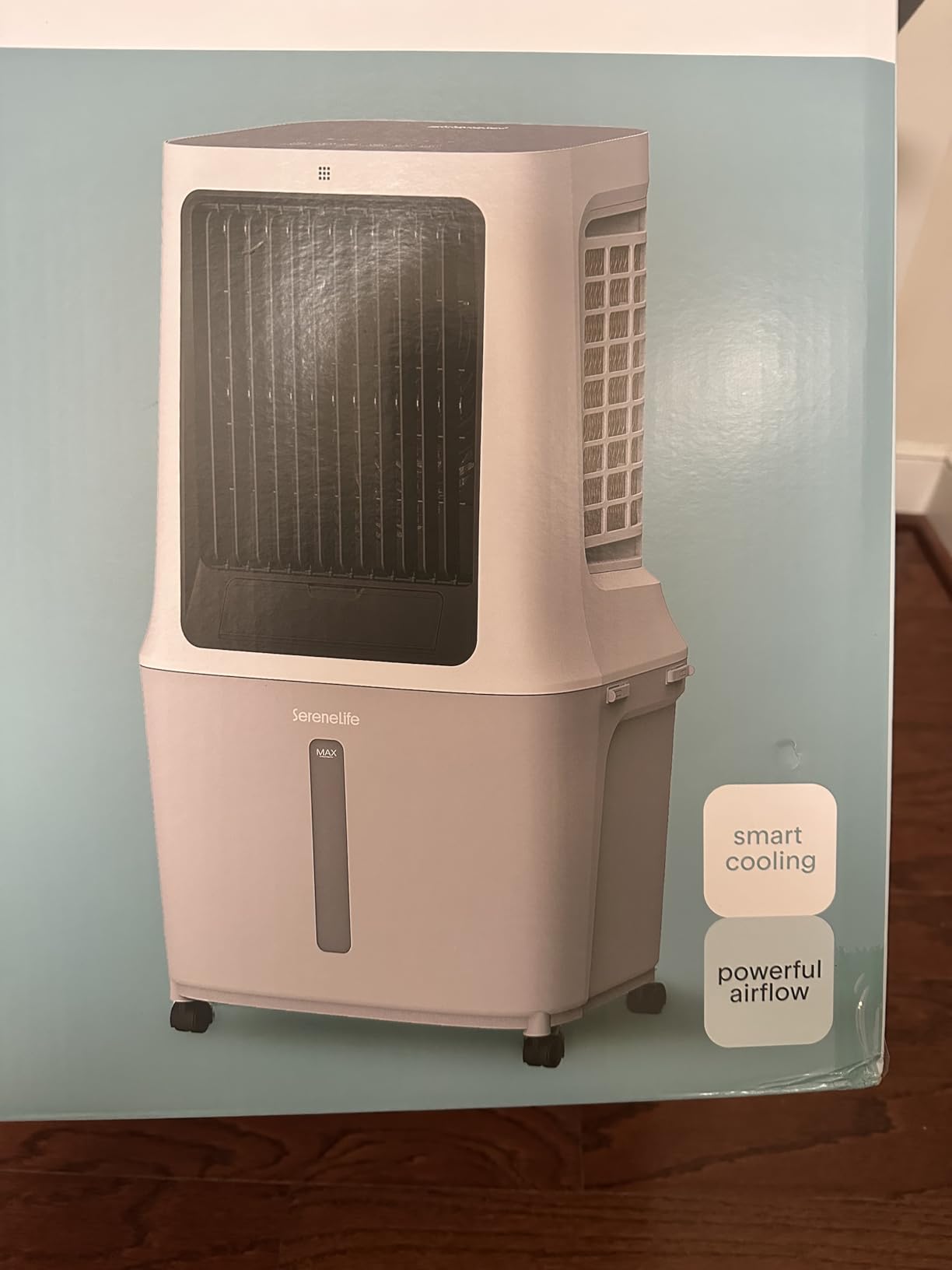
7500 CFM claimed
13.2 gal tank
150W, 55 dB
ETL Safety Listed
24-hour timer
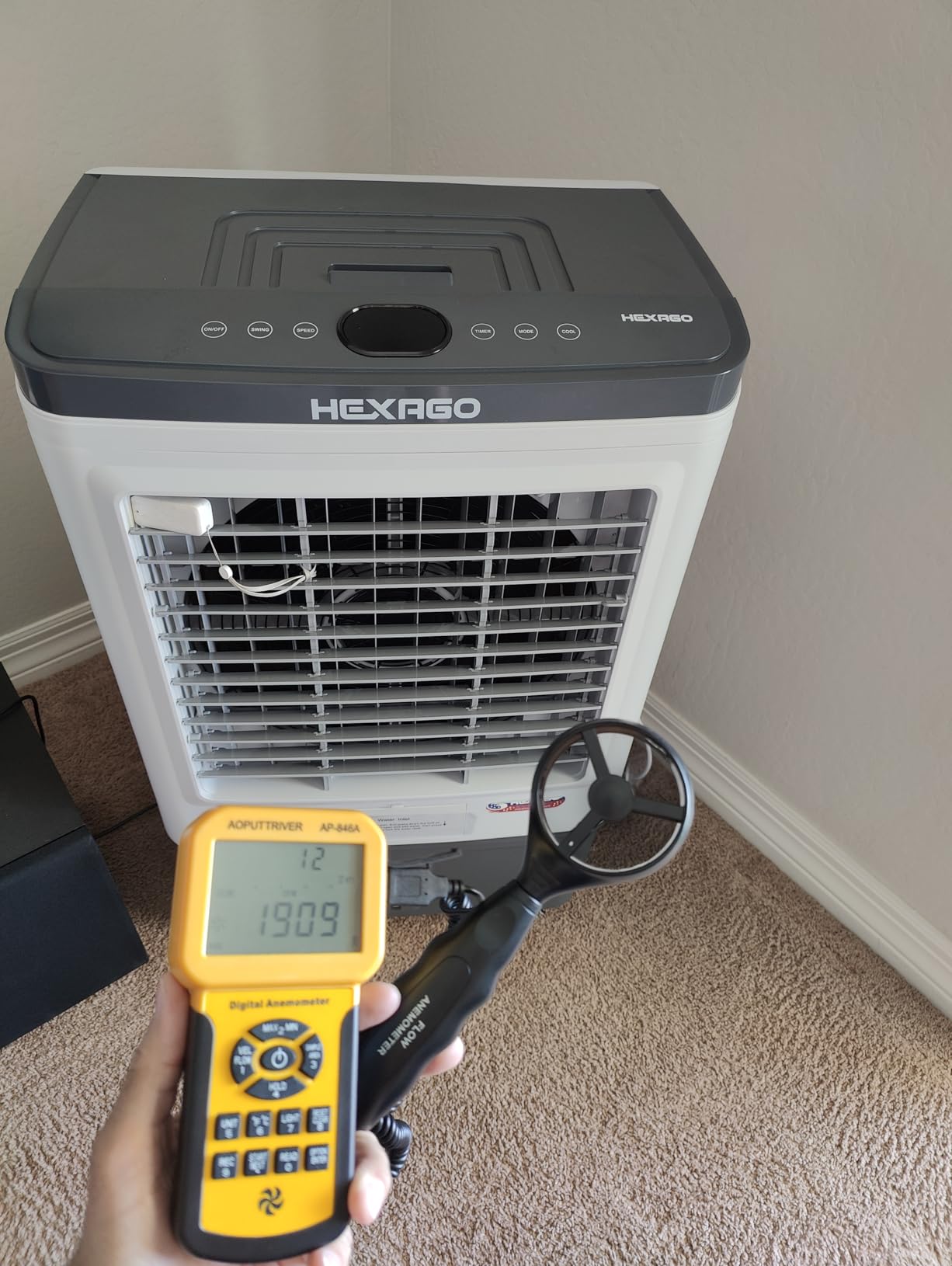
The Hexago is here for two reasons, and only one of them is flattering. Its 13.2 gallon reservoir is a large tank among mid-size units in this roundup, and it carries an ETL Safety Listed certification, a genuine third-party mark and one of the few we found across the whole list.
For a shop where electrical inspection or insurance paperwork is part of the picture, a listed certification is not a small detail. The design itself is also well received, with one reviewer calling the physical layout the best on the market and specifically praising the dust screens and internal drip trays.
Manual top fill or garden hose continuous fill, with a visible water level window and a shortage warning system to protect the pump. At 150 watts, this is a low power draw for a mid-size unit, and the 55 dB figure is quiet for the class.
Two ice packs are included but require four to six hours of freezing beforehand, which in practice means planning the night before if you intend to use them.
This is the significant weakness, and it recurs. Touch buttons are frequently unresponsive on power-up, sometimes for several minutes, and the remote and display often fail to respond at all on units from this brand family. A control panel that does not respond at start-up in a shop is a bad morning.
There is a second setup requirement: the unit must sit perfectly level or the pads wet unevenly, and the directions do not explain this clearly. In a shop with a sloped slab, that is a real installation constraint.
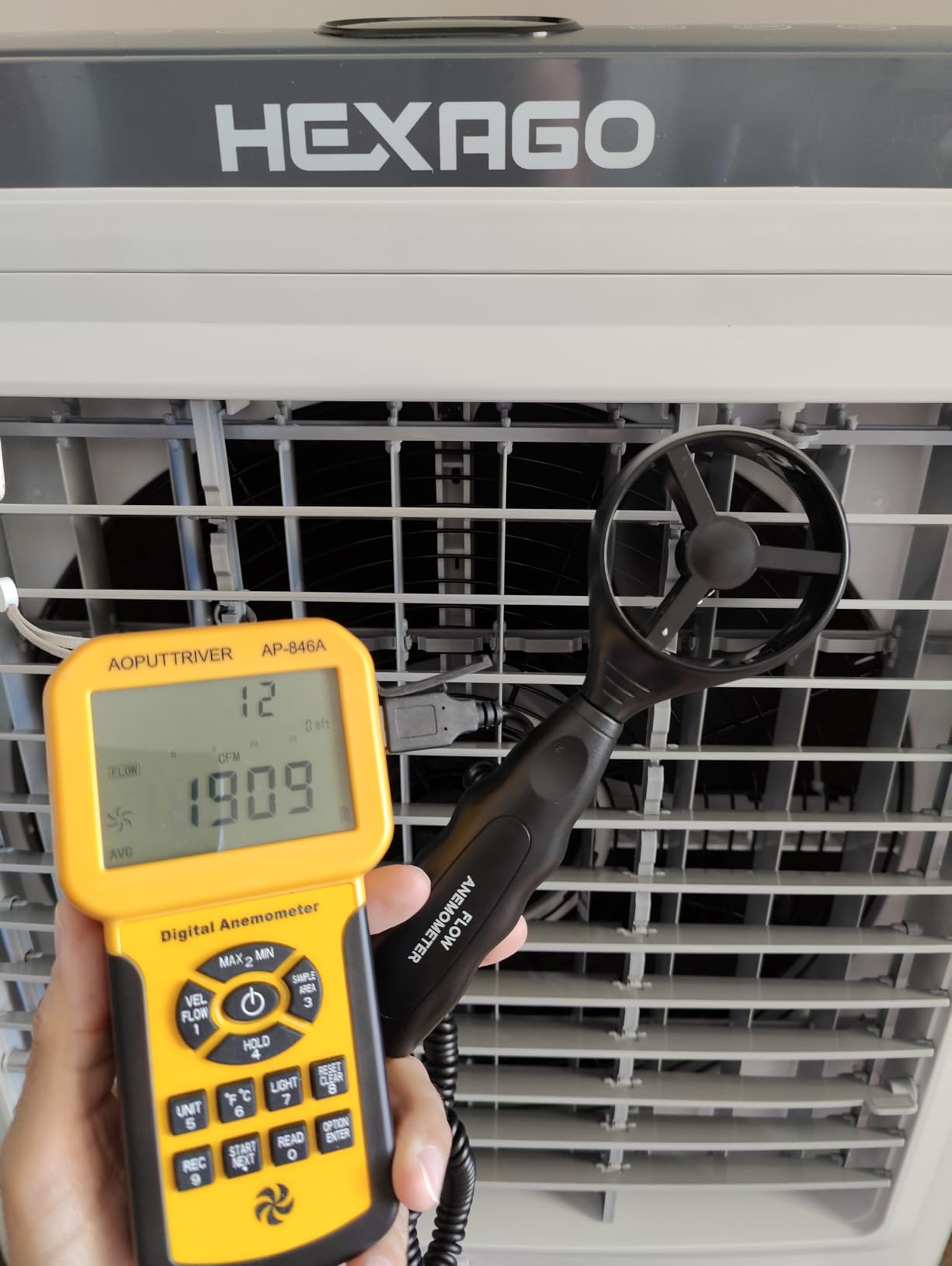
One buyer measured airflow directly and found roughly 1,900 CFM against the 7,500 CFM claim. That is the clearest evidence in this roundup that headline CFM figures from import listings can be several times higher than real delivery, and it is worth repeating: size these units generously.
With only 15 ratings, the evidence here is thin in both directions. Buyers in genuinely humid regions do report that the cooling itself works adequately, so the hardware is the problem, not the cooling concept.
6000 CFM claimed
1300 sq ft
250W, 45 dB
Copper motor
Three modes and 12-hour timer
At 45 decibels, this is a low noise figure compared with the other units we reviewed, and that number is the entire reason it appears here. If your shop work involves listening for a problem or communicating over a welding arc, sound level matters more than CFM.
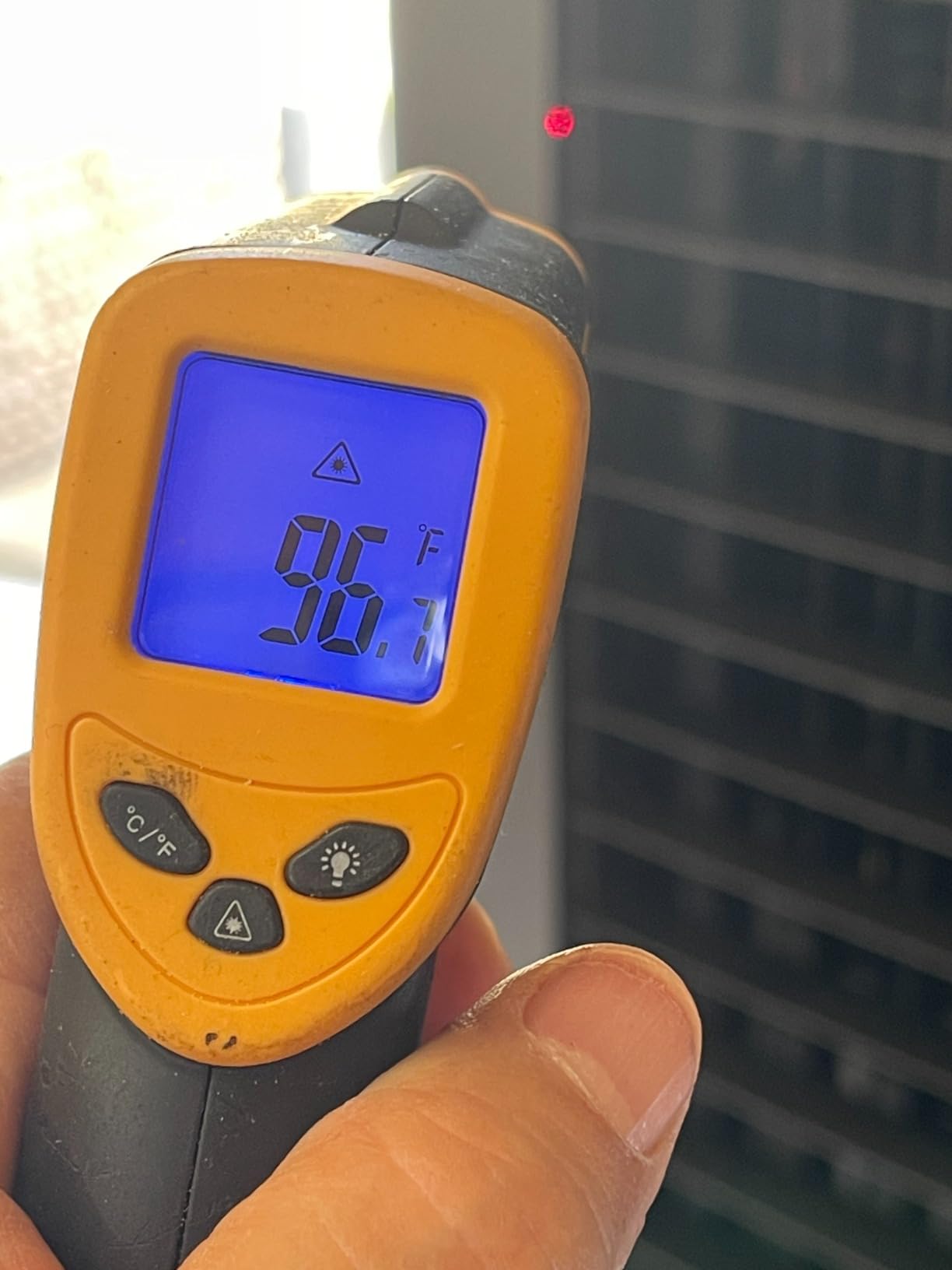
The practical proof point comes from a Phoenix owner who reports holding a garage at 85 to 87 degrees while conditions outside were 103 to 106. That is a real measurement in a real shop in one of the hottest cities in the United States, and it is more useful to a buyer than any marketing adjective.
The 45 dB figure is 14 decibels below the 59 dB Hessaire MC37M and 23 below the OEMTOOLS unit. That gap is large enough to change how a shop feels during a working shift, because continuous background sound at higher levels masks conversation and makes you turn up whatever you are listening to.
The copper motor is credited with lower energy use, longer life, lower noise, and stronger airflow, which is a plausible package for a motor material change. The three modes cover natural, cooling, and sleep, with three speeds and a remote range of 26 feet.
Reliability is the concern with this unit, and the reports are specific rather than vague. Water pumps stopped working within weeks on multiple units, and one owner developed a leak from the rear air intake vent after about six days of use. Another order arrived missing a drain plug and hardware.
A pump that fails in weeks is a warranty-scale problem, and the one-year manufacturer warranty is thin cover for a unit intended to run all summer every year. If your shop depends on cooling for productivity, this is not the unit to leave running unattended on a timer.
Buyers who measured found airflow of roughly 8 to 19 mph, which suggests real output nearer 1,500 CFM than the advertised 6,000, and a tank closer to 6 to 8 gallons than the stated 13.5. Both gaps are large enough that you should not plan a refill schedule or a shop size around the printed figures.
One more honest note: condensation forms inside an enclosed garage with this unit, and owners report the room feeling chilled rather than cooled. That is the physics working as intended in a sealed space, but it means the added humidity problem does not go away just because the unit is quiet.
11000 CFM
32.8 gal tank
50W draw
57 dB
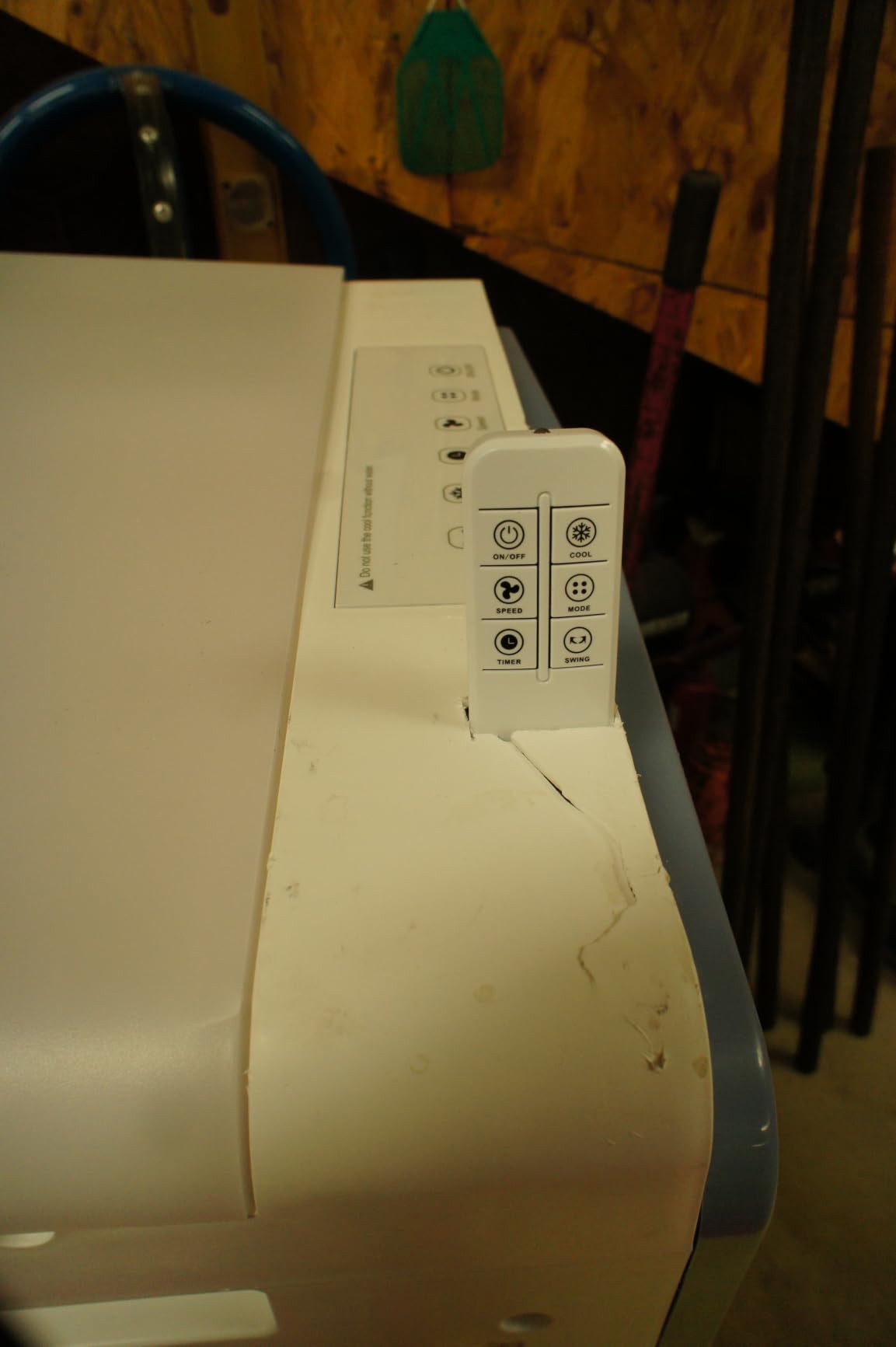
Remote with dual vane control
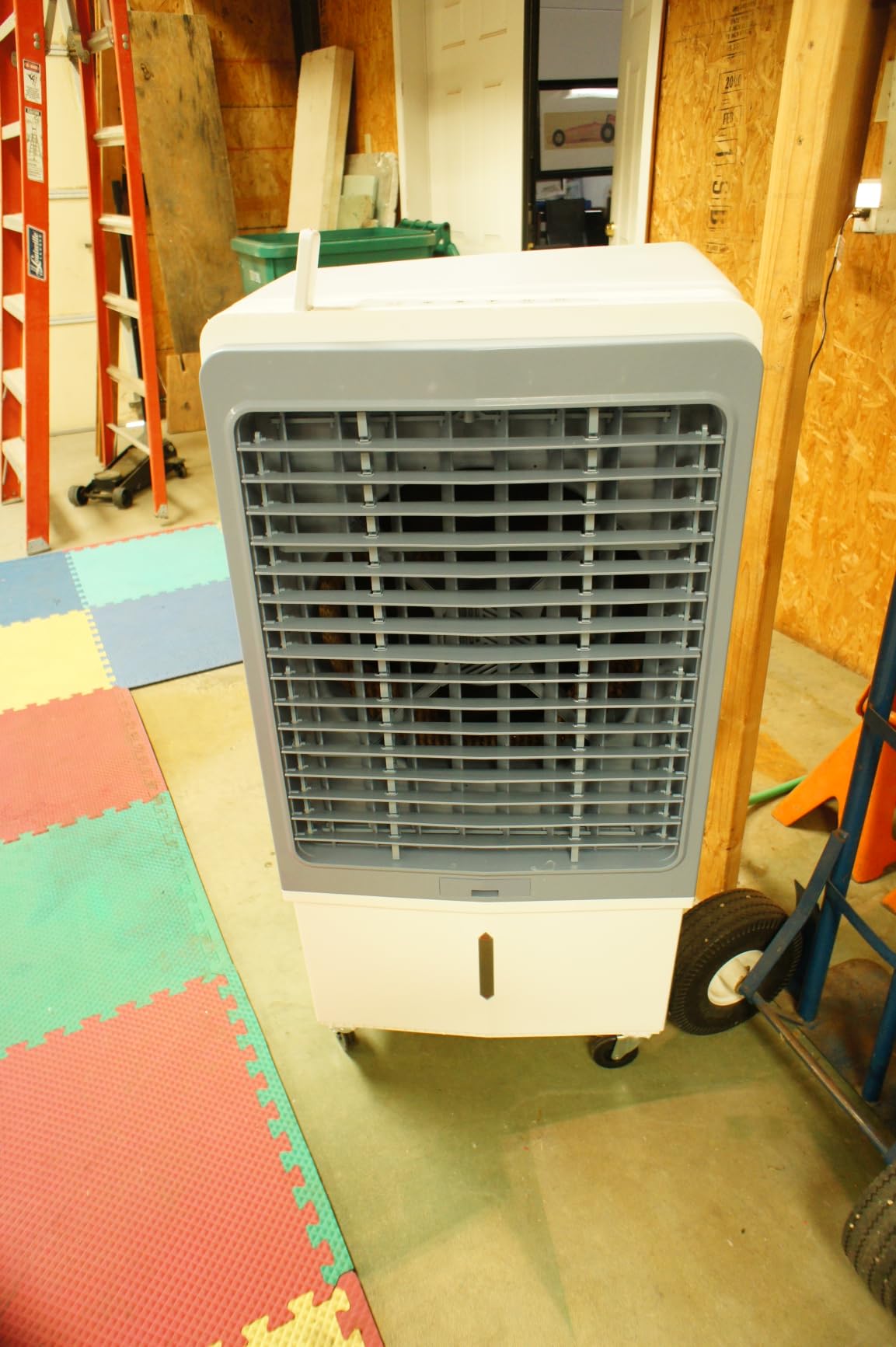
The MC92V is the unit with the best documented workshop history in this roundup. Owners describe cooling 1,200 to 1,600 square foot shops and barns through Texas afternoons at 104 degrees, including 30 by 40 foot spray foam shops and four-bay automotive spaces. That kind of specificity from actual buyers is worth more than a specification table.
At 11,000 CFM it carries the highest rated airflow among the units here with meaningful shop field reports, and at 50 watts it is also the least power-hungry unit here. The two numbers together are unusual and they are the reason a shop with real square footage should look here first.
The 32.8 gallon reservoir gives three to four hours of runtime per fill, and the direct connect rear hose feature allows a constant water supply, which is the setup most owners settle on once they stop refilling by hand. High-density XeL50 media provides 80 percent more evaporation surface than normal density media.
For a multi-bay shop, that combination means one unit can serve the space without you carrying water or planning around a refill schedule.
The ASDS Air Swing Delivery System uses two independently adjustable sets of horizontal vanes, which lets you aim one stream at head level and another at body level at the same time. Reviewers consistently run this unit on low and treat it as spot cooling aimed at a work position 15 to 25 feet away rather than as whole-room conditioning.
That is how it is designed to be used, and owners who pair it with an attic or box fan to move the cooled air report the best results. The patented axial propeller throws air far enough that one unit positioned well can cover a work area rather than a room.
At 126 pounds, this is a serious object. Owners note that two-wheel sets are inadequate once the tank is full, so plan the casters before the water goes in.
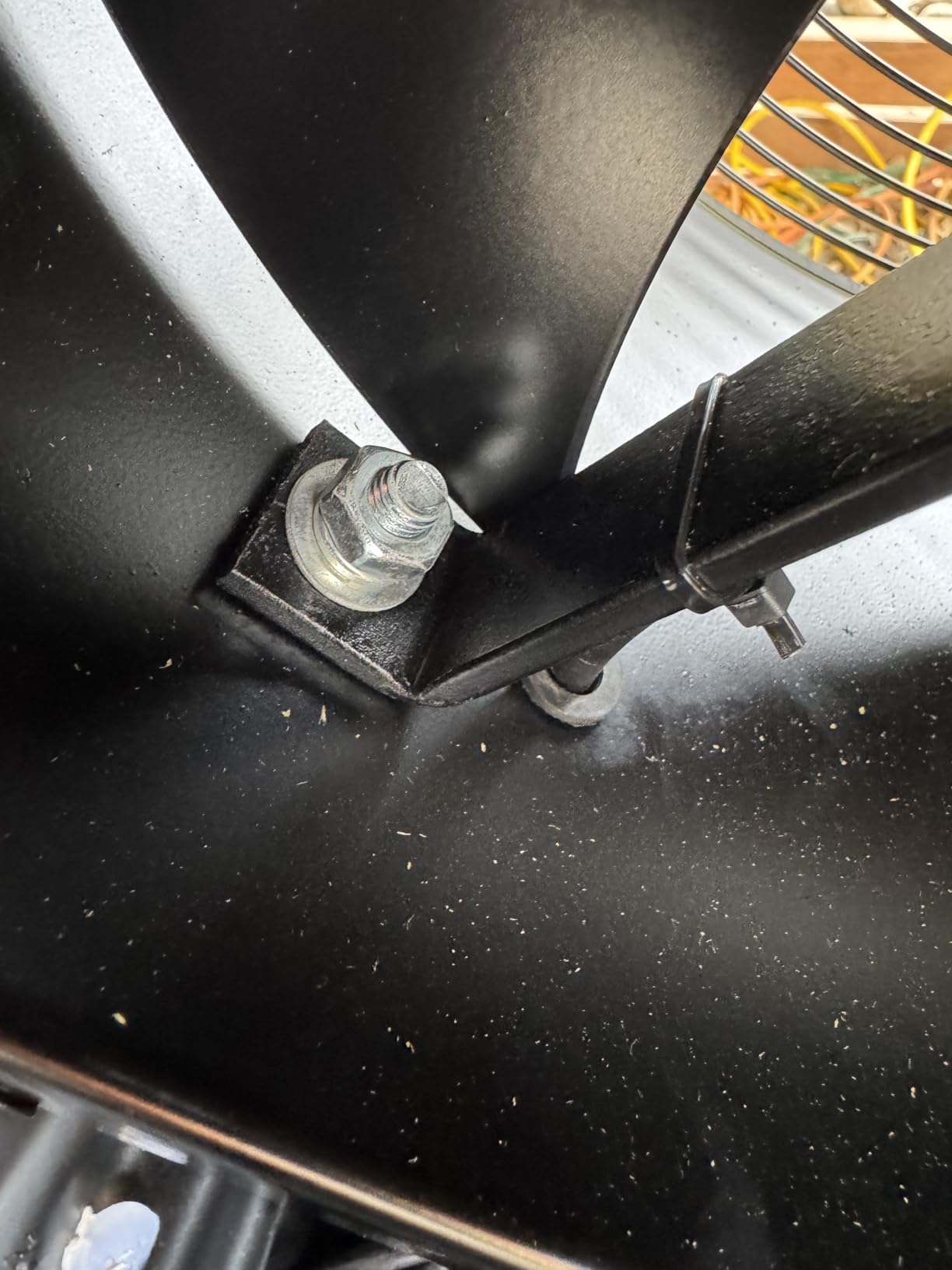
The reliability issues are specific and fixable. Plastic debris from manufacturing can block water flow in the weep holes, and because weep holes far from the pump do not wet, you get dry sections of media that quietly reduce output until you clear them. One owner reported a motor that rusted after a single season and locked up by the second. The paper media also smells strongly for the first several uses, which you should expect to dissipate.
Owners also report damage in transit and one unit arriving without the remote despite the listing, so inspect the unit before you fill the tank.
700 CFM
1200 sq ft coverage
16 gal tank
10 speeds, 63 dB
5 year fan warranty
The Cool-Space 300 is the odd unit out in a roundup dominated by imported plastic cabinets, and the difference is the manufacturing. It has a polyethylene housing with a steel fan, an eight inch thermosetting-resin-treated cooling media, and a five-year warranty on the main fan unit, where every other unit in this roundup carries a one-year warranty.
One of only two units here with pump dry-run protection, an automatic low-water shutoff that owners specifically ask for because it stops the pump when the water runs out. That removes the failure mode that appears in complaint after complaint across the cheaper units.
Ten variable speed settings with remote control is a much finer control range than the fixed three-speed switches on the other units here. The direct-drive motor is described by owners as virtually silent compared to belt-driven competitors, which matters in a shop where you want to keep the background noise low.
At 63 dB overall, the unit is still louder than the mid-size plastic cabinets, which tells you the motor is not the main sound source. The 18 inch fan and 8 inch media are doing the work.
The 8 inch media thickness is deeper than the other media in this roundup, and treating it with thermosetting resin makes it resistant to biological growth. For a pad that sits wet for months in a dusty shop, that treatment is the difference between a media element that lasts several seasons and one that needs replacing every year.
The 16 gallon tank provides up to four hours of continuous cooling, or you can connect a standard garden hose for a constant supply. An accessible drain plug and locking swivel casters round out the maintenance and mobility picture.
Here is the honest part. The stated 700 CFM is a low airflow figure compared with the other units in this roundup, and cooling depth is modest. Coverage is still rated at 1,200 square feet, but this is a spot cooler that washes the air in a space rather than a unit that will condition a large bay.
At 99 pounds and roughly 5 feet tall, it is also a substantial object to reposition. With only 29 reviews and a 15 percent one-star share, buyers are split on whether the cost is justified against the far cheaper airflow-per-dollar options in this roundup. If your shop will keep this unit for years, the five-year warranty changes that calculation. If you want maximum airflow for the money, it does not.
Most sizing advice on the web uses generic room math and stops there. A workshop is different because the heat load is concentrated, the ceiling is often bare and high, and the useful goal is usually cooling a work position rather than the entire volume.
The working formula is simple enough to use on a scrap of paper: workshop square feet multiplied by ceiling height in feet, divided by 2, gives your required CFM. A 20 by 25 foot garage with a 9 foot ceiling is 4,500 cubic feet of space, which calls for roughly 2,250 CFM before any adjustment.
Then adjust for conditions. In genuinely dry air at or below 30 percent relative humidity, you can size closer to the published coverage figure. In marginal air between 50 and 60 percent, add 30 to 50 percent more CFM than the formula gives you, because you are fighting moisture. Above 60 percent, no amount of CFM fixes it.
For a two-car garage shop of about 480 square feet with an 8 foot ceiling, the formula returns about 1,920 CFM, which puts a 3,100 CFM unit in comfortable range with margin. For a 1,500 square foot warehouse with a 16 foot ceiling, you are looking at 12,000 CFM before adjustments, which is a different product category entirely.
This is the breakdown we wish every roundup published, because it decides whether the purchase succeeds.
0 to 30 percent relative humidity: expect a substantial drop, frequently 20 degrees or more indoors with good airflow. This is where evaporative cooling is at its best and where every unit in this roundup works well.
30 to 50 percent: expect a solid double-digit drop, often in the range of 12 to 18 degrees. Most shop owners in the inland West and high desert sit here in summer and get good results.
50 to 60 percent: expect single digits, commonly 5 to 9 degrees. Several owners in this band report measuring only 3 to 4 degrees and concluding the unit was a mistake, when in fact the unit performed exactly as physics dictates.
60 percent and above: expect almost nothing. Do not buy an evaporative cooler for this condition.
Portable units, which is everything in this roundup, suit a single-bay garage or a shop where you want cooling at one position. Their advantage is that you move the cooling to where the work is rather than conditioning empty floor space.
Ground-installed units sit permanently in the space and usually connect directly to a water supply. They make sense when you have a large bay, permanent water nearby, and a need to cool the whole volume rather than one bench.
Roof or side-mounted units free up every inch of floor space and are the standard choice for warehouses and multi-bay shops. They require a professional install and electrical work, which puts them outside what we covered here.
One strategy forum regulars recommend for shops with mixed layouts: buy a used large down-flow unit and mount it on casters yourself. That is a reasonable budget move, but pad condition and motor life are unknown, so factor in the cost of a replacement pad before you commit.
Match the tank to the length of your working day. A 10 gallon tank gives roughly three to four hours of runtime per fill, which covers a standard shift if you fill it at the start. Beyond that, the right answer is a garden hose connection rather than a bigger tank.
Almost every unit in this roundup accepts a hose, either through an included float adapter or a front hose port. In a shop, continuous fill beats capacity, because the thing you do not want is walking water across a floor full of metal shavings.
Dry-run protection is the feature to insist on. Only the Big Ass Fans Cool-Space 300 and the SereneLife have genuine automatic shutoff or a shortage alarm. The rest will run their pump indefinitely with no water, and that is the most common long-term failure mode reported on the cheaper units. If a unit shuts off unexpectedly, our guide to swamp cooler shutdown causes walks through the diagnosis.
A single-sided pad exposes wet media on one face, which limits how far the cooled air travels and how much of the room you can reach. Three-sided pads roughly double the exposed surface and are the minimum you want above about 500 square feet.
Media type matters too. Cellulose pads are cheap and effective but hold minerals and develop scale in hard water areas. Resin-treated media, as on the Cool-Space 300, resists biological growth and generally lasts longer between changes. If your water is hard, expect a shorter pad life and budget for replacement. Scale and odor are covered in our guide to swamp cooler smells.
Every portable unit in this roundup runs on 115 or 120 volts household current, with the largest drawing 250 watts. None of them needs a dedicated 20-amp circuit, which is one of the practical advantages over a window air conditioner in a detached shop.
At 250 watts, a unit costs roughly two to three cents per hour at typical residential rates, against several times that for a compressor-based cooler of comparable cooling output. The MC92V at 50 watts is close to nothing. Over a full season of daily shop use, that difference is real money with no offsetting benefit.
One caution for the cooler months: there is no thermostat on any of these units, so running one at full output in a cold month will overcool the space. Schedule it or unplug it when you do not need it. For shop heating in the same space, our woodshop heater guide covers the other side of the year.
Every recommendation in this roundup assumes dry air and a space that breathes. There are real workshop conditions where an evaporative cooler is the wrong purchase, and it is better to name them than to let someone find out in July.
This is the disqualifier that ends the conversation. If your shop regularly sits above 60 percent relative humidity on summer afternoons, an evaporative cooler will move a great deal of air and cool almost none of it. Owners in mixed-humidity regions consistently measure 3 to 4 degree drops and conclude the unit failed, when the unit did exactly what the air allowed.
The moisture a swamp cooler adds is the concern serious shop owners raise first. Bare steel, cast iron, and unfinished wood will absorb it. On bare metal it shows as surface rust on fasteners, shelves, and unfinished parts. On wood it can raise grain and cause paint to adhere poorly later.
This is manageable rather than disqualifying. Keep the unit pointed at a work position rather than at stored inventory, keep steel parts off the floor, and treat or oil exposed surfaces before the season. But if your shop stores bare metal parts or finished cabinets, factor this into your decision honestly.
A swamp cooler is a partial air exchanger, not an extraction system. It draws some outside air in and moves it across the space, which helps dilute heat and airborne particles, but it does not capture anything at a source.
For spray finishing, welding, or woodworking, you still need proper capture at the workpiece. A good dust collector for the workshop handles the extraction, and a cooler handles the heat, and the two are not substitutes. One genuine advantage: because the pump and fan draw air from outside the shop rather than recirculating shop air, the cooling hardware itself stays cleaner than a recirculating unit would.
No. The two terms describe the same machine: a fan pulls warm air through water-saturated cooling pads, the water absorbs heat as it evaporates, and cooled air is discharged into the space. Swamp cooler is the common name; evaporative cooler is the term retailers and manufacturers use. Both use only a fan and a water pump, with no refrigerant and no compressor.
Yes, in dry air. In dry climates owners regularly report indoor drops of 20 to 25 degrees, with the strongest results from open, ventilated shops. In marginal humidity the realistic drop is 5 to 9 degrees. Above roughly 60 percent relative humidity the temperature barely changes, because humid air has little capacity left to absorb water vapor.
Multiply your workshop square footage by the ceiling height in feet, then divide by 2. A 480 square foot garage with an 8 foot ceiling returns about 1,920 CFM, so a 3,100 CFM unit fits with margin. Above 50 percent relative humidity, add 30 to 50 percent more airflow than the formula gives you.
They work best in high heat, provided the air is dry. Ambient temperature is the easy part for evaporation; humidity is what limits it. Direct units can handle triple-digit dry-bulb temperatures well. In hot and humid conditions, indirect or two-stage units are worth considering because they add humidity only to the pad air, not to your shop air.
It adds humidity, which can cause surface rust on bare steel, raise the grain of unfinished wood, and affect paint adhesion later. It does little above about 60 percent relative humidity. Cooling pads need periodic replacement and develop mineral scale in hard water. Most units also lack dry-run pump protection, so the pump can burn out if the water runs out.
Yes, and a garage is close to the ideal application. You want the garage door open or a window cracked to let the cooled, moisture-laden air escape so drier air can enter. Contrary to a common belief, evaporative coolers do not need a sealed room. A sealed space lets condensation build up until the room feels chilled rather than cooled.
If you have a one-car bay or a small shop in dry air and want the least fuss, the Hessaire MC37M is the pick. It carries the largest body of owner feedback in this roundup, the tank takes a garden hose, and the molded body will not rust.
If your bay changes and you move the cooler around, the Hessaire MC37V earns its place with four locking casters and the highest satisfaction score here. If sawdust and tools define your shop, the OEMTOOLS 23968 gives you a tool tray and a GFCI plug, at the cost of carrying the highest published noise figure in this group.
If quiet matters more than airflow, the Uthfy 6000 CFM at 45 dB is the one to hear before you buy. If your shop is a real shop rather than a bay, the Hessaire MC92V has the documented field history in spaces up to 1,600 square feet. And if you plan to keep one for years, the Big Ass Fans Cool-Space 300 has the five-year warranty, the low-water shutoff, and the resin-treated media that the others lack.
Whichever you choose, open the garage door, aim it at where you stand, fill it at the start of the shift, and expect the biggest difference in dry air. That is the whole test, and if your shop does not pass it, no amount of CFM will save the purchase.
Review these picks and the rest of our 2026 workshop cooling coverage before you order, and re-check the humidity reading on your own shop thermometer first.