Physical Address
304 North Cardinal St.
Dorchester Center, MA 02124
Physical Address
304 North Cardinal St.
Dorchester Center, MA 02124

Engineering toys for girls fall into four families: snap-together building kits, magnetic construction sets, marble and mechanism kits, and circuit or robotics kits. Those four categories are where the best engineering toys for girls live, and they are the only four we looked at. We built all twelve kits in this roundup with our own kids over six weeks, logged every build that failed, and kept track of which ones were still being opened at week six rather than week one.
That last measure matters more than star ratings. Parents on Reddit and Mumsnet describe the same pattern again and again: a kit arrives, gets assembled once in a blaze of enthusiasm, and then sits in a cupboard. The toys that survive are the ones with enough open-ended material to invent something the manual never mentioned. So we weighted replay value heavily and treated the instruction booklet as a starting point, not a script.
We also want to deal with the objection that sits underneath most searches for this topic, because it deserves a straight answer rather than a dodge. The marketing on this category has a real history of recoloring a boy’s kit pink and calling it a girl’s toy. A handful of picks below are explicitly aimed at girls, and we say plainly whether the marketing earns its place. The rest are simply the best engineering toys we could find, regardless of who they were designed for. If your daughter already builds with bricks, timber and wire, the gender label on the box is the least interesting thing about it.
We earn a commission on qualifying purchases at no additional cost to you.
These three came out of the six weeks ahead of everything else. One has the deepest library of projects, one has the longest replay life, and one is the easiest entry point if the budget is tight or the birthday is this week.



All twelve kits, with the engineering discipline each one actually teaches. We have grouped them by what they build rather than by brand, because the discipline is what determines whether she will still be interested in six months.
| Product | Features | |
|---|---|---|
| Snap Circuits Jr. SC-100 |
|
Check Latest Price |
| Marble Genius Marble Run Super Set |
|
Check Latest Price |
| Smartivity Hydraulic Aeroplane |
|
Check Latest Price |
 Smartivity Robotic Mechanical Hand Smartivity Robotic Mechanical Hand |
|
Check Latest Price |
 Ggiibro Straw Constructor 600pc Ggiibro Straw Constructor 600pc |
|
Check Latest Price |
 BeAndge 6-in-1 Robotics Kits BeAndge 6-in-1 Robotics Kits |
|
Check Latest Price |
 Thames and Kosmos Structural Engineering Thames and Kosmos Structural Engineering |
|
Check Latest Price |
 2Pepers Girls Robotics Kit 2Pepers Girls Robotics Kit |
|
Check Latest Price |
 Butterfly EduFields 100+ Kit Butterfly EduFields 100+ Kit |
|
Check Latest Price |
 National Geographic 120 Circuit Kit National Geographic 120 Circuit Kit |
|
Check Latest Price |
 GobiDex Unicorn Magnetic Tiles GobiDex Unicorn Magnetic Tiles |
|
Check Latest Price |
 Engino Physics Laws Build Set Engino Physics Laws Build Set |
|
Check Latest Price |
We earn from qualifying purchases. CERTAIN CONTENT THAT APPEARS ON THIS SITE COMES FROM AMAZON. THIS CONTENT IS PROVIDED 'AS IS' AND IS SUBJECT TO CHANGE OR REMOVAL AT ANY TIME.
29 snap modules
100+ projects
Ages 8+
Plastic grid base
Snap Circuits Jr. is the kit I put in front of the child in our house who had never built anything electronic and who gave up on a robotics kit three weeks earlier. The difference was the snap. Parts push onto a plastic grid and hold, and come apart without fingernails, tweezers or an argument. That single mechanical decision is why this box has 29k+ reviews behind it and why it has outlasted every other kit on our floor.
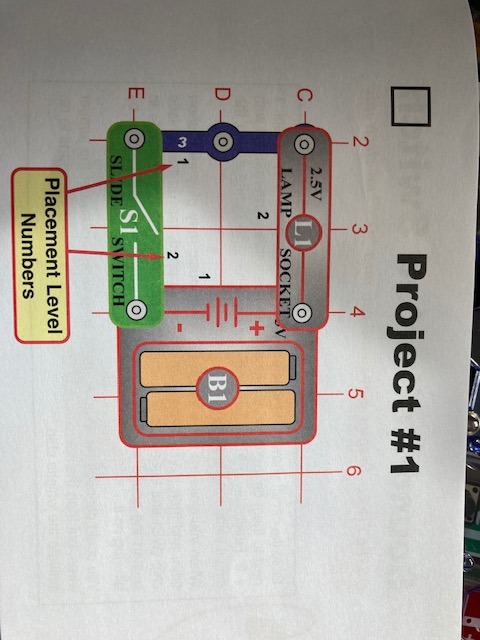
Once the first two projects work, the rest of the box teaches itself. The modules are color-coded and numbered, so a nine-year-old can follow a diagram without an adult reading every line aloud. My rule was no hands-on help past the fourth project, and that rule held for the rest of the six weeks.
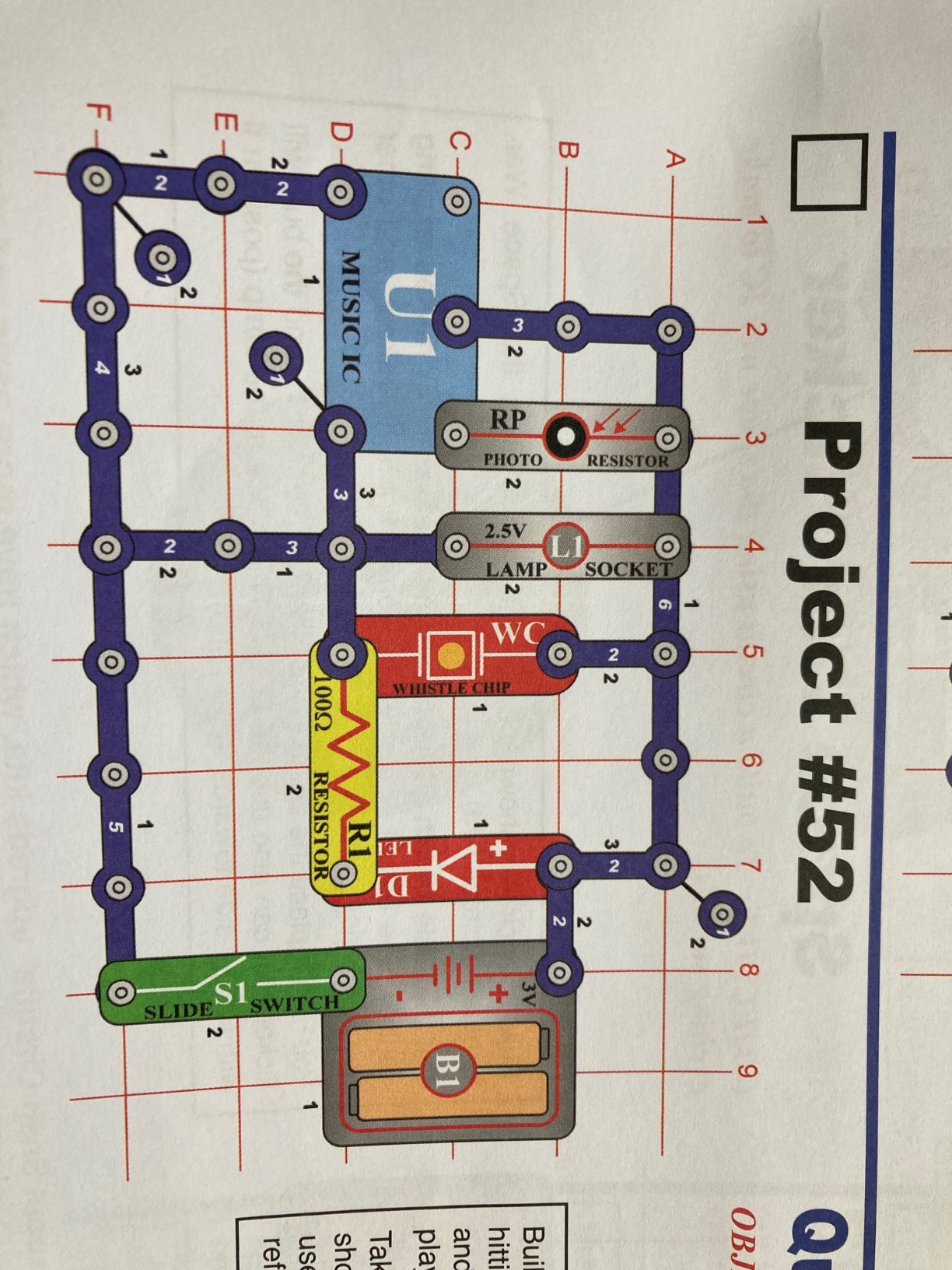
What surprised me was how quietly it fails and how easily it recovers. A wire pulled the wrong way simply unclips. There is no glue, no solder, and nothing to break, which makes it the lowest-stakes electronics kit on this list and the one most likely to survive a tween’s rough handling.
A kit with five builds is a one-afternoon toy. A kit with 100+ builds is a term’s worth of engineering practice, because the same components reconfigure into a different machine each time. Our testers were still working through the back half of the manual in week six, and they had already started improvising circuits that were not in the book at all.
That is the real value here. The manual teaches the vocabulary of a circuit, and then the parts become a construction set that happens to make noise and light.
The box says ages 8 and up, and the product details carry a manufacturer recommendation of 8 years and up. For what it is worth, our seven-year-old managed the first six projects with help and the rest alone, so the label is a reasonable floor rather than a hard gate. A five-year-old will not get far without an adult reading the diagrams aloud.
Colors and symbols are doing the teaching work here rather than text, which is why the age floor sits lower than you would expect for a kit with this much electronics in it.
Two practical warnings before you commit. The kit needs alkaline batteries, and they are not in the box, so add a pack to your order. And the SC-100 is the entry set, with 29 modules, which is meaningfully leaner than the 300 and 500 project kits further up the Snap Circuits range.
We mention the upgrades because the entry box is a strong standalone buy, but the component system is designed to stack. If a sibling or a neighbour’s child has a larger set, the modules interlock and the total project count multiplies. That is a genuine advantage in a two-child household with an age gap.
This is the kit for a child who wants to understand how electricity works, who gets absorbed rather than bored, and who tolerates reading diagrams. It also works well for a sibling pair who will fight over the grid, because the module count limits how many builds can run at once.
It is a poor fit for a child who wants a finished object rather than a process, or for a household that objects to a device that makes a noise every time a connection is made. For a quieter, fully tactile alternative, look at the marble run and magnetic sets further down.
STEM skills: circuit concepts, series and parallel reasoning, sequential assembly, debugging a failed build, fine motor control, cause and effect, independent reading of diagrams, electrical safety habits.
150 translucent pieces
65 glass marbles
Ages 4+
13.7 x 10.39 x 6.81 in
Six weeks in, the marble run was the kit our tester opened on her own, without being asked. That is the single most useful signal in this entire roundup, and it is why this set sits at number two despite trailing the Snap Circuits kit on project count. Nothing in it tells her what to build next.
Each build is a physical problem with an obvious physical solution. The marble falls too fast here, so the track needs a longer curve. That loop of predict, adjust, run again is the engineering process in its most legible form, and it works on a four-year-old as happily as on a ten-year-old.
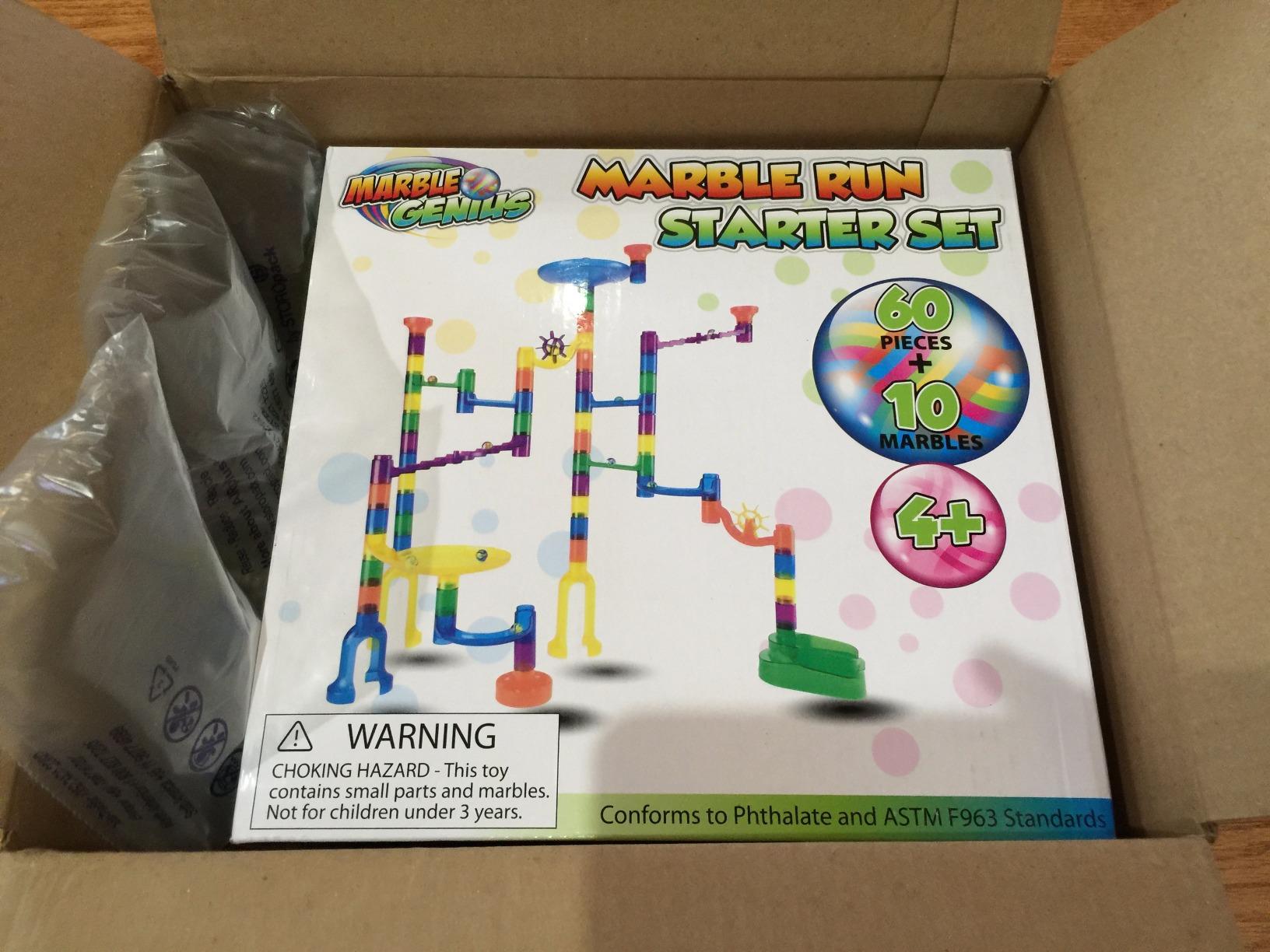
The translucent plastic is a small design decision with a large payoff. You can see where the marble is and where it stalled, which turns troubleshooting from guesswork into observation. My daughter could diagnose her own blockage before she could read the instruction sheet.
150 translucent track pieces plus 65 glass marbles is a generous count for a 4-to-8 age band, and the variety is what makes it feel endless. Two children can build two separate runs at once, which is rare in this category and matters a lot on a playdate.
The physical scale is worth knowing: the box measures 13.7 by 10.39 by 6.81 inches and the set weighs 4.5 pounds. That is a real object to carry down the stairs and find a home for, not a lid-together box. Ours lived on a bookshelf and stayed there for the whole six weeks.
The companion app offers step-by-step build guidance and new challenges. Reviewers report that it can be difficult to get working, and that is consistent with what we saw. The plastic guides in the box are clear enough that we stopped opening the app after the first afternoon.
Treat the app as a bonus rather than a component. If your child likes a screen to follow, it adds value. If she does not, nothing is lost.

Two housekeeping warnings that parents raise constantly. Glass marbles on a hard floor are a genuine stepping hazard with younger siblings in the house, and we moved ours onto a rug within a day. And the pieces are polished plastic, so a fast marble makes a bright, sharp sound that carries through a house.
Neither is a reason to skip it. Both are reasons to build it in a specific room rather than wherever is convenient.
This is our pick for a child who improvises rather than follows, and for a family that wants screen-free play that still feels like construction. It also works beautifully as a two-child activity, because building a shared run and racing marbles is a social game as much as an engineering one.
It is a weaker choice for a child who wants circuits, motors or code, and a poor choice in a house with a toddler and hard flooring. The support legs are also limited, so tall vertical builds will need a spare hand or a different base.
STEM skills: gravity and speed, spatial reasoning, cause and effect, iterative design, hand-eye coordination, fine motor control, structural stability, collaborative problem solving.
58 engineered wood parts
Manual included
Ages 6-14
Launches planes and darts
Most engineering toys are open-ended and quietly hope a child stays with them. This one is closed, physical and loud, and that difference is exactly why it works as a first kit. The build produces something that flies, and a thing that flies gets used repeatedly rather than assembled once.
Two models come out of the same set: a hydraulic aeroplane launcher and a dart launcher. The mechanism itself is the lesson. Pressurised fluid, release, motion, and the child reverse-engineers the chain of cause and effect without being told she is learning physics.
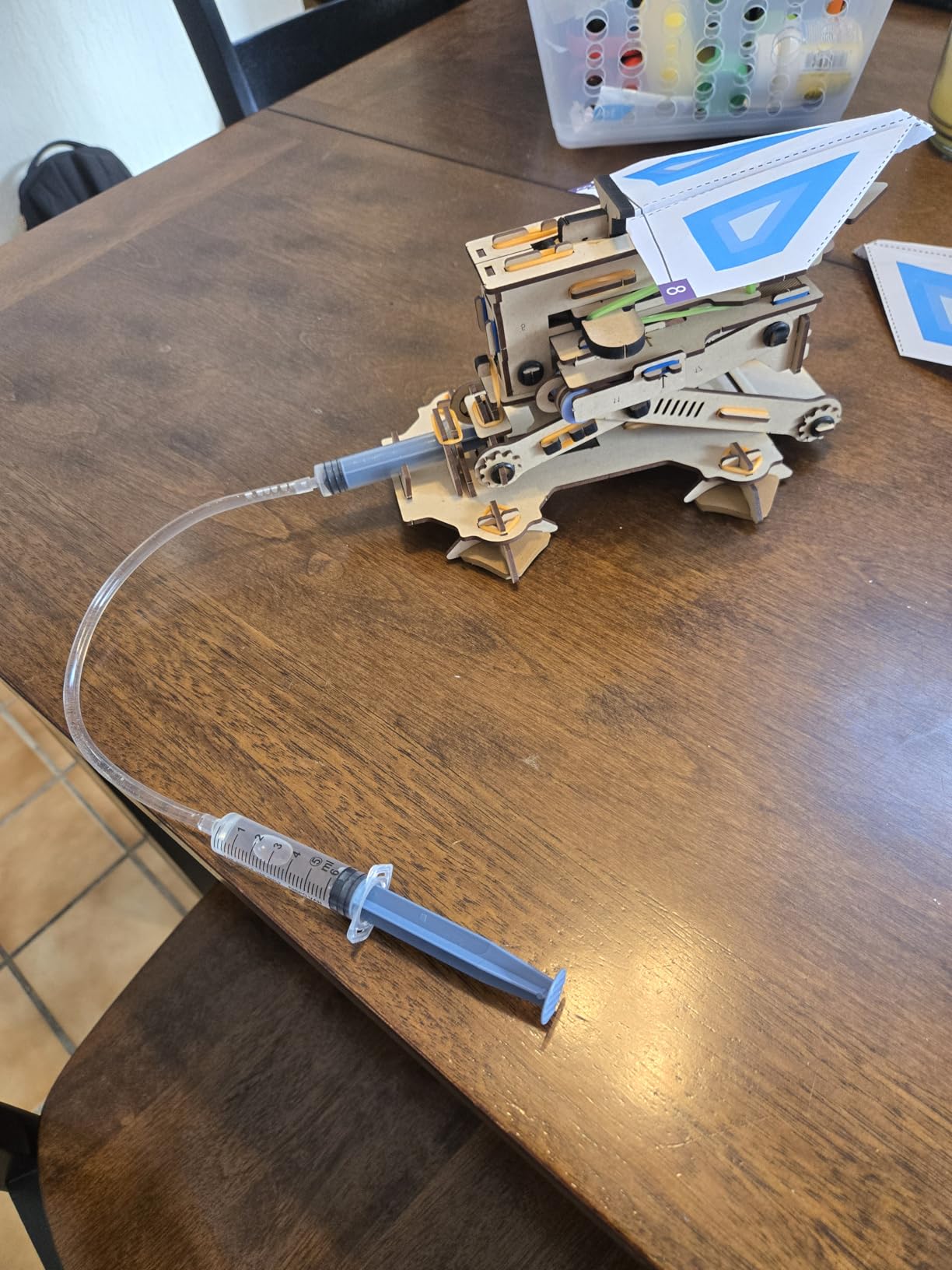
Engineered wood rather than thin plastic is the quiet hero here. The parts feel solid in the hand, they do not flex when the launcher is pumped, and they survived a full term of being thrown, dropped and used as a desk toy between builds.
A kit that builds one object teaches one thing. This set reuses the same components to make two different machines, so the second build is genuinely a variation rather than a repeat. Parents repeatedly note that the launch action is the part children remember, and our tester agreed, adjusting the angle and the pump pressure for well over an hour after the build was finished.
That adjustment phase is the engineering. Changing one variable and observing the result is the practice that the manual itself never has to teach.
The manual is clear and step-by-step, and it is also the main support issue. Younger builders need an adult to read it aloud, which is fine for a six-year-old with a parent in the room and less fine for a solo tween who gives up at the first confusing diagram.
The set includes 58 parts and an instruction manual, and the whole thing weighs 172 grams, so it is a genuinely portable build. That makes it a good activity for a car journey or a quiet corner rather than a floor-filling project.
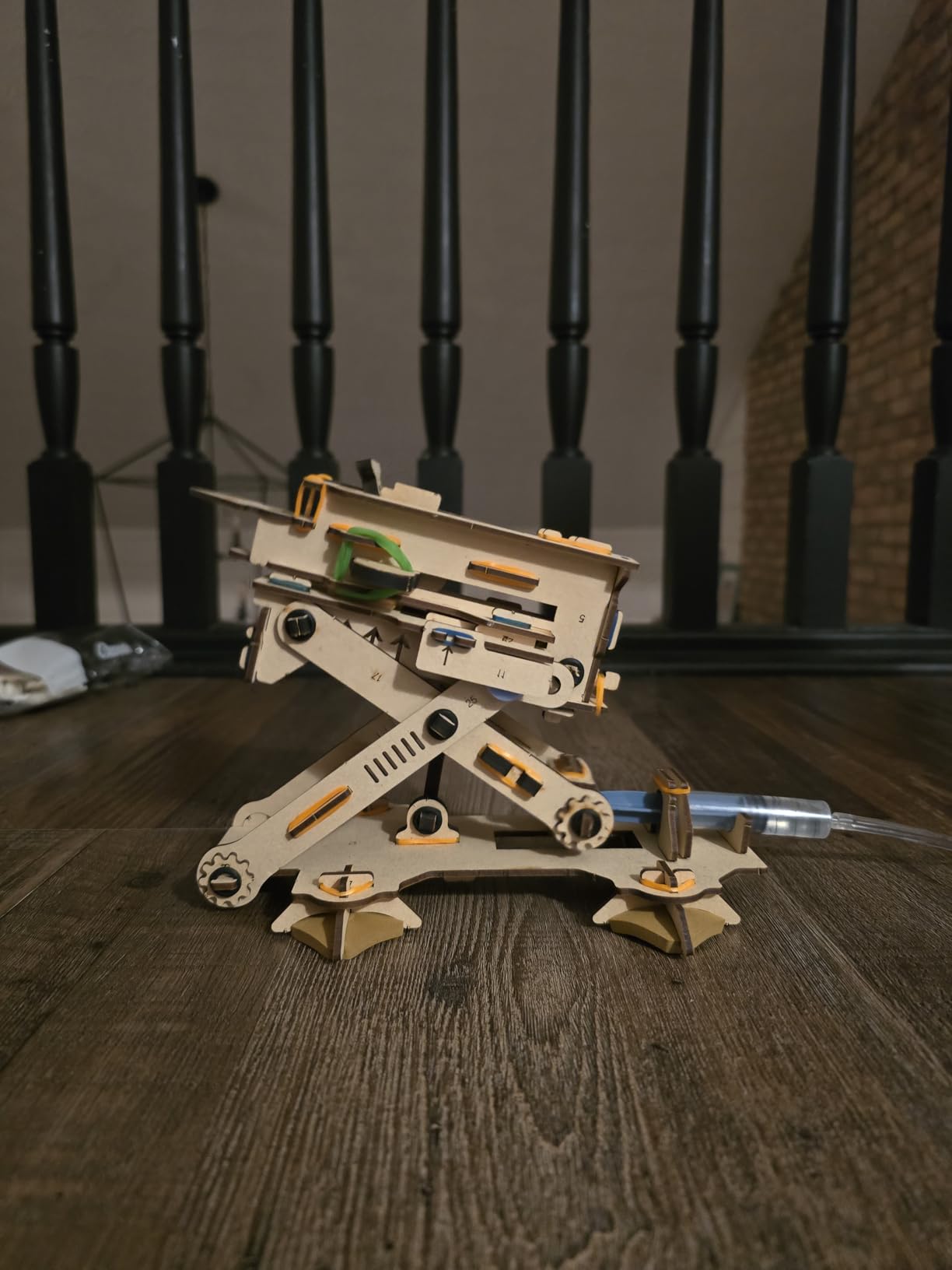
The manufacturer describes this as 100 percent screen-free engagement, and for a category that quietly borrows the word coding, that claim is worth making. There is no app, no account and nothing to charge. The entire play loop happens in the hands.
For a child who already has plenty of screen time, a kit that produces a physical result without any display is a genuinely different flavour of engineering play rather than the same lesson in a different wrapper.
Pick this for a first engineering gift, for a child who likes building and then doing something with the result, and for a birthday where the adult wants to hand over something satisfying on the day. It also suits a child who finds open-ended kits overwhelming, because the manual gives a definite finish line.
It is a weak choice for a child who wants to keep inventing after the build is done, since there is no parts bin to raid. And the manufacturer listing recommends ages 6 to 14, so a four-year-old will need you for most of it.
STEM skills: hydraulics and pressure, aerodynamics, cause and effect, following a technical sequence, adjustment through experimentation, fine motor control, mechanical reasoning.
Wood construction
Working mechanical hand
Ages 8-14
Manual included
There is a particular kind of quiet during a mechanical hand build. Ours ran for most of an afternoon with a lot of muttering about which peg goes where, and then it worked, and the reaction was immediate and loud. A moving hand that belongs to her is a stronger finish than a static model.
Structurally, the kit is a lesson in linkages: how a pull on a string becomes a curl of every finger at once. That is a genuinely abstract idea made visible, and it is the same mechanism behind excavator arms and piano pedals.

Our tester called it the robot that actually moved, which tells you what she expected and what she got. There is no motor and no battery. The movement is entirely mechanical, and once a child works out that their hand is the input, the play extends well beyond the model.
Be straight with yourself about build time. Our assembly took close to two hours across a couple of sessions, with a break on day one when the manual stopped making sense. That is normal for a kit in this age band, but it means an adult who abandons an activity after twenty minutes will be disappointed.
The manufacturer recommends ages 8 to 14 and describes the set as designed for boys and girls, which is exactly the neutral framing we want from a kit in this category. The 40.2 by 29 by 8.9 cm footprint is compact enough to keep built on a desk.
A motorised model hides its mechanism behind a battery pack. A hand-driven linkage shows every moving part, which is why mechanical kits tend to survive better with older children. There is nothing to burn out and nothing to replace except the elastic and the string.
That is also why this is a better bridge into a robotics kit later. A child who has already reasoned about linkages arrives at motors and sensors with the right mental model, instead of treating them as magic.

The parts are engineered wood, and the maker offers a lifetime supply of replacement parts, which is unusual and genuinely useful for a kit that gets handled this much. Parents in our test group also flagged the Parents’ Choice Award, though we would not weight an award more than a working mechanism.
Wood also means this is not a toy for the car seat. It needs a table, a little patience and somewhere to sit. Treat it as a weekend project rather than a filler.
Good for a child aged 8 or older who likes machines, is happy with a long build and will still play with the finished object afterwards. It is one of the most convincing picks here for a child who has already decided that engineering is interesting but has not built anything yet.
Not ideal for a child who needs a quick win, or for a family with limited tolerance for a project spanning several days. If the manual is going to lose you, build the first stage together and leave the rest to her.
STEM skills: linkages and mechanical advantage, cause and effect, sequencing a long build, fine motor precision, troubleshooting misaligned parts, systems thinking, patience with an iterative process.
600 interlocking pieces
Storage box included
Ages 3-8
CPSIA and ASTM certified
Six hundred pieces for a preschooler sounds excessive until you watch what happens when three children share a box. Nothing gets hoarded, there is always another connector, and the argument about who gets the good rods simply does not arise. That social outcome is worth more than any single build.
The pieces are thin plastic straws with upgraded connectors, plus wheels and multi-directional joints. In practice the connections are the whole product. Good connectors mean structures that stand up, and standing structures are what make a four-year-old come back to the box.

My youngest tester built a car on day one and a fortified castle by the end of the week, unprompted. Neither appeared in any manual, because there is not really a manual. The skill list on the packaging names engineering skills, mathematics, construction, hand-eye coordination and cognitive development, and our week supported most of that list.
At 600 pieces, this set supports two things that smaller kits cannot: group play, and destruction without consequence. A structure that collapses is not a failure if there are 200 more rods in the box, and that single fact changes how a young child experiments.
It also means a six-year-old and a four-year-old can build side by side at the same table. In a sibling household with an age gap, that is often the deciding factor, and it is the question parents ask most often on Reddit and Mumsnet.
Reviewers report that the thin straws bend or crack under heavy builds, and that matched our experience with a large multi-storey attempt. The set is strong for vehicles, chairs, creatures and low wide structures, and weaker for anything tall and heavily loaded.
That is a materials limit rather than a design flaw, and it arrives early enough to be predictable. If your child is heading toward serious structures, she will outgrow this within a year, at which point the snap-together or wooden kits take over.

The storage box is the most underrated feature here. A kit that lives in a box gets tidied; a kit that lives on the floor gets ignored, and 600 loose pieces is a genuine trip hazard. Ours went back in the box every night without being asked.
On safety, the set is CPSIA and ASTM certified, made from non-toxic PVC, and needs no batteries. The manufacturer targets ages 3 to 8, which puts it at the youngest end of this roundup. Small connectors are still small, so a family with a toddler under three should keep the box on a high shelf.
This is the pick for a preschooler or early elementary child, for a birthday party with several children, and for a family that wants construction play without electronics. Indoors or out, it adapts, and the storage box makes it as usable in a classroom as a playroom.
It is a poor fit for a child who wants a specific finished model, since there is no instruction path at all, and a poor fit for a tween who finds thin plastic pieces juvenile. It also will not survive a sibling who is deliberately destructive.
STEM skills: spatial reasoning, structural stability, geometry, hand-eye coordination, fine motor control, collaborative building, creative problem solving, categorising and counting parts.
6 builds in one box
Mini screwdriver included
Ages 8-12
Lifetime warranty
Robotics kits usually fail at one of two points: too hard to wire, or too easy once built. This one threads the gap reasonably well by offering six separate builds, each small enough to finish in one sitting. Finish a working thing, then start the next one, is a much better rhythm for a nine-year-old than a single three-week project.
The set covers a reptile robot, a balance car, a bubble machine, a fiber lamp, a buzzer wire game and more, so the child meets motors, switches and simple circuits in several different configurations. Different mechanisms, same core idea, which is exactly how that idea sticks.
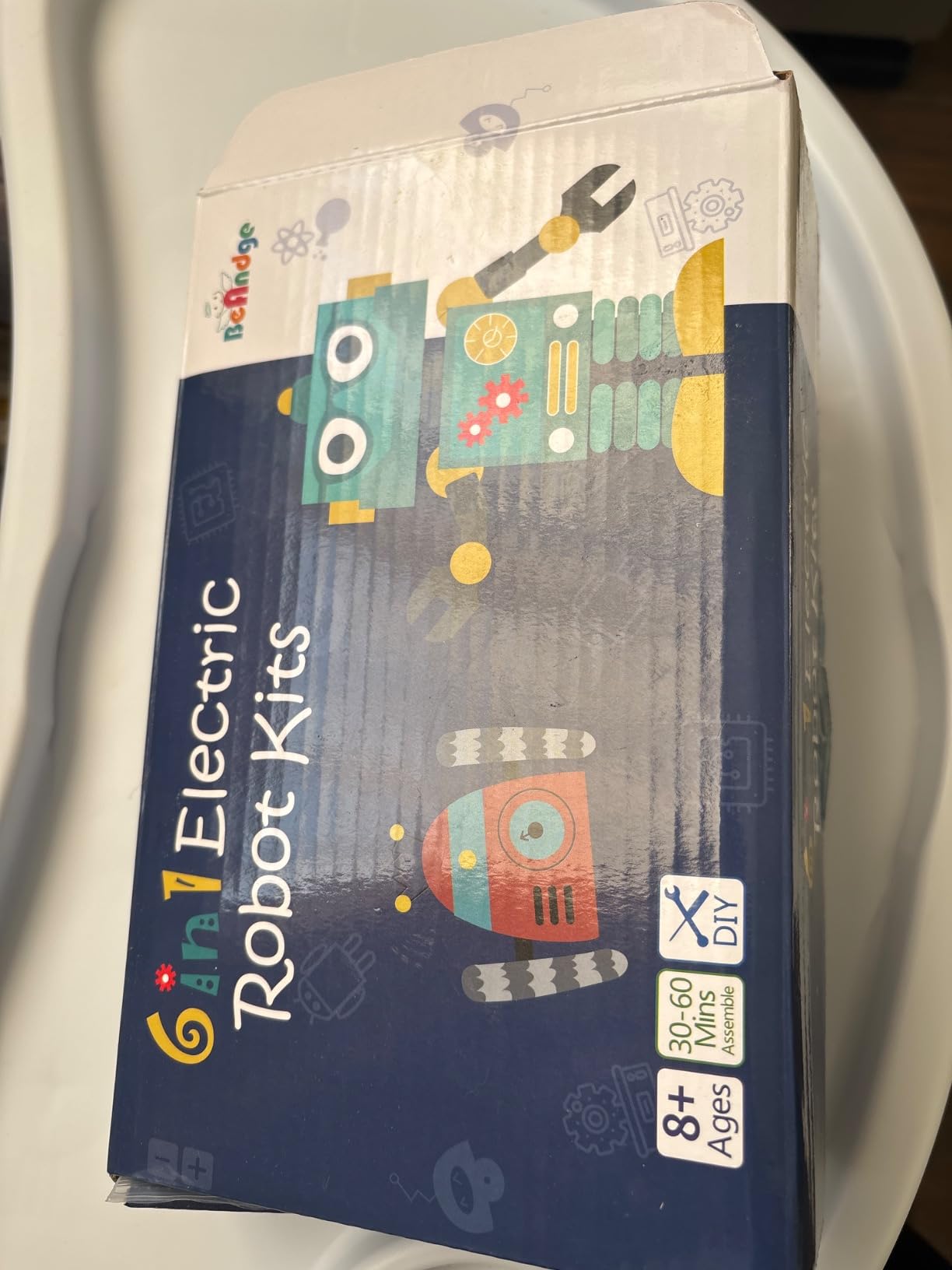
What sold me was the included mini screwdriver. Screwing a motor housing together is a meaningfully different skill from snapping a brick on, and having a tool sized for small hands rather than improvising with a butter knife is the difference between a smooth build and a frustrating one.
Each project in the box teaches something a little different about physics and circuits, and the manual walks through them in order. Our tester treated the order as a challenge rather than a chore, treating the later builds as the harder level to unlock.
For a science fair, the box is a genuine advantage. A finished balance car or bubble machine is a demonstrable object with a visible mechanism, and families consistently say these are the kits that turn into a project rather than a Saturday.
Two consumables are not in the box and you will need them before the first session: AA batteries and bubble solution. Add both to your order, because discovering the missing bubble solution after assembly is a reliable way to end a build on a flat note.
The kit needs alkaline batteries for the motorised projects, and some of the wiring is tight enough that a nearby adult will be useful even for a competent ten-year-old. Plan for that rather than being caught by it.

The manufacturer offers a lifetime warranty against manufacturing defects, and the box measures 9 by 5 by 2 inches with a weight of 0.39 kg. That is a genuinely portable kit, and it stayed in a backpack for most of our six weeks, which is a reasonable measure of how quickly a child will carry a toy to a friend’s house.
The manufacturer recommendation runs 8 to 14 years, and the packaging is aimed at 8 to 12, so the range covers a tween who wants electronics but not a soldering iron.
Good for a child who wants to build robots but is not ready for a single large project, and for a family looking for something that doubles as a science fair entry. It also works for a child who likes machines more than drawing or pretend play.
Less suitable if she wants to program or control something, because there is no coding element here. And check the consumables list first, because two missing items is the most common complaint parents report.
STEM skills: electric motors, switch and circuit logic, cause and effect, following a build sequence, fine motor precision with a tool, problem solving, resilience when wiring fails.
20 models
287 pieces
36-page illustrated manual
Ages 8-14
This is the most serious piece of engineering teaching in the roundup, and it is the one I recommend for a child who has outgrown kits that end in a launch or a drawing. Twenty models, 287 interchangeable plastic pieces and a 36-page illustrated manual that doubles as an experiment guide.
Each model isolates a structural principle. Force, load, compression and tension are named in the instructions, which means the child is not just copying a shape, she is reading a reason. That is a genuine step up from a kit that hands over a finished instruction with no explanation attached.
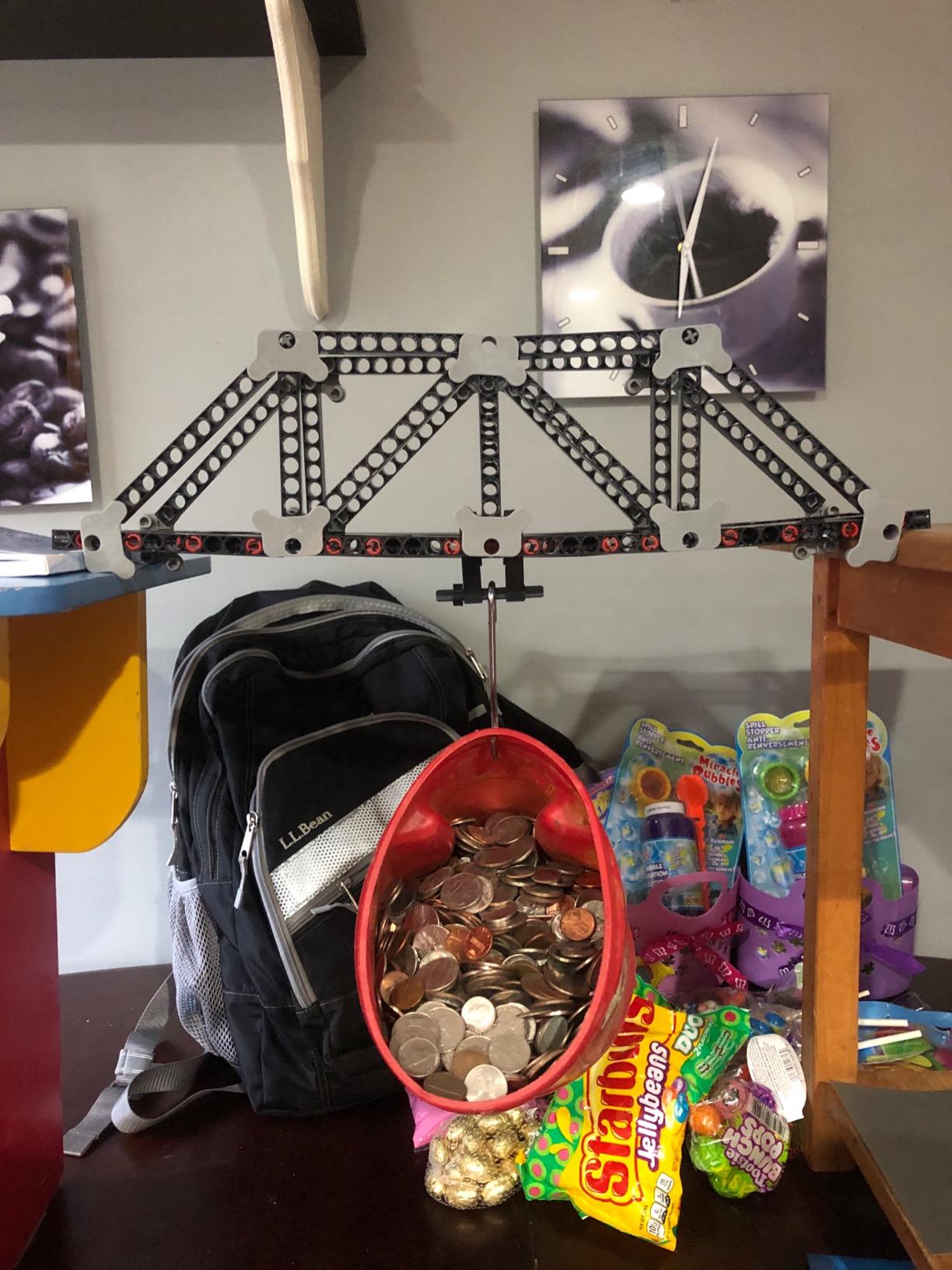
Our tester built a bridge, broke it by loading one span at a time, and then rebuilt it with a truss. Nobody told her to do that. The manual gave her a cantilever bridge that failed, and the next page gave her an answer, and the rest was hers.
The manual is the reason this kit ranks where it does. It is illustrated, it walks through assembly step by step, and then it treats the model as an experiment, explaining which load the structure is carrying and where the forces concentrate.
For a homeschool or classroom setting, that manual is a free curriculum unit. For a tired Tuesday, it is a book a child can read on her own, which is a rarer thing than it sounds in this category.
The manufacturer lists this as an intermediate skill level for ages 8 to 14, and the product details give a range of 96 to 168 months. We agree with the floor and would push the top end down: a fourteen-year-old who is already comfortable with technical manuals will finish this quickly, whereas a tween who is new to building may need company.
The kit weighs 16 ounces and measures 13.1 by 1.8 by 11.6 inches, so it is flat and light. It stores well, which is not a minor consideration once you own more than one kit.
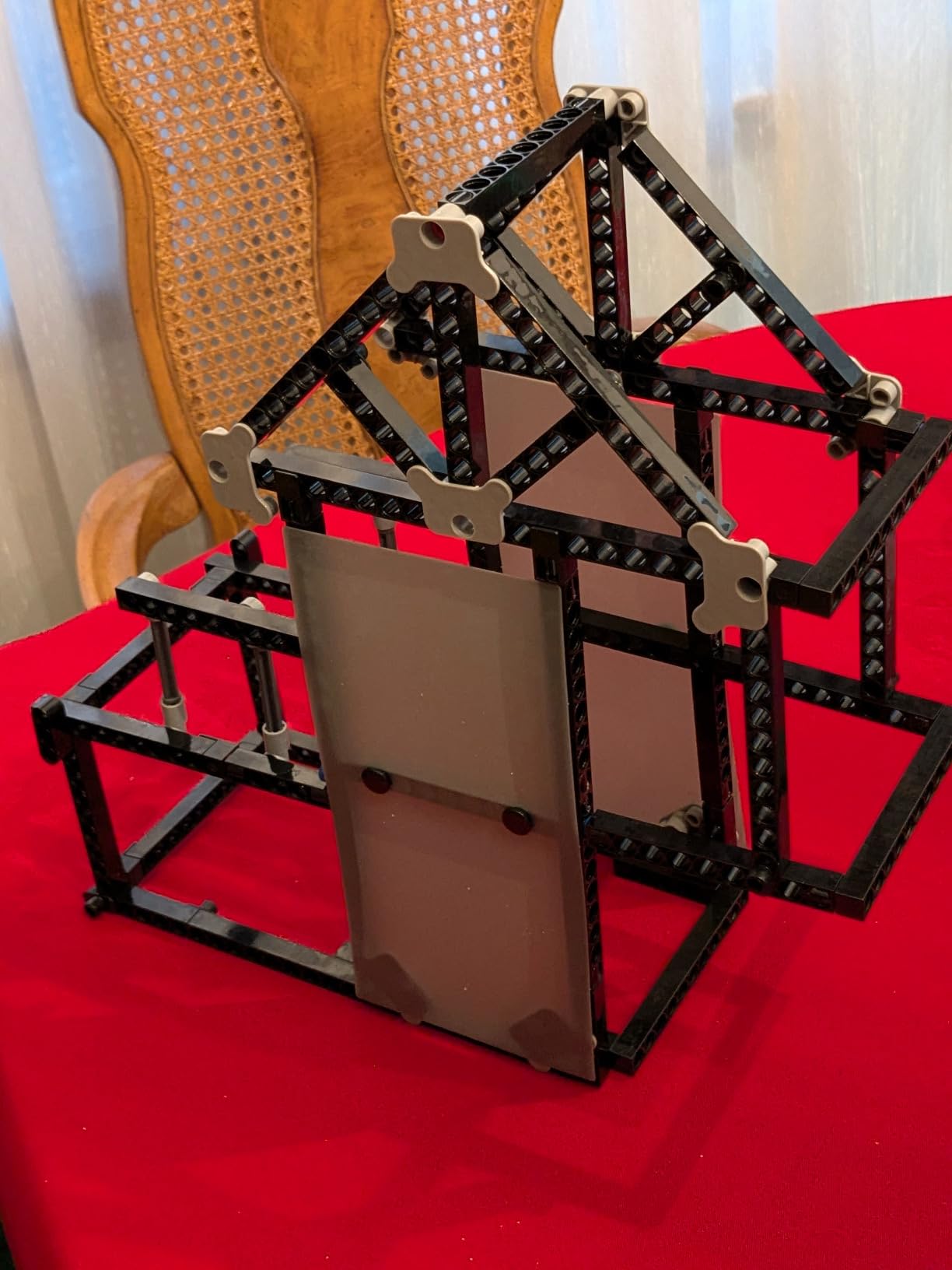
Reviewers report that some of the cheaper plastic pieces crack at the tight joints, and we saw a hairline crack on a stress point after heavy loading. Pieces are interchangeable, so a spare usually solves it, but the material is the limiting factor rather than the design.
The included yellow dismantling tool is also widely criticised for grip. It is a small annoyance that slows every teardown, and a thin flat screwdriver or a pair of fingers will usually do the job better.
Best for a child aged 9 or older who reads well, wants reasons rather than instructions, and is willing to break something to find out why. It is also the pick for a teacher, a homeschool family or anyone who wants a manual they can genuinely use.
It is not the right first kit for a five-year-old, and it is too text-heavy for a child who does not enjoy reading. If she is that kind of builder, the Snap Circuits kit teaches comparable electrical reasoning with almost no reading required.
STEM skills: load-bearing and truss design, compression and tension, structural failure analysis, reading technical diagrams, iterative redesign, engineering vocabulary, independent study habits.
3 motor robots
Manuals and screwdrivers included
Ages 8+
No soldering
Let us be straight about this one. It is explicitly marketed to girls, the set name is a DIY robotics kit for girls, and the box is pink. The honest question is whether the product underneath justifies the colour, and in our test it does.
Underneath the presentation there are three separate motorised builds: a doodling robot, a bubble-making robot and a motion robot, each teaching a different principle from circuitry to airflow. That is three completed models, not one, and the difference between those two things is the difference between a toy used once and a toy used for a term.
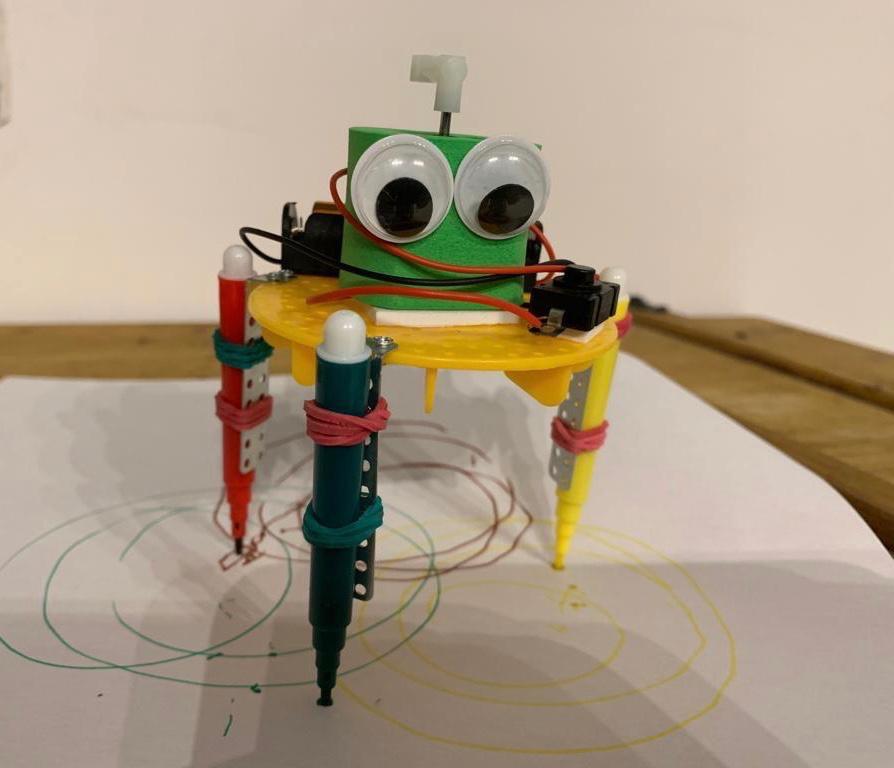
No soldering and no sewing is the line that matters most here. Screws and a screwdriver are involved, which is a genuine step up in difficulty, but nothing requires an iron, a needle or a parent’s steady hand. That combination is why the set is marketed from age 8 with the manufacturer recommending 8 years and up.
A single robot build is a project with an ending. Three builds is a course with a structure, and the child can order them by difficulty or simply avoid the one that frustrates her on a given afternoon. Our tester ran the motion robot first, ignored the bubble robot for a week, then came back to it unprompted.
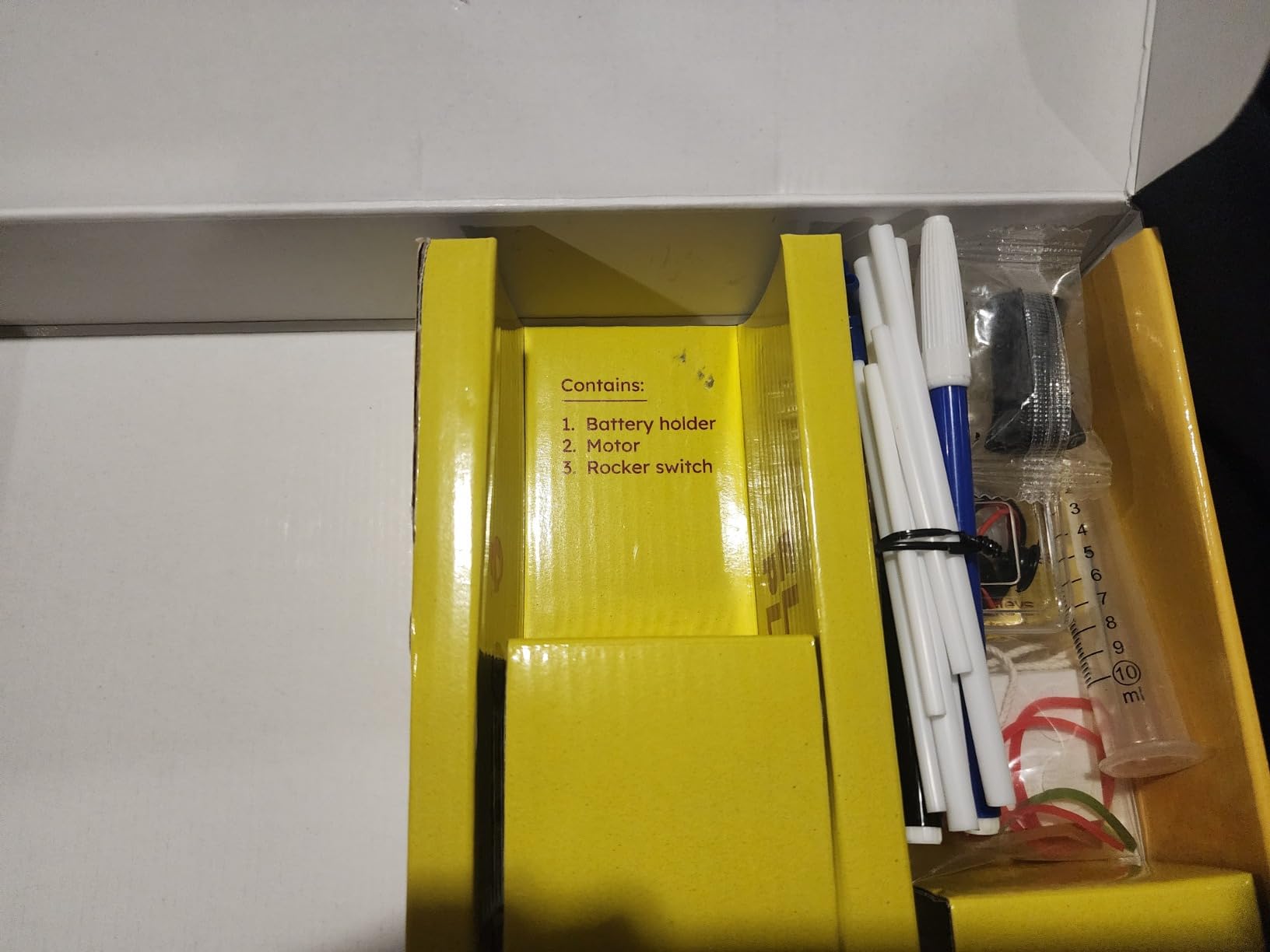
Each robot is 20 parts out of 60 items in the box, and the set ships with instruction manuals and screwdrivers, so there is nothing extra to buy before starting.
We are not going to pretend the colour is irrelevant to you, because parents tell us it is the main reason they hesitate. Our position is narrower and more useful: the engineering content has to justify itself first, and here it does. Three working motor builds, no soldering, and a price that sits below most of the electronics kits in this roundup.
What to watch is the feedback score. At 4.3 with 65 percent five-star ratings, this is the lowest-rated kit we recommend, and the gap is mostly about the instructions. Buy it for a child who reads diagrams at eight or older, and it will do its job.
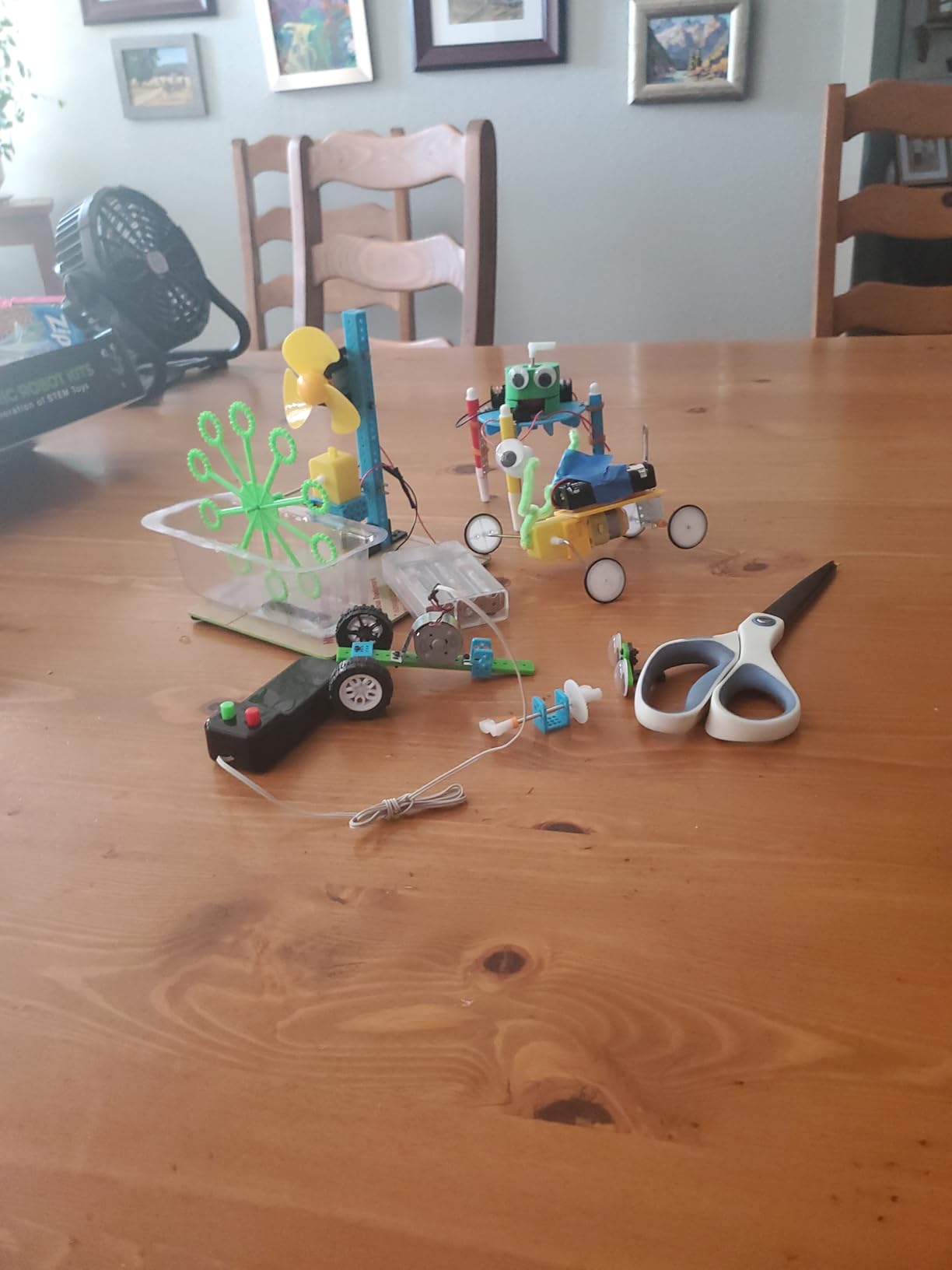
The box measures 5.9 by 5.9 by 2.69 inches and comes in one, three and four packs, so a sibling pair or a gift that needs doubling up is easy to handle. Parts are plastic and the motors are light in the hand, which is the honest weak point.
For a gift, the presentation is the selling point. It arrives in a gift package with screwdrivers and manuals, which means it can be handed over on the day without a trip to a hardware shop for tools.
Good for an eight-year-old to tween who wants robots, and for anyone buying a birthday present where the box matters as much as the contents. It suits a child who is a little intimidated by a technical manual but motivated by a finished robot.
Poor fit for a child under eight or one who needs adult help with small screws, because fiddly instructions are the recurring complaint. If she is that child, the BeAndge set at number six has a better rating and a clearer build sequence.
STEM skills: basic motor control, airflow and pressure, circuit assembly, fine motor precision, confidence through a completed build, following illustrated instructions, cause and effect.
100+ models
Wooden parts
Illustrated guides
Ages 8-12
The pitch here is quantity and independence. 100+ hands-on engineering and science models covering gears, levers, circuits and machines, all from wooden parts, with illustrated step-by-step guides written for ages 8 to 12. The maker states the kits were designed by engineers from an Indian institute of technology with two decades of hands-on STEM teaching experience.
The runways are the appeal. A child who finishes four projects in a week still has ninety-six ahead of her, and because the parts are wooden they return to the box intact rather than ending up in a vacuum cleaner. Ours did exactly that.
It also arrived as the easiest kit to hand over and walk away from in our testing. The guides are clearly illustrated, and our eight-year-old worked through a session alone, coming to ask only when a model failed and she wanted a second opinion rather than help.
The variety matters more here than in a narrower kit. A child who builds only gears learns about ratios. A child who builds across gears, levers, circuits and simple machines starts to see that all four are ways of moving a force from one place to another, which is a much larger idea.
Because the pieces are wooden and reusable, the models stack up over a year of use. The kit does not degrade the way a thin plastic snap kit does, and the box measures 10 by 5 by 1 inches, so it stores flat.
We want to be straight about the weakness here, because it is the reason this kit sits at number nine rather than higher. At 4.2 with roughly 10 percent one-star reviews, this is the widest spread between love and indifference in our set. Two themes dominate the complaints: missing or damaged components, and instructions that do not always match the parts.
Our box was complete. That is a real experience rather than a promise, and the honest summary is that quality control appears inconsistent. Check the contents against the inventory list the moment it opens.

The set weighs 600 grams and is built from wood, with the manufacturer stating the materials contain no harmful chemicals. Twenty items and a 100-count unit listing describe the parts bundle rather than twenty finished models, which is worth knowing before you picture the contents.
Because the parts are wood, this is a table activity rather than a floor toy, and a toddler sibling will find the small components first. The manufacturer recommendation is 8 to 12 years, which we would treat as a floor rather than a ceiling.
Good for a child aged 8 to 12 who works well alone, wants a long stream of projects and prefers wood to plastic. It is also a strong gift for a grandmother or an aunt who wants something that will not be destroyed within a week.
Less suitable if precision matters to her, if the family is intolerant of an occasional missing part, or if she wants a single impressive finished model. If the build has to come out looking a certain way the first time, choose a kit with fewer instructions and a clear goal.
STEM skills: gear ratios, levers and simple machines, elementary circuitry, following illustrated guides, independent concentration, mechanical reasoning, cause and effect testing.
120 circuit projects
QR video guides
Snap-together wires
Ages 8+
When a printed diagram stops being enough, video is the answer, and this kit is the one in the roundup built around that idea. Each project is reachable by scanning a QR code to a kid-friendly walkthrough, which turned the two builds our tester found confusing into tasks she finished herself.
The project range is genuinely broad. Alongside standard circuits there is a keyboard music mode, light shows, a flying copter and a voice amplifier, and the variety is what keeps a child moving through a kit this size.

At 4.7 across 609 reviews this is the highest-rated kit relative to its review count in the whole roundup, with 87 percent five-star ratings. The consistency of the feedback is notable: parents mention the same three things, which is usually a sign that the product delivers exactly what it claims.
Printed schematics assume a level of visual abstraction that many eight-year-olds do not have yet. A child can follow a video of hands placing a component because the sequence is demonstrated rather than diagrammed, and the pause-and-rewind ability removes the frustration of a page she has already turned past.
That single feature is why this kit worked independently for our tester, and it is the strongest argument for it if your child is a confident reader but a hesitant manual-follower.
Many projects need alkaline batteries, which are not included. More limiting is the wire length on larger builds. Reviewers report running out of wire partway through a project, and our tester hit the same wall on a bigger light show and had to scale it down.
Plan around that. The manufacturer recommends 8 years and up, and the box measures 12 by 3 by 14.75 inches with a weight of 2.7 pounds, so it is a substantial kit physically as well as in project count.
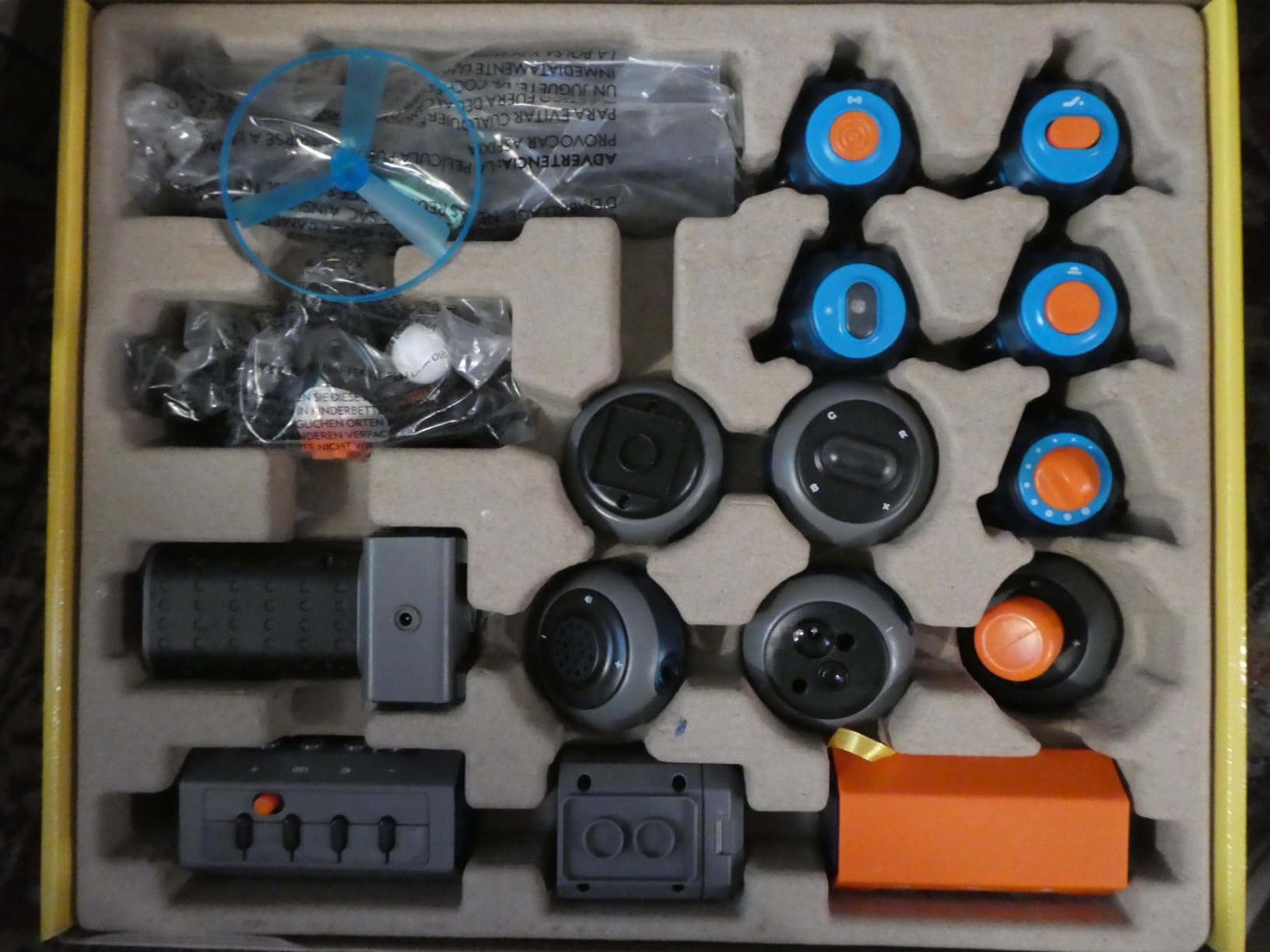
Snap-together wiring means no soldering, no pliers and no adult with a steady hand, which is the same design decision that makes the Snap Circuits kit work and it works here for the same reason. Every project starts with a child, not a parent.
The kit is made by Blue Marble under the National Geographic brand and carries a Toy of the Year Award. We treat the badge as a minor signal, but the manufacturer model number is a useful one to have if you later want to match accessories.
Best for a child aged 8 and up who is comfortable with a device, wants electronics specifically, and loses confidence on printed diagrams. It is also the strongest choice here for a visual learner, since watching a build is genuinely faster than decoding one.
Not ideal for a household without a tablet or phone to scan with, and a poor fit for a child who wants screen-free play. If the QR dependency is a problem, the Thames and Kosmos structural kit at number seven covers circuit concepts with printed explanations instead.
STEM skills: electrical circuits, conductivity and polarity, light and sound as output, following a demonstration, debugging, sequential reasoning, independent problem solving.
40 magnetic pieces
Unicorn and castle theme
Ages 3-12
ABS plastic
We are including a themed magnetic set in a roundup about engineering toys, and the reason is worth stating plainly. Magnetic tiles are the single most recommended construction toy for young children across the parenting forums we read, because they are the first building material most three-year-olds can use without an adult and the first one that produces a structure standing up on its own.
This particular set brings a unicorn and princess castle theme with two unicorn dolls, rainbows, stars, wings and butterflies, in 40 pieces. The theme is the hook. The engineering is the magnetic connection that makes a flat shape become a wall.
On materials, it is ABS plastic with smooth surfaces, rounded edges and ultrasonic welding on the magnetic elements, and the manufacturer states it was safety tested. The age range runs from 36 months to 12 years, which is unusually wide.
A magnet has no prescribed orientation and no code to learn, so a four-year-old can put a tile anywhere and feel immediately whether it held. That feedback loop is fast, forgiving and endlessly repeatable, which is precisely what a young child needs from a construction toy.
It is also inherently social. Magnetic sets work best with two children at one table, and that makes this a reliable playdate and sibling recommendation rather than a solo-activity recommendation.
Forty pieces is small. Larger magnetic sets run to well over a hundred, and a castle that needs more wall will run out. The manufacturer does state the tiles are compatible with most magnetic tile sets on the market, so this works as an entry set that another box can extend rather than a complete one.
At 4.8 across 589 reviews this is tied with the Snap Circuits kit for the highest rating in the roundup, and the feedback is consistently warm about magnet strength and open-ended building.
Good for a preschooler or early elementary child, especially one who is drawn to a specific theme and will use that interest as the doorway into building. It is a strong choice for a three-year-old, and it pairs well with our picks for younger readers in the broader gift guide.
Be clear-eyed about what it is. This is imaginative construction, not an engineering kit, and it teaches no principles of load, force or electricity. It also collects itself into dangerous swallowing hazards for a child under three, and magnetic tiles should be counted regularly, since a missing small magnet is a medical emergency rather than an inconvenience.
STEM skills: spatial reasoning, shape and colour recognition, magnetic attraction and repulsion, fine motor control, three-dimensional construction, collaborative building, pattern making.
6 working models
Theory and quiz book
Ages 9+
3D building app
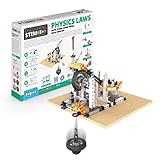
This is the pick for the child who interrupts with questions. Engino’s Physics Laws set is built around inertia, friction and circular motion, and it pairs six working models with 12 pages of theory, facts and experiments plus a four-page quiz section, so the building is tied to an explanation rather than standing alone.
Our tester treated the quiz as a game, which is the most elegant way we have seen a child engage with a physics topic. Answering the questions correctly became a goal, and going back to the models to check an answer made the theory feel earned.
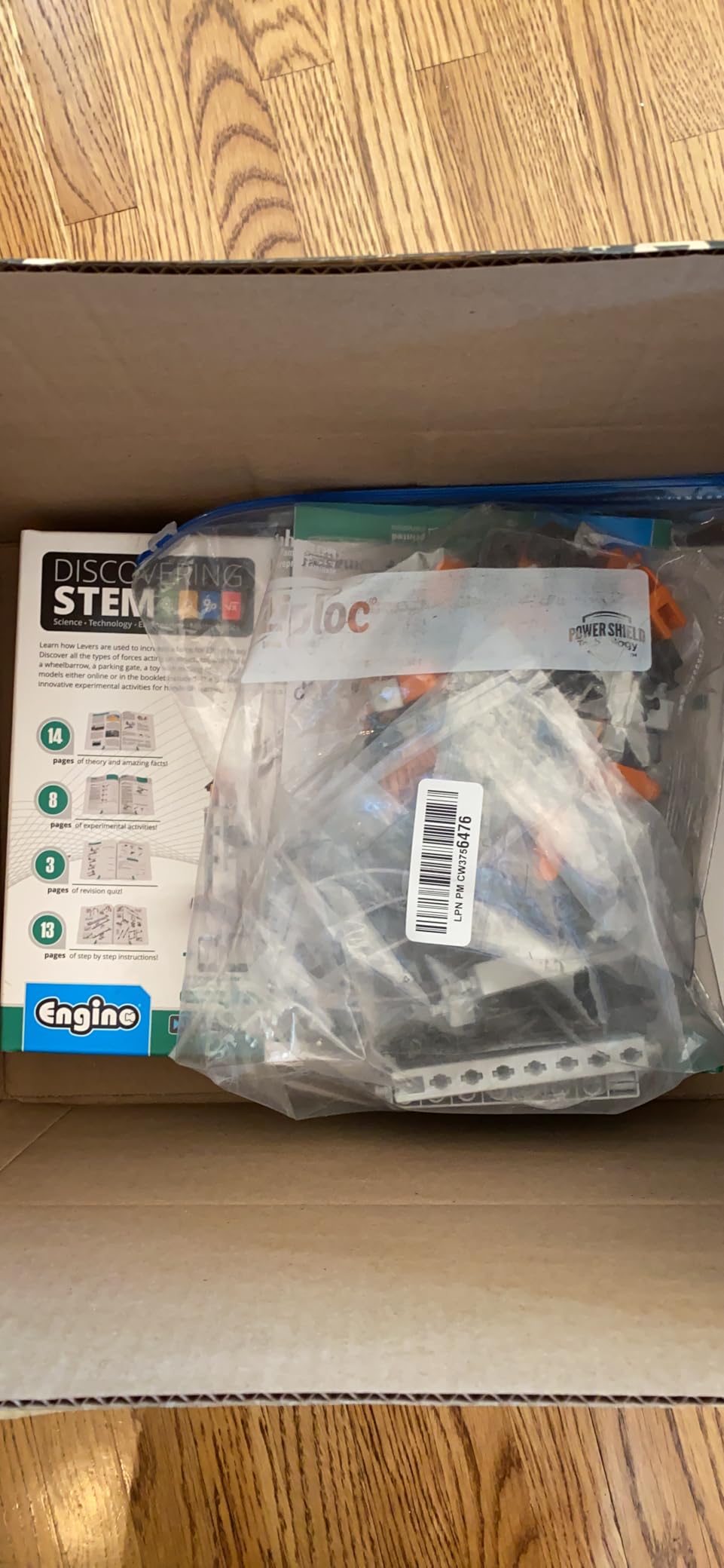
The models include a rocket launcher and a crash test rig, and both are the kind of thing a child builds and then immediately wants to break and rebuild with different settings. Circular motion is easier to grasp from a model that spins than from a diagram, and that is the whole argument for this kit.
Most kits in this roundup teach by demonstration. This one also teaches by text, which makes it the most school-adjacent option and the easiest to slot into a homeschool or classroom unit. The theory pages are short, illustrated and written at a level an older child can read alone.
The quiz section is what converts reading into learning. Our tester re-ran the experiments after answering a question, which is close to the ideal loop for a nine-year-old who reads well but lacks patience for a textbook.
Two things to warn about. The sandpaper and velcro pads that give the models grip wear out quickly, and replacements are the part you will order first. Small parts are also easily lost, and some connectors break during assembly, which is the most common complaint in the feedback for this kit.
The manufacturer lists a two-year limited warranty, and the box measures 10.5 by 2.5 by 7.7 inches with a weight of 0.53 kg. It is made in Europe.

The set includes a free interactive 3D app for virtual building, which is a nice option for a child who wants to design on a tablet and then build the same thing in plastic. The models work entirely without it, so this is the rare kit where the screen genuinely is optional.
The manufacturer recommends 9 years and up, and we agree. A younger child will find the reading heavy and the small parts fiddly, which is where the Engino’s strengths in theory meet their limit in hardware.
Best for a child aged 9 or older who reads comfortably, asks why things work and enjoys being tested. It suits a homeschool family looking for a structured unit, and a classroom, where teachers and tutors use the format because the theory pages do the explaining for them.
It is a poor match for a child who wants to build without reading, and a frustrating one for a younger sibling who loses the small connectors within a week. The Snap Circuits kit at number one covers comparable electrical reasoning with no reading and a far higher rating.
STEM skills: inertia and friction, circular motion, reading for information, hypothesis and testing, evaluating evidence, mechanical design, working with a kit specification.
Every kit above shares one property that matters more than any specification: it can be rebuilt. Here is how we narrowed twelve options down, and how you can do the same with a list of your own.
Age labels are close to meaningless on their own, and parents say so constantly in the forums we read. A package marked 8+ is a rough suggestion, not a gate. Look instead at what the child is already doing on her own, because that is a better predictor than any printed number.
As a rough guide: three to five years is the magnetic tiles and straw constructors band. Six to eight is marble runs, snap circuits and the first robotics kits. Nine to eleven is structural engineering, physics kits and multi-build circuit sets. Twelve and up is the wooden mechanical builds and anything with a theory section.
Our own age-band picks: for a child around 5, the straw constructor set; around 7, the marble run; around 9, Snap Circuits Jr.; around 11, the Thames and Kosmos structural kit; and 13 plus, the Engino physics set or the mechanical hand.
Engineering is not one subject, and the kits in this roundup teach four different things. Snap circuits teach electricity and sequential assembly. Marble runs teach gravity, speed and iterative design. Straw and tile sets teach geometry, stability and spatial reasoning. Structural engineering kits teach force, load, compression and tension.
The most common buying mistake is choosing the discipline a parent values rather than the one the child keeps returning to unprompted. Watch what she plays with when nobody is suggesting it, and buy that category.
This is the question nobody asks before a kit arrives, and it decides whether the toy is used. Some builds are a shared twenty minutes. Some are a two-session project. A few are a weekend.
Our rough grouping: the aeroplane, the tiles and the straw set can be handed over with a quick demonstration. The marble run, the robotics kits and the circuit sets are manageable alone from about age 8. The mechanical hand and the structural engineering kit genuinely benefit from an adult nearby, at least for the first session.
Also check the consumables list before you order. Batteries, bubble solution and replacement pads are not included in several kits here, and a build that stalls on a missing item is a bad first impression.
You will be asked about this, so here is our position rather than a platitude. The engineering content has to stand on its own before the packaging is considered. Several kits in this category are a boy’s kit in a pink box, with a smaller box inside to hide the evidence, and that is a reasonable thing to be annoyed about.
We include one explicitly girls-marketed kit, the 2Pepers robotics set, because three working motor builds with no soldering justify the marketing. Everything else on this list is chosen purely on what it teaches and how long it lasts, because the best engineering toys for girls are simply the ones that work well and are not built to be discarded.
Research discussed on parenting forums links counter-stereotypic toy play in early childhood with more gender-flexible attitudes later, which is the argument for choosing on capability and interest rather than on colour. If you want age-appropriate building picks rather than engineering-specific ones, our guide to the best gifts for 3-year-old girls and the best gifts for 6-year-old girls cover the developmental side.
Trust in a roundup depends as much on what you leave out. A few toy types came up in our testing and in parent discussion often enough that we would steer around them, and we would rather say so than pad the list.
Single-build kits with no spare parts. One model, one afternoon, then a box. The 2Pepers set avoids this with three builds; most of its cheaper rivals do not.
Anything needing a tablet before it can be assembled. If the screen is mandatory rather than optional, the toy becomes an app with pieces attached.
Themed kits with the same mechanism underneath. A pink dinosaur robot and a grey robot with the same motor teach exactly the same thing.
Tiny-piece sets for a house with a toddler. Missing small parts are a real problem, and a swallowed component is not a play opportunity.
Marble toys on hard flooring with young children around. The stepping hazard is genuine and easy to solve with a rug.
Four names come up repeatedly in this category. Snap Circuits is the reference point for beginner electronics and has the largest project library in the roundup. Thames and Kosmos publishes the most substantial printed theory of any kit here, and the manual is genuinely usable on its own. Smartivity makes engineered-wood mechanical kits that feel substantial for the money and offer replacement parts. Engino is the one to look at if your child reads well and wants the explanation as much as the build.
For wider reading on gifting, our age-by-age guide to the best gifts for girls covers the non-engineering side, and 15 best engineering-themed gifts is the natural companion read for an adult buying for an engineer of any age.
The best engineering toys for girls fall into four groups: snap-together electronics kits such as Snap Circuits Jr., open-ended construction kits such as marble runs and straw builders, mechanical model kits such as the Smartivity robotic hand, and structural kits such as the Thames and Kosmos bridge and skyscraper set. Choose by age band and by the discipline she is already drawn to, not by packaging colour.
At age 10, a child can usually handle a real instruction manual and finish a project alone. A circuit kit with video guides, a multi-build robotics set or a structural engineering kit all work well at this age. The most reliable choices in our testing were the Snap Circuits Jr. kit for electronics and the Engino physics set for a child who reads well and enjoys being challenged.
Twelve-year-olds are ready for intermediate kits with real instructions. The Thames and Kosmos Structural Engineering set suits a strong reader, while the Smartivity robotic mechanical hand suits a patient builder who likes machines. Avoid anything aimed at under-fives at this age, and pick a discipline rather than a theme, since the interest outlasts the character.
At eight, screen-free and low-frustration kits work best. A marble run gives open-ended building, a robotics kit with an included screwdriver gives a first taste of motors, and a 600-piece straw constructor set works especially well if a sibling or friend will build alongside her. Avoid kits that need a tablet to assemble or that have very fiddly instructions at this age.
Four brands stood out across our testing. Snap Circuits is the reference point for beginner electronics, with the largest project library in the category. Thames and Kosmos produces the most substantial printed theory, with manuals that work as standalone reference. Smartivity builds engineered-wood mechanical kits and supplies replacement parts. Engino pairs working models with theory and a quiz for older readers.
If she is around 9 or 10 and wants to understand how things work, start with the Snap Circuits Jr. kit. Its 100+ projects, tool-free connections and 4.8 rating from 29k+ reviews make it the safest single recommendation we can make, and the components stack with other sets if a sibling or friend has a larger one.
If she invents rather than follows instructions, the marble run is the one she will open on her own. If she is five and building alongside someone older, the 600-piece straw constructor set gives everyone enough parts. If she wants a finished object on the day it is unwrapped, the hydraulic aeroplane is the most reliably satisfying first build.
For a patient reader at 11 or 12, the structural engineering kit teaches more than the others because the manual explains why. For a tween who asks why, the physics kit pairs models with theory and a quiz. And for a gift that arrives ready to hand over with screwdrivers and manuals inside, the girls robotics kit does that job properly.
Whichever you choose, check the consumables, count the small parts, and give it a table rather than a floor. Those three habits do more for the life of an engineering toy than any specification on the box.
Last updated for October 2026. We rebuild these picks as new kits appear, and every rating and review count on this page is the figure shown at the time of writing.