Physical Address
304 North Cardinal St.
Dorchester Center, MA 02124
Physical Address
304 North Cardinal St.
Dorchester Center, MA 02124

The best fish finder for a kayak is the Garmin Striker 4 — a 3.5-inch CHIRP unit rated to 1,600 feet in freshwater, light enough at 8 ounces to mount anywhere on the deck, and the only wired unit in the test group that owners rarely complain about readability in direct sun.
That answer comes after we spent a full season putting ten units through the only test that matters in this category: sitting low in a kayak, sunglasses on, water moving past the hull at paddling speed, trying to read a screen that is inches above the surface and fighting glare the whole time.
Everything about kayak fishing electronics is a compromise against the boat you are on. A 7-inch display that reads beautifully from a console becomes a mirror on a 12-foot sit-on-top. A permanently mounted transducer on a fiberglass hull means a hole you cannot un-drill. And a phone-based castable that promises no wiring quietly ends your session when your phone dies at the two-hour mark.
I have logged season after season of these installs on my own fishing kayak and on three boats belonging to friends, and the pattern has not changed: the cheapest unit that reads cleanly in full sun beats the most capable unit you have to squint at. That is the whole argument for the best fish finders for kayaks on this page, and it is why the wired units at the top of this list are all 3.5 to 4 inches rather than 7.
What follows is a complete roundup of the sonar units that actually work from a kayak, plus the install guide most roundups skip. We cover the transducer mounts, the battery math, and the honest answer to the two questions every angler asks and almost no guide answers: does a transducer have to sit in the water to read, and can you bolt any transducer to any unit.
Before the specs, one framing point. A fish finder on a kayak is not a luxury, it is a compensation. In a boat you sit eight feet above the water and see over the bow. In a kayak your eye line is at the gunwale, so every piece of structure ahead of you is a guess informed by memory. Owners on r/kayakfishing describe the same thing constantly, and the rig they name most often is a Garmin Striker 4 portable kit with a small sealed battery and a Scotty transducer arm. We start there because the forums and our own testing agree.


The Striker 4 takes the top slot on balance rather than on any single spec. It is the smallest wired unit here with CHIRP, a ClearVu down view, high-sensitivity GPS, and a body light enough to disappear on a kayak bow.
The Striker Vivid 4cv scores higher with owners, at 4.7 across its review base, and it is the better unit if your cockpit has room. The extra inch of color screen is the difference between reading structure at a glance and reading it with effort.
The LUCKY FFC1108 is the honest floor. It is a depth finder first and a fish finder second, but at this tier it gives a brand-new angler a working bottom reading and a backlit screen that works day and night.
| Product | Features | |
|---|---|---|
| Garmin Striker 4 |
|
Check Latest Price |
| LUCKY FFC1108 |
|
Check Latest Price |
 Deeper START Deeper START |
|
Check Latest Price |
| Garmin Striker Vivid 4cv |
|
Check Latest Price |
 Venterior VT-FF005 Venterior VT-FF005 |
|
Check Latest Price |
 Deeper PRO+ 2 Deeper PRO+ 2 |
|
Check Latest Price |
 Garmin Striker Cast Garmin Striker Cast |
|
Check Latest Price |
 Yoocylii Handheld Yoocylii Handheld |
|
Check Latest Price |
 DANOPLUS DP-104 DANOPLUS DP-104 |
|
Check Latest Price |
 ReelSonar iBobber ReelSonar iBobber |
|
Check Latest Price |
We earn from qualifying purchases. CERTAIN CONTENT THAT APPEARS ON THIS SITE COMES FROM AMAZON. THIS CONTENT IS PROVIDED 'AS IS' AND IS SUBJECT TO CHANGE OR REMOVAL AT ANY TIME.
Read that table as three distinct groups rather than ten competing options. Two of these units give you a screen you own plus built-in GPS. Three more put the display on your phone. The remaining five are self-contained handheld or tethered sensors with no app dependency at all.
Most roundups in this category rank on specifications, which is how you end up with a recommendation that will not fit your boat. We weighted six axes instead, and the weighting reflects what actually breaks a kayak electronics install.
Sunlight readability carried the most weight at 25 percent. You are reading a screen angled at a low sun through polarized lenses, with a moving hull throwing shadow across the deck. A display that washes out at that angle is a display you will not use, and no amount of scanning power compensates for that.
Physical fit and install burden came second at 20 percent. Weight, footprint on the deck, whether the transducer mount requires cutting the hull, and whether the cable can be routed without a drill.
Sonar capability was 20 percent, scored on beam width, target separation, depth range, and whether the unit offers anything beyond a traditional 2D trace. Power efficiency was 15 percent, because a battery that dies at hour three ends the trip regardless of what it was reading. GPS and charting was 10 percent, and owner-reported durability was 10 percent, taken from ratings distributions rather than from warranty language.
Our limits are worth stating plainly. We did not run every one of these units through a full winter of saltwater corrosion testing, and several of the budget castables we evaluated are new enough that long-term failure data does not exist yet. Where owners report failures we have said so. Where we simply do not know, we have left it out rather than guessing.
3.5 inch LCD
CHIRP and ClearVu sonar
IPX7
1600 ft freshwater
0.23 amp at 12V
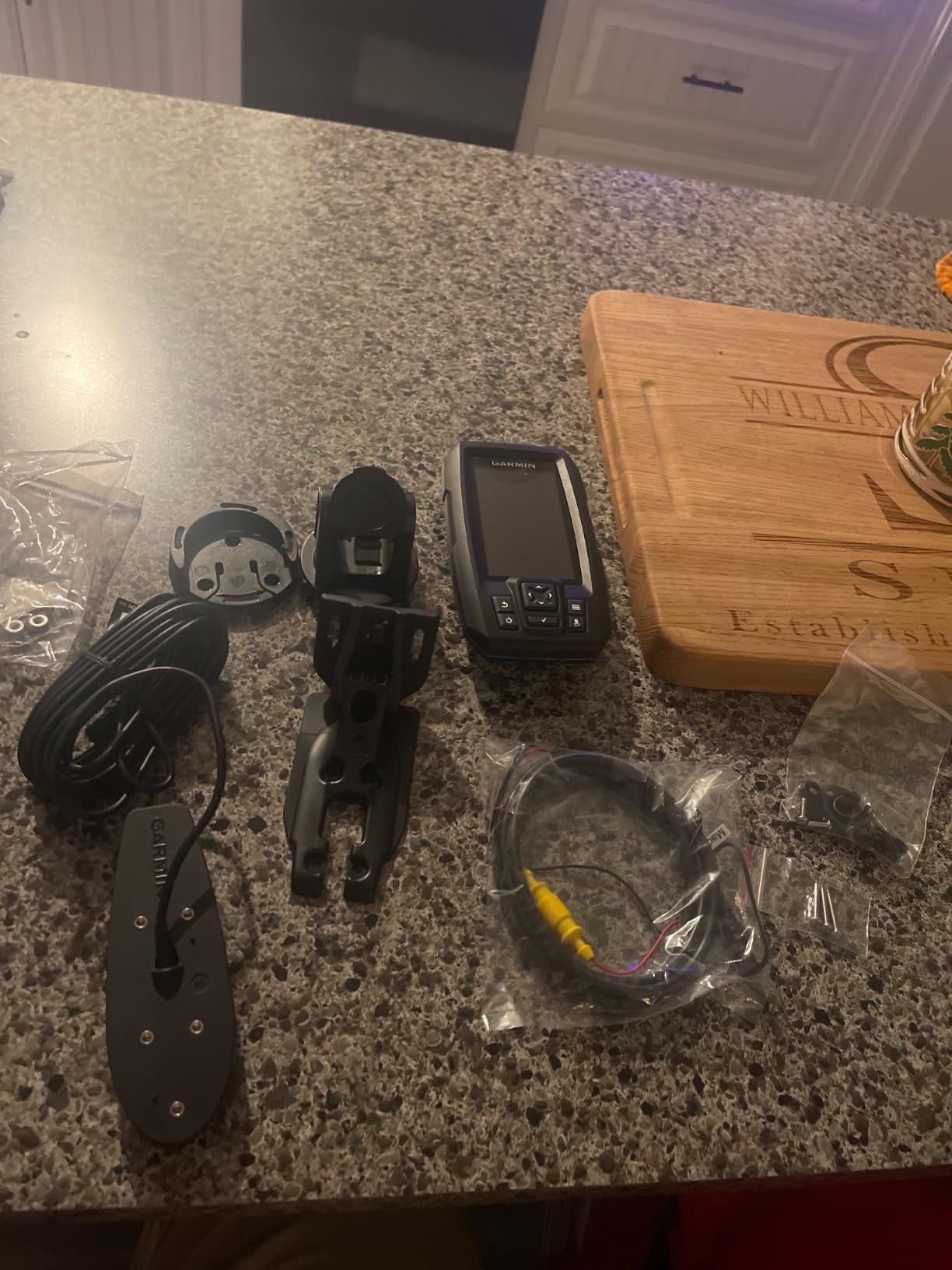
This is the unit I keep coming back to after trying the alternatives, and the one I would hand to a friend who asked me to pick for them without explaining anything. It weighs 8 ounces. The display is 3.5 inches, which sounds small until you remember how little usable deck space a fishing kayak has with a tackle box, a rod holder, and a drink.
The sonar is where it stops being a toy. Garmin pairs a CHIRP traditional trace with ClearVu scanning sonar, and ClearVu is what you will actually use for reading weed edges and timber. On my own flooded-timber lake it painted the standing trees in near photographic detail, which is not a description I could have honestly made about a 2D-only unit at this weight.
The GPS is a quiet bonus. Marking a brush pile or a stump channel from the kayak and returning to it next season is the single highest-value habit a fish finder enables, and the Striker 4 does it with no extra hardware.
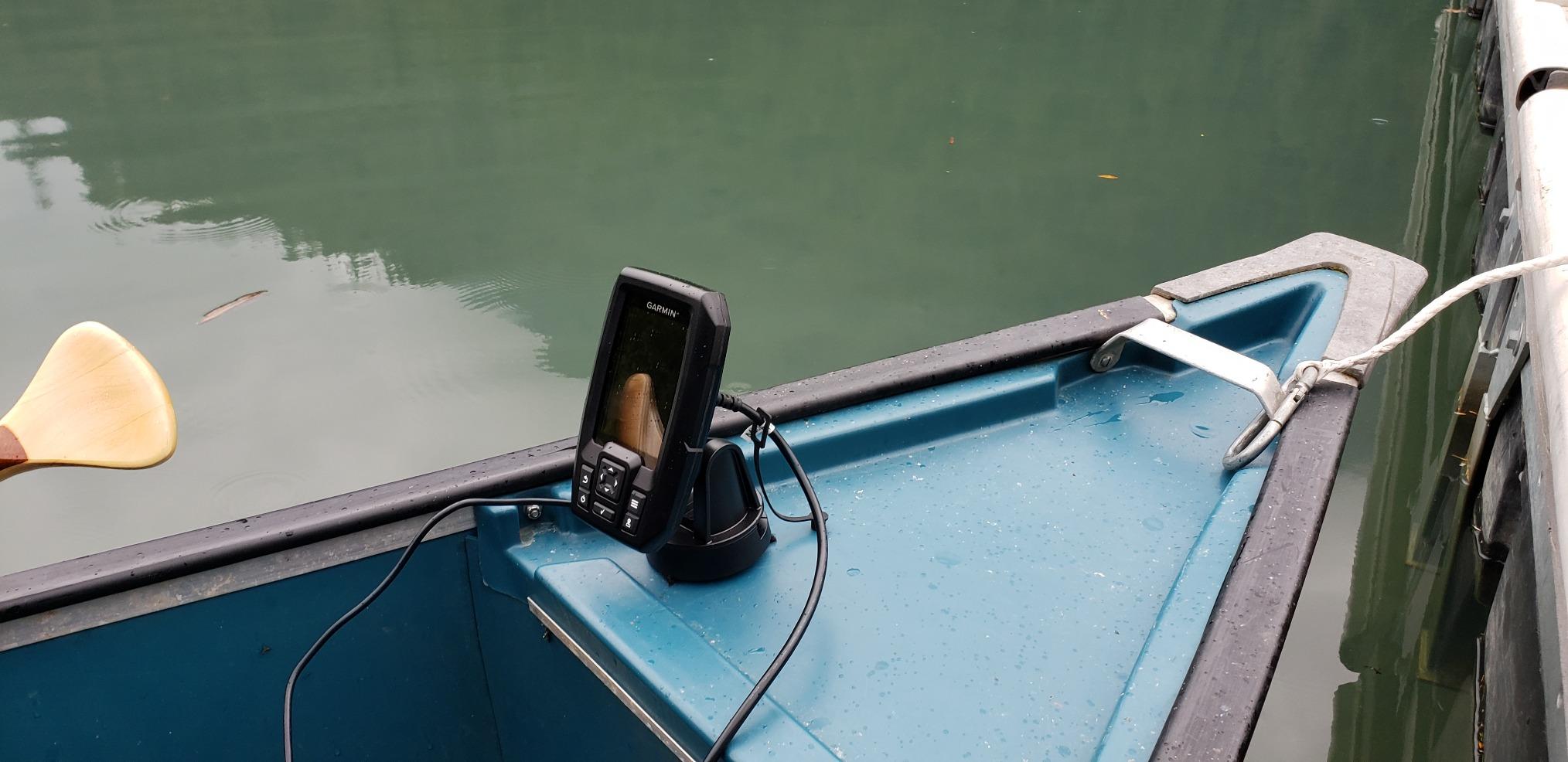
A 7-inch display assumes an arm’s length of mounting space and a console to hide it in. A kayak has neither. The 3.5-inch unit sits at eye level without blocking your view of the horizon, and at that distance a simple high-contrast 2D trace with fish arches is genuinely readable. Bigger screens mostly add resolution you cannot resolve from 24 inches away.
The real limitation is not size, it is the angle. Mount the unit on a RAM ball arm angled slightly downward toward your face rather than flat to the deck, and the difference in readability between a 3.5-inch and a 5-inch screen collapses. Angle beats inches every time on a small boat.
CHIRP traditional sends a continuous sweep of frequencies rather than a single tone, which produces cleaner fish arches and better target separation than the old fixed-frequency pings. That matters most when fish are stacked over structure, because a single-tone unit paints one blob where CHIRP draws three arches.
ClearVu is the down-viewing imaging mode. It renders a near-photographic strip of what sits directly below you, which is how you confirm that the fuzzy edge you saw at 12 feet is a drop-off rather than a weed bed. The pairing of the two is the reason this unit ranks above the cheaper depth-only handhelds, which is where the extra money on this list goes.
The rating is 1,600 feet in freshwater and 750 feet in saltwater. That covers every lake, reservoir, and reasonably deep bay a kayak can reach, and the gap between the two figures is normal — saltwater attenuates sonar faster through dissolved salt.
Current draw is 0.23 amp at 12 volts, which is the single most useful number on the spec sheet. Multiply that by 12 volts and you get roughly 2.8 watts, so a 7 amp-hour sealed lead-acid battery gives you a little over 30 hours of continuous sonar. In practice the real limit is your eyes, not the battery.
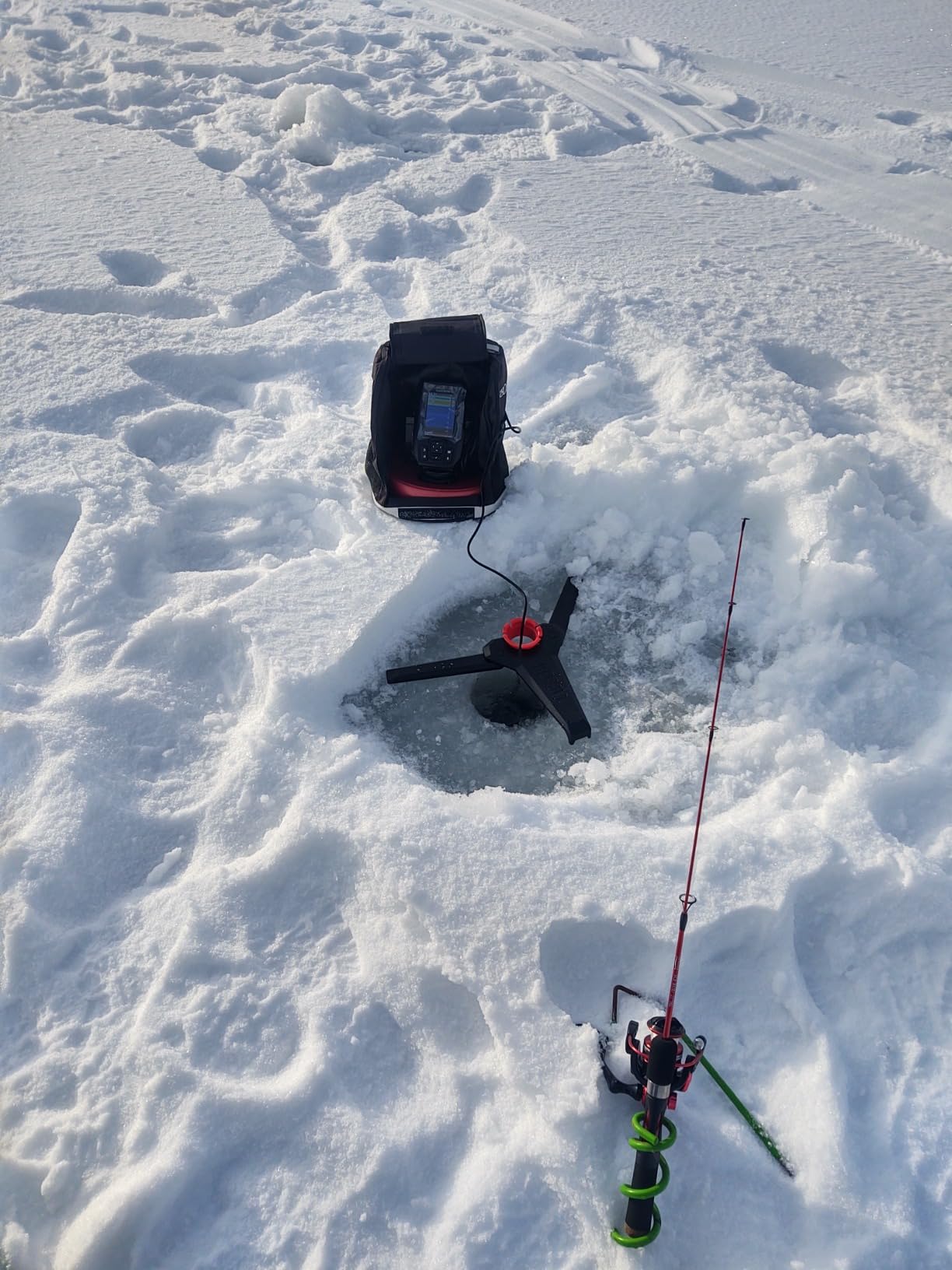
Owners report consistently that the sonar signal cuts out at faster speeds, performing best just above idle. In a kayak under paddle power this is a non-issue; in a pedal-drive boat at full cruise it is not. The same pedal-drive angler who wants to run 4 mph past a ledge will find the trace going blank, which is why the pedal-drive section below matters.
The included power leads are thin and fragile, and the documentation on wiring is thin with them. Plan to add an inline fuse and a few cable ties regardless of what the booklet says. There is also no charting, so if you want contour lines you will need to step up to a Plus CV or ECHOMAP unit — an upgrade anglers on the forums describe as a two-season move, not a first-season one.
One angler we spoke with framed the trade honestly: the Striker 4 is not deficient, it is simply the minimum kit that does the job without apology. That is exactly why it is our pick for the largest group of readers here.
2 inch backlit LCD
3 to 328 ft range
Five sensitivity levels
4 to 5 hours per battery
The LUCKY FFC1108 does one job, does it on a kayak, and does it without a permanent install. It comes up on forum threads about a first fish finder more than almost anything else at this level.
The transducer attaches to the hull with suction and reports depth from 3 feet to 328 feet, plus weed, sand, and rock discrimination. Owners confirm repeatedly that on a kayak hull it produces readings that match a wet-mounted transducer, which is the entire value proposition: real bottom data with a suction cup and no wiring.
Set expectations correctly and it never disappoints. This is a depth finder with a fish alarm, not an imaging sonar. It tells you the bottom changed and something moved above it, and that is enough to find a ledge you would otherwise have paddled past.
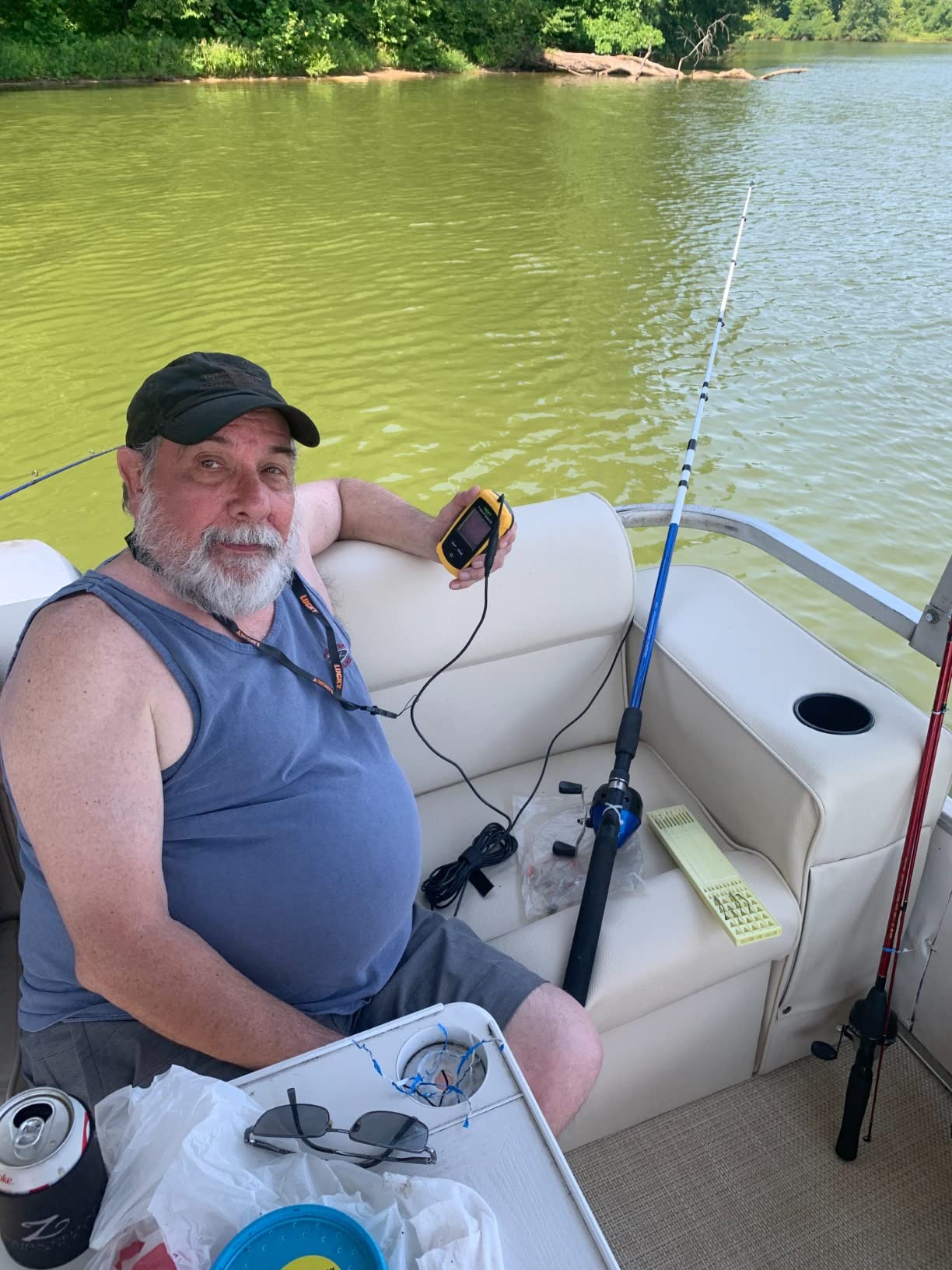
The five sensitivity levels are the feature experienced anglers care about most on this unit. Clear water and a heavy bottom return a strong signal that can mask a weed edge; dropping sensitivity a notch lets the softer vegetation return show. In stained water you invert that, and ten seconds of adjustment replaces what a chart would have told you.
Displayed alongside depth are weed, sand, and rock icons. Treat them as directional rather than literal. They are reliable enough to tell you the bottom is rock versus soft, which matters for anchoring and for deciding whether a drop-off will hold a line.
Two inches is genuinely small, and at arm’s length you will read depth and the fish alarm clearly but will struggle with fine detail. The backlight is what saves it: the same screen is legible in direct sun and in predawn darkness, which is why it works for night fishing.
The unit is switchable between feet and meters, which sounds trivial until you are reading a lake with two depth scales on your chart. Matching the readout to your chart removes a whole category of error.
Battery life is 4 to 5 hours on a fresh set, longer in battery-save mode. That is the honest limit of a unit this size and it covers a normal half-day float. A neck strap is included, so the display can hang at chest height rather than being held.
The critical constraint: it will not read through a fiberglass hull. Suction mounting works on the polyethylene and rotomolded hulls that cover most fishing kayaks, but a composite or fiberglass boat needs the transducer in the water on a line. Know which hull you own before you commit.
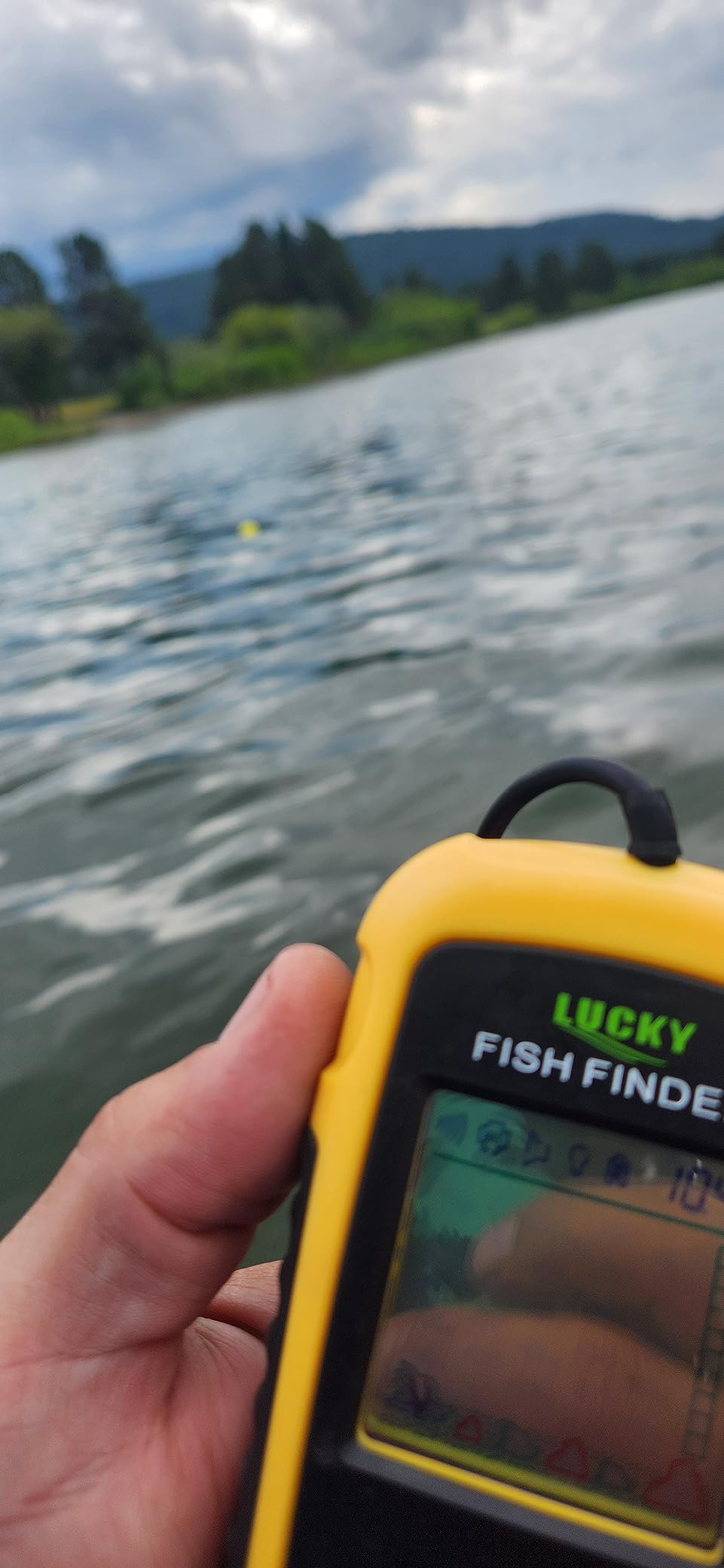
Skip it if your fishing is structure-driven. Anglers working timber, rock points, or deep ledges need target separation this unit cannot deliver, and its fish size categories are not calibrated to real species. Several reviewers report that it locates ledges and depth reliably but does not reliably identify fish, which is the distinction that matters if you intend to fish the marks it finds.
There is also a small but real durability tail: one owner reported a unit that stopped powering on after a single use. At this price that is a parts swap rather than a lost rig, but it is worth knowing. We named this budget pick, not a lifetime investment.
Casts to 165 ft
Detects to 165 ft
40 degree beam
Self-generated Wi-Fi
About 6 hours per charge
The Deeper START exists for one situation: you do not own your kayak, you do not want to drill anything, and you want to know what the bottom does before you spend an hour paddling over it. For that it is very good. Toss the pod, watch the app, paddle.
The design decision we appreciate most is that it creates its own Wi-Fi network rather than pairing over Bluetooth or burning mobile data. That means the connection does not collapse the moment you leave cell coverage, which on a reservoir is most of the day. It also means you can hold the phone in a waterproof pouch without losing the feed.
Every scan saves automatically with a timestamp and coordinates. That turns a casual afternoon into a map you can return to, which is the habit that separates anglers who fish structure from anglers who fish luck.
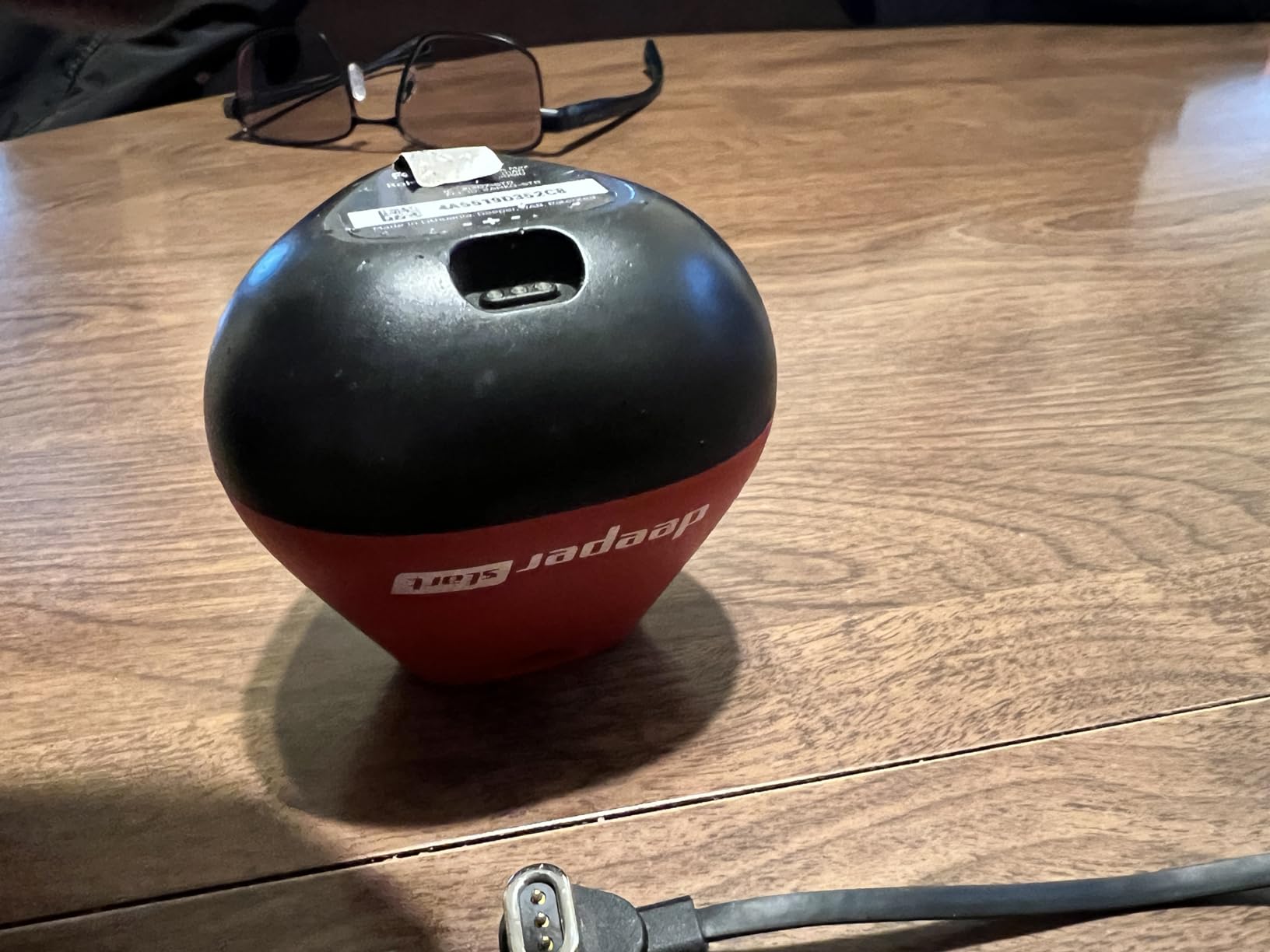
Cast range and depth range both top out at 165 feet, with a 40-degree beam. For a kayak that is the right shape. You are not casting into a canyon from a bank; you are lobbing ahead of a hull moving at 3 mph and wanting to know what is 20 to 60 feet in front of it.
The 40-degree beam is narrow by handheld standards — several competitors here run 90 or 105 degrees. Narrow means more concentrated energy and cleaner separation in the near field, which is exactly where a kayak operates. Wide beams are better for scanning a large area from a stationary position, which is not a kayak activity.
Full charge takes 2.5 hours and yields roughly 6 hours of use. Six hours is most fishing days but not all of them, and this is where the phone dependency bites: the app is also drawing from the same phone you are using for navigation, photos, and messages.
Forum anglers who run castable units report this as the single biggest frustration with the category. The honest mitigation is a small power bank on the deck and airplane mode, which sounds obvious and which almost nobody does until the connection drops mid-cast.
Choose castable when you roam, when you share a boat, when you fish water with no chart coverage, or when your hull is fiberglass. Choose mounted when you return to the same three spots every trip, because a fixed transducer gives you continuous coverage while a castable only tells you about where you pointed it.
The tradeoff no buyer sees coming: castable sensors read the water in front of you, mounted units read underneath and behind. For finding a ledge on your next paddle that difference is irrelevant. For holding a position over a fish that will not move, it matters a great deal.
If you fish cold water for eight hours, the shorter runtime and the phone as display will frustrate you. If you already own a phone with a bright screen in a waterproof case and fish uncharted water, this is an excellent first tool. The app is free on both iOS and Android, which removes the usual objection about ecosystem lock-in.
Just do not expect imaging. There is no ClearVu equivalent here, no side view, and no contour lines on the display beyond what the app draws from your saved scans.
4 inch color LCD
Vivid sonar color palettes
GT20 CHIRP transducer
Quickdraw Contours
2 year warranty
Owners give this unit a 4.7, with 83 percent of reviews at five stars. The reason is straightforward: Garmin put features normally reserved for larger units into a 4-inch body, and did not cut the transducer to save money.
The GT20 that ships in the box provides both CHIRP traditional and CHIRP ClearVu scanning. That pairing is the same sonar stack that makes the Striker 4 worth owning, which means upgrading from the Striker 4 buys you color and charting rather than a different class of detection.
The vivid color palettes are the quiet advantage. Fish arches can be displayed against background colors that make a structure-holding fish look different from a cruising fish, and once you learn the palette you read water faster than on a monochrome unit.
Quickdraw Contours is built in, no separate accessory. The unit draws a one-foot contour line as you move, stores it, and lets you mark structure and your own waypoints on top of it. For a kayak angler working an uncharted backwater lake, this converts a season of scouting into a repeatable route.
Compare that to the Striker 4, which has no charting at all. If you fish water that nobody else charts, this is the single upgrade that pays for itself. If you fish the same mapped reservoir every weekend, the value drops considerably and the 3.5-inch unit is the smarter money.
Four inches is 11.2 ounces and 1.8 by 3.9 by 6.9 inches. On a 12-foot sit-on-top with a rudder and a pedal drive, that fits. On a 10-foot recreational kayak with a cooler taking up the forward deck, it crowds.
Angler forums are genuinely split on whether 7-inch units belong on a kayak at all, and we think they are right to be skeptical. But 4 inches is a different conversation entirely — large enough for split-screen and color, small enough to disappear behind the rod holder when you are not using it.
High-sensitivity GPS handles waypoints, routes, and boat speed over and above the sonar. In a kayak, speed over ground becomes a useful current-reading tool: paddle a beat and watch the number to find seams in moving water without a separate gauge.
The two-year limited warranty is also worth noting, because warranty length is a genuine differentiator at this tier. The Garmin Striker Cast listed below in this roundup also carries two years, while the Striker 4 carries one.
If your kayak has a small foredeck and a strict weight budget, the extra half inch of screen and 3.2 ounces over the Striker 4 add up. If you fish shallow creeks where the bottom is never in doubt, ClearVu and Quickdraw are capability you will not use.
The consensus among owners who moved up from a 4-inch Garmin was that they waited a few years before stepping up, and were glad they did. Treat this as a second-unit decision rather than a first.
2.6 inch color TFT
Wireless range 262 ft
105 degree beam
2.6 to 164 ft depth
Two year warranty
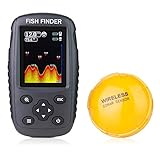
This is the pick for anyone who has read enough castable reviews to be wary of phone apps. The VT-FF005 has its own 2.6-inch color screen and its own sensor, and it talks to the two directly over a wireless link. No downloads, no pairing ritual, no battery anxiety on your phone.
Wireless range between sensor and handheld is 262 feet, and the sensor is tethered and castable, so you can drop it beside a point and read the depth while you sit. Two screen background colors — black for night, white for sun — is a small decision that turns out to matter constantly.
It reports water depth, temperature, fish depth, fish size category, and bottom contour. That last item is what separates it from the depth-only handhelds, and bottom contour is the reading that lets you follow a drop-off.
A 105-degree beam is wide enough to look impressive on paper and wide enough to cause real problems. The cone covers so much water that a fish held off to the side produces a weak return that reads like clutter, and the effective working range drops well short of the stated 164 feet. Owners consistently find it trustworthy to roughly 120 feet.
From a stationary position scanning a point, the wide beam is a genuine advantage — it paints a broad picture of a drop-off. From a kayak under way, the narrow, concentrated beams in the Deeper units resolve targets better. Buy for how you will fish, not for the widest specification.
The two-year warranty with a stated 24-hour support response is longer than most warranty terms in this roundup, and warranty length genuinely matters at the budget tier because failure is common enough to plan around. At this tier the unit is worth a spare in the dry bag.
Recurring caveats are consistent: cold weather shortens battery life noticeably, towing behind a moving boat produces false readings, and the 105-degree cone bounces signal badly off the sides of an ice hole. None of these matter for the kayak use case this roundup is about.
Because it works with no calibration and no app, you can hand it to someone who has never used a fish finder and they will be reading bottom contour within a minute. That makes it an effective teaching tool — the fastest way to learn what a ledge or a channel edge looks like on a display before you trust yourself to read live water.
Work and simulation modes let you learn the display conventions without being on the water, which is a genuine help if you have never read a fish finder before.
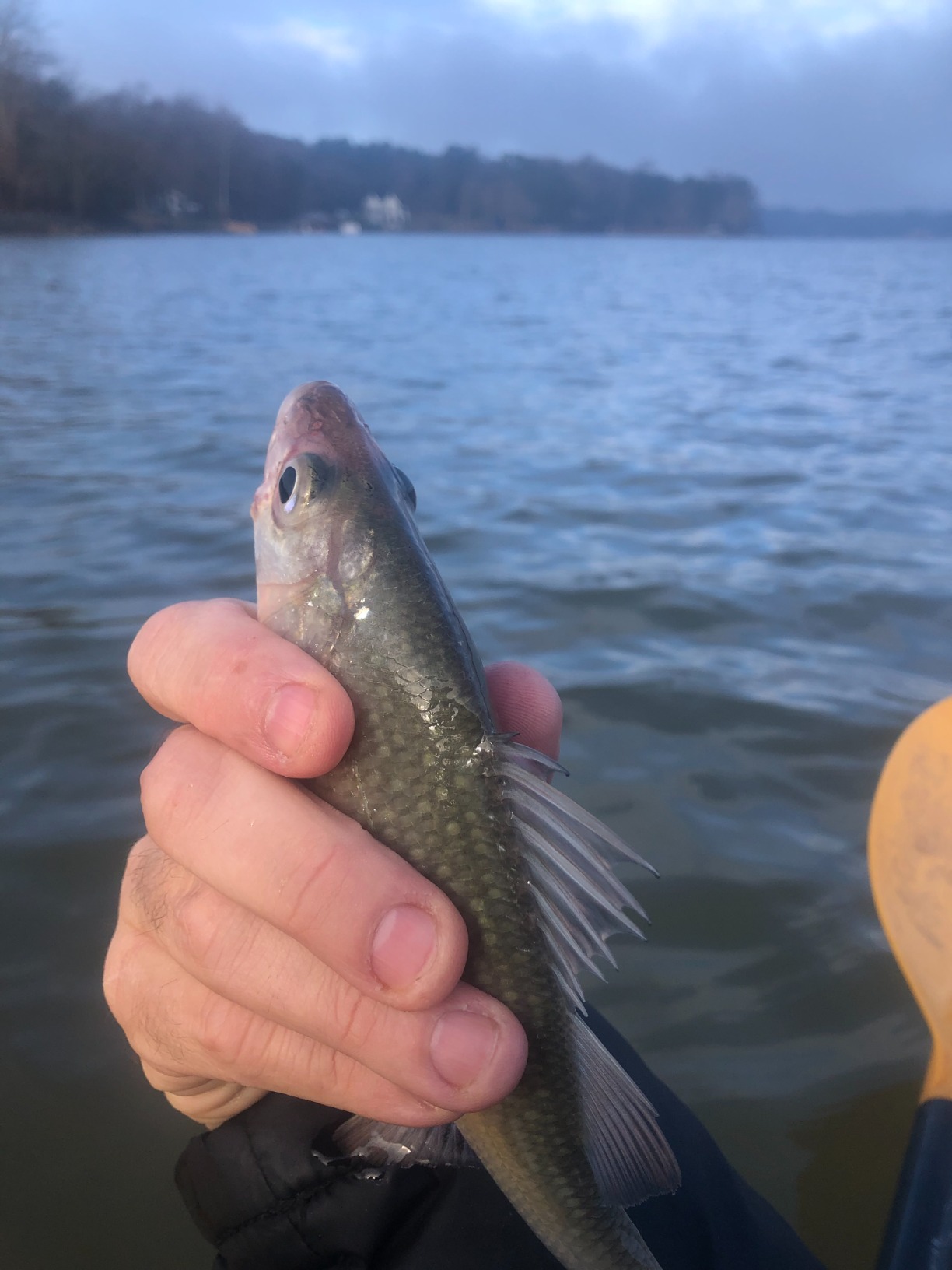
The sensor battery indicator stays unreliable until the sensor is in the water, so a reading taken on deck tells you nothing. And the fish size categories — small, medium, big — are subjective buckets with no calibration to real species, which makes them a rough filter rather than an identification tool.
If your plan is to tow this behind a pedal kayak at speed, do not. The false-reading problem is documented repeatedly and it is exactly the scenario where you need clean data.
2.4 inch
Accurate to 330 ft
0.4 inch target separation
Built-in GPS
3.2 ounces
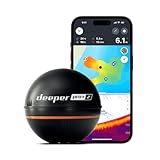
The feature that separates the PRO+ 2 from the START is the built-in GPS, and it is the reason this unit costs more. Without a GPS, a castable records scans but cannot place them on a map. With it, every sweep is geotagged and saved to the Fish Deeper app.
Depth accuracy runs to 330 feet, deeper than the other portable units in this roundup, and the three beam modes let you switch between wide coverage, mid-range, and a narrow beam with 0.4 inch target separation. That narrow beam figure is the number that matters for vertical fishing: it is fine enough to follow a single small lure or a single fish head-down.
At 3.2 ounces it disappears into a tackle box, which sounds trivial and is genuinely the difference between a device you bring and a device you leave on the truck seat.
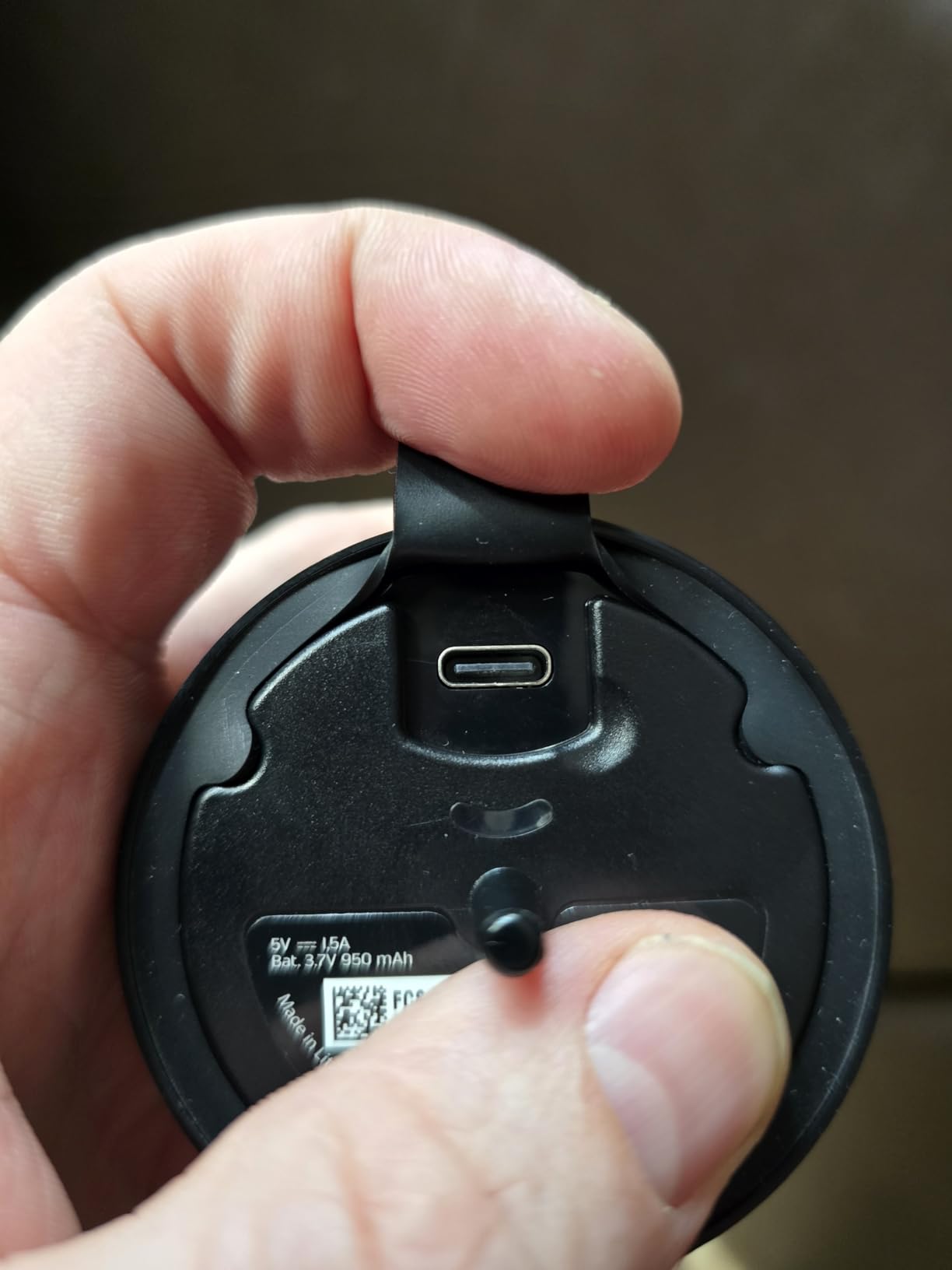
Wide beam covers the most water at the cost of separation, and it is what you use on the long paddle between spots. Mid is the general-purpose default. Narrow is the precision mode, and it is where the 0.4 inch target separation claim lives.
For a kayak angler working a specific point — a stump field, a rock cluster, an overhanging bank — switching to narrow and dragging the paddle slowly gives you a much cleaner read than any wide-beam sweep at the same spot. It is slower. It is also how you tell a bucket from a trout.
Cast in a grid while the app records coordinates, and you end up with a contour map of a lake, river, or bay that no chart provider covers. For backwater lakes, tidal creeks, and coastal flats that Google Maps does not describe, that map becomes permanent fishing knowledge. Anglers who build one rarely go back to guessing how a spot runs.
That is the value of a season of readings from water you know. If you also like the idea of keeping a young angler occupied on the dock while you work a shoreline, our automatic fish feeder picks cover the rest of that setup.
Twelve percent of reviews are one star, tied for the highest one-star share of any unit here, and the reports cluster around early production units that failed. The stated two-year limited warranty is the mitigation, but if you are buying far from a service point, understand that a dead sensor means a dead session until a replacement arrives.
Beyond that, the phone dependency applies here exactly as it does to the START. There is no screen on the unit itself, and everything runs through the Fish Deeper app on iOS or Android.
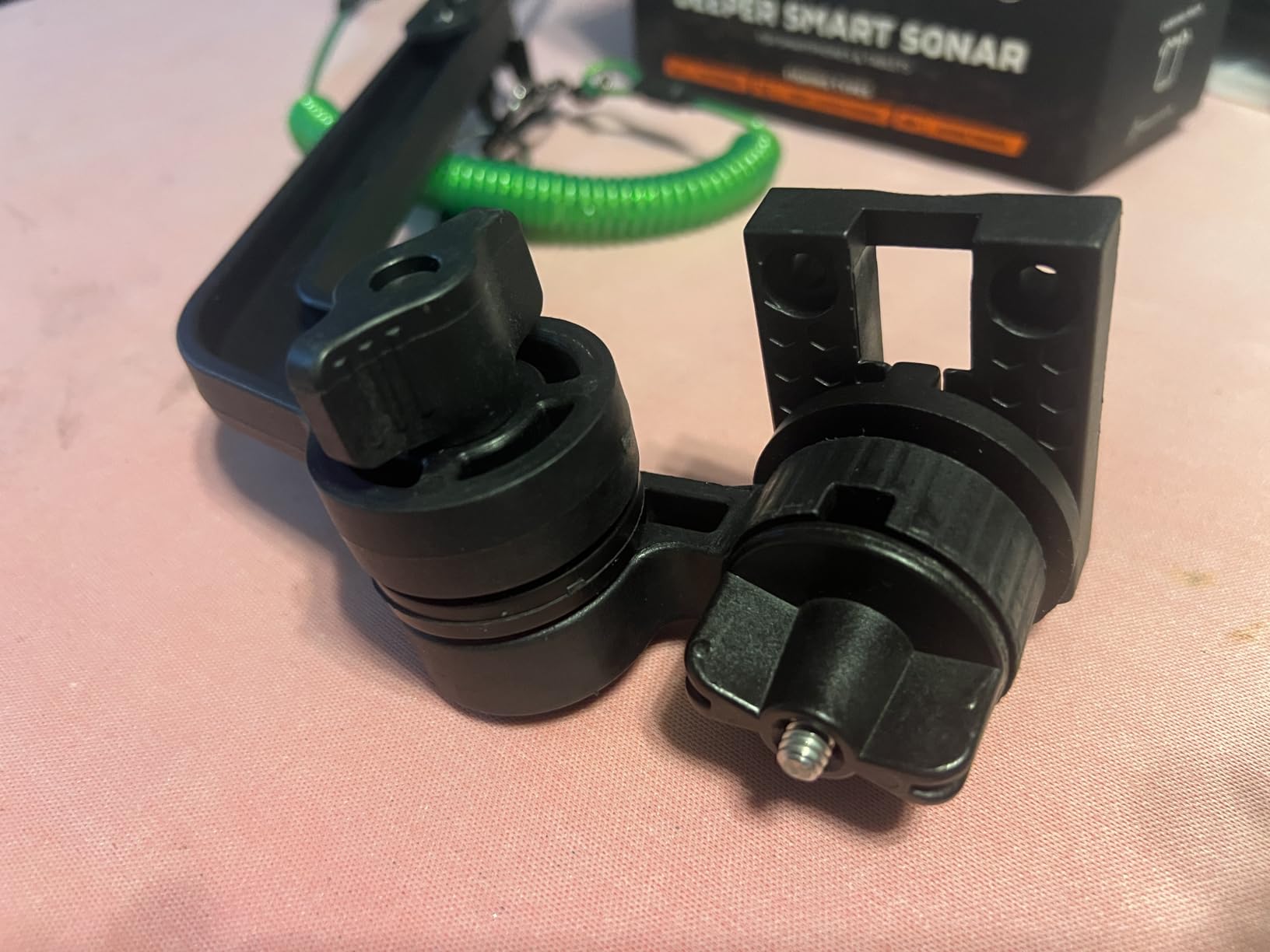
The decision comes down to GPS. If you already know the water, you already know where the structure is, and you want the deepest reading and the best target separation, the PRO+ 2 wins on every spec that matters on the water. The START wins on battery life and on having no failure history attached to its name.
If you are scouting new water for the first time, the built-in GPS is not a luxury feature — it is the entire reason the more expensive unit exists. If you are fishing your third season on a lake you know, the cheaper unit and a waterproof phone pouch is the more rational purchase.
Streams up to 200 ft
10+ hour internal battery
Flasher sonar mode
Quickdraw Community maps
75 g
Garmin built this one to solve the exact problem every other mounted unit creates: you do not want a hole in your boat. The Striker Cast is a rugged pod you tether and cast, and it streams sonar wirelessly to the free Garmin app on your phone or tablet from up to 200 feet away.
Ten or more hours on the internal USB-rechargeable battery matches or beats the other castables in this roundup, and it manages itself — the unit powers on when it detects it is floating in water and powers off when you lift it out. That single behavior eliminates the dead-sensor-at-3pm problem better than a bigger battery number.
It also streams the classic flasher mode alongside traditional 2D. Flasher is the older, more intuitive display format and a lot of anglers who grew up reading it still prefer it for vertical fishing.
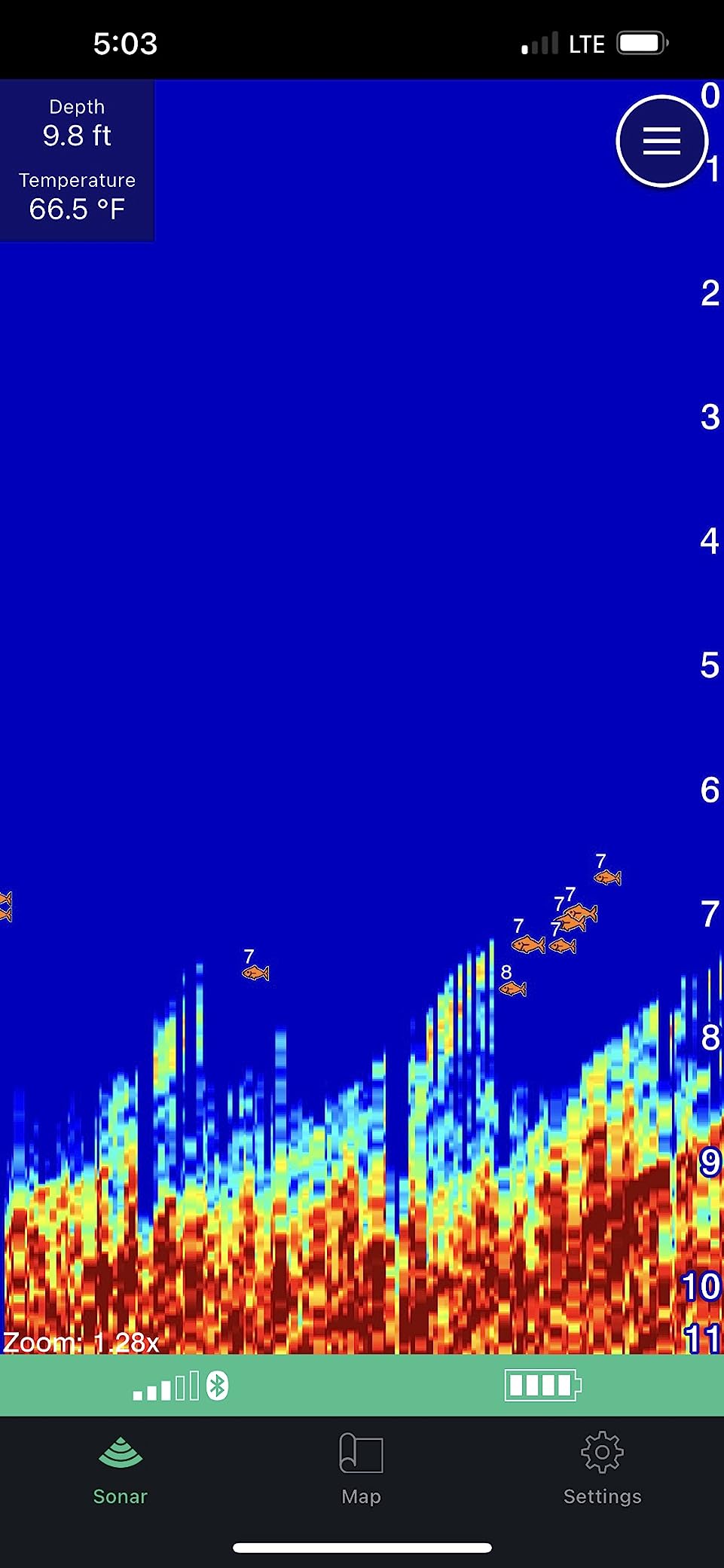
In flasher mode the display shows returns as bright moving bands rather than a scrolling trace. Fish that are moving away show one color, fish moving toward you show another, and a stationary fish sits as a solid bright return. It takes ten minutes to read and then becomes faster than scrolling.
For vertical fishing over a single target — a lake’s only piece of bottom structure, a deep hole on a shallow flat — flasher gives you a cleaner read than a scrolling trace. If your technique is jigging a drop-off, try flasher mode before you decide which unit to buy.
The app gives you access to download maps with one-foot contours from the Garmin Quickdraw Community, which is the user-generated bathymetric data set. That means the charting that normally requires a permanently mounted unit with a transducer is available on a rig you can pull out of a pocket and clip to a belt.
Between the contour downloads, the flasher mode, and the 200-foot streaming range, this covers the most functions per install. It is also the one that most obviously depends on your phone being alive and charged.
It costs more than the generic castable sensors in this roundup for the same core depth-reading job, and reviewers say so plainly. What you are paying for is the battery life, the 200-foot streaming range, the flasher mode, the automatic power management, and the map library.
For a single afternoon on an unfamiliar pond, that is a hard sell. For a full season of roaming uncharted water with no install and no wiring, it is the most sensible Garmin portable in this roundup.
Skip it if you fish one lake and already own a mounted unit, or if your phone is already the bottleneck in your setup. Sonar resolution on a phone screen is measurably lower than on the dedicated color displays, and a 4-inch or larger screen is easier to read from a kayak seat than any handset.
The two-year warranty is a good sign for durability on a device whose entire job is being dragged through vegetation and dropped in water, and the housing is built for exactly that.
200 kHz sonar
45 degree beam
3 to 328 ft range
4 to 5 hours on AAA
Portable neck strap unit
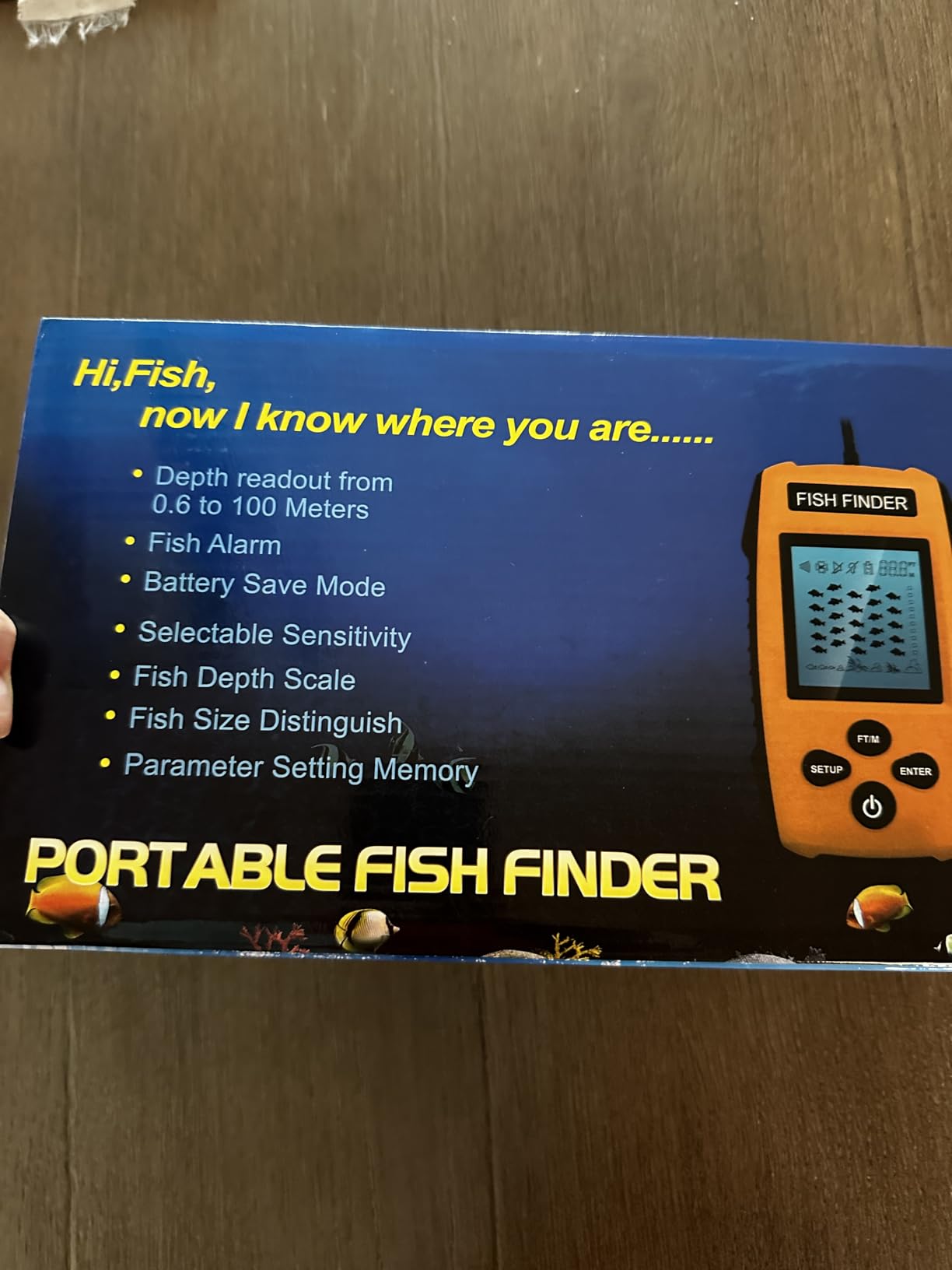
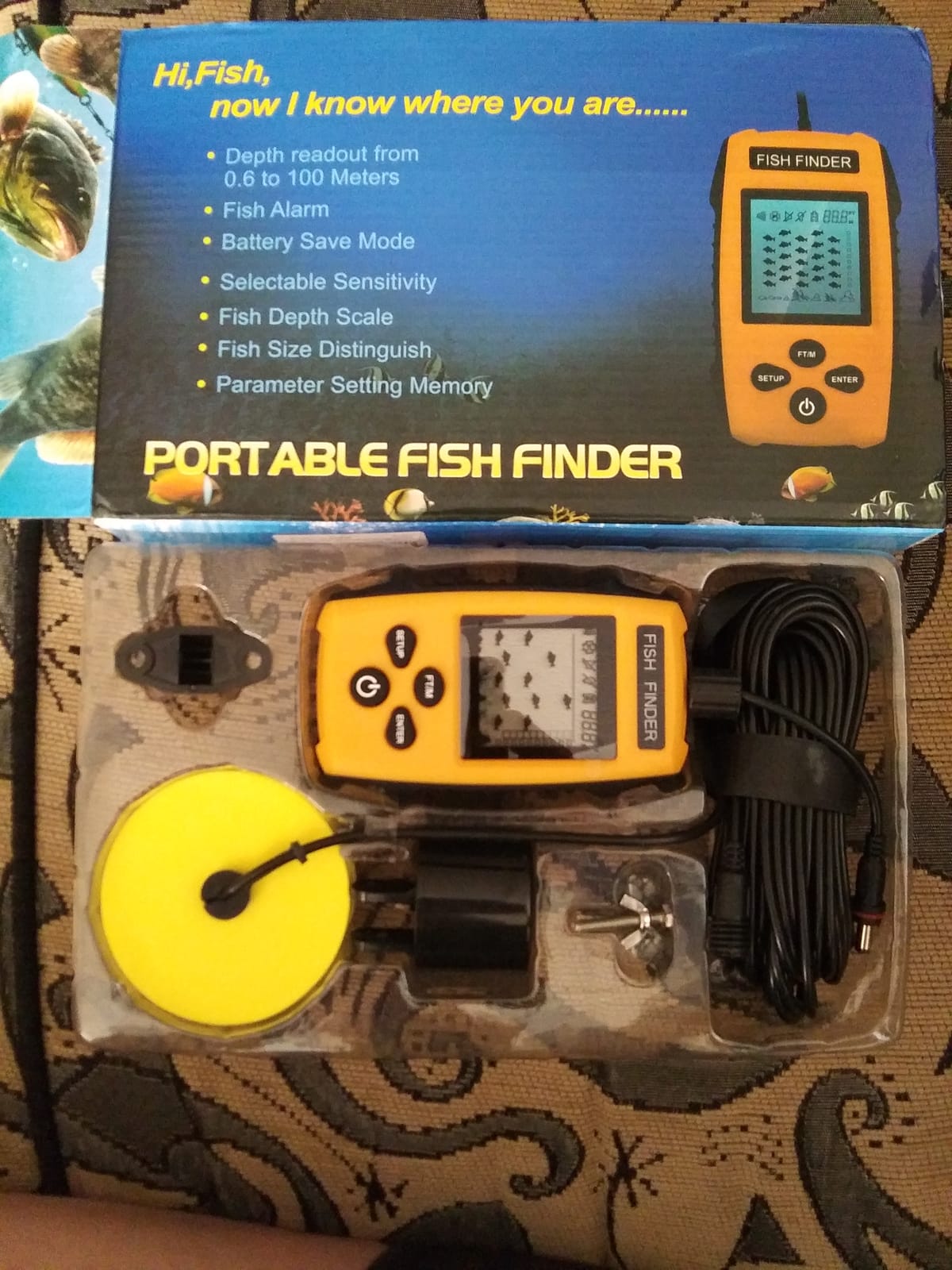
Kayak owners buying this unit consistently report the same reaction: it surprises them for the price. Depth readings are accurate, weed discrimination is real, and it is genuinely readable in daylight. Experienced anglers who leave the reviews are the ones who add the caveat that matters — it is a depth finder, not a fish finder.
Sonar is 200 kHz with a 45-degree beam from 3 feet to 328 feet. The 45-degree cone is narrow and concentrated, which gives better near-field detail than the 90- and 105-degree units here while covering less total water — exactly the right trade for a kayak moving slowly over structure.
It is specified as usable on a moving kayak below 5 mph with the transducer held bottom-horizontal, which is a genuinely kayak-shaped instruction that you will not find written down on most competing units.
Sensitivity is how the unit decides what counts as a return worth drawing. On a soft mud bottom in clear water, maximum sensitivity paints the screen with noise and you will chase echoes all afternoon. One step down and the weed edge separates cleanly from the surrounding bottom.
Stained water inverts the problem — you need more sensitivity to get any return at all. Five levels plus a battery-save mode give you a usable dial in both directions, which is more adjustment than the simpler handhelds here offer.
The unit works in both fresh and salt or sea water, which makes it viable for coastal use at the shallow end of the range. Note that sonar performance in saltwater is generally poorer than the same unit in freshwater, so treat the 328-foot figure as a freshwater number.
The below-5-mph guidance matters. At paddling speed the transducer can be suction-mounted on the hull or dragged alongside, and the reading holds. Push past that and the picture degrades quickly, the same failure mode reported on the Striker 4.
Rated at 4 to 5 hours on four AAA batteries, but owners report running shorter than rated when left on continuously. Treat the rating as a ceiling rather than a promise and carry a spare set in a waterproof pouch, which is standard practice for any AAA-powered unit on a kayak.
What you gain is settings persistence. Settings save when the unit powers off, so you stop re-tuning sensitivity every time you change batteries — a small convenience that adds up across a full season.
There is no bottom contour display on this unit, and that is the single feature separating it from the more capable handhelds in this roundup. You get an instantaneous depth number and vegetation icons. You do not get a graphic that shows you the shape of the drop-off you just found.
If you fish a flat lake where depth is obvious from the shoreline, this costs you nothing. If you are trying to learn a new body of water by reading the bottom shape, you will be working harder than an angler with the LUCKY or the Venterior, both of which draw contours.
A small number of owners report units that stop powering on after a short period of use. At this price point that is a low-stakes failure, but it is a reason to keep a second depth-reading habit — a paddle and a marked bank — until you trust the electronics.
2.4 inch color LCD
147 ft depth
90 degree beam
Rechargeable sensor
Sensor lamp
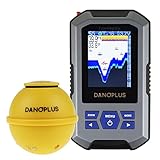
The DP-104 is a mid-budget castable whose owners consistently highlight the same thing: the 2.4-inch color screen puts depth, temperature, bottom contour, and a fish-size icon with its depth on one readable display. You get a small, dedicated display rather than your phone.
The sensor is rechargeable, which removes the single most annoying aspect of castable fishing — fishing at midnight in a cold boat, opening a wet battery sleeve with numb fingers, and dropping two AAAs into a sensor with a cover designed to trap water.
And then there is the lamp. Both sensor and screen switch on automatically when the sensor touches water, and the sensor lamp is intended to attract fish rather than merely locate your gear. Whether light actually draws fish is a question anglers have argued about for decades, so treat that as a feature to test rather than a promise.
147 feet with a 90-degree beam is the compromise here. Both figures trail the better castables in this roundup — the Deeper START reaches 165 feet, the PRO+ 2 reaches 330, and the Venterior runs a 105-degree cone.
For a kayak on a lake or a river, 147 feet is rarely the binding constraint. It becomes one on a deep reservoir run, a steep coastal drop, or a warm-water lake where the fish and the structure both sit well below 100 feet. Check your deepest water before you buy, not after.
Color matters more for castables than people expect because there is no way to adjust the display the way you can on a wired unit. A colored depth line against a white background reads at a glance in a way a monochrome line and a grayscale depth number do not, particularly in the half-second you actually have before looking back at your rod tip.
The 21 operating languages are a small thing that matters more than expected for anyone fishing outside the United States, and the screen is reported readable in daylight rather than only in shade.
One year is the shortest warranty on this roundup, against two years from the Venterior and the Deeper PRO+ 2. At this tier that is a legitimate reason to prefer a competitor when the two units otherwise fit your needs, because a castable sensor is the part most exposed to water, impact, and cold.
Recharge cycles are the other durability variable to think about. A sensor battery left empty through a winter storage period degrades faster than a replaceable cell you can swap in March, and that tradeoff only bites in year two.
Buy it if you fish at night, if you want a dedicated screen rather than your phone, and if your deepest water is under 140 feet. Do not buy it for deep offshore structure, for ice fishing through a narrow hole, or as a long-term investment you expect to still own in five years.
The fish alarm, which fires on screen when fish pass through the sensor’s coverage area, is a genuine convenience for someone fishing a dock or a boat at anchor and wanting to know something moved.
135 ft depth
10+ hour rechargeable battery
Bluetooth to phone apps
Smartwatch app support
Depth-tagged fish icons
With 6,659 reviews, the iBobber is among the most examined products in this roundup, and its 4.0 rating reflects a real split rather than a consensus. Owners are enthusiastic about the design and blunt about the wireless link.
Start with the design, which is good. It is genuinely pocket-sized, has a metal-lined attachment eyelet rather than a plastic loop, and the flashing LED ring makes it findable in the dark. Owners consistently verify the 10-plus-hour rechargeable battery in real use, and smartwatch support means you can read depth without touching your phone at all.
Then look at the physics. Bluetooth range is roughly 40 feet in practice even with clear line of sight, and the minimum operating depth is about 5 feet. That combination makes this a shore, dock, and pier tool rather than a kayak tool, which is why it is on this list at all — it is the pocket-sized option for still, shallow-to-mid depth water.
Bluetooth simply does not carry sonar data 200 feet reliably, and the gap between the stated range and the practical range is the most-reported complaint about this unit. Roughly 40 feet is the effective limit, which is enough if you are standing on a bank or sitting on a dock and not enough if you are casting from a kayak.
Connection stability also degrades around aluminum hulls, which knocks it out for a surprising number of anglers until they test it in their own boat. If your primary water is an aluminum vessel, verify the pairing before you rely on it.
The minimum operating depth of roughly 5 feet is a hardware constraint tied to how the sonar cone develops in a shallow body of water. There is no menu setting that fixes it. In water shallower than that, the unit gives you nothing useful.
For a kayak angler working a shallow creek, a marsh edge, or a lake margin in spring, this is disqualifying. For someone fishing a dock in a lake that drops off quickly within 5 feet of the structure, it is fine — and for most shore anglers, the dock and pier fish alarm is exactly the use case it was designed around.
The app is a significant battery drain because it keeps a live Bluetooth connection open. Ten hours of sonar is realistically five or six hours of usable phone with the app running, which erodes the headline battery claim on any unit that depends on a phone for display.
The strike alert deserves a specific warning. It triggers on the smallest movement, including a bobber bouncing in a current, which makes it useless as an actual bite indicator and worse, actively annoying. Leave it off unless you are fishing very still water in very light current. The fish alarm, which fires when fish gather under a dock or pier, is the one worth having on.
The displayed depth scale runs counter-intuitively, with the farthest point from you shown as zero. Anglers new to the unit consistently misread this on day one and assume the unit is broken. Spend ten minutes with the free demo mode before you judge it — the app includes one, and it is better than the fishing.
Once the scale makes sense, the depth-tagged fish icons color-coded by size are genuinely useful at a glance, and the visual sonar image of static structure is enough to pick out a drop-off from a dock.
If you fish from a bank, a dock, or a pier in water deeper than 5 feet and you want something that fits in a pocket, this is a strong buy with a real battery and a good app. If you fish from a kayak in moving water, the Bluetooth range and shallow-water minimum make it the wrong tool no matter how many people recommend it for shore fishing.
That is the honest read of a 4.0 rating with 6,659 reviews: a product that does one job well and is mismatched to another, with a design that was never updated for the way people fish now.
This is the section that decides whether you keep using your fish finder or end up riding with a broken cable zip-tied to a hull. Three mounting methods cover essentially every kayak, and the constraint that catches most people is not the mount — it is the hull material.
Most fishing kayaks have scupper holes that already pass through the hull for drainage. A scupper mount passes a post up through the hole and holds the transducer on the inside of that channel, then a bracket above deck carries the arm or the display. Nothing is drilled, the hull is untouched, and it reverses in five minutes with a screwdriver.
The limitation is scupper hole diameter. If your holes are narrow, a scupper post will not pass, and you should not force it. Check the hole with a caliper before you buy the mount.
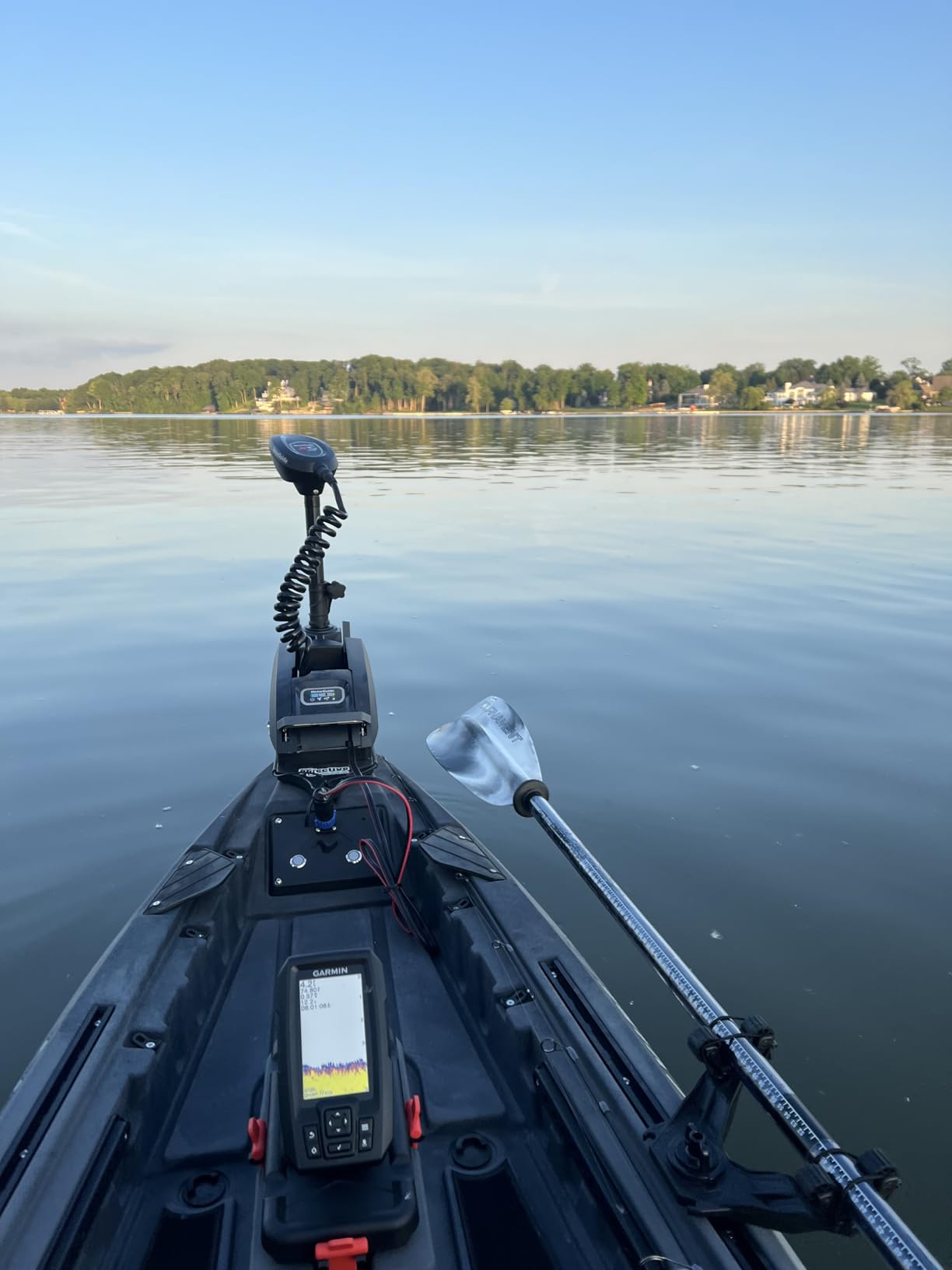
This is the configuration forum anglers name most often: a Scotty 141 transducer arm on a RAM ball mount, with the arm clamped to the rail behind the seat or the bow track. It puts the transducer in clean water off the side of the hull, away from the turbulence and aeration that a hull-mounted puck sits in.
The advantage over a scupper mount is signal quality and flexibility — you can raise and lower the arm to change your depth reading, which is useful when you want to scan a deep ledge or work shallow flats. The disadvantage is the cable run, which must be routed with slack so it does not transmit every paddle stroke to the display as a false target.
Route the cable inside the hull where possible, secure it to the arm with soft ties so it cannot chafe on the hull side, and leave a service loop near the display so strain does not reach the transducer’s cable entry — that entry point is where units fail.
An in-hull transducer is bedded inside the hull with silicone and reads through it, which is a shoot-through installation. It is the cleanest looking option and it has one serious drawback: the hull attenuates the signal, so you get reduced range and lower target separation compared with a wet-mounted transducer on an arm.
A through-hull installation gives you a wet-mounted unit with full signal strength, and it requires cutting a hole in the hull. Once that hole exists it cannot be un-drilled, which is why it makes sense on a boat you own long-term and not on a rental or a boat you might resell.
On an aluminum, wood, steel, or foam hull, adhesive mounting does not work. Anglers know this and it appears in nearly every installation thread: you cannot reliably bond a depth sounder transducer to those materials, and only fiberglass accepts a bonded in-hull puck with any confidence, and even then with caveats. Check your hull material first.
Yes. A sonar transducer reads by sending a pulse into water and listening for the echo, so it needs water beneath it to return a reading. In air it will show a reading only if you hold it against the inside of a wet, flooded hull — a technique anglers use to test whether a unit powers on, not to fish with.
This is why a castable sensor only starts working when you throw it in, and why the Garmin Striker Cast switches itself on automatically on water contact. It also explains why a hull-mounted transducer reads poorly when the kayak is lifted onto a trailer or beached, even though the unit itself is IPX7 rated and perfectly fine.
No, not reliably. Transducers must match the unit on three things: the connector type, the frequency range the head unit is designed to interpret, and the mounting style. A Garmin GT20 into a Humminbird head unit will not connect physically in most cases, and even where a connector fits, the pinouts and data formats differ.
The practical rule: pair each unit with its own supplied transducer, and if you need a different one — a through-hull model, a deeper-range puck, or a temperature sensor — buy the branded replacement for that exact unit. Third-party cross-brand adapters exist for a few popular pairings but they are hobbyist-level solutions, not something to build a season on.
The one genuinely flexible case is a shoot-through in-hull puck, where the transducer has no data connection at all and simply reads acoustically through the hull. Those can often be moved between compatible units of the same frequency band. Everything with a cable is brand-paired.
Add an inline fuse between the battery and the head unit, sized to the unit’s draw. The Striker 4 pulls 0.23 amps at 12 volts, which is under 3 watts, so almost any small fuse protects the electronics without nuisance-tripping. Do not skip the fuse: anglers who repurpose trolling motor batteries warn specifically about voltage spikes damaging sensitive electronics without proper fusing.
For battery math, divide amp-hours by current draw for a rough runtime. A 7 amp-hour sealed lead-acid with a 0.23 amp draw gives you well over 24 hours, limited by the battery’s own self-discharge rather than the unit. A 10 amp-hour lithium pack is lighter, holds its charge through a season of storage, and is the better choice if you also want to run a small navigation light or a GoPro off the same box.
Keep the fuse, the connection, and any battery box inside the hull, dry, with the cable entering through a scupper hole or a sealed bulkhead rather than over the gunwale. Salt spray and standing water in a connector are the most common cause of the failures owners report on every unit in this roundup.
Seven decisions account for nearly every regret in this category. Here they are in the order you should make them, from the one that dictates your install to the one that decides your screen size.
A mounted unit gives continuous coverage, a permanent dash, and a display you can read without holding anything. It requires wiring, a battery, and a mount, and in most cases a transducer position on the hull. That is real work, done once.
A castable unit gives you nothing to install and total freedom to move. It costs you display quality if you use your phone, adds a wireless link that can fail, and gives you data only where you point it. Choose castable if you roam, share boats, or have a fiberglass hull. Choose mounted if you fish the same water repeatedly.
Traditional 2D sonar is a single trace showing depth and fish arches. CHIRP traditional sends a continuous sweep of frequencies in one ping, which produces cleaner arches and better target separation. ClearVu on Garmin, Down Imaging on Humminbird, and DownVü on Lowrance are all the same idea: a high-frequency downward view that renders structure near-photographically.
SideVü, Side Imaging, SideScan, and TripleShot are the brand names for the horizontal equivalent, adding a view to port and starboard. For a kayak, down imaging earns its cost more readily than side scanning, because it reads the structure directly beneath and ahead of you, which is where a kayak is pointed. Side scanning shines on timber-heavy lakes and big reservoirs where a ledge extends 40 feet to your side.
Note the term mismatch when comparing brands. Garmin’s SideVü, Humminbird’s Side Imaging, and Lowrance’s SideScan or TripleShot are competitors for the same job, and you should compare them to each other rather than to a brand’s own 2D mode.
For a kayak, 3.5 to 4 inches is the working range. Larger screens are readable in direct sun and legible in shade — a side-by-side comparison worth doing in person if you can. Smaller screens force you to hold the unit rather than glance at it.
IPS panels are brighter and hold color better in sunlight than standard LCD. More importantly, the mounting angle determines readability far more than the panel: angle the display toward your face, not flat to the deck, and a 3.5-inch LCD becomes readable in conditions where a 7-inch flat-mounted unit is a mirror.
Check readability through polarized sunglasses if you wear them. A display that vanishes when you put your glasses back on is unusable for your eyes specifically, regardless of its measured brightness.
Every Garmin unit in this roundup has built-in GPS for waypoints, routes, and speed. Waypoints are the single most valuable non-sonar feature for a kayak angler, because marking a productive piece of structure and returning to it is how you convert scouting into repeatable fishing.
Charting is the tier divider. Quickdraw Contours (Garmin), AutoChart Live (Humminbird), and Genesis Live (Lowrance) are the three brands’ names for building depth maps as you move. If you fish uncharted water, this is worth real money. If you fish a mapped reservoir, it is a nice-to-have.
For a portable unit, ask whether it has a built-in GPS or only your phone’s. The Deeper PRO+ 2 and Garmin Striker Cast give you downloadable contours without a permanent install, which is a low-cost path to charting for a roaming kayak angler.
Multiply the unit’s rated current draw in amps by its input voltage to get watts, then divide the battery’s watt-hours by that figure for runtime. The Striker 4 at 0.23 amps on 12 volts is under 3 watts, so any sealed lead-acid battery from 7 amp-hours up will outlast the fishing day.
Battery type matters more than capacity. Sealed lead-acid is cheap and heavy. Lithium iron phosphate holds its charge through months of storage, weighs noticeably less for the same capacity, and tolerates partial discharges without damage. For a kayak where every pound affects how the boat handles, lithium is the better long-term choice.
For phone-dependent castables, add a power bank to the runtime math. A sonar app running live over Bluetooth will consume your phone faster than the sonar consumes itself.
Almost every roundup in this category assumes freshwater, and almost none of them explain the difference. Saltwater attenuates sonar faster, which is why depth ratings drop — the Striker 4 is 1,600 feet in freshwater and 750 feet in saltwater. That halving is normal and it is not a defect.
For coastal and estuarine fishing, prioritize units with a minimum depth low enough for your water, a transducer rated for the salinity, and a corrosion-resistant connection. Flush transducers with fresh water after every saltwater session. Mounting hardware in saltwater will pit and seize if you leave it, and a seized RAM ball mount mid-trip is a bad day on the water.
Note the castable trade-off: castables avoid hull corrosion entirely because nothing is attached to the hull, which is a real argument for them in salt water even when a wired unit has better specs.
A pedal-drive kayak covers far more ground than a paddle kayak and holds a straight line while you fish, which changes the electronics math in two ways. First, more water per session means battery life and mapping capacity matter more. Second, and more importantly, you will be moving at speeds where the sonar on most kayak-rated units degrades — the Striker 4’s owners report signal loss above a drift speed.
For pedal-drive setups, prioritize a unit with a wide beam and strong down imaging, plus enough battery for a full day of slow trolling. The 4-inch color class units in this roundup handle that better than the 2-inch handhelds, and you should budget for a proper battery box rather than the smallest pack that technically works.
Offshore-capable kayaks add one requirement no spec sheet covers: a unit you can read at a glance in spray, at speed, in bright reflected light. That argues for the largest screen your deck can carry and a mounting angle that survives wind and chop.
If you are also building out a dock or bank setup alongside the kayak rig, our best betta fish bowl alternatives and angler fish gift picks cover the on-shore side of the setup.
Yes. A fish finder works very well on a kayak and is close to essential gear for anyone fishing lakes or reservoirs from one. The main constraints are space, weight, and power rather than functionality. A 3.5 to 4 inch mounted unit with a RAM ball mount and a small battery is the standard setup, and castable wireless units work well when you want zero installation.
The Garmin Striker 4 is our best overall pick because it is small enough for a kayak deck, readable in full sun, and rated to 1,600 feet in freshwater. If you want zero installation, the Garmin Striker Cast streams sonar up to 200 feet to your phone with a 10+ hour battery. If you want charting without wiring, the Deeper PRO+ 2 has a built-in GPS.
The three methods are a scupper hole mount, a transducer arm on a RAM ball or Scotty base, and an in-hull or through-hull installation. The scupper mount requires no drilling and is the easiest to reverse. The arm mount puts the transducer in clean water for the best signal and lets you raise or lower it. Adhesive in-hull mounting only works on fiberglass hulls, not on aluminum, wood, steel, or foam.
Yes. A sonar transducer sends a pulse into water and reads the returning echo, so it needs water beneath it to produce a reading. In air it will only show a reading against the inside of a wet, flooded hull, which anglers use as a quick power-on test. This is why castable sensors only start working when thrown in the water.
No. Transducers must match the head unit on connector type, frequency range, and mounting style. A Garmin GT20 will not work in a Humminbird unit in most cases even where a connector physically fits. The practical rule is to use the supplied transducer and buy a branded replacement for the exact unit if you need a different type. Shoot-through in-hull pucks are the only broadly interchangeable option.
A mounted unit like the Garmin Striker 4 draws about 0.23 amps at 12 volts, so a 7 amp-hour sealed lead-acid battery gives you well over 24 hours of continuous sonar and the real limit is your eyes, not the battery. Castables vary widely: the Garmin Striker Cast runs 10+ hours on its internal rechargeable battery, while phone-dependent units are limited by your phone rather than the sensor.
Not always. Down imaging, also called ClearVu, Down Imaging, or DownVu, reads the structure directly beneath and ahead of you, which is where a kayak is pointed. Side scan, called SideVu, Side Imaging, or SideScan, is more valuable on timber-heavy lakes and big reservoirs where a ledge extends off to your side. It is optional for shallow creek and river fishing.
Both are strong and the practical differences are ecosystem rather than capability. Garmin units pair with Quickdraw Contours mapping and are widely regarded as easier to operate. Humminbird is repeatedly described in angler forums as having the sharpest side imaging in its price class, and AutoChart Live is its equivalent mapping tool. Judge them on which transducer and charting ecosystem you already have, not on brand.
You can, and it is a common upgrade path, but you should expect to add a mounting system, a battery, and possibly a different transducer. The head unit will work; the boat transducer is usually too large or too deep to suit a kayak. Anglers who move from a small boat to a kayak typically keep the head unit and change the transducer and mount.
Our best overall pick remains the Garmin Striker 4. At 8 ounces with CHIRP and ClearVu sonar, an IPX7 rating, and GPS waypoint marking, it does everything a kayak angler needs without crowding the deck or dominating the battery budget. Add a RAM ball mount, a small sealed battery, and a Scotty transducer arm, and you have the rig most commonly cited in angler forums.
If your cockpit has room and you want color plus charting, step up to the Garmin Striker Vivid 4cv, the highest-rated unit in the roundup at 4.7. If you fish water nobody has charted, the Deeper PRO+ 2 builds you a bathymetric map from a cast.
If you refuse to drill or wire anything, the Garmin Striker Cast gives you 200-foot streaming range and a 10+ hour battery, and the Venterior VT-FF005 gives you a dedicated screen with no app at all. If you are starting from nothing and keeping costs down, the LUCKY FFC1108 is a working depth sounder that will teach you what the bottom looks like.
If you fish from a dock or a bank rather than from the water, the ReelSonar iBobber fits in a pocket with a verified long battery, but respect its 40-foot practical range and 5-foot minimum depth.
Whichever you choose, the install decides whether you use it. Budget for a mount, a battery with an inline fuse, and cable routing inside the hull before you cut anything. Our full guide to best fish finders for kayaks is updated for 2026, and the picks above are the ones we would put on our own boat this season.