Physical Address
304 North Cardinal St.
Dorchester Center, MA 02124
Physical Address
304 North Cardinal St.
Dorchester Center, MA 02124

Leverage the power of triangulating DNA matches to unlock your ancestral puzzle, but are you ready to discover the tools that can elevate your journey?
Triangulating your DNA matches represents one of the most powerful techniques in modern genetic genealogy. As we move through 2026, more family historians are discovering how this method transforms scattered autosomal DNA matches into organized genetic networks that reveal ancestral connections. Whether you are trying to identify an unknown great-grandparent or simply confirm a suspected relationship, understanding how to triangulate DNA segments effectively separates casual testers from serious genealogists.
The landscape of DNA testing has shifted dramatically over the past year. With changes at major testing companies and evolving privacy standards, knowing which tools and methods work best has become essential. This guide walks you through everything from the fundamental concepts of shared match triangulation to advanced techniques using chromosome browsers and third-party analysis platforms. You will learn the Point A, Point B, Point C framework that professional genetic genealogists use, discover how to interpret centimorgan thresholds for accurate relationship prediction, and explore real case studies demonstrating how triangulation solves real family history mysteries.
By the end of this guide, you will understand not just what DNA triangulation means, but how to apply it systematically to build confirmed ancestral lines, avoid false matches that lead research astray, and integrate genetic evidence with traditional genealogy documentation for irrefutable proof of kinship.
DNA triangulation is a methodology used in genealogical research to confirm shared ancestry among three or more individuals by identifying common DNA segments on specific chromosomes. When properly executed, this technique provides strong evidence that multiple testers inherited the identical by descent (IBD) segment from a shared ancestor.
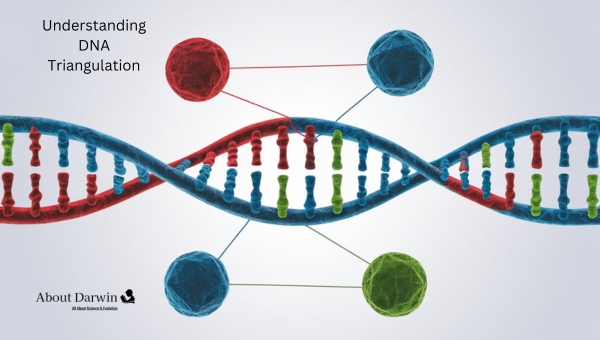
The concept derives from classic surveying techniques where a point is determined by measuring angles from two known points. In genetic genealogy, Point A represents your DNA, Point B represents one match, and Point C represents a second match. When all three points share the same DNA segment on the same chromosome location, you have achieved true triangulation.
For triangulation to yield valid genealogical proof, all participants must match each other on the same DNA segment, typically measuring at least 7-10 centimorgans depending on the testing platform and analysis tools used. This creates a genetic triangle where Person A matches Person B, Person A matches Person C, and Person B matches Person C on overlapping chromosome locations, indicating a shared genetic heritage from a common ancestor.
Access to detailed segment data is necessary for accurate triangulation, which may require additional tools beyond basic testing platforms like AncestryDNA. While ethnicity estimates provide broad geographic origins, triangulation focuses on the specific inherited segments that connect you to your genetic matches, allowing precise tracing of your genetic lineage through specific ancestral lines.
Professional genetic genealogists use a systematic framework for identifying and confirming triangulated groups. This Point A, Point B, Point C methodology provides a structured approach that ensures you are working with valid genetic connections rather than coincidental segment matches.
Begin by selecting a DNA match with whom you share at least 15-20 centimorgans. This match serves as your anchor point, or Point A. Ideally, this person has a family tree attached to their profile or has responded to contact attempts, as you will eventually need genealogical context to identify your most recent common ancestor (MRCA).
Document the total shared centimorgans, the number of segments shared, and any known relationship information. If you have access to a chromosome browser, note the specific chromosome number and segment start and end points. This baseline data becomes crucial as you expand your triangulation group.
Next, identify a second match (Point B) who shares DNA with both you and Point A. On platforms with chromosome browsers, verify that Point B matches you on the same chromosome segment where you match Point A. The overlap does not need to be perfect, but there must be some shared region among all three testers.
Research Point B’s family tree or gather whatever genealogical information they can provide. Look for common surnames, geographic locations, or time periods that overlap with Point A’s ancestry. At this stage, you are building a hypothesis about which ancestral line these matches might share.
The final step involves finding Point C, a third match who shares DNA with both you and Point A, and ideally with Point B as well. When all three matches share overlapping segments, you have created a true triangulated group. This configuration strongly suggests that all participants inherited that DNA segment from a shared ancestor.
Once you have established a triangulation group, the genealogical work begins. Compare family trees among all participants to identify the most recent common ancestor. This ancestor passed down the shared DNA segment to all members of your triangulated group, giving you a confirmed genetic connection to that specific branch of your family tree.
AncestryDNA’s platform, while the largest database of genetic testers, presents significant limitations for precise genealogical research due to its lack of detailed DNA segment data. While it provides valuable ethnicity estimates and genetic communities, the platform does not offer chromosome locations or specific DNA match start and end points that true triangulation requires.
Without a chromosome browser, confirming whether shared DNA occurs on the same segment becomes challenging. Two matches might both share DNA with you but on entirely different chromosome segments, meaning they do not triangulate despite appearing in your shared match lists. This limitation hampers the ability to effectively leverage new DNA matches for genealogical purposes requiring segment-level precision.
Shared match triangulation represents a fundamental technique for discovering potential shared ancestry among autosomal DNA testers. This process occurs when Person A matches Person B, Person A matches Person C, and Person B matches Person C, suggesting a possible common ancestor shared by all three participants.
To confirm true triangulation rather than coincidental matches, these participants must share the same DNA segment on the same chromosome. This requirement can be difficult to achieve on platforms that do not provide segment data, such as AncestryDNA, where researchers must rely on indirect methods to infer potential triangulation.
To ensure reliable identification of common ancestors, effective triangulation usually involves segments of at least 7 centimorgans. Segments below this threshold carry higher risks of false positives due to population-level genetic similarities rather than true shared ancestry. Additionally, the relationships between individuals can affect the accuracy of triangulated connections, as shared DNA might not always come from the same ancestral line when dealing with endogamous populations or pedigree collapse.
To improve triangulation accuracy, consider using third-party tools and chromosome browsers available through platforms like GEDmatch, Family Tree DNA, or MyHeritage. These resources provide detailed segment data, enhancing your ability to confirm shared segments and validate common ancestry with greater precision.
Also Read: What Is AncestryDNA Triangulation? – Family History Guide
Understanding centimorgan thresholds is essential for accurate relationship prediction and reliable DNA triangulation. Centimorgans (cM) measure the likelihood that two DNA segments will recombine in a single generation, effectively quantifying genetic distance between matches.
For triangulation purposes, segment size directly correlates with accuracy. Segments measuring 15 centimorgans or larger carry approximately 99% probability of being identical by descent (IBD) rather than identical by state (IBS), meaning they genuinely came from a shared ancestor rather than representing population-level genetic similarities.
Segments between 10-15 centimorgans offer strong reliability for triangulation, with roughly 95% accuracy for IBD identification. These segments typically trace back to common ancestors within 6-8 generations, making them valuable for genealogical research involving third, fourth, and fifth cousins.
The 7-10 centimorgan range represents the practical minimum for serious triangulation work. While segments in this range have a 75-90% chance of being IBD according to research from the Shared cM Project, they require careful analysis and additional supporting evidence. Segments below 7 centimorgans should generally be excluded from triangulation groups as false match rates increase substantially.
When working with smaller segments, additional verification becomes necessary. Look for multiple triangulated matches on the same segment, confirm genealogical connections through traditional research, and consider the population background of your matches. Endogamous communities may require higher thresholds due to increased background genetic sharing.
To illustrate how triangulation works in practice, consider this real-world example of identifying an unknown third great-grandfather. Sarah, an avid genealogist, had documented all her ancestral lines except for her paternal great-great-grandmother’s father. Traditional records from rural Virginia in the 1820s provided no clear documentation.
Sarah began by examining her autosomal DNA matches on a platform with chromosome browser capabilities. She identified a match named Robert who shared 42 centimorgans across three segments. After contacting Robert, she learned his family tree included a cluster of ancestors from the same Virginia county where her brick wall ancestor lived.
Using the chromosome browser, Sarah identified that one 18-centimorgan segment on chromosome 7 represented their largest shared region. She then examined her shared matches with Robert, finding three other testers who also matched on the same chromosome 7 segment with overlapping start and end points.
Sarah contacted these triangulated matches and discovered they all descended from a man named William Harrison through different children. By comparing the amount of shared DNA and using relationship prediction tools, Sarah determined that William Harrison was likely her third great-grandfather. Traditional genealogical research then confirmed this hypothesis through land records and church documents that connected William to her documented great-great-grandmother.
This case demonstrates how triangulation transforms random DNA matches into confirmed ancestral connections. Without the chromosome-level data showing shared segments, Sarah would have had no way to distinguish matches who truly shared that specific ancestor from those related through different family lines.
Navigating the complexities of AncestryDNA triangulation comes with several challenges that can impact genealogical research outcomes. While DNA testing provides valuable insights, limitations in analyzing shared matches on Ancestry’s platform can lead to misinterpretations and faulty assumptions about shared ancestry.
Consider these significant challenges when working with AncestryDNA data:
A common misconception among genetic genealogy beginners involves using close relatives for triangulation. Many assume that if they match a sibling and both match a distant cousin, they have created a valid triangulated group. However, this represents a fundamental misunderstanding of how genetic inheritance works.
When comparing DNA with a sibling, parent, or other close relative, you share large portions of your genome through immediate common ancestors (your parents). Any match you both share could have inherited DNA from either of those parents, meaning you might match on completely different segments inherited from different grandparents.
For example, if you and your sister both match a third cousin, you might have inherited that shared DNA from your paternal grandfather, while your sister inherited her matching segment from your maternal grandmother. Without a chromosome browser to verify you both match on the exact same segment, including the same start and end points, you cannot assume true triangulation occurred.
Effective triangulation requires matches who are distant enough that they only share one known connection. Second cousins and beyond work well for triangulation because they share only one set of great-grandparents with you. Parents, siblings, grandparents, aunts, uncles, and first cousins should be excluded from triangulation groups but can serve as valuable tools for separating maternal and paternal matches through other techniques.
Analyzing the accuracy of triangulated matches in genealogy requires a careful approach due to inherent complexities and potential errors in genetic analysis. Triangulation, used to identify a common ancestor among shared matches, can be prone to inaccuracies when researchers fail to account for segment size, population genetics, and relationship complexity.
Research from the genetic genealogy community shows a 75-90% chance of correctly identifying a common ancestor through triangulation, influenced significantly by the size of shared segments. Segments under 10 centimorgans increase the likelihood of false matches due to population-level genetic similarities, complicating the triangulation process and potentially leading to incorrect ancestral assignments.
The accuracy of triangulation can reach up to 99% when properly selected segments measuring 15+ centimorgans are used effectively with thorough genealogical documentation. However, this high accuracy is often hindered by platforms lacking segment data, making it challenging to confirm if matches truly share the same chromosome segment or merely appear in shared match lists coincidentally.
To maximize accuracy, combine genetic triangulation with traditional genealogical research. Build family trees for your matches, identify the most recent common ancestor through documentary evidence, and use the genetic data to confirm your paper trail. This integrated approach provides the strongest proof of kinship available to modern genealogists.
Different DNA testing companies offer varying capabilities for triangulation. Understanding each platform’s strengths and limitations helps you maximize your genetic genealogy research across multiple databases.
Family Tree DNA (FTDNA) and MyHeritage DNA provide built-in chromosome browsers that make true segment triangulation straightforward. Both platforms allow you to select matches and view exactly where your segments overlap. MyHeritage offers a particularly user-friendly interface showing triangulated segments automatically, while FTDNA provides advanced tools for separating maternal and paternal matches when you have connected relatives tested.
23andMe includes a chromosome browser in their DNA Relatives tool, allowing you to compare segments with matches directly. Their interface shows where you share DNA and provides relationship predictions based on total shared centimorgans. However, recent changes at the company may affect long-term data access, making it wise to download your raw data for backup and third-party analysis.
Since AncestryDNA lacks a chromosome browser, researchers use indirect triangulation methods. The shared matches feature shows who matches both you and another tester, but remember that these individuals may match on different segments. To achieve true triangulation with Ancestry matches, encourage your matches to upload to GEDmatch or another platform with chromosome browsing capabilities, where you can verify segment overlap.
Effective tools are crucial for navigating the complexities of genealogical DNA research, particularly when dealing with autosomal DNA matches and triangulation groups. The right resources can streamline your analysis process and deepen your understanding of genetic genealogy principles.
Also Read: Debunking DNA Myths and Facts About DNA and Genealogy
GEDmatch serves as an essential platform for serious genetic genealogists seeking to perform true DNA triangulation. Users can upload raw DNA data from various testing companies to this accessible platform, significantly broadening their research scope beyond any single company’s database. By utilizing GEDmatch’s settings to filter out close relatives, researchers can focus on more distant genetic matches, aiding in the identification of common ancestors through shared DNA segments.
The One-to-One comparison tool allows you to examine specific segment data between any two kits, showing exactly where your DNA overlaps and the precise centimorgan measurements. This level of detail is essential for confirming true triangulation.
The One-to-Many tool generates lists of all matches sharing DNA with a selected kit, which you can then analyze for triangulation potential. By comparing these matches against each other using the Multi-Kit Analysis tools, you can identify triangulated groups efficiently.
GEDmatch offers a range of features that enhance your genealogical research:
Privacy considerations have evolved at GEDmatch, and users should review current settings to ensure they are comfortable with data sharing levels. Law enforcement matching features can be opted out of while still maintaining full functionality for genealogical research.
Many genealogists confuse triangulation with clustering, but these represent distinct methodologies with different applications in genetic genealogy. Understanding both techniques allows you to use them together for comprehensive ancestral discovery.
Clustering, particularly the Leeds method, organizes your DNA matches into groups based on shared connections. Matches who appear in each other’s shared match lists get grouped together, suggesting they likely share a common ancestor. This creates a genetic network that can point toward specific family lines without requiring segment-level data.
Triangulation, by contrast, confirms that matches share the exact same DNA segment. While clustering tells you that matches are likely related to each other, triangulation proves they inherited that DNA from the same source. Clustering identifies candidates for triangulation; triangulation validates the genetic connection.
Effective genetic genealogy combines both approaches. Use clustering to organize your hundreds or thousands of matches into manageable groups by ancestral line. Then apply triangulation within those clusters to confirm which matches truly share specific segments and identify the common ancestor who passed them down. This systematic approach transforms overwhelming match lists into structured genetic networks that yield documented ancestral connections.
DNA triangulation in genetic genealogy is a method where three or more people who all share an overlapping DNA segment in common compare their family trees to identify the ancestor who passed down that shared DNA. When Person A matches Person B on a specific chromosome segment, Person A matches Person C on the same segment, and Person B matches Person C on that same segment, they have triangulated and likely share a common ancestor.
In genetic genealogy, four approaches to triangulation exist: Segment Triangulation (confirming shared DNA segments on the same chromosome location), Shared Match Triangulation (using in-common-with tools to identify potential connections), Visual Triangulation (using chromosome browsers to see overlapping segments graphically), and Pedigree Triangulation (comparing family trees to confirm genealogical connections between genetic matches).
While DNA inheritance becomes more random with each generation, detectable autosomal DNA relationships typically extend to about 6-8 generations (fifth to seventh cousins), sharing approximately 0.78 centimorgans on average. However, some distant segments can persist for 10 or more generations in rare cases. By 10 generations, the probability of sharing detectable autosomal DNA drops below 10%, though Y-DNA and mitochondrial DNA can trace much deeper direct lines.
The term triangulation appears in both fields but means different things. In psychology, triangulation refers to a manipulation tactic where one person involves a third party in a conflict to create imbalance, considered unhealthy for relationships. In genetic genealogy, triangulation is purely a technical method for confirming shared ancestry through DNA analysis. The genealogical process involves no emotional manipulation; it simply describes the mathematical relationship between three people’s genetic data.
Since AncestryDNA lacks a chromosome browser, true segment triangulation requires workarounds. First, identify shared matches using the shared matches feature. Then, encourage these matches to upload their raw DNA data to GEDmatch, MyHeritage, or Family Tree DNA where chromosome browsers allow you to verify if they share the exact same segment. Alternatively, use Ancestry’s shared match data to build genetic clusters, then verify connections through traditional genealogy research to identify common ancestors.
DNA triangulation accuracy depends on segment size. Segments over 15 centimorgans provide approximately 99% accuracy for identifying identical by descent (IBD) DNA from a shared ancestor. Segments of 10-15 cM offer roughly 95% accuracy. The 7-10 cM range shows 75-90% reliability. Segments below 7 cM carry high false match risks and should not be used for triangulation. Combining triangulation with traditional genealogical documentation provides the strongest proof of ancestry available.
Relationship prediction relies on total shared centimorgans and the number of segments shared. The Shared cM Project, maintained by Blaine Bettinger, provides probability tables showing likely relationships based on these measurements. For example, 100 cM typically indicates a relationship between second cousins once removed and third cousins. Triangulation adds another layer by confirming that multiple matches share the same specific segment, increasing confidence in the predicted relationship and helping identify which ancestral line the connection comes from.
For reliable triangulation, use segments of at least 7-10 centimorgans as a practical minimum. Segments of 7 cM and above have a 75-90% chance of being identical by descent (IBD) rather than identical by state (IBS). For highest confidence, prioritize segments of 15 cM or larger, which carry approximately 99% probability of representing true shared ancestry. Segments below 7 cM should generally be excluded from triangulation due to high false match rates.
Also Read: Top UK Genealogy Websites for Tracing Ancestral Lines
In your journey of triangulating your DNA matches, you have learned a systematic method that confirms shared ancestry with scientific precision. While limitations and challenges exist across different testing platforms, understanding the nuances of segment data, centimorgan thresholds, and the Point A, Point B, Point C framework leads to accurate insights about your genetic heritage.
Remember that triangulation represents just one tool in the genetic genealogist’s kit. Combining this technique with clustering methods, traditional documentary research, and careful analysis of relationship predictions creates the strongest possible proof of kinship. The case studies and frameworks presented in this guide provide templates you can apply to your own family mysteries.
As you move forward in 2026, continue building your skills with chromosome browsers, third-party tools like GEDmatch, and platforms offering segment-level analysis. Each triangulated group you identify adds a confirmed branch to your genetic family tree, transforming anonymous DNA matches into named ancestors with documented connections. By embracing this analytical approach, you are equipped to explore deeper into your genetic heritage, uncovering familial connections with a research-focused mindset that separates speculation from proven fact.